





About this worksheet
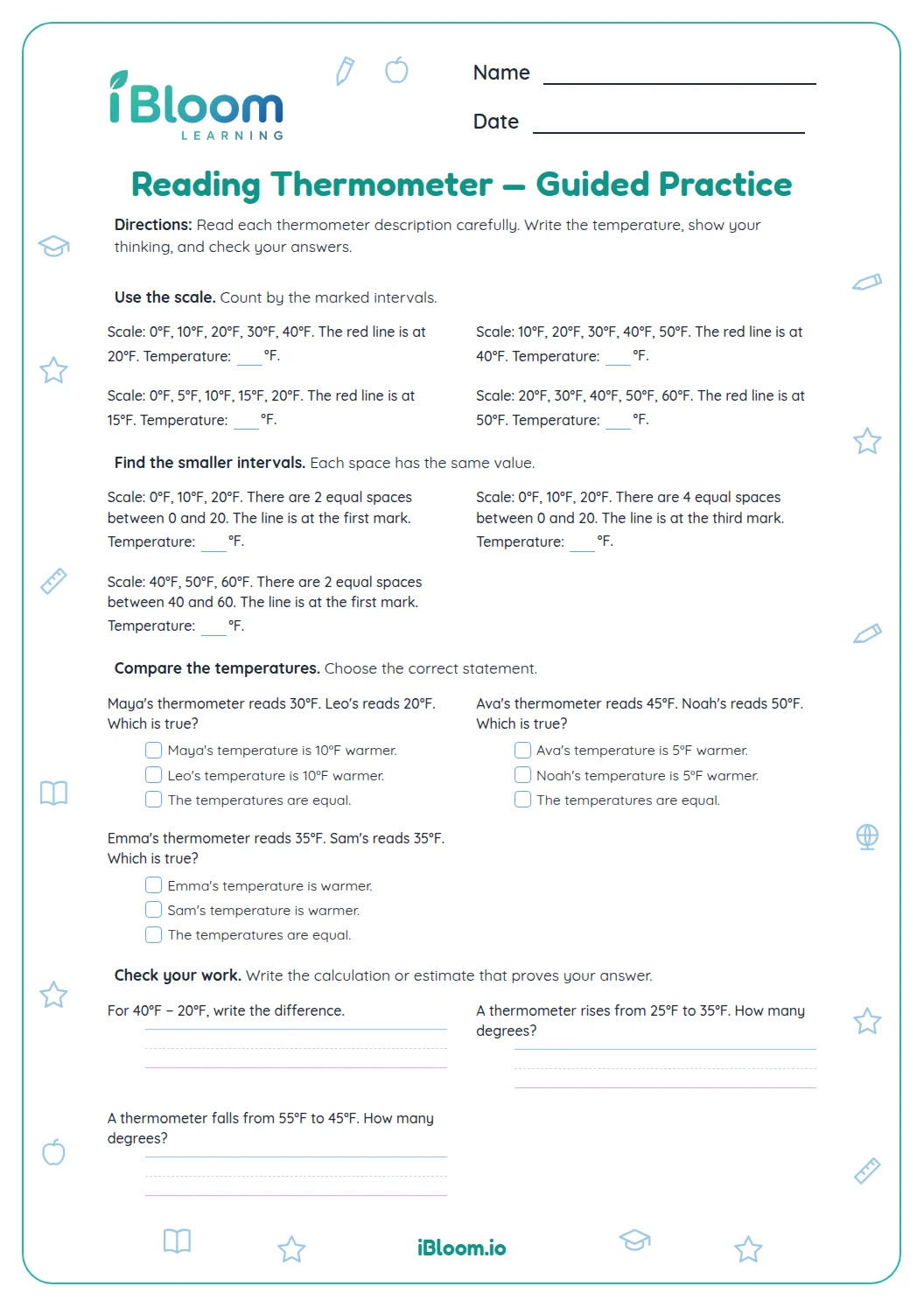
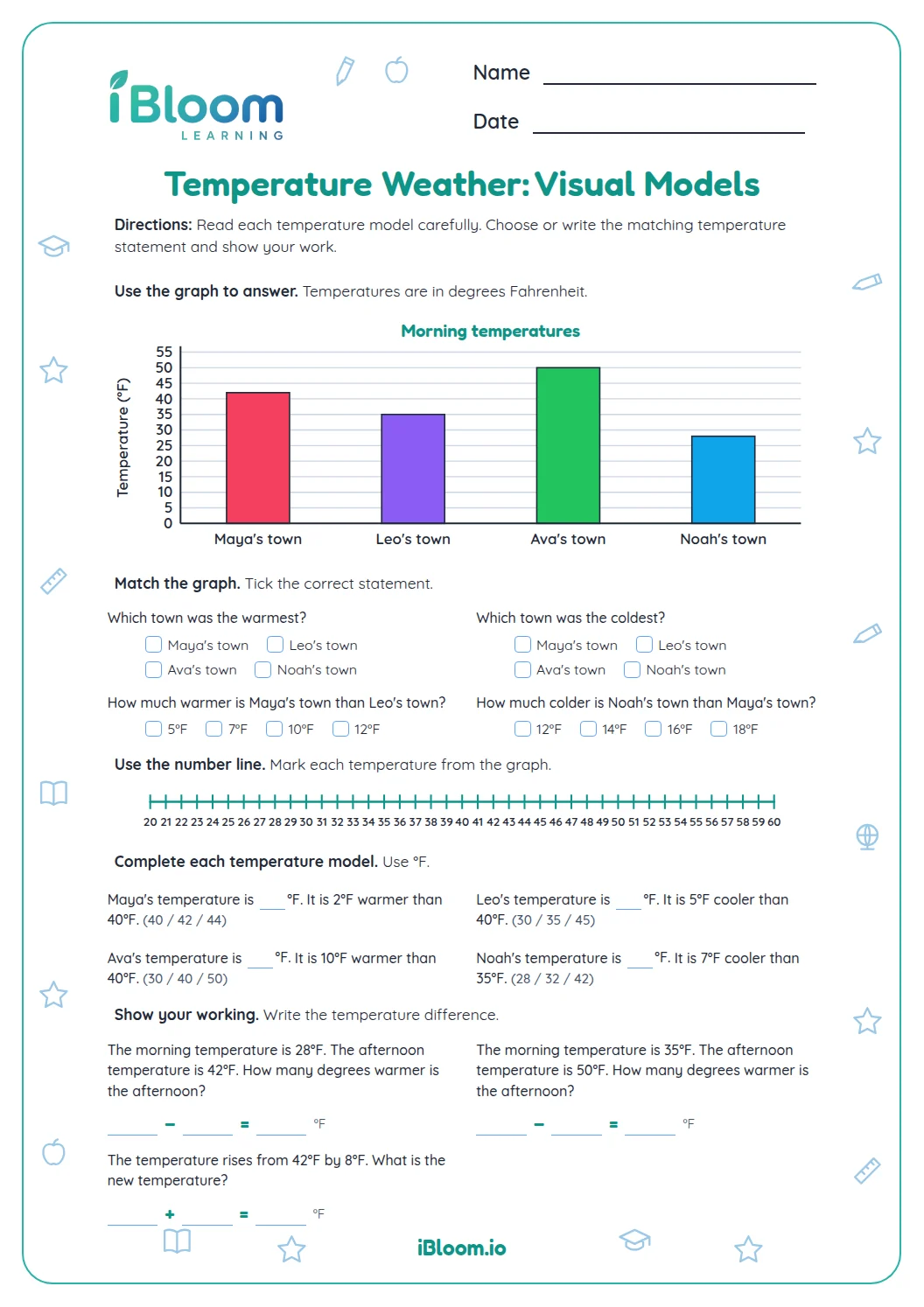
This Grade 3 measurement sheet practices reading Fahrenheit temperatures and reasoning about simple changes in familiar settings. Eight number-line models show a marked temperature to read; six word problems ask students to add or subtract a temperature change. The template does not draw thermometer columns, so the scale is rebuilt as a number line with clear Fahrenheit values. The answer key is included.
How do you read a temperature scale?
Read the scale labels first, then locate the marked level. Each number line runs from 0°F to 50°F in five-degree steps. A marked point gives the temperature reading.
The number line serves as a clear model of a thermometer scale: labels show values and a marked point shows a reading.
- 1Read the labeled scale from 0°F to 50°F.
- 2Find the point at 15.
- 3Write the reading with its unit: 15°F.
How can a temperature change be represented?
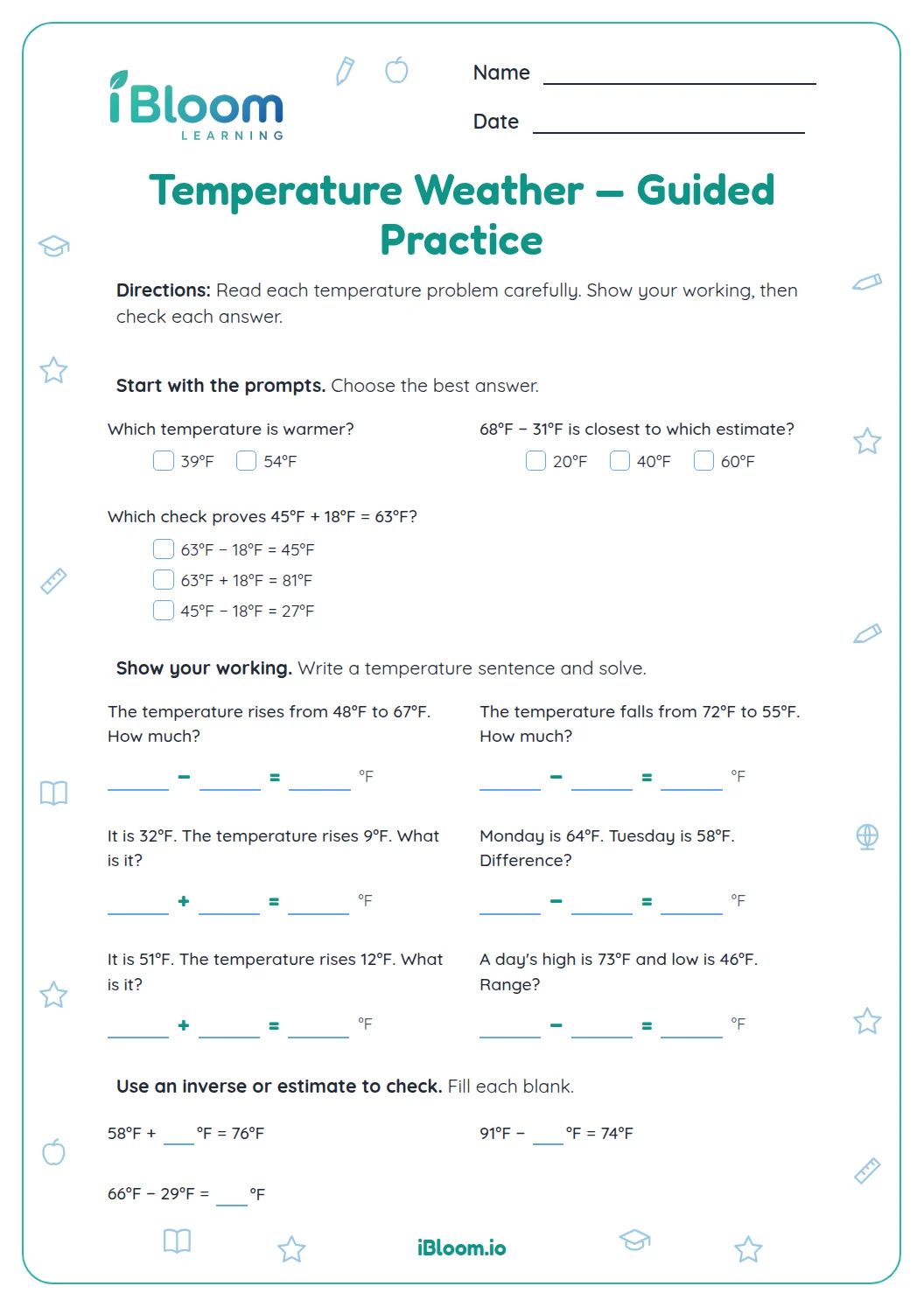
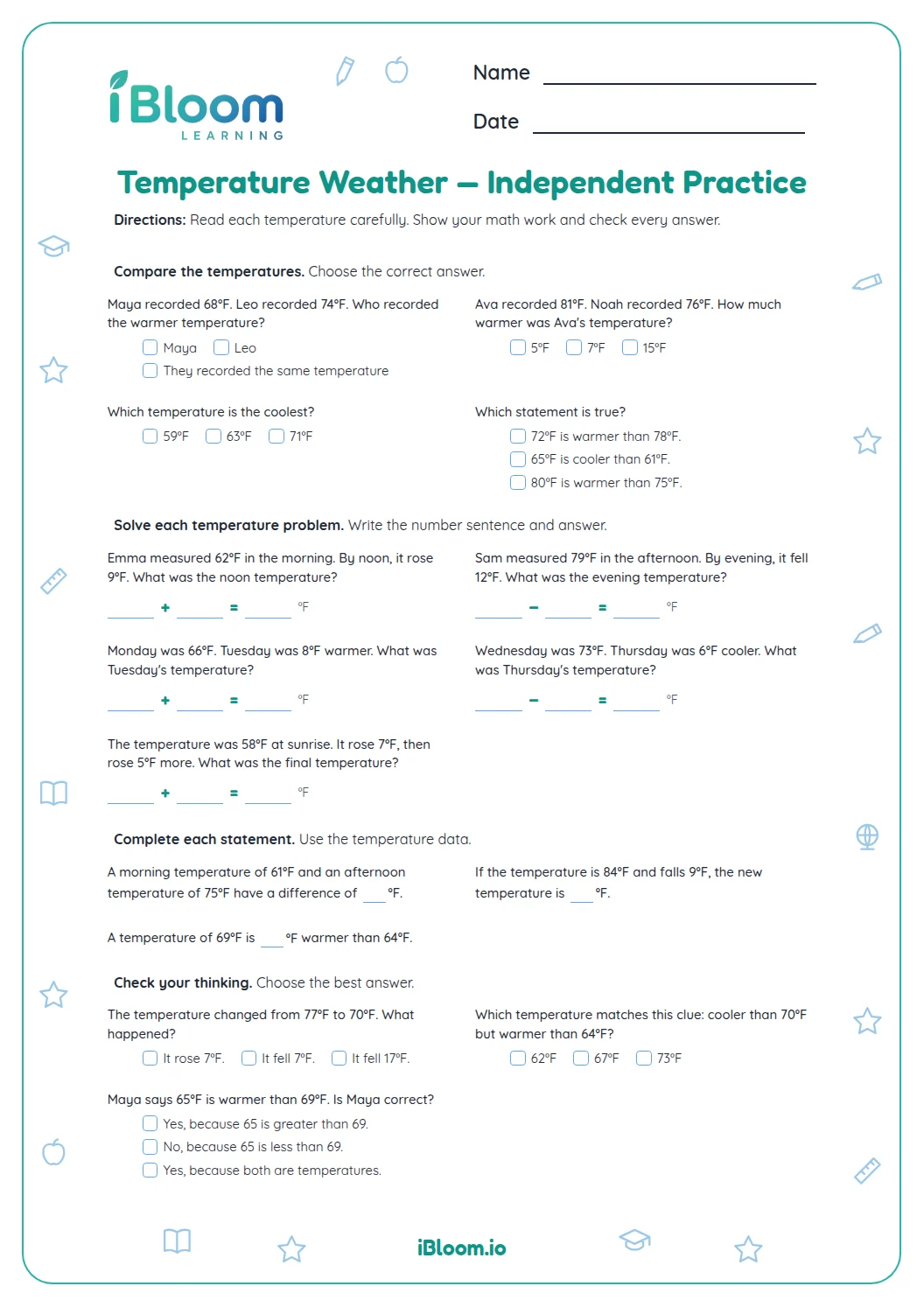
A rise means add; a drop means subtract. For a morning temperature of 12°F that warms by 8°F, calculate 12 + 8 = 20°F. Keep the unit in the answer so the number is clearly a temperature.
What does each part practice?
Part A has eight temperature readings shown on number lines. Part B has six real-world stories about warming or cooling. Students read a scale first, then apply addition or subtraction to find a new temperature.
How to use this worksheet
- 1Read the number line endpoints and count the labeled steps.
- 2Use the point to identify the temperature in Part A.
- 3In Part B, underline whether the temperature rises or falls.
- 4Add for warming and subtract for cooling.
- 5Include °F and check the key.
Common mistakes and quick fixes
The mistake
Reading the nearest labeled tick instead of the marked point.
The fix
Follow the number line to the exact point, counting each step.
The mistake
Adding when the story says the temperature drops.
The fix
Let “warmer” signal addition and “cools” or “falls” signal subtraction.
The mistake
Leaving the unit off the answer.
The fix
Write degrees Fahrenheit with every temperature.
What to practice next
Make more practice
Questions parents and teachers ask
Why are number lines used for thermometer readings?
A thermometer is a marked scale, and the number line models the same idea: labels show values and a marked point shows a reading. It lets students practice reading a scale even though the worksheet template does not draw a thermometer column.
How many temperature questions are on the sheet?
There are 14 questions. Part A has eight number-line readings, and Part B has six real-world temperature-change stories. A separate four-page answer key lists the Fahrenheit reading or result for each item and shows the equation work for the story problems.
What unit does this worksheet use?
The worksheet uses degrees Fahrenheit, shown as °F. Students should include that unit when they write a temperature. Each number line also shows values in five-degree steps, so children can connect the marked point to a value on the scale.
How do I solve a warming or cooling problem?
Add when the temperature gets warmer and subtract when it cools or falls. For example, 12°F warming by 8°F becomes 20°F. Writing the starting temperature and the change as an equation helps keep the direction clear and the unit attached.
What should students include with each answer?
Write the number of degrees Fahrenheit, using °F. For the scale questions, read the marked point first. For the stories, decide whether the temperature rises or falls, calculate the new value, and include °F in the answer. The answer key lists each reading and change.