






About this worksheet
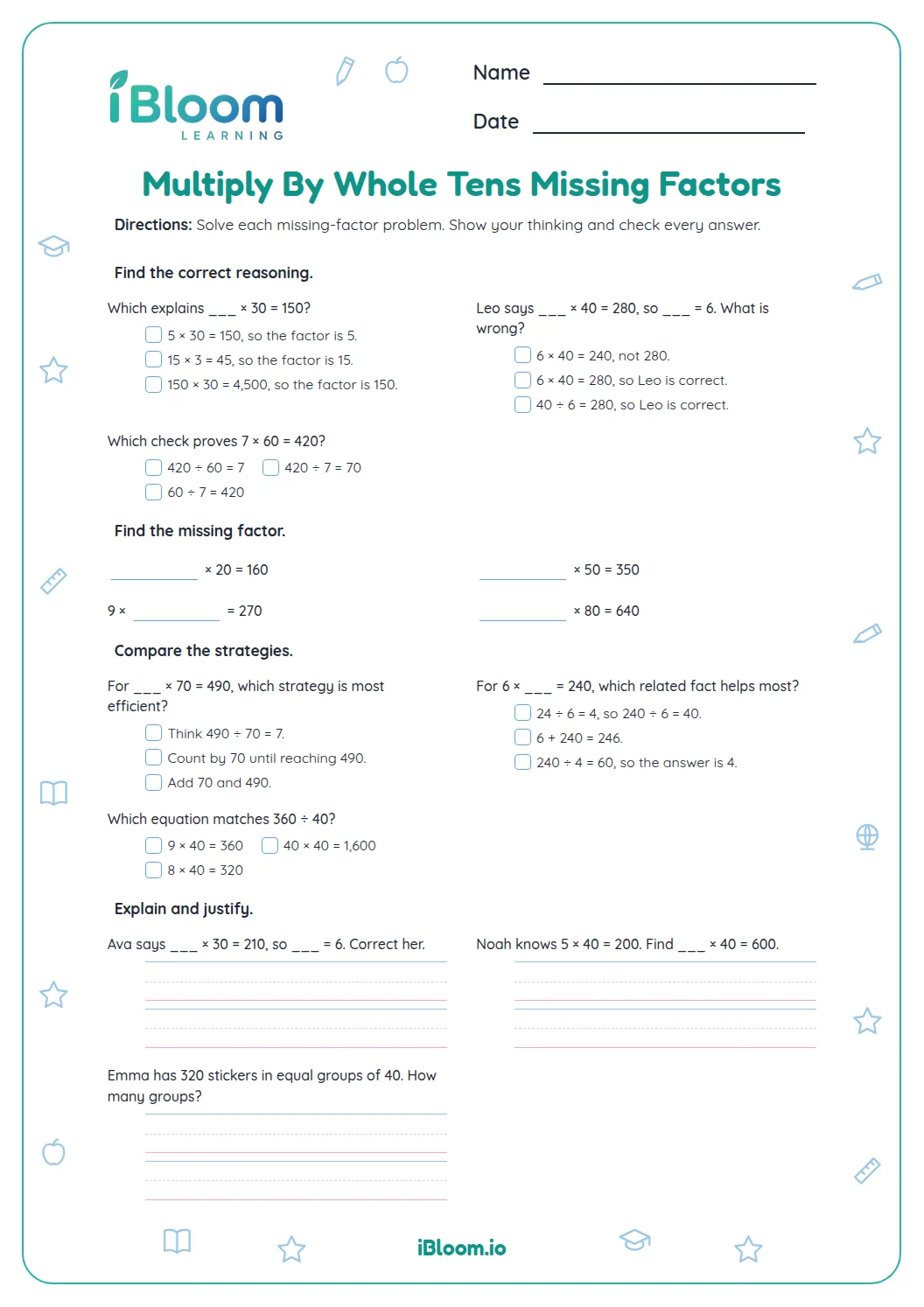
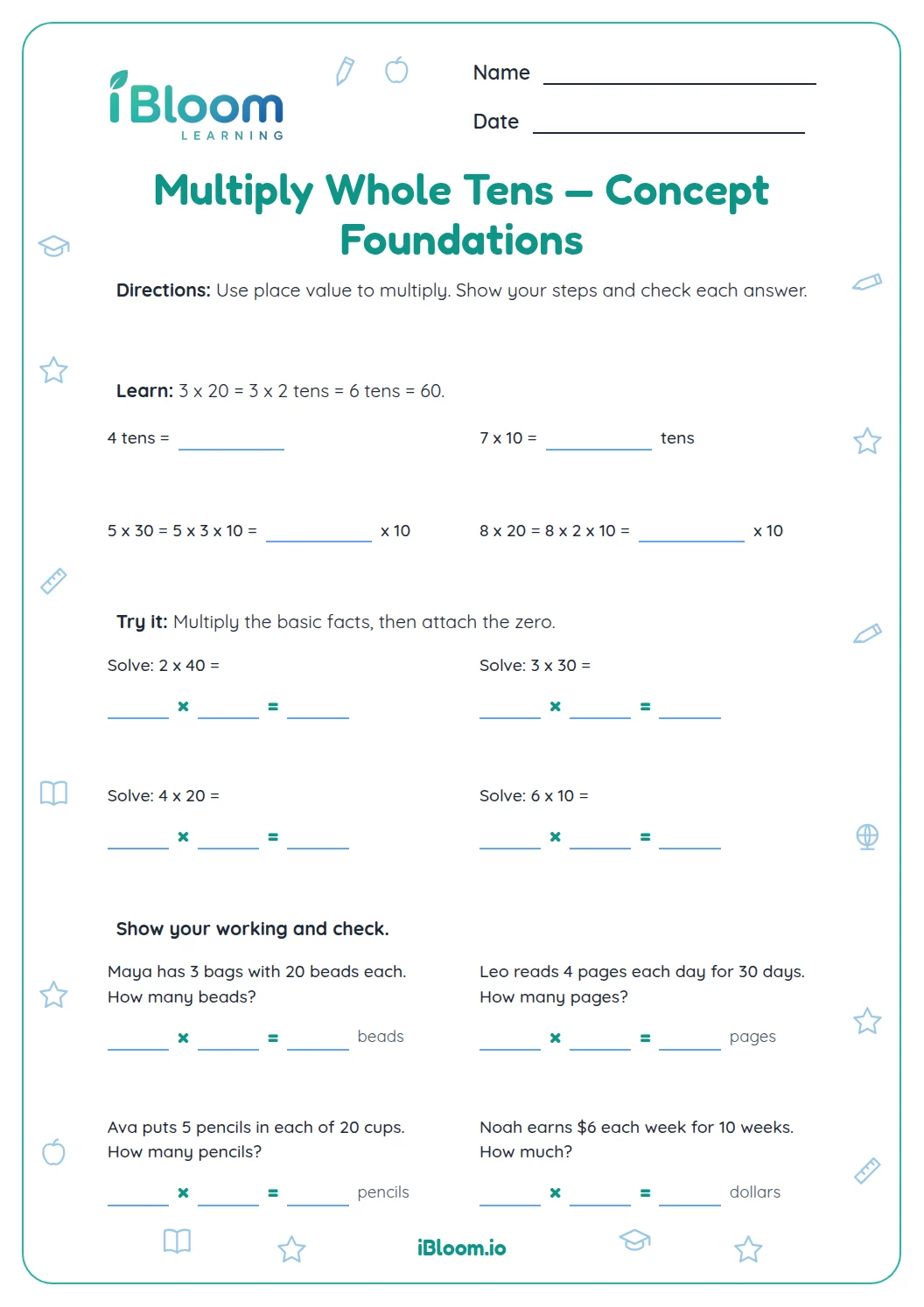
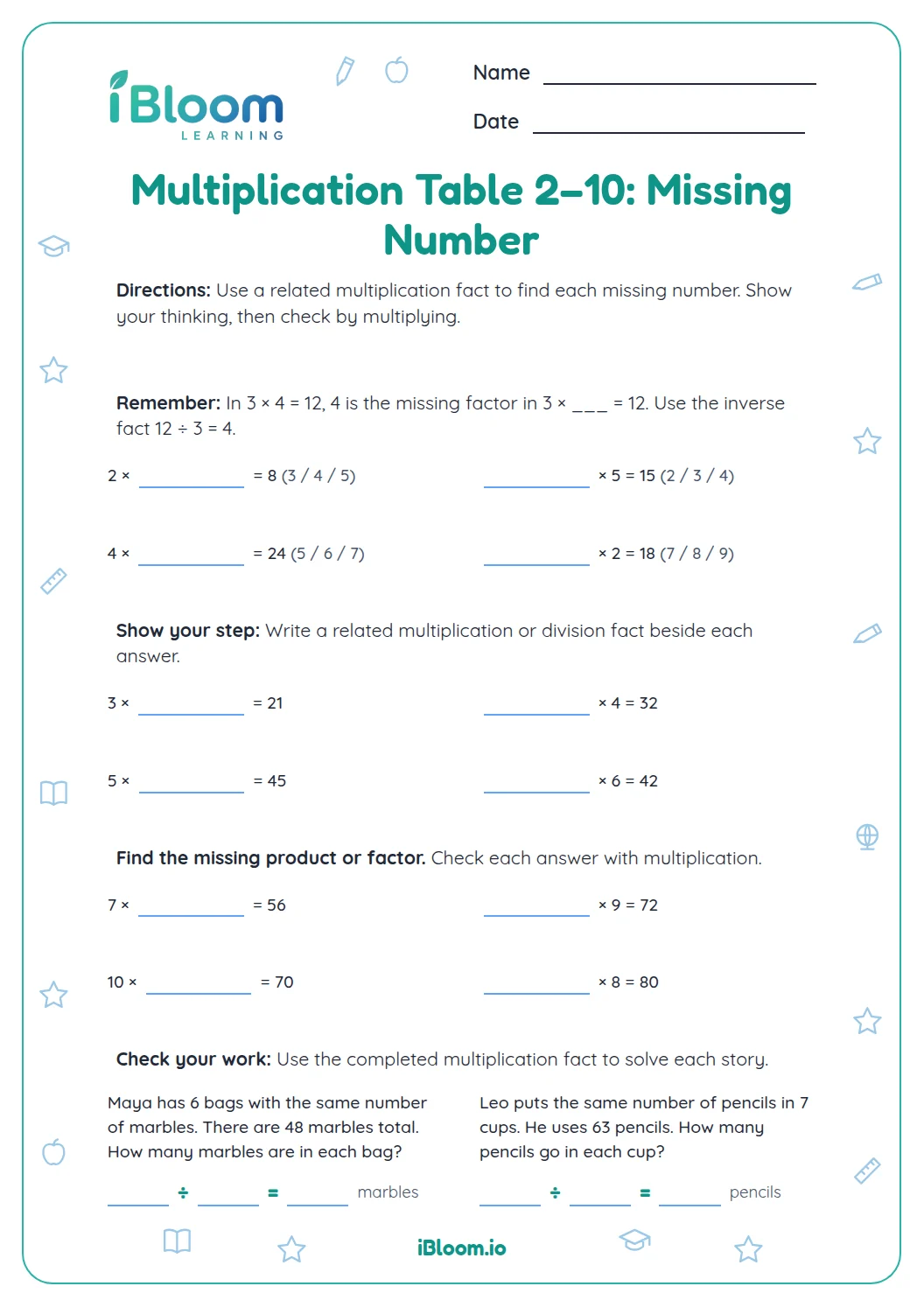
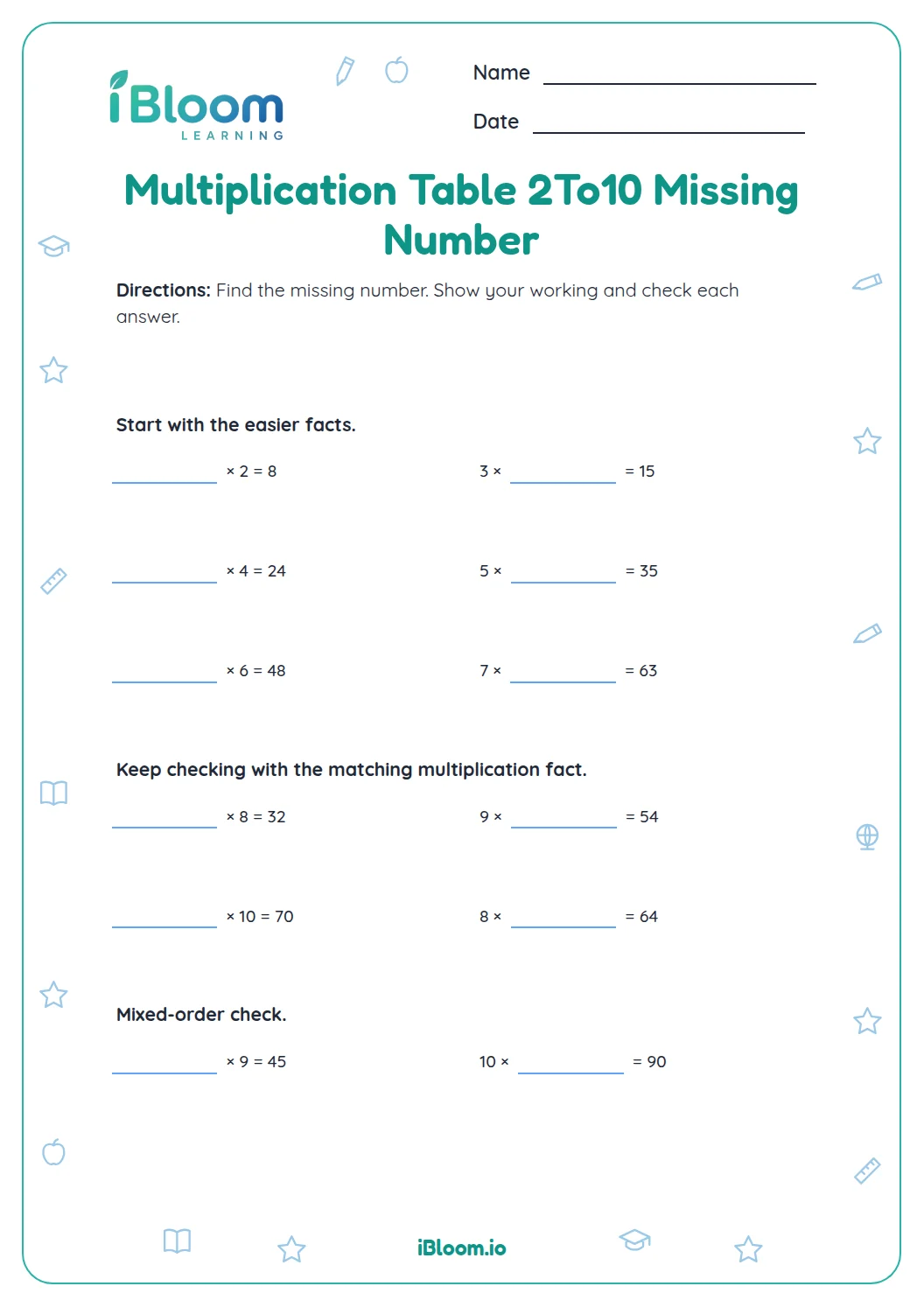
This Grade 3 worksheet builds fluency with missing factors when one factor is a whole ten. Children solve equations such as 4 × ___ = 120 by using 4 × 3 = 12, then extending that fact to 120. Sixteen questions move from a missing second factor to a missing first factor, with a separate answer key. The practice supports Common Core 3.OA.A.4, which asks students to find an unknown whole number in a multiplication or division equation.
Aligned to 3.OA.A.4
How does a basic fact help?
For 4 × ___ = 120, first notice that 4 × 3 = 12. Since 120 is ten times 12, the missing factor is ten times 3: 30.
Check by multiplying: 4 × 30 = 120. The related fact keeps the arithmetic small.
- 14 × ___ = 120
- 24 × 3 = 12
- 3120 is 10 times 12
- 4The missing factor is 3 × 10 = 30
What changes across the questions?
The first eight equations leave the whole-ten factor blank. The last eight put the blank before the whole ten, so the unknown factor is a one-digit number. Every product is an exact multiple of ten.
How can a child check a missing factor?
Put the answer back into the equation and multiply. If the product matches the number on the other side, the factor works.
How to use this worksheet
- 1Look at the product and the known factor.
- 2Find a basic fact with the same digits, such as 4 × 3 = 12.
- 3Decide whether the missing factor needs to be a whole ten or a one-digit number.
- 4Write the factor and multiply to check.
- 5Use the answer key after completing the full set.
Mistakes to watch for
The mistake
Dropping the zero and writing 3 for 30.
The fix
Ask whether 4 × 3 equals 120; then scale 3 by ten.
The mistake
Adding instead of multiplying.
The fix
Substitute the answer and check the product.
The mistake
Treating the product digits as the answer.
The fix
Use the known factor to identify the related multiplication fact.
Common Core alignment
This worksheet connects the skill to the following Common Core standard.
Find an unknown whole number in a multiplication or division equation.
On this sheet: Every item asks for the missing factor in a multiplication equation with a whole-ten factor.
Show the official wordingHide the official wording
Determine the unknown whole number in a multiplication or division equation relating three whole numbers. For example, determine the unknown number that makes the equation true in each of the equations 8 × ? = 48, 5 = _ ÷ 3, 6 × 6 = ?
What to practice next
Make more practice
Further reading
Questions parents and teachers ask
What is a missing factor?
A missing factor is an unknown number being multiplied. In 4 × ___ = 80, the missing factor is 20 because 4 × 20 = 80. You can check by multiplying the known factor by your answer, then comparing the product with the number on the other side.
How do whole tens help with multiplication?
A whole ten such as 30 is 3 groups of ten. Use the related fact 4 × 3 = 12, then scale the product to 120. This keeps the basic multiplication fact small and helps children check their answers with familiar facts.
Is an answer key included?
Yes. A separate key lists the missing factor for every equation. After solving a problem, substitute your answer and multiply to check that the product matches the number on the other side. Review the related fact if the product is off.
How long does this worksheet take?
Plan for about 15 minutes, including a quick multiplication check. A child can also explain which related fact helped find each missing factor before checking the answers. The questions move from a missing second factor to a missing first factor.