




About this worksheet
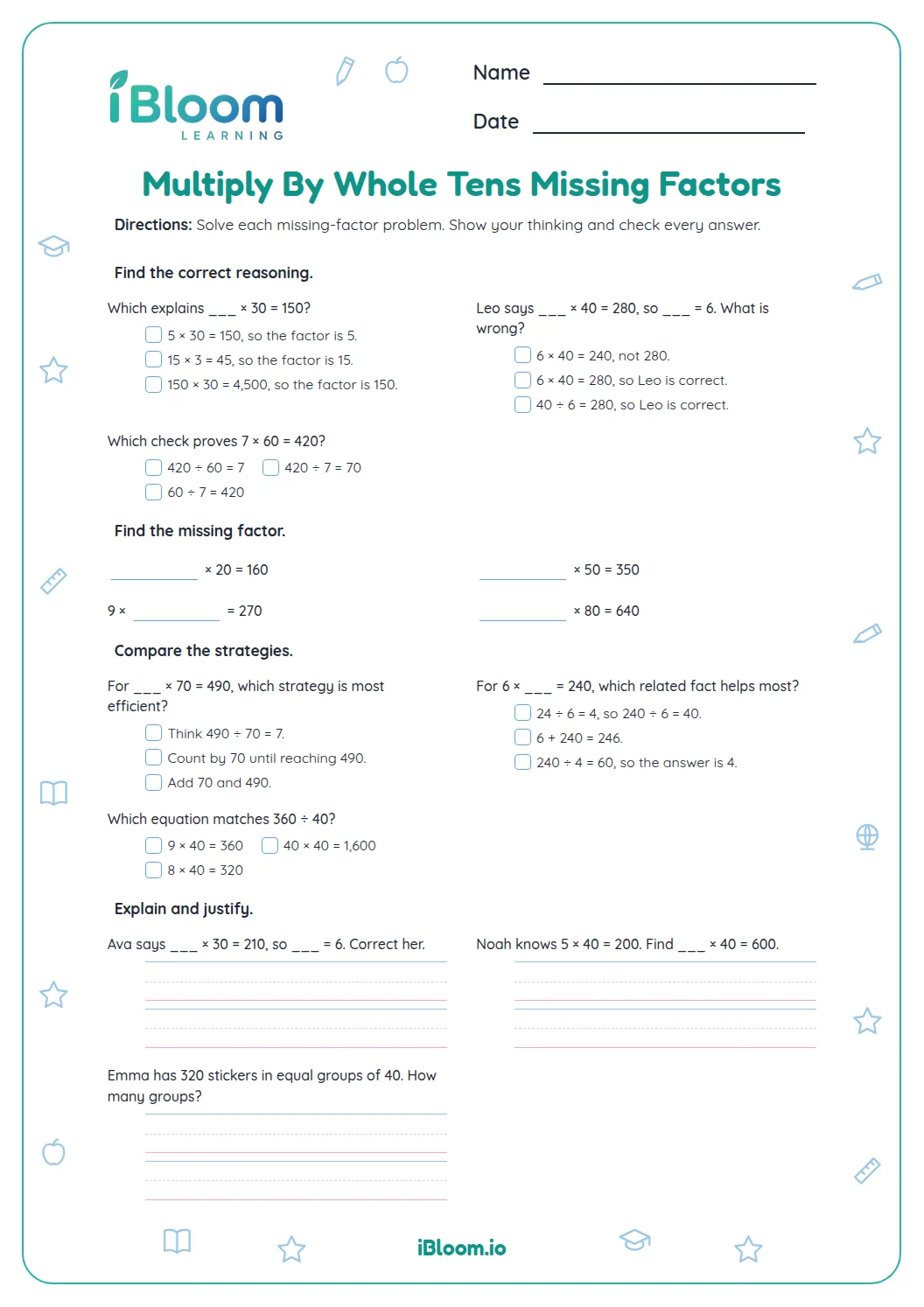
This Grade 3 printable worksheet builds missing-factor reasoning with products and factors that are multiples of ten. Learners first find the unknown number of tens in equations, then solve equal-group prompts with a missing factor, and finally write equations for five multiplication stories. The separate answer key includes all 16 results. The practice connects to CCSS 3.OA.A.4 for unknown factors in multiplication equations.
Aligned to 3.OA.A.4
How does a known factor help find the blank?
In Part A, each equation gives a product and one factor. Divide the product by the known factor to find the missing factor. For question 1, 120 ÷ 3 = 40, so three groups of 40 make 120.
How can equal groups describe a missing factor?
Question 7 says five boxes contain 300 pencils altogether. Divide 300 by 5 to find the same number in each box: 60 pencils. Check with 5 × 60 = 300.
- 15 × ___ = 300
- 2300 ÷ 5 = 60
- 35 × 60 = 300
How should learners model the final stories?
Choose a multiplication equation that matches the number of groups and the amount in each group. For the library story, 9 shelves with 30 books each gives 9 × 30 = 270 books.
How to use this worksheet
- 1Circle the number of equal groups and underline the total.
- 2Write a multiplication equation with the blank in the missing factor position.
- 3Divide the product by the known factor, or use a related fact.
- 4Write the missing whole-ten factor.
- 5Multiply to check that the product matches the story.
Common mistakes and quick fixes
The mistake
Dividing the number of groups by the total.
The fix
Use total ÷ number of groups to find the amount in one group.
The mistake
Dropping a zero when multiplying by a whole ten.
The fix
Think of 3 × 4 = 12, then scale to 3 × 40 = 120.
The mistake
Using the total as one group’s amount.
The fix
Check: the per-group amount multiplied by the number of groups must equal the total.
Common Core alignment
This worksheet gives learners practice with the following Common Core skill.
Find an unknown factor in multiplication equations with whole-number products.
On this sheet: The first two parts ask learners to determine a missing factor in multiplication facts and equal-group stories.
Show the official wordingHide the official wording
Determine the unknown whole number in a multiplication or division equation relating three whole numbers. For example, determine the unknown number that makes the equation true in each of the equations 8 × ? = 48, 5 = □ ÷ 3, 6 × 6 = ?
What to practice next
Make more practice
Further reading
Questions parents and teachers ask
What does “whole tens” mean here?
The factors and products include multiples of ten such as 20, 30, 40, and 120. Learners can use a basic fact such as 3 × 4 = 12, then reason that 3 × 40 = 120. Ask the learner to point to the clue that supports the response.
How many questions are on the worksheet?
There are 16 questions in three parts: six equations with a missing factor, five equal-group stories with a missing factor, and five stories that ask for the total. The answer key lists all 16 answers. An adult can read the prompt aloud and invite a short explanation.
How can I explain question 1?
Question 1 asks for the number that makes 3 groups equal 120. Since 12 divided into 3 equal groups is 4, 120 divided into 3 equal groups is 40. Check by multiplying 3 × 40 to get 120. Then compare the work with the separate key for that question.
What equation fits the box story?
For question 7, five boxes contain 300 pencils. The equation is 5 × ___ = 300. Dividing 300 by 5 gives 60 pencils per box, and multiplying 5 × 60 checks the total. Reread the printed prompt before reviewing the matching answer.
Why write an equation for the story problems?
An equation shows how the groups relate to the total and makes the answer easier to check. For nine shelves with 30 books each, write 9 × 30 = 270. The product names the total number of books. Use one missed response as a chance to explain the idea aloud.
Is an answer key included?
Yes. A separate answer key lists the missing factors, each equal-group amount, and all five story totals. For the story questions, encourage the learner to write the multiplication equation as well as the product so the model is visible. The separate key makes it easy to check this item after practice.