


About this worksheet
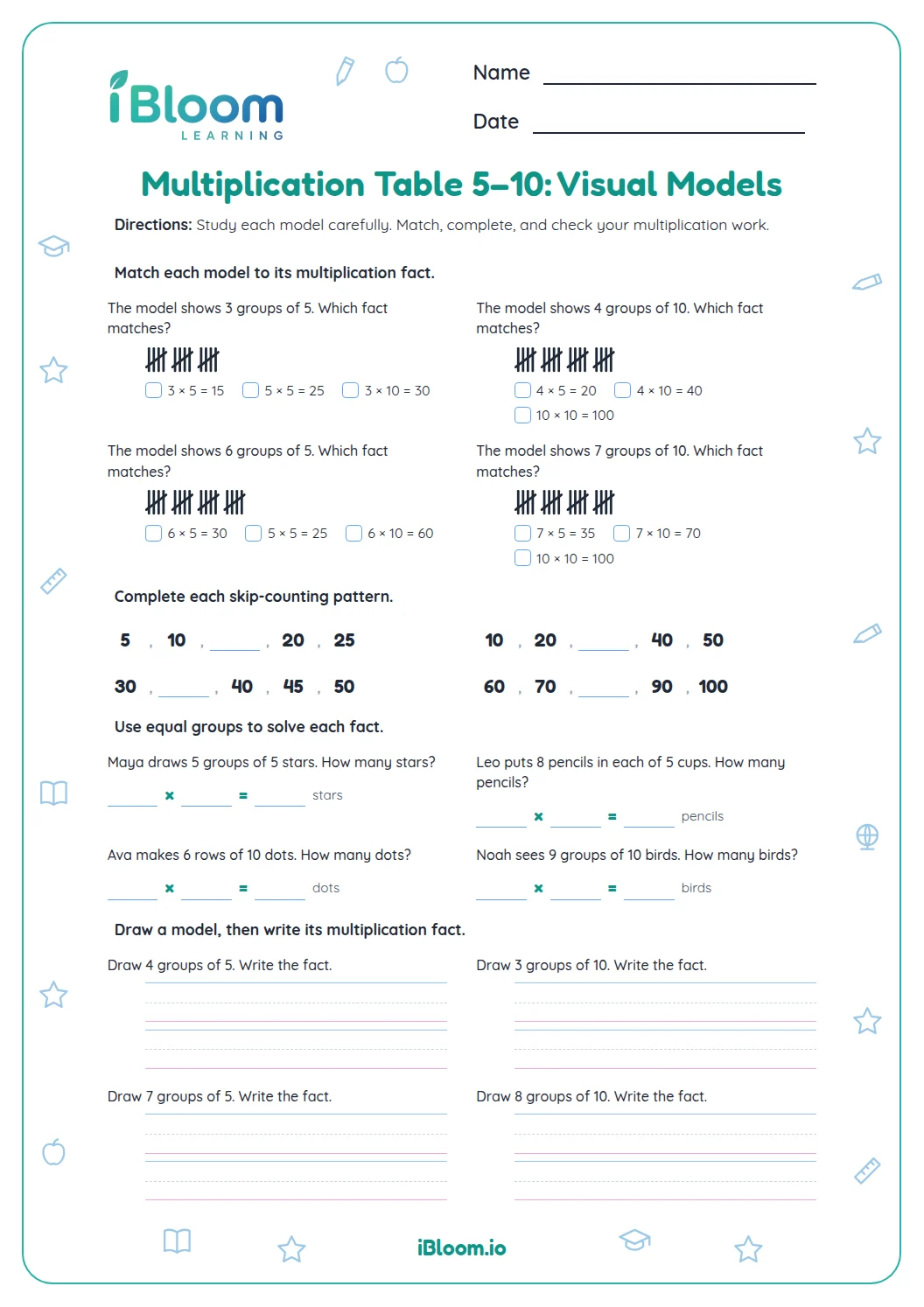
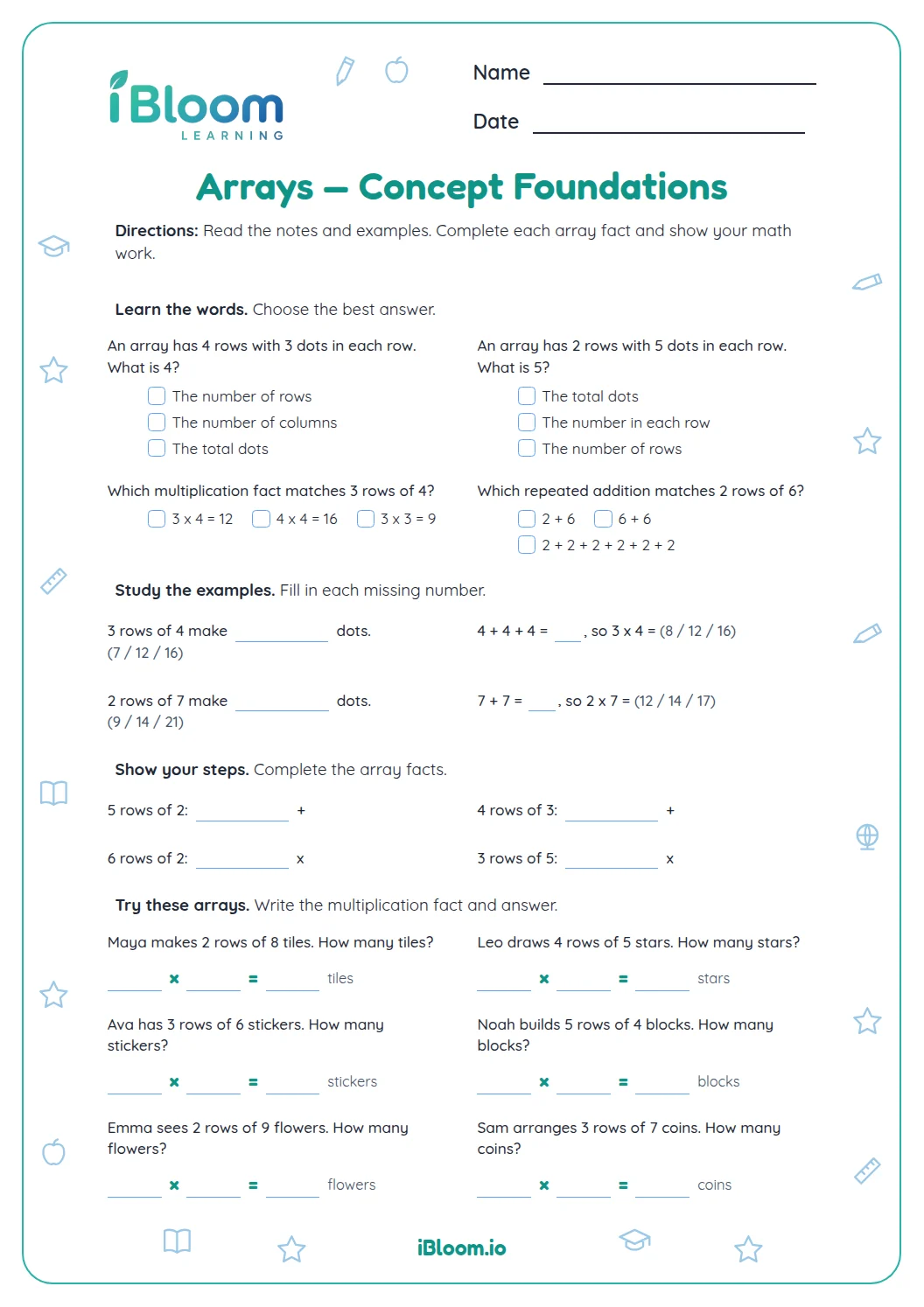
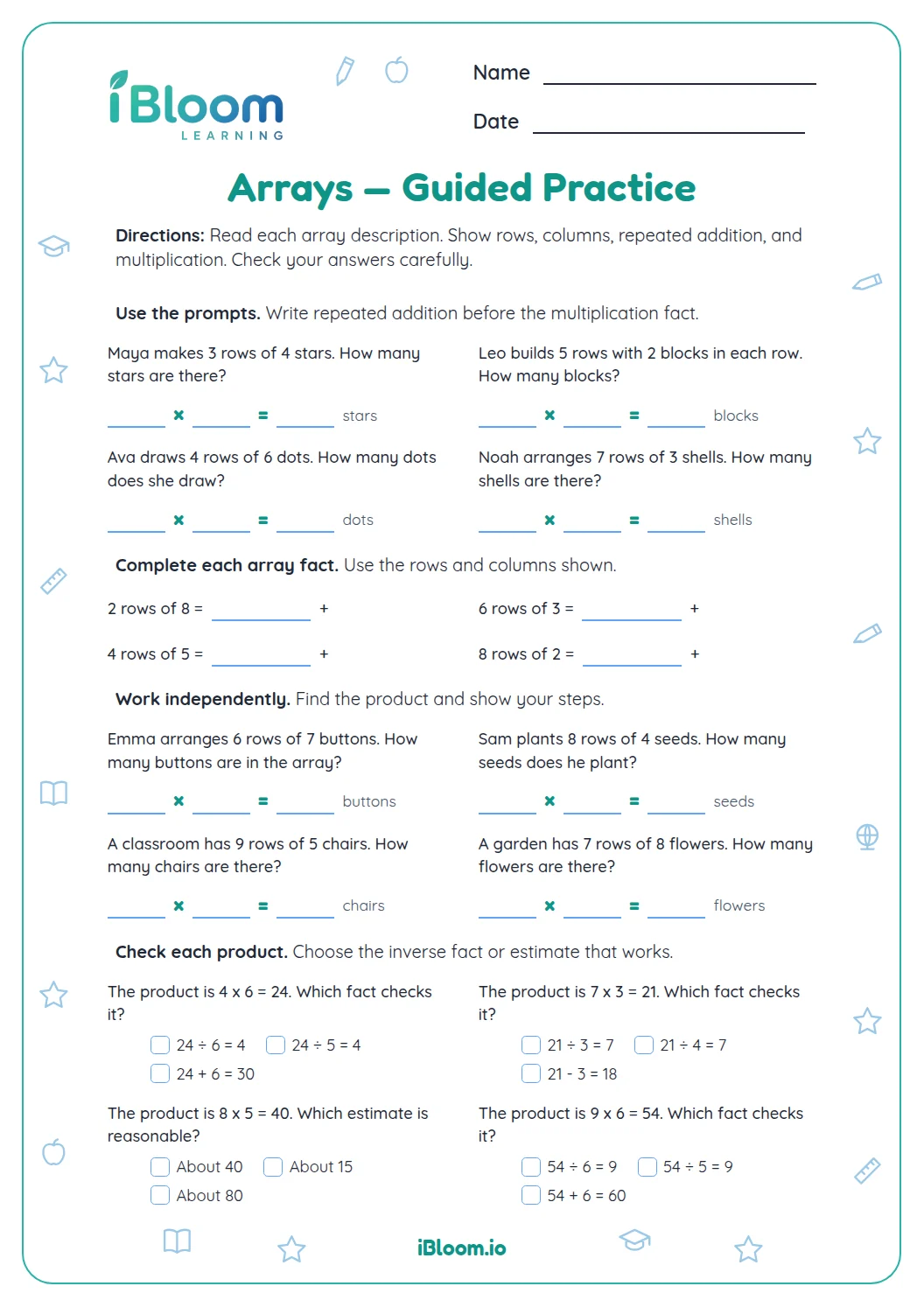
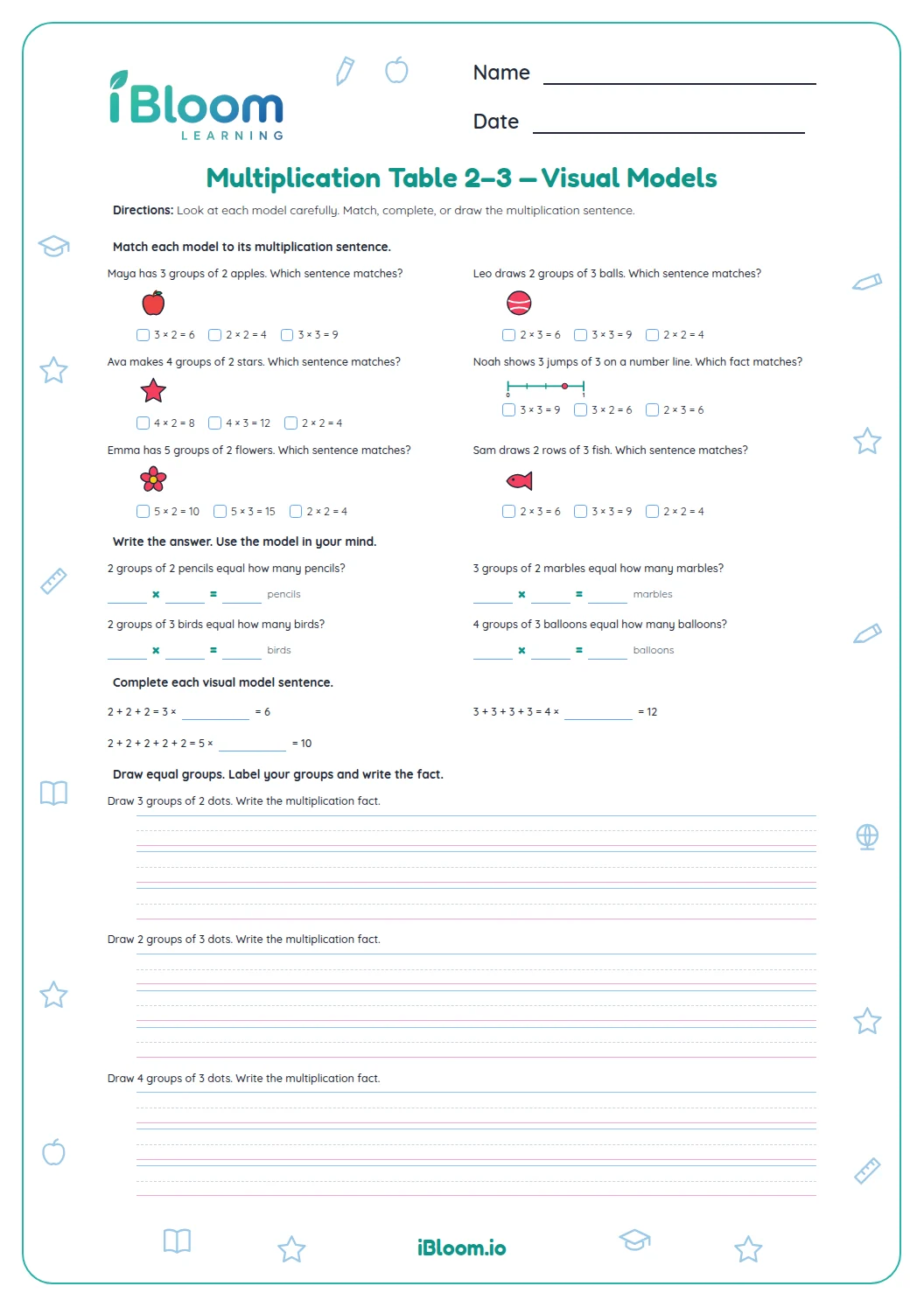
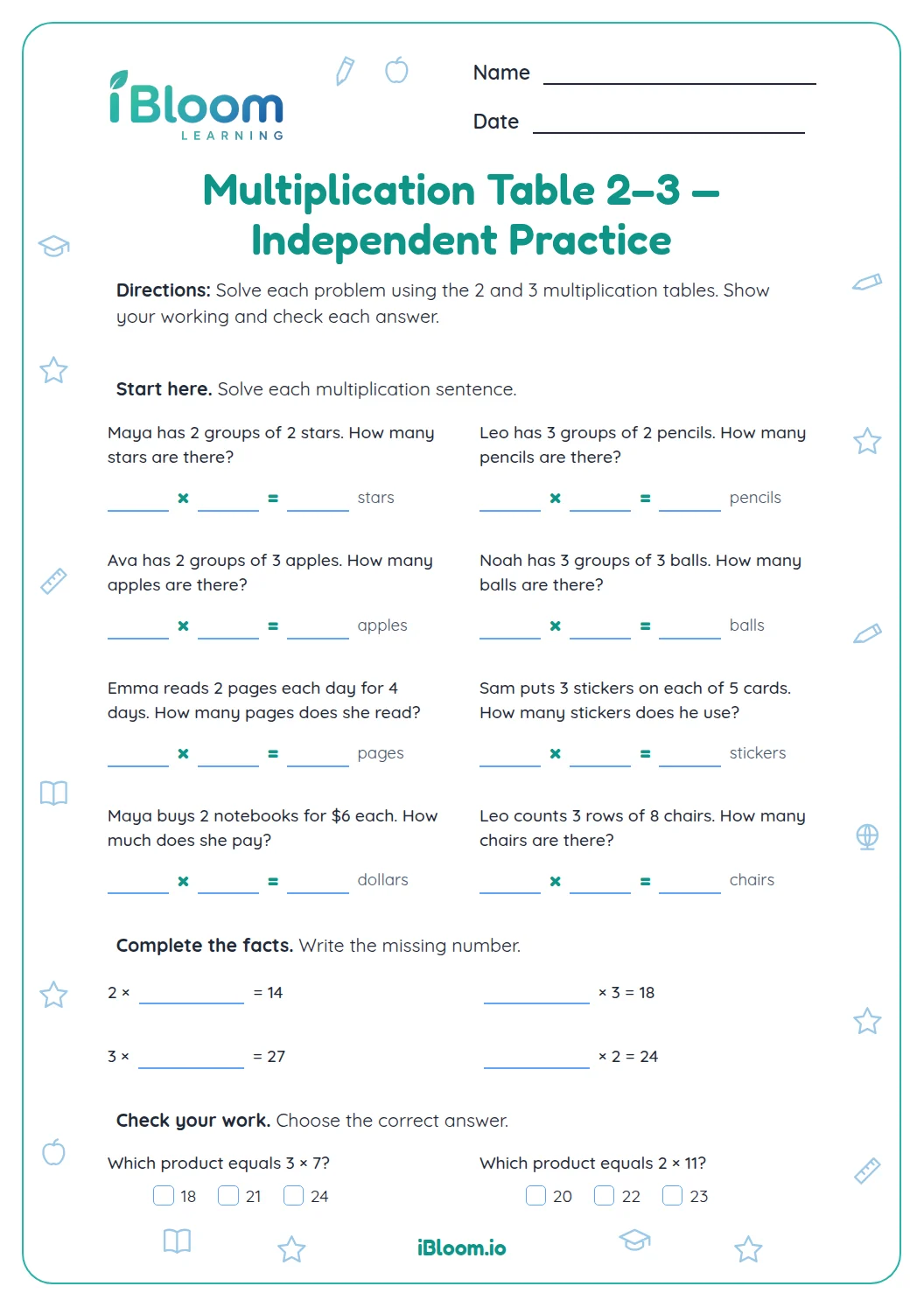
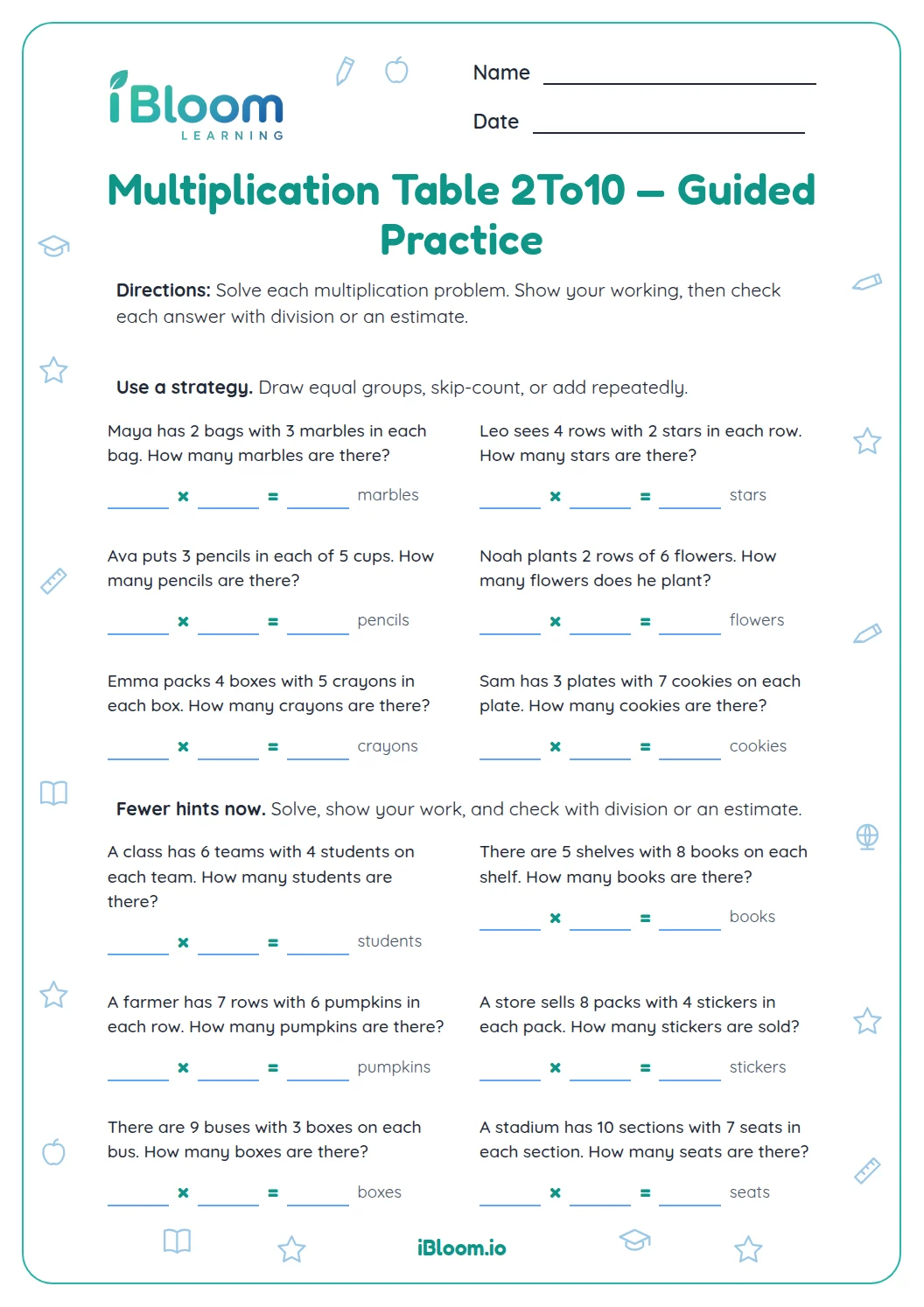
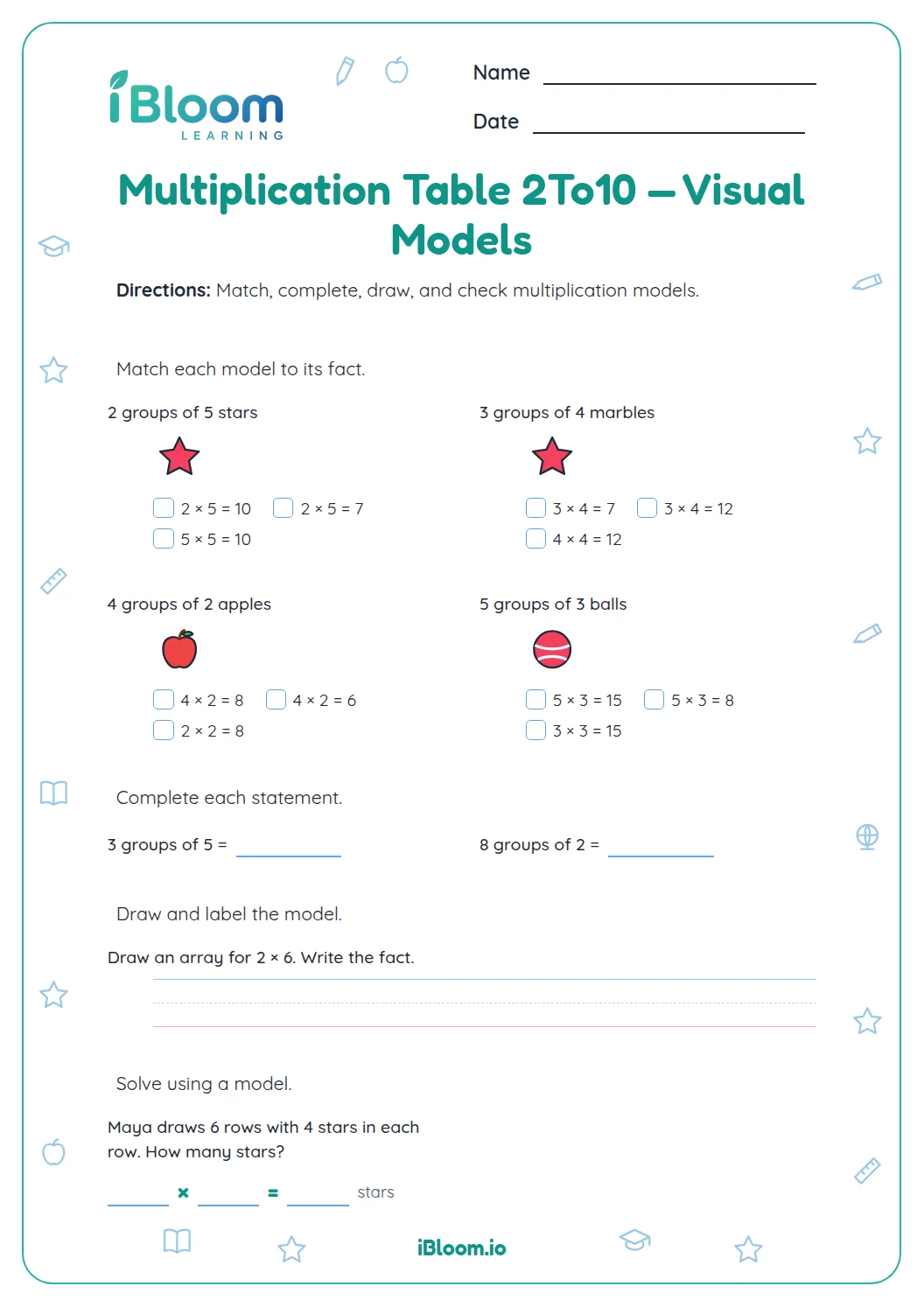
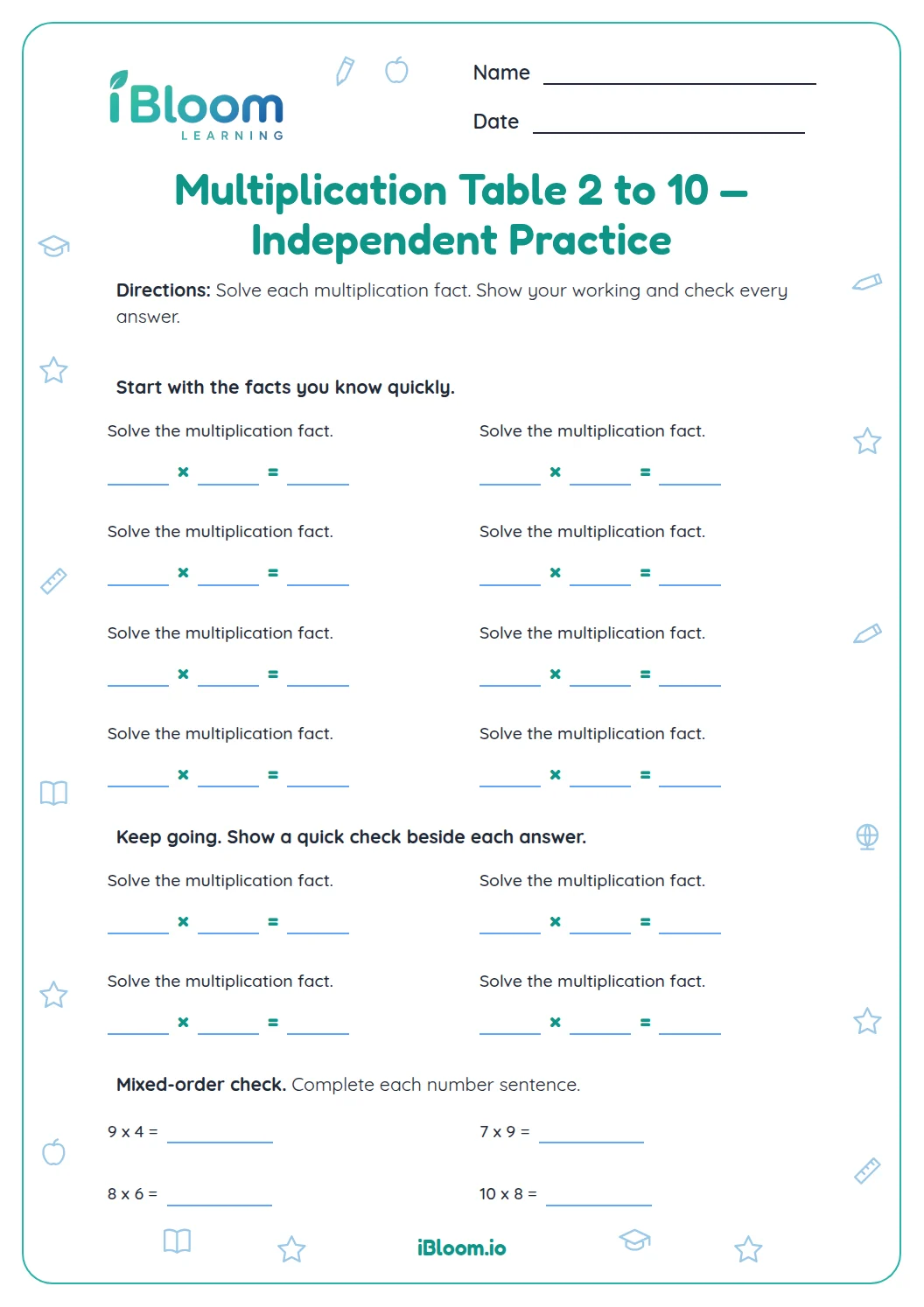
This free Grade 3 multiplication worksheet builds the meaning behind the 5 through 10 tables. Children read arrays, connect rows and columns to totals, find missing factors, and solve six equal-group situations. The practice interprets products as totals in equal groups, the focus of CCSS 3.OA.A.1. It includes 20 questions and a separate answer key.
Aligned to 3.OA.A.1
What do the factors tell us?
A multiplication fact names equal groups. In 6 × 3, there are 6 groups with 3 objects in each group, for 18 objects altogether. Switching the factors describes a turned array: 6 rows of 3 and 3 rows of 6 both show 18.
Questions 1–5 begin with facts from the 5 through 9 tables; question 14 gives a direct fact from the 10 table. Say what each factor counts before finding the product.
- 13 rows × 6 apples in each row
- 23 × 6 = 18 apples
- 3The factors count rows and dots per row.
How do arrays make a fact visible?
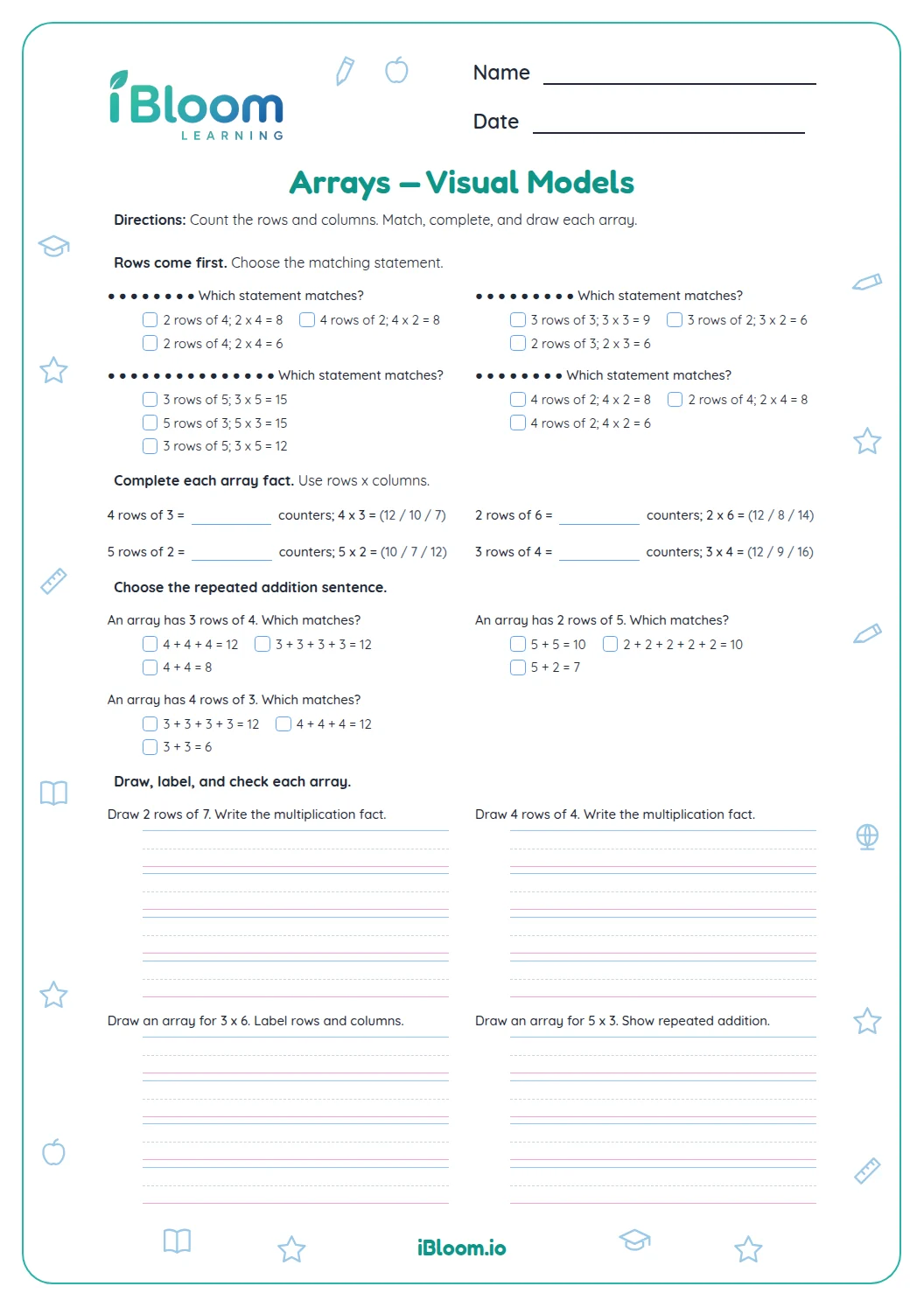
An array organizes objects into straight rows and columns. Count by the number in each row, or multiply rows by columns. The drawings in Part B let children see why a product is a total rather than a name to memorize.
For q7, the 4-by-5 array can be read as 4 × 5 or 5 + 5 + 5 + 5.
- 14 rows of 5
- 25 + 5 + 5 + 5 = 20
- 34 × 5 = 20
How can a known fact reveal a missing factor?
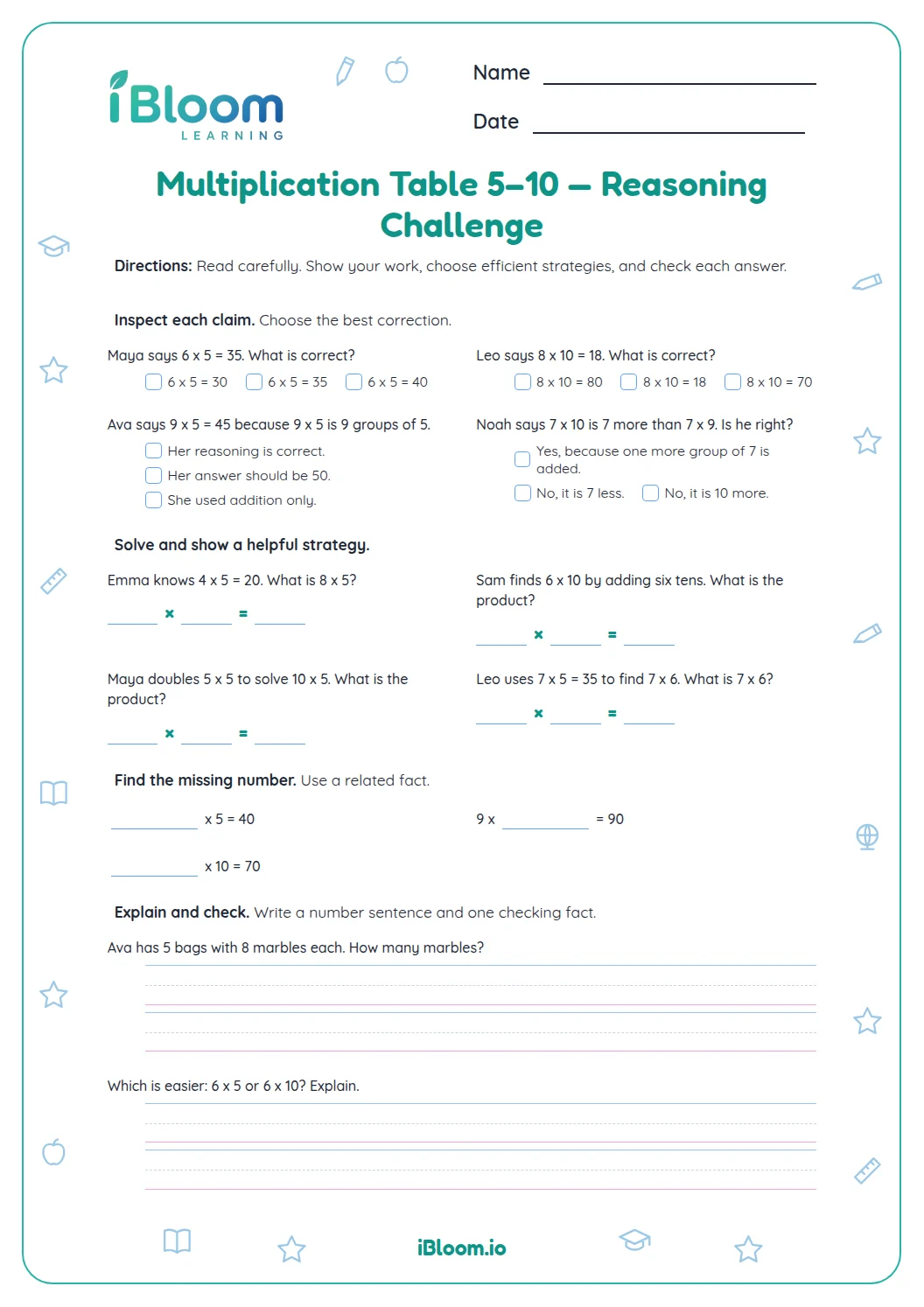
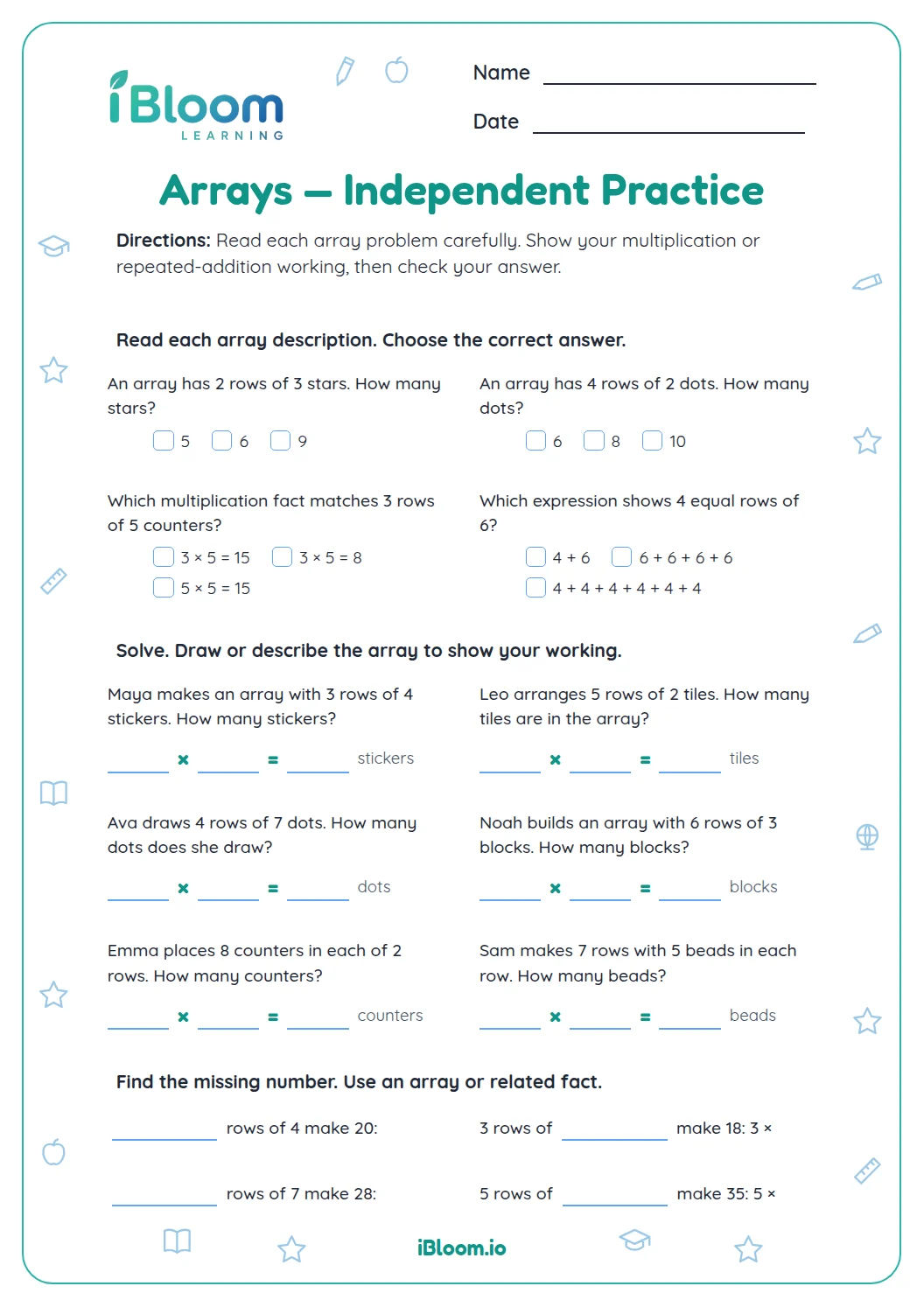
A blank factor asks how many equal groups or objects per group complete the product. Use a related fact: for ___ × 6 = 36, ask how many sixes make 36.
The multiplication table patterns help: facts with 5 end in 0 or 5, while facts with 10 have a zero in the ones place.
- 1___ × 6 = 36
- 2Think: 6 × 6 = 36
- 3The missing factor is 6.
How do we solve equal-group stories?
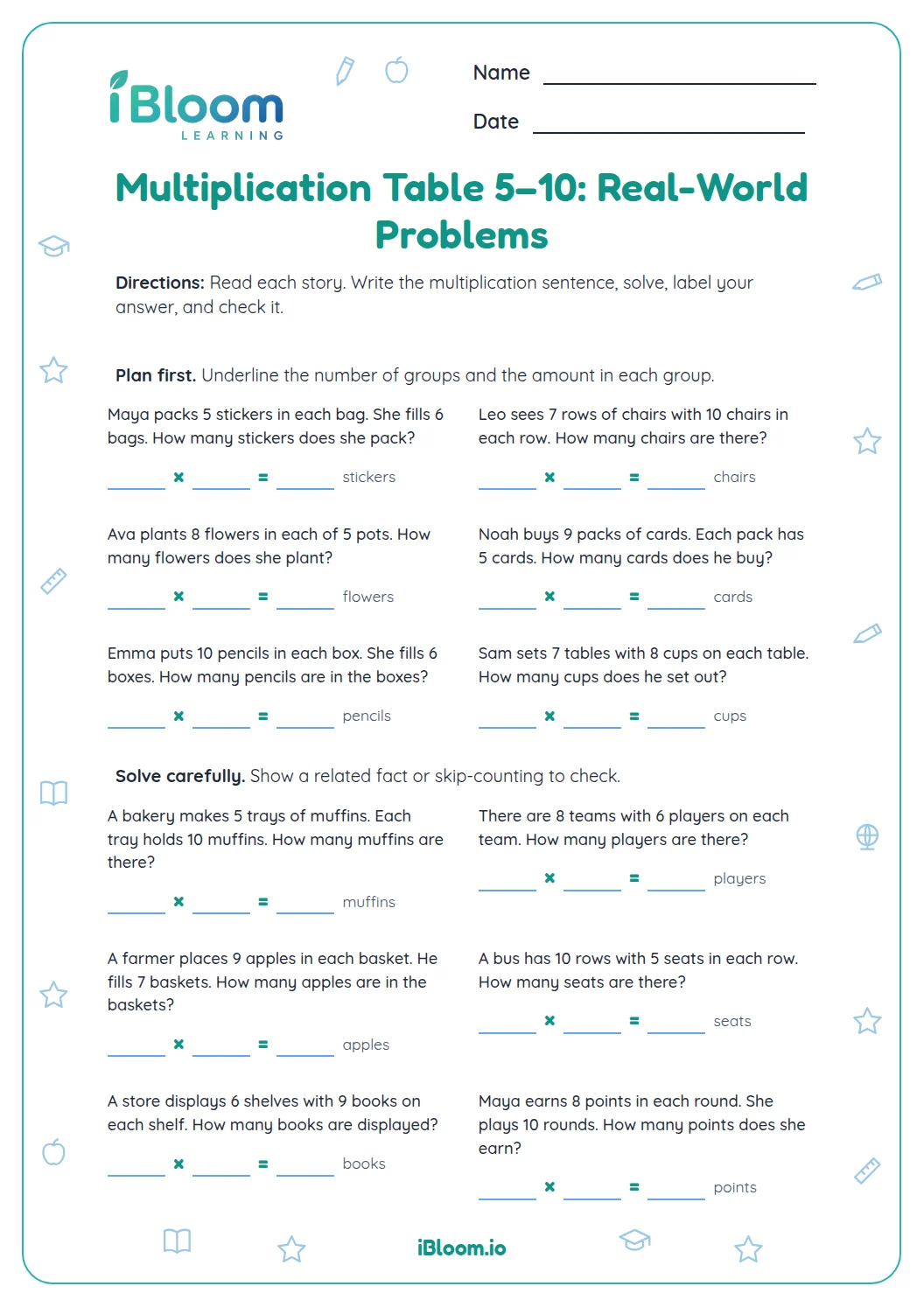
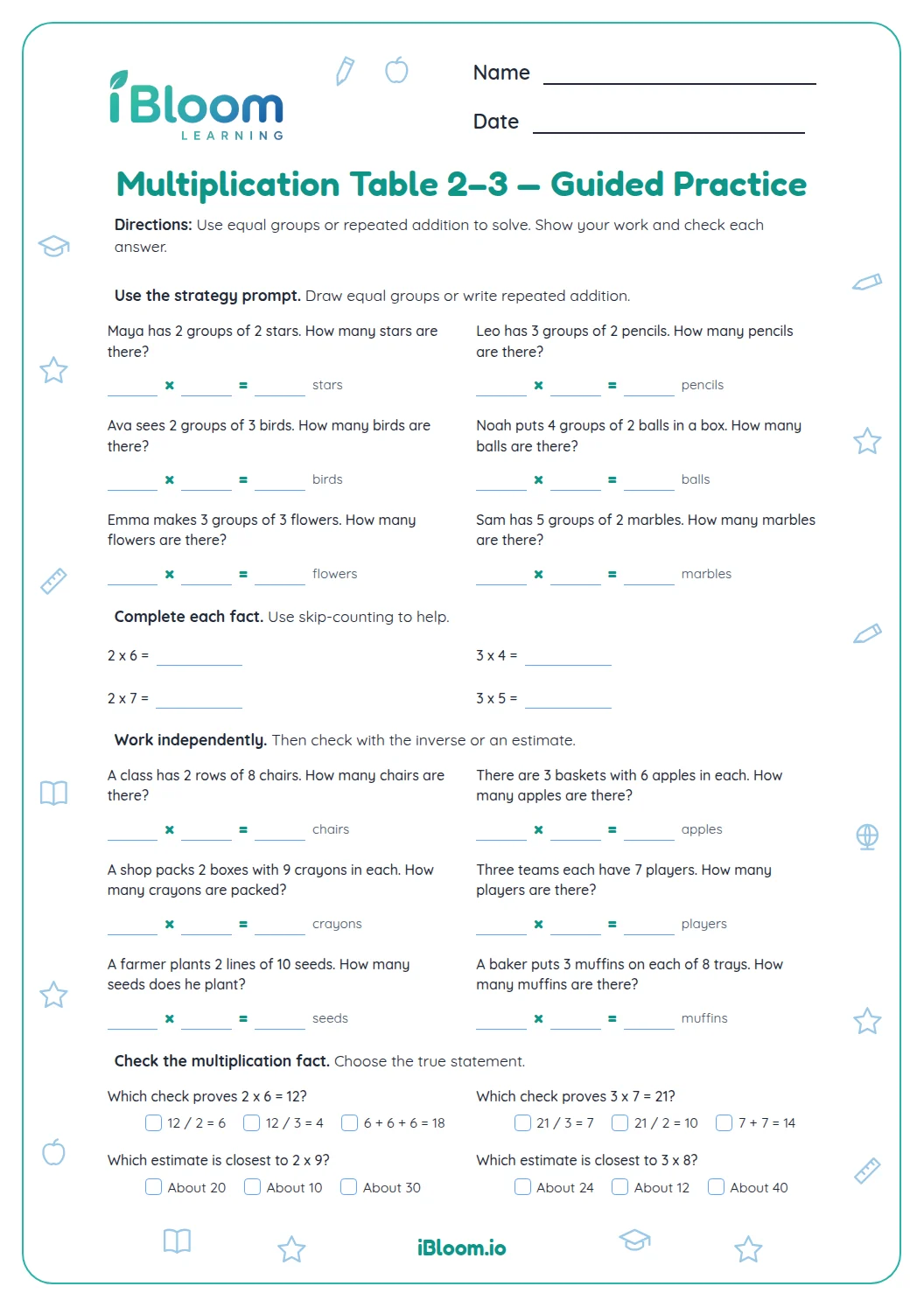
Underline the number of groups and the amount in each group. Write those as factors, then label the product with the story’s unit. A quick reasonableness check asks whether the total is larger than one group.
Part D uses six short situations with trays, bags, teams, garden rows, books, and rolls so the equal groups are easy to identify.
- 16 rows of 5 muffins
- 26 × 5 = 30
- 3There are 30 muffins.
How to use this worksheet
- 1Read a factor sentence and tell what each factor counts.
- 2For arrays, count the rows and the objects in each row.
- 3Use a known multiplication fact to fill each blank.
- 4In each story, mark the number of groups and group size.
- 5Write the equation before the answer and include the unit.
- 6Check the product with repeated addition or a related fact.
Common slips and ways to check
The mistake
Treating the two factors as if they name the same thing in every story.
The fix
Say “groups” for one factor and “in each group” for the other before multiplying.
The mistake
Counting every array dot one by one and losing the row structure.
The fix
Count by rows, then confirm with rows × columns.
The mistake
Giving only a number in a story answer.
The fix
Add the item named in the question, such as “30 muffins.”
Common Core alignment
The questions connect multiplication products to equal groups and arrays.
Interpret a product as the total in a stated number of equal groups.
On this sheet: The sheet interprets multiplication facts and arrays as totals in equal groups.
Show the official wordingHide the official wording
Interpret products of whole numbers, e.g., interpret 5 × 7 as the total number of objects in 5 groups of 7 objects each. For example, describe a context in which a total number of objects can be expressed as 5 × 7.
What to practice next
Make more practice
Further reading
Questions parents and teachers ask
Which multiplication tables does this worksheet include?
The 20 questions directly practice facts from the 5, 6, 7, 8, 9, and 10 tables. Arrays, missing factors, and equal-group stories help connect each product to what the factors count. The separate key gives all products and story totals.
How can an array help with a multiplication fact?
An array places objects in equal rows and columns. Count the rows and the objects in each row, then multiply those counts. For example, question 6 has 3 rows of 6 apples, so 3 × 6 = 18. Rotating the array keeps the total unchanged.
What is a missing factor?
A missing factor is the unknown number in a multiplication sentence. For ___ × 6 = 36, ask how many sixes make 36. Since 6 × 6 = 36, the blank is 6. The worksheet gives two missing-factor questions. Use the product to check.
Can children use skip-counting to check a product?
Yes. To check 7 × 6, count seven groups of six: 6, 12, 18, 24, 30, 36, 42. The last number is the product. Repeated addition, 6 + 6 + 6 + 6 + 6 + 6 + 6, shows the same groups. The repeated groups match the factors.
How many story problems are included?
Questions 15 through 20 give six equal-group stories about muffins, shells, players, plants, books, and rolls. Write the number of groups times the amount in each group, then label the total with the item being counted. The six problems appear at the end of the sheet.
Is an answer key included?
Yes. A separate answer key lists the 20 products and totals. For each story problem, check that the multiplication equation uses the stated groups and that the final answer includes the correct unit, such as muffins or players. Review the unit with its matching story.