


About this worksheet
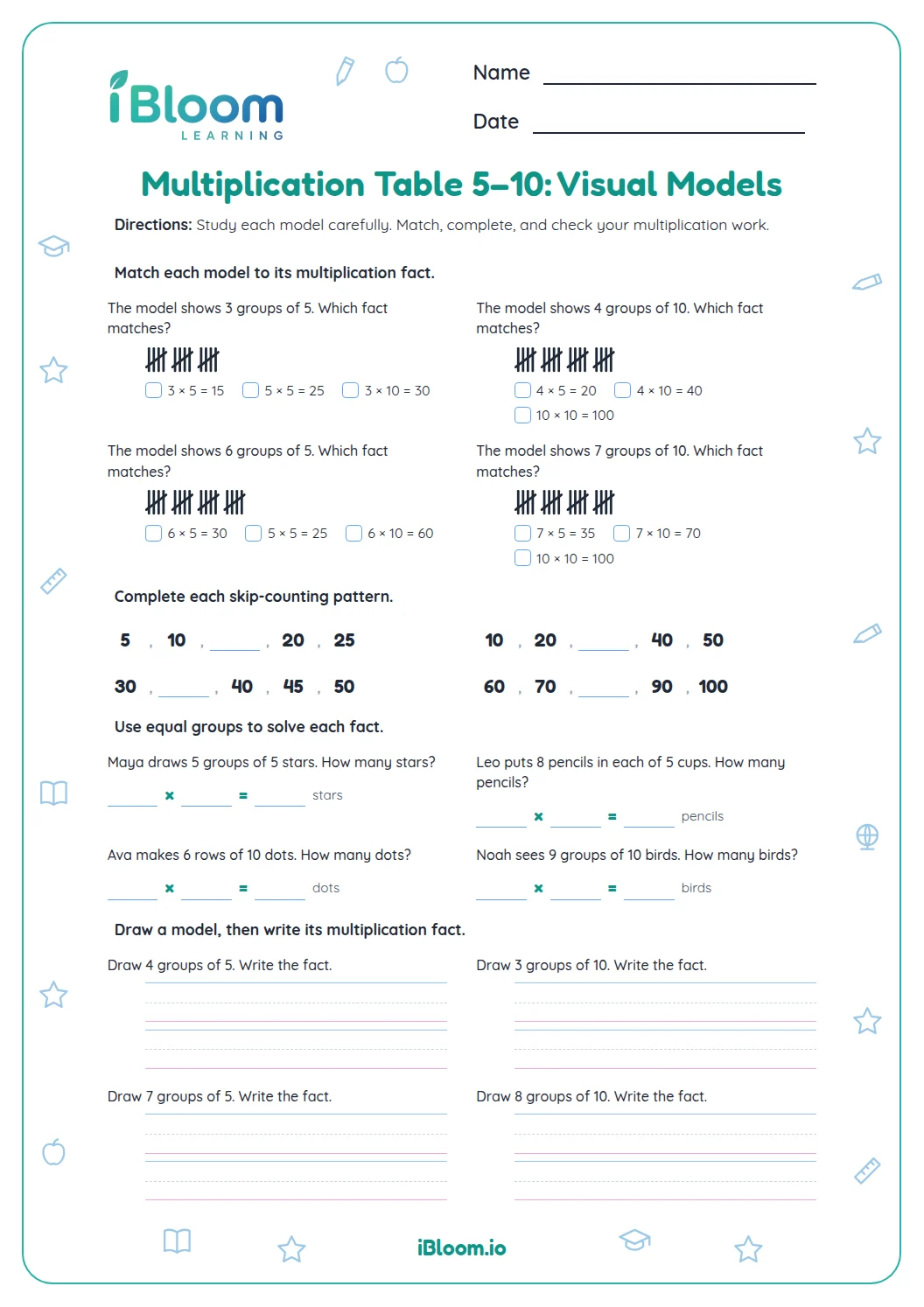
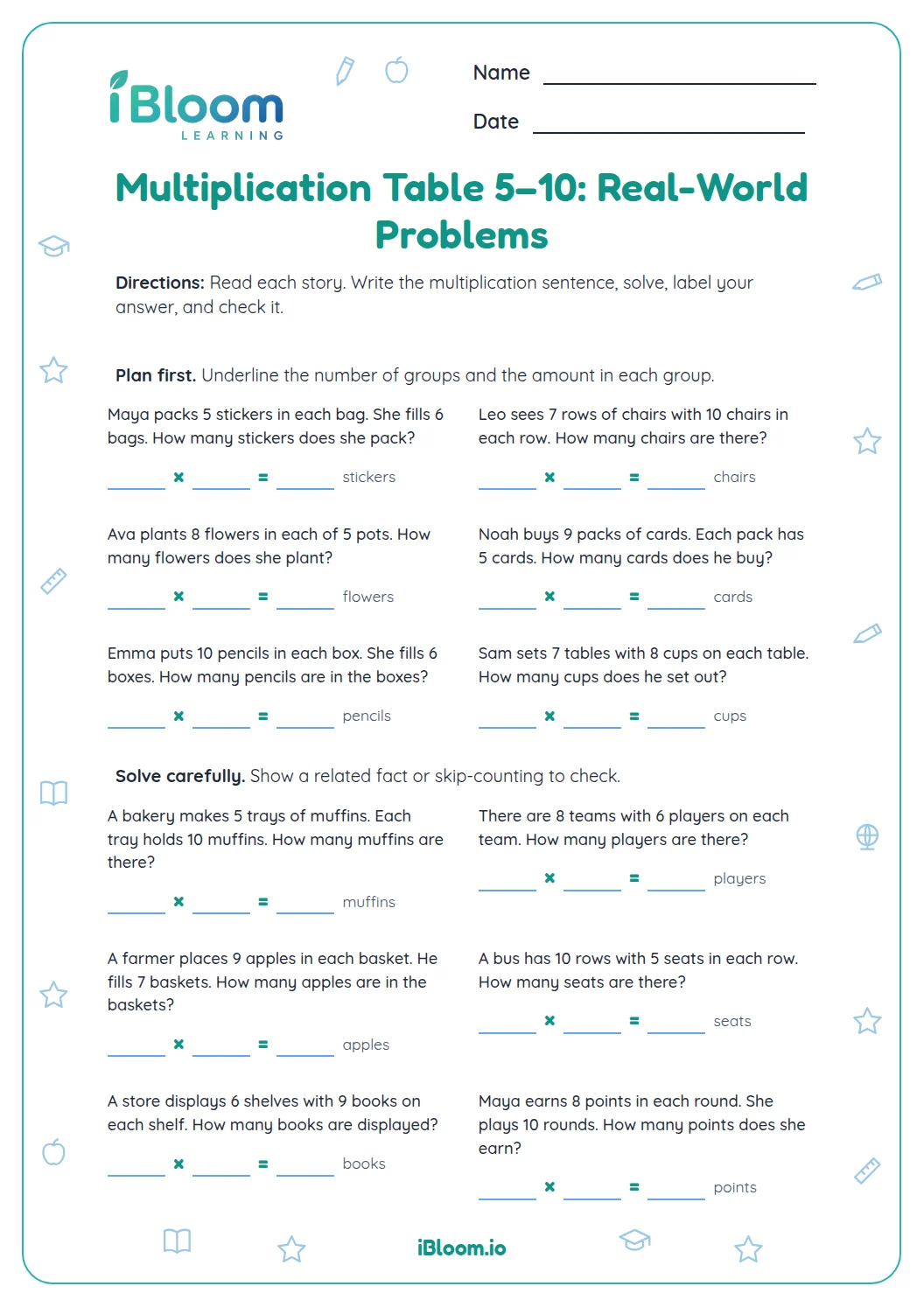
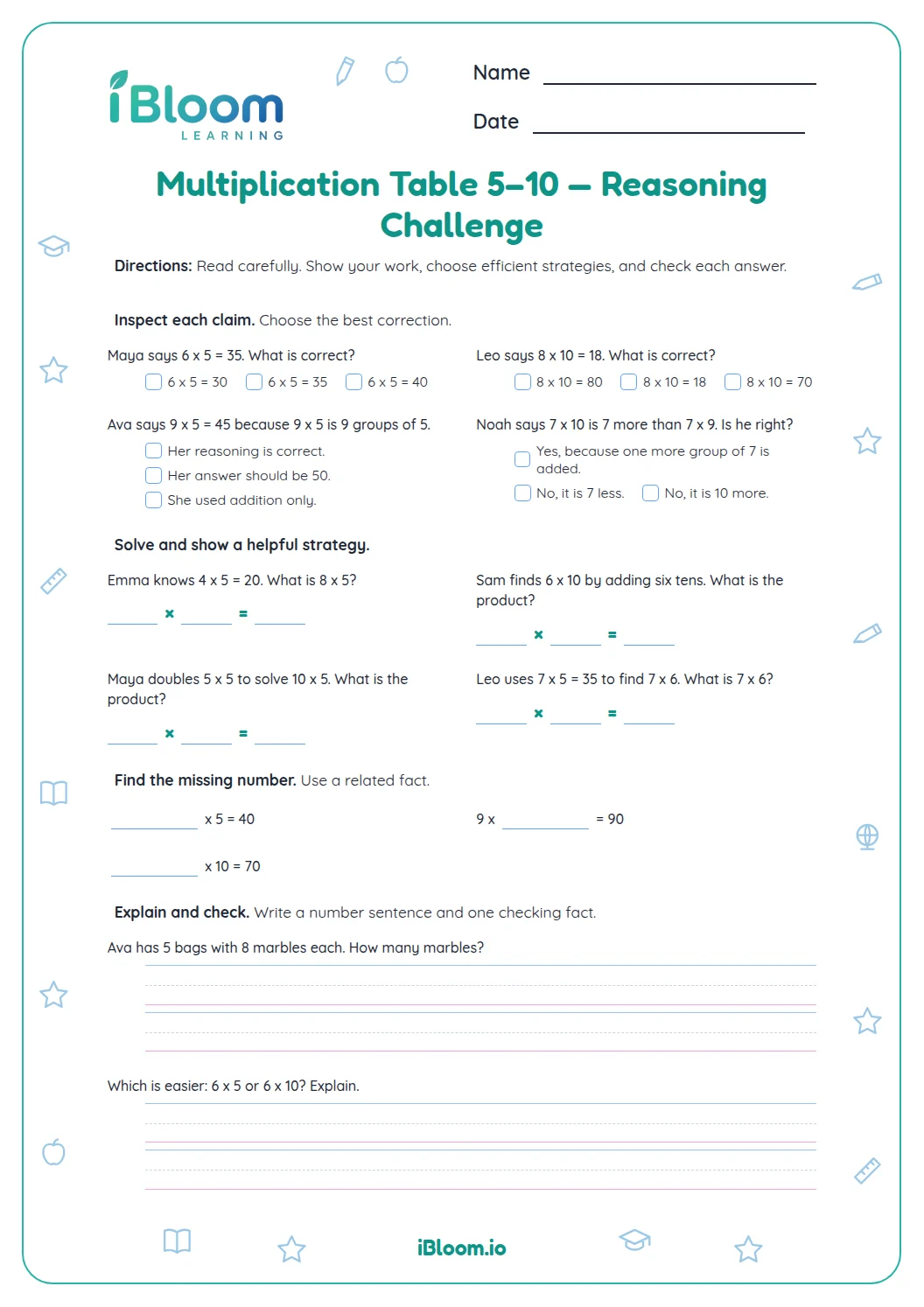
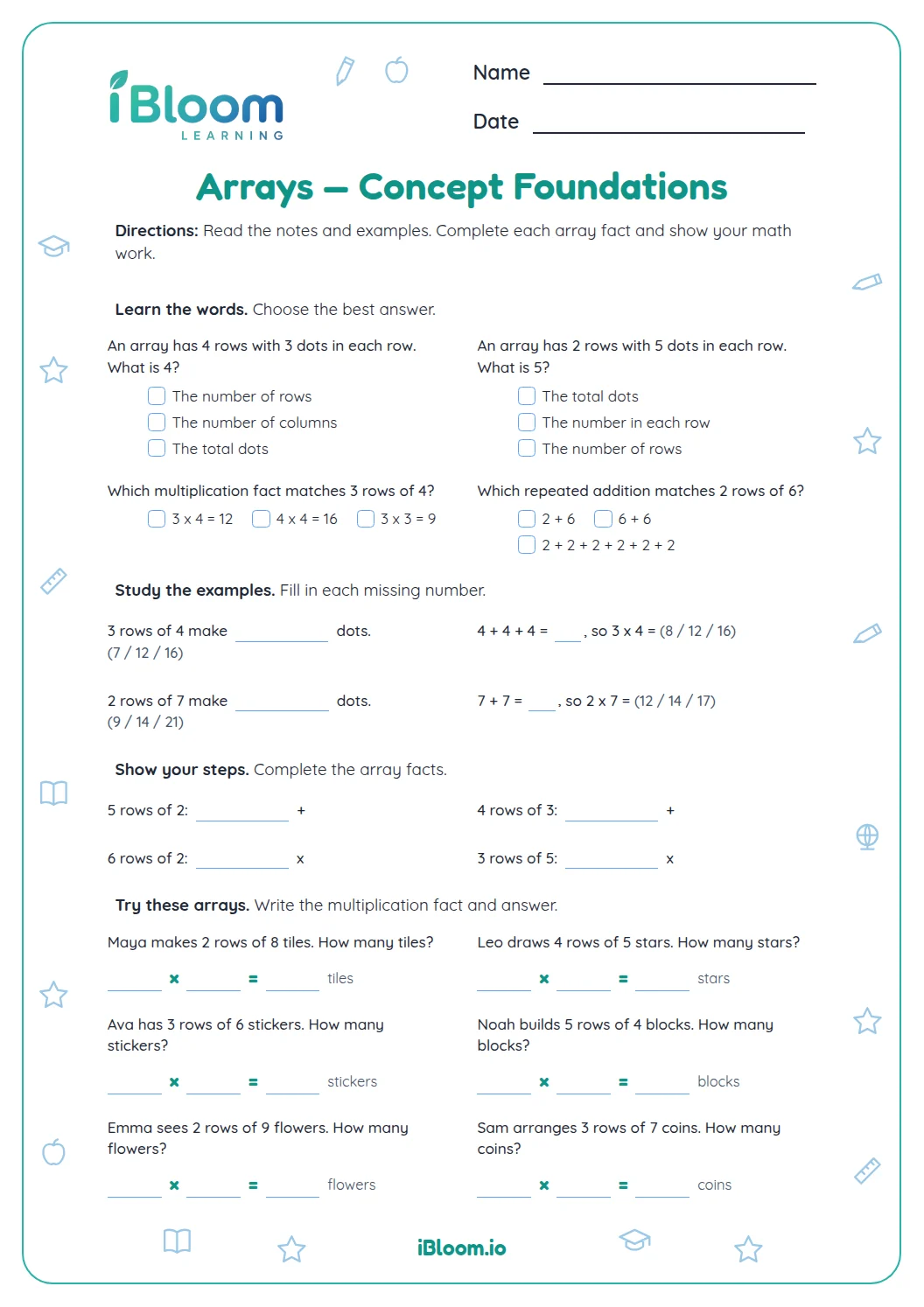
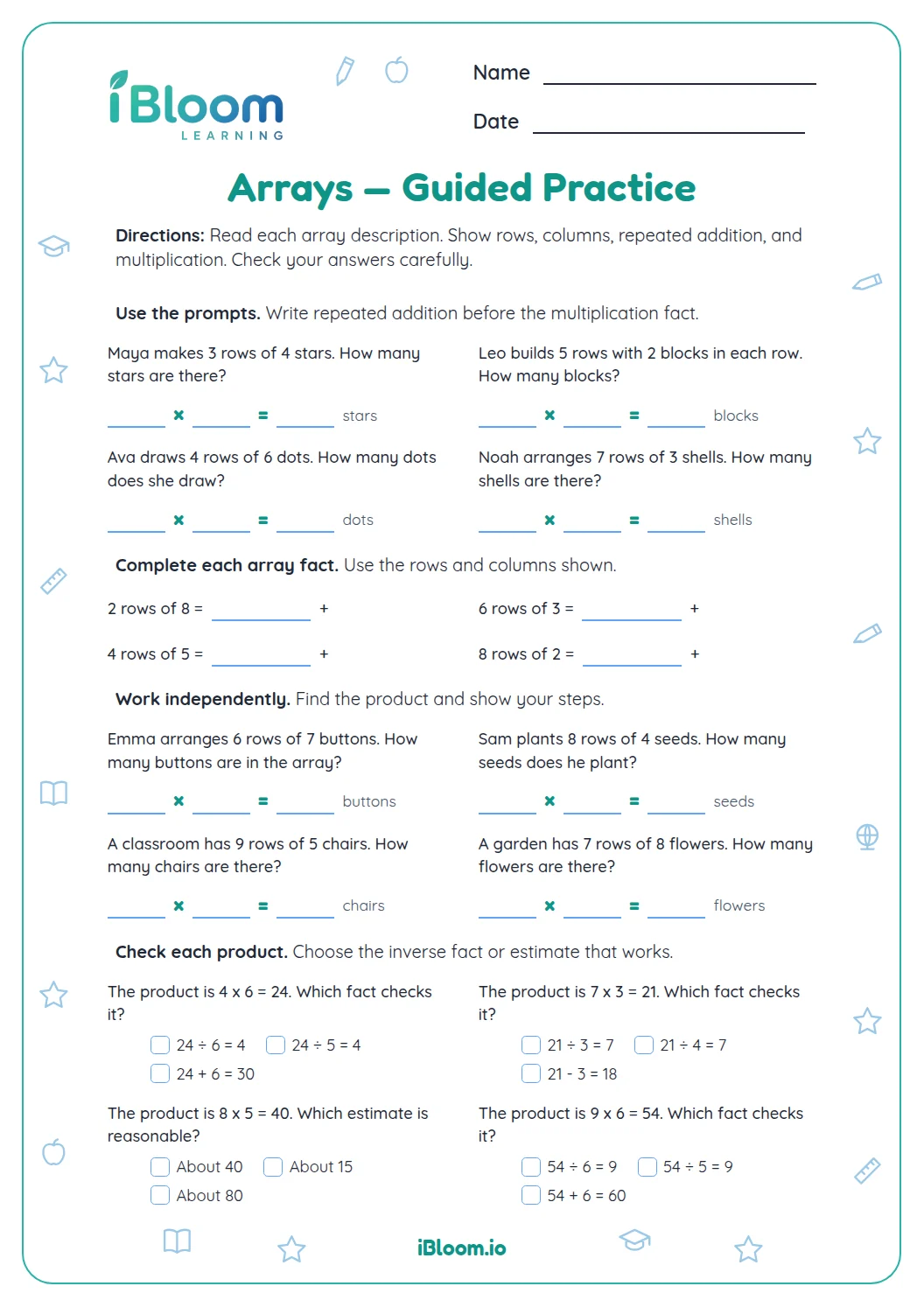
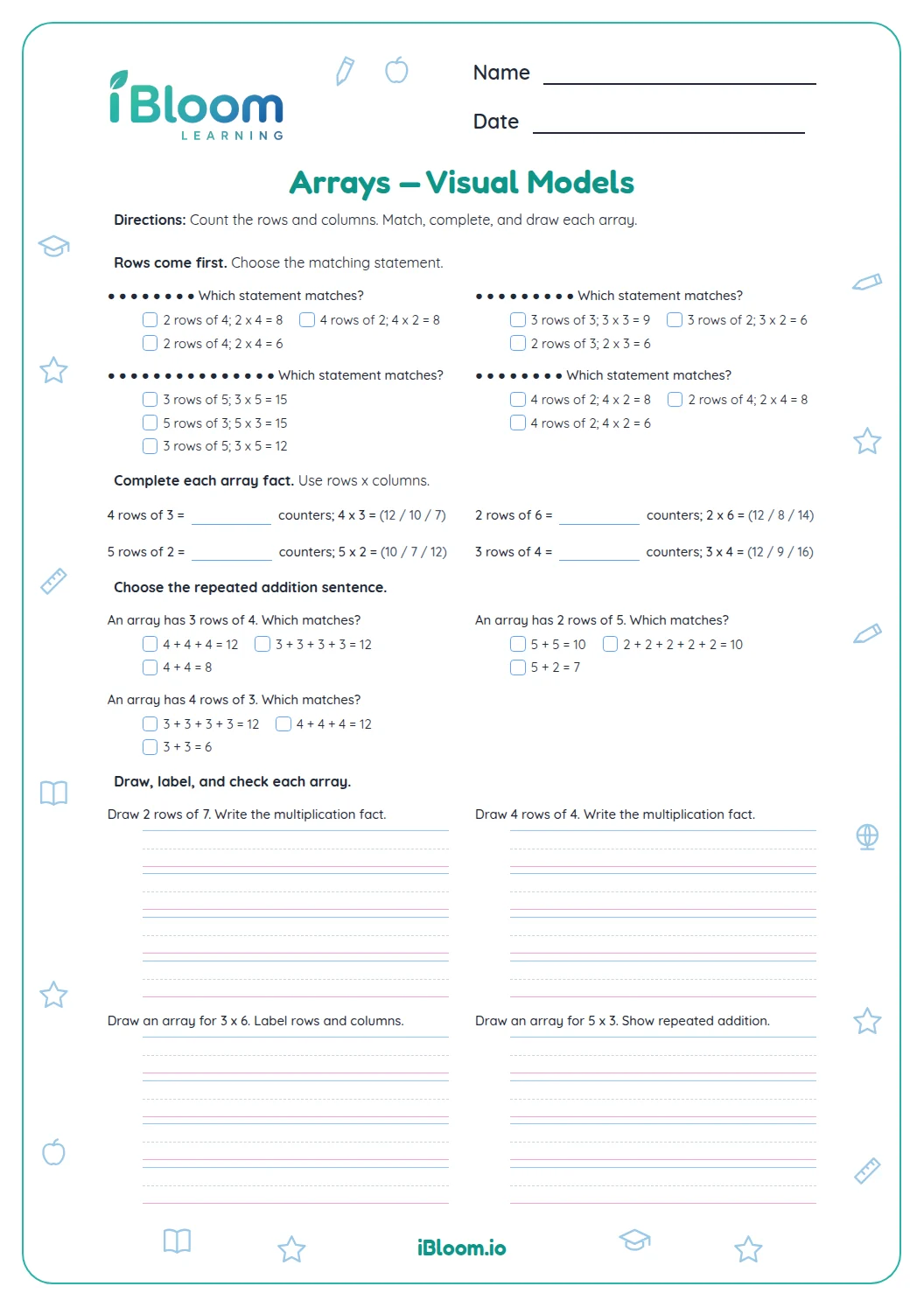
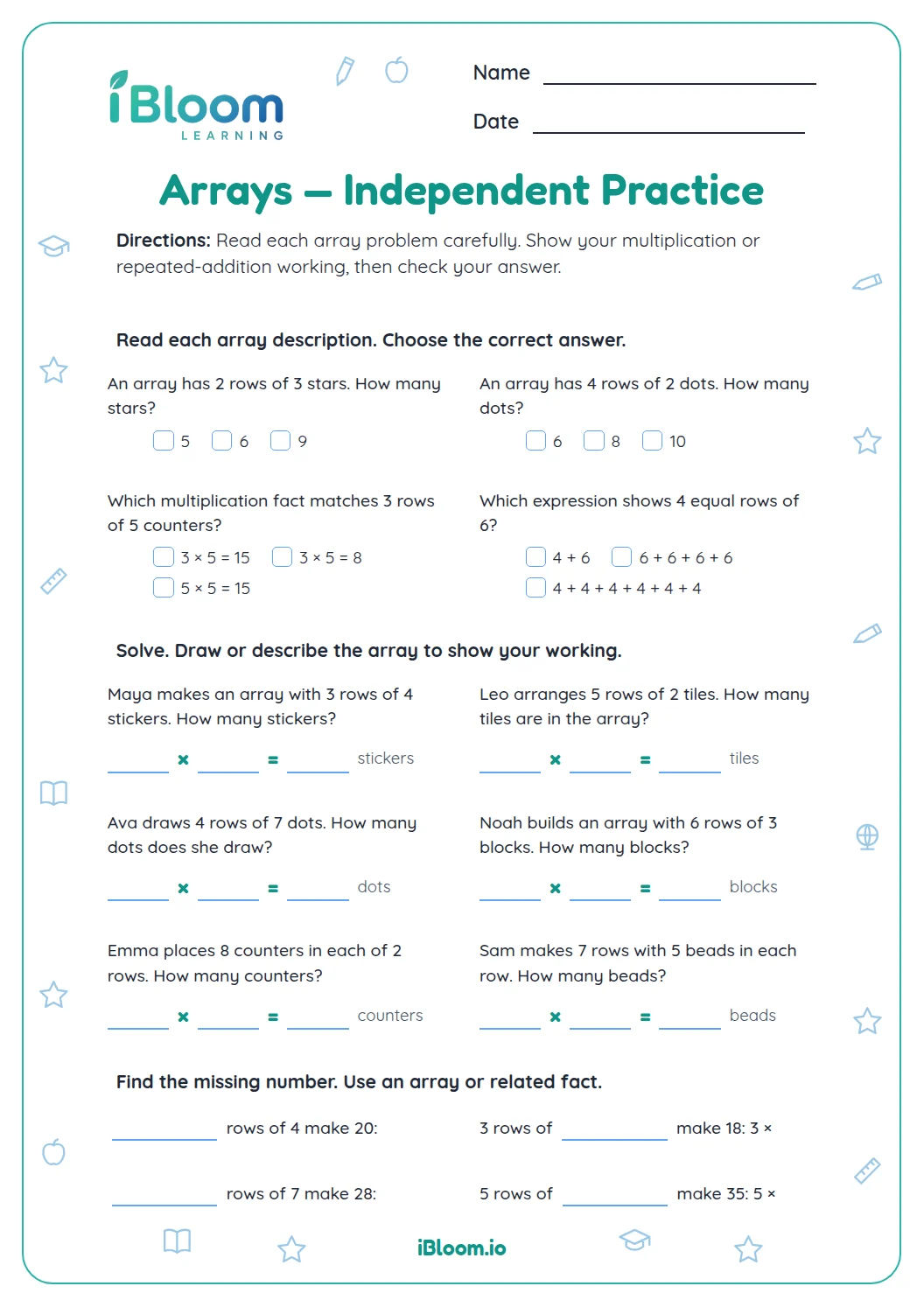
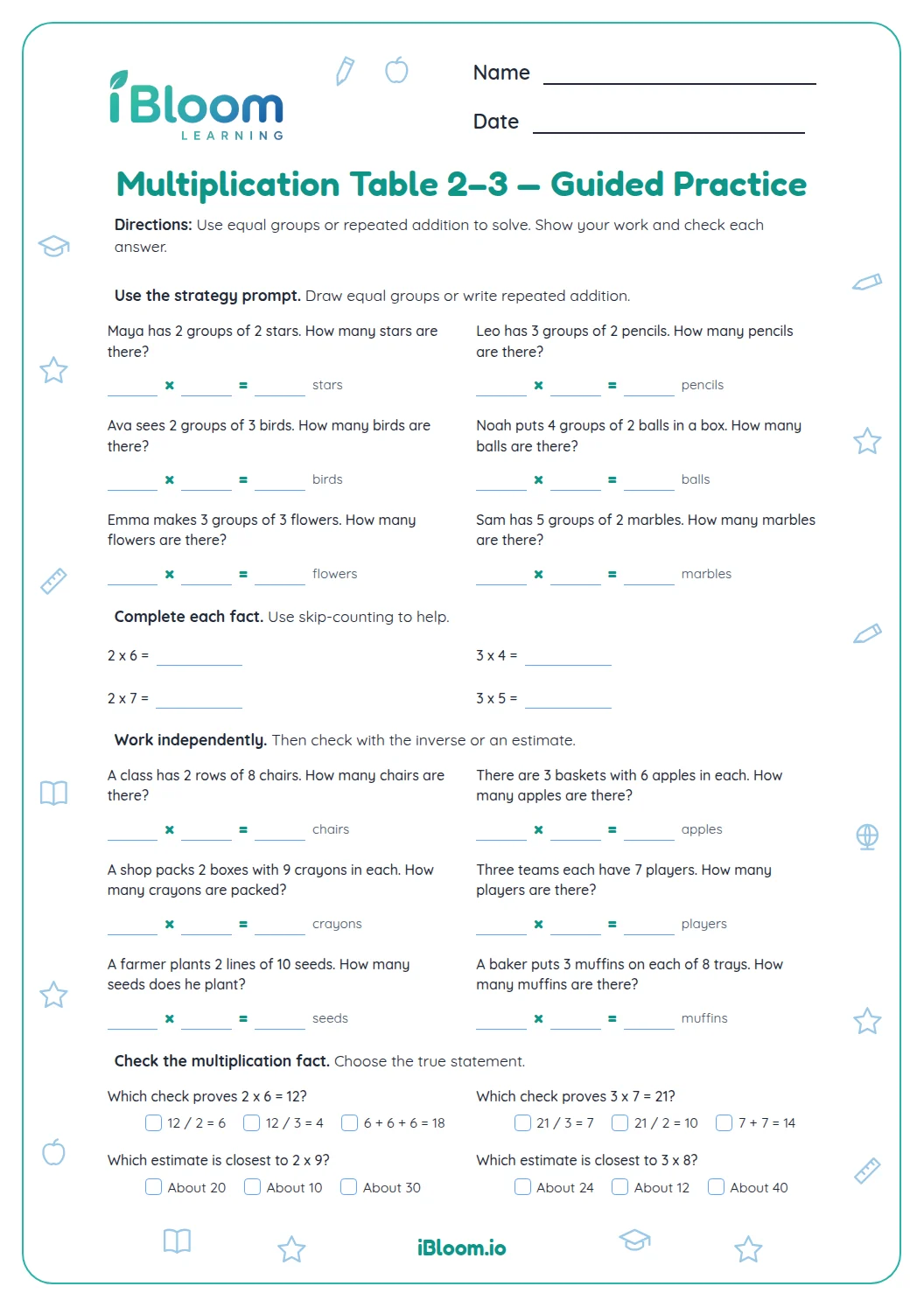
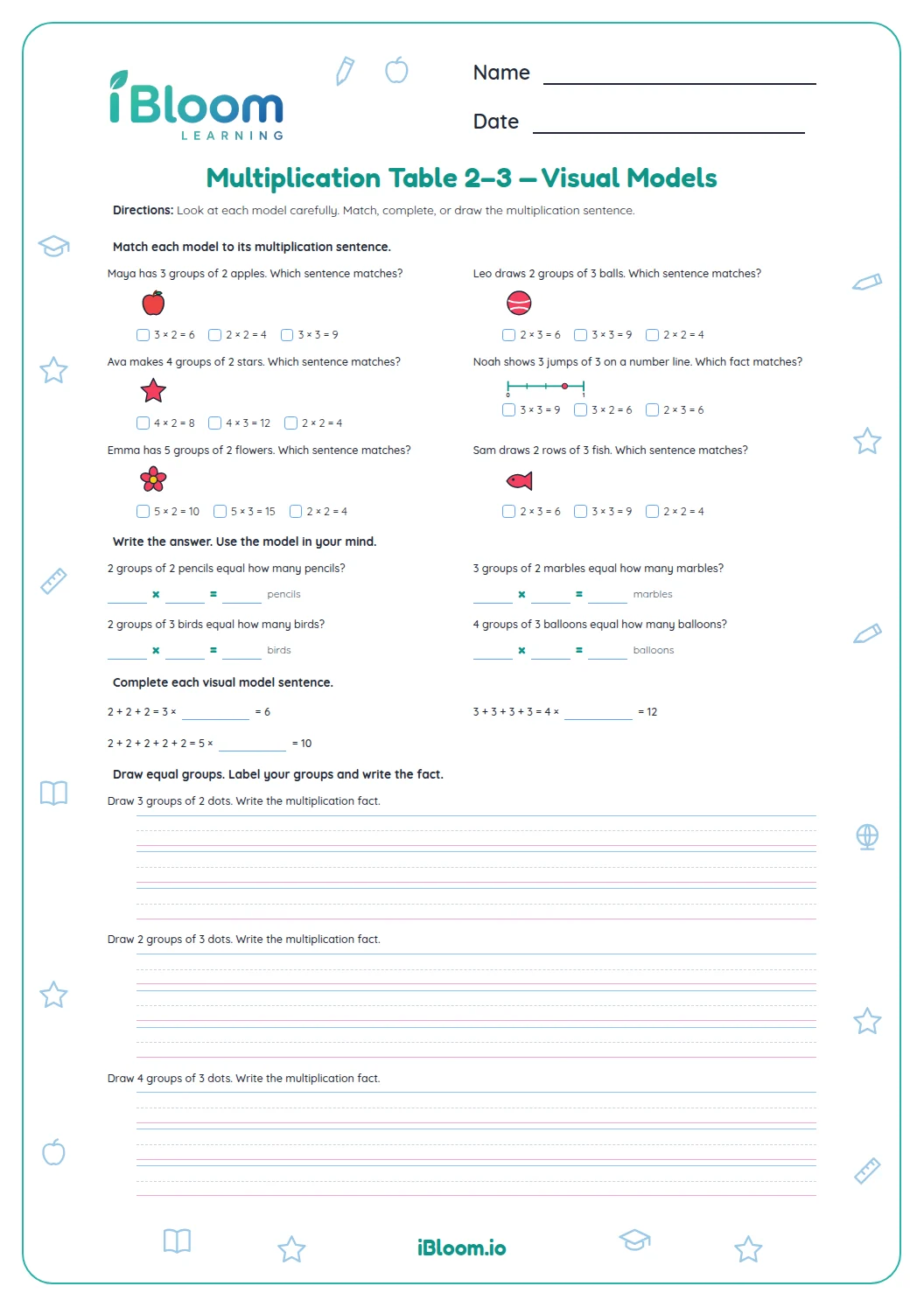
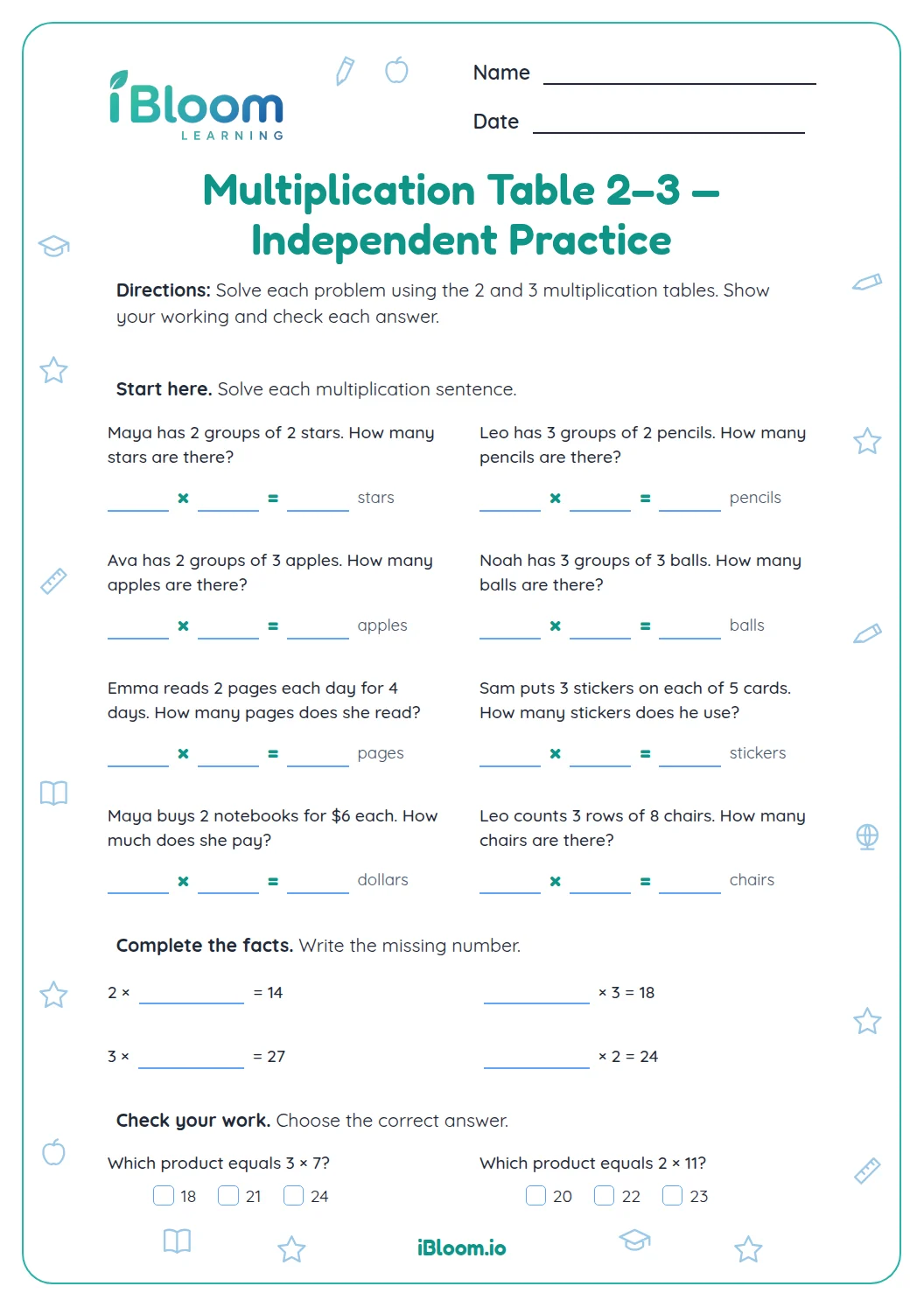
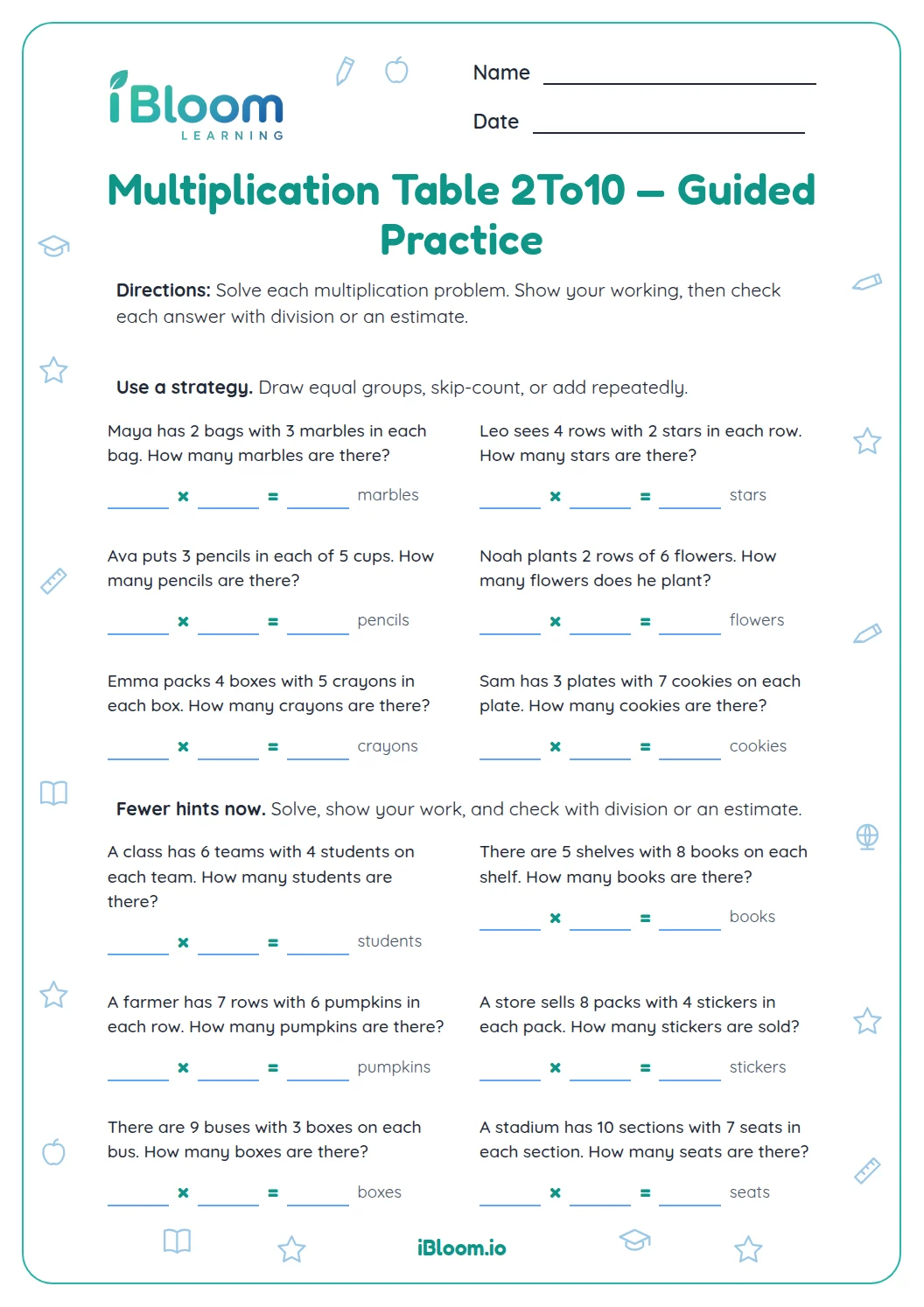
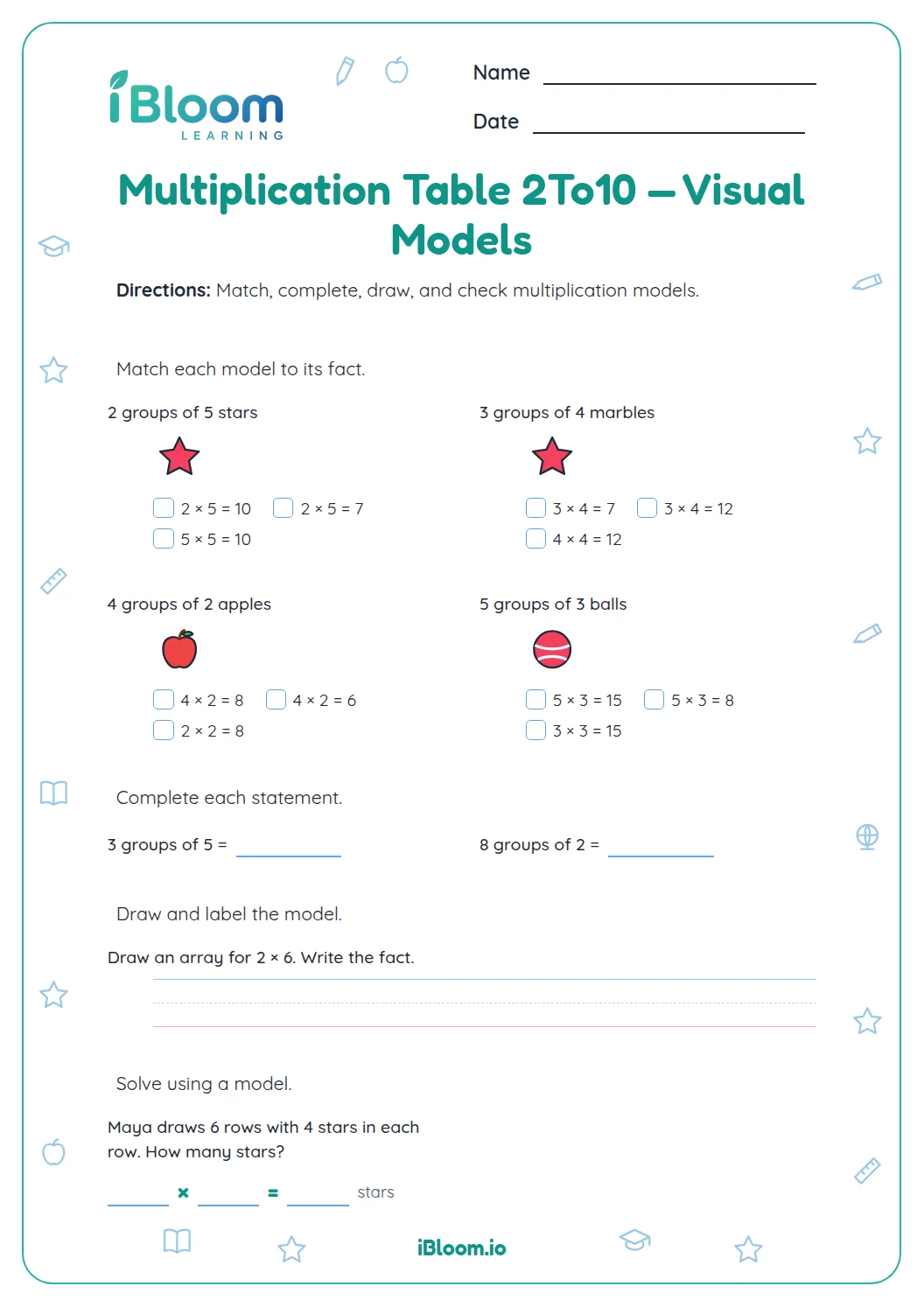
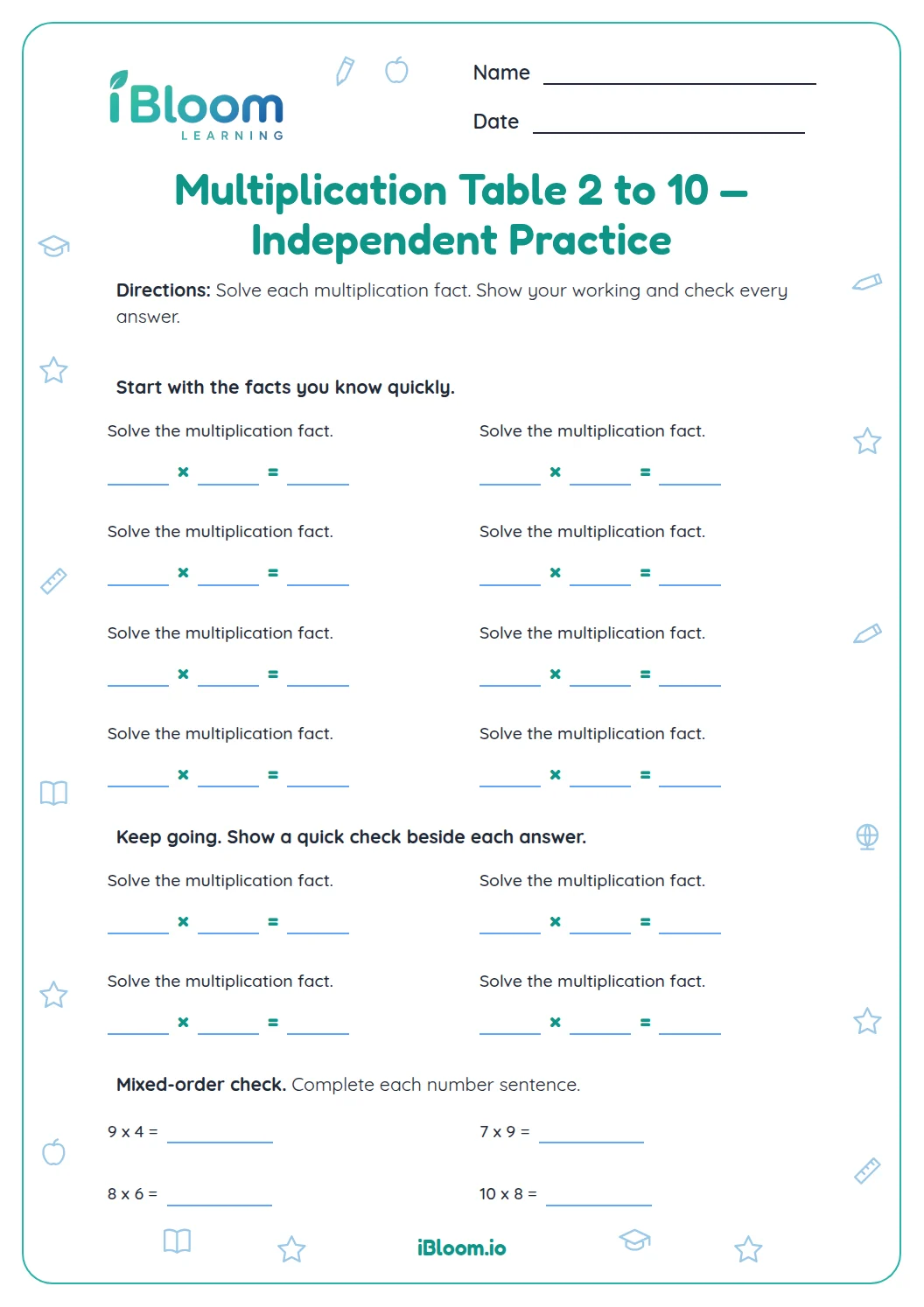
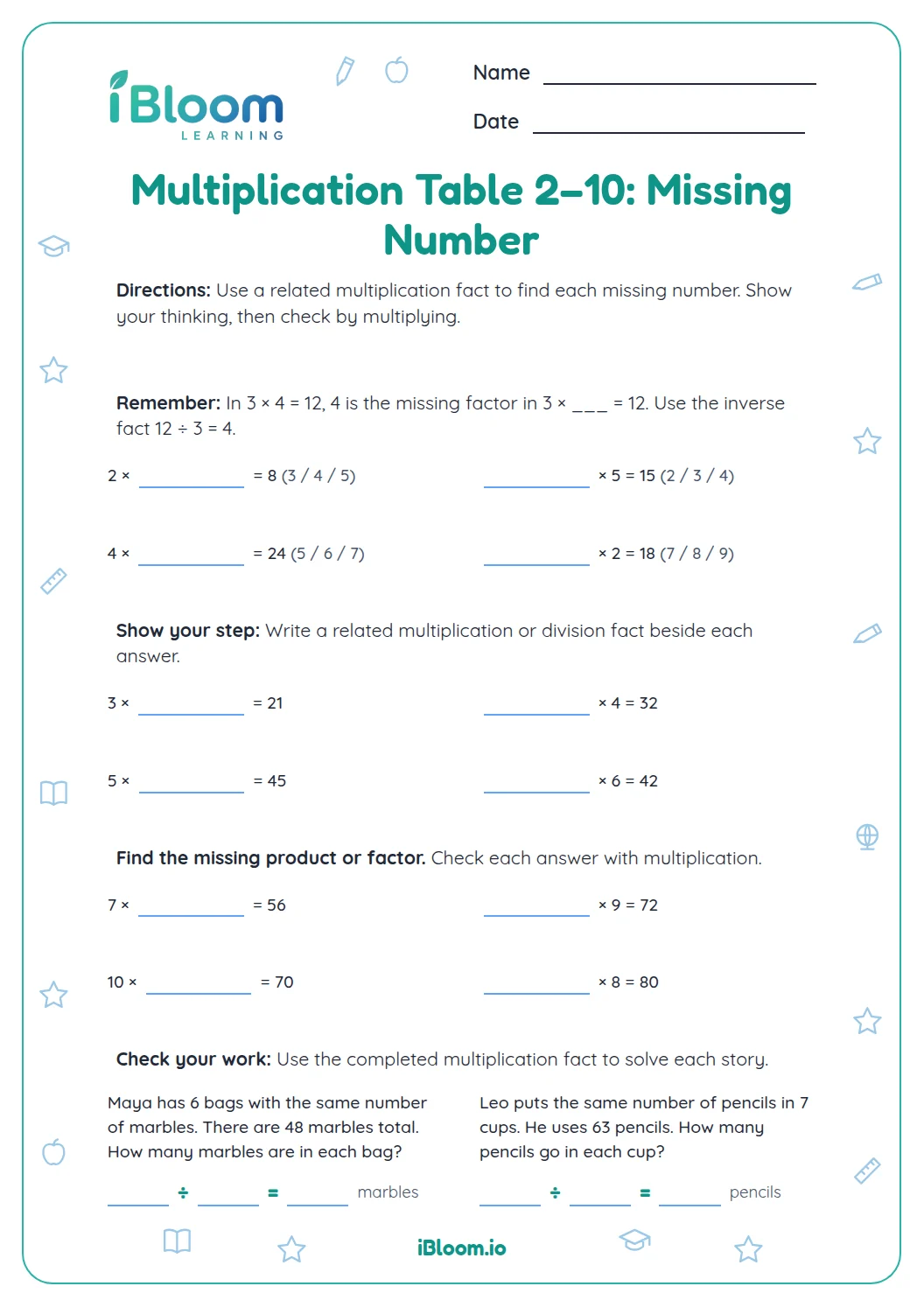
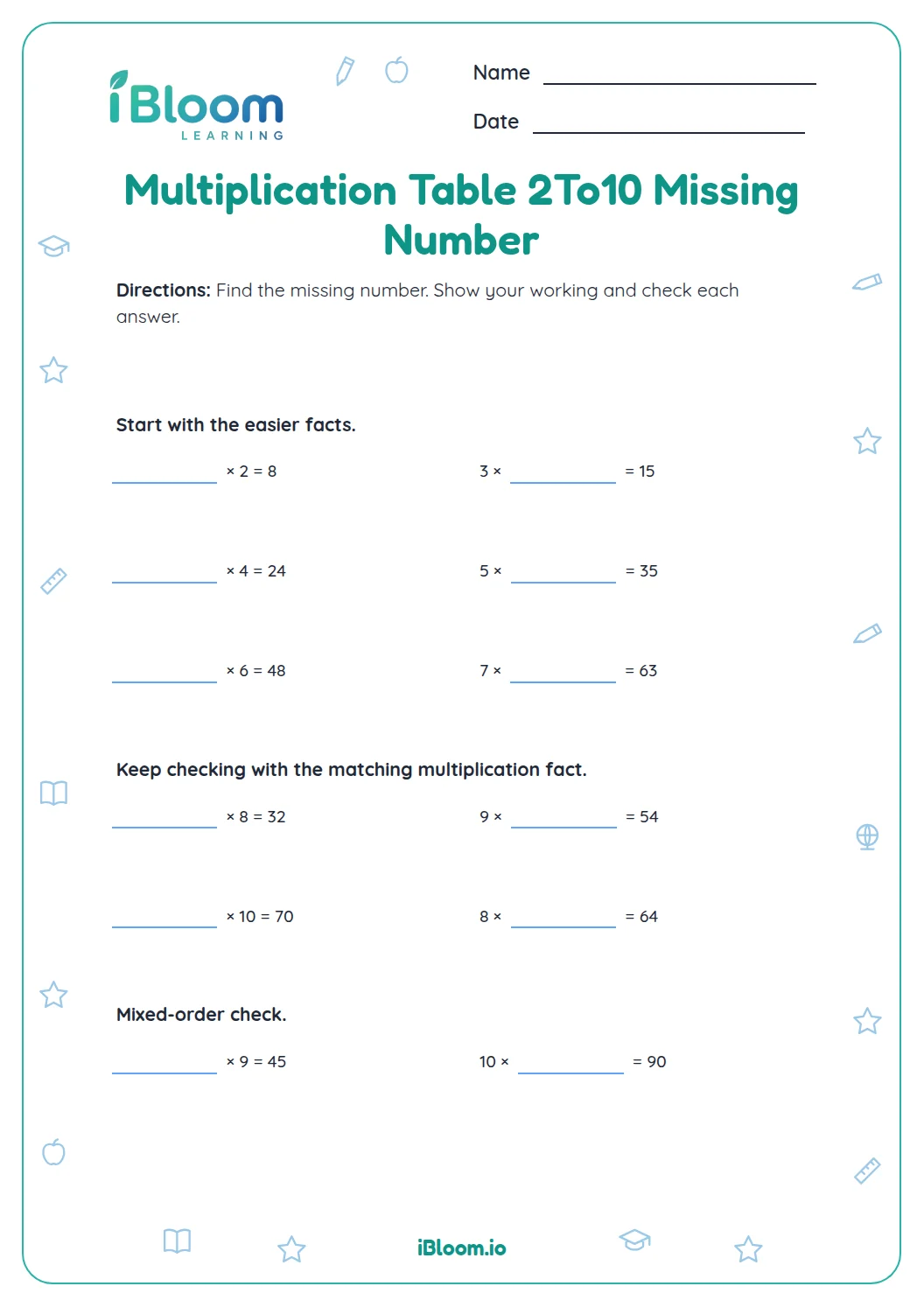
This Grade 3 worksheet gives students 18 independent practice questions on multiplication tables 5–10. Part A asks for products, Part B reverses known facts to find a missing factor, and Part C applies multiplication to four equal-group stories. Every product stays within 100, and the facts use factors from the tables named in the title. Students can write an equation for each story and check with a related division fact. The practice supports CCSS 3.OA.C.7, fluency with multiplication facts within 100.
Aligned to 3.OA.C.7
How are the facts grouped?
Part A has eight product questions drawn from the 5–10 tables. Students can use a familiar fact, such as doubling a known product or multiplying by ten, to work efficiently.
- 1For 5 × 8, use five groups of eight or the known 4 × 8 fact plus one more group of eight.
How do students find a missing factor?
Part B gives a product and one factor. Think of the related division fact or ask which table fact makes the product.
- 1In ___ × 6 = 42, ask “42 divided into groups of 6 gives how many groups?” The missing factor is 7.
What should students do with each story?
Part C describes equal groups. Identify how many groups there are and how many are in each group, then multiply to find the total. The working area gives room for an equation.
- 1Eight rows with six seedlings each can be represented by 8 × 6 = 48 seedlings.
How can I support this practice?
- 1Solve the product facts in Part A.
- 2For Part B, use division or a multiplication fact family to find the missing factor.
- 3In each story, identify the number of groups and the amount in each group.
- 4Write a multiplication equation in the work area.
- 5Check the product with a related division fact.
What should students check?
The mistake
Multiplying the two numbers in a missing-factor equation without checking the product.
The fix
Use the known factor and product to ask which number completes the multiplication fact.
The mistake
Reversing the story numbers and losing what each number means.
The fix
Label groups and items per group before writing the equation.
The mistake
Stopping after writing an equation.
The fix
Calculate the total and include the unit or item named in the question.
Curriculum alignment
This worksheet practices the Common Core skill named below.
Fluently multiply and divide within 100.
On this sheet: Eighteen questions move from multiplying with tables 5–10 to finding missing factors and solving equal-group stories.
Show the official wordingHide the official wording
Fluently multiply and divide within 100, using strategies such as the relationship between multiplication and division (e.g., knowing that 8 × 5 = 40, one knows 40 ÷ 5 = 8) or properties of operations. By the end of Grade 3, know from memory all products of two one-digit numbers.
What to practice next
Make more practice
Further reading
Questions parents and teachers ask
Do the story problems ask students to show work?
Yes. The four equal-group stories provide a working grid and an answer box. Students can write a multiplication equation, solve it, and label the result with the item named in the story, such as seedlings or markers. The answer key lists the totals.
Are all answers included?
Yes. The key gives the products, missing factors, and story totals. For the stories, check that the equation matches the number of groups and the number in each group before checking the final product. A related division fact is another useful way to verify the answer.
What is a missing-factor problem?
A missing-factor equation gives a product and one factor, then asks for the other factor. In 9 × ___ = 63, recall that 9 × 7 = 63, or divide 63 by 9. Either method identifies 7 as the missing factor.
How can students check a multiplication answer?
Students can reverse the fact with division or represent equal groups. For 8 × 6, they can check that 48 split into 8 equal groups has 6 in each group. For a story problem, they should also make sure the equation follows the story’s group count.
How does this page fit Grade 3?
The product questions use multiplication facts within 100, and the story problems describe one-step equal groups. Students can use multiplication strategies and related division facts, the focus of CCSS 3.OA.C.7. Each story asks for one total and gives room to record a multiplication equation.