


About this worksheet
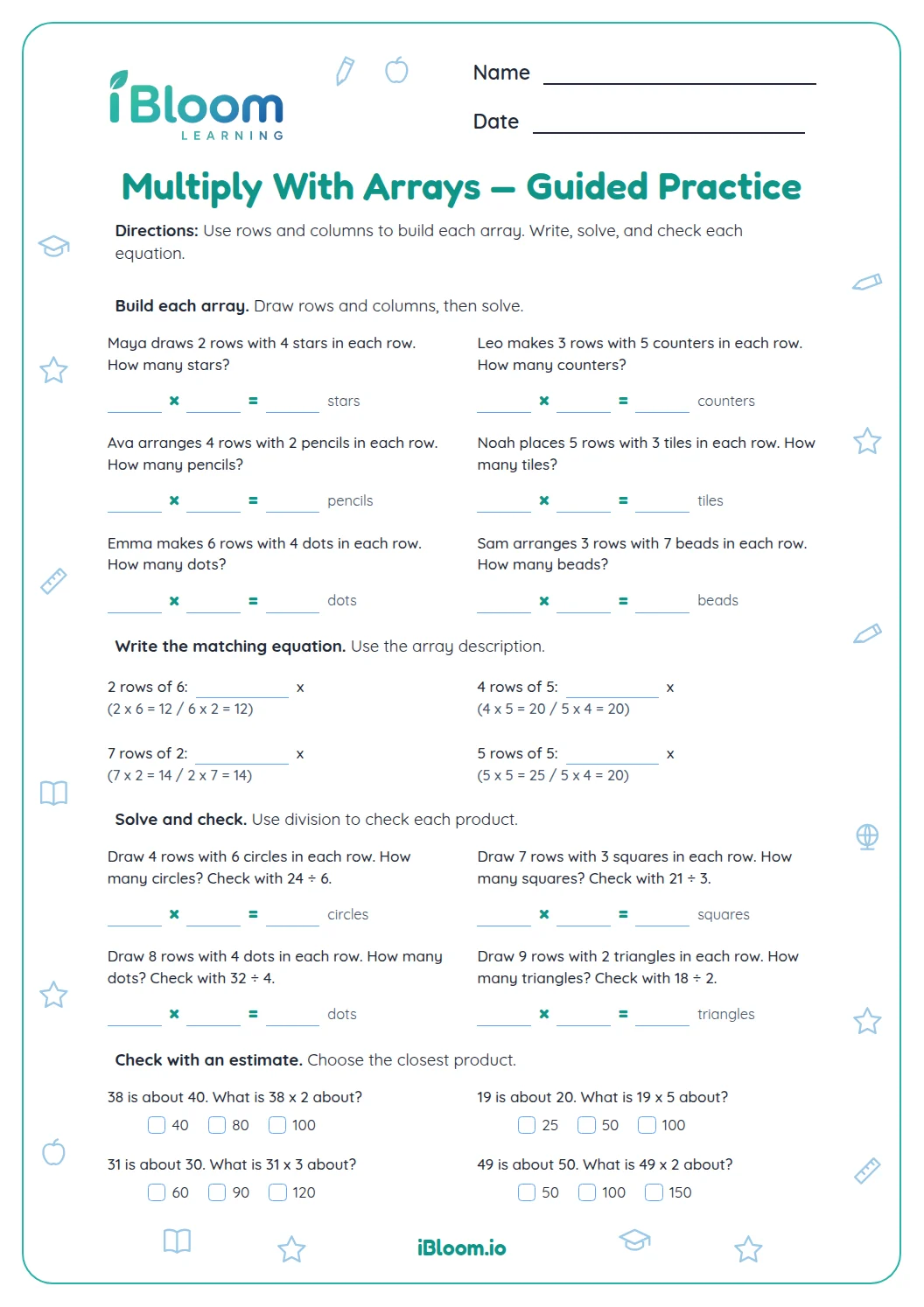
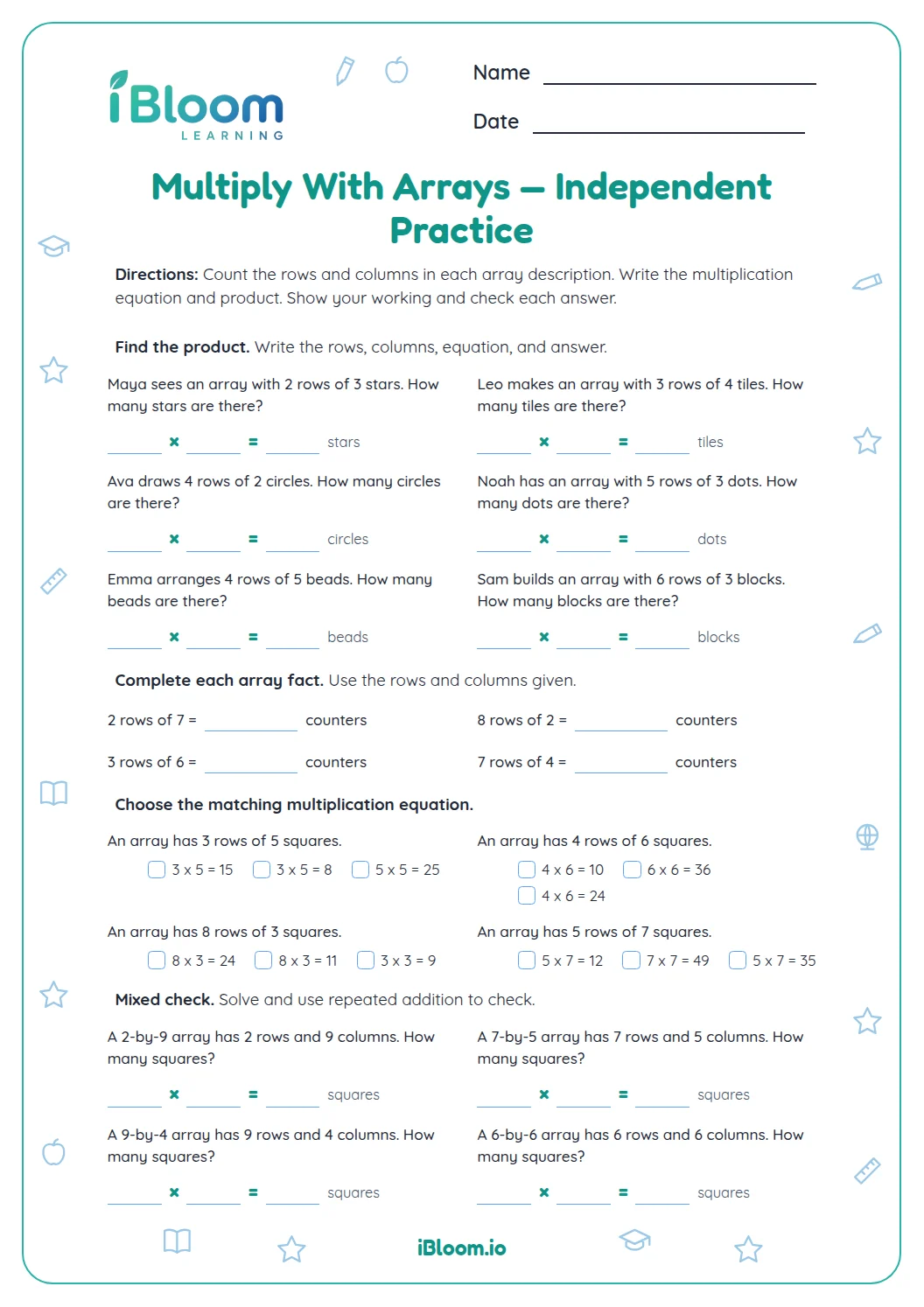
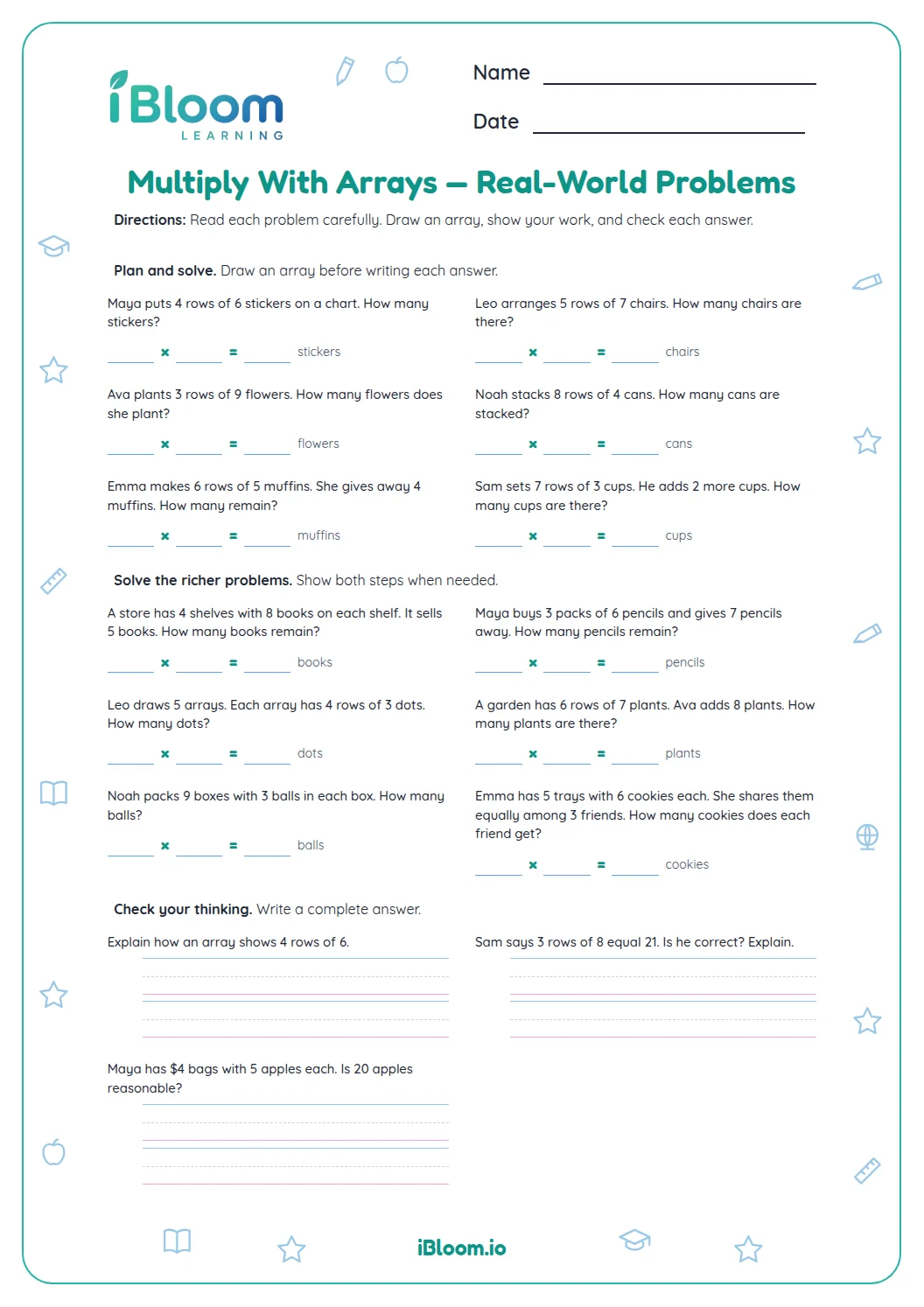
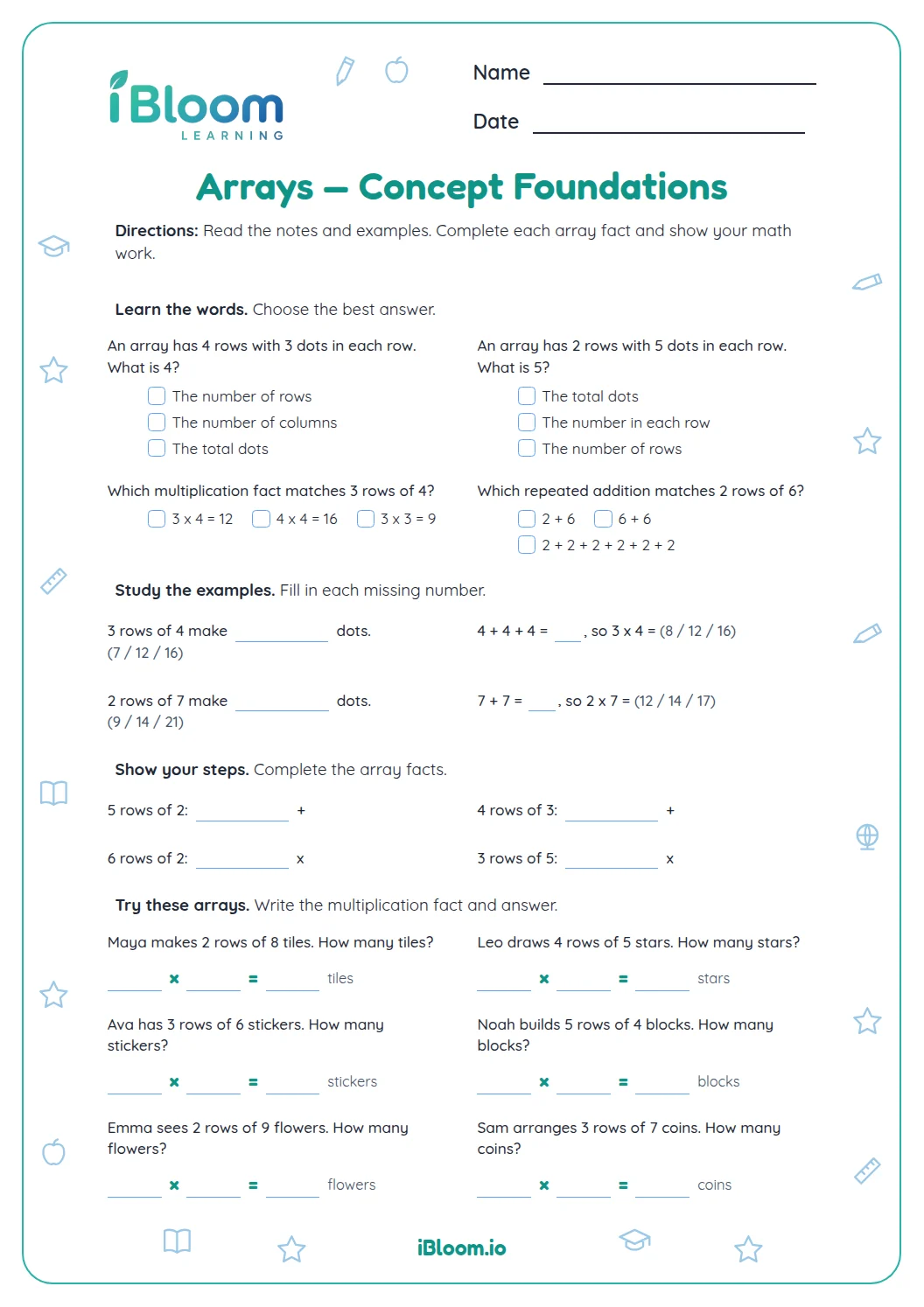
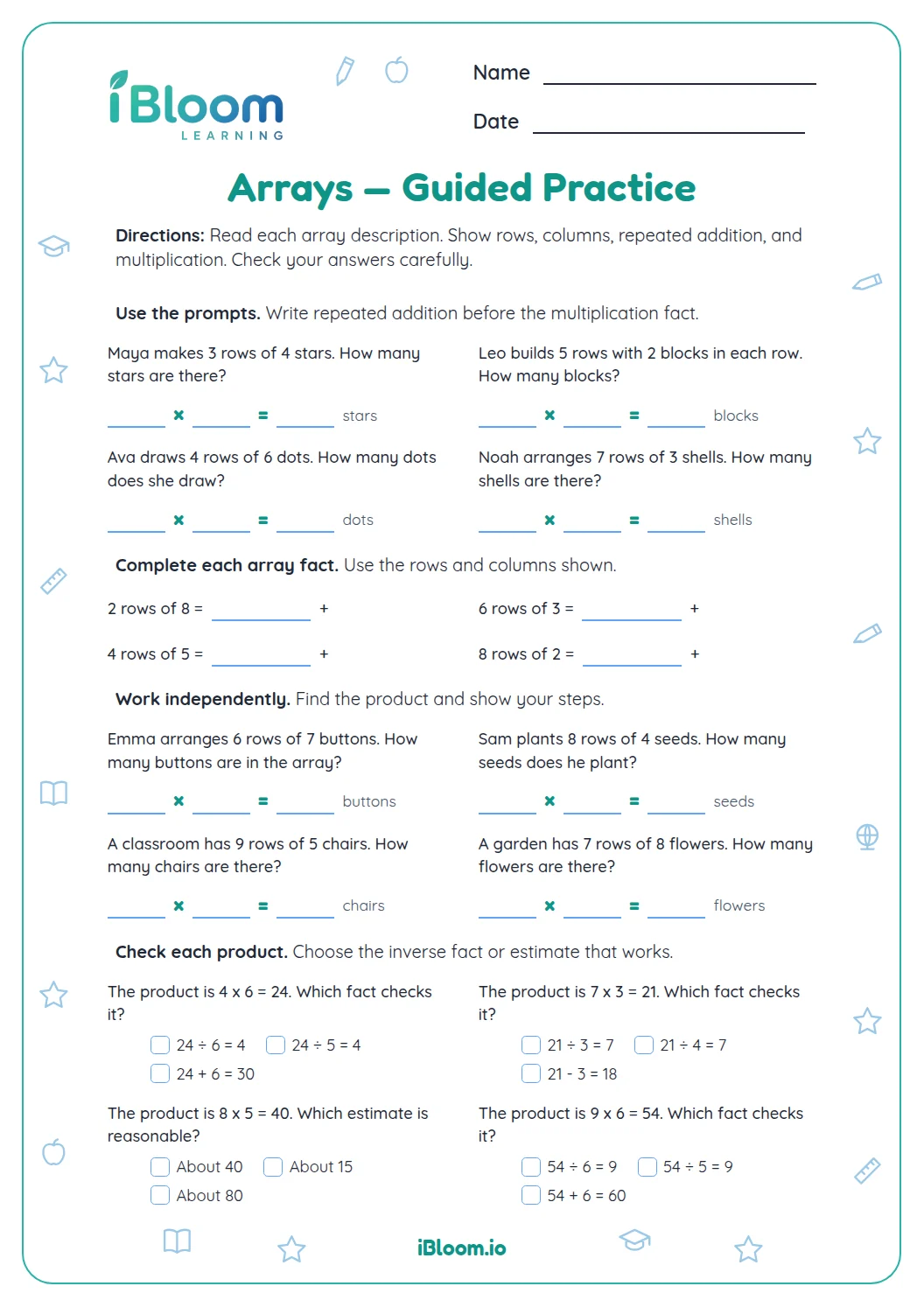
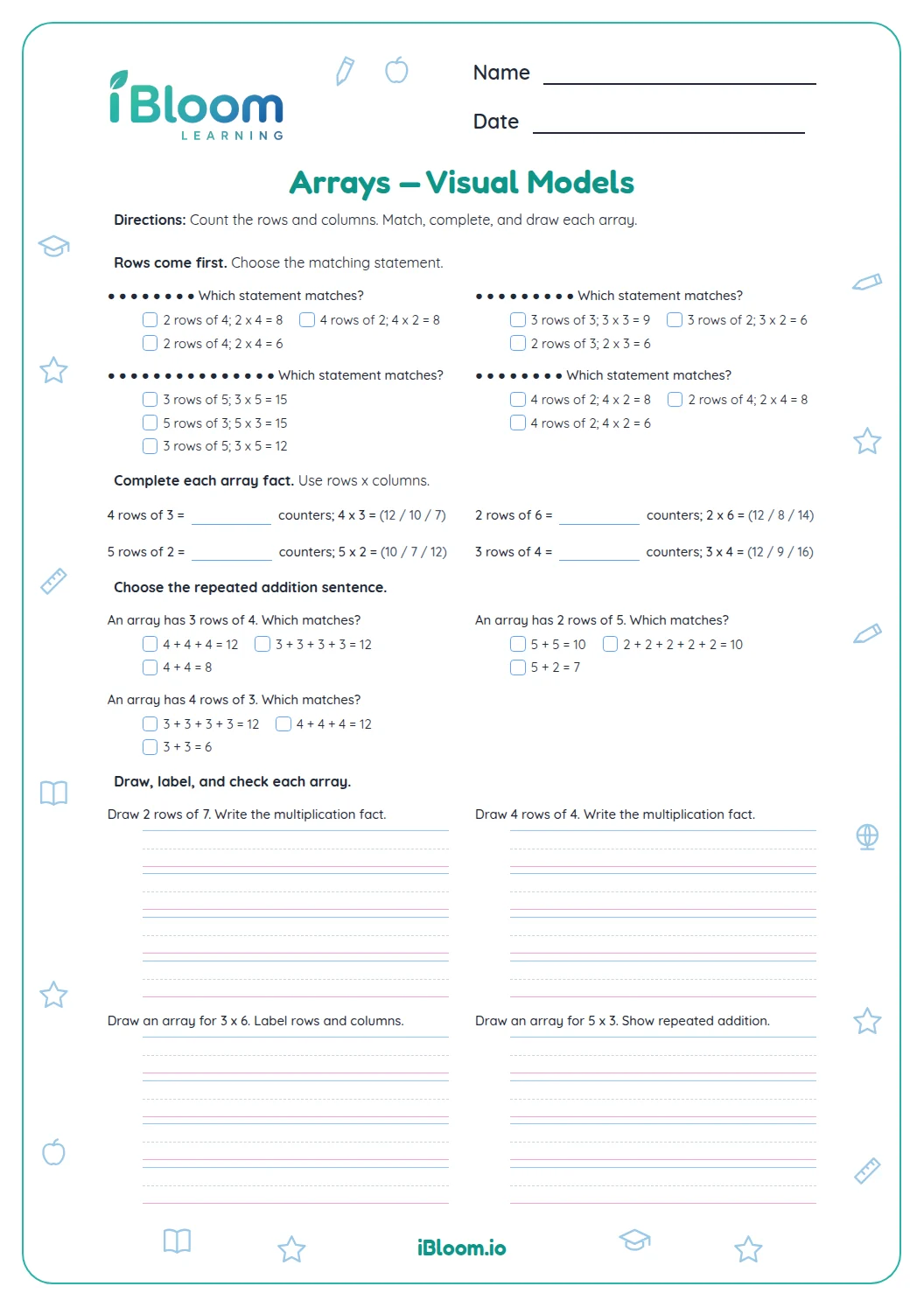
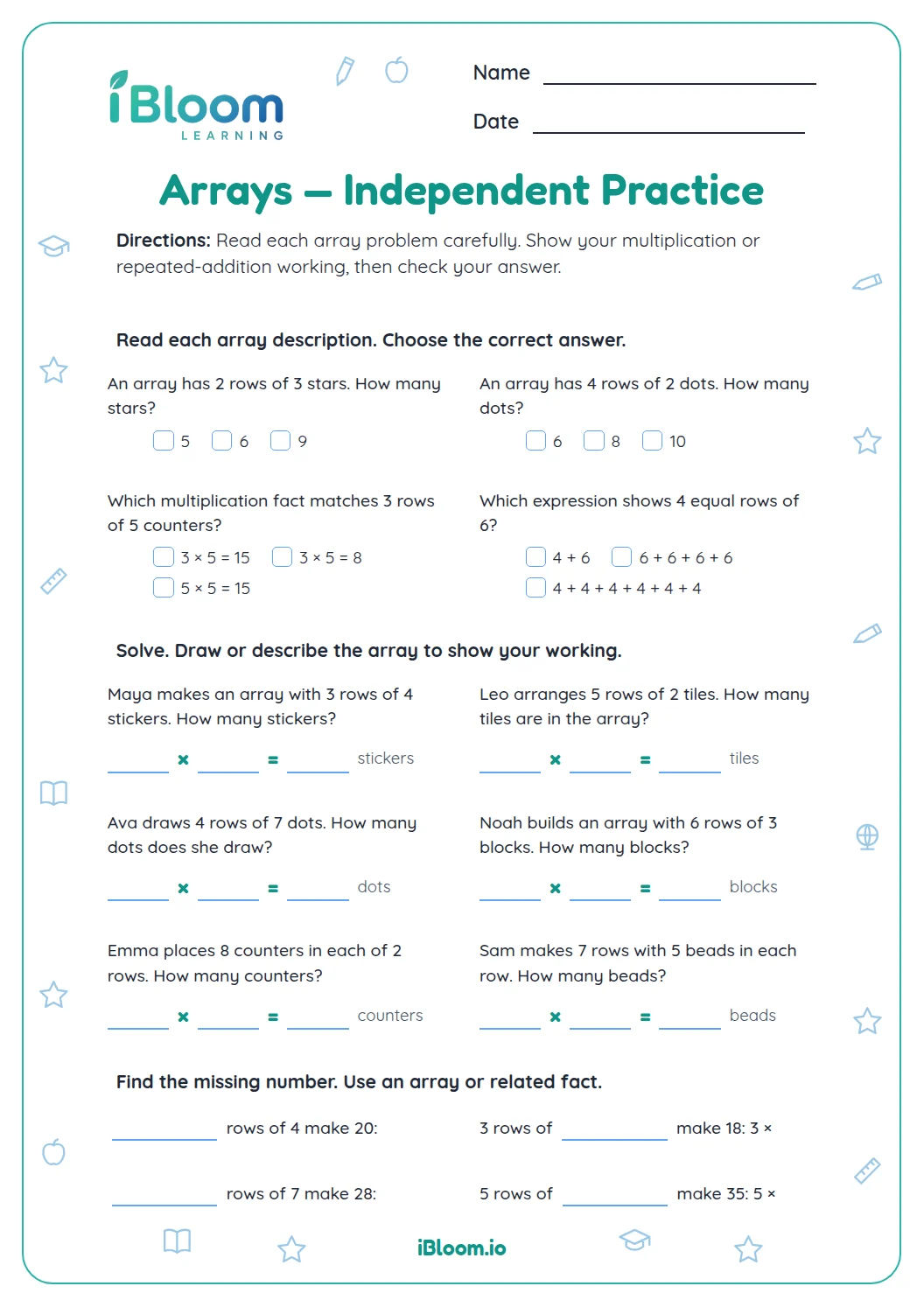
This Grade 3 worksheet uses four pictured arrays, six equal-group questions, and six repeated-addition connections. Children count equal rows and express groups as multiplication. It practices CCSS 3.OA.A.1 by interpreting products as equal groups.
Aligned to 3.OA.A.1
How does an array show multiplication?
An array has equal rows and columns. The row count and the number of objects in each row are the factors. A 3-by-5 array has 3 rows of 5: 5 + 5 + 5 = 15, so 3 × 5 = 15.
For question 1, count 2 rows with 4 objects in each row. The product is 2 × 4 = 8 objects.
How does repeated addition connect?
Each equal addend can stand for one row or group. In 3 + 3 + 3 + 3, there are four groups of three, so the multiplication sentence is 4 × 3 = 12.
Turning an array changes which factor names the rows, but it does not change the total. Three rows of five and five rows of three both contain 15 objects.
Read an array
- 1Count the rows from top to bottom.
- 2Count the objects in one row.
- 3Skip-count by the row size or add equal row sizes.
- 4Write rows × objects in each row = total.
- 5Check the product against the array or repeated addition.
Common mix-ups
The mistake
Multiplying the row count by itself instead of by the objects in each row.
The fix
Read both dimensions: number of rows and number of columns. Multiply those two counts.
The mistake
Counting only the objects in one row as the total.
The fix
Skip-count once for every row, or add the equal row sizes.
The mistake
Writing the column count first when the directions ask for rows first.
The fix
Name the rows, then the objects in each row, and keep that order in the multiplication sentence.
Common Core alignment
This page builds the Grade 3 connection between equal groups, arrays, and multiplication.
Interpret products as equal groups.
On this sheet: Each model has equal rows and asks learners to express its total as a product.
Show the official wordingHide the official wording
Interpret products of whole numbers, e.g., interpret 5 × 7 as the total number of objects in 5 groups of 7 objects each.
What to practice next
Make more practice
Further reading
Questions parents and teachers ask
What does an array show?
An array shows equal groups arranged in rows and columns. Count the rows and the objects in each row, then multiply those two counts. For example, four rows of three dots show 4 × 3, or 12 dots altogether. Each factor names one dimension of the array.
How do I find the total without counting every dot?
Skip-count by the number of objects in one row. For four rows of three, count 3, 6, 9, 12. The last number is the total. You can also add the equal row sizes: 3 + 3 + 3 + 3.
Does turning an array change its total?
No. Turning a 3-by-5 array gives 5 rows of 3 instead of 3 rows of 5, but both arrangements contain 15 objects. This is why 3 × 5 and 5 × 3 have the same product. This is the commutative property of multiplication.
What order should I use in a multiplication sentence?
Use the number of rows first and the number of objects in each row second. Then write the total after the equals sign. A 6-row array with 4 in every row can be recorded as 6 × 4 = 24.
What does each factor mean in these questions?
For an equal-row array, the first factor tells how many rows there are. The second tells how many objects are in each row. In a 4-row array with 9 objects per row, 4 × 9 = 36. The product is the total number of objects.