



About this worksheet
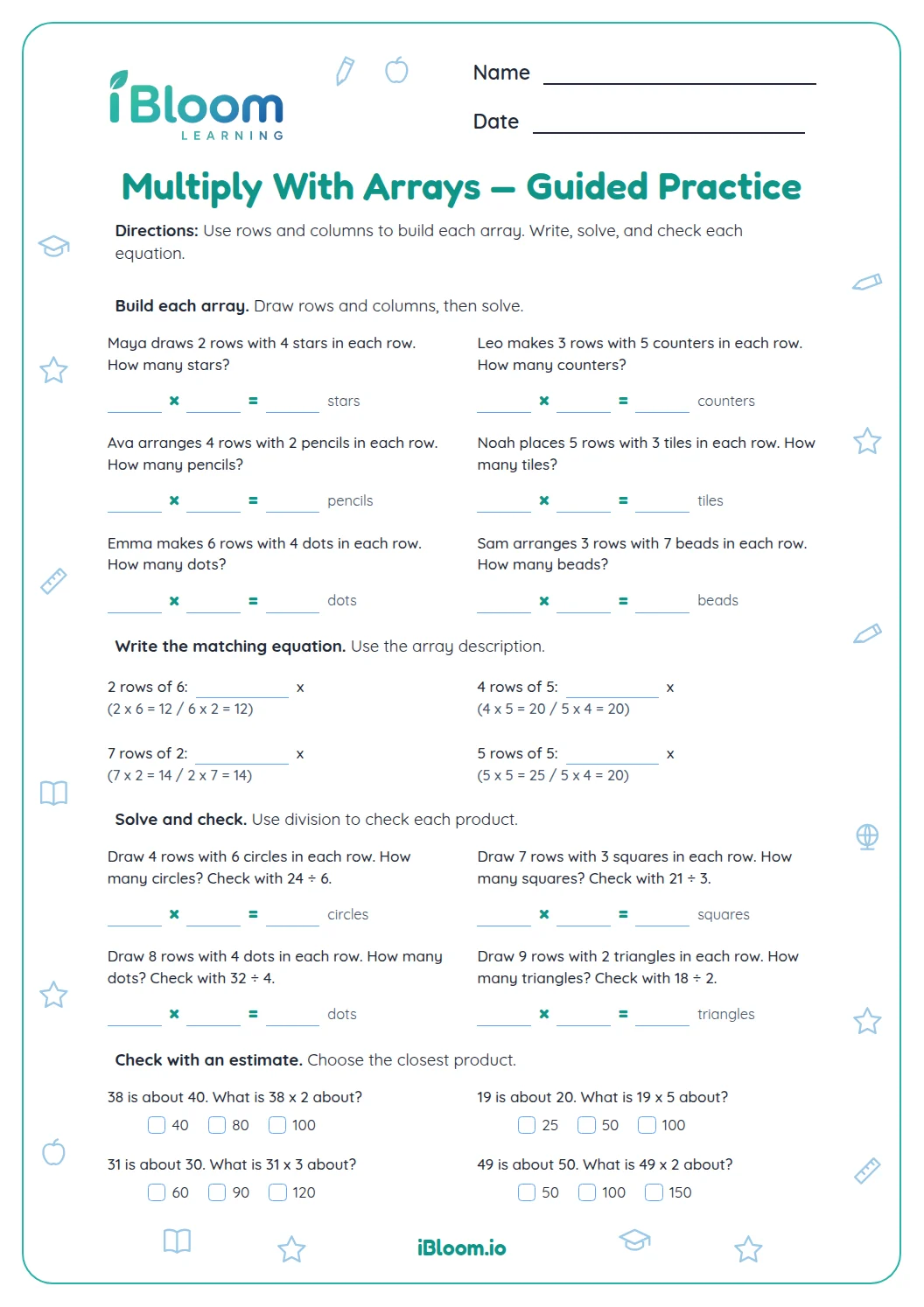
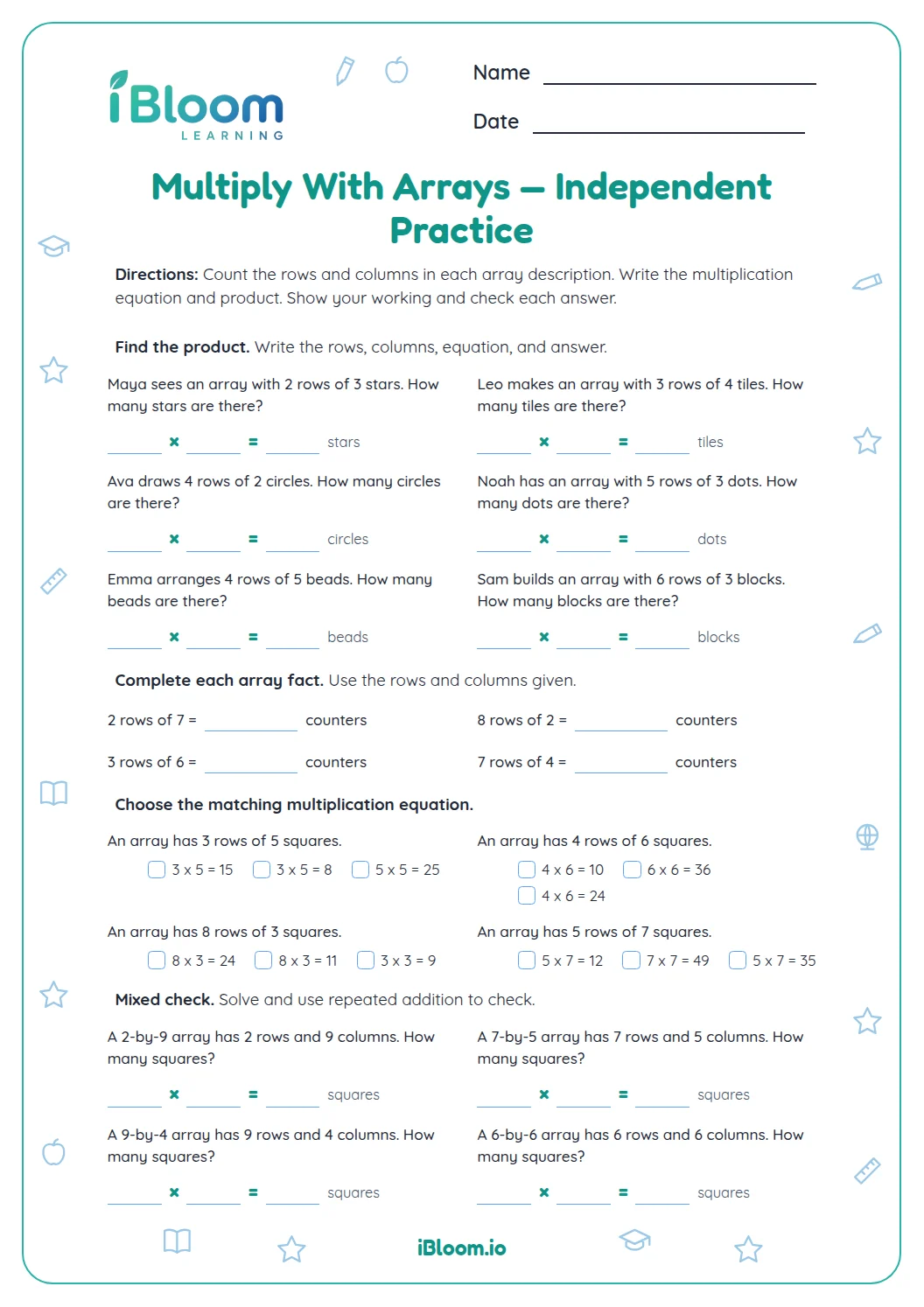
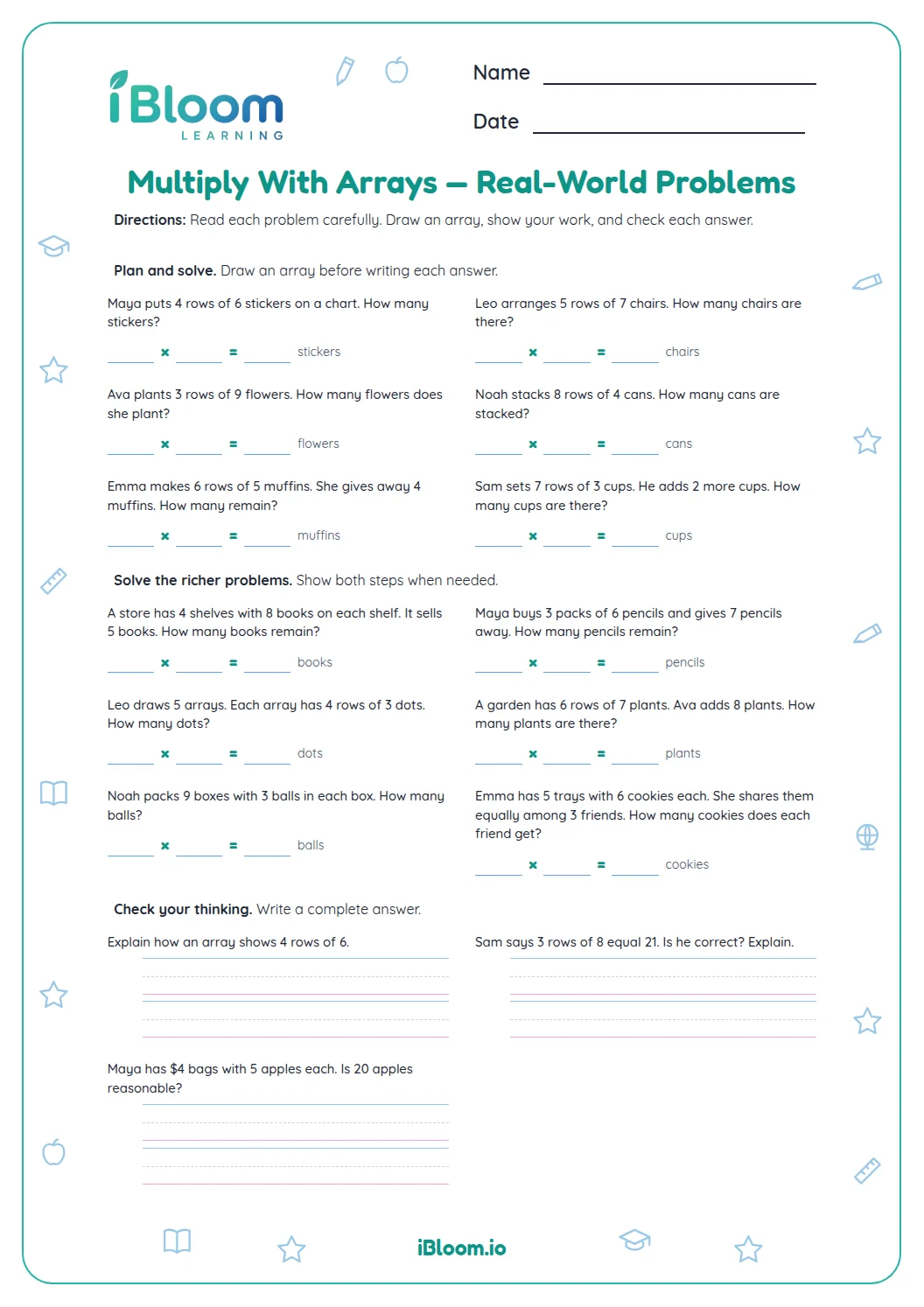
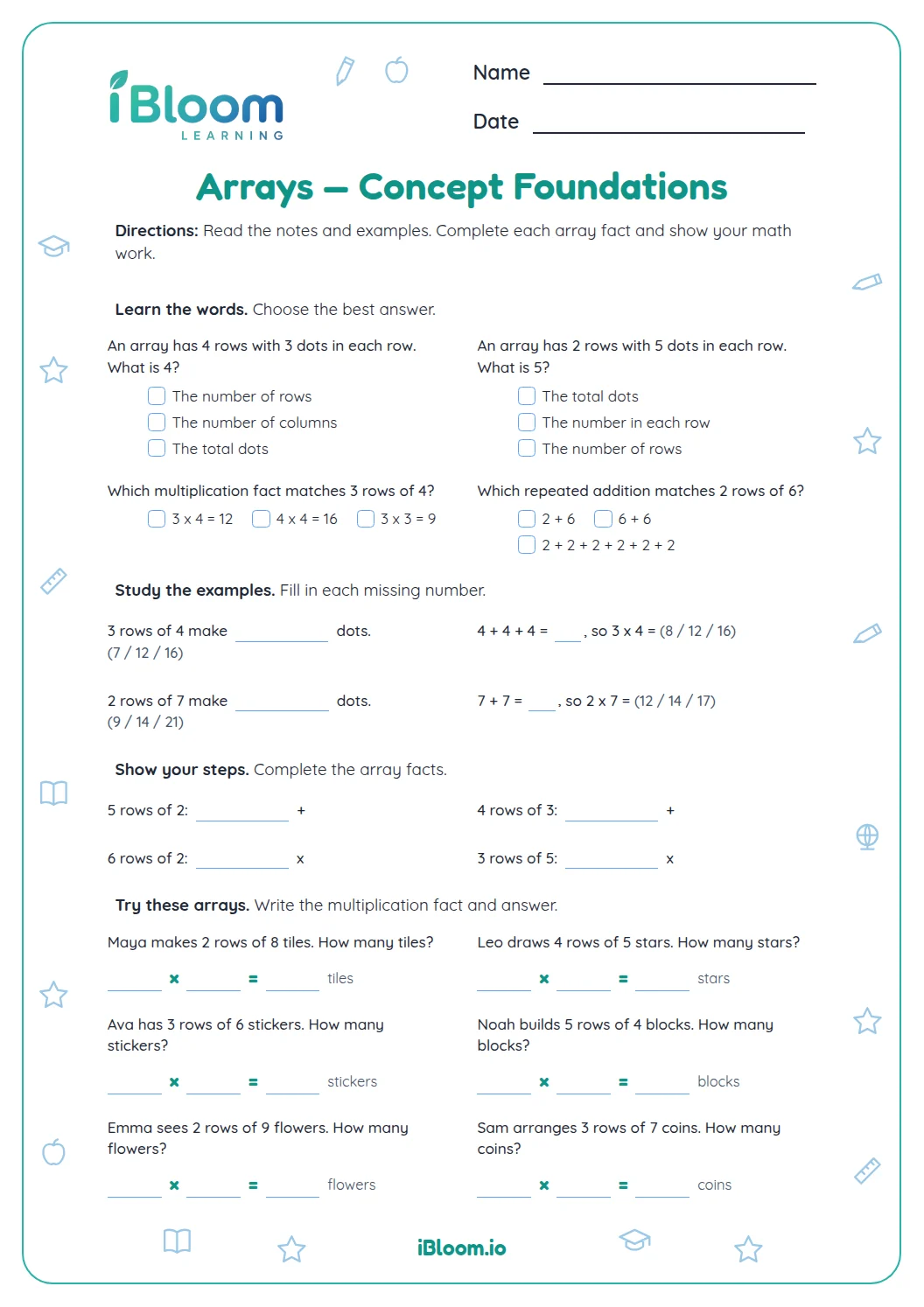
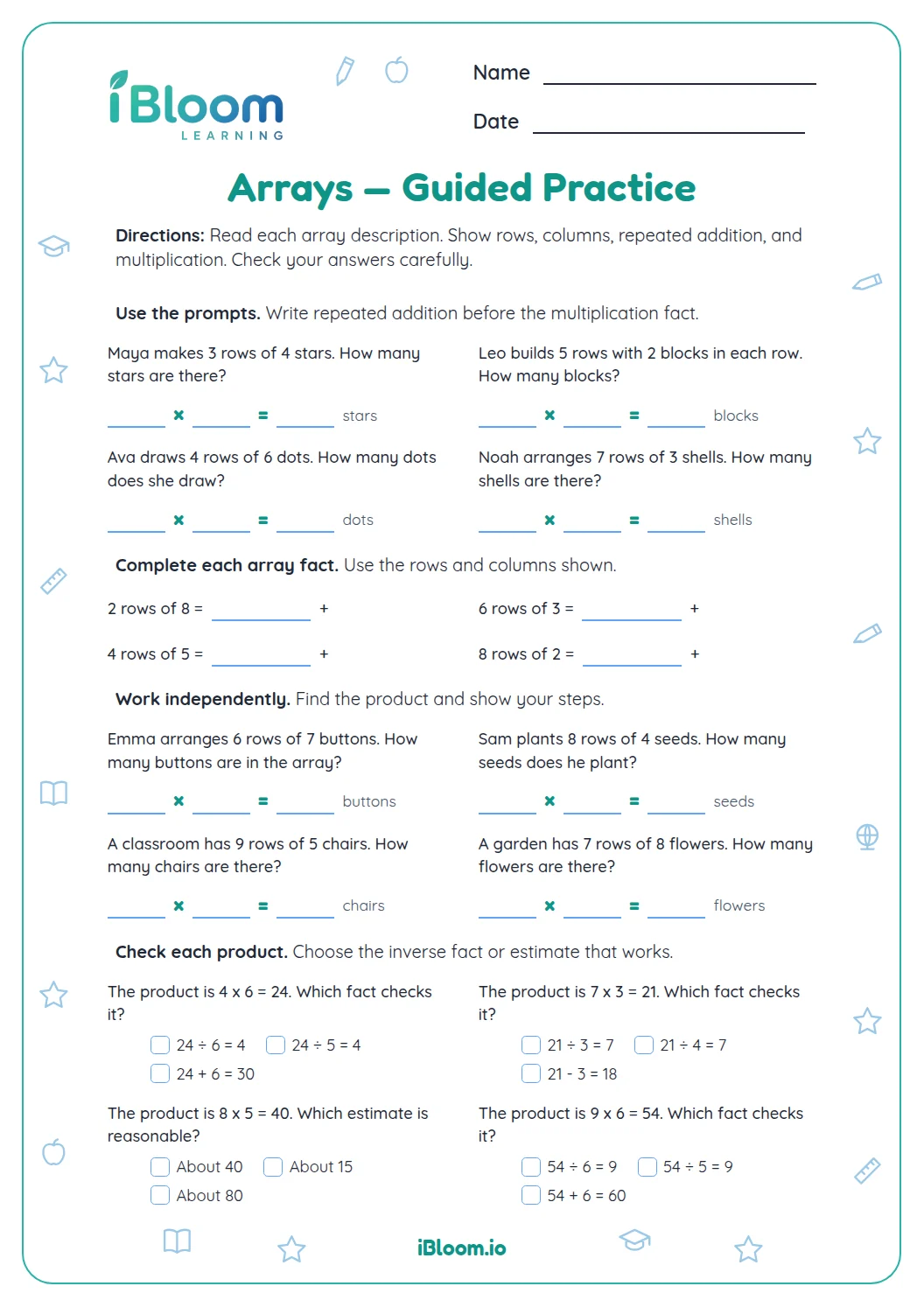
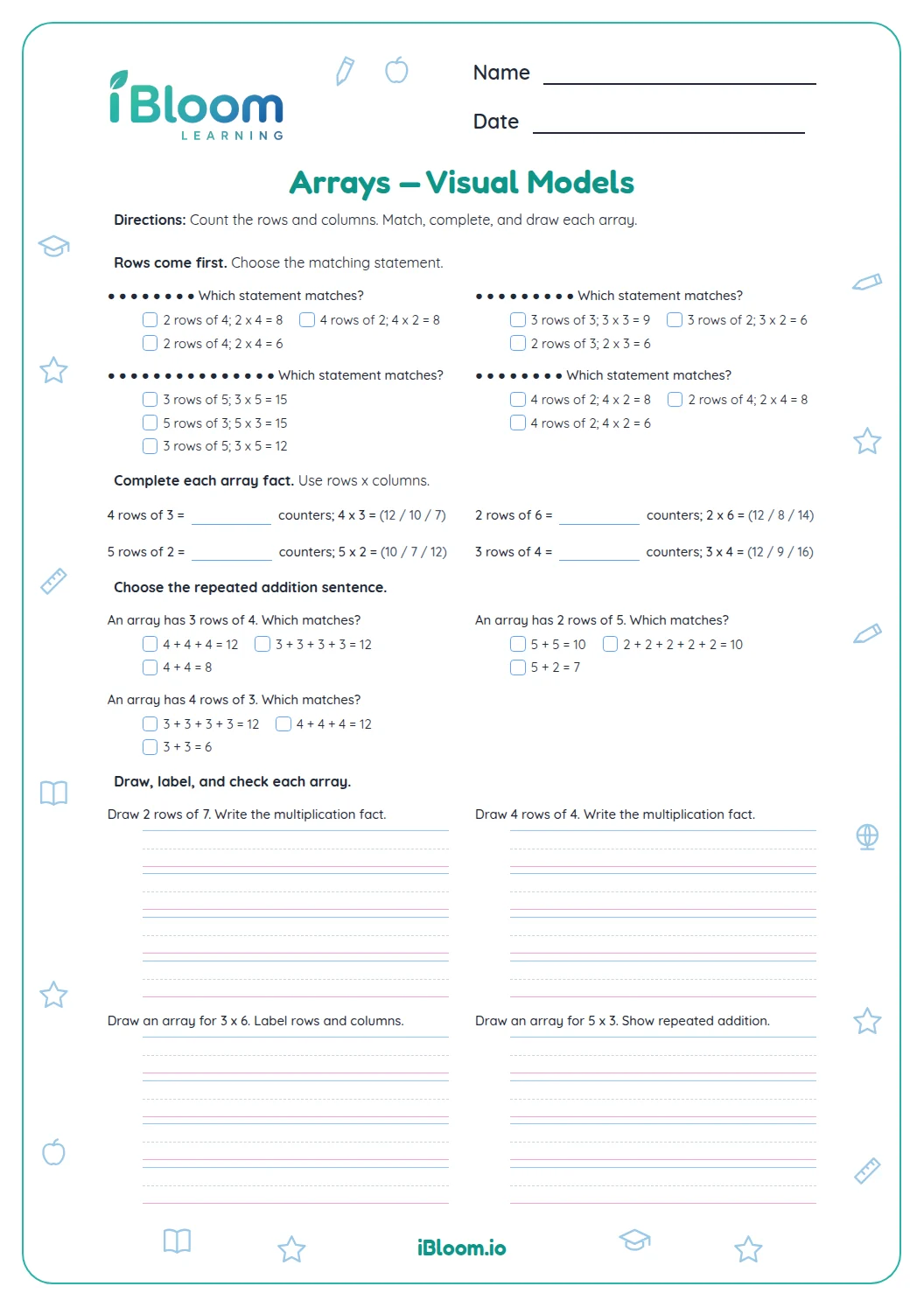
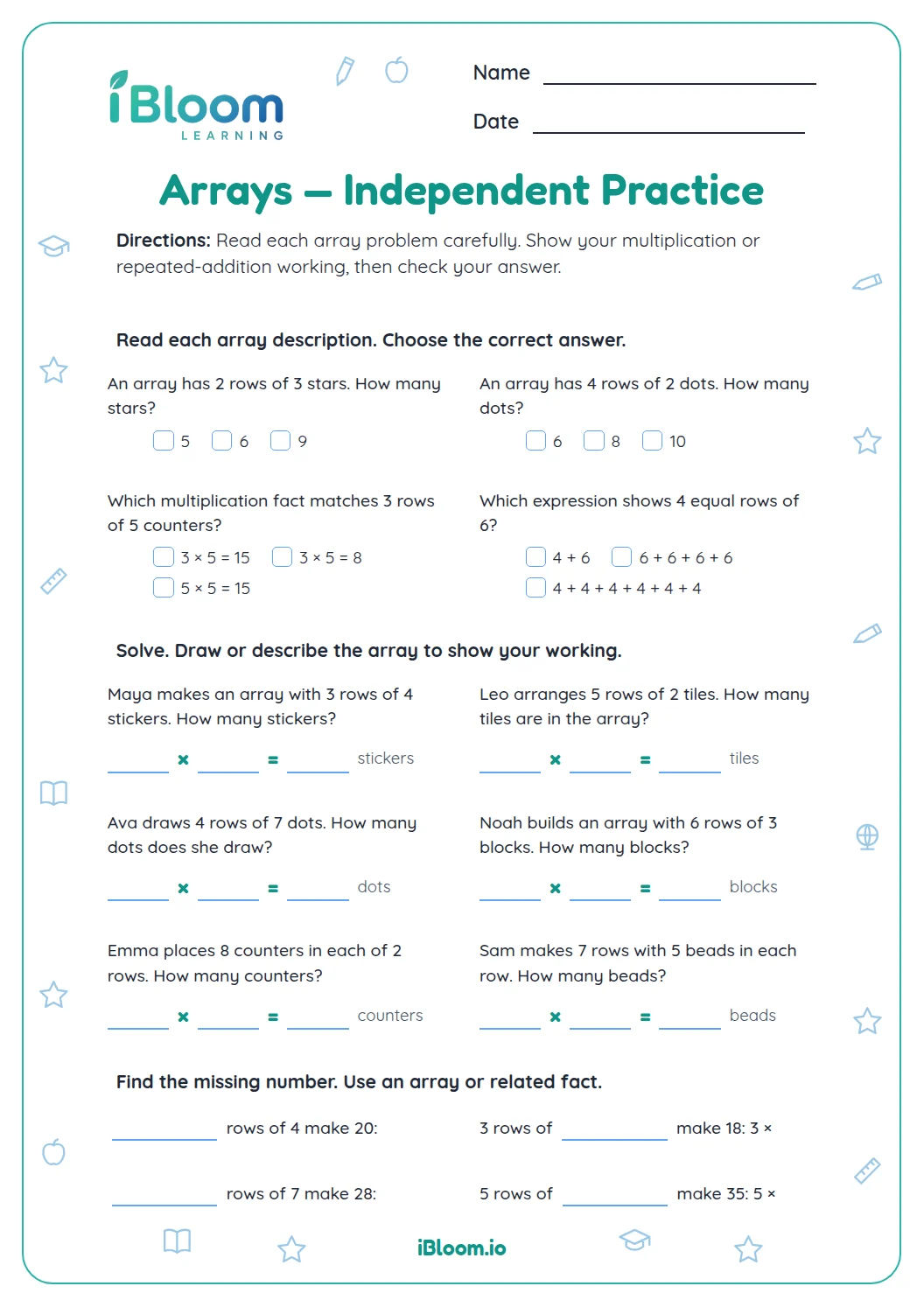
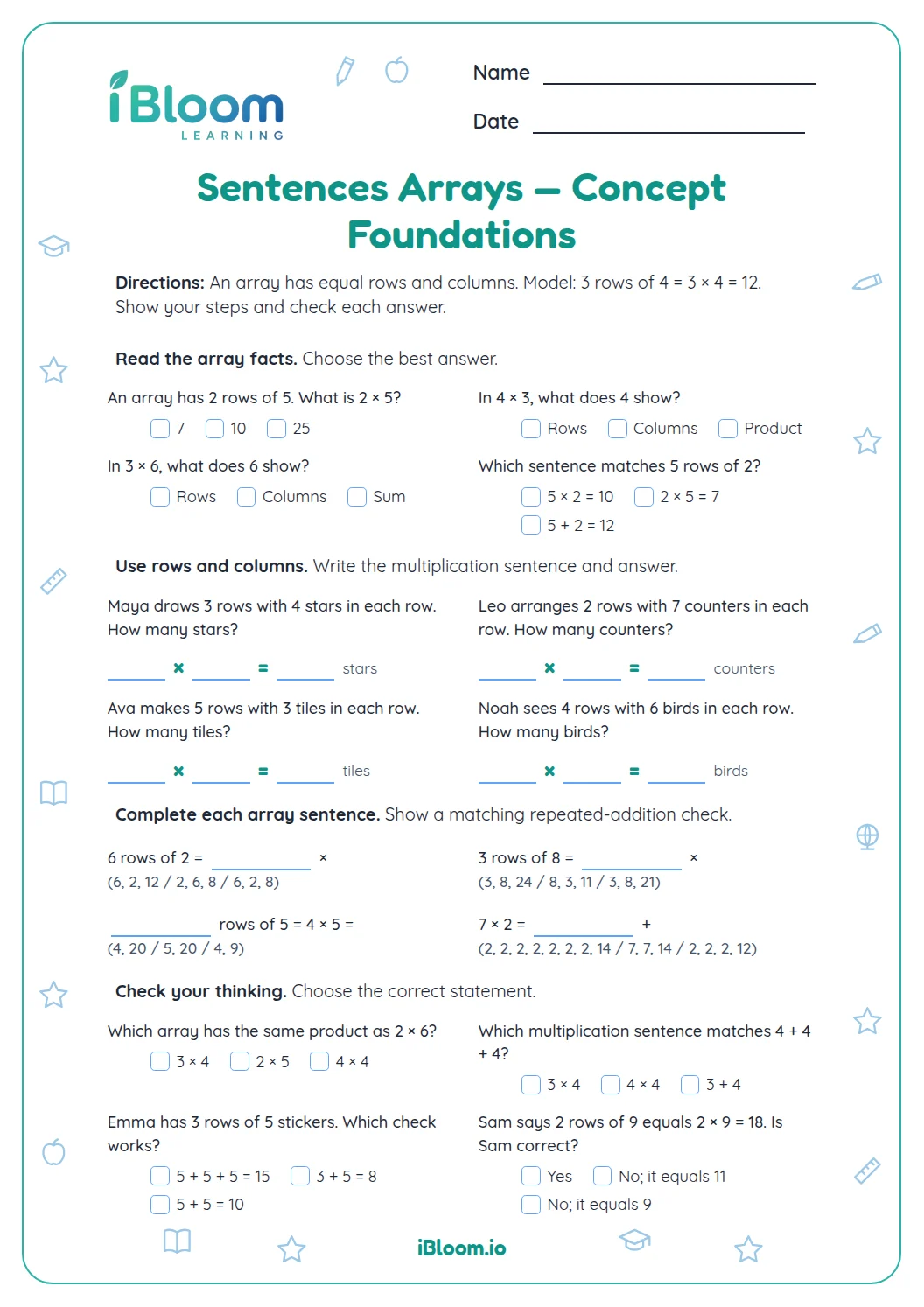
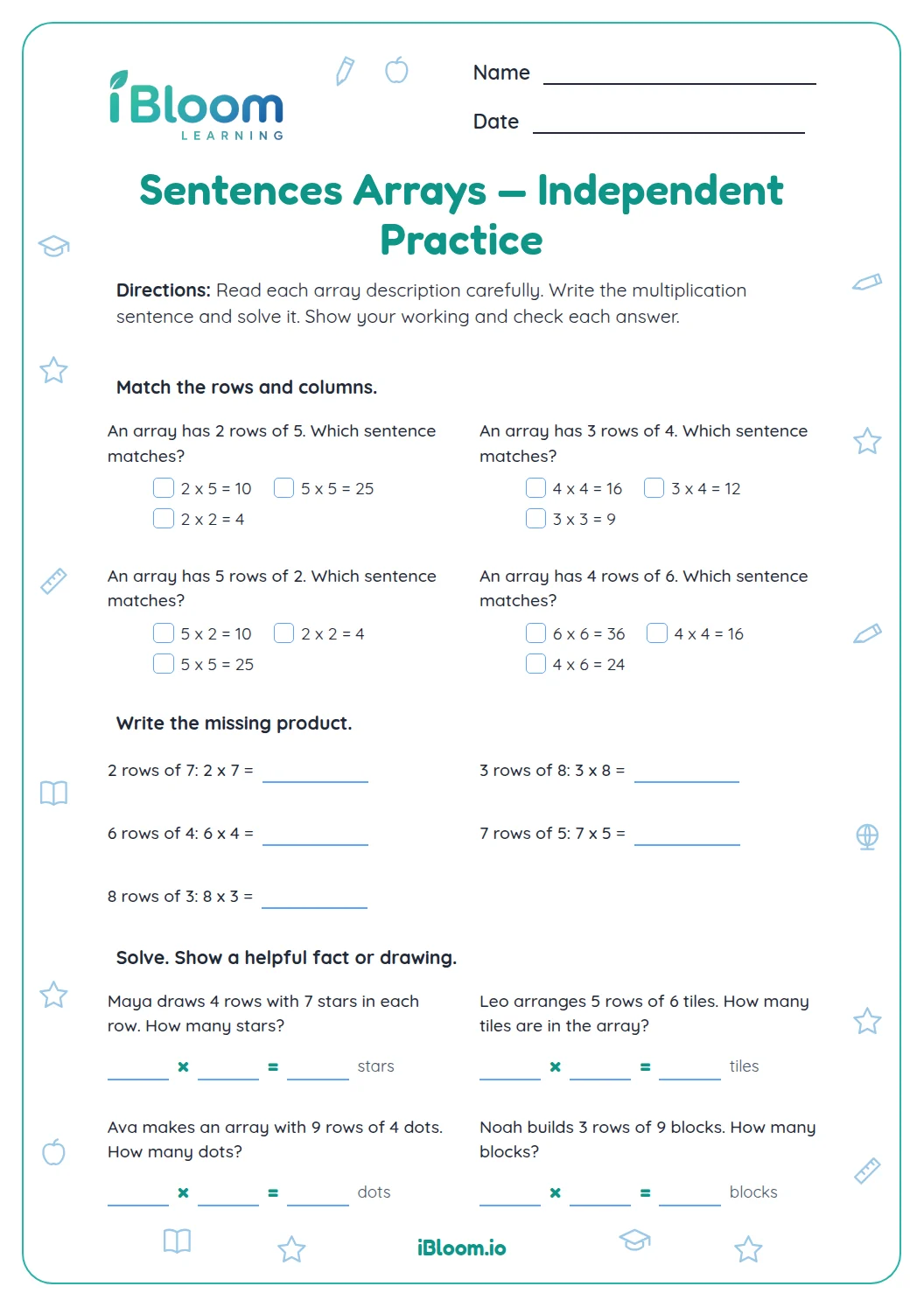
This Grade 3 worksheet uses drawn arrays to connect equal groups with multiplication. Students count dots, identify rows and columns, write equations, and name products across 16 questions. A separate answer key is included. The work practices CCSS 3.OA.A.1.
Aligned to 3.OA.A.1
How can I read an array?
Count the rows and the number of dots in each row. Because each row has the same number, multiplication gives the total without counting every dot one by one.
- 13 rows with 4 dots in each row
- 23 × 4 = 12 dots
Can I turn an array around?
A turned array has the same total but switches the row and column counts. For example, 3 rows of 4 and 4 rows of 3 both show 12 dots. Say which count is rows when you write the equation.
How to use this worksheet
- 1Count the equal rows in the array.
- 2Count the dots in one row.
- 3Write rows × dots in each row.
- 4Solve to find the total.
- 5Check by skip-counting the rows.
Common mistakes and quick fixes
The mistake
Reversing rows and columns in a description.
The fix
Rows go across; columns go up and down.
The mistake
Writing the number of rows as the product.
The fix
Multiply rows by the number of dots in each row.
The mistake
Counting a dot twice while recounting.
The fix
Count one complete row at a time, then multiply.
Common Core alignment
This page practices CCSS 3.OA.A.1 through the questions on the worksheet.
Read rows and columns as equal groups and connect them to a product.
On this sheet: Read rows and columns as equal groups and connect them to a product.
Show the official wordingHide the official wording
Interpret products of whole numbers, e.g., interpret 5 × 7 as the total number of objects in 5 groups of 7 objects each.
What to practice next
Make more practice
Further reading
Questions parents and teachers ask
What is an array?
An array is an organized set of objects in equal rows and columns. Students use the number of rows and the number in each row to write a multiplication equation and find the total. Every model on this worksheet is drawn with equal groups.
How many questions are included?
There are 16 questions, and every item includes a drawn array. Some ask for the total, while others ask students to describe rows and columns or record the matching multiplication equation. The key identifies the product or equation for each drawing.
What does rows times columns mean?
It counts equal groups. The row count tells how many groups there are, and the column count tells how many objects are in each group. Their product is the total shown by the array. Students can also turn the array and notice the same total.
Do turned arrays have the same product?
Yes. Turning an array swaps its row and column counts but keeps the same number of objects. For instance, 3 rows of 4 and 4 rows of 3 both have 12 objects. Name the rows and columns clearly when writing an equation.
What should I do if my child counts each dot?
Counting each dot is a useful way to check. Then have your child count one row and use that amount for every row, connecting the repeated groups to multiplication. This builds a bridge from counting objects to understanding a product.
Is the answer key separate?
Yes. The answer key is separate from the worksheet and lists the matching product, equation, or row and column description for each array. Students can use it to check after they have recorded their own work. This gives students another chance to explain their reasoning clearly.