



About this worksheet
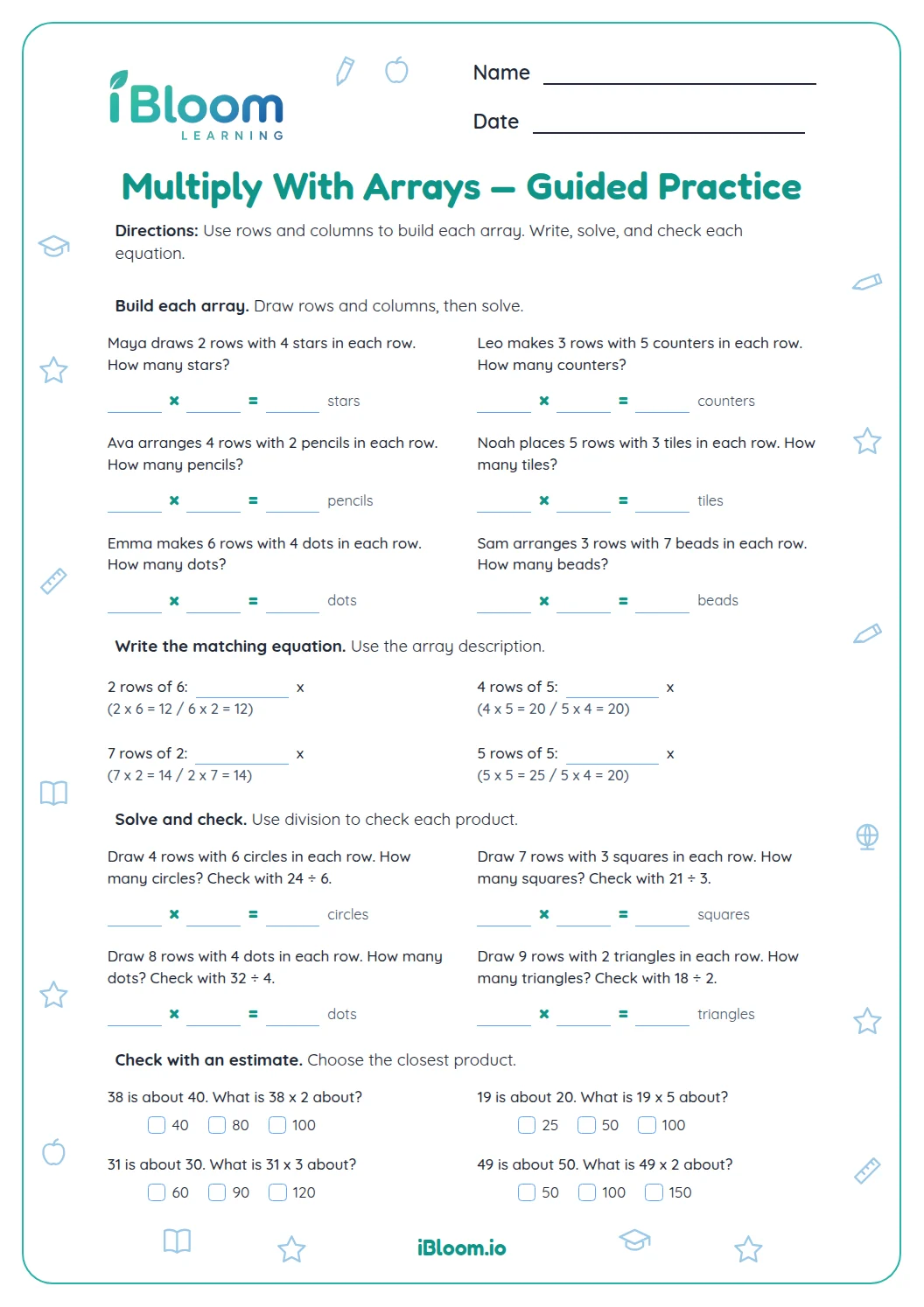
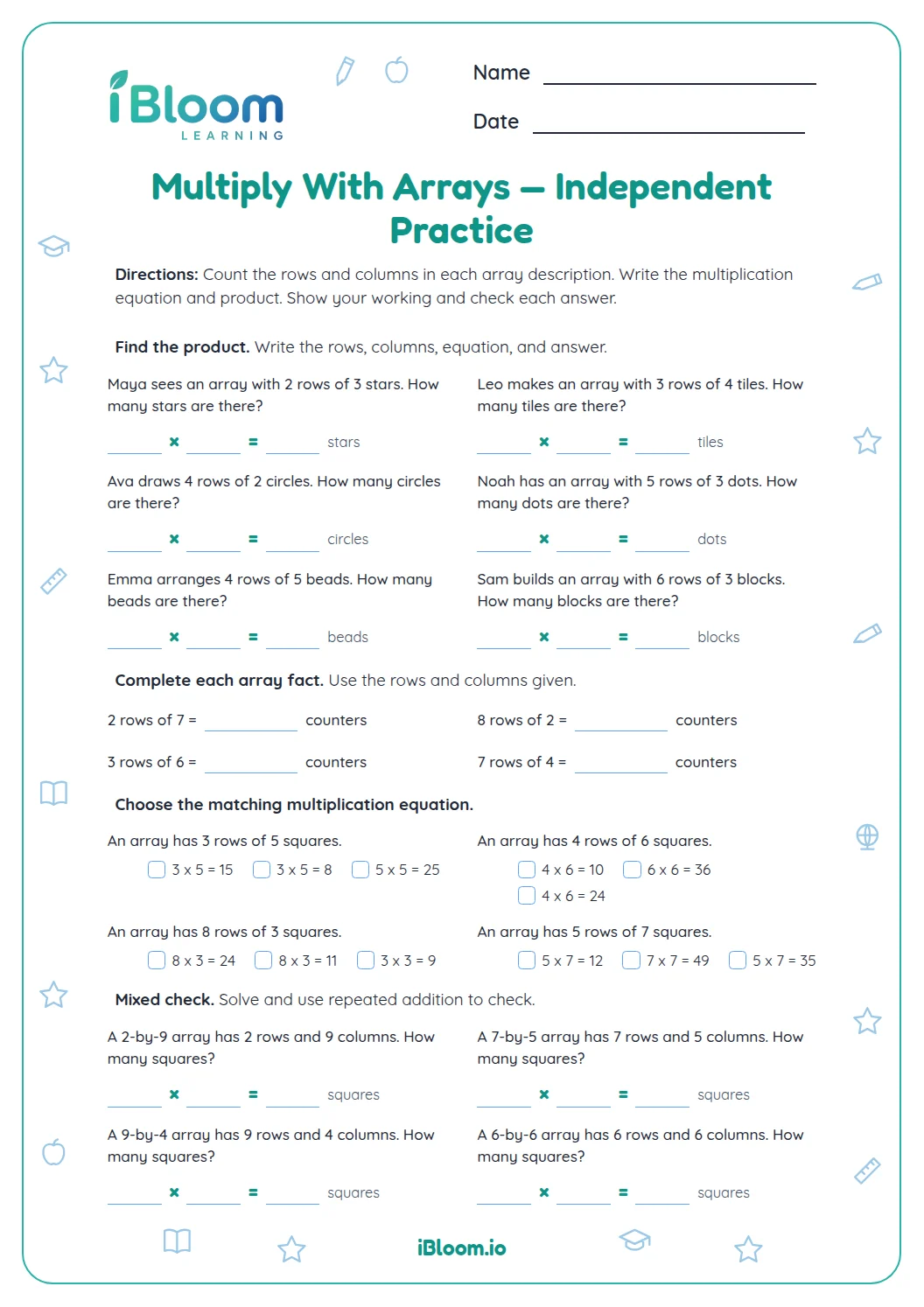
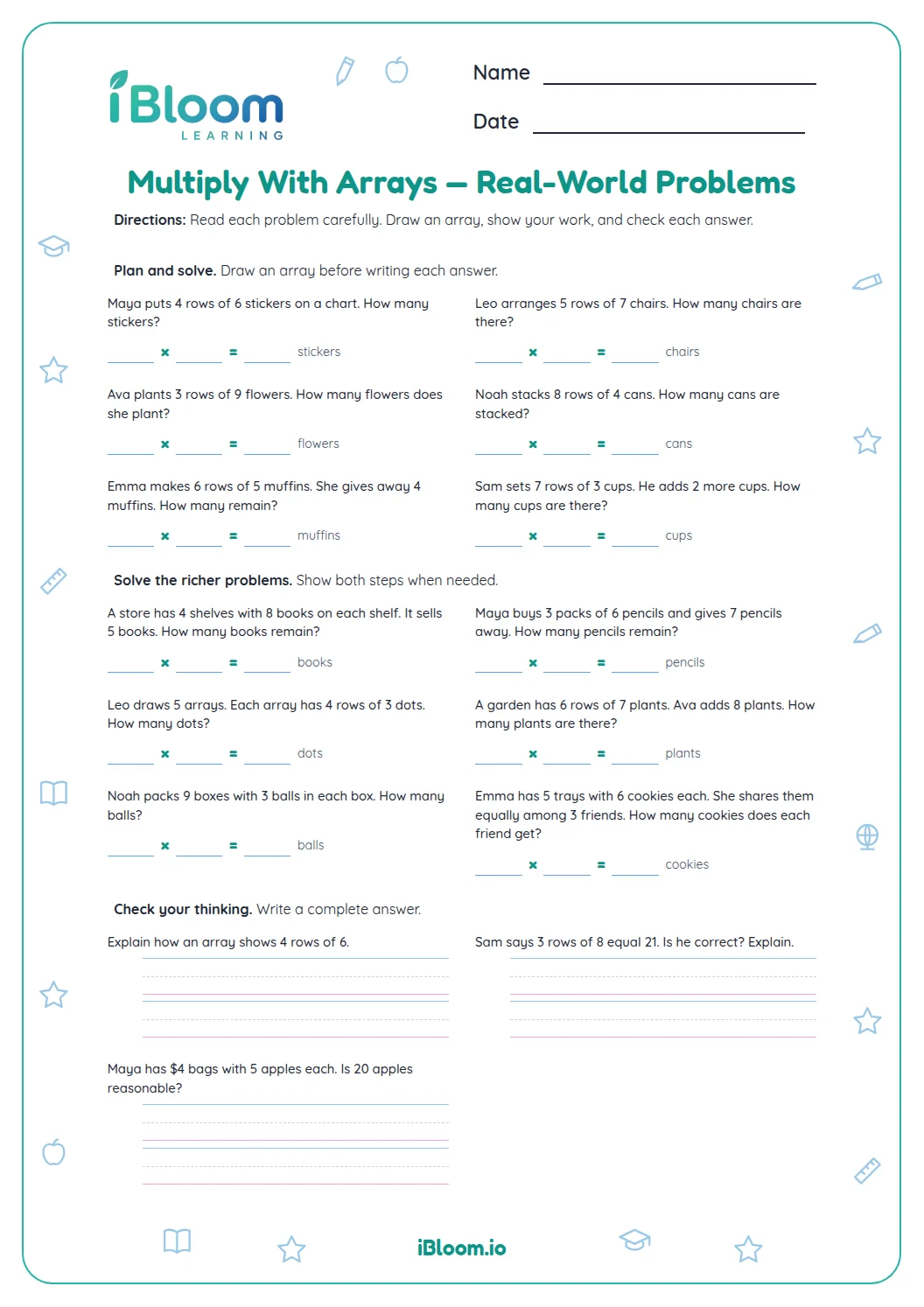
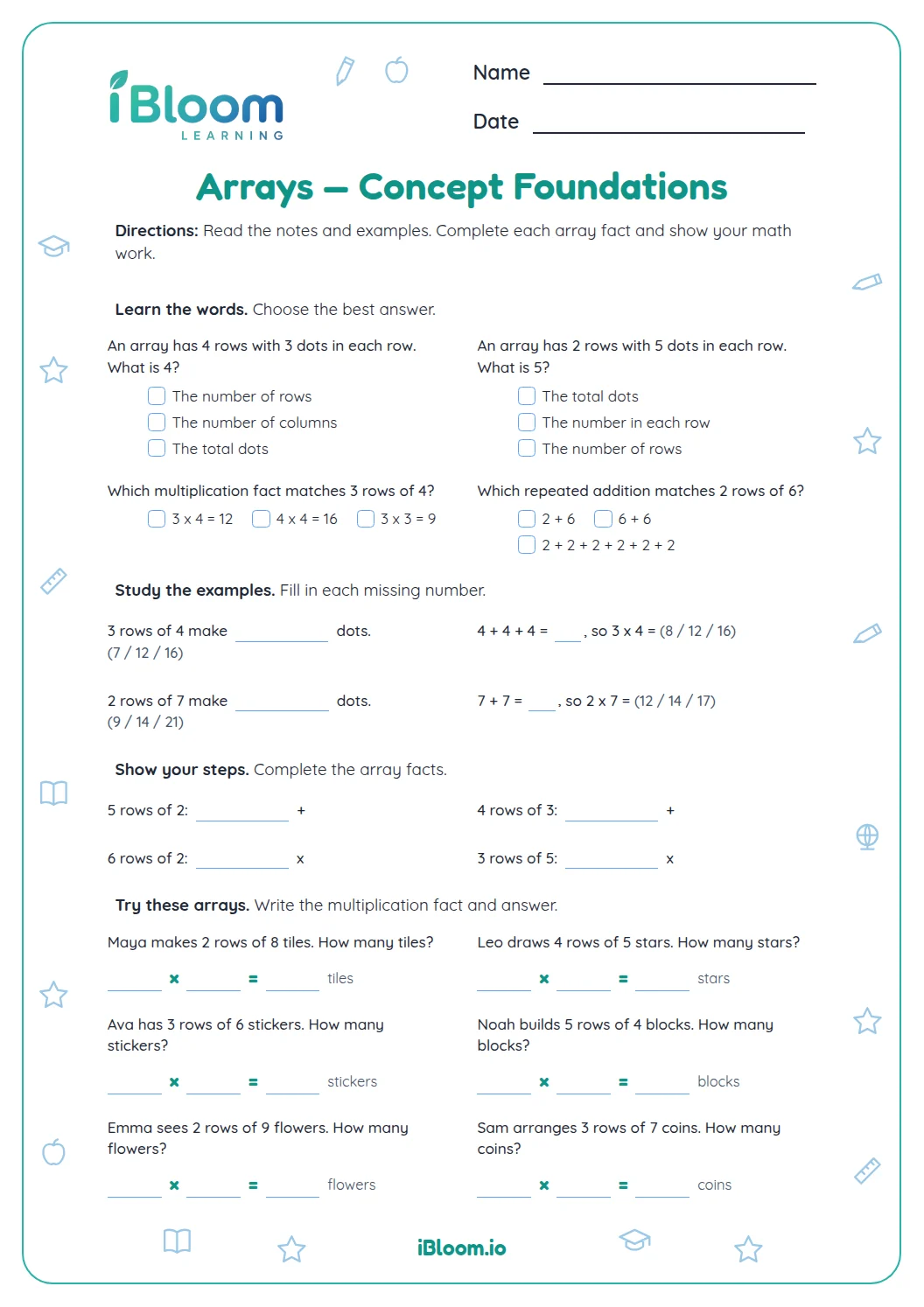
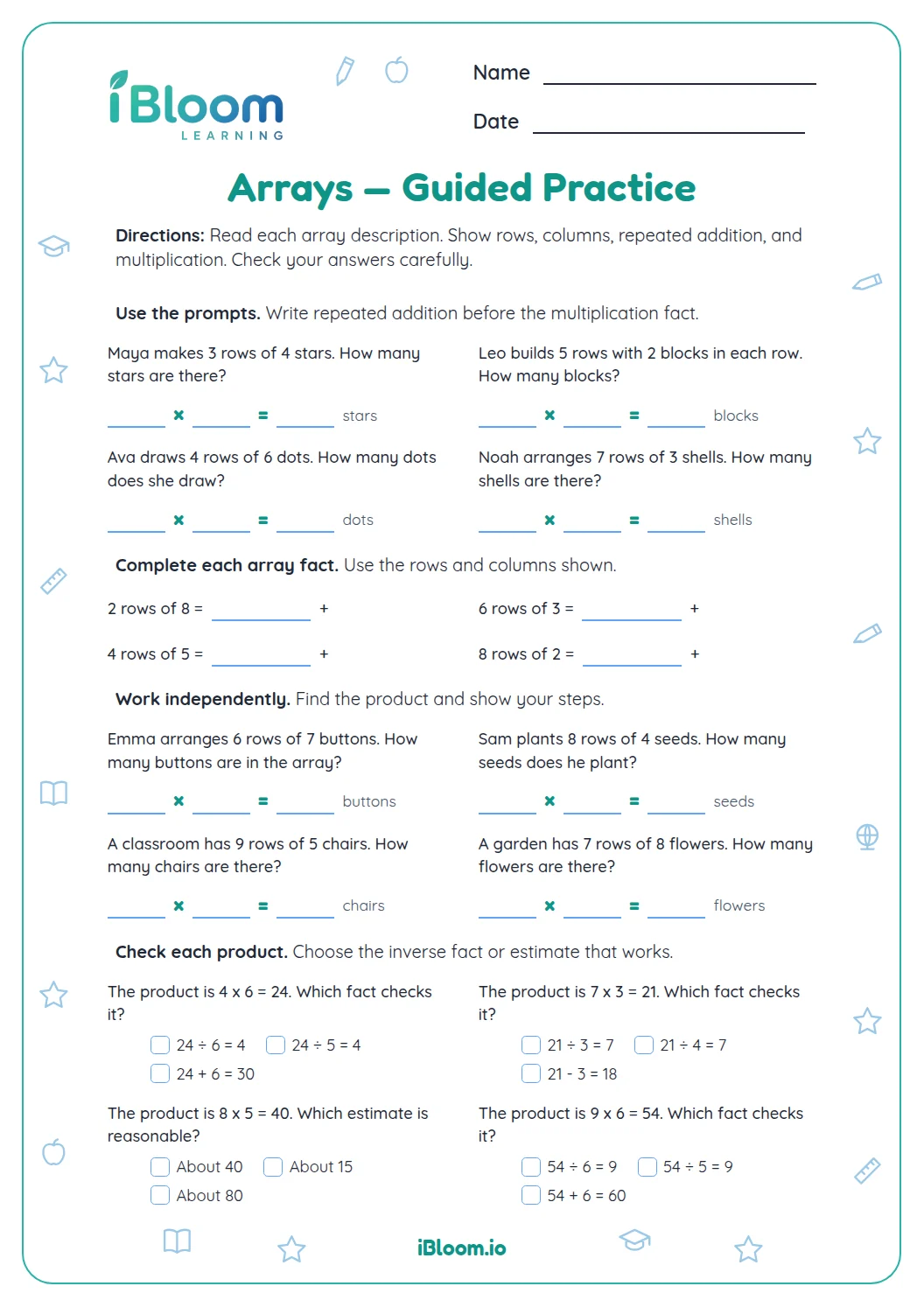
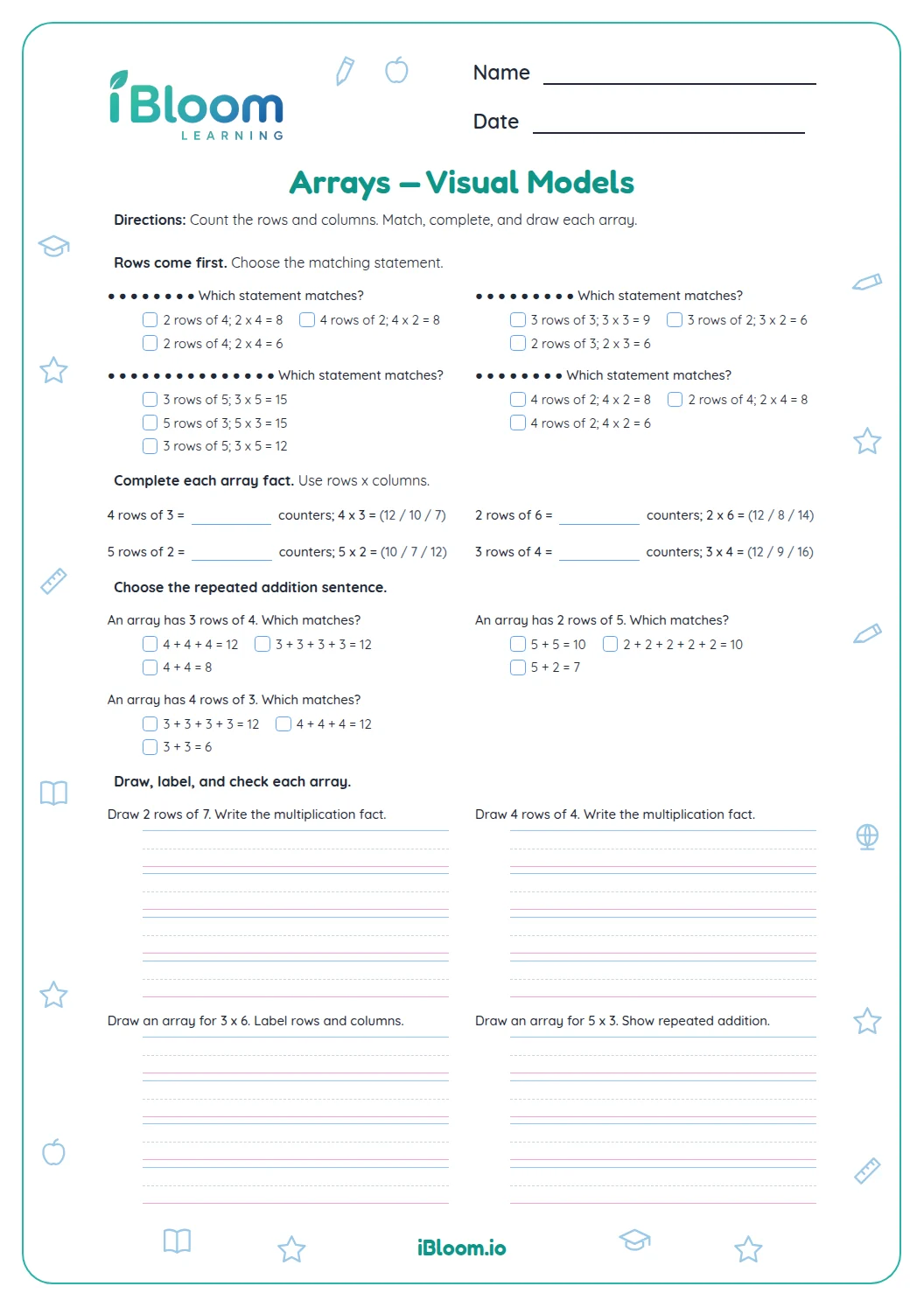
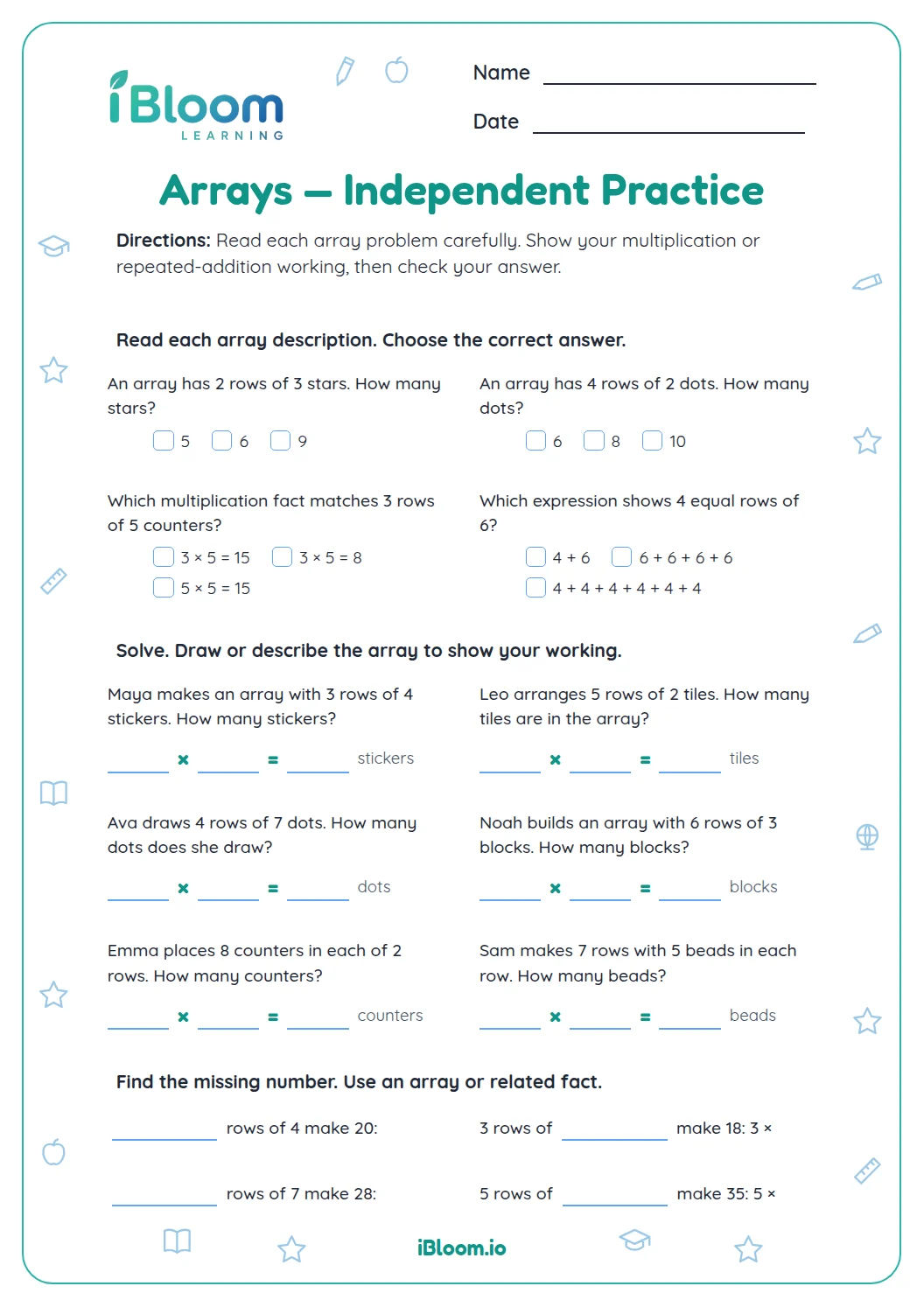
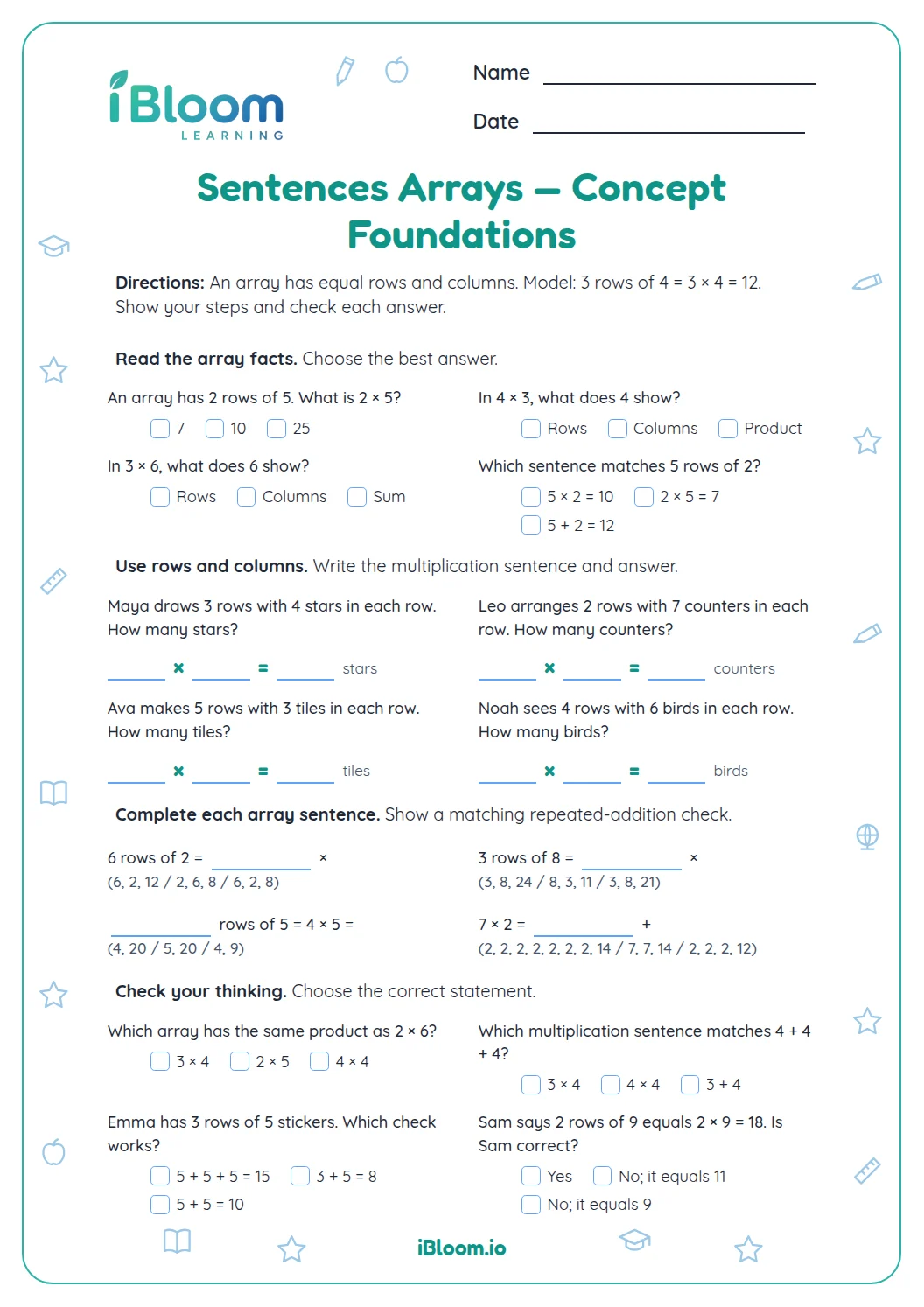
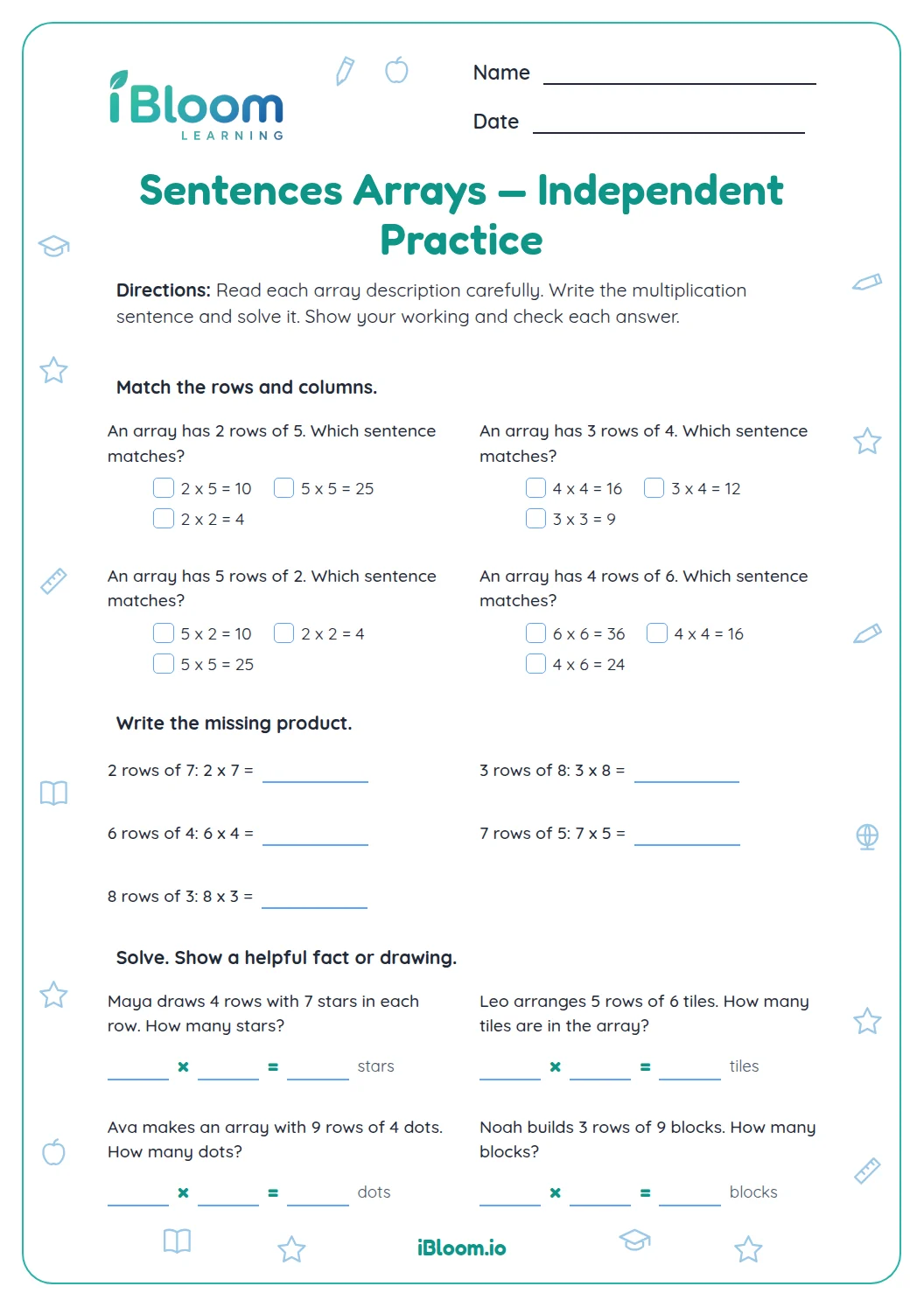
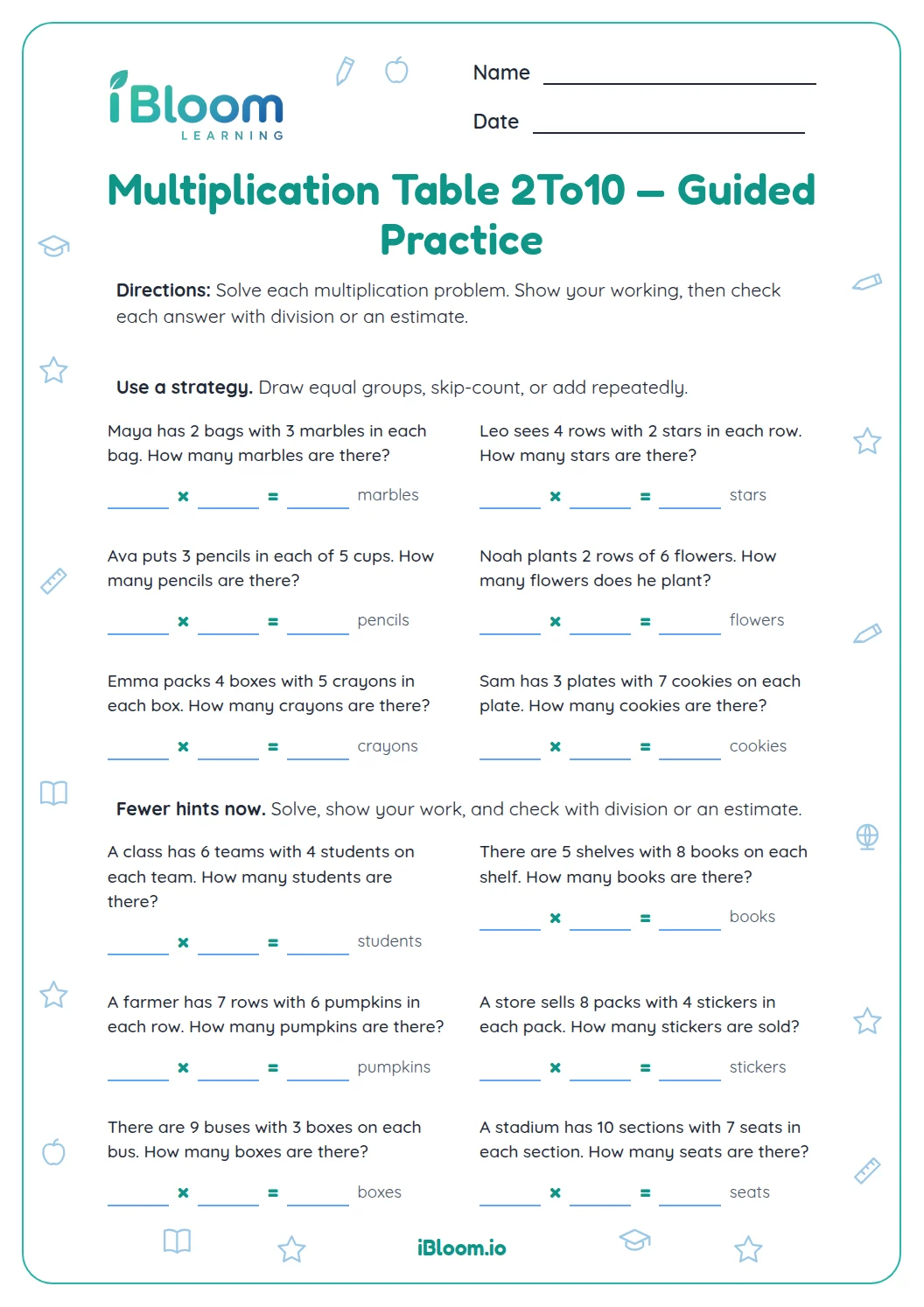
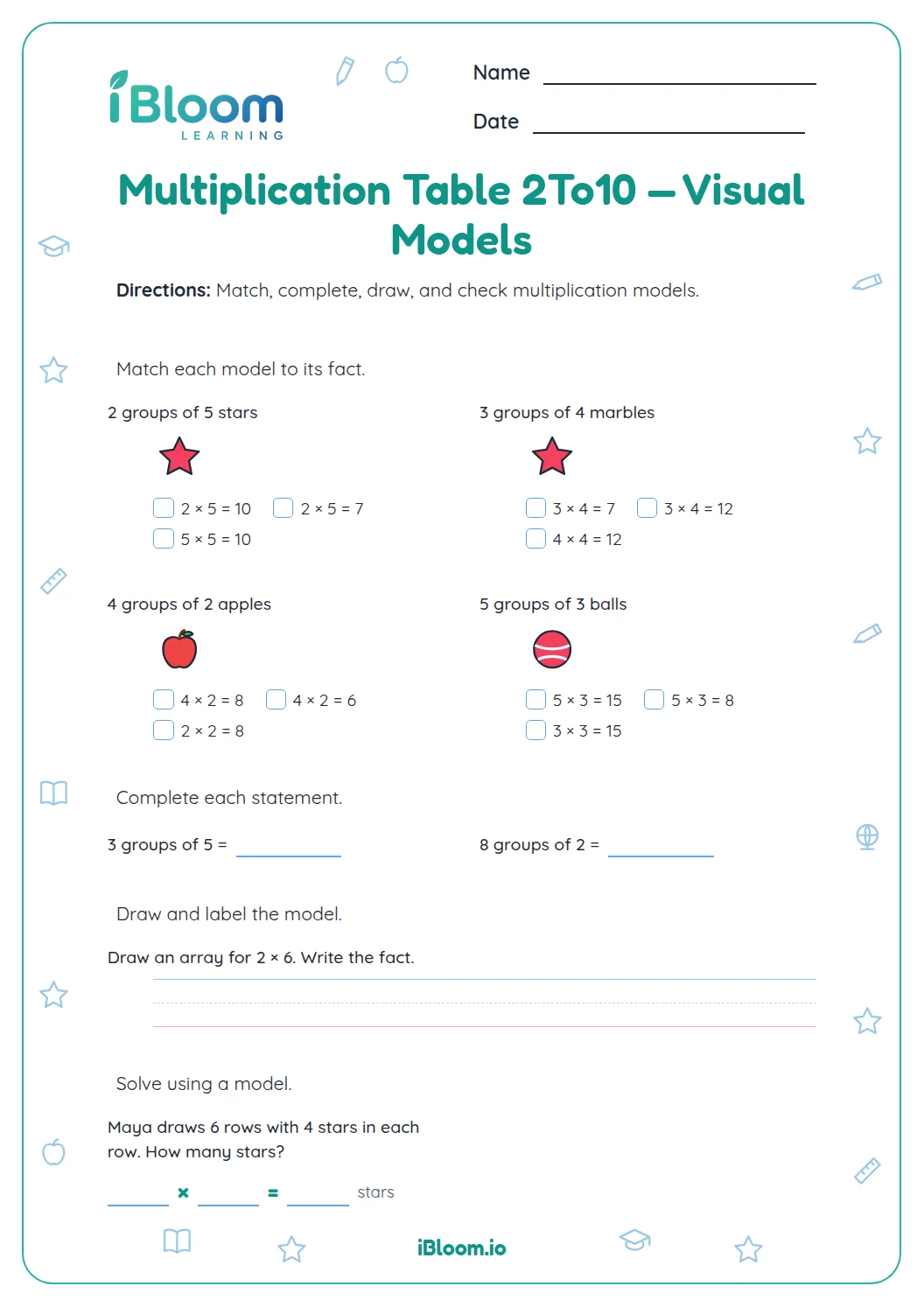
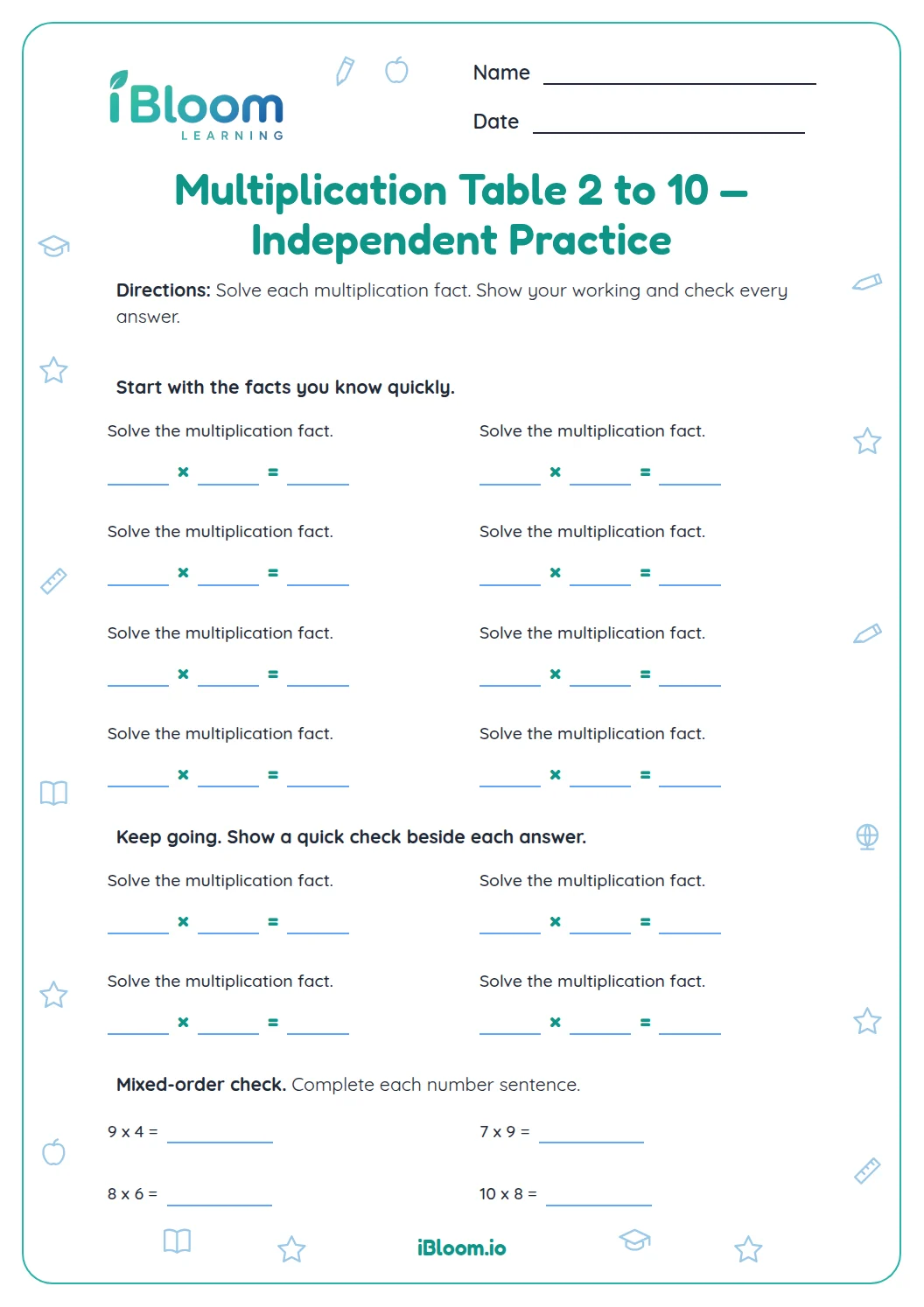
This free Grade 3 math worksheet asks children to use arrays to make multiplication visible. Part A counts dots in arrays; Part B chooses matching products, Part C completes multiplication facts, and Part D reasons about equal groups. The answer key lists the correct products and choices. The practice aligns with CCSS 3.OA.A.1, interpreting a product as the total in equal groups.
Aligned to 3.OA.A.1
How do you read rows and columns?
Count the horizontal rows and the objects in each row. Part A uses small dot arrays; multiply the number of rows by the number in each row.
- 1Three rows of five dots: 3 × 5
- 2There are 15 dots in all.
How do you write an array equation?
Part B asks children to match row and column counts to a product. In Part C, each number sentence gives the factors and leaves the product blank.
How can arrays support reasoning?
Part D asks children to select equations and products that represent equal groups, including a related-fact strategy.
How can I use this worksheet?
- 1Count the rows first, then count objects in one row.
- 2Write rows × objects per row as a multiplication equation.
- 3For each number sentence, multiply the two factors and write the product in the blank.
- 4Use the rows and columns named in Part D to find the matching product.
- 5Explain the relationship in Part D with a complete thought.
What mistakes should I watch for?
The mistake
Adding rows and columns instead of multiplying.
The fix
Think of the same number repeated once for each row.
The mistake
Reversing a row count and group size without naming either.
The fix
Label the factors as rows and objects in each row.
The mistake
Giving the number of rows as the product.
The fix
Count all objects or multiply the two array dimensions.
Common Core alignment
The array pictures make equal groups visible while children connect them to multiplication equations and products.
Interpret arrays as equal groups and write a product for them.
On this sheet: Questions use rows and columns to represent multiplication and reason about equal groups.
Show the official wordingHide the official wording
Interpret products of whole numbers, e.g., interpret 5 × 7 as the total number of objects in 5 groups of 7 objects each. For example, describe a context in which a total number of objects can be expressed as 5 × 7.
What to practice next
Make more practice
Further reading
Questions parents and teachers ask
What is a multiplication array?
An array is an arrangement in equal rows and columns. Three rows of five dots show 3 × 5, or 15 dots total. On this worksheet, children count two dot arrays, connect row counts to multiplication, complete facts, and use related facts to reason about products.
How many questions are on the worksheet?
There are 14 questions in four parts: two array counts, two product choices, four multiplication facts, and six reasoning choices. The worksheet and answer key each have two pages. Every key response is a number, equation, or selected choice that matches the drawing or prompt.
Does the worksheet include word problems?
No, it uses arrays, multiplication facts, and equal-group language instead of story problems. Children count dots, choose a matching product, fill in four facts, and select equations or related facts that fit. This keeps the practice focused on interpreting arrays and connecting them to multiplication.
How can I support a child who is stuck?
Ask the child to point to each row and count how many objects are in one row. Then count the rows and write the row count and group size as factors. Skip-counting by the group size can check the product; for 3 rows of 5, count 5, 10, 15.
What does 3.OA.A.1 mean?
This Common Core standard asks students to interpret a product as a total number of objects in equal groups. The worksheet practices that idea with dot arrays, row-and-column language, matching equations, and related multiplication facts. For example, 4 rows of 3 dots make 12 dots altogether.
How long should the worksheet take?
Allow about 15 to 20 minutes for the 14 questions. Counting the two arrays and completing the four facts may go quickly, while the final reasoning choices call for more thought. Children can pause after a part, then use the separate two-page answer key to check their work.