





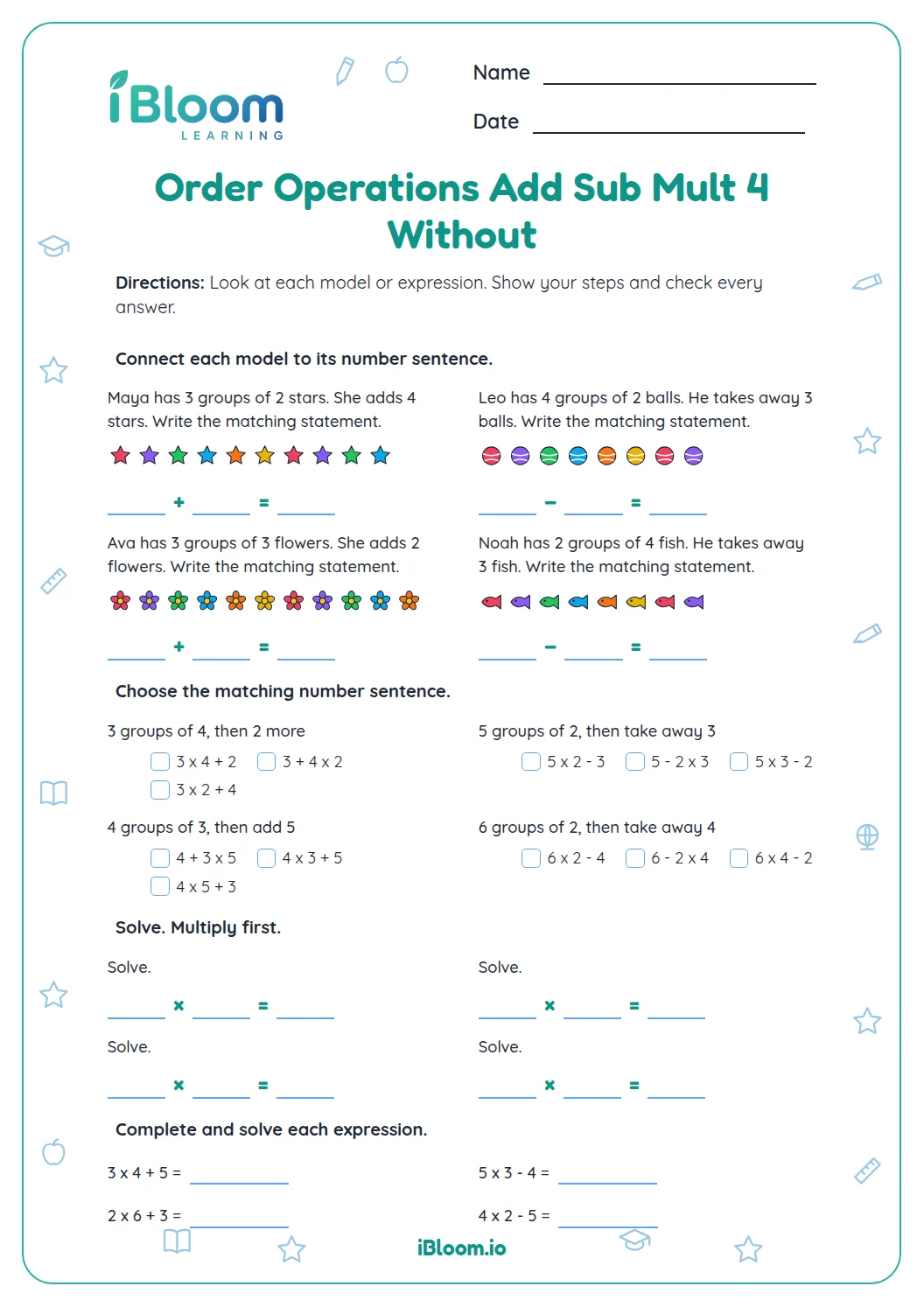

About this worksheet
This Grade 3 worksheet practices two-step real-world problems that combine multiplication with addition or subtraction. Students find equal groups first, then use the story to decide whether to add more or subtract an amount. The problems support CCSS 3.OA.D.8 by asking learners to represent and solve two-step situations with equations and check whether an answer is reasonable. A separate key gives the total with its unit.
Aligned to 3.OA.D.8
How can a student find the two steps?
Mark the equal groups first: how many groups and how many in each group? Then look for what happens next. If more are added, add; if some are used or given away, subtract.
- 14 × 6 + 9 = 33 crayons
- 2Multiply first: 24 + 9 = 33.
Why write an equation for each action?
Two short equations keep the quantities in order and make the reasoning visible. Include the unit in the answer so the number has a clear meaning.
How can students check the result?
Estimate the first product, then consider whether the second action should make the total larger or smaller. Four groups of six is 24; adding nine should make a total a little above 24.
How to use this worksheet
- 1Read the whole story once before calculating.
- 2Underline the number of groups and the amount in each group.
- 3Find the first total with multiplication.
- 4Use the last action in the story to add or subtract.
- 5Write both equations and label the answer.
- 6Estimate to check whether the answer is reasonable.
Common mistakes and quick fixes
The mistake
Doing the addition or subtraction before finding the groups.
The fix
Follow the actions in the story: find the group total first.
The mistake
Subtracting when the story adds more.
The fix
Pay attention to verbs such as adds, joins, gives, or uses.
The mistake
Giving only a number with no unit.
The fix
Name what the total counts, such as crayons or players.
Common Core alignment
These Common Core standards describe the skills practiced on this worksheet.
Represent and solve two-step word problems with equations.
On this sheet: Each story takes two steps and combines multiplication with addition or subtraction.
Show the official wordingHide the official wording
Solve two-step word problems using the four operations. Represent these problems using equations with a letter standing for the unknown quantity. Assess the reasonableness of answers using mental computation and estimation strategies including rounding.
What to practice next
Questions parents and teachers ask
How do students organize a two-step word problem?
First identify the equal groups and find their total with multiplication. Then read what happens next: add when more items join, or subtract when items are used, given away, or removed. Each question includes a blank in a two-step expression, so students can calculate and label the final answer.
Why write two equations?
Two equations show how the story’s actions connect. In question 1, four tables with six crayons make 24 crayons; adding nine more gives 33. The first equation finds the group total, and the second applies the next action. Use the key to review the choices together.
How can a student check whether an answer is reasonable?
Estimate the group total and consider whether the next action should make it larger or smaller. Four groups of six is 24, so adding nine should produce a result a little above 24. A much smaller answer would be a signal to reread the steps.
What operations are practiced?
Every story uses multiplication to find equal groups, followed by addition or subtraction. Students write equations and label the total with the object or measure from the story. The answer key gives the final total with its unit. Use the key to review the choices together.
Do students write equations or choose an answer?
Students solve each two-step expression in the blank provided and label the total with its unit. For question 1, the expression is 4 × 6 + 9 = 33 crayons. The separate answer key lists the final total for each story; accept equivalent calculations that show multiplication before addition or subtraction.