







About this worksheet
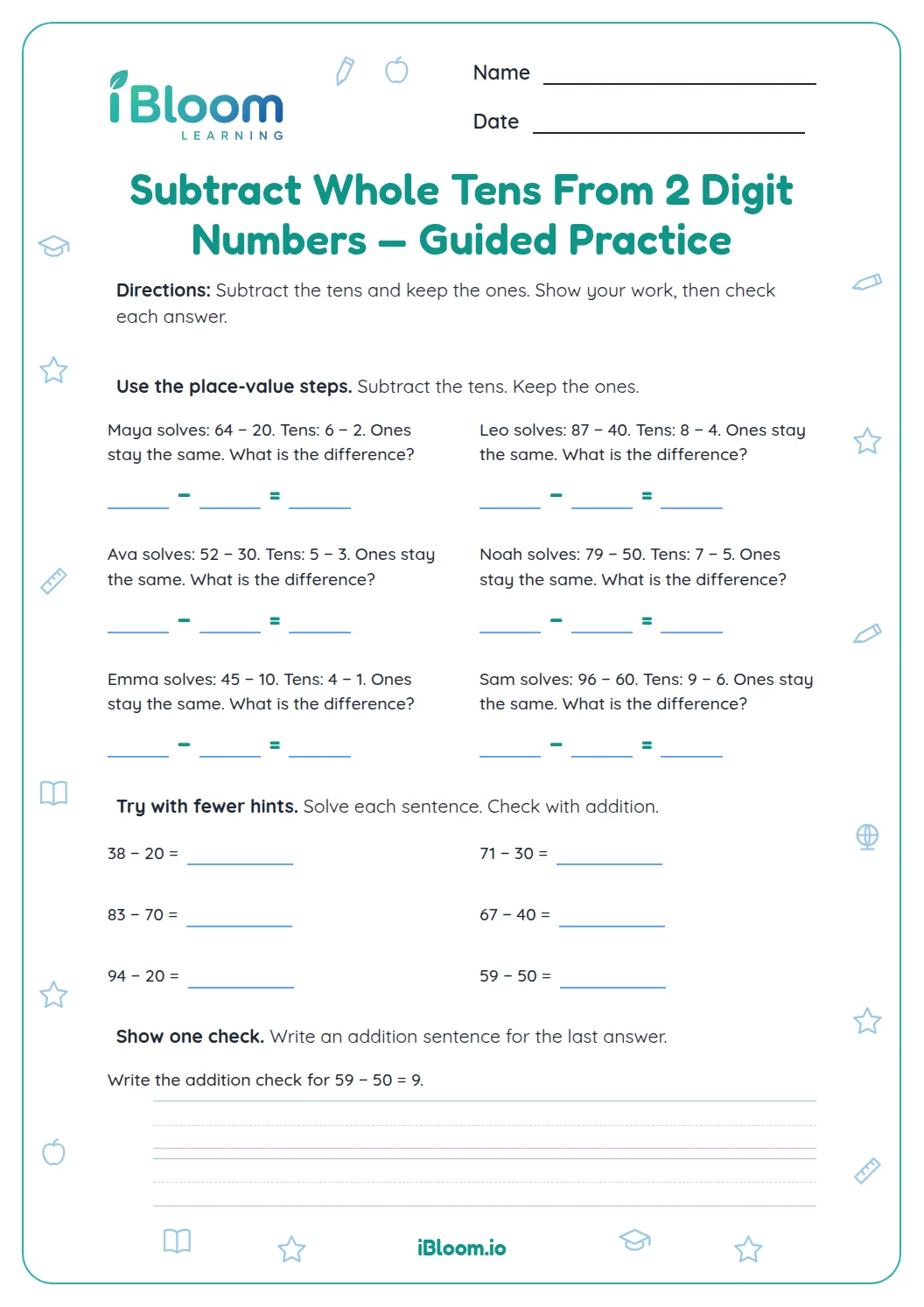
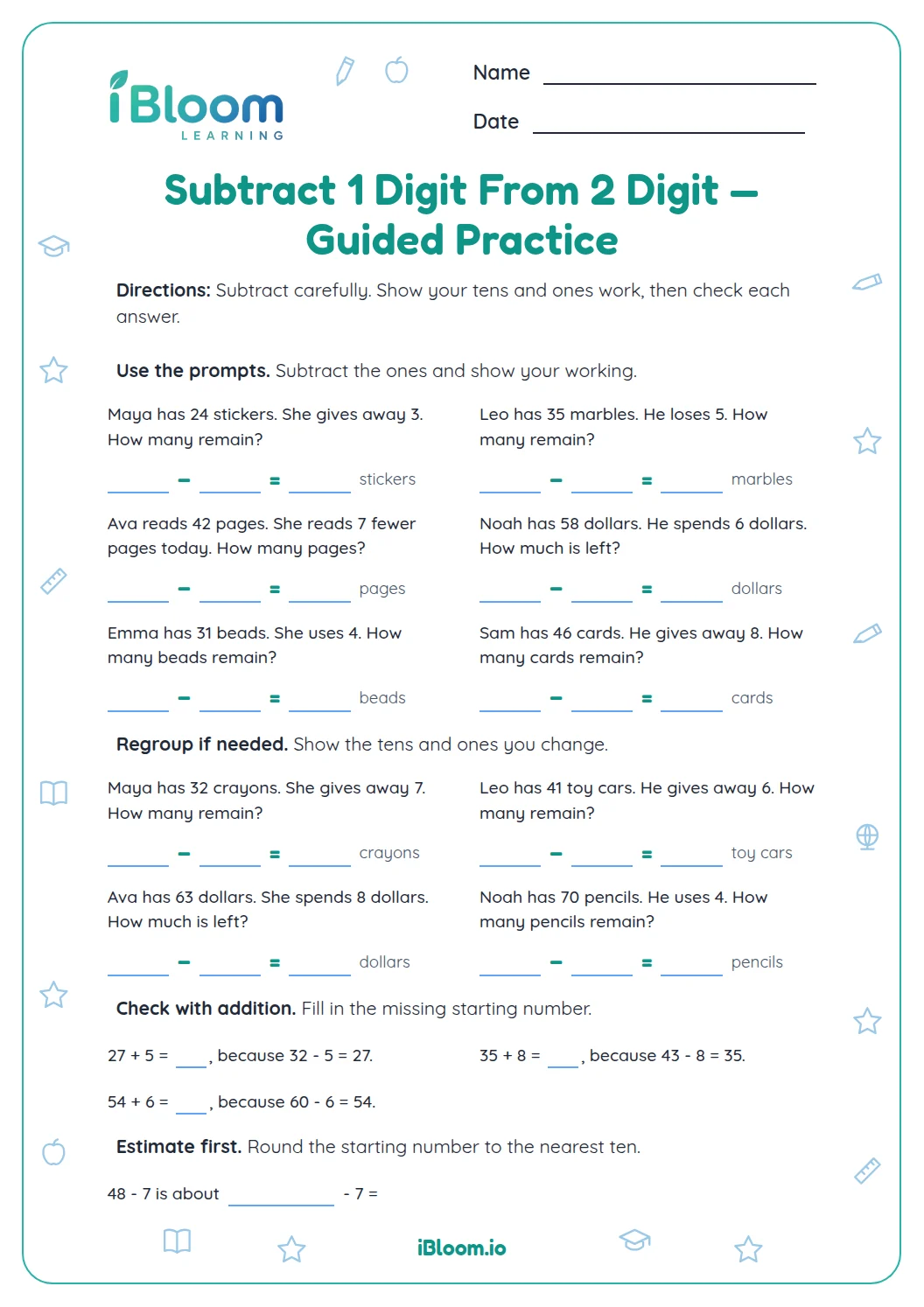
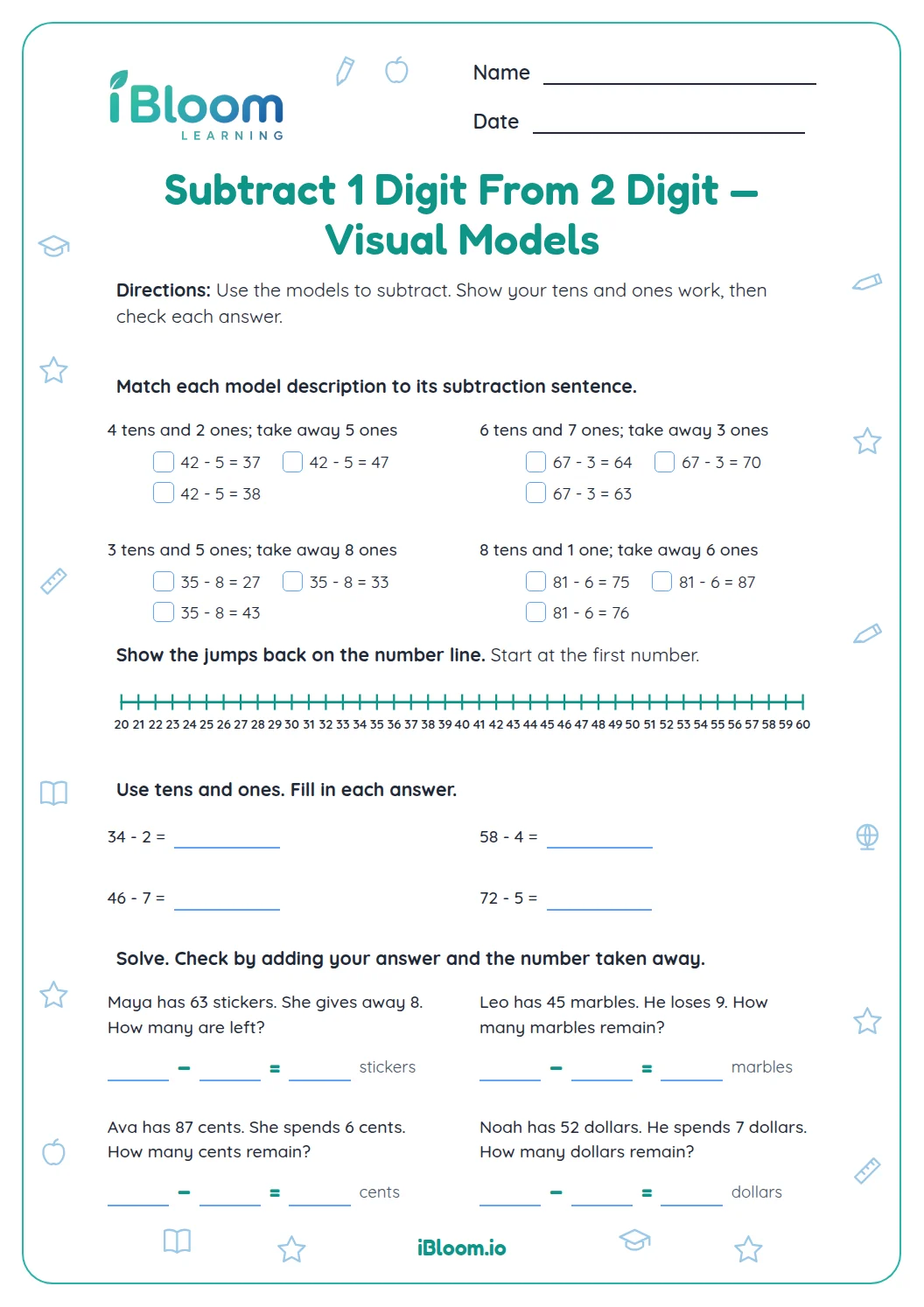
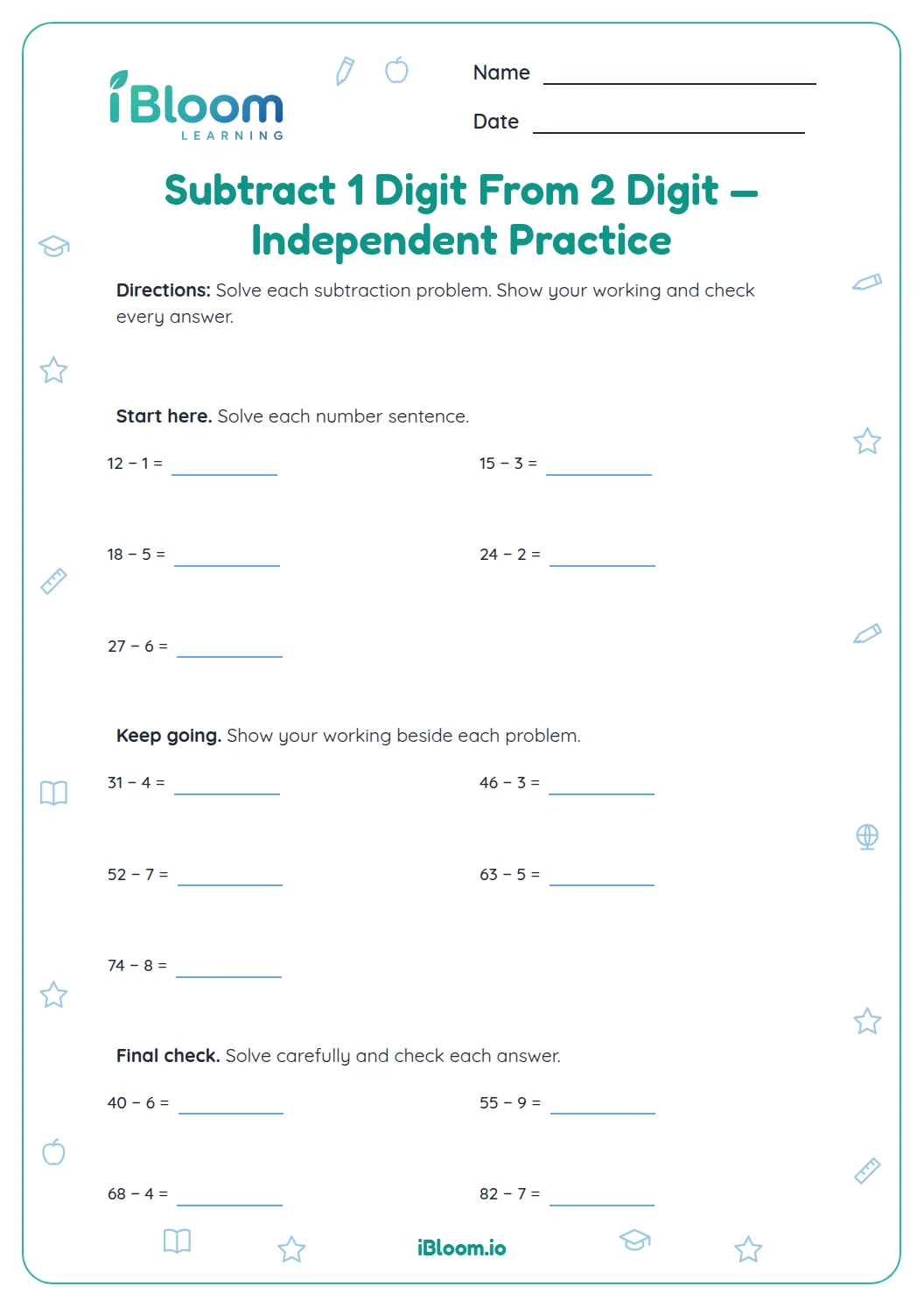
This Grade 3 printable builds reasoning with subtracting whole tens from two-digit numbers. Children find differences, compare choices, check a classmate’s work, and solve short stories, then explain how place value keeps the ones digit unchanged. The 16 questions progress from direct subtraction to applied reasoning, with an answer key for checking. It practices CCSS 3.NBT.A.2.
Aligned to 3.NBT.A.2
What is the main idea?
When subtracting a multiple of ten, subtract in the tens place. The ones stay as they are because no ones are taken away.
For 84 − 30, think 8 tens − 3 tens = 5 tens, then keep 4 ones: 54. Question 2 uses the same reasoning with 67 − 40 = 27.
How does the practice build?
The first part gives a clear starting point. Later items ask learners to apply the same idea in a new form and check that the result makes sense. Use the answer key after independent work so the learner can explain any correction.
How can an adult support the practice?
Read the directions together, then ask the learner to name the first step before writing. Encourage a check with a second method when one is available. The short written responses leave room to put the reasoning into words.
How to use this worksheet
- 1Read each subtraction aloud as tens and ones.
- 2Complete Part A and explain why the ones digit stays fixed.
- 3Use addition to check one answer in Part B.
- 4Write an equation for each story in Part C.
- 5Finish with the short explanation items and check the key.
Common mistakes and quick fixes
The mistake
Subtract the number of tens from the ones digit.
The fix
say “6 tens minus 4 tens” before writing 27.
The mistake
Change the ones digit even though no ones are removed.
The fix
check that the ones digit matches the starting number.
The mistake
Choose the smaller result when comparing take-away amounts.
The fix
with the same start, taking away less leaves more.
Common Core alignment
This worksheet gives focused practice with the standard below.
Subtract within 1,000 by using place value and related addition.
On this sheet: Subtract within 1,000 by using place value and related addition.
Show the official wordingHide the official wording
Fluently add and subtract within 1000 using strategies and algorithms based on place value, properties of operations, and/or the relationship between addition and subtraction.
What to practice next
Make more practice
Further reading
Questions parents and teachers ask
How can a child subtract 40 from 67?
Subtract 4 tens from 6 tens and keep the 7 ones: 67 − 40 = 27. On this sheet, children use the same place-value idea in direct problems, checks, and short stories. Invite the learner to point to the numbers or words in the prompt that support this answer, then check the completed item against the key.
Does subtracting whole tens change the ones digit?
No. Taking away whole tens changes the tens place while the ones place stays the same. For example, 91 − 50 leaves 41. Invite the learner to point to the numbers or words in the prompt that support this answer, then check the completed item against the key.
How can addition check subtraction?
Add the difference to the amount taken away. If 75 − 20 = 55, then 55 + 20 should equal 75. Invite the learner to point to the numbers or words in the prompt that support this answer, then check the completed item against the key.
What is included in the worksheet?
There are 16 questions across four parts: direct reasoning, checking work, four short word problems, and written responses. A separate answer key is included. Invite the learner to point to the numbers or words in the prompt that support this answer, then check the completed item against the key.
Is the practice suitable for Grade 3?
Yes. The problems use two-digit numbers and subtract whole tens, emphasizing place value and the relationship between subtraction and addition. Invite the learner to point to the numbers or words in the prompt that support this answer, then check the completed item against the key.
How long should the worksheet take?
Plan for about 25 minutes, including time to show equations and explain a couple of answers. Learners who finish early can make a new subtraction equation with the same difference. Invite the learner to point to the numbers or words in the prompt that support this answer, then check the completed item against the key.