


About this worksheet
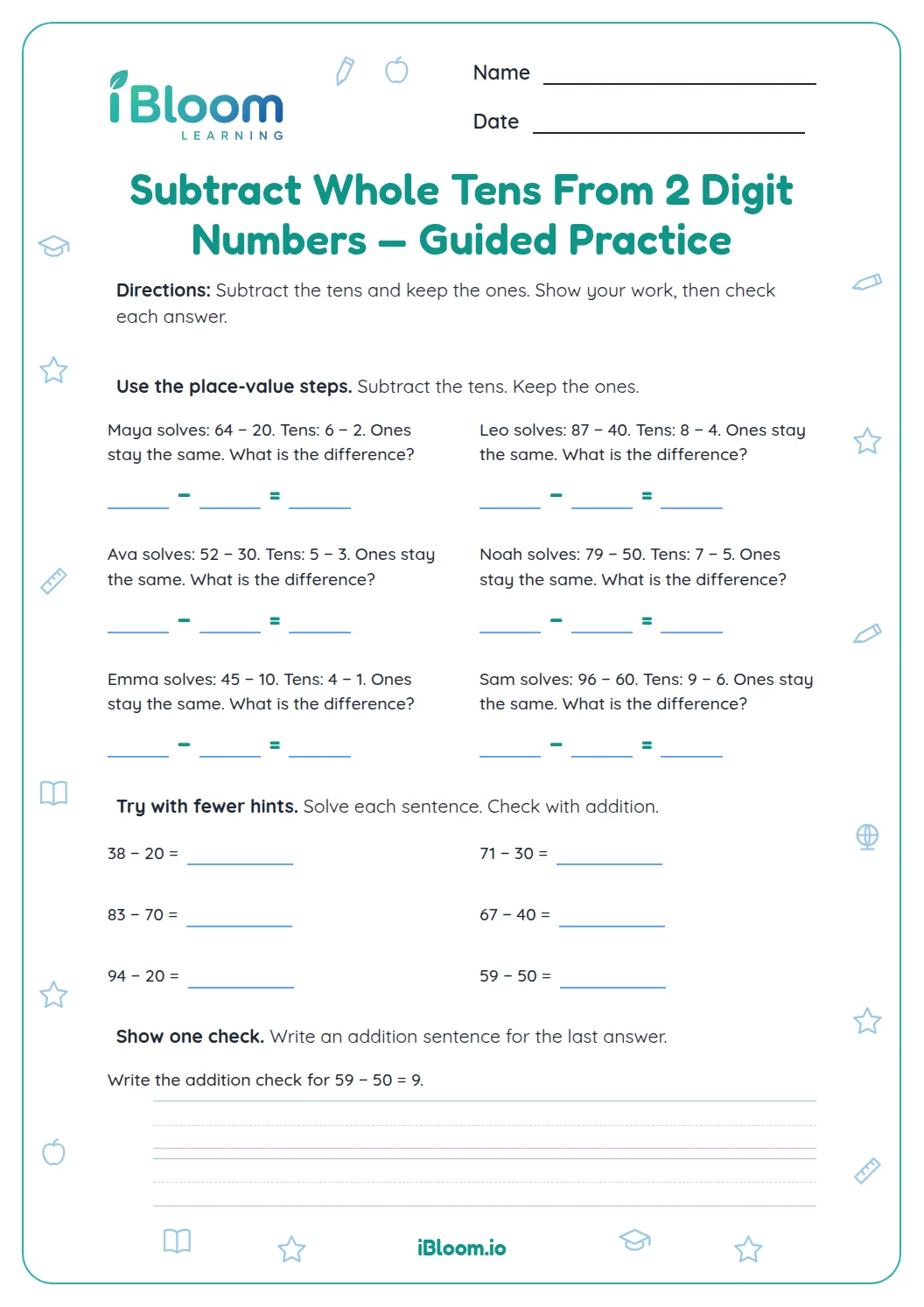
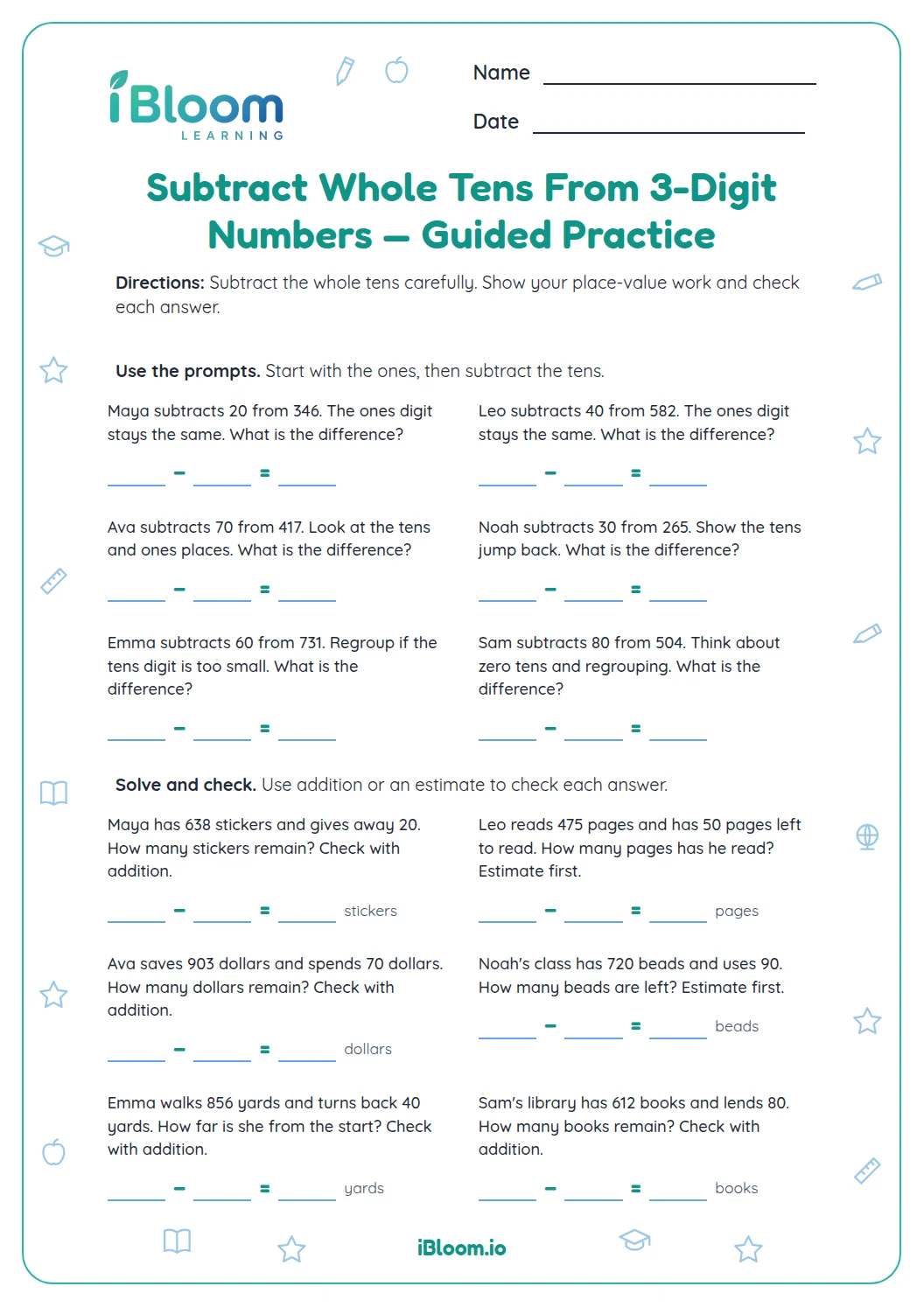
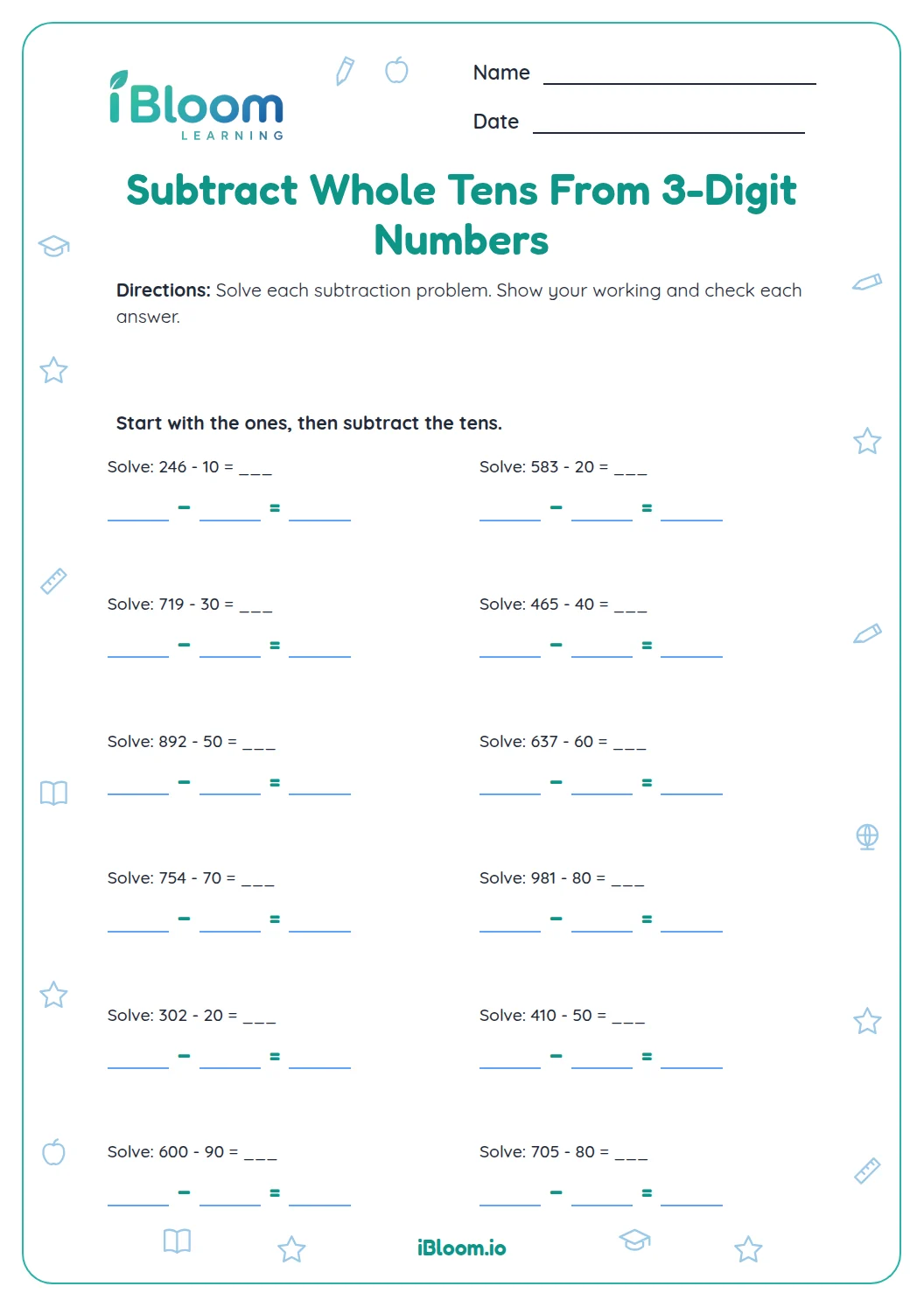
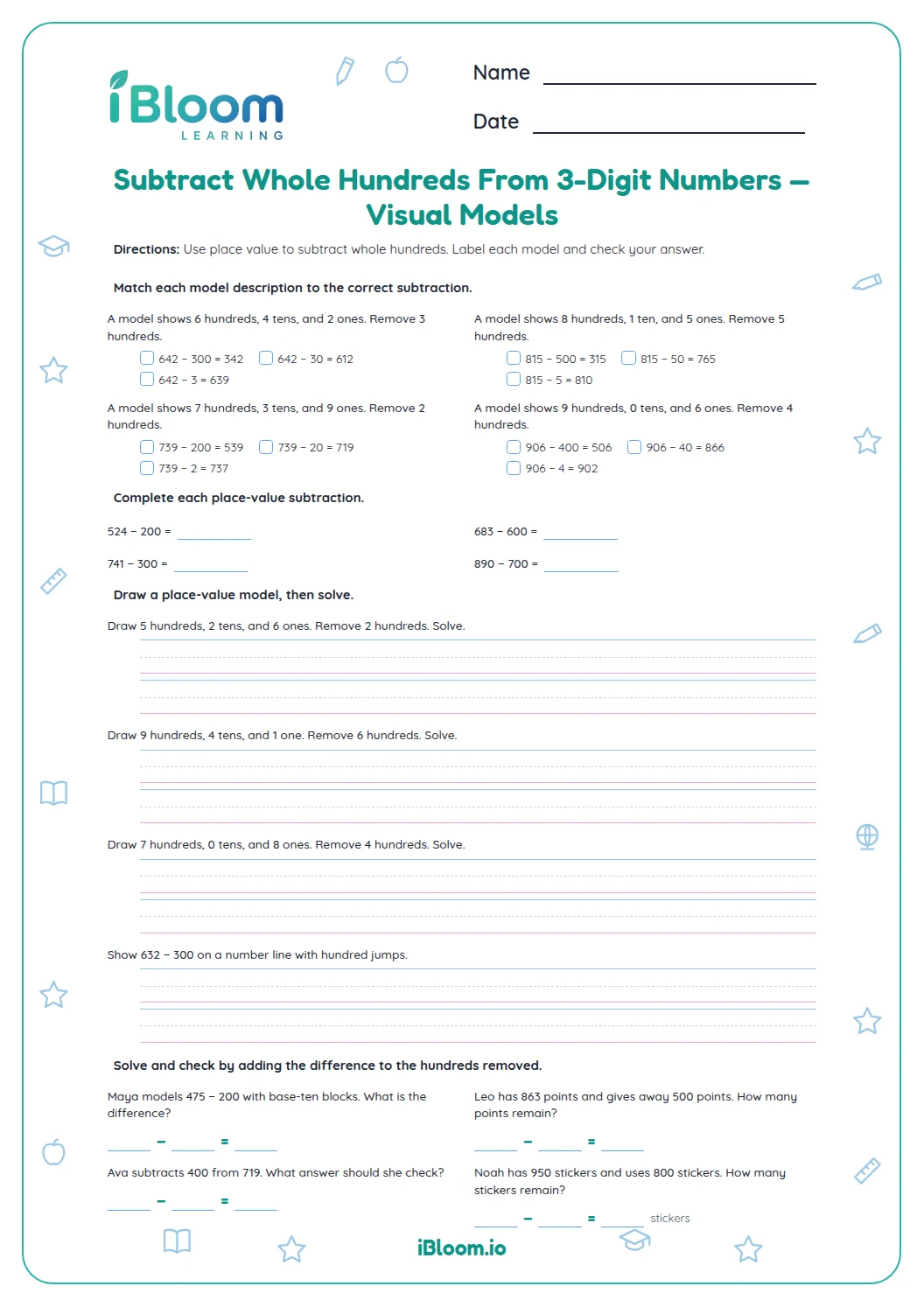
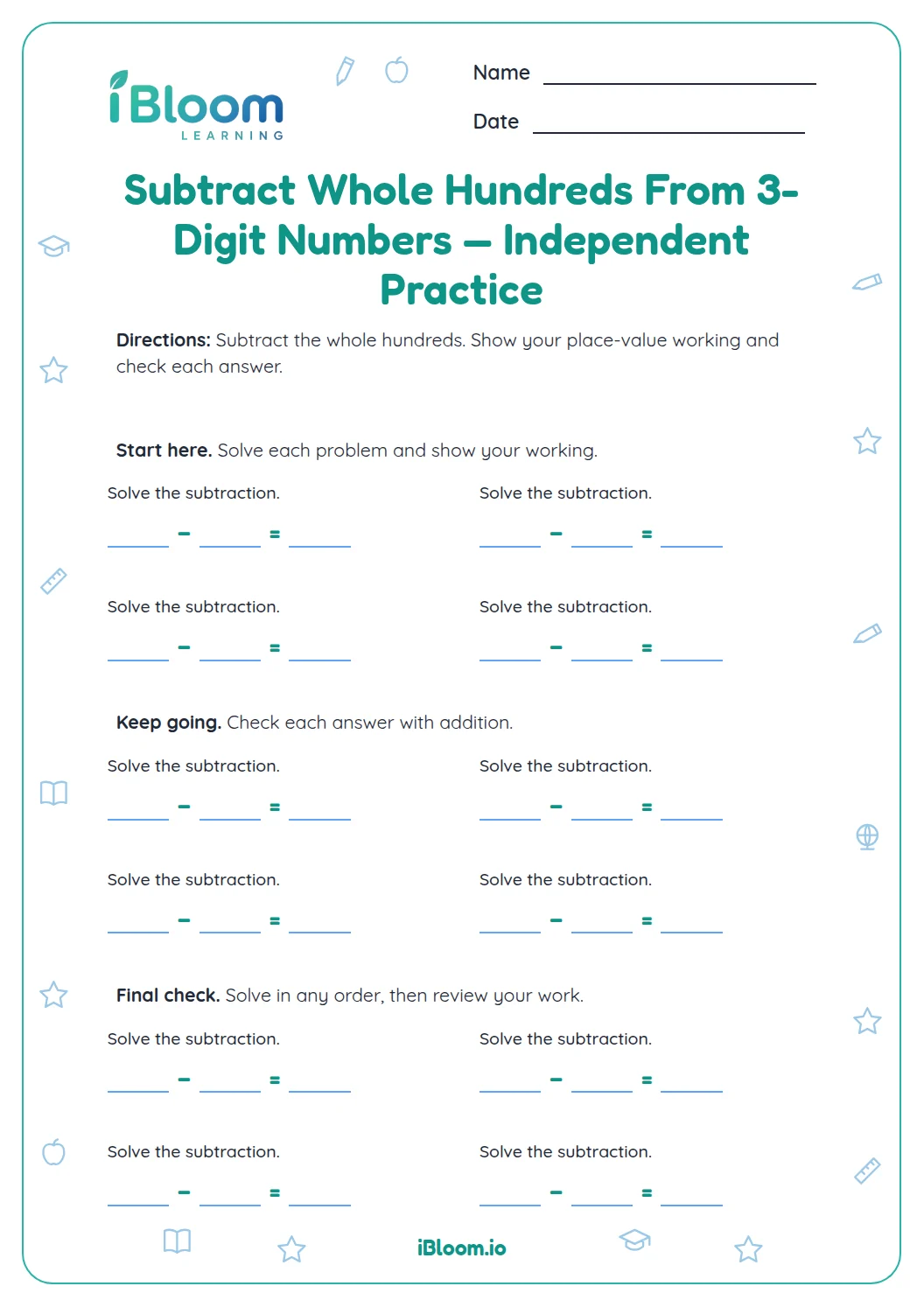
This printable practices its named skill: subtracting a multiple of ten from a two-digit number. Fourteen short situations use familiar amounts and varied answer choices. The skill aligns with CCSS 2.NBT.B.5. A separate key provides all answers for checking.
Aligned to 2.NBT.B.5
How do you spot the subtraction?
Identify the starting amount, then find how many tens are removed. The remaining amount answers the story.
What changes when you subtract tens?
For Question 1, subtract 30 from 68. That removes 3 tens, leaving 38.
- 168 − 30 = 38
- 2Check: 38 + 30 = 68
How can a child check the answer?
Add the tens back to the difference. The sum should equal the starting number.
How to use this worksheet
- 1Read the whole story before calculating.
- 2Mark the starting amount and the number removed.
- 3Write a subtraction equation using those two numbers.
- 4Subtract the tens and keep track of the ones.
- 5Label the result with the matching item or unit.
- 6Check the equation and story against the answer key.
Mistakes to watch for
The mistake
Adding the removed amount to the starting amount.
The fix
If items are given away, used, sold, or leave, subtract.
The mistake
Changing the ones digit when subtracting only whole tens.
The fix
Subtract the tens and keep the ones digit unchanged.
The mistake
Writing a correct number without saying what it measures.
The fix
Use the unit named in the story, such as “38 pencils.”
Curriculum alignment
Subtract two-digit numbers within 100 using place-value strategies.
On this sheet:
Show the official wordingHide the official wording
Fluently add and subtract within 100 using strategies based on place value, properties of operations, and/or the relationship between addition and subtraction.
What to practice next
Make more practice
Further reading
Questions parents and teachers ask
What skill does this page practice?
It practices subtracting a whole ten from a two-digit number in short stories. Students find what remains after an amount such as 20, 30, or 40 is taken away. The 14 questions use varied contexts and the answer key lists each difference.
How can a child subtract 30 from 68?
Think of 68 as 6 tens and 8 ones. Remove 3 tens and keep the 8 ones, leaving 38. Check by adding 30 back to 38; the total returns to 68. This place-value method keeps the ones clear while the tens change.
Why does the ones digit stay the same?
The amount being subtracted is a whole number of tens, so it has zero ones. For example, subtracting 30 removes three tens. The ones in 68 stay as 8, and the tens decrease from six to three. Add back 30 to check.
What kinds of stories are included?
The stories use pencils, seats, shells, books, points, apples, miles, balloons, visitors, seeds, rolls, cones, and folders. Each asks how many remain after a multiple of ten is removed from a two-digit amount. The settings vary while the subtraction skill stays focused.
Is an answer key included?
Yes. The separate key gives the answer to all 14 story problems. Students can check a response by adding the tens back to the difference and seeing whether the sum matches the starting amount. This inverse check helps catch a subtraction slip.