




About this worksheet
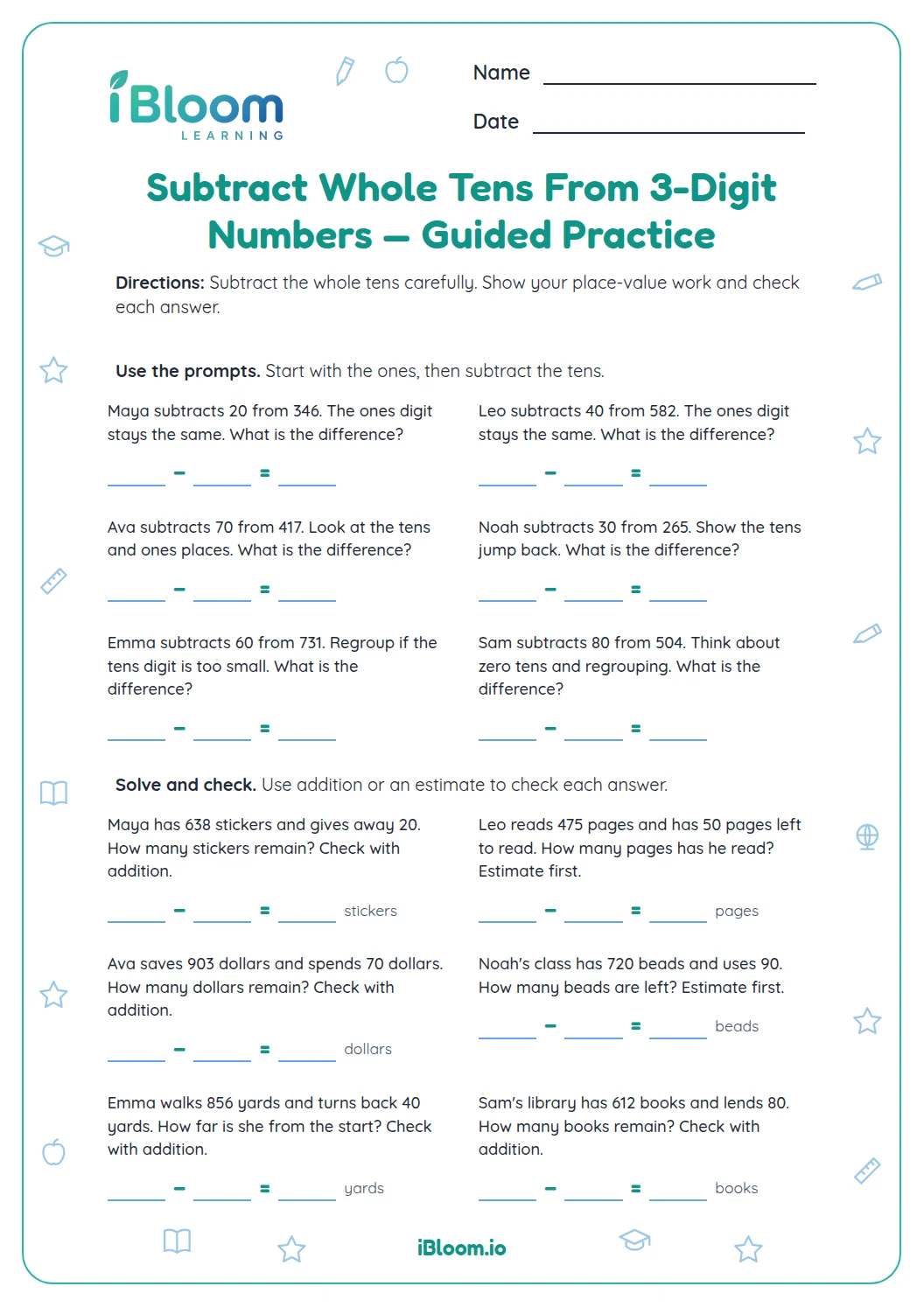
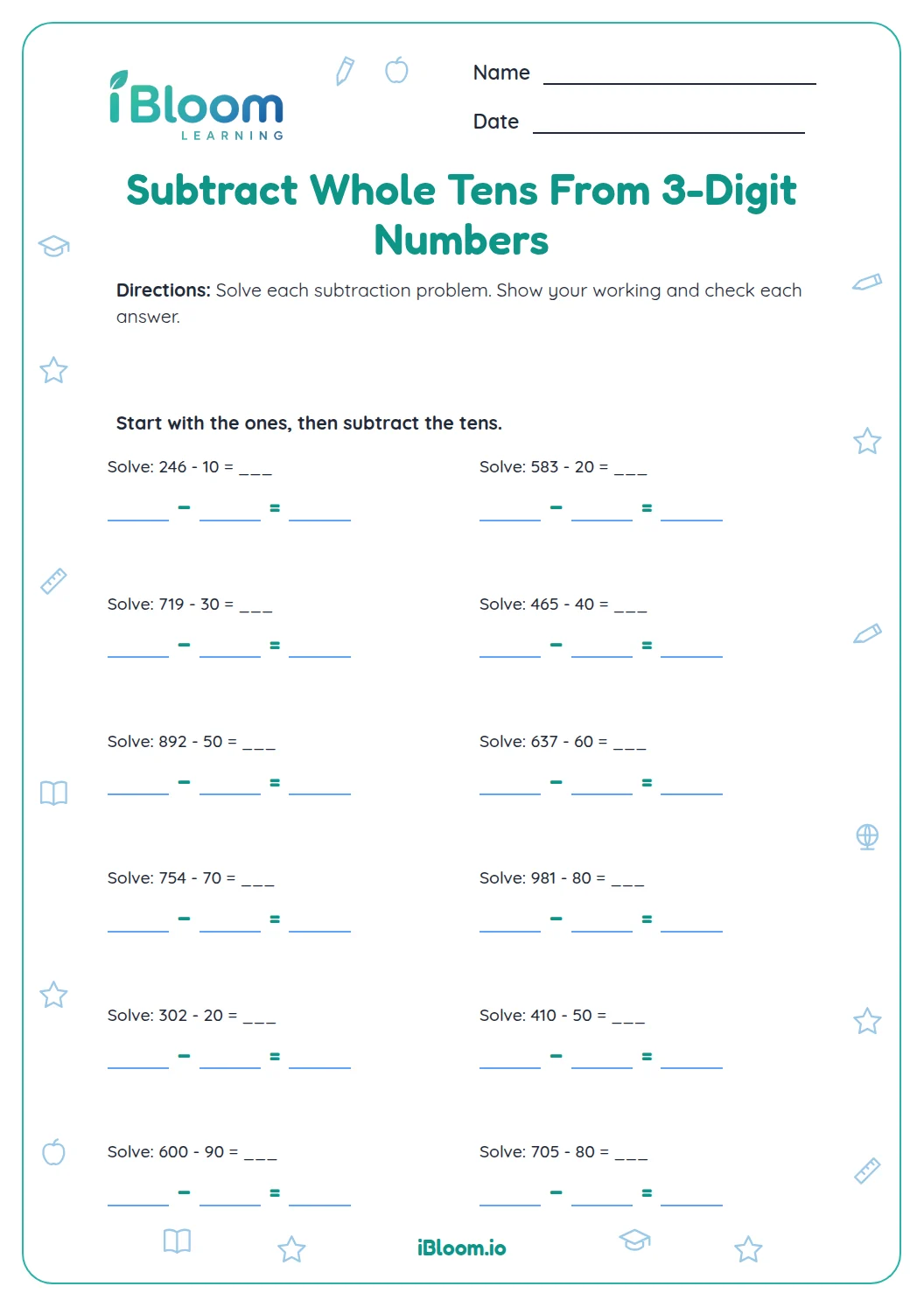
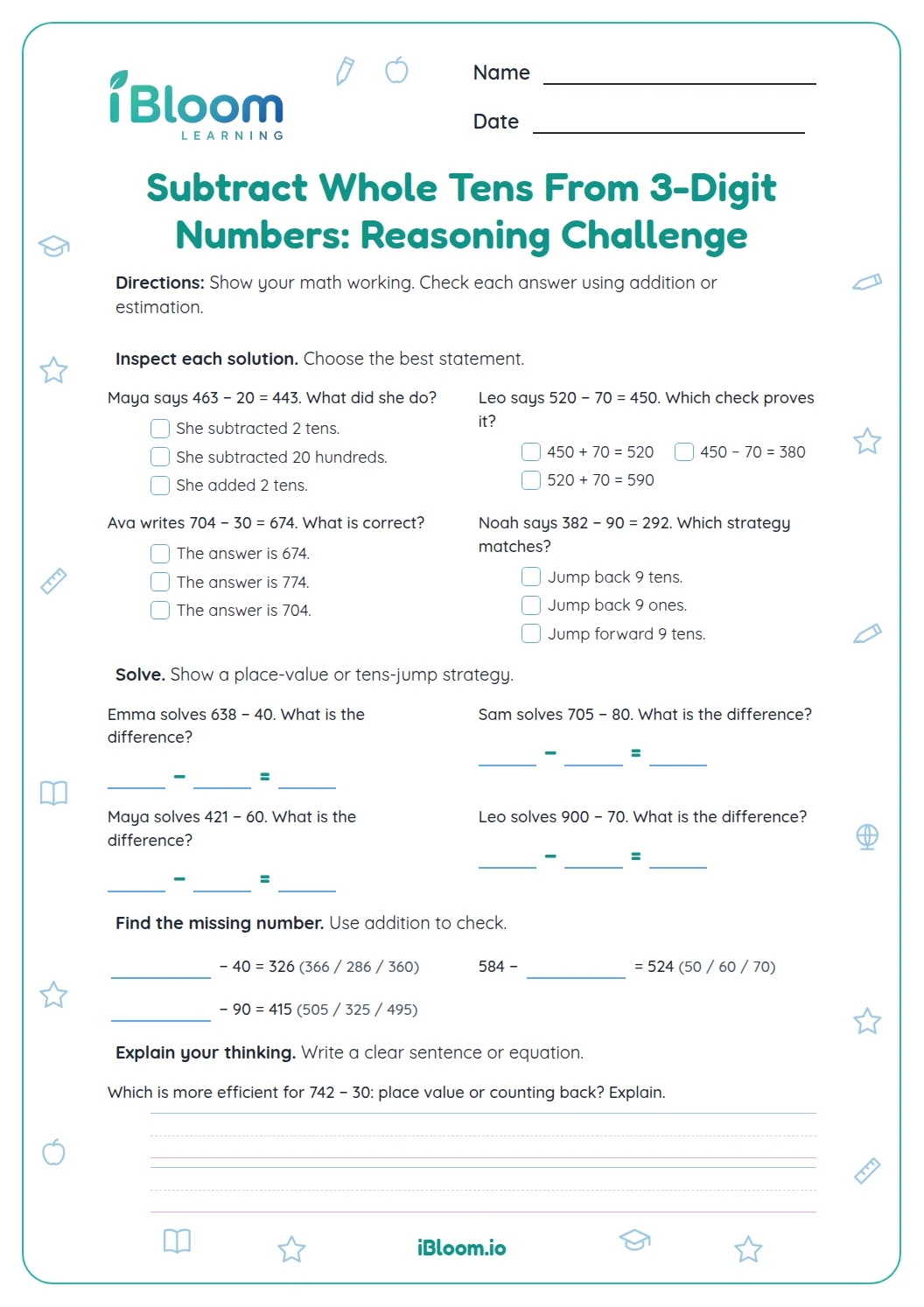
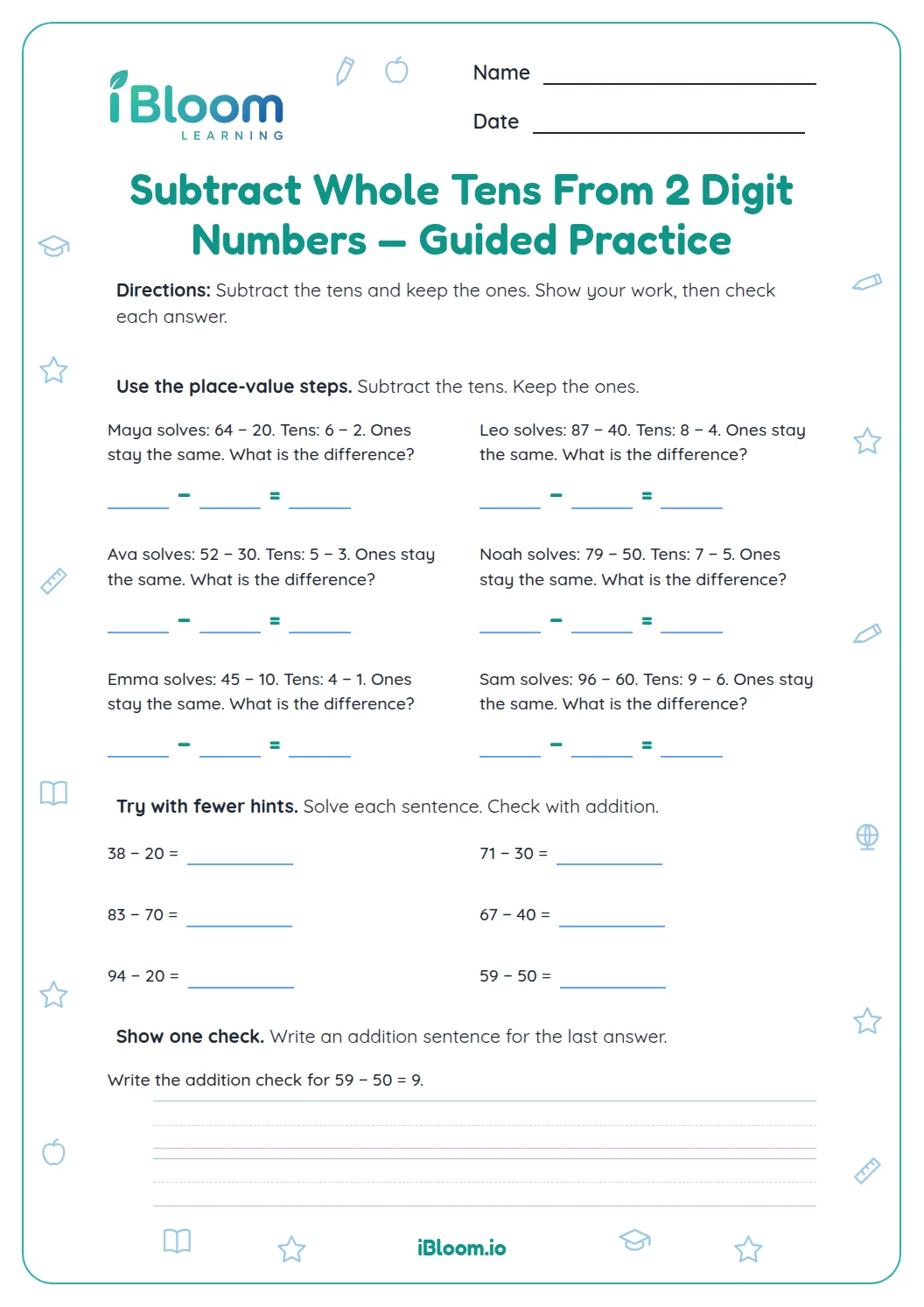
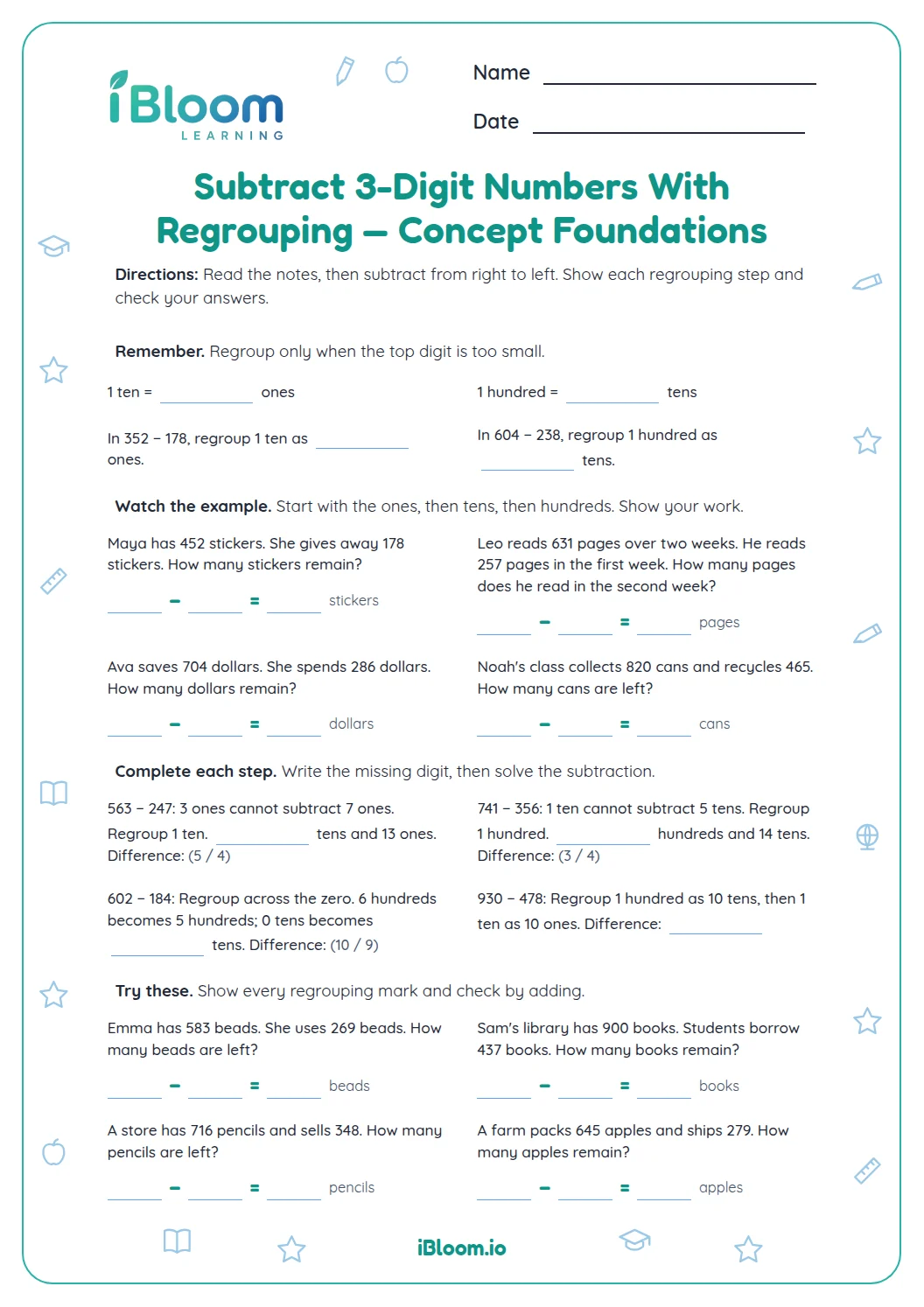
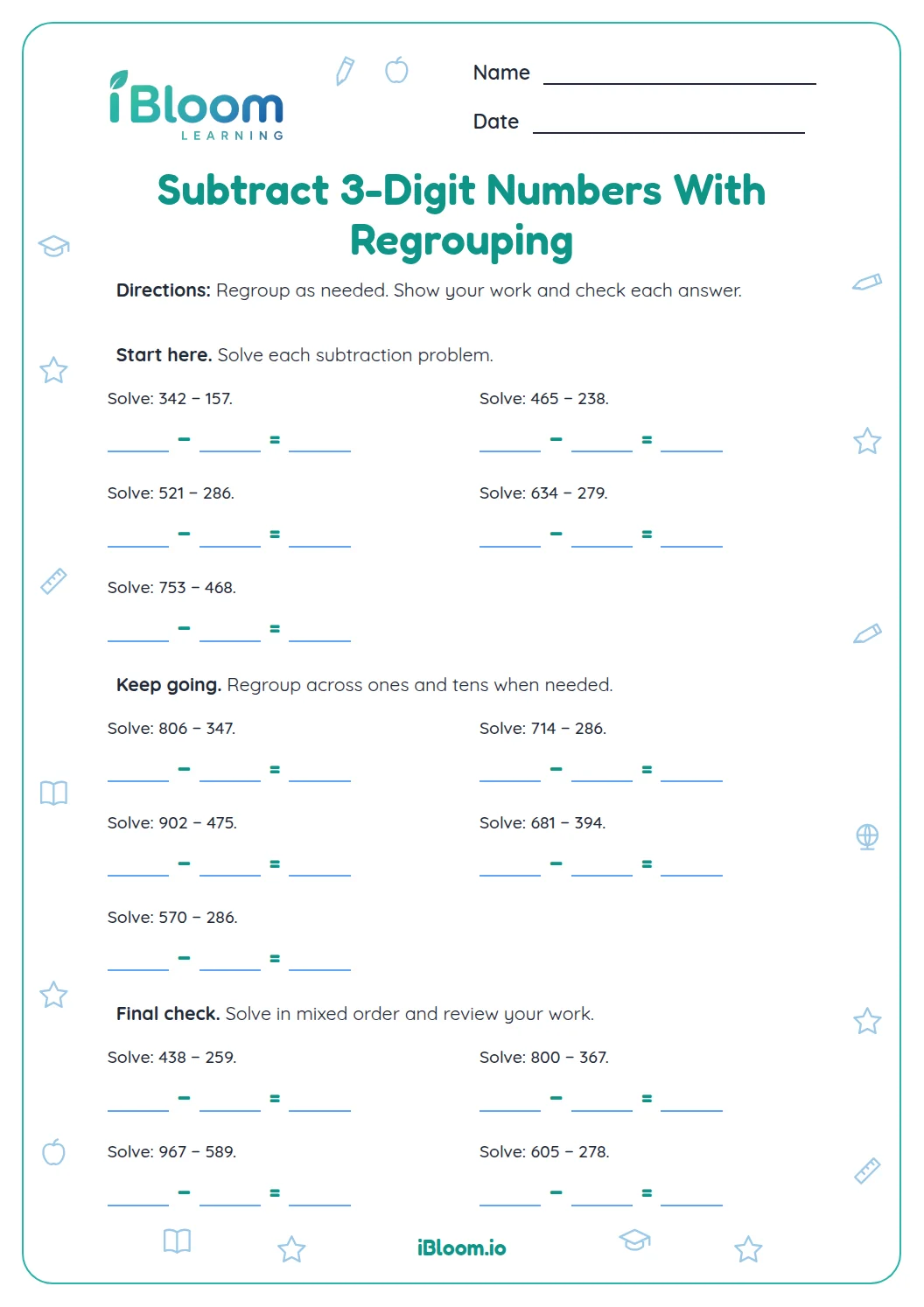
This Grade 3 concept worksheet helps learners subtract whole tens from three-digit numbers. The first problems pair number sentences with base-ten drawings; later items build independence and include examples with zero in a place. Children can keep the hundreds and ones in view while subtracting tens, then check a difference by adding the tens back. The practice aligns with CCSS 3.NBT.A.2 and includes a separate answer key.
Aligned to 3.NBT.A.2
What changes when you subtract a whole ten?
A whole ten removes tens, not ones. In question 1, 347 has 3 hundreds, 4 tens, and 7 ones. Taking away 20 removes two tens; 3 hundreds and 7 ones remain, with 2 tens left. The answer is 327.
- 1347 = 3 hundreds, 4 tens, 7 ones
- 220 = 2 tens
- 34 tens − 2 tens = 2 tens
- 4Keep 3 hundreds and 7 ones
- 5347 − 20 = 327
How do you handle a zero in the number?
Keep every place lined up. In question 8, 905 − 20, subtract two tens from the zero tens. Regroup one hundred as ten tens: 10 tens − 2 tens = 8 tens, so the difference is 885. The 5 ones stay in the ones place.
How can addition check a difference?
Add the number of tens removed back to the difference. For question 11, 857 − 30 = 827; check 827 + 30 = 857. If the original number does not return, review the tens subtraction.
What does the practice include?
The 15 problems start with base-ten drawings and continue with equations, including numbers that have zero tens or ones. The key lists every difference for quick checking.
A place-value method
- 1Read the three digits by hundreds, tens, and ones.
- 2Write the whole tens as a number of tens.
- 3Subtract in the tens place, regrouping a hundred if needed.
- 4Keep the hundreds and ones in their own places.
- 5Write the three-digit difference.
- 6Add the tens back to check the original number.
Common whole-ten subtraction slips
The mistake
Subtracting the tens digit as ones, such as treating 20 as 2.
The fix
Name the value: 20 is 2 tens, so subtract in the tens place.
The mistake
Changing the ones digit when taking away a whole ten.
The fix
Whole tens have zero ones, so the ones digit stays the same.
The mistake
Ignoring a zero in the tens place and writing a negative digit.
The fix
Trade one hundred for ten tens before subtracting.
Common Core alignment
These differences use place-value strategies within 1,000.
Subtract whole tens from three-digit numbers using place value.
On this sheet: Subtract whole tens from three-digit numbers using place value.
Show the official wordingHide the official wording
Fluently add and subtract within 1000 using strategies and algorithms based on place value, properties of operations, and/or the relationship between addition and subtraction.
What to practice next
Make more practice
Further reading
Questions parents and teachers ask
Why do the ones stay the same?
A whole ten has zero ones, so subtracting 20 or 70 does not change the ones value. In 347 − 20, the 7 ones remain while two tens are removed. If the tens digit is zero or too small, regroup a hundred as ten tens before subtracting.
What if the number has zero tens?
Regroup one hundred as ten tens. For 905 − 20, trade one hundred for ten tens, subtract two tens to leave eight tens, and keep the remaining eight hundreds and five ones. The difference is 885. The base-ten drawing at the start of the sheet helps show the place values.
How do base-ten drawings help?
The first two drawings separate hundreds, tens, and ones into visible groups. They show the starting number before any tens are removed. Learners can then identify which place changes and keep the hundreds and ones aligned while solving the number sentence.
How many problems are on the sheet?
There are 15 three-digit subtraction equations. The first two include base-ten drawings; the remaining questions ask learners to use place value independently, including numbers with zero tens or zero ones. A separate answer key lists every difference and helps check regrouping.
How can I check an answer?
Add the whole tens back to the difference. For example, if 857 − 30 is 827, check that 827 + 30 returns to 857. This inverse operation checks the subtraction, and the separate key lists all 15 results.