






About this worksheet
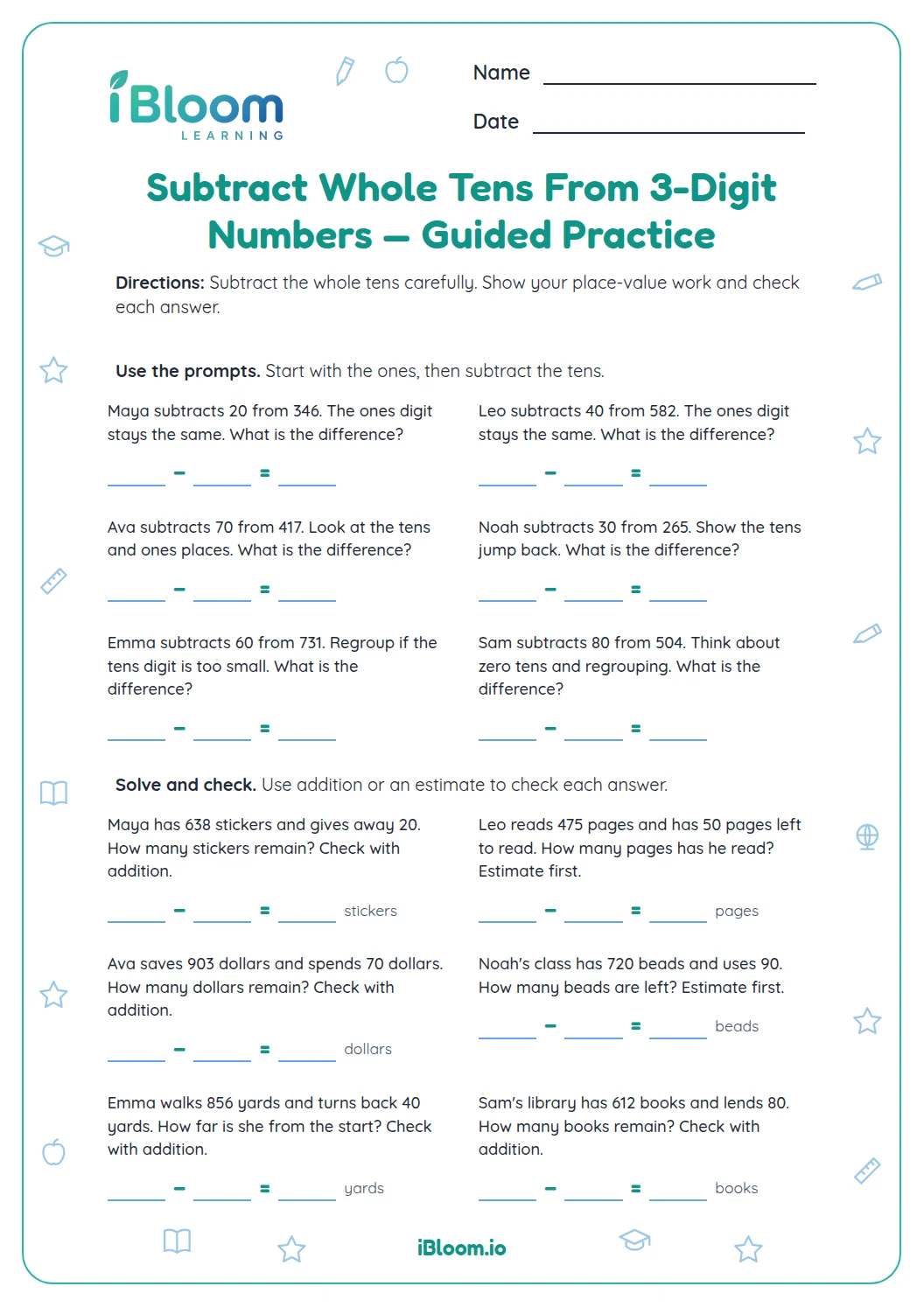
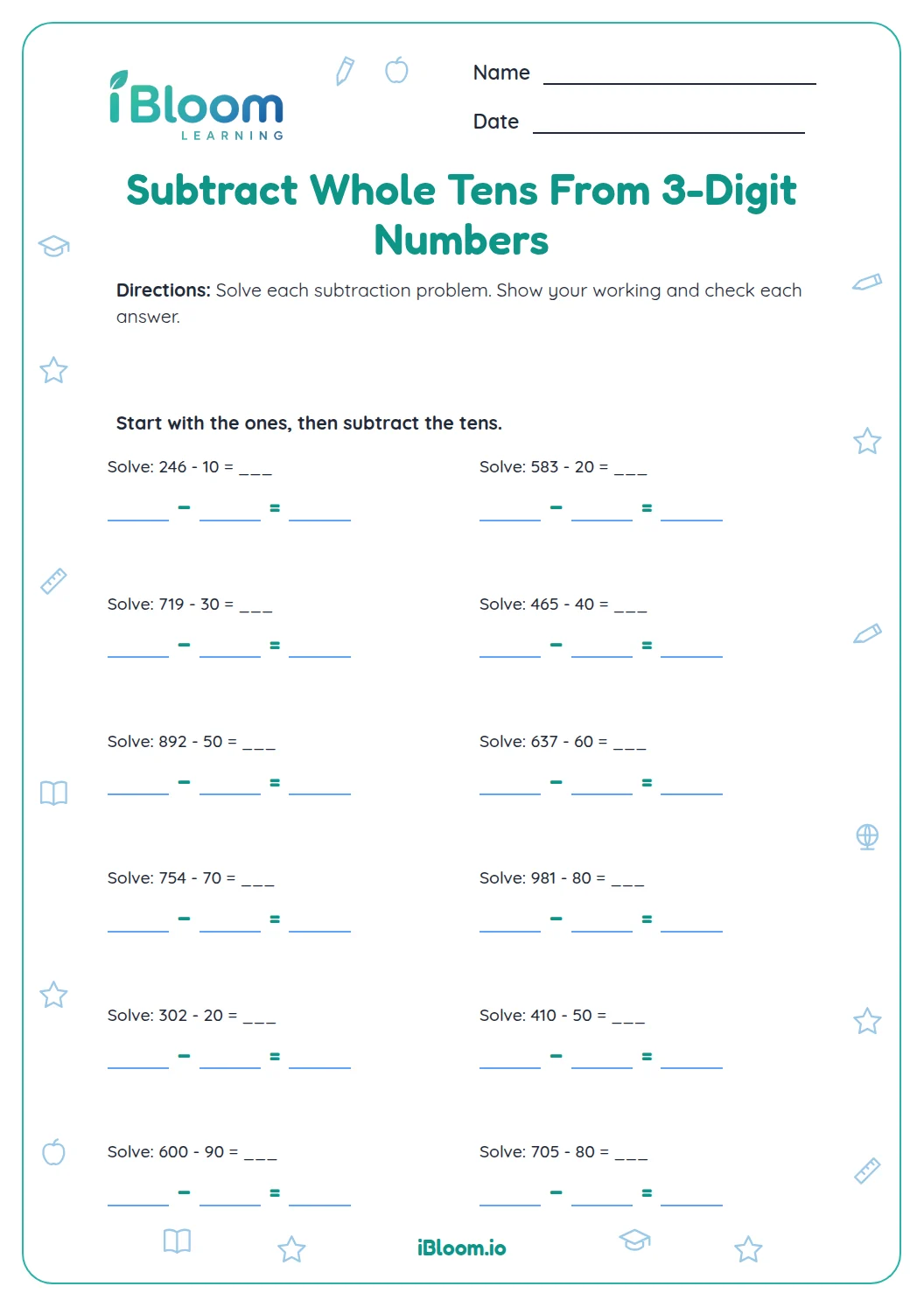
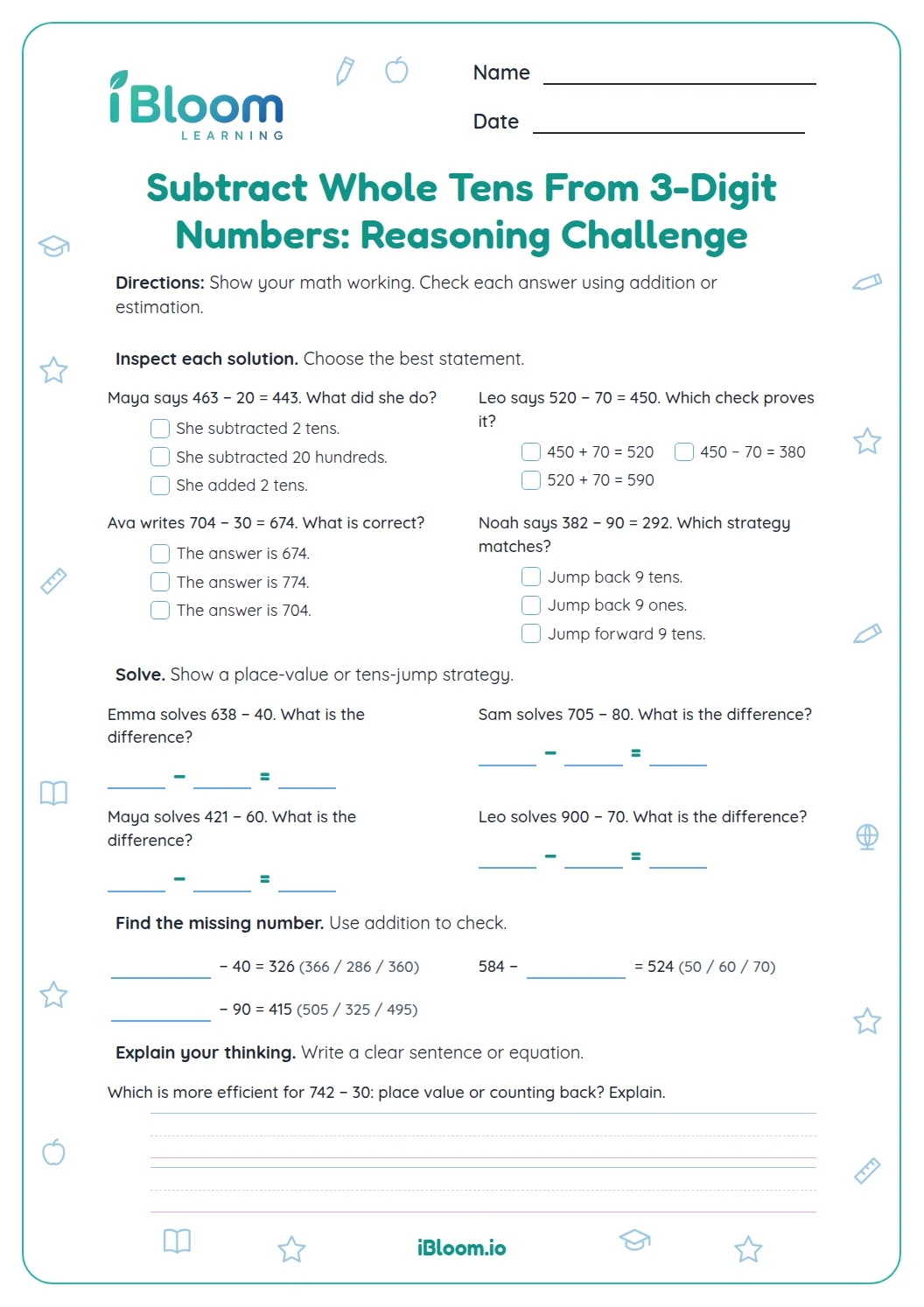
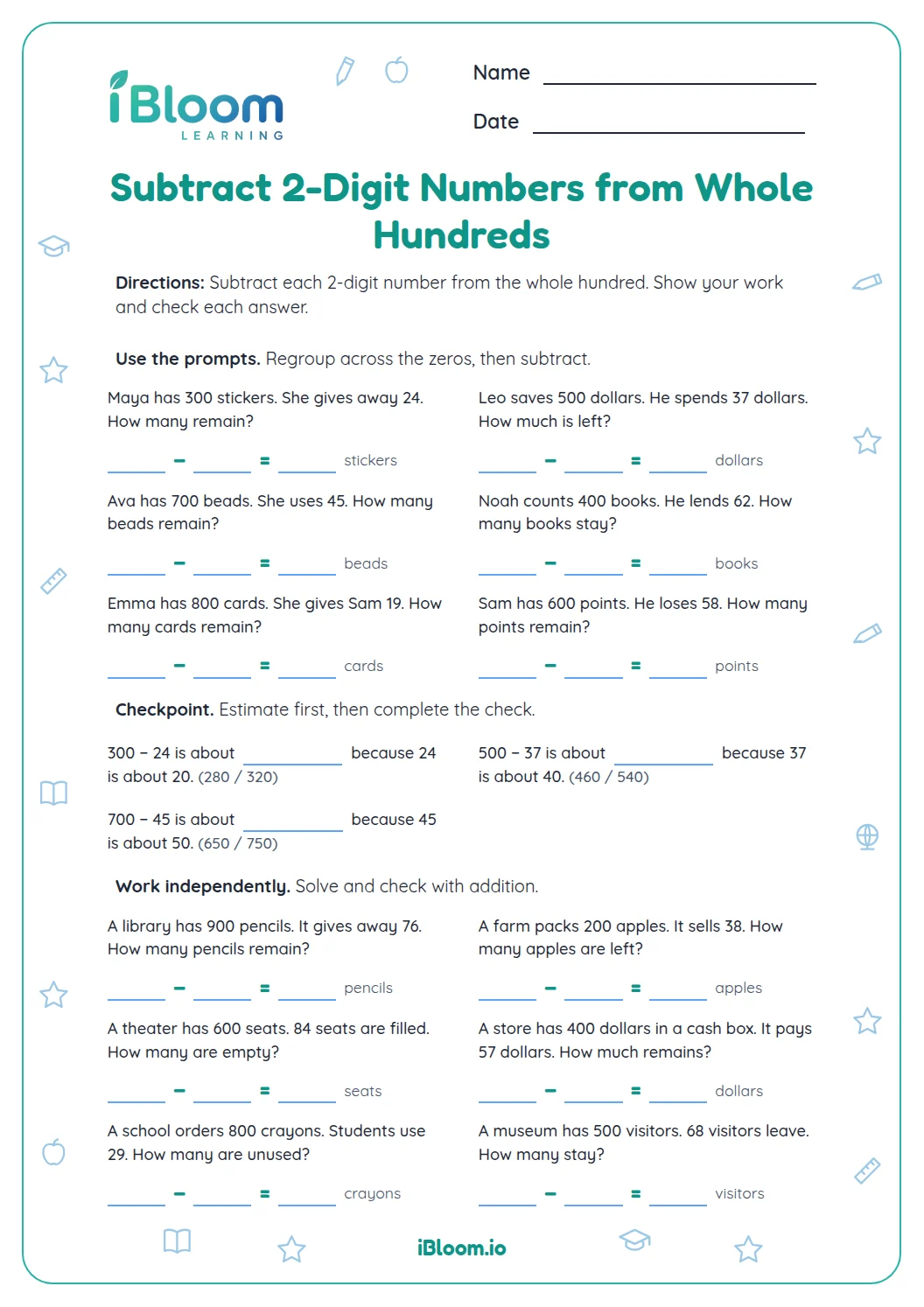
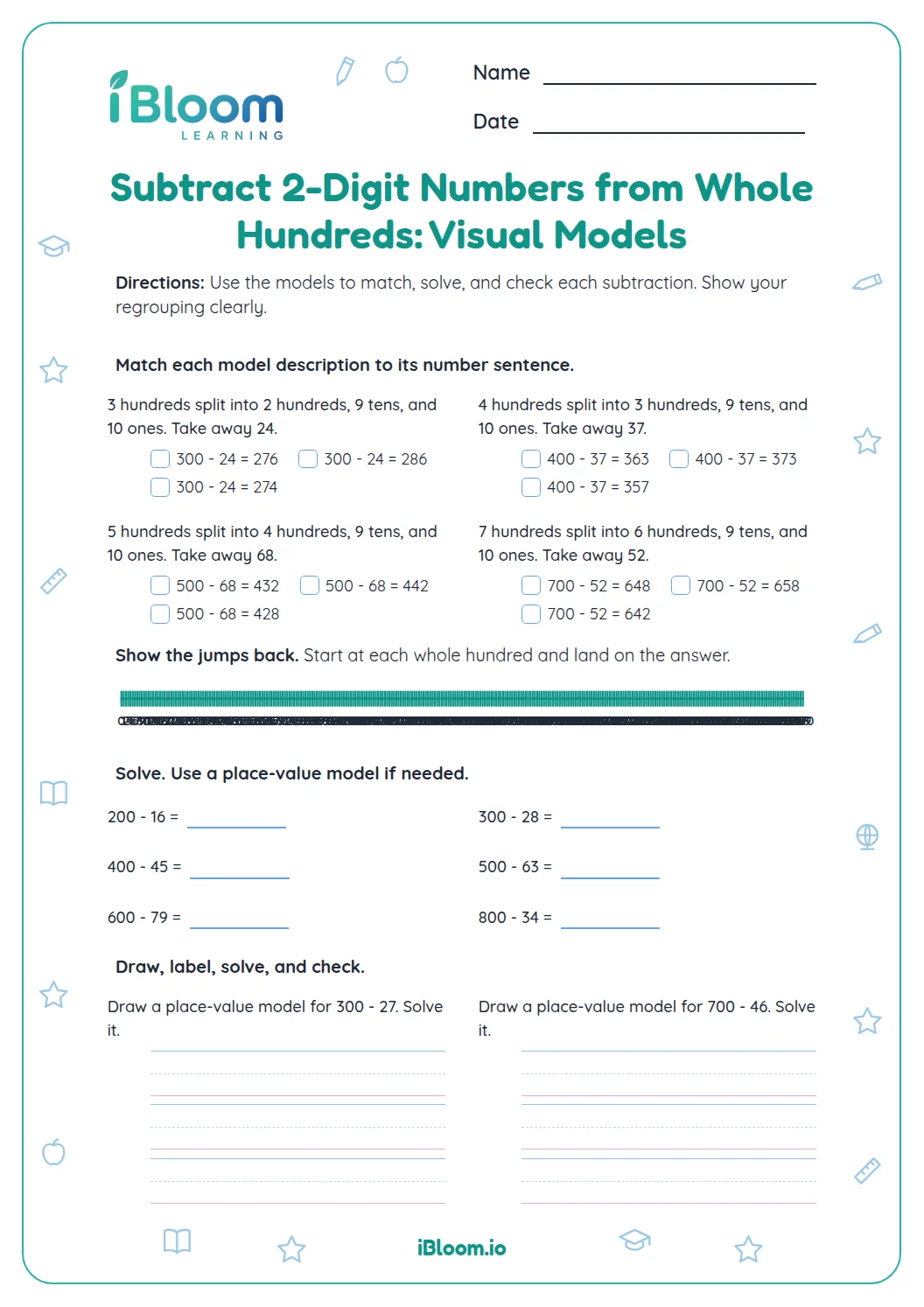
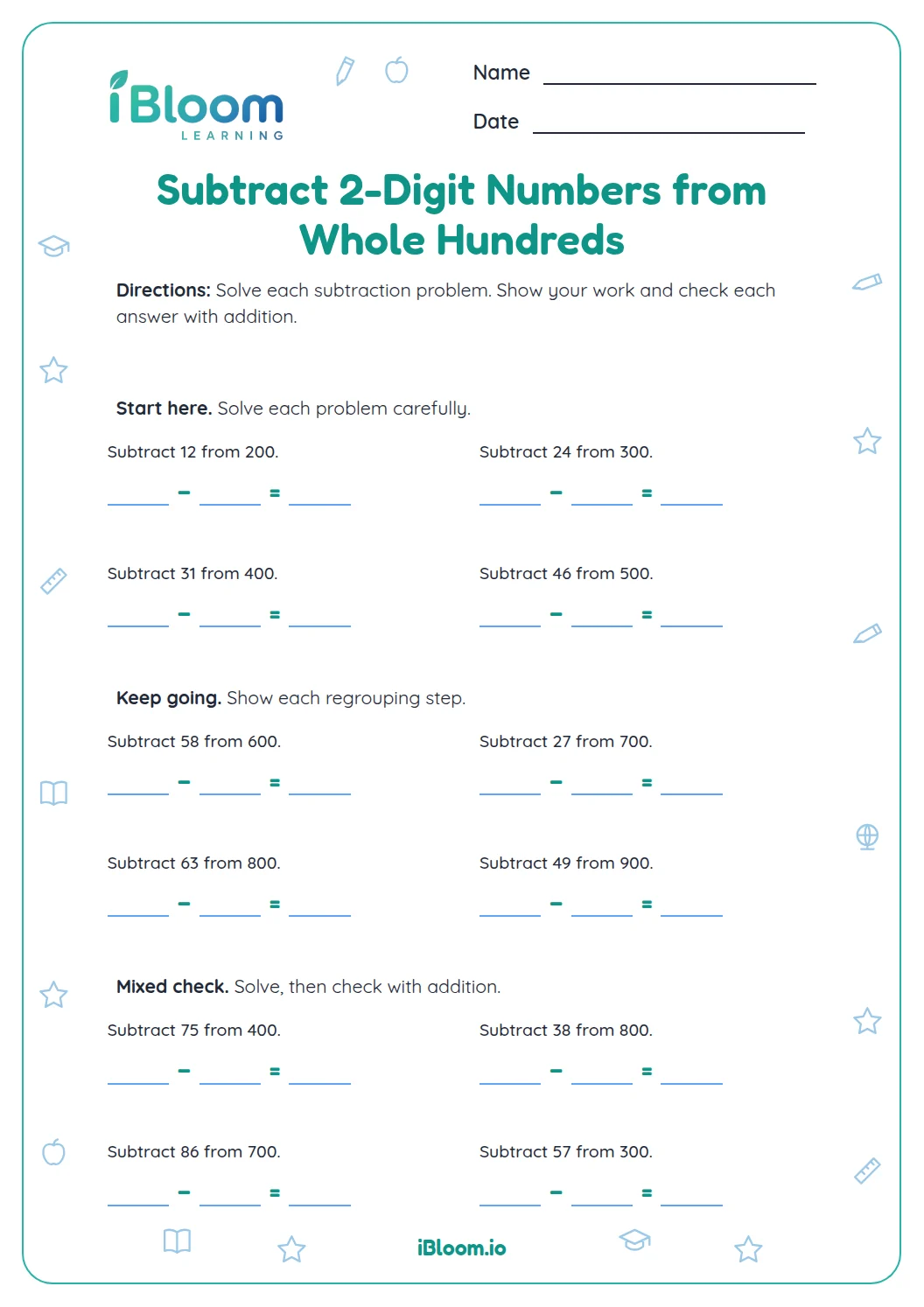
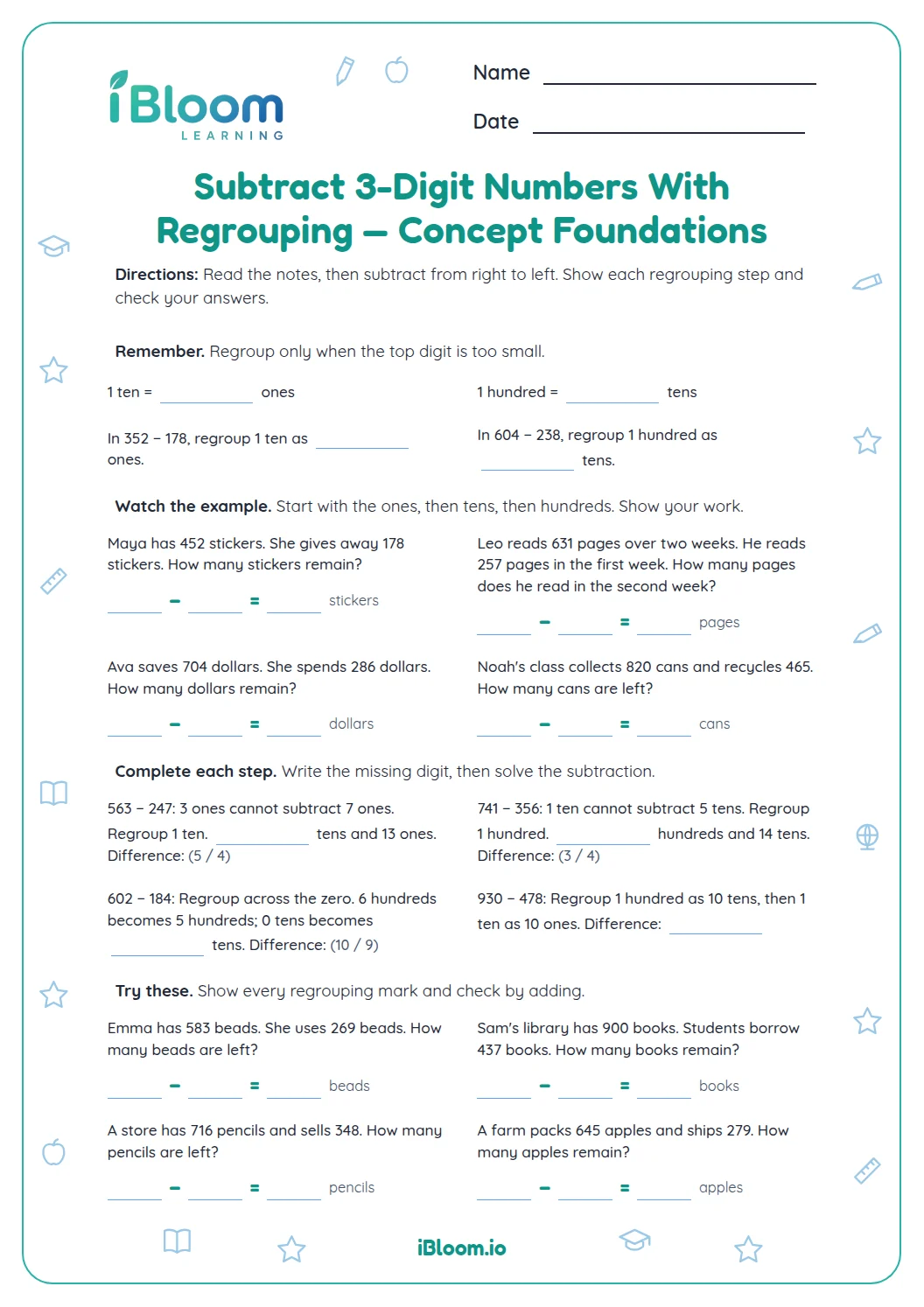
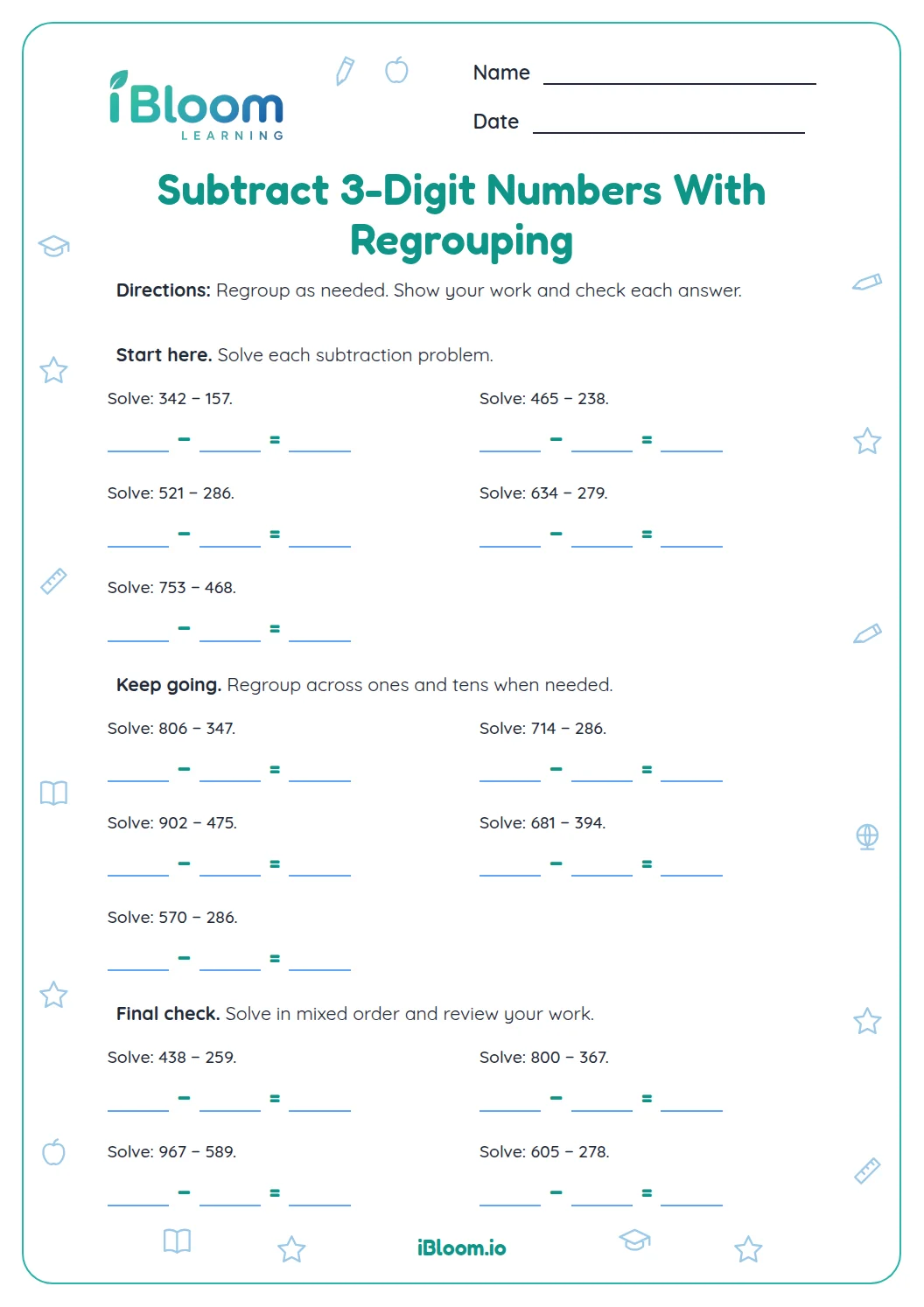
This Grade 3 worksheet turns subtracting whole tens from three-digit numbers into short real-world problems. Children write an equation, solve, and name what remains; some questions require regrouping a hundred as ten tens. Fourteen stories use quantities such as books, seats, and meters, with a separate answer key. The work practices CCSS 3.NBT.A.2.
Aligned to 3.NBT.A.2
What is the main idea?
Subtracting whole tens changes the hundreds or tens value, while the ones remain the same. Regroup a hundred as ten tens when needed.
For 684 − 30, take 3 tens from 8 tens and keep the 6 hundreds and 4 ones. The answer is 654 books.
How does the practice build?
The first part gives a clear starting point. Later items ask learners to apply the same idea in a new form and check that the result makes sense. Use the answer key after independent work so the learner can explain any correction.
How can an adult support the practice?
Read the directions together, then ask the learner to name the first step before writing. Encourage a check with a second method when one is available. The short written responses leave room to put the reasoning into words.
How to use this worksheet
- 1Read the story and circle the starting amount.
- 2Underline how many tens are removed.
- 3Write a subtraction equation.
- 4Regroup one hundred as ten tens if needed.
- 5Solve and include the unit in the answer.
Common mistakes and quick fixes
The mistake
Subtract tens from the ones digit.
The fix
line up the place values and name the tens being removed.
The mistake
Forget to regroup when the tens digit is too small.
The fix
rename one hundred as ten tens first.
The mistake
Leave out the unit.
The fix
reread the question and label the answer.
Common Core alignment
This worksheet gives focused practice with the standard below.
Subtract within 1,000 by using place value and related addition.
On this sheet: Subtract within 1,000 by using place value and related addition.
Show the official wordingHide the official wording
Fluently add and subtract within 1000 using strategies and algorithms based on place value, properties of operations, and/or the relationship between addition and subtraction.
What to practice next
Make more practice
Further reading
Questions parents and teachers ask
How do you subtract whole tens from a three-digit number?
Subtract the tens from the tens place and keep the ones digit. If the tens place has too few tens, regroup one hundred as ten tens. This set practices examples such as 684 − 30 = 654 and 925 − 40 = 885.
Do any problems need regrouping?
Yes. In 702 − 60, there are no tens to take away, so regroup one hundred as ten tens: 702 becomes 6 hundreds, 10 tens, and 2 ones. Then subtract 6 tens to get 642. Invite the learner to point to the numbers or words in the prompt that support this answer, then check the completed item against the key.
Why should the answer include a unit?
A unit tells what the number counts or measures. The answer key includes books, seats, meters, dollars, or another unit from the story so the result answers the question completely. Invite the learner to point to the numbers or words in the prompt that support this answer, then check the completed item against the key.
What kinds of situations appear?
The 14 stories use books, seats, supplies, distances, and other familiar quantities. Each asks what remains after a whole number of tens is removed, and each gives space for an equation. Invite the learner to point to the numbers or words in the prompt that support this answer, then check the completed item against the key.
How can a learner check an answer?
Add the amount removed back to the remainder. For example, 654 + 30 should return to 684. If it does not, check the tens subtraction and the ones digit. Invite the learner to point to the numbers or words in the prompt that support this answer, then check the completed item against the key.
Is regrouping always needed?
No. Some problems have enough tens in the tens place, while others need one hundred regrouped as ten tens. Check the tens digit before subtracting. Invite the learner to point to the numbers or words in the prompt that support this answer, then check the completed item against the key.