




About this worksheet
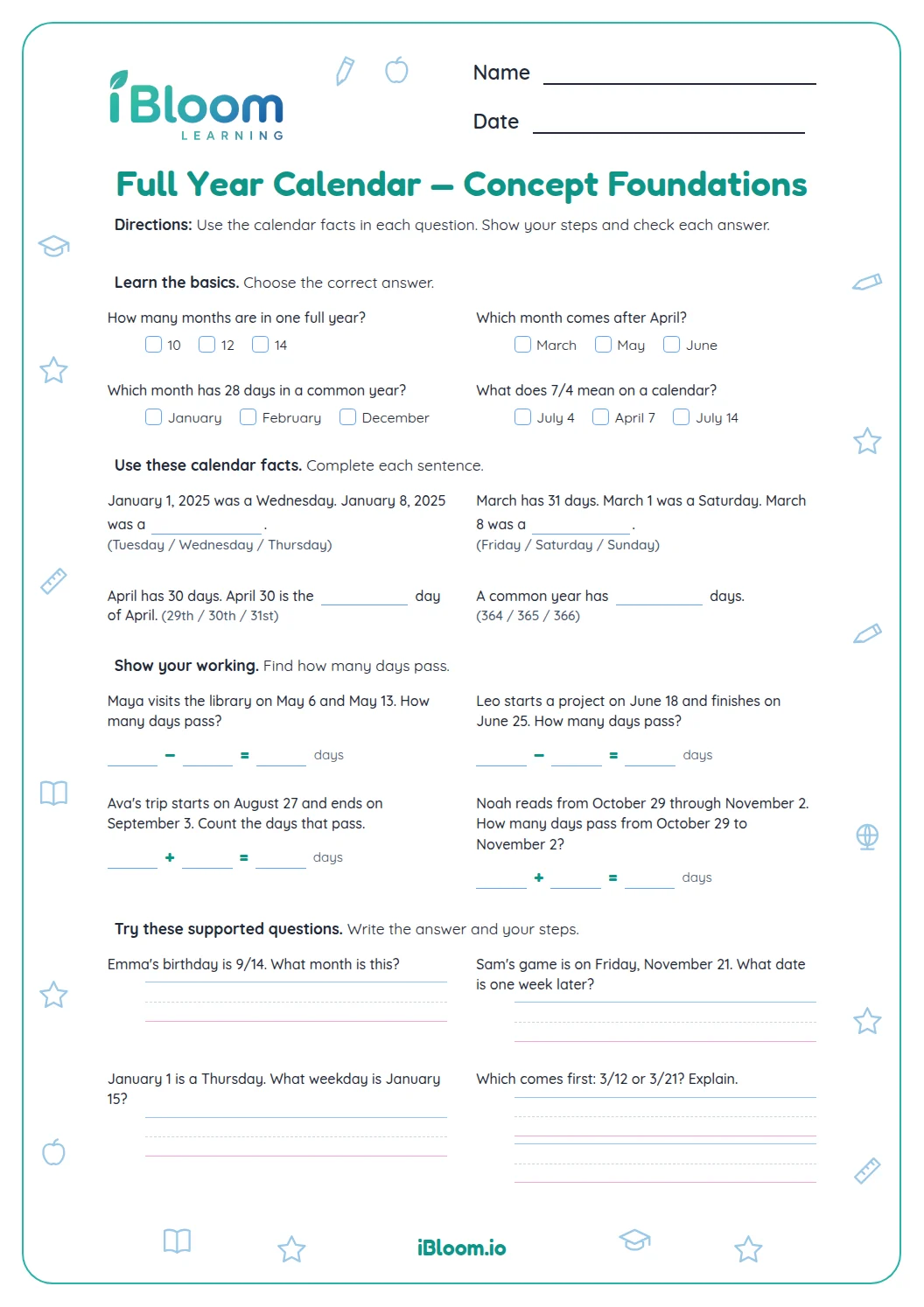
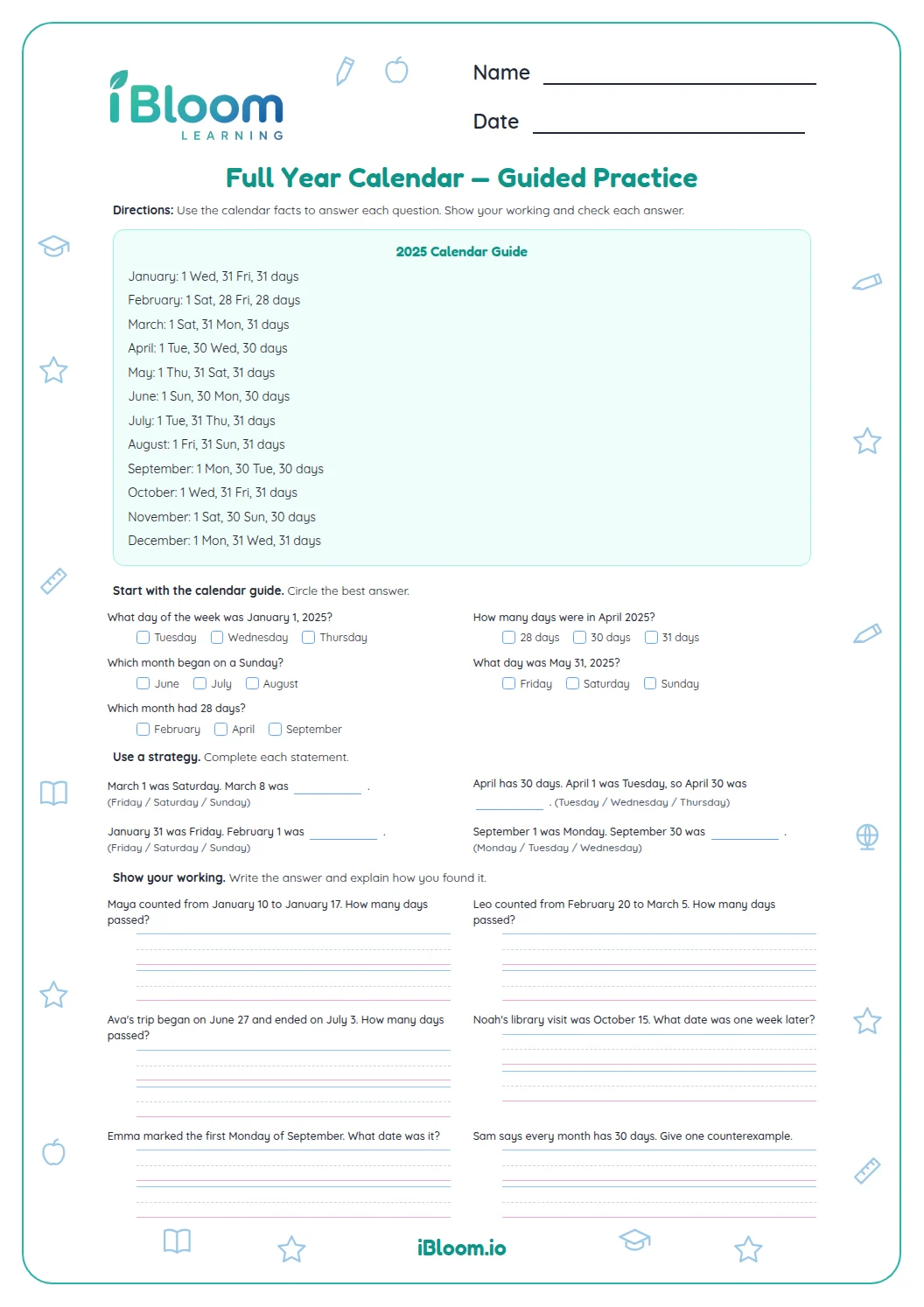
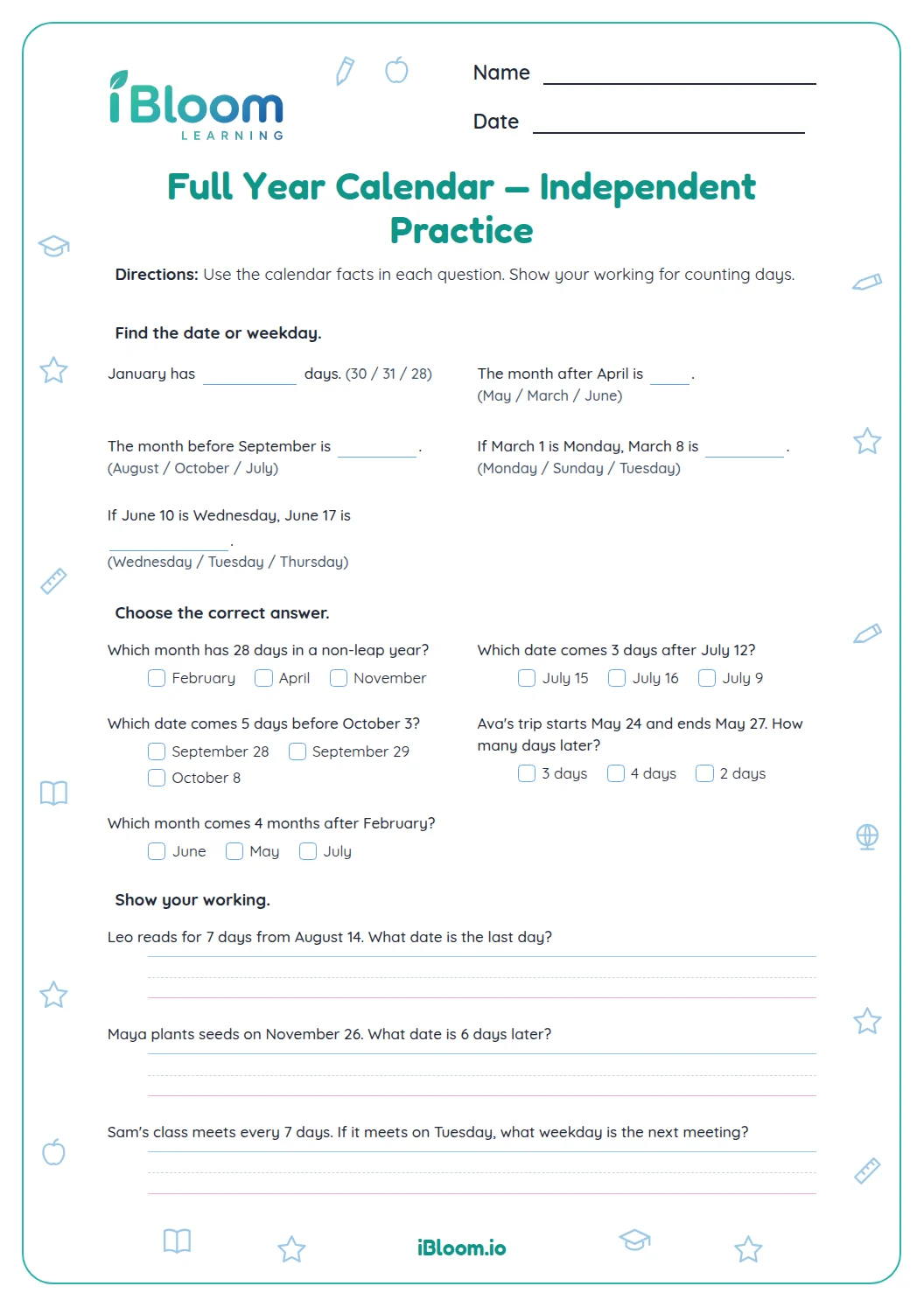
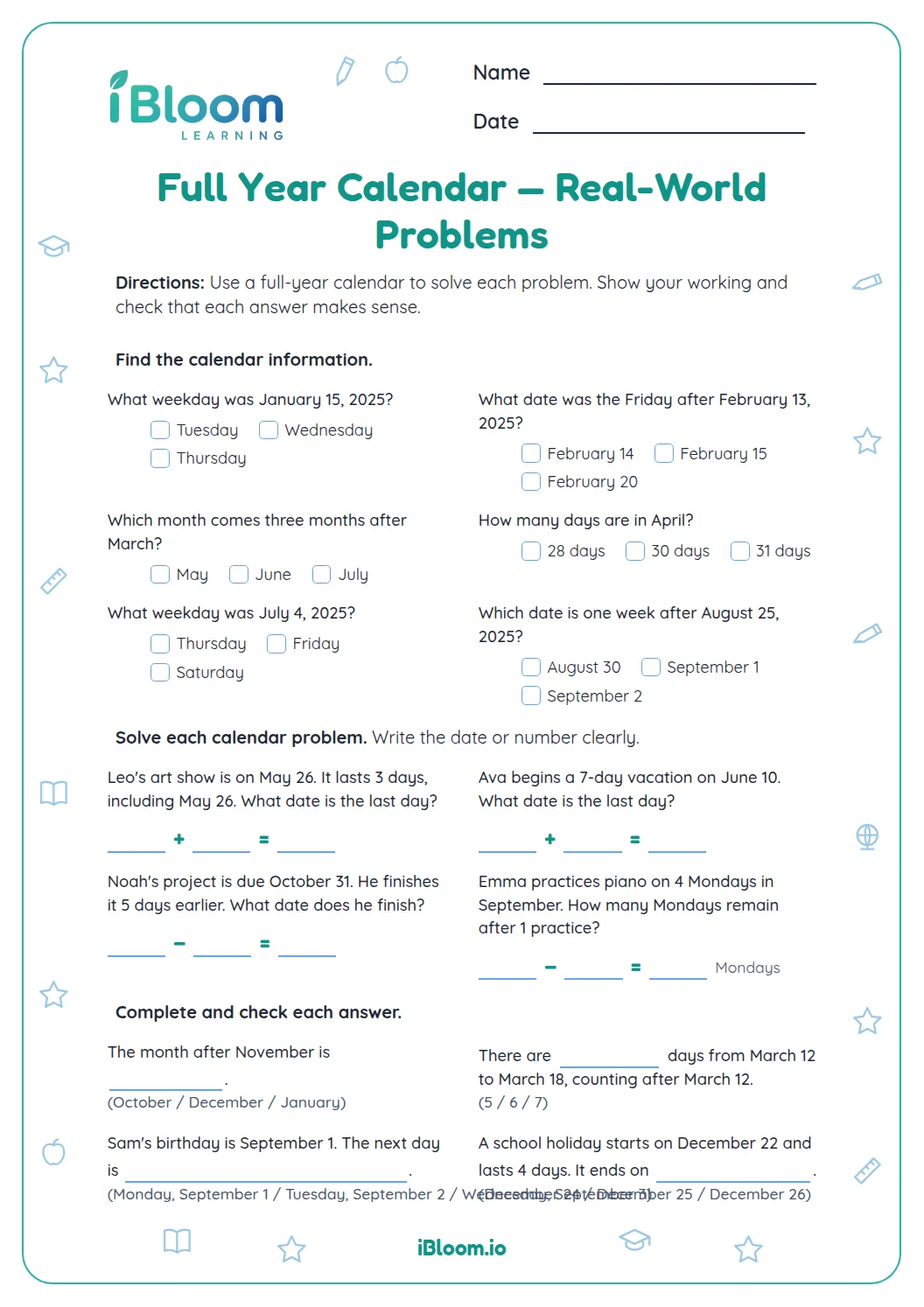
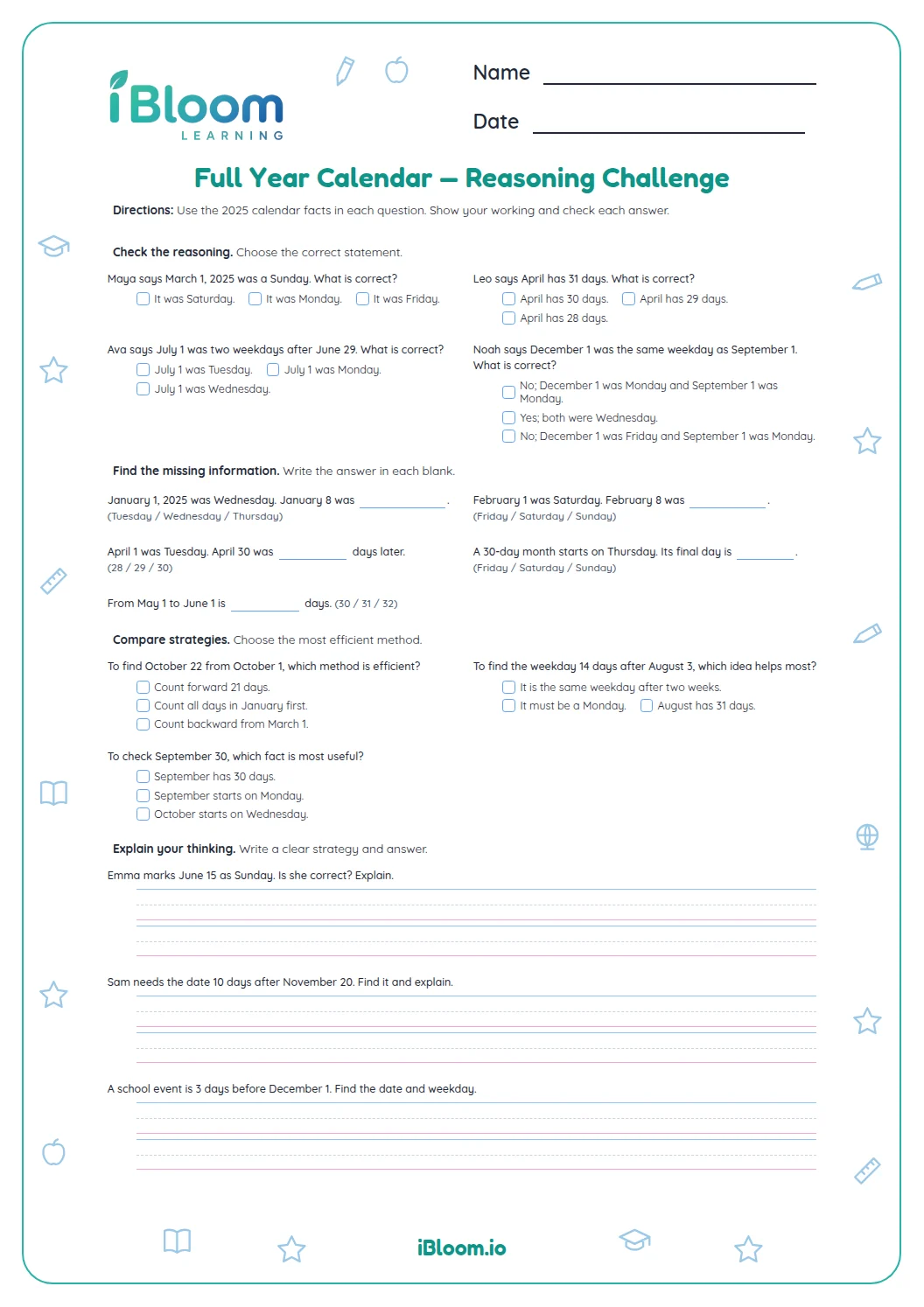
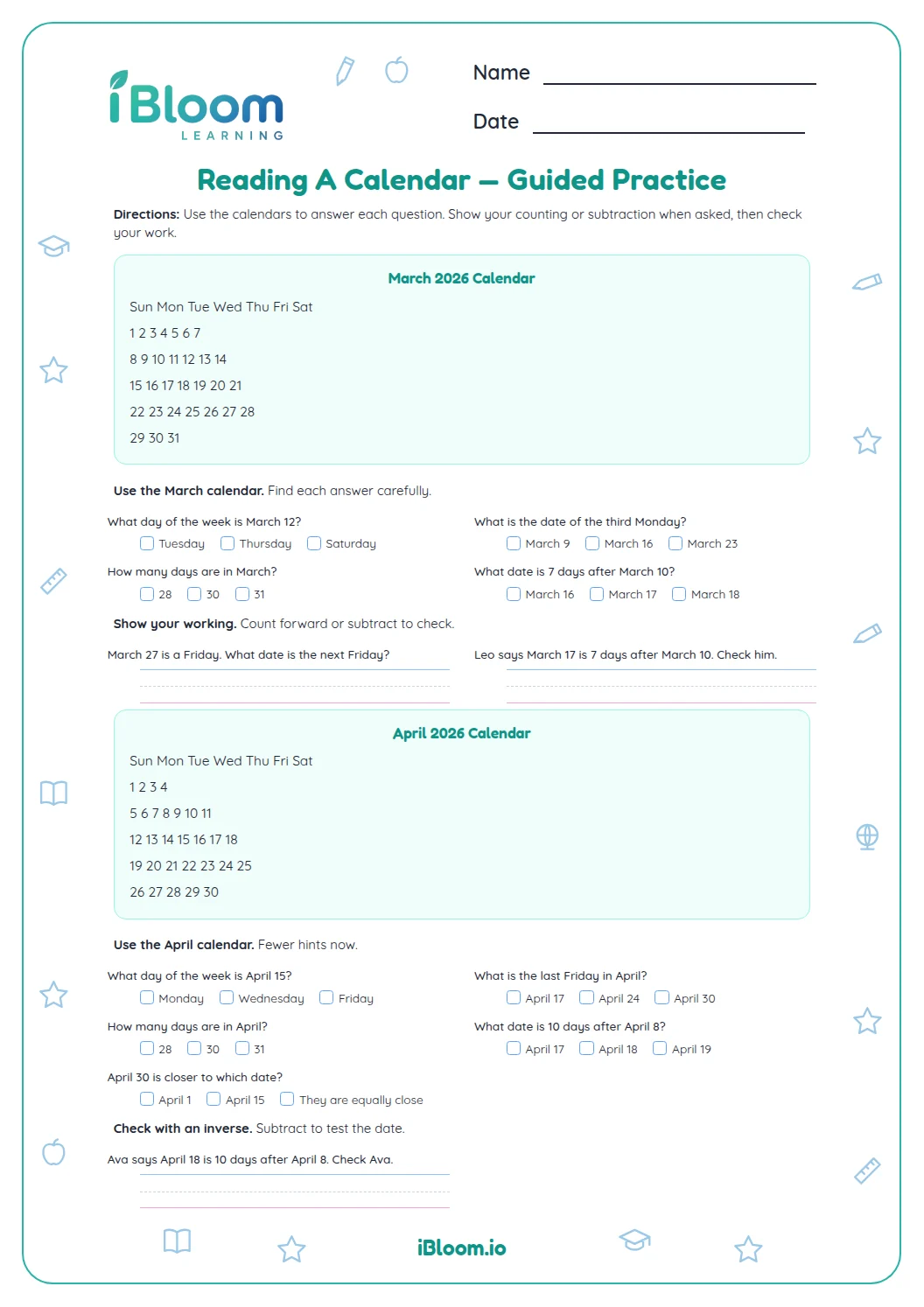
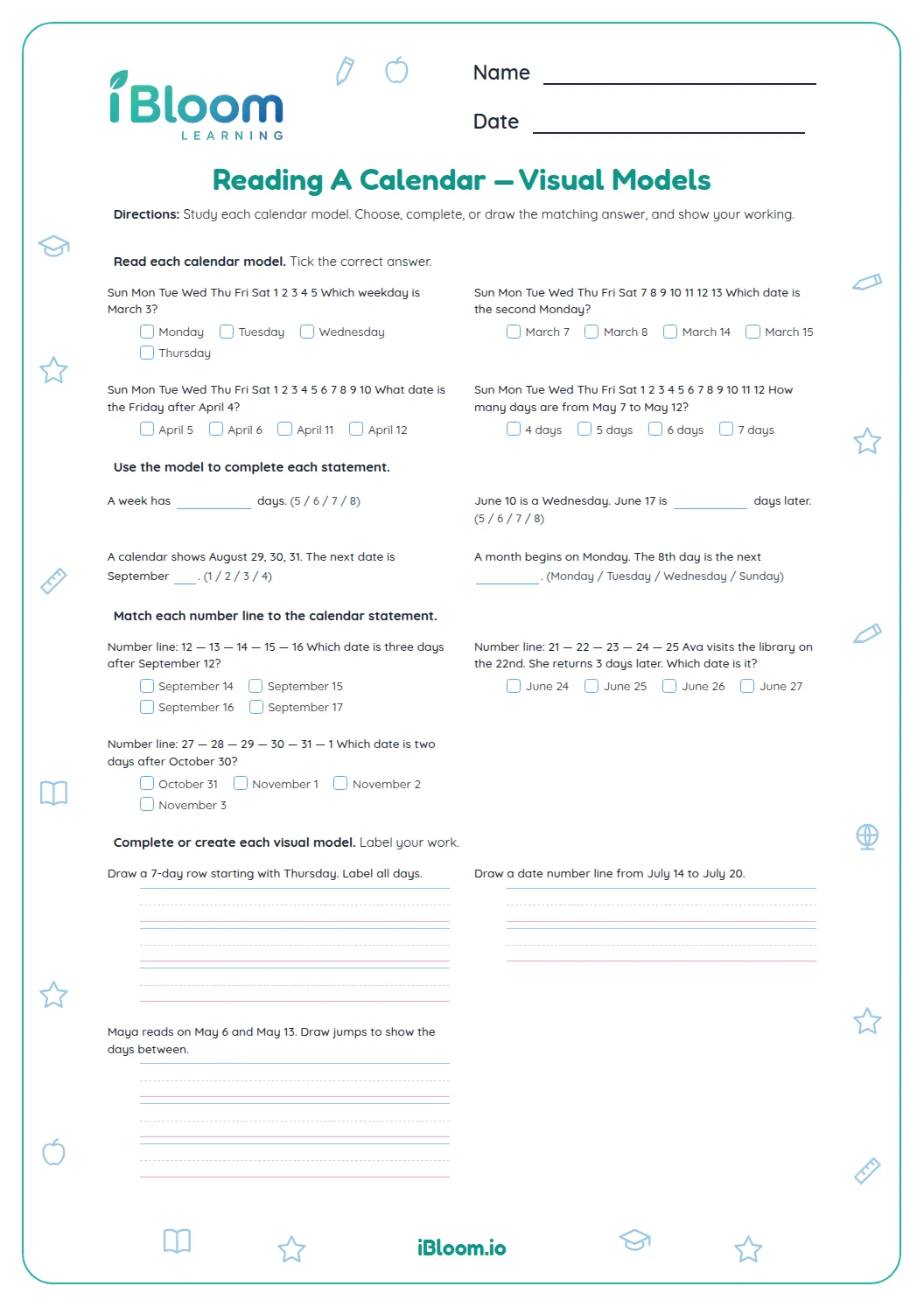
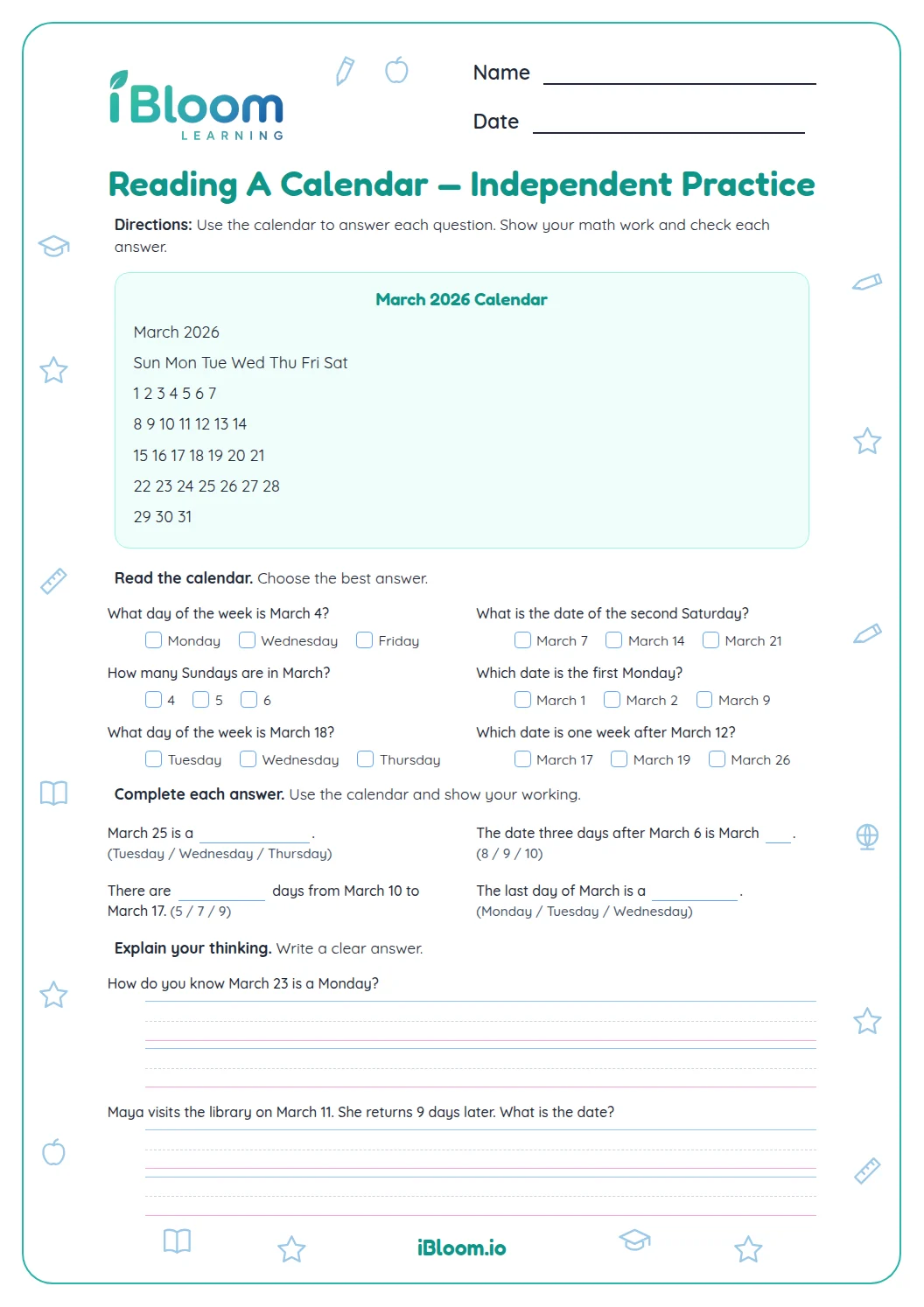
This free printable calendar worksheet gives Grade 3 students three ways to organize dates across a year. Part A completes four month sequences that together include January through December. Part B reads six short weekday strips. Part C uses four number lines to move forward or backward between dates in a month. There are fourteen questions and a separate answer key. The date-jump questions practice Common Core 2.MD.B.6 by representing whole-number sums and differences on number lines. Students label their answers with a month so each number becomes a meaningful calendar date.
Aligned to 2.MD.B.6
How does the sheet cover the whole year?
Part A groups the twelve months into four quarters of three months each. Children supply March, June, September, and December, completing the year in order. Read each finished sequence aloud, then connect the end of one group to the start of the next.
Part B adds weekdays to dates in February, May, August, and November. Each strip has one weekday missing. Children use the neighboring days to complete it, keeping the weekday sequence moving forward. Two more strips cross from October into November and from December into January; the weekday order keeps going when the month changes.
How do children count days on a date number line?
Begin at the stated date and count the spaces you move, leaving the starting tick uncounted. After means move right to larger dates; before means move left to smaller dates. Every number line in Part C stays within one named month.
- 1Start at March 12.
- 2Move 3 spaces right: 13, 14, 15.
- 312 + 3 = 15, so the date is March 15.
How can I check both the date and the reasoning?
Ask your child to point to the starting tick, show one jump for each day, and read the landing date. On question 12, four days before June 20 lands on June 16. The movement and the written answer should agree.
The key gives the missing months, weekday names, and final dates. A student can check a backward jump by moving forward the same number of spaces to return to the starting date.
How to use this worksheet
- 1Read January through December together before completing Part A.
- 2In Part B, read each date strip from left to right and fill in the missing weekday.
- 3On each Part C line, mark the starting date lightly with a pencil.
- 4Draw one jump for each day, moving right for after and left for before.
- 5Write the month and landing number, then check by reversing the jumps.
Mistakes to notice and how to help
The mistake
Counting the starting date as day one and answering March 14 for three days after March 12.
The fix
Start counting when the pencil reaches 13; the third jump lands on 15.
The mistake
Moving right for four days before June 20.
The fix
Say before means earlier, then move left toward smaller dates.
The mistake
Writing a date number when Part B asks for a weekday.
The fix
Reread the question and answer with the day’s name, such as Friday.
Common Core alignment
Represent forward and backward date jumps as sums and differences on number lines.
On this sheet: Part C uses equally spaced date ticks to represent adding or subtracting whole numbers of days.
Show the official wordingHide the official wording
Represent whole numbers as lengths from 0 on a number line diagram with equally spaced points corresponding to the numbers 0, 1, 2, …, and represent whole-number sums and differences within 100 on a number line diagram.
What to practice next
Make more practice
Further reading
Questions parents and teachers ask
Which months appear on the worksheet?
All twelve months appear in Part A, grouped into four quarters of three months each. Children complete each quarter’s third month. Part B reads weekdays within and across months, including December into January. Part C uses March, June, September, and December for date jumps.
Do we need a wall calendar to answer the questions?
No, each question supplies its own month group, weekday strip, or number line. The strips use dates from 2026 and continue into January 2027. Children can answer directly from the printed sequence, then check the dates on a wall calendar if one is available.
Why does the starting date not count as the first day?
The starting tick marks when the wait begins. One day has passed only when you reach the next date. For March 12 plus three days, the landing dates are March 13, March 14, and March 15. Counting the spaces makes that difference visible.
Should my child write the month in every date answer?
Yes, Part C asks for the month and date together. A bare 15 identifies the number reached, while March 15 tells which calendar date is meant. Part A asks for month names only, and Part B asks for weekday names, so the answer format changes by part.
How can we extend the number-line practice?
After checking a date answer, ask your child to reverse the same jumps. March 15 minus three days returns to March 12. Then choose another starting tick on that line and a small number of days that keeps the landing date inside its printed range.