
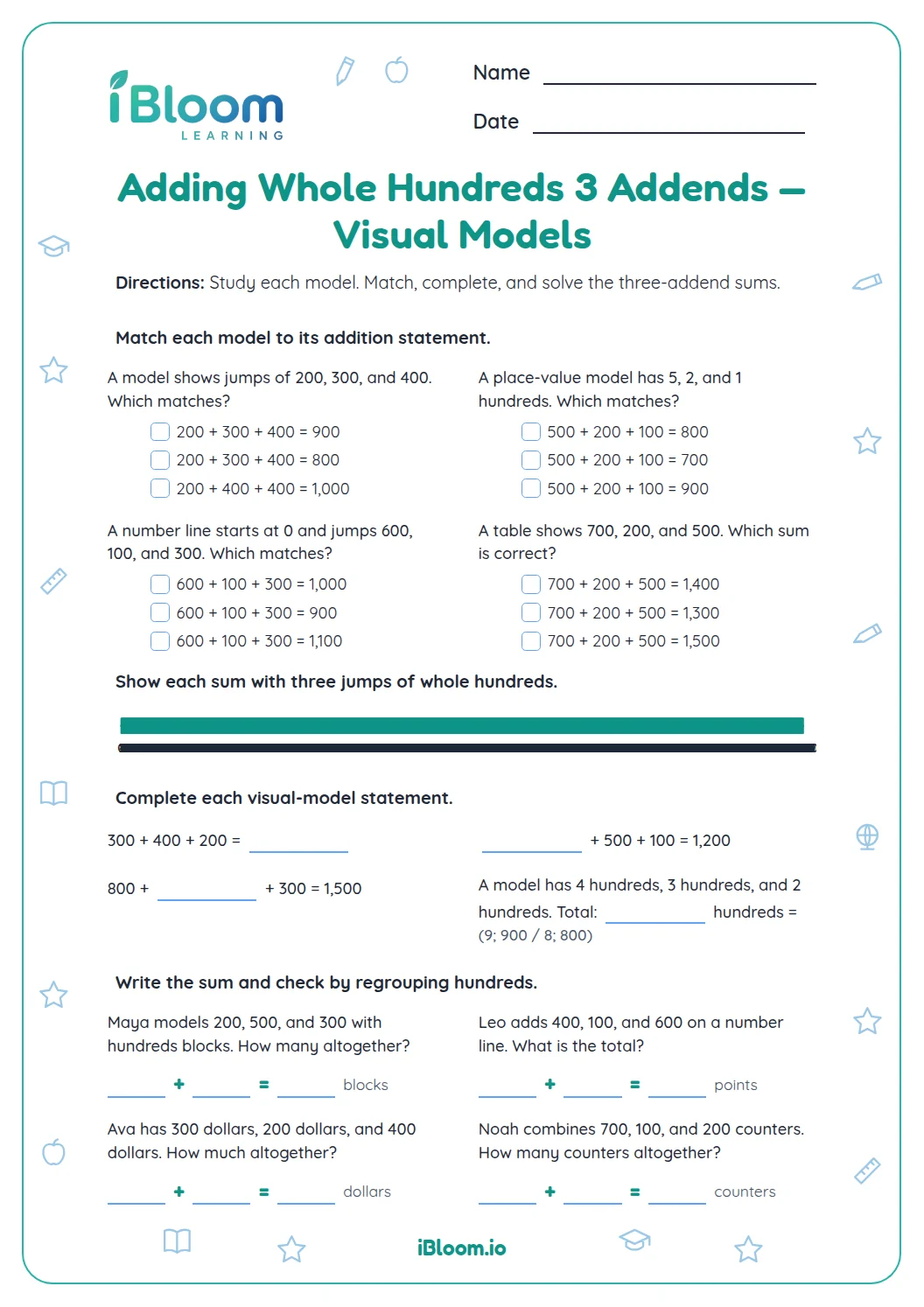
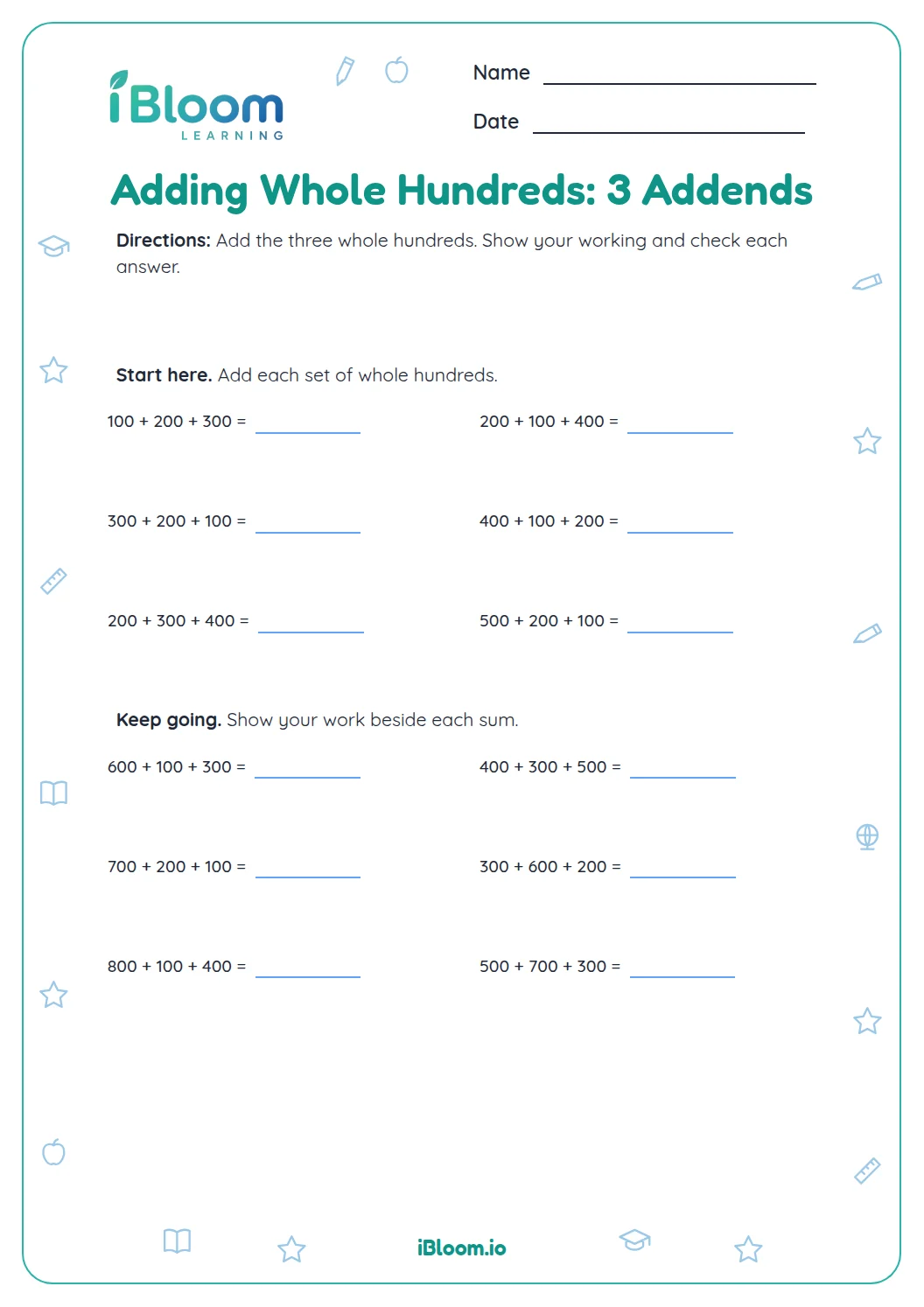
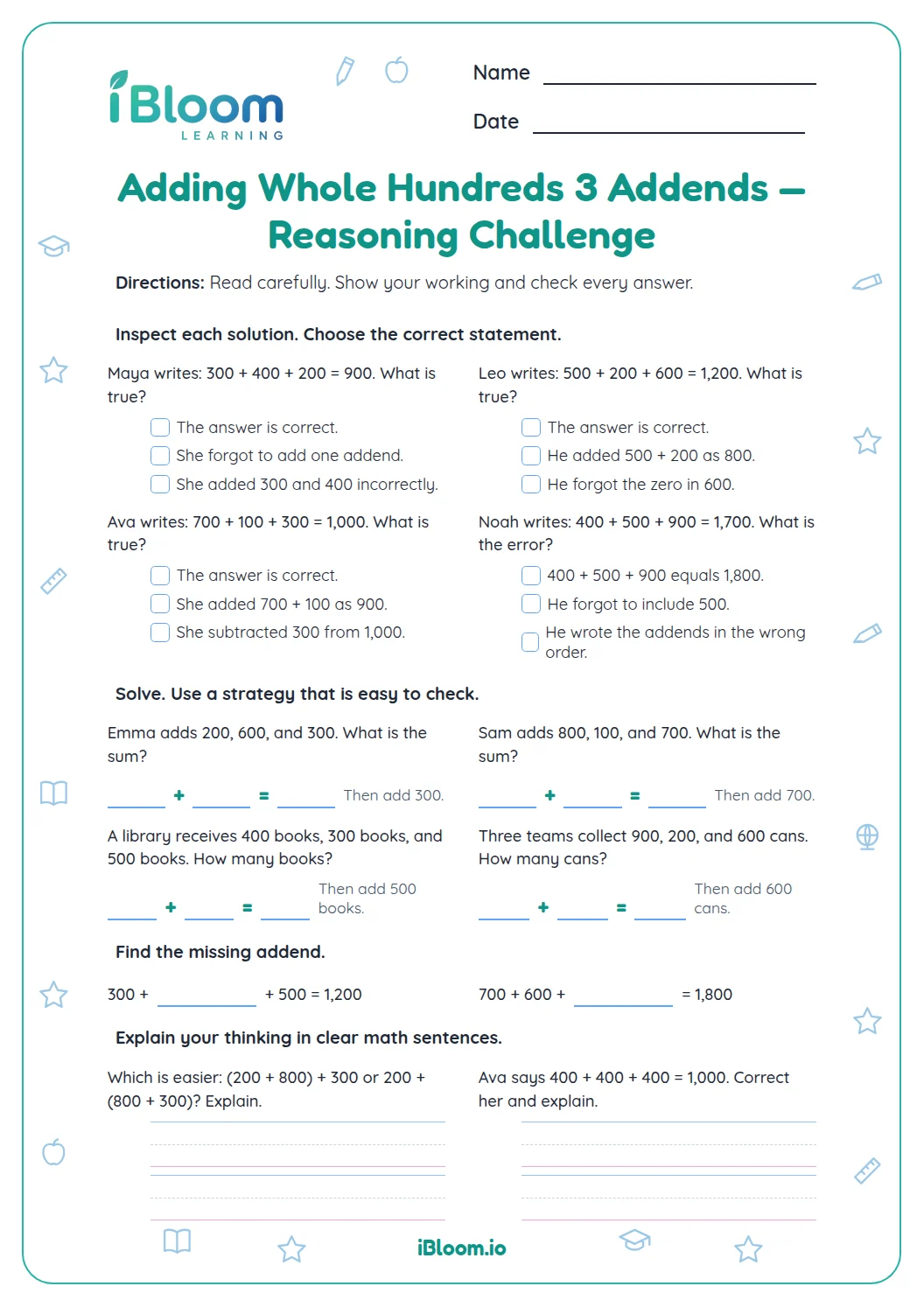
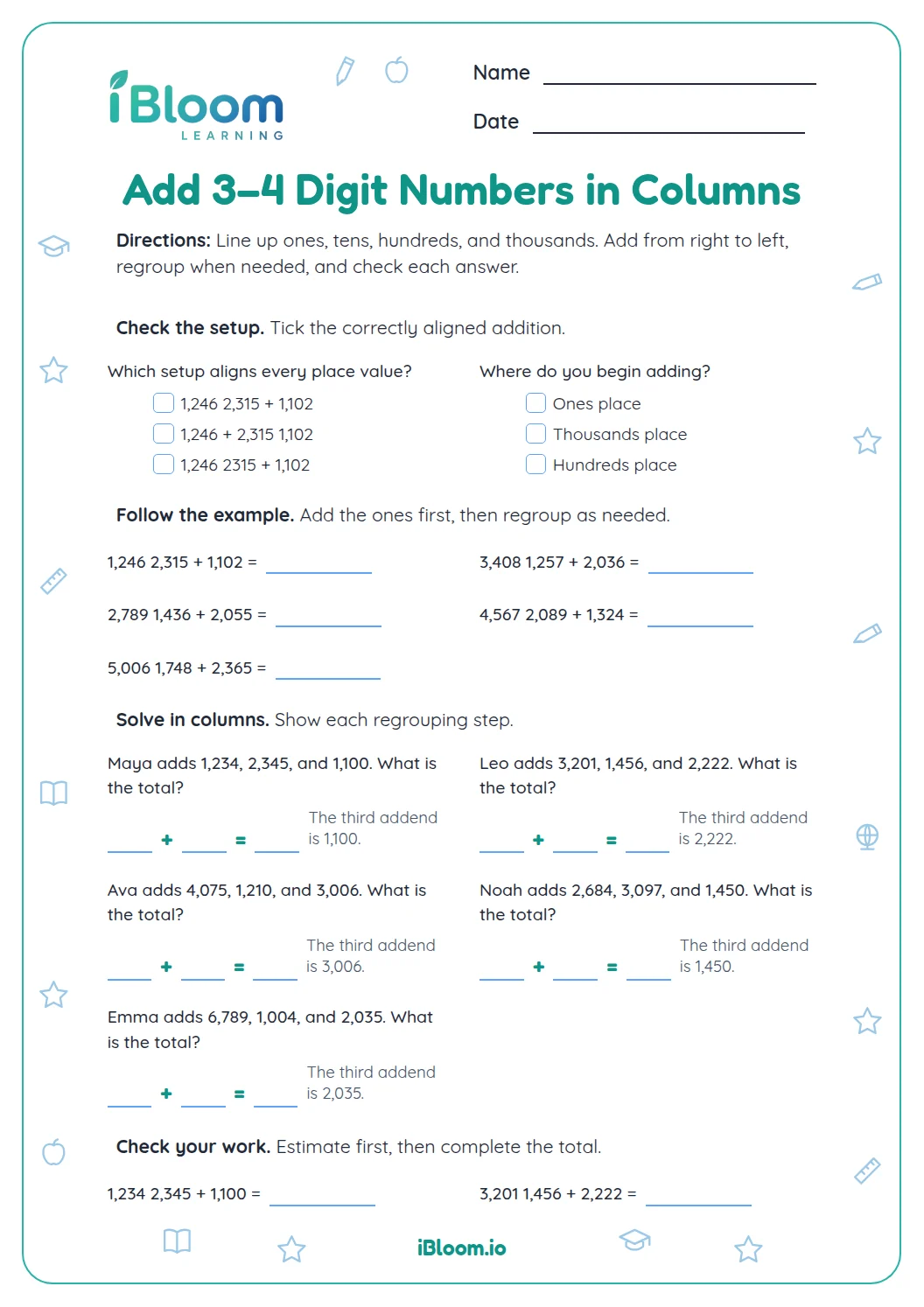

About this worksheet
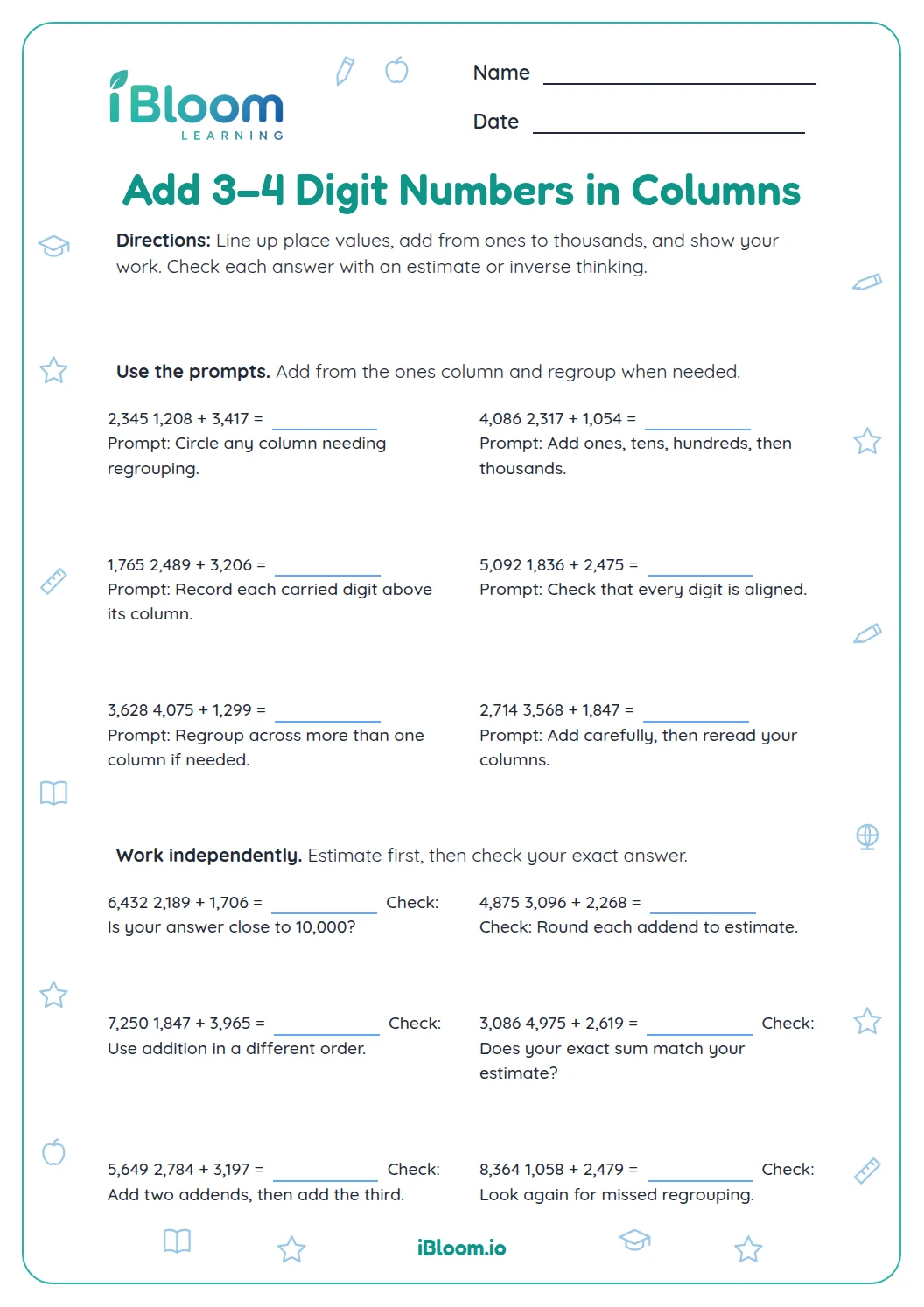
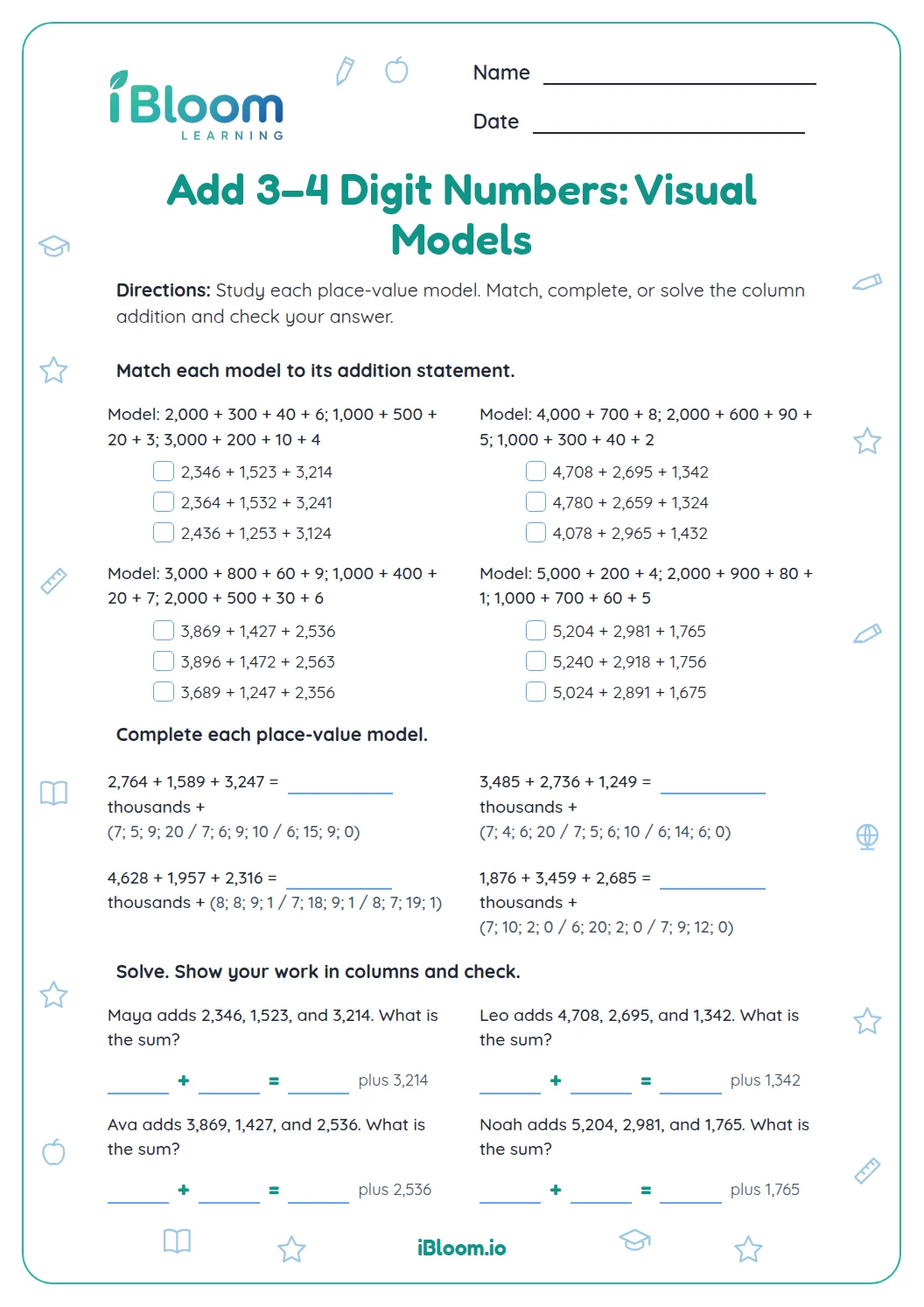
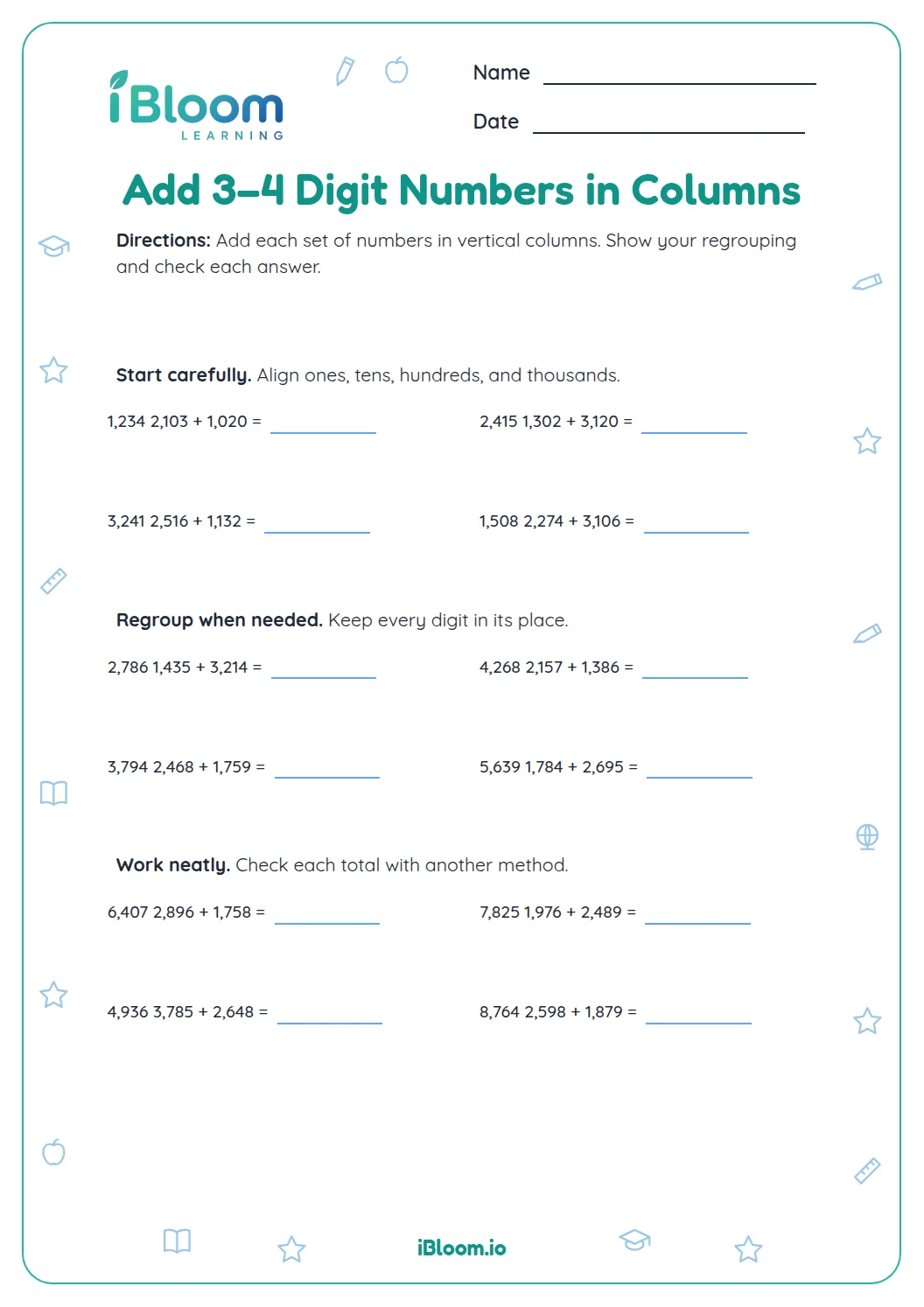
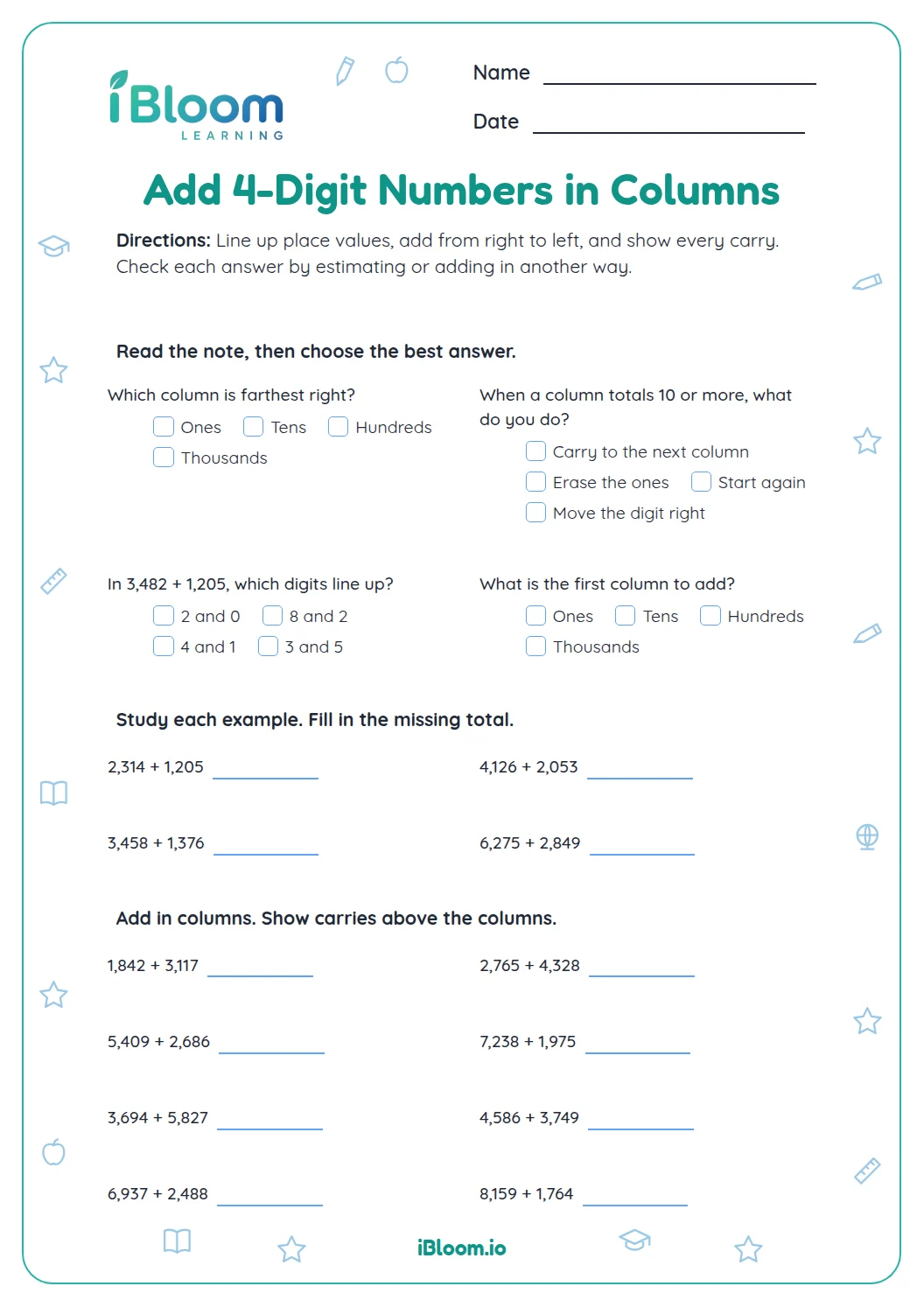
This printable gives Grade 4 students focused practice adding three four-digit numbers in real-world settings. The 14 compact stories use amounts such as books, donations, miles, and visitors; each asks for one total and provides working space. Students use place-value strategies and regroup as needed. The skill aligns with CCSS 4.NBT.B.4, and a separate answer key lists each total.
Aligned to 4.NBT.B.4
How do you add three four-digit amounts?
Line up the place values, combine digits by place, and regroup when a column reaches ten. In question 2, $1,300 + $2,400 + $1,500 = $5,200. Keep the dollar sign and comma in the final amount.
- 1Add 1,300 and 2,400 to get 3,700.
- 2Add 1,500 more.
- 3The total raised is $5,200.
How can you check a total?
Add the first two amounts, then add the third. Estimate with thousands to see whether the total is reasonable. Keep units such as dollars, miles, and books attached to the story.
How can students use the practice?
The 14 stories use three four-digit quantities throughout. The answer key makes it easy to check each sum after students have shown their work.
How to solve the problems
- 1Underline the three amounts in the story.
- 2Line up thousands, hundreds, tens, and ones.
- 3Add one place-value column at a time.
- 4Regroup when a column totals ten or more.
- 5Check the sum with an estimate or a second addition order.
Common addition mistakes
The mistake
Forgetting to regroup a column.
The fix
Trade each group of ten for one unit in the next place.
The mistake
Misaligning digits.
The fix
Keep each digit in its thousands, hundreds, tens, or ones column.
The mistake
Dropping a comma or money sign.
The fix
Write the final total with the same unit and money format as the story.
Common Core alignment
This sheet practices multi-digit addition using place-value strategies.
Add multi-digit whole numbers accurately, including the story totals on this sheet.
On this sheet: Students add three four-digit whole numbers in each context.
Show the official wordingHide the official wording
Fluently add and subtract multi-digit whole numbers using the standard algorithm.
What to practice next
Make more practice
Further reading
Questions parents and teachers ask
How many problems are included?
The worksheet includes 14 real-world addition problems. Each story gives three four-digit amounts and asks students to find one total, with space for a written answer and a separate key for checking. The printed directions remind students to use the numbers and units shown in each problem.
Are all the addends four-digit numbers?
Yes. Every problem uses three four-digit numbers, so students practice combining thousands, hundreds, tens, and ones. The settings include books, fundraising, harvests, visitors, and other familiar totals. The worksheet keeps one answer in each item so students can check their work clearly.
Does the printable include an answer key?
Yes. A separate answer key lists the total for all 14 stories. Students can use it after solving each problem and check whether the units, dollar signs, and commas match the context. The key follows the same question order as the printable for quick review.
What does question 2 ask students to add?
Question 2 combines $1,300, $2,400, and $1,500 from three fundraising events. Their sum is $5,200. The key preserves the dollar sign and comma so the amount is easy to read. Students can write a brief check beside an answer before comparing it with the key.
How can students check their sums?
Students can estimate by rounding each amount to a nearby thousand, then compare the estimate with the exact total. They can also add the numbers in a different order to confirm the same sum. Parents or teachers can review one item at a time and discuss how the answer was found.