
About this worksheet
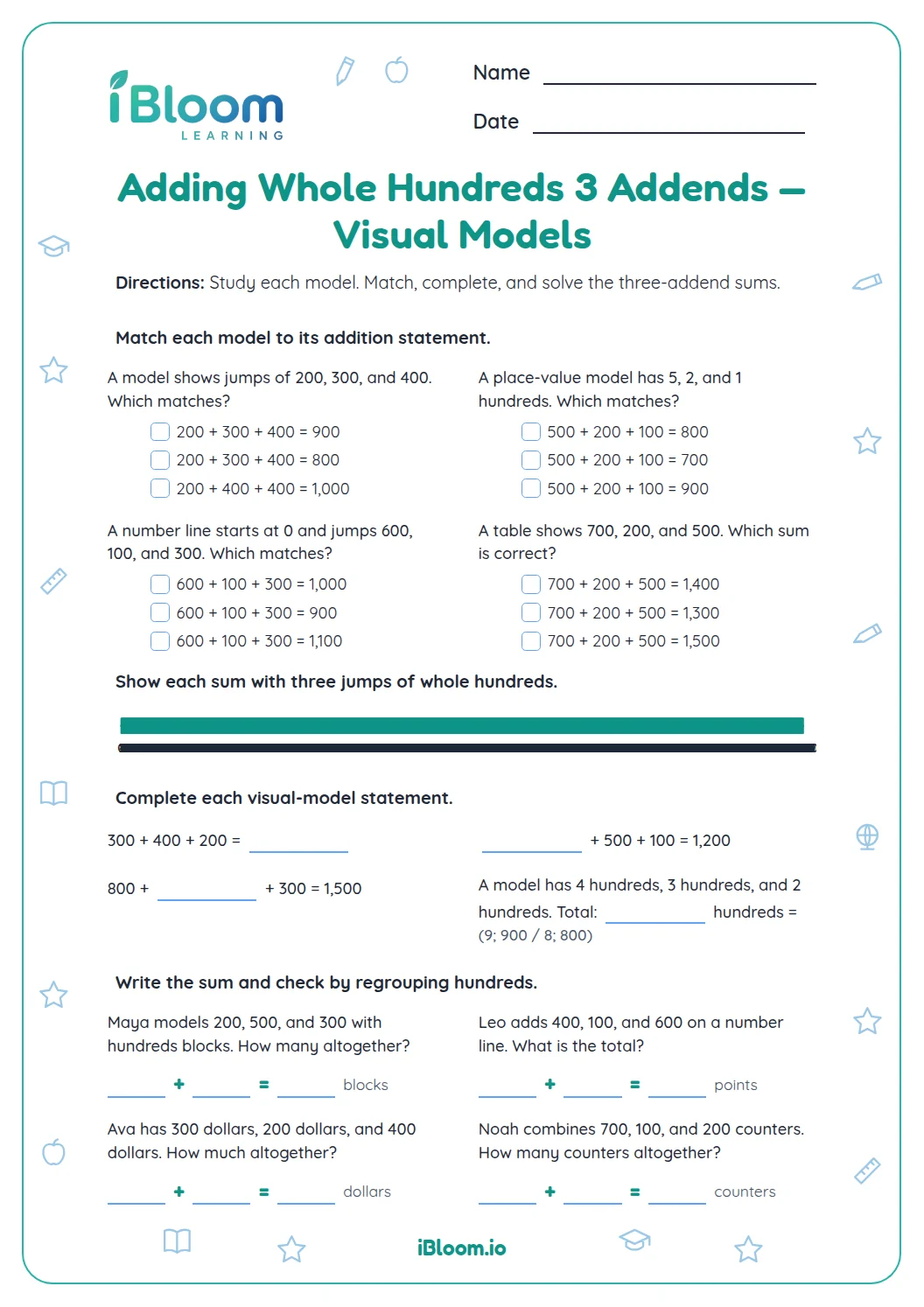
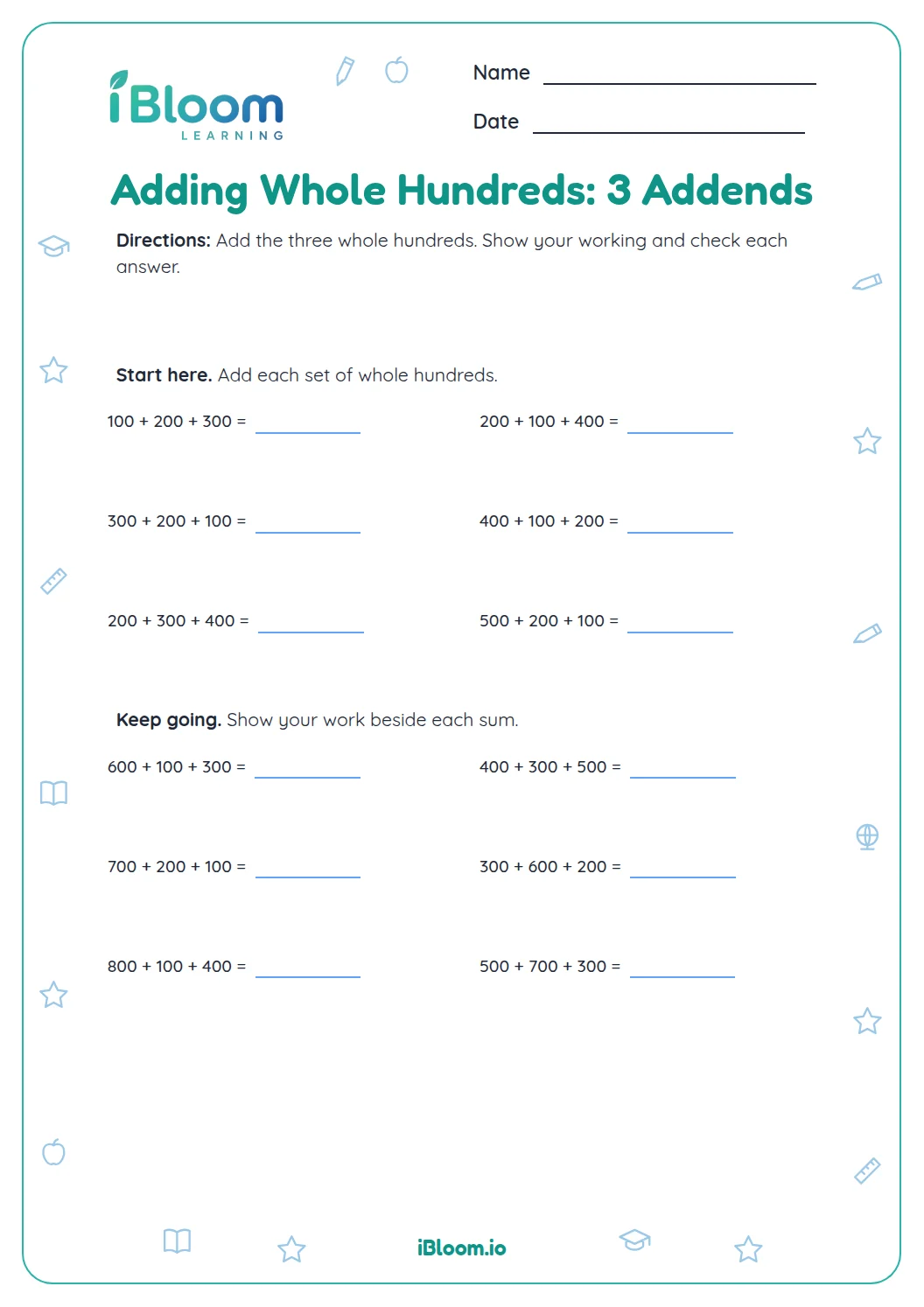
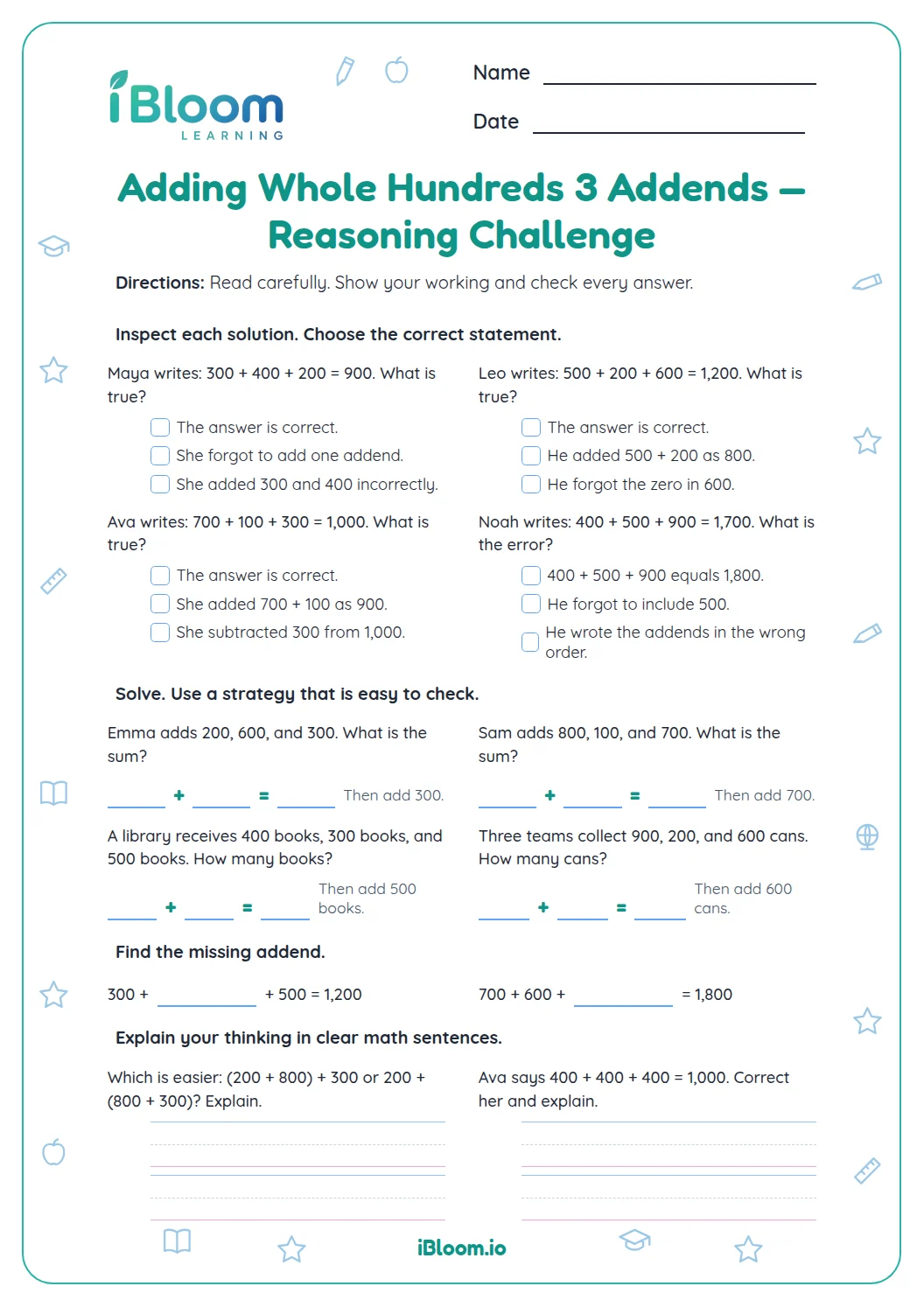
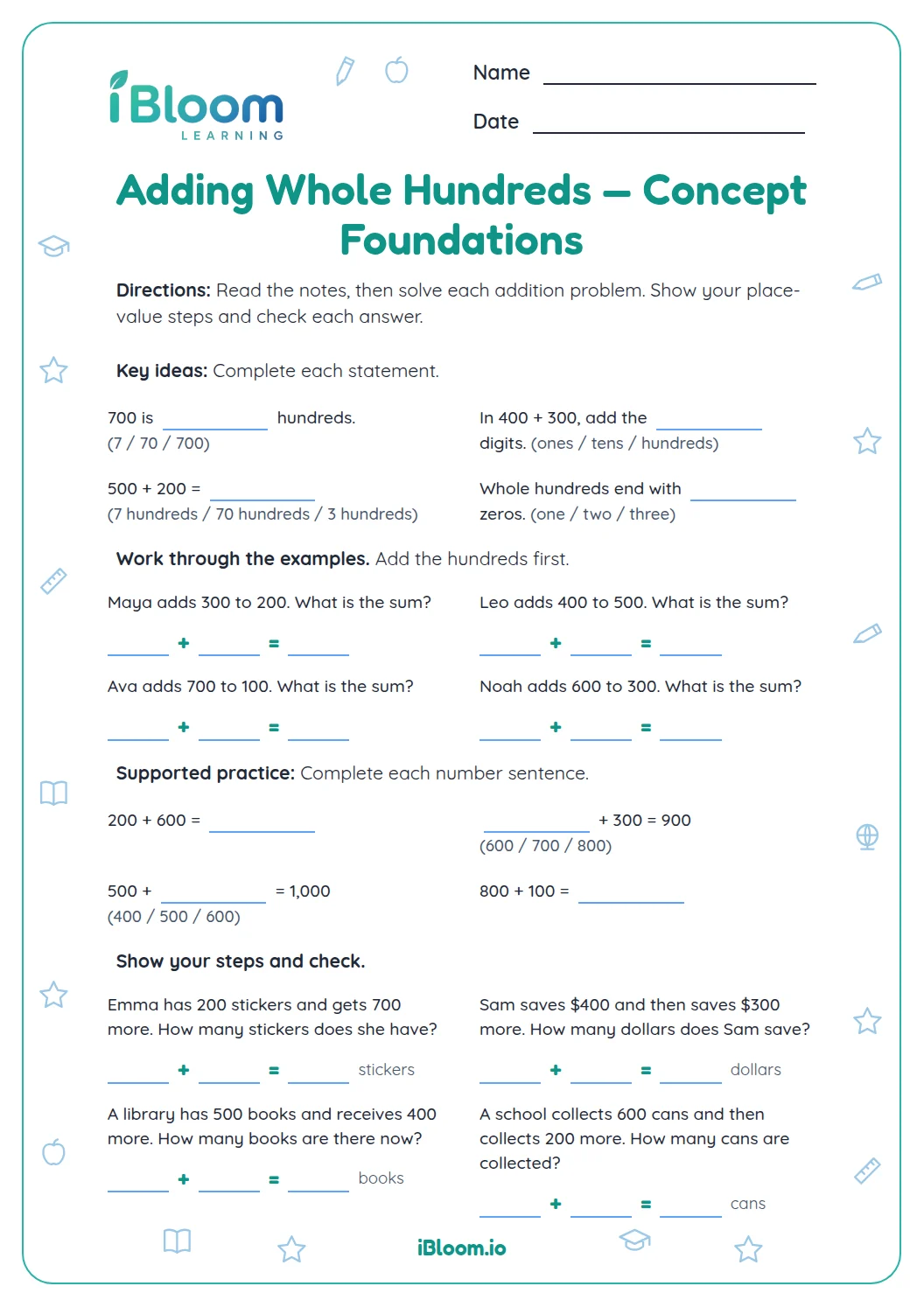
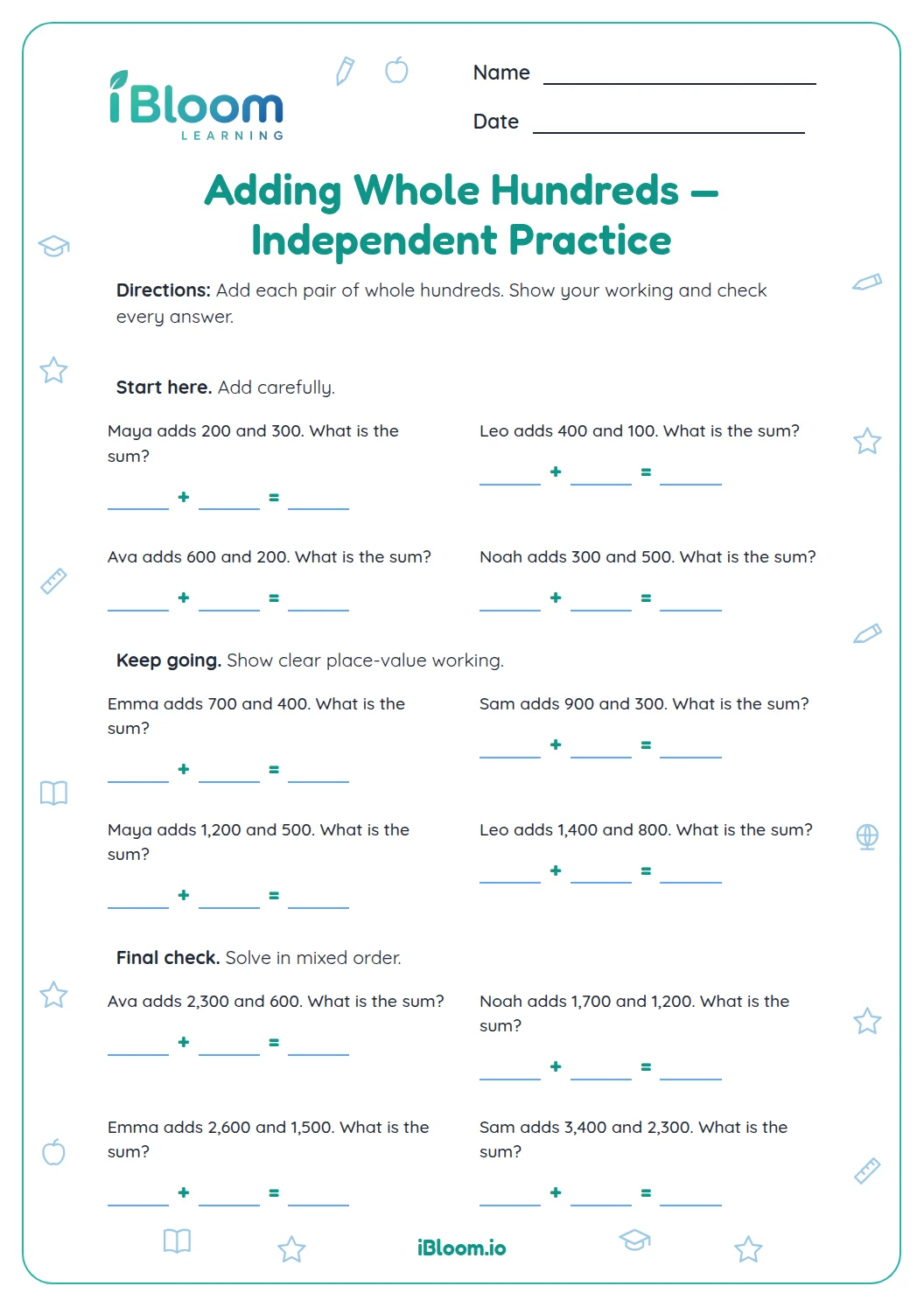
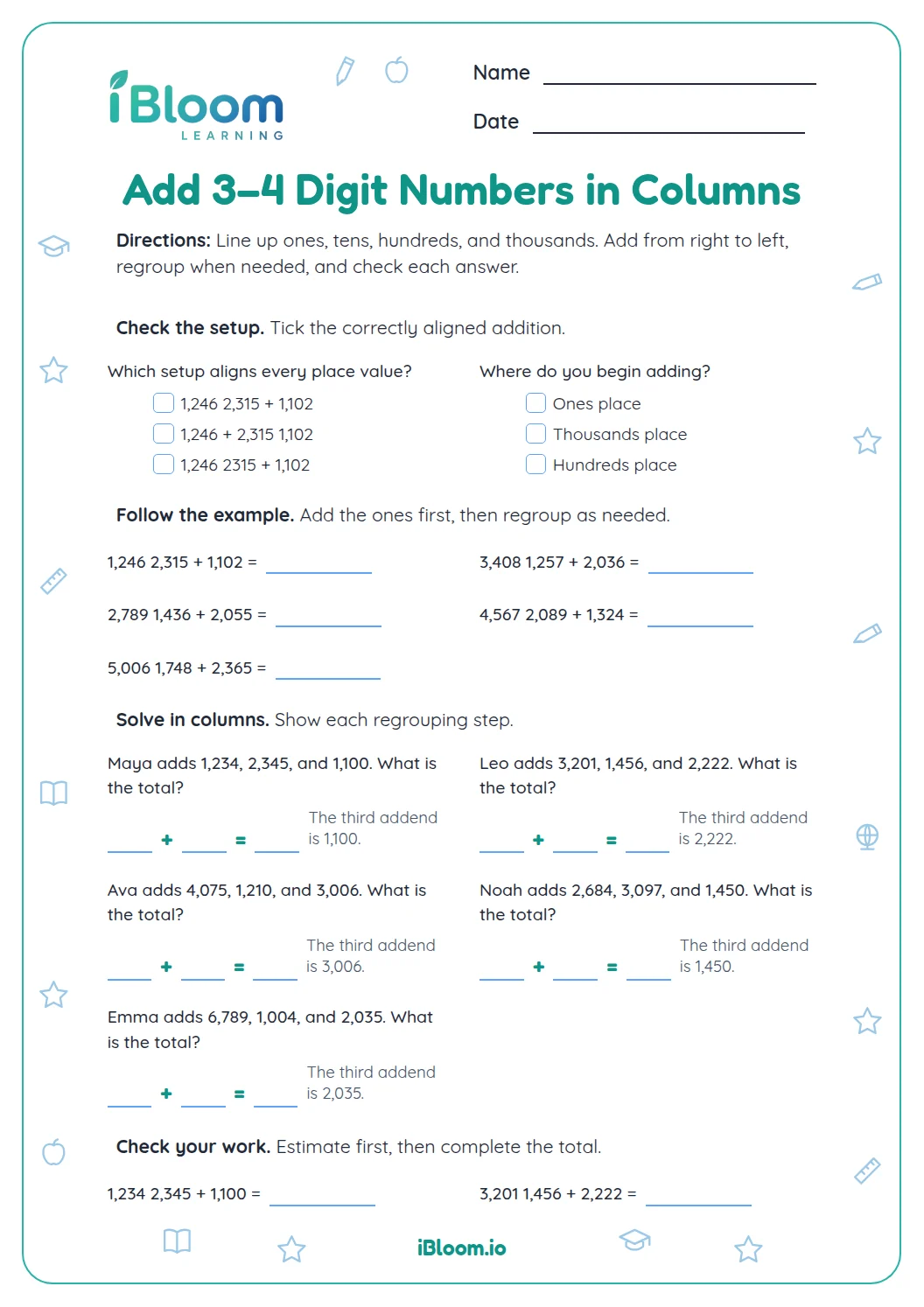
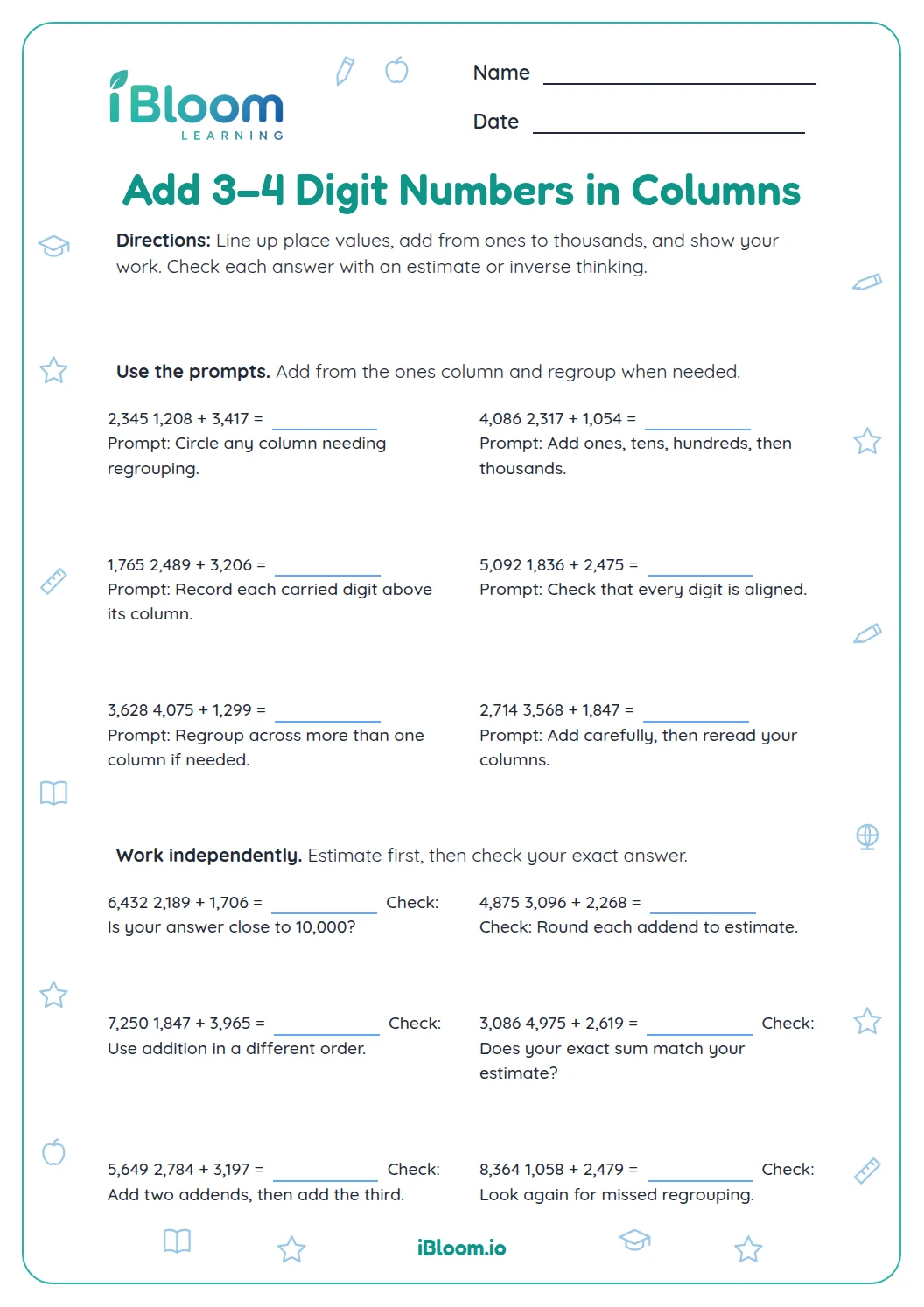
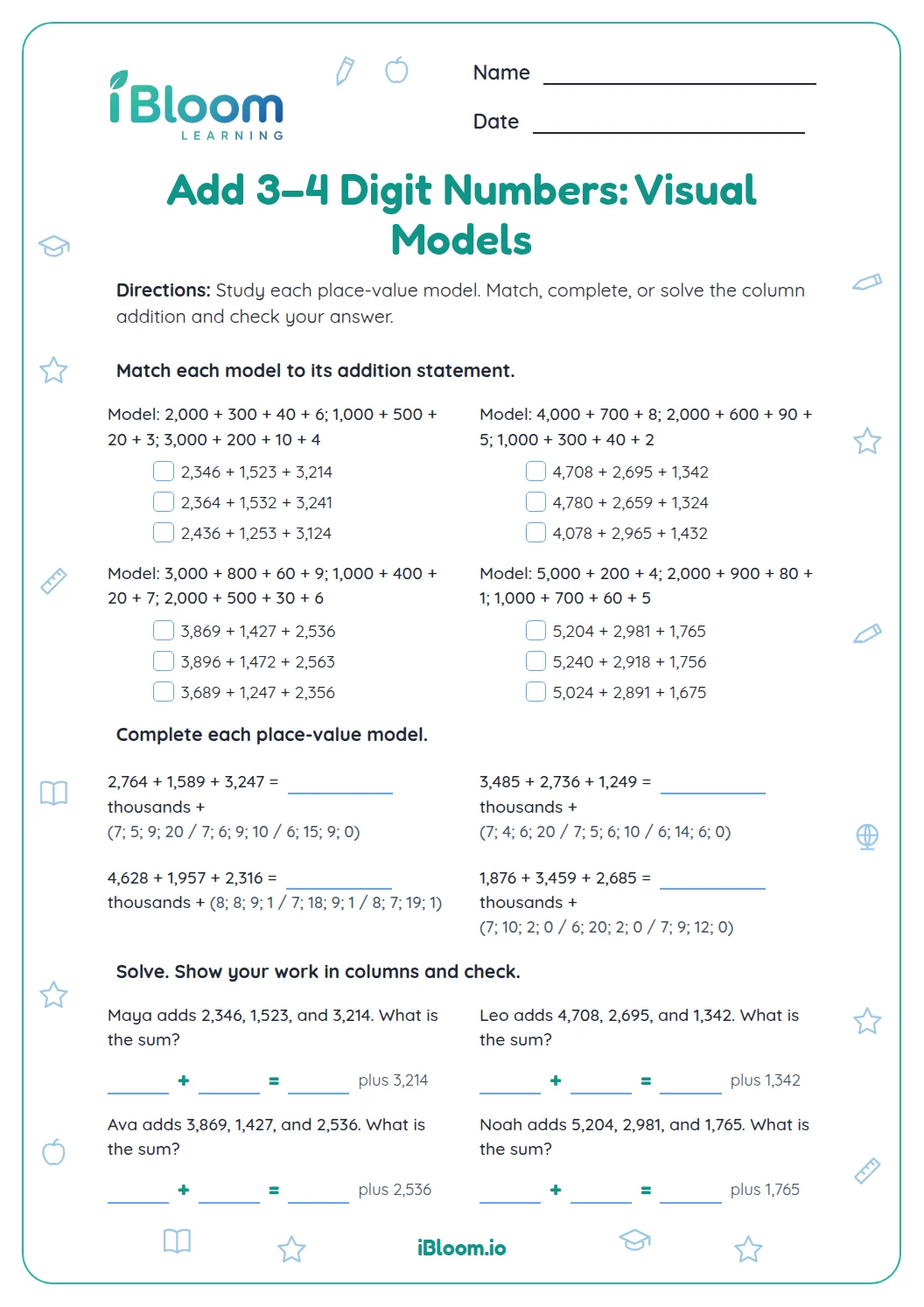
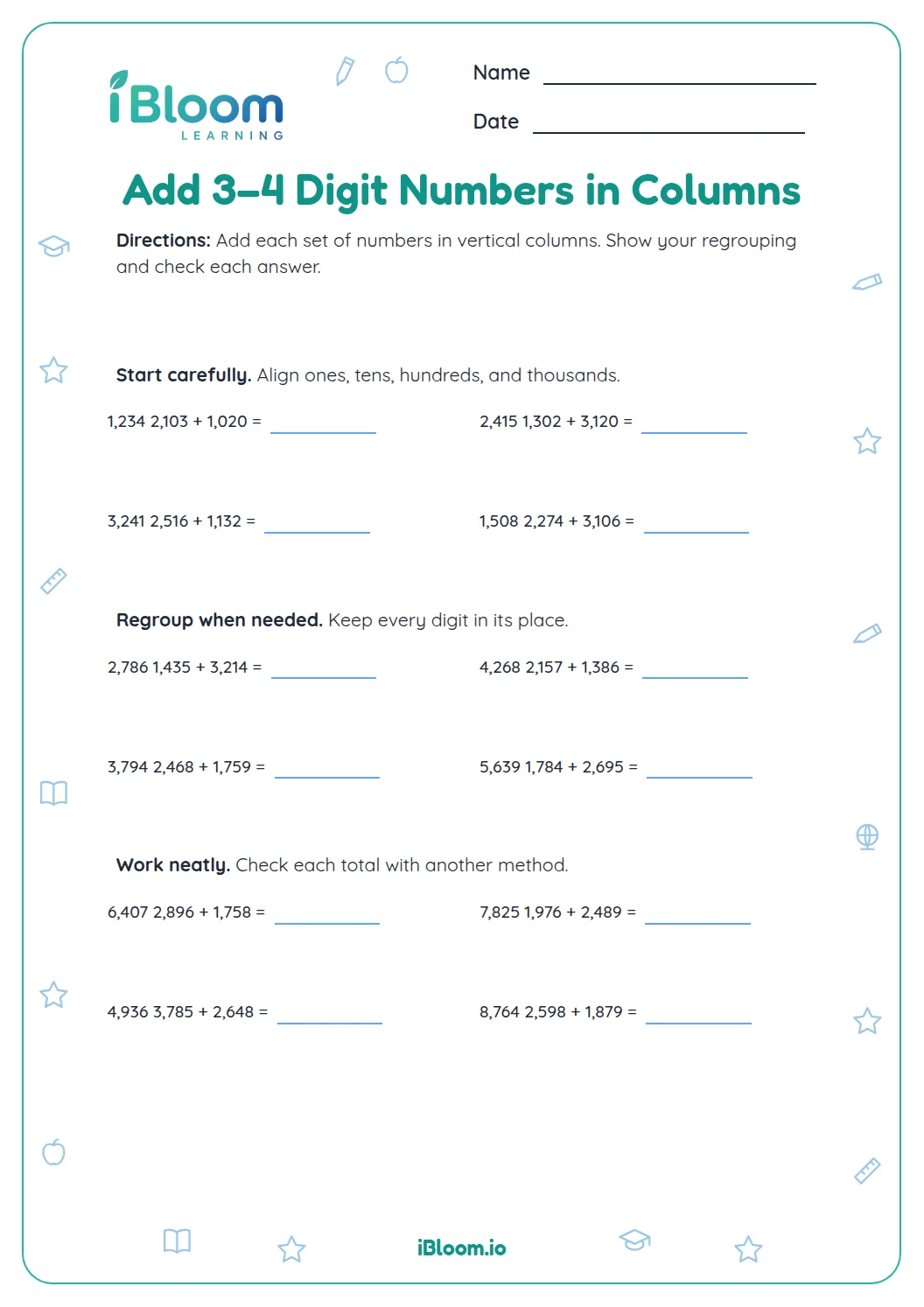
This Grade 4 guided practice focuses on adding three four-digit whole hundreds. Twelve compact number sentences use comma formatting throughout; one asks children to describe a useful grouping and one applies the skill to a planting story. The separate answer key includes the totals and a sample grouping.
Aligned to 4.NBT.B.4
What does this addition worksheet include?
This Grade 4 guided practice focuses on adding three four-digit whole hundreds. Twelve compact number sentences use comma formatting throughout; one asks children to describe a useful grouping and one applies the skill to a planting story. The separate answer key includes the totals and a sample grouping.
- 11,200 + 1,600 + 2,300
- 2Group 1,200 + 2,300 = 3,500
- 33,500 + 1,600 = 5,100
- Part A: add three-digit hundreds
- Part B: add larger multiples of 100
- Part C: solve three word problems and one missing-addend equation
What is a helpful way to add three numbers?
Add two addends to make a partial sum, then add the third. Estimate first so the final answer is in a reasonable range. Students may regroup the addends when that makes the mental addition easier.
How does the two-step method work?
Use one of the worksheet sums to see the partial sum before adding the last number.
- 1200 + 300 + 400
- 2First: 200 + 300 = 500
- 3Then: 500 + 400 = 900
How to use this worksheet
- 1Read all three addends before starting.
- 2Line up the hundreds or thousands.
- 3Add two addends, then include the third.
- 4Estimate the total to see whether it is reasonable.
- 5For a missing addend, subtract known amounts from the total.
Common mistakes and quick fixes
The mistake
Adding only two of the three addends
The fix
Mark each addend after including it in the total.
The mistake
Misaligning place values
The fix
Write hundreds under hundreds and thousands under thousands.
The mistake
Treating a missing addend as the total
The fix
Subtract the known addends from the stated total, then add to check.
Common Core alignment
This sheet practices the listed standard through its questions.
Use place value and the standard algorithm to add multi-digit numbers.
On this sheet: The practice adds three multi-digit whole numbers.
Show the official wordingHide the official wording
Fluently add and subtract multi-digit whole numbers using the standard algorithm.
What to practice next
Make more practice
Further reading
Questions parents and teachers ask
How do students add three whole hundreds?
Add two addends first, then add the third to that partial sum. For example, 200 + 300 = 500, and 500 + 400 = 900. The worksheet uses this approach in its first part, then moves to larger multiples of 100 and short word problems.
How many problems are included?
There are 14 questions: six sums with three-digit hundreds, six sums with larger multiples of 100, three word problems, and one missing-addend equation. Students can use the guided order in the directions and show partial sums before checking the answer key.
Do the addends need to be added in the printed order?
No. Addition can be grouped in a convenient order, as long as all three addends are included. The directions suggest adding the first two and then the third; students may also choose a pair that makes a friendly partial sum. The final total should be the same.
How can students check a total?
Estimate the total before calculating, then add the three addends and compare the result with the estimate. For 1,200 + 600 + 300, adding 1,200 and 600 gives 1,800; adding 300 gives 2,100. The answer key lists the exact total for each item.
What does the missing-addend problem practice?
The missing-addend question asks students to find the number that makes 1,500 + 2,200 + ___ equal 6,000. First combine the known addends to get 3,700, then find the difference between 6,000 and 3,700. The missing addend is 2,300.
Is an answer key included?
Yes. A separate answer key lists the totals for all 14 questions, including the word problems and missing addend. Students can compare their result with the key after showing their calculation or partial sums, then review any regrouping step that led to a different total.