
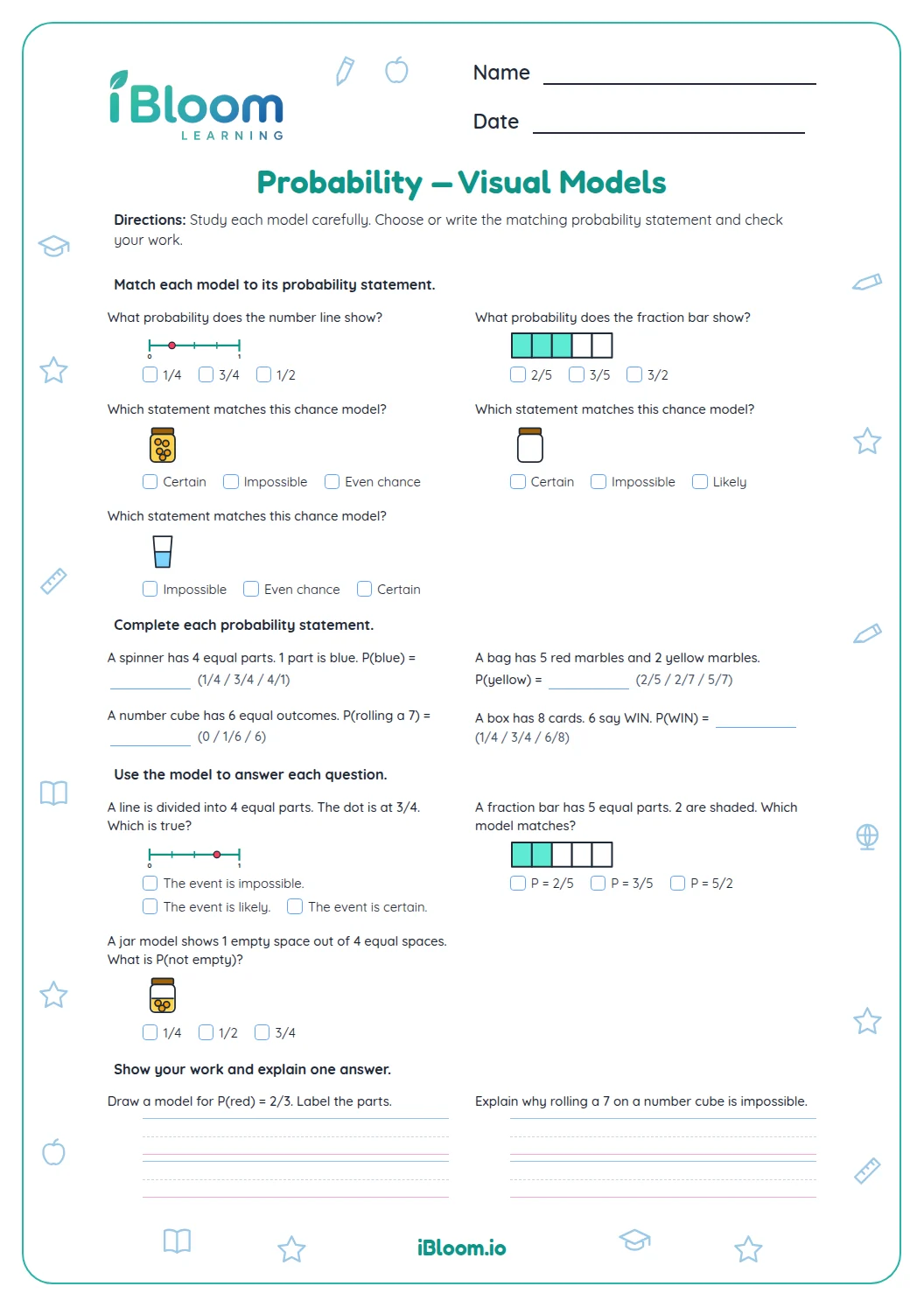
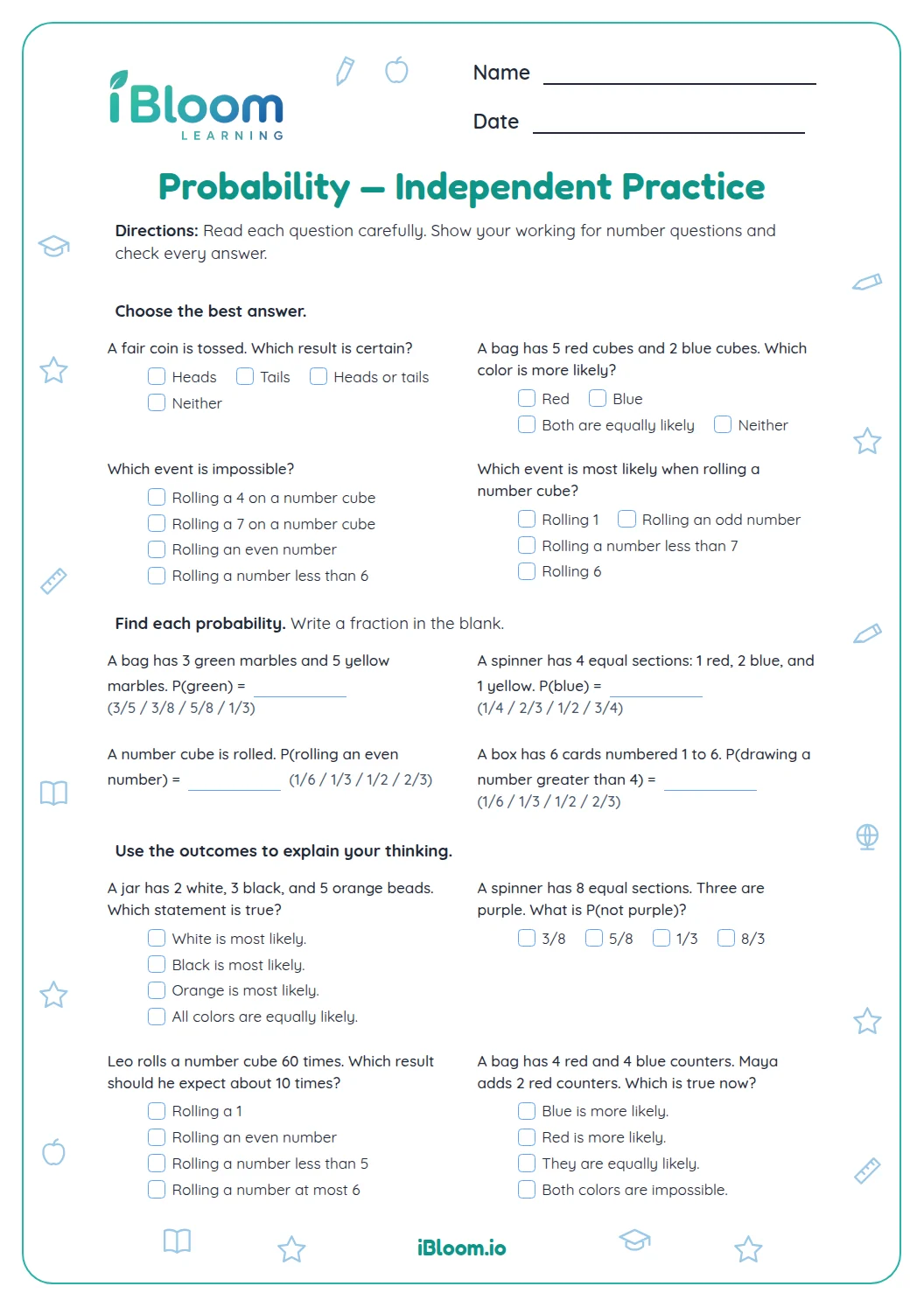
About this worksheet
This Grade 4 printable practices fraction models, equivalent fractions, comparisons, and pie-slice data. Students read a shaded circle, complete fraction statements, and interpret equal-slice situations in 14 questions. It includes two worksheet pages and a separate two-page answer key. The questions connect fraction comparison to Common Core 4.NF.A.2.
What does this worksheet include?
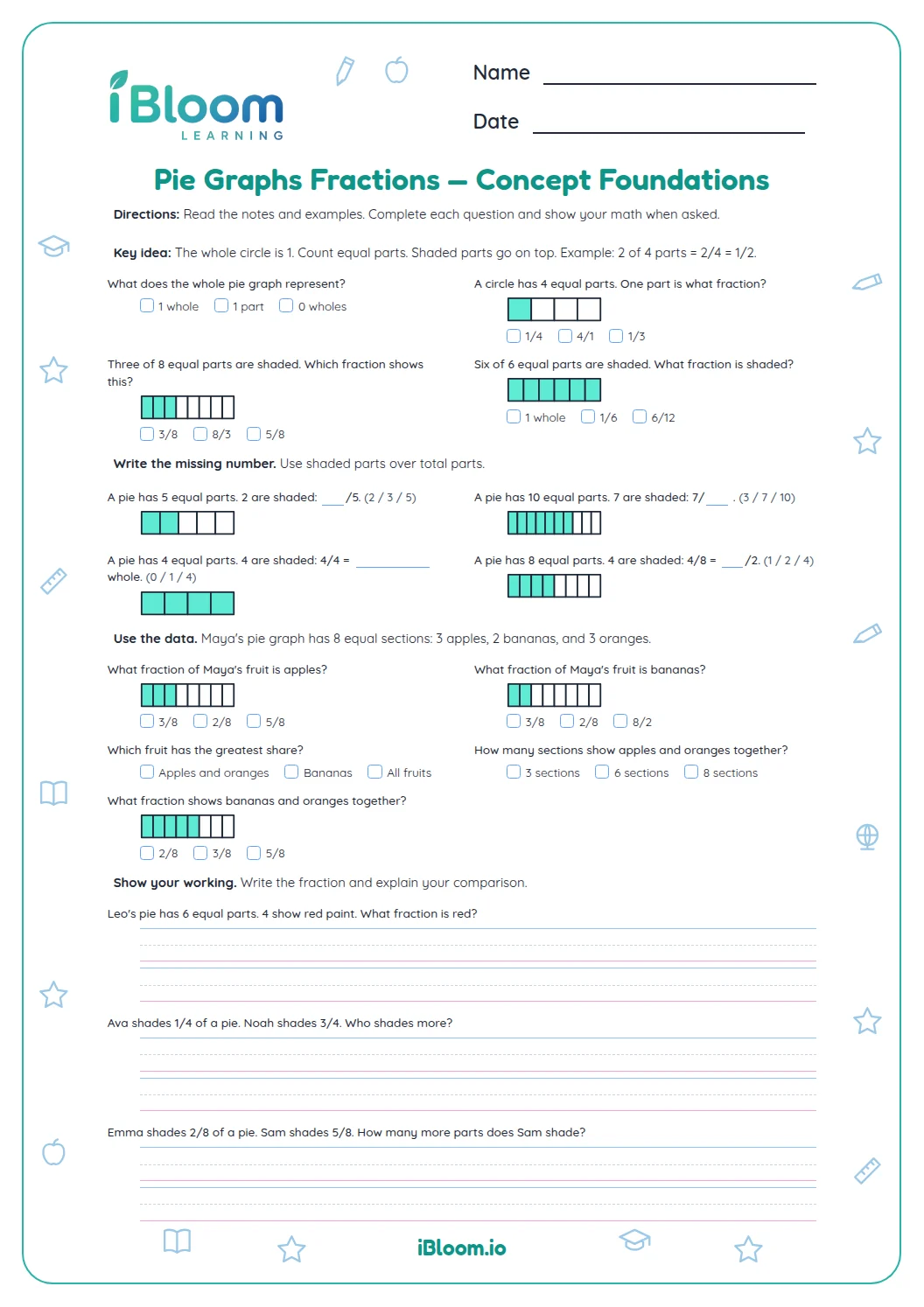
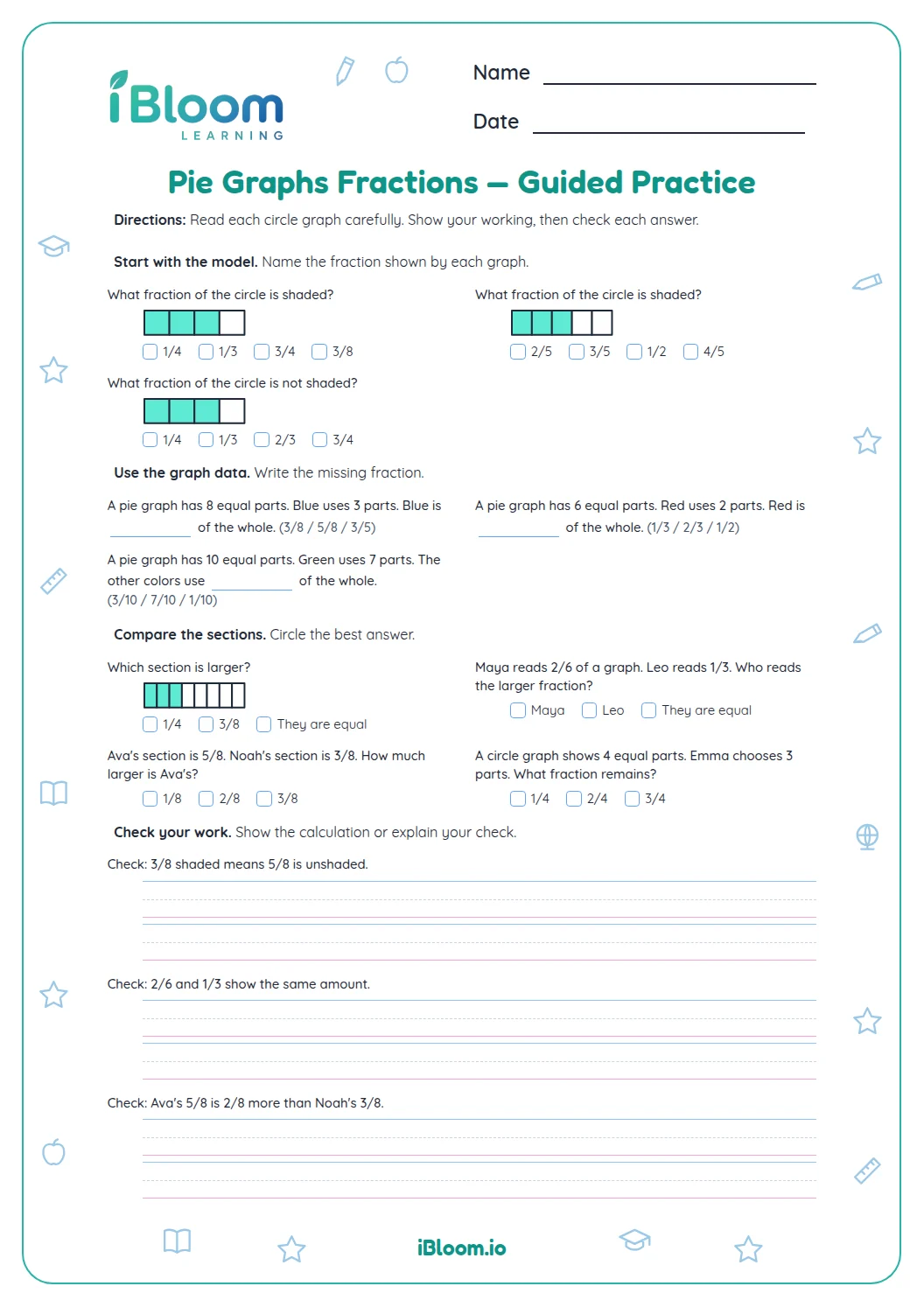
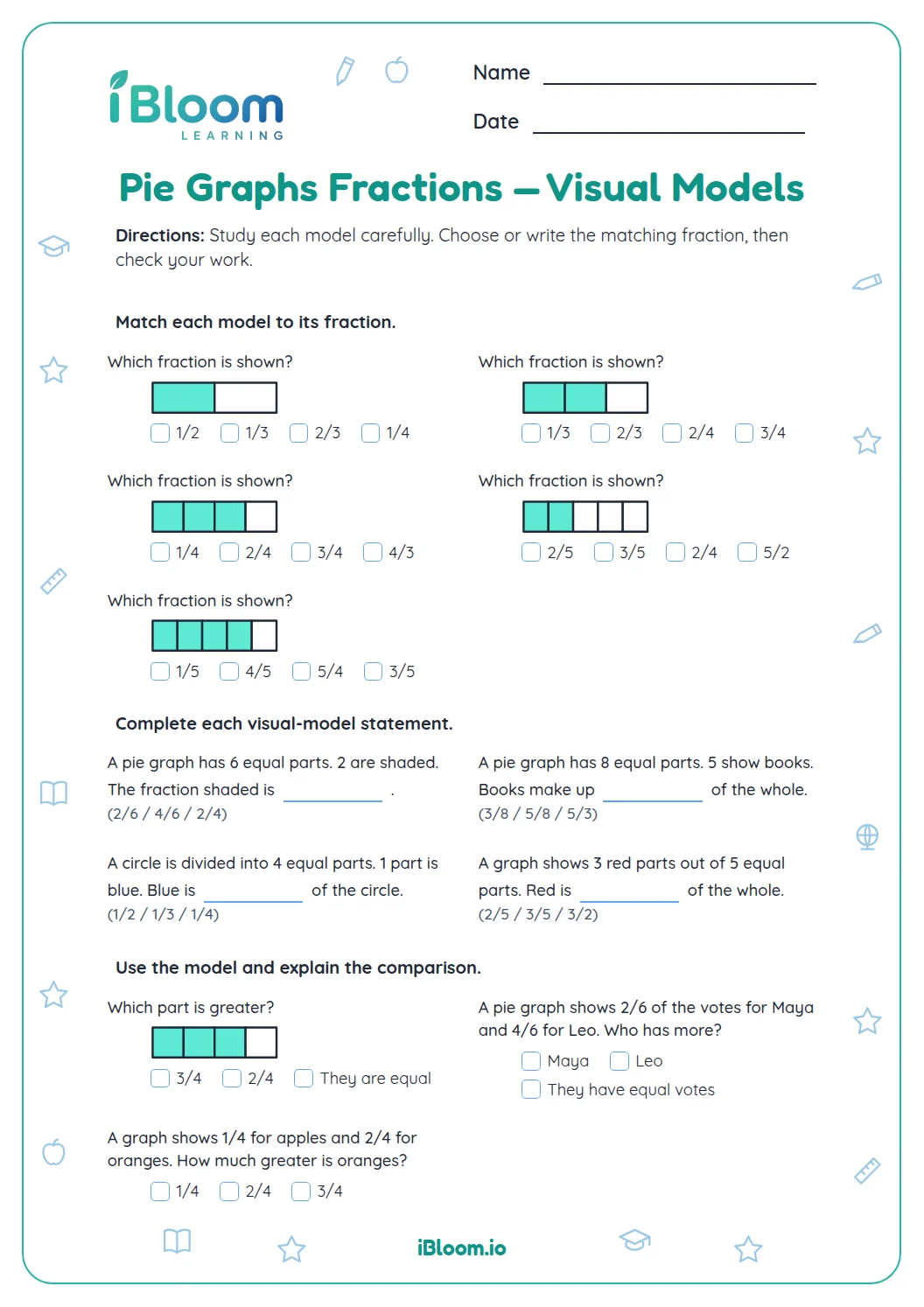
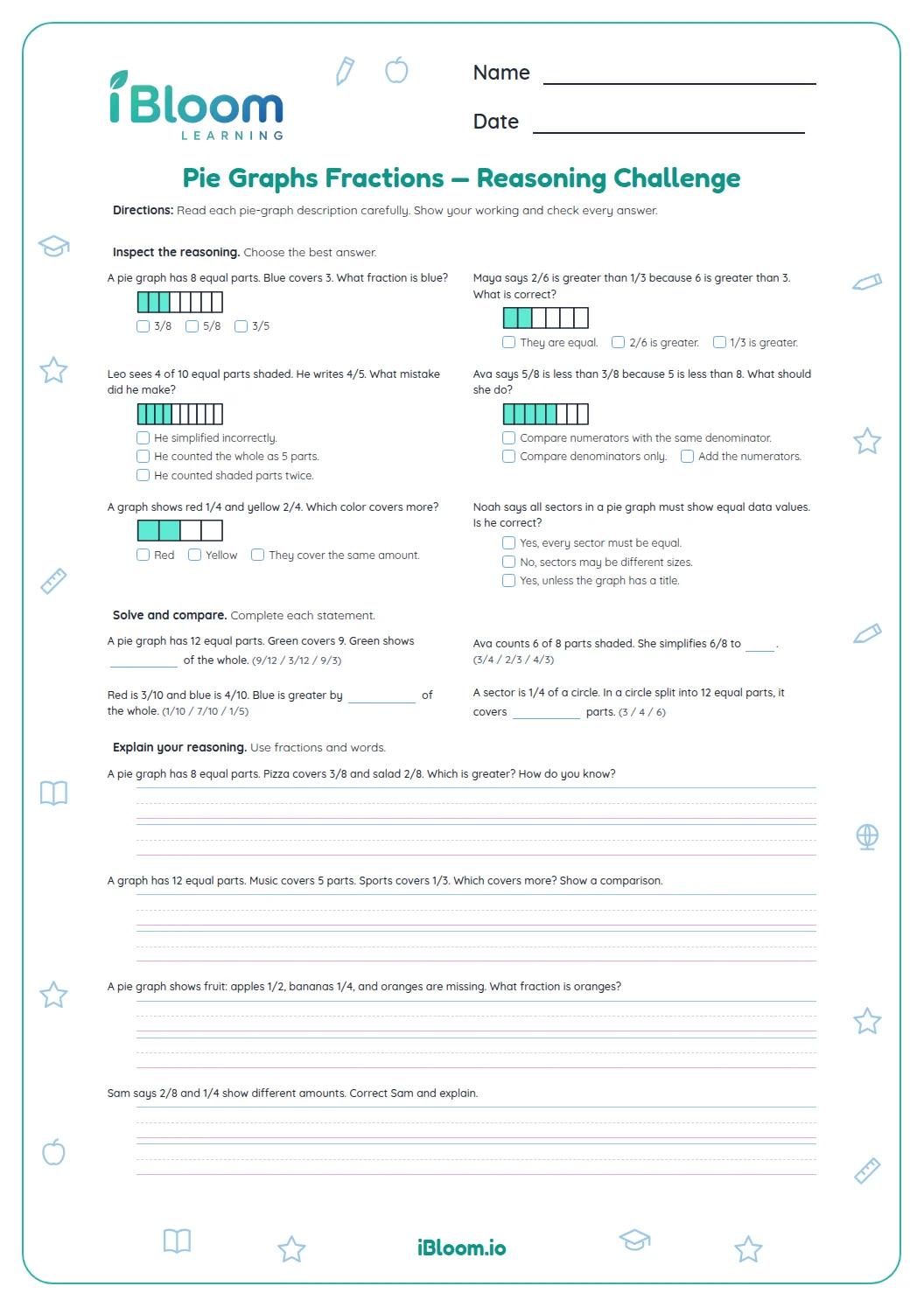
Students read one shaded circle model, then use the same fraction idea in pie situations. Count equal slices for the denominator and shaded slices for the numerator.
- 14 equal slices
- 21 shaded slice
- 3The shaded fraction is 1/4
- Part A: read the circle model and identify slice shares.
- Part B: complete fraction statements, compare amounts, and solve pie questions.
- The answer key lists the fraction or numerator for each item.
How do you read a fraction model?
Count the equal pieces for the denominator and the shaded pieces for the numerator. In question 1, one of four equal slices is shaded, so the answer is 1/4.
- 1Question 2: 8 equal parts altogether
- 23 shaded parts
- 3Write 3/8
How can you compare fractions with equal denominators?
When denominators match, each fraction counts the same-sized parts. Compare the numerators. For question 10, both fractions are eighths, and five eighths is greater than three eighths. For unlike denominators, look for equivalent fractions or use a model.
How do pie situations connect to fractions?
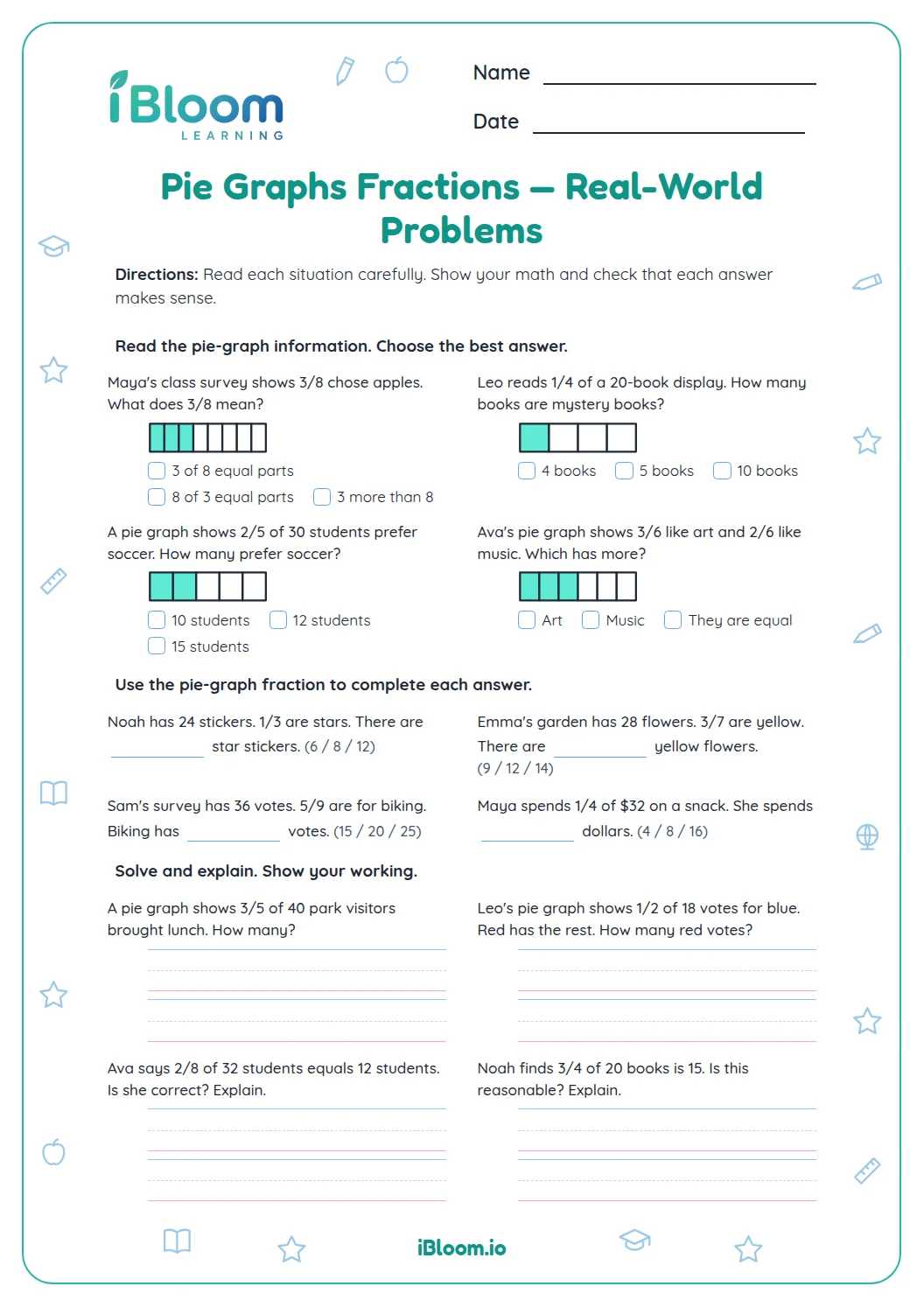
A pie divided into equal slices can represent a whole. If a question asks what fraction remains, subtract the eaten slices from all slices. If it combines two flavors, add their slice counts before writing the fraction.
How to solve the fraction questions
- 1Count the equal slices or parts before counting the shaded ones.
- 2Write shaded parts over total parts.
- 3For a remaining amount, subtract used parts from the whole.
- 4For equal denominators, compare or add numerators while keeping the denominator.
- 5Use the key to check equivalent fractions and simplify when asked.
Fraction mistakes to watch for
The mistake
Writing the total number of parts on top.
The fix
Say “shaded out of total”; shaded parts are the numerator.
The mistake
Changing the denominator when adding fractions with equal-sized parts.
The fix
Keep the denominator because the size of each slice stays the same.
The mistake
Counting only the eaten slices when asked what is left.
The fix
Subtract eaten slices from the whole number of slices first.
What to practice next
Make more practice
Questions parents and teachers ask
Are actual pie charts printed on the page?
Yes. Question 1 shows a circle divided into equal parts, with one part shaded. Students name that fraction, then use fraction notation in the remaining items about equivalent values, comparisons, and pie-slice situations. The separate answer key lists each expected fraction or numerator.
How many questions are included?
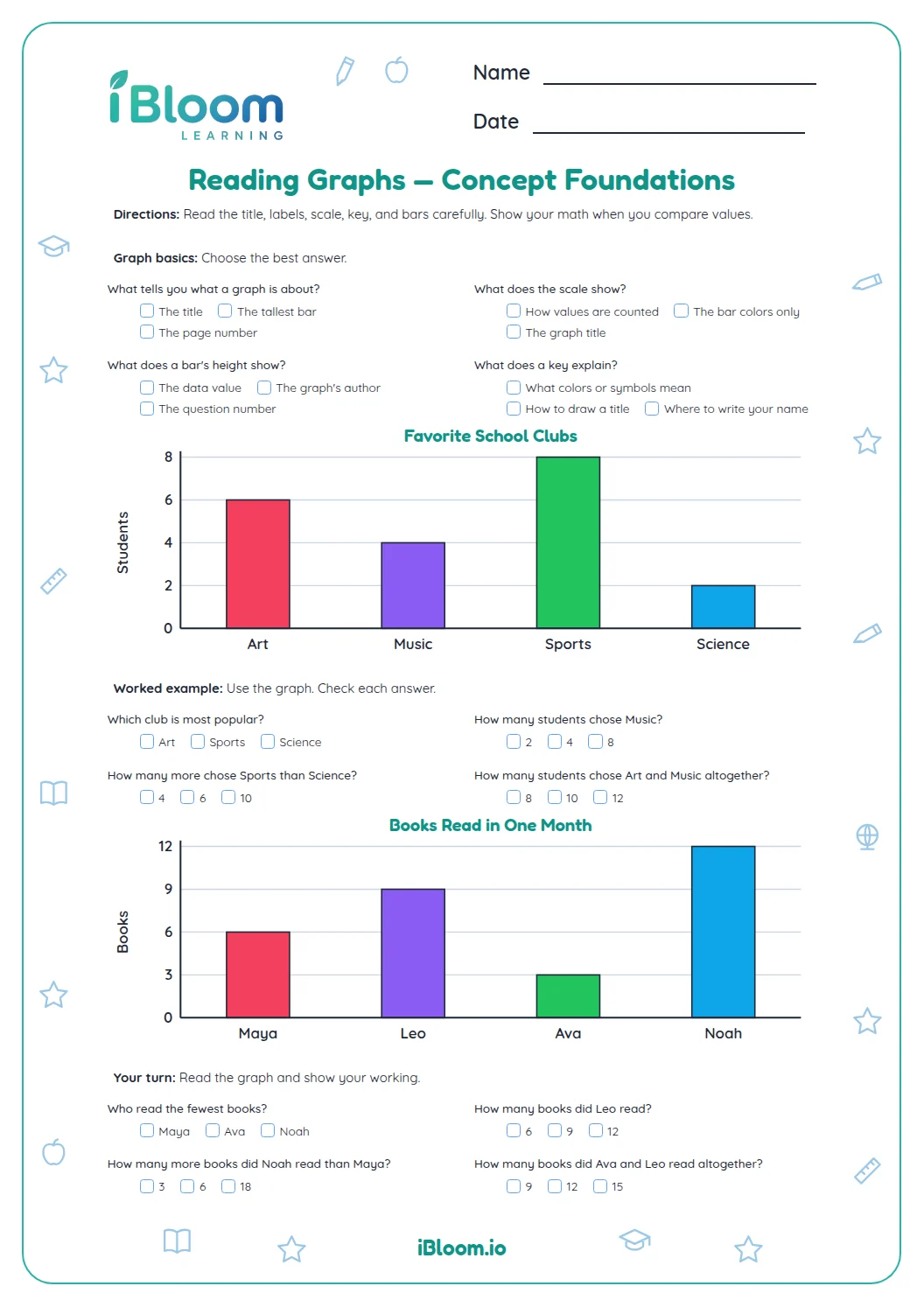
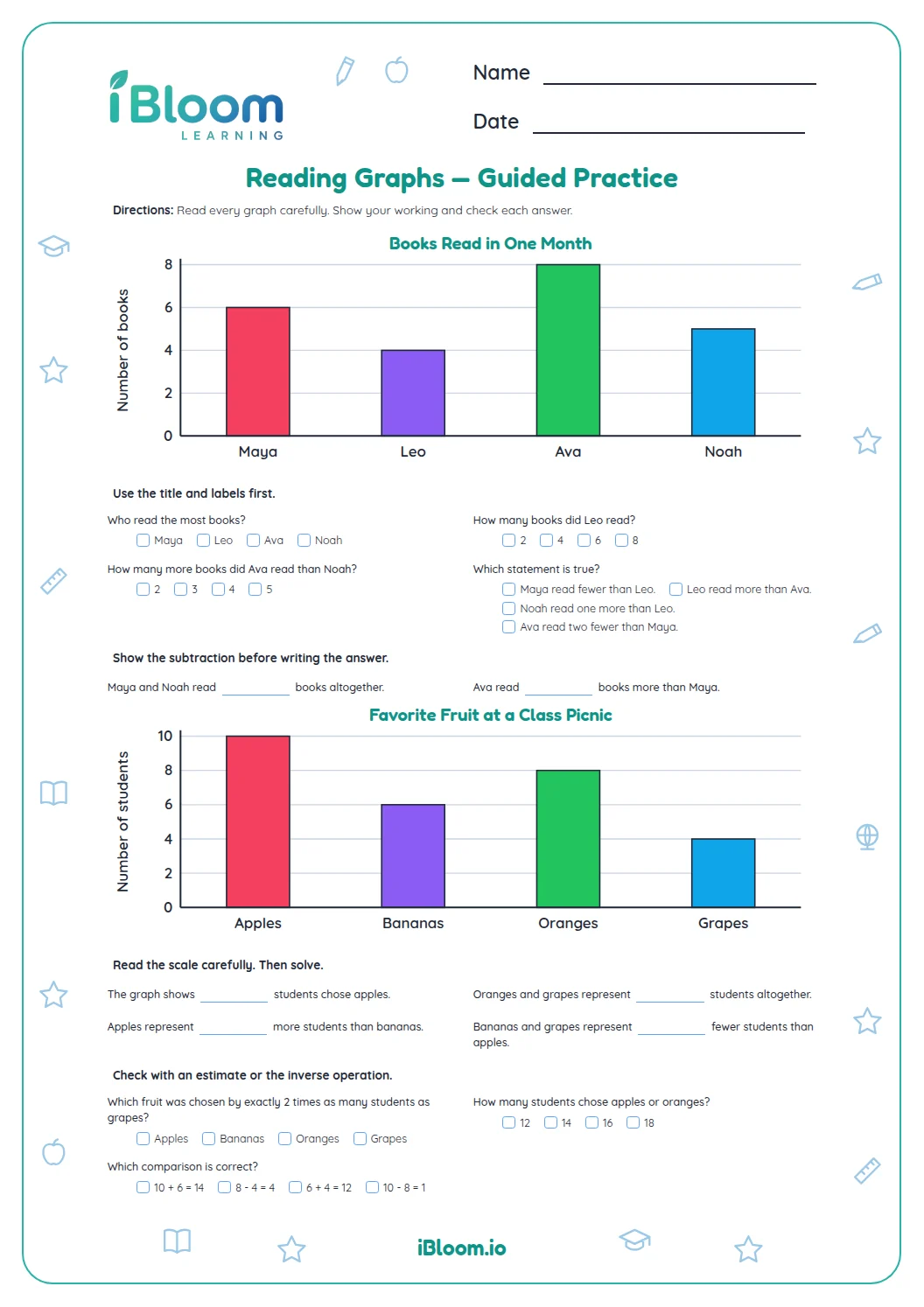
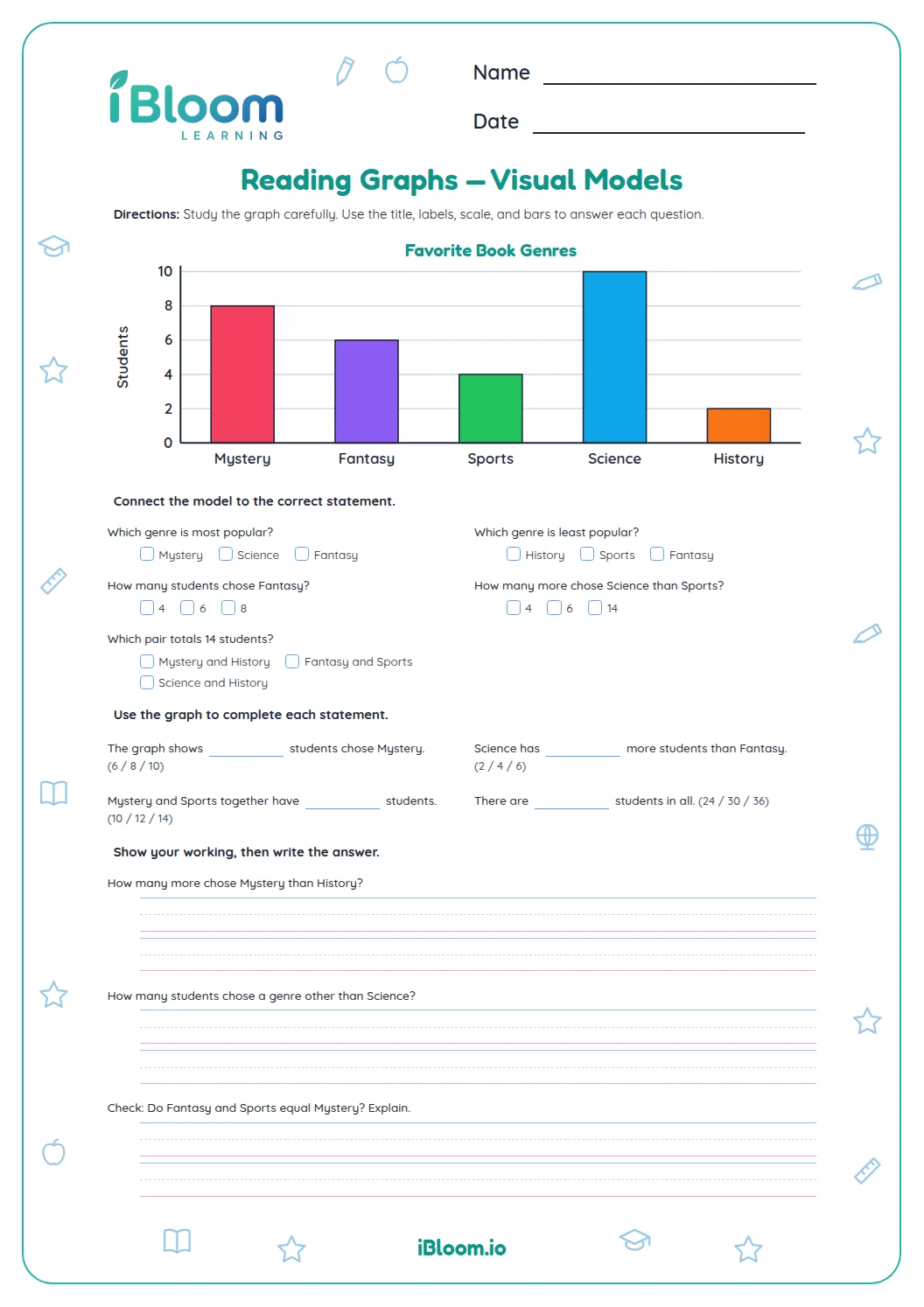
There are 14 questions in two parts. Students read one shaded circle model, complete fraction statements, compare fractions, and interpret pie-slice situations. The separate answer key lists each fraction or missing numerator, so students can check the model and calculations after completing the printable.
Should students simplify every fraction?
Write the fraction that directly answers the question unless it asks for an equivalent form. For example, 3 of 12 servings is 3/12, which is equivalent to 1/4. The answer key gives the expected form for each item and helps students see each quantity as equal parts of one whole.
What does the denominator tell you?
The denominator tells how many equal parts make the whole. In a pie cut into 8 equal slices, each slice is one eighth. The numerator counts how many of those parts are being described, such as 3/8 for three cherry slices.
How can students compare fractions?
When denominators match, compare the numerators because the pieces are the same size. When denominators differ, rename the fractions with a common denominator or use a benchmark. Question 10 compares 3/8 and 2/3; writing them as 9/24 and 16/24 shows that 2/3 is greater.