


About this worksheet
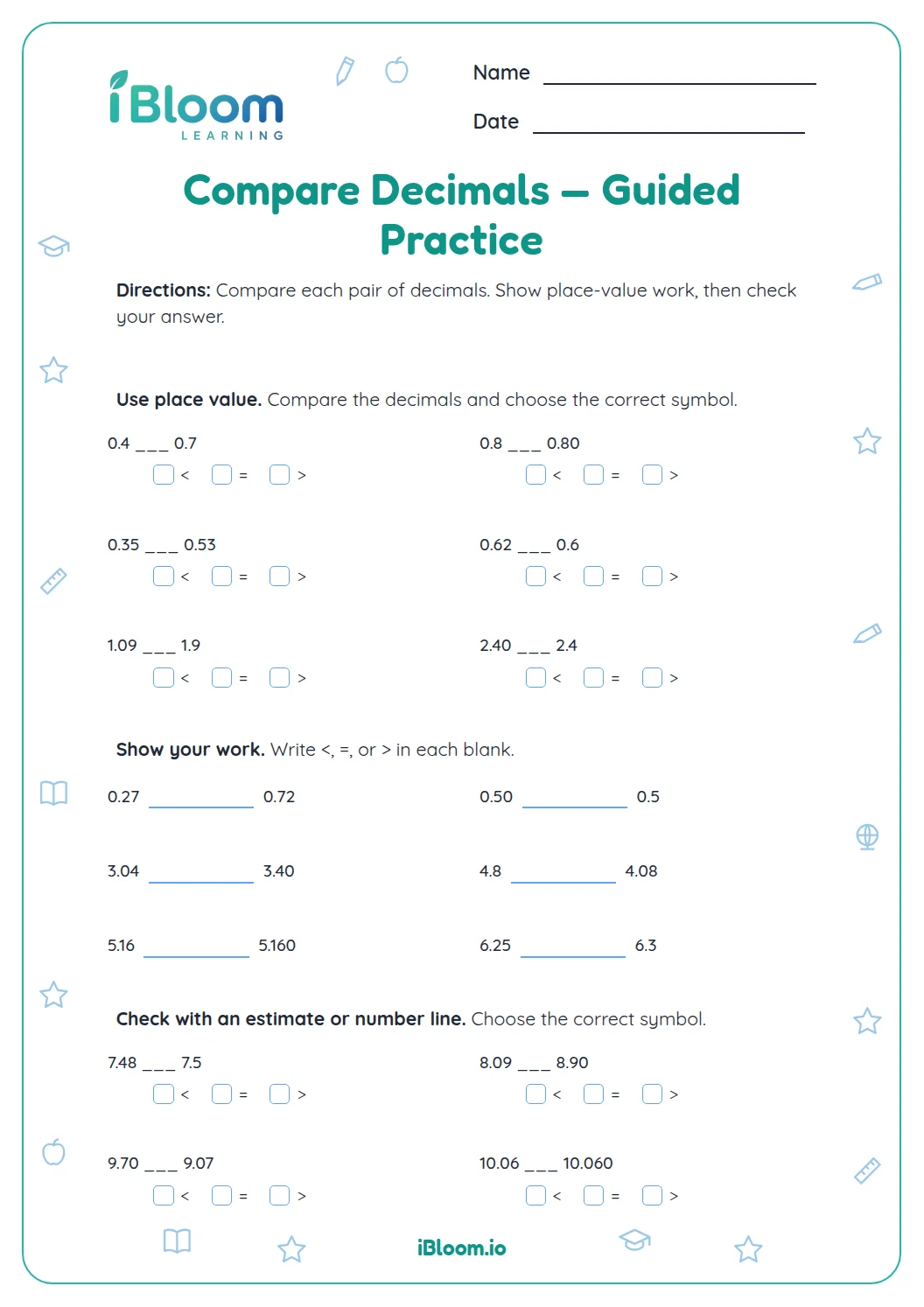
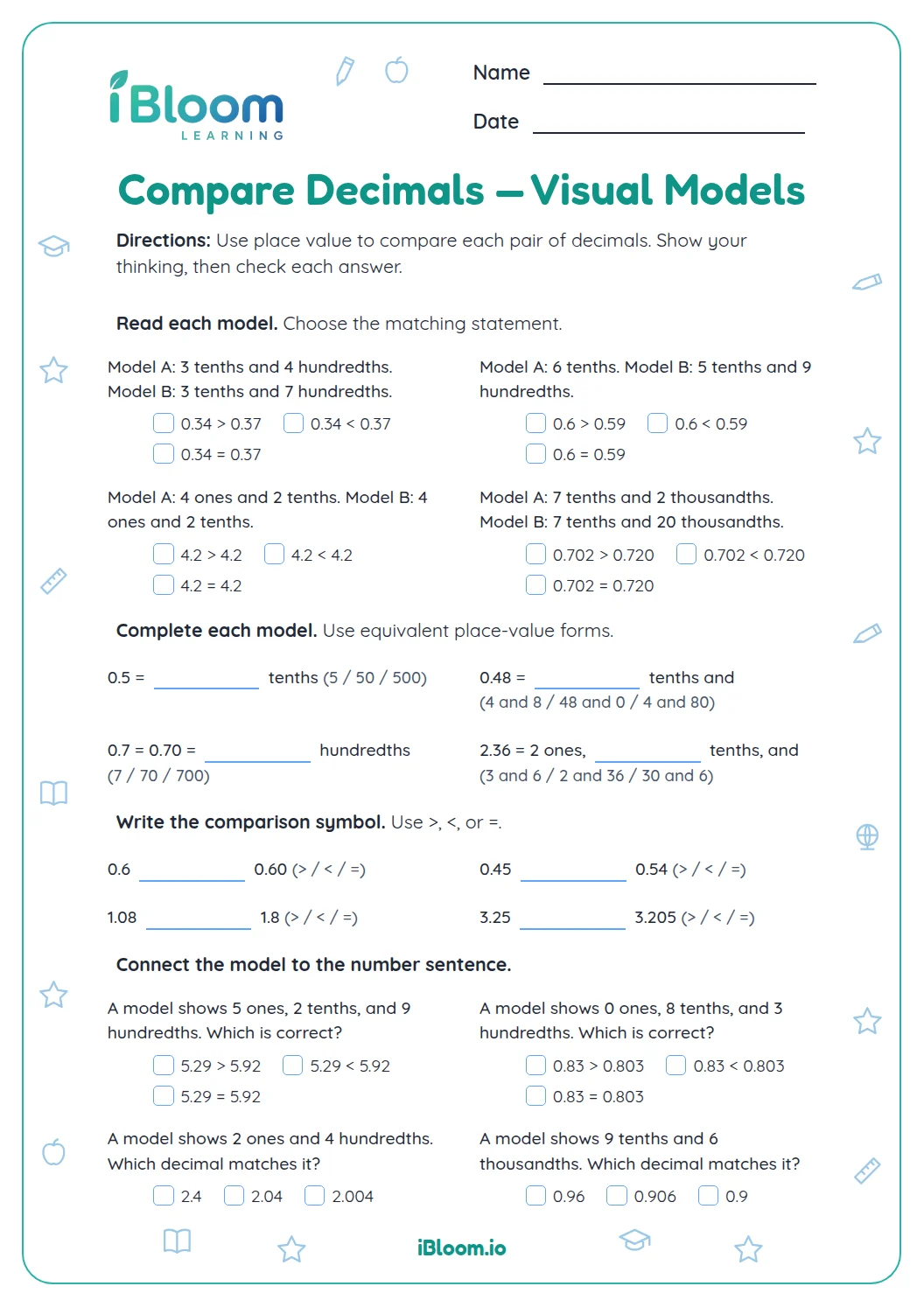
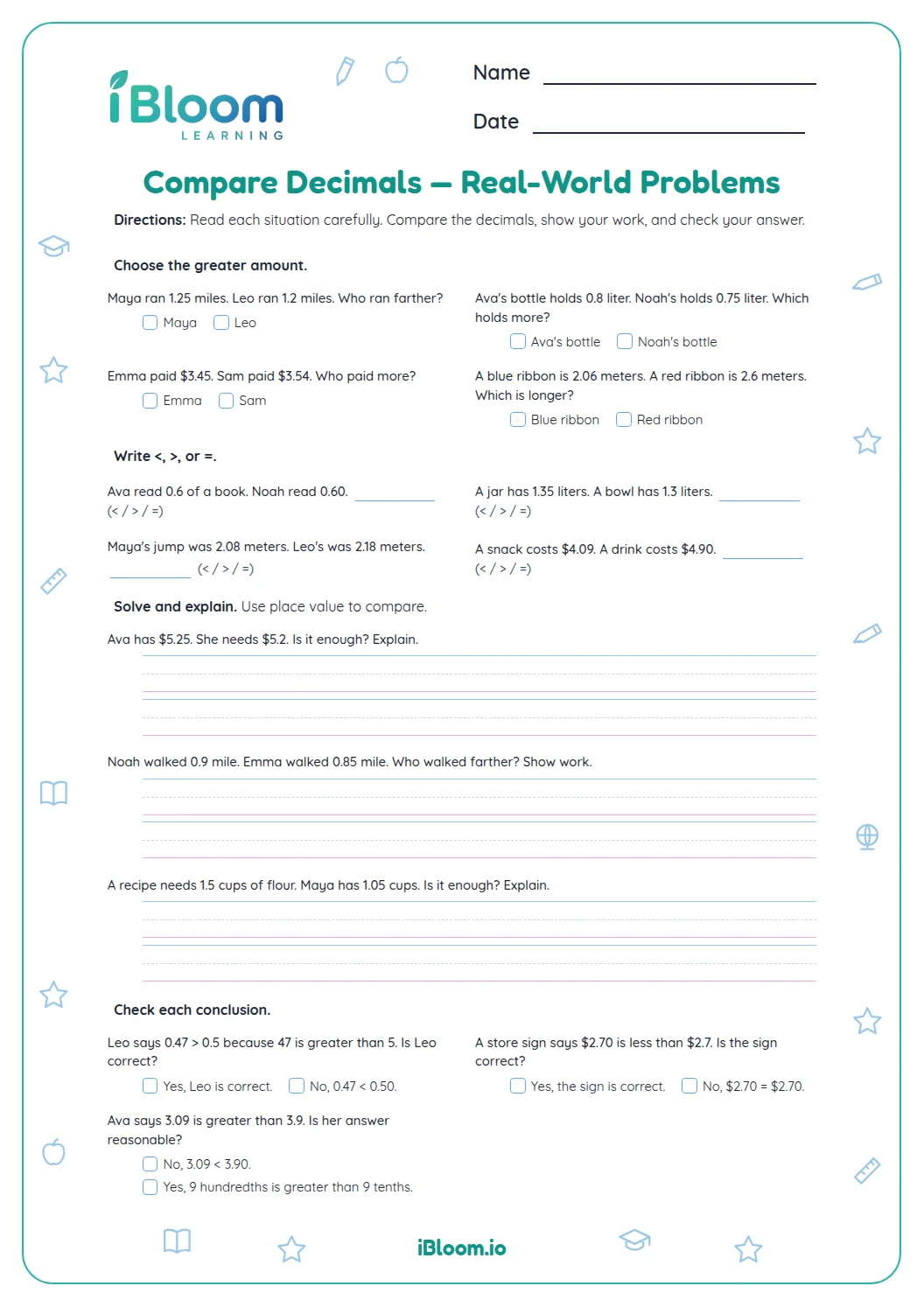
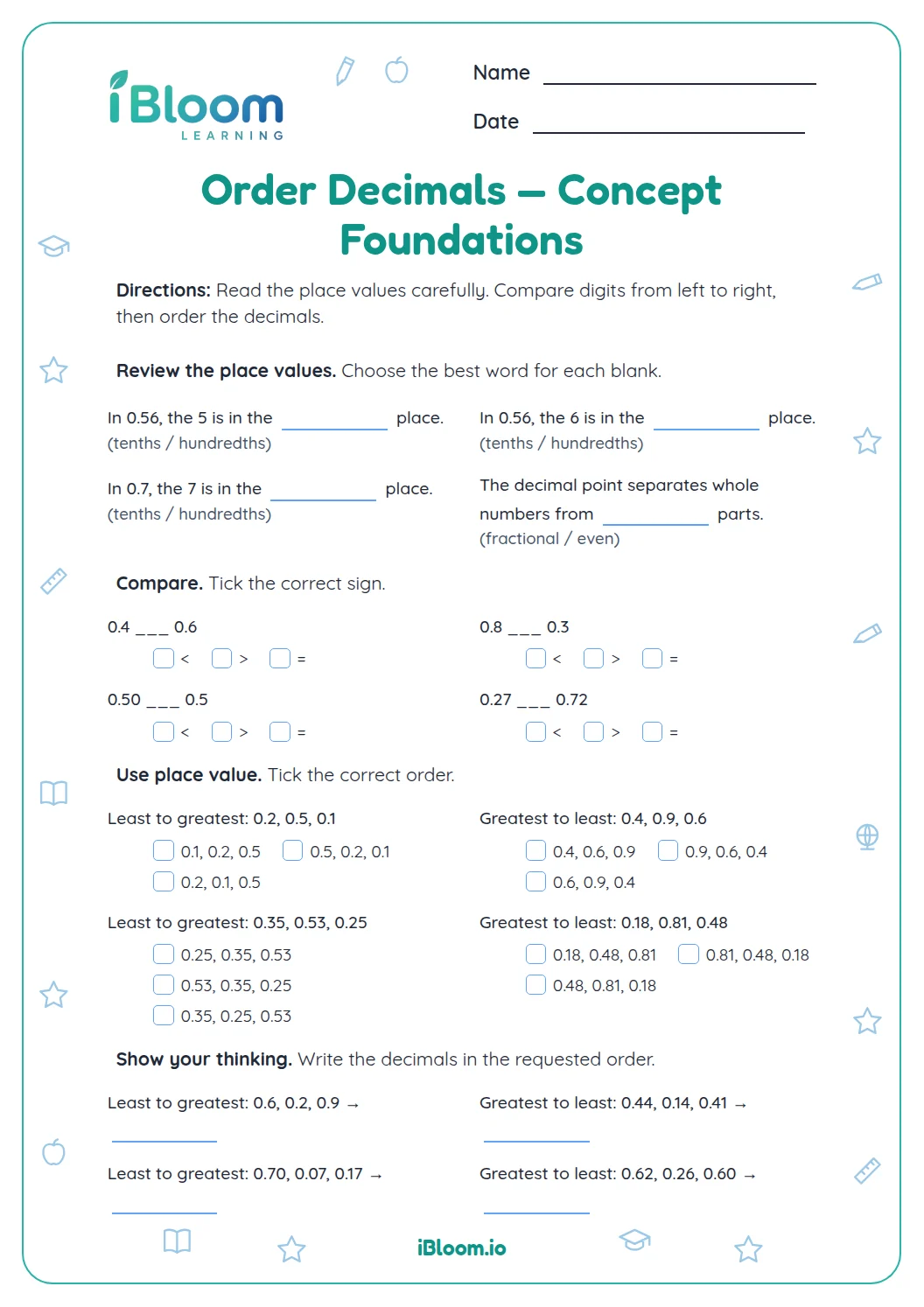
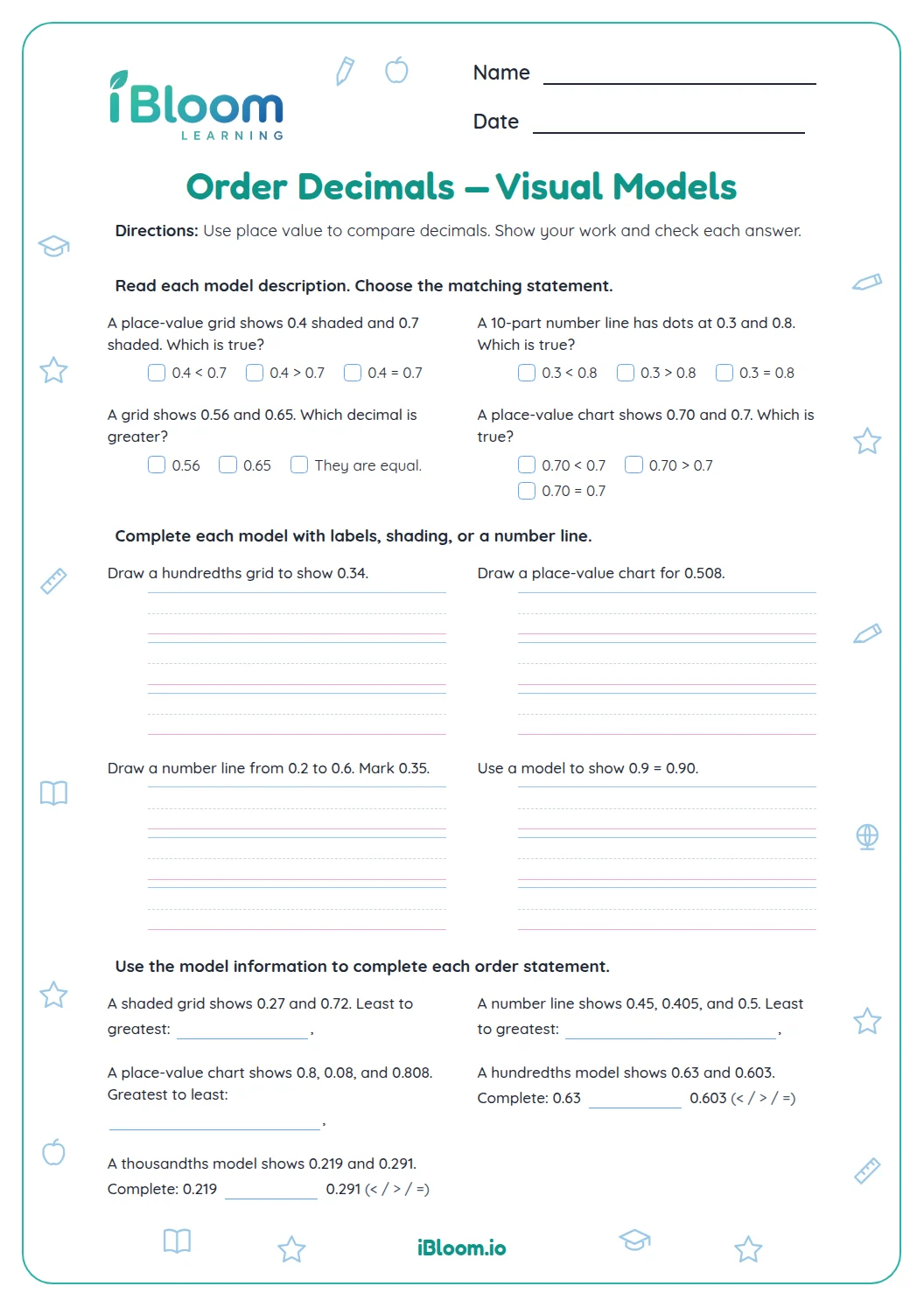
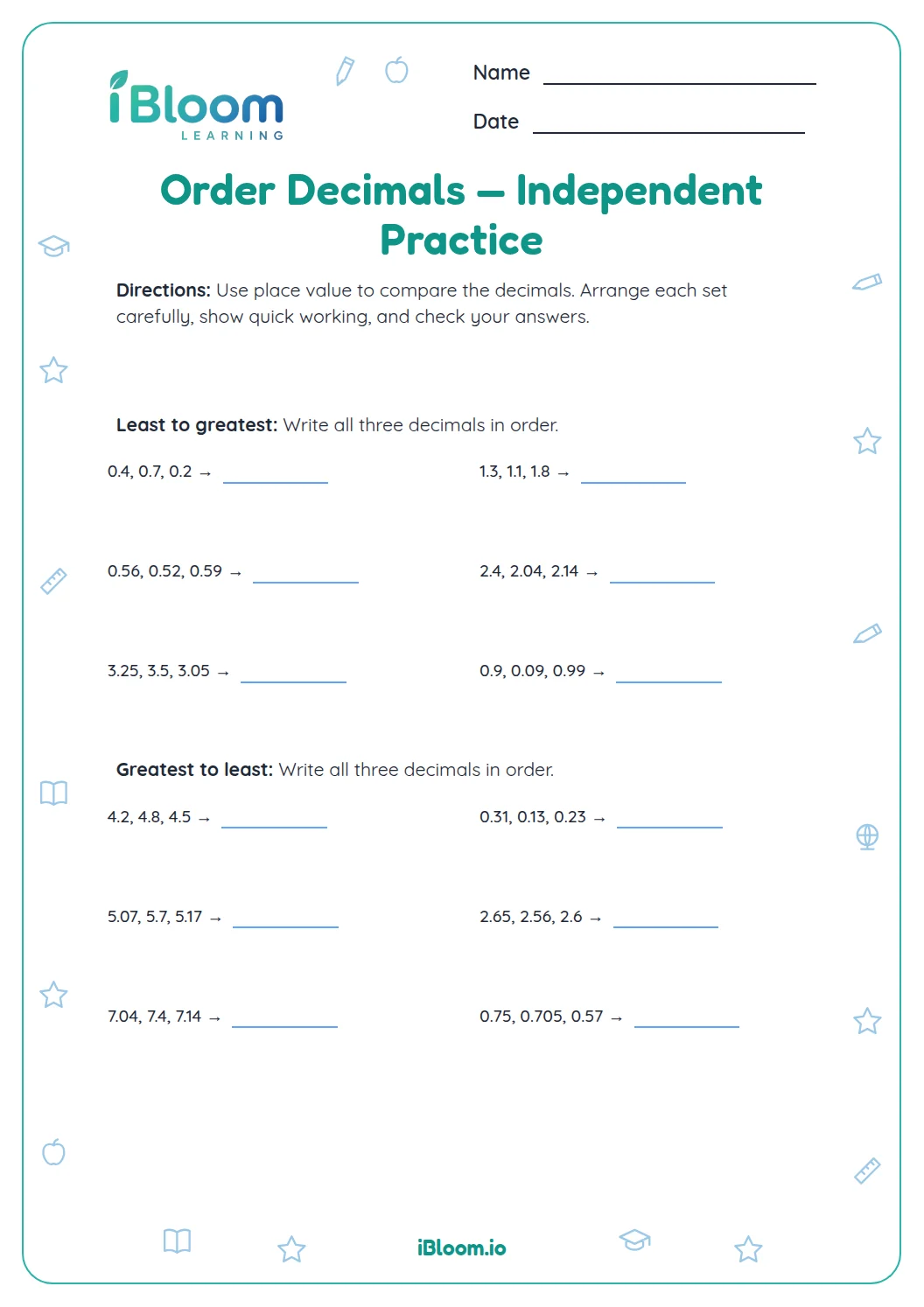
Compare decimals with place value in this Grade 4 reasoning worksheet. Students work through 15 questions, including comparison symbols, ordering, and written explanations. The answer key gives the correct comparisons and sample reasoning for open-ended items.
Aligned to 4.NF.C.7
How can place value settle a comparison?
Compare digits from left to right. For 0.47 and 0.5, write 0.5 as 0.50. Four tenths is less than five tenths, so 0.47 < 0.50.
Do ending zeros change a value?
No. The decimals 5.30 and 5.3 name the same amount. A zero at the end can help line up place values, but it does not change the value.
How do you check a claim?
Check the first place where the digits differ. In Ava’s claim, 0.42 and 0.5 differ in the tenths place: 4 tenths is less than 5 tenths.
How do you order close decimals?
Add zeros at the end when they help compare equal place values, then read from left to right. Keep the original values in your final order.
How to use this worksheet
- 1Line up decimal points.
- 2Compare the ones, tenths, and hundredths.
- 3Use zeros at the end to make place values easier to compare.
- 4Write the symbol or order the numbers.
- 5For explanations, name the place that decides the comparison.
Common mistakes and quick fixes
The mistake
Comparing digits without place value.
The fix
Say 4 tenths and 5 tenths, rather than just 4 and 5.
The mistake
Thinking a longer decimal is always larger.
The fix
Compare each place from left to right; 0.47 is less than 0.50.
The mistake
Treating a trailing zero as a new value.
The fix
Use 5.30 = 5.3 to see that the zero keeps the value unchanged.
Common Core alignment
This practice connects the worksheet activity to the following Common Core skill.
Compare decimals to hundredths by reasoning about their size.
On this sheet: Students compare decimals, order them, and justify conclusions using place-value reasoning.
Show the official wordingHide the official wording
Compare two decimals to hundredths by reasoning about their size. Recognize that comparisons are valid only when the two decimals refer to the same whole. Record the results of comparisons with the symbols >, =, or <, and justify the conclusions, e.g., by using a visual model.
What to practice next
Make more practice
Further reading
Questions parents and teachers ask
How do you compare two decimals?
Compare digits from left to right, beginning with the ones place and moving through tenths and hundredths. Add zeros at the end when useful. For example, 0.47 is less than 0.50 because four tenths is less than five tenths. The comparison questions use tenths and hundredths, including values with a trailing zero.
Do zeros at the end change a decimal?
No. A zero added at the end names the same value, so 5.3 and 5.30 are equal. Writing an ending zero can make it easier to line up place values while comparing. Line up the decimal points and compare the digits from left to right.
How do students explain a comparison?
Ask students to name the place where the digits first differ. That place determines which decimal is greater, as long as both decimals refer to the same whole. The final questions invite a brief written reason. A hundredths digit has a smaller place value than a tenths digit.
What does the ordering question ask?
Students arrange three decimals from least to greatest. They can write zeros at the end to compare equal place values, then put the original decimal forms in order. More than one decimal can fit between the endpoints; the key gives one valid example.
Does the answer key include reasoning?
Yes. The separate answer key lists comparison symbols and an order for the set. It also includes sample explanations for open-ended questions; other clear reasoning based on decimal value may be correct. Explain which place decides the comparison instead of counting the digits.