


About this worksheet
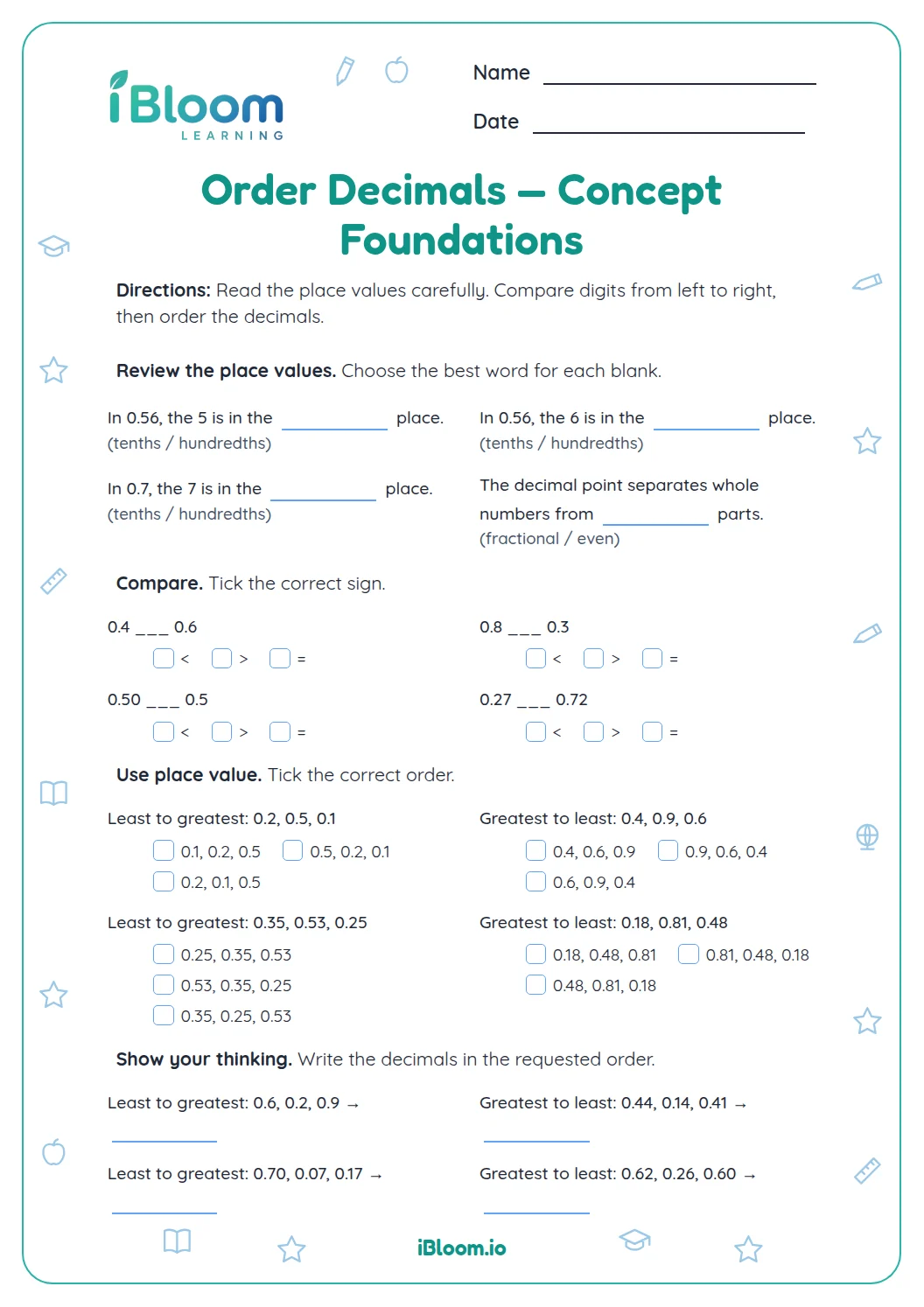
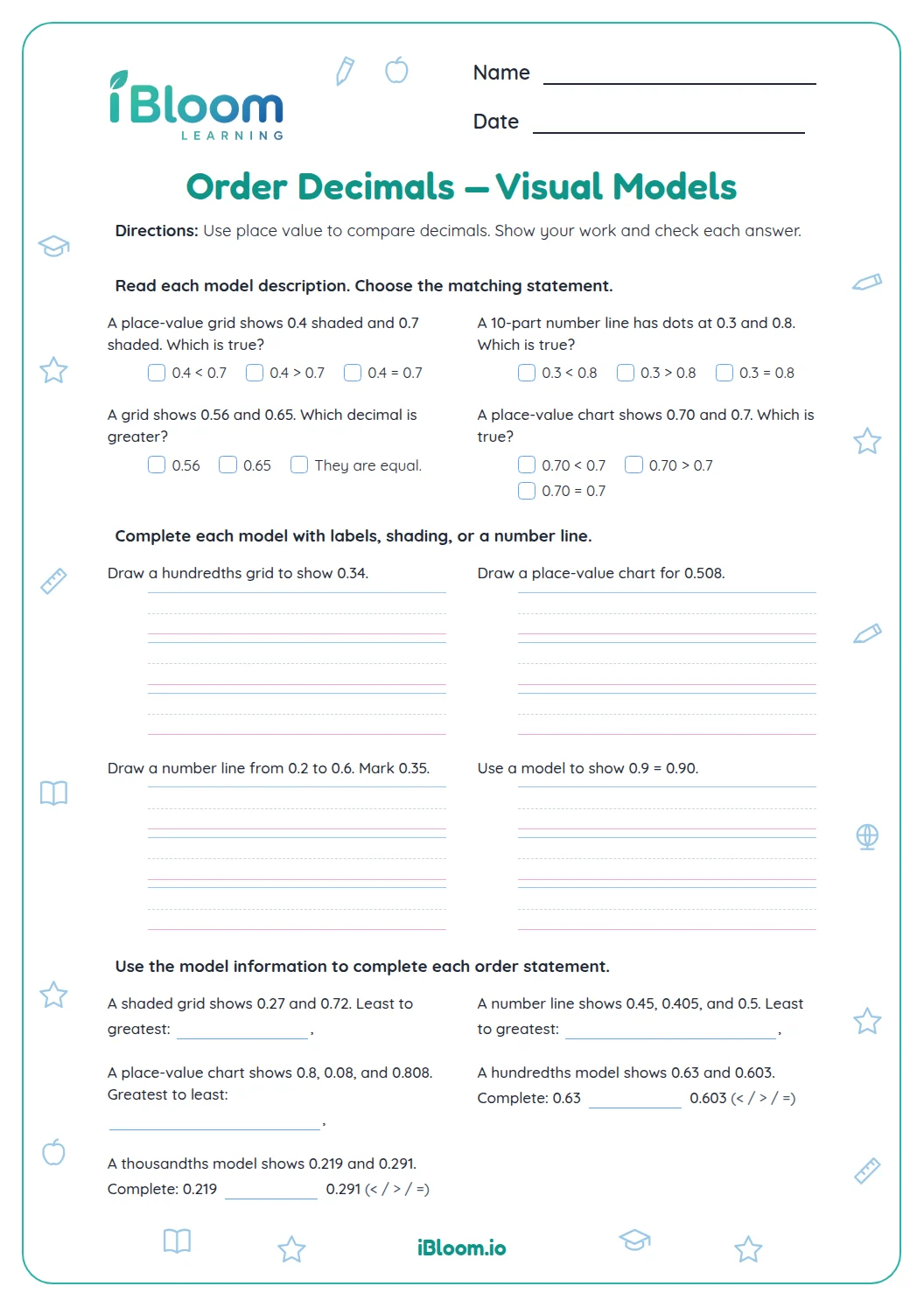
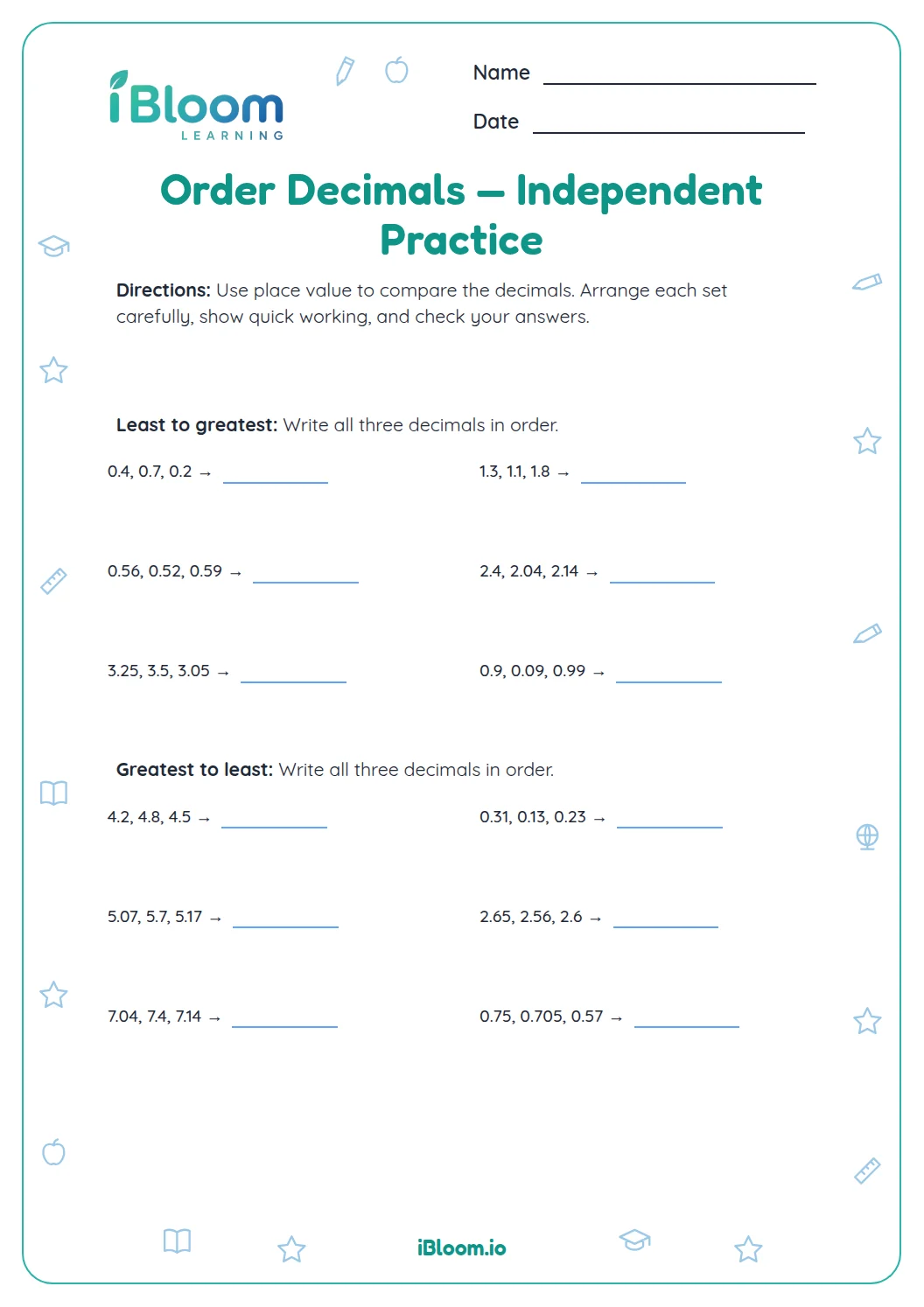
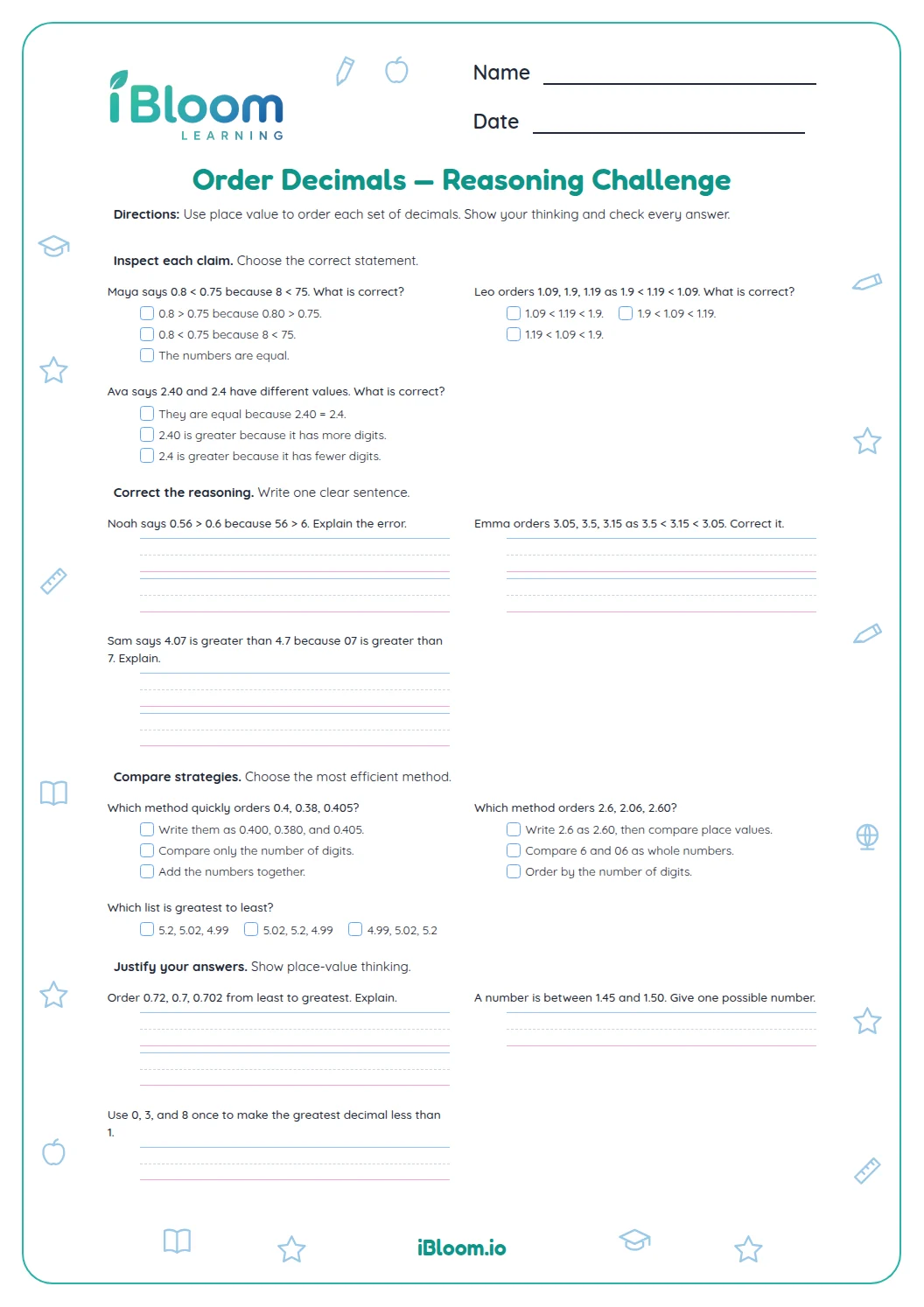
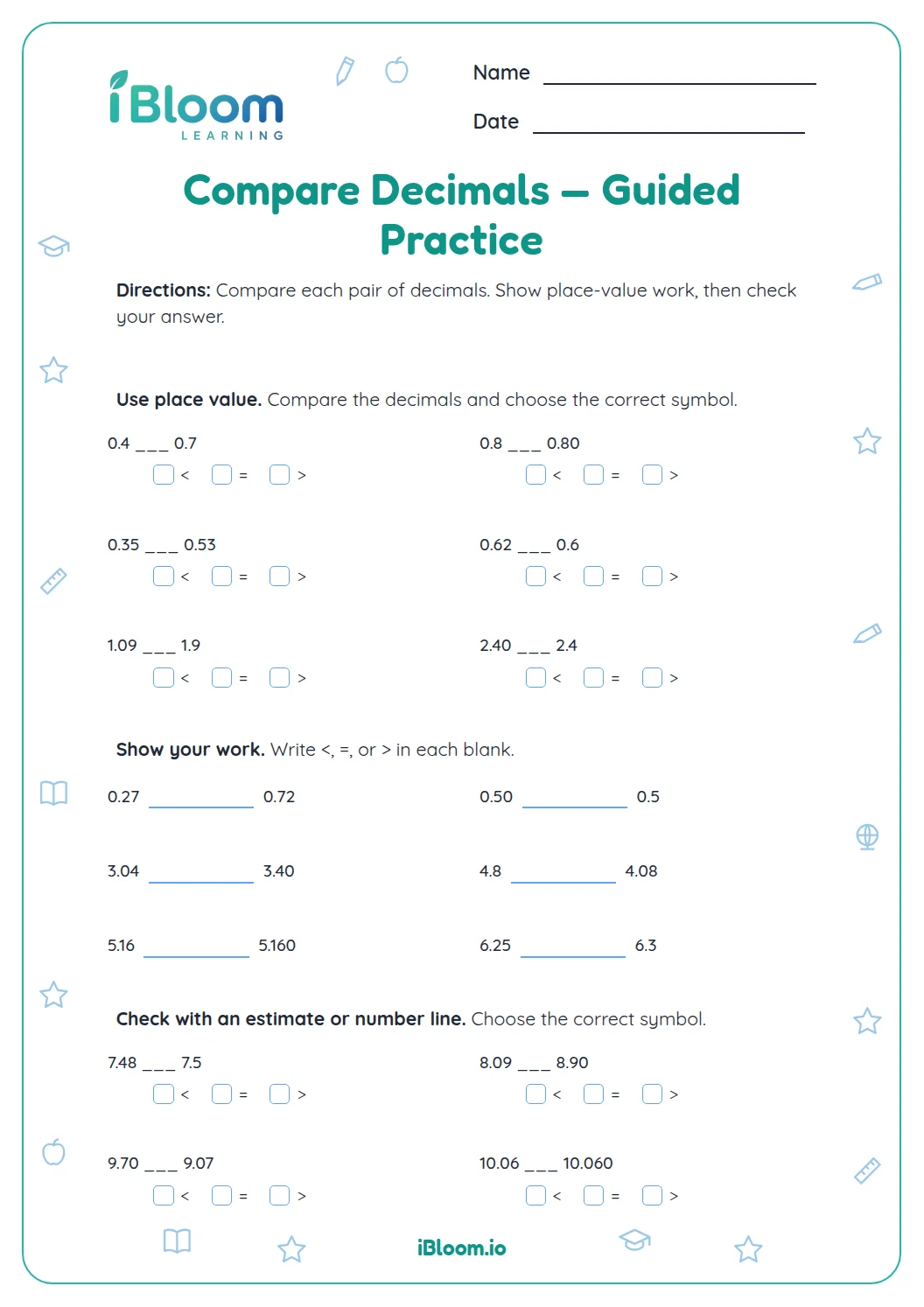
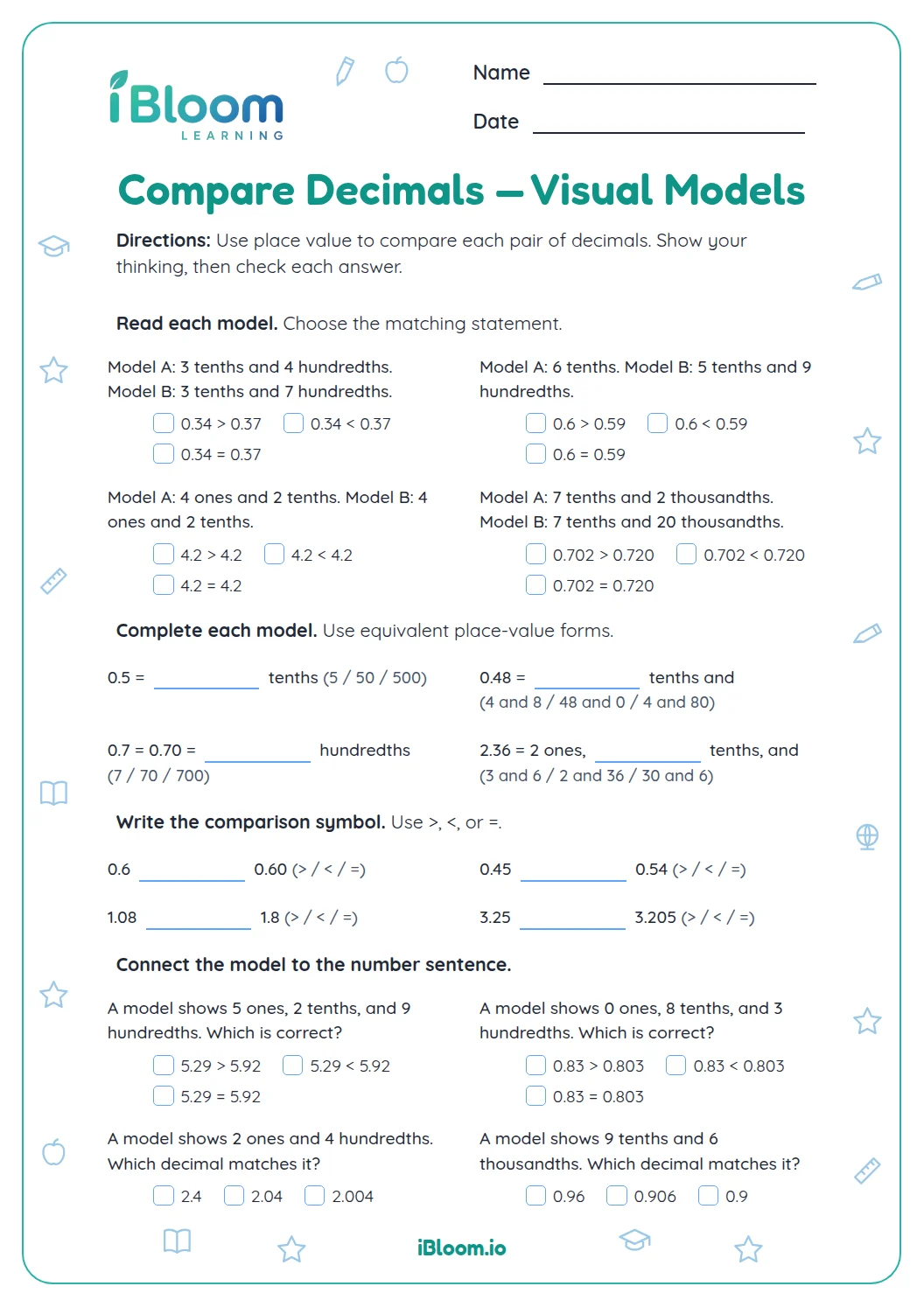
This Grade 4 worksheet gives students 14 decimal questions using values through the hundredths place. They compare pairs with <, >, or =, order six sets in both directions, and finish with four multiple-choice checks. The work follows the old sheet’s place-value method: compare digits from left to right and treat a trailing zero as an equivalent form. A separate key shows each answer.
Aligned to 4.NF.C.7
How do you compare two decimals?
Start with the greatest place value shown. In 0.63 and 0.60, the tenths are equal, so compare the hundredths: 3 hundredths is greater than 0 hundredths. Therefore 0.63 > 0.60.
- 10.63 ___ 0.60
- 2Tenths match: 6 = 6
- 3Hundredths: 3 > 0
- 40.63 > 0.60
How can you order a group of decimals?
Write equivalent place values when it helps: 0.8 is 0.80, and 0.08 is 0.08. Then compare each value from the tenths place onward. For greatest to least, begin with the greatest value.
Does a zero at the end change a decimal?
A zero after the last nonzero digit does not change the value. For example, 0.7 and 0.70 both name seven tenths. A zero inside the number can matter: 0.07 is seven hundredths, which is less than 0.7.
How to use this worksheet
- 1Read whether the task asks for a comparison, least to greatest, or greatest to least.
- 2Compare whole-number parts first, then tenths and hundredths.
- 3Use a trailing zero to line up place values when it helps.
- 4Write all values in the exact direction requested.
- 5Check the four choice questions after completing the ordering sets.
Common mistakes and quick fixes
The mistake
Comparing digits before place values
The fix
Compare matching places from left to right; do not decide from a digit in a different place.
The mistake
Treating a trailing zero as a new amount
The fix
Rewrite 0.7 as 0.70 to compare place values; they are equal.
The mistake
Reversing the requested order
The fix
Circle “least” or “greatest” in the prompt before writing the ordered list.
Common Core alignment
Compare decimals to hundredths and record comparisons with >, =, or <.
On this sheet: Students compare decimals to hundredths and arrange sets by their values.
Show the official wordingHide the official wording
Compare two decimals to hundredths by reasoning about their size. Recognize that comparisons are valid only when the two decimals refer to the same whole. Record the results of comparisons with the symbols >, =, or <, and justify the conclusions, e.g., by using a visual model.
What to practice next
Make more practice
Further reading
Questions parents and teachers ask
What decimal place values are used?
The 14 questions use tenths and hundredths. Students compare values such as 0.63 and 0.60, then order groups in either direction. This keeps the practice focused on reading decimal place value and recognizing that a trailing zero can represent an equivalent form.
How do you compare 0.63 and 0.60?
The tenths digits match, so compare the hundredths digits. Three hundredths is greater than zero hundredths, which means 0.63 is greater than 0.60. The same left-to-right comparison helps with the pair questions and with deciding where each value belongs in an ordered set.
Why are 0.7 and 0.70 equal?
The zero in the hundredths place adds no hundredths, so both decimals name seven tenths. Writing 0.7 as 0.70 can help line up places while comparing, but the zero at the end does not make the number larger or smaller.
How many questions are on the worksheet?
There are 14 questions in three parts: four pair comparisons, six ordering sets, and four multiple-choice checks. The ordering section includes both least-to-greatest and greatest-to-least directions, so students practice reading the requested order carefully and comparing each place value.
Is the answer key included?
Yes. A separate answer-key page gives the comparison symbol, each ordered list, and the correct choice for every item. Students can use it after finishing to check whether they compared matching place values and followed the direction in each ordering prompt.
How long does this decimal practice take?
Plan for about 20 to 25 minutes. Students compare four pairs, arrange six groups, and answer four checks. If a learner is new to decimals, pausing to write a trailing zero such as 0.8 = 0.80 may make the place-value reasoning clearer.