
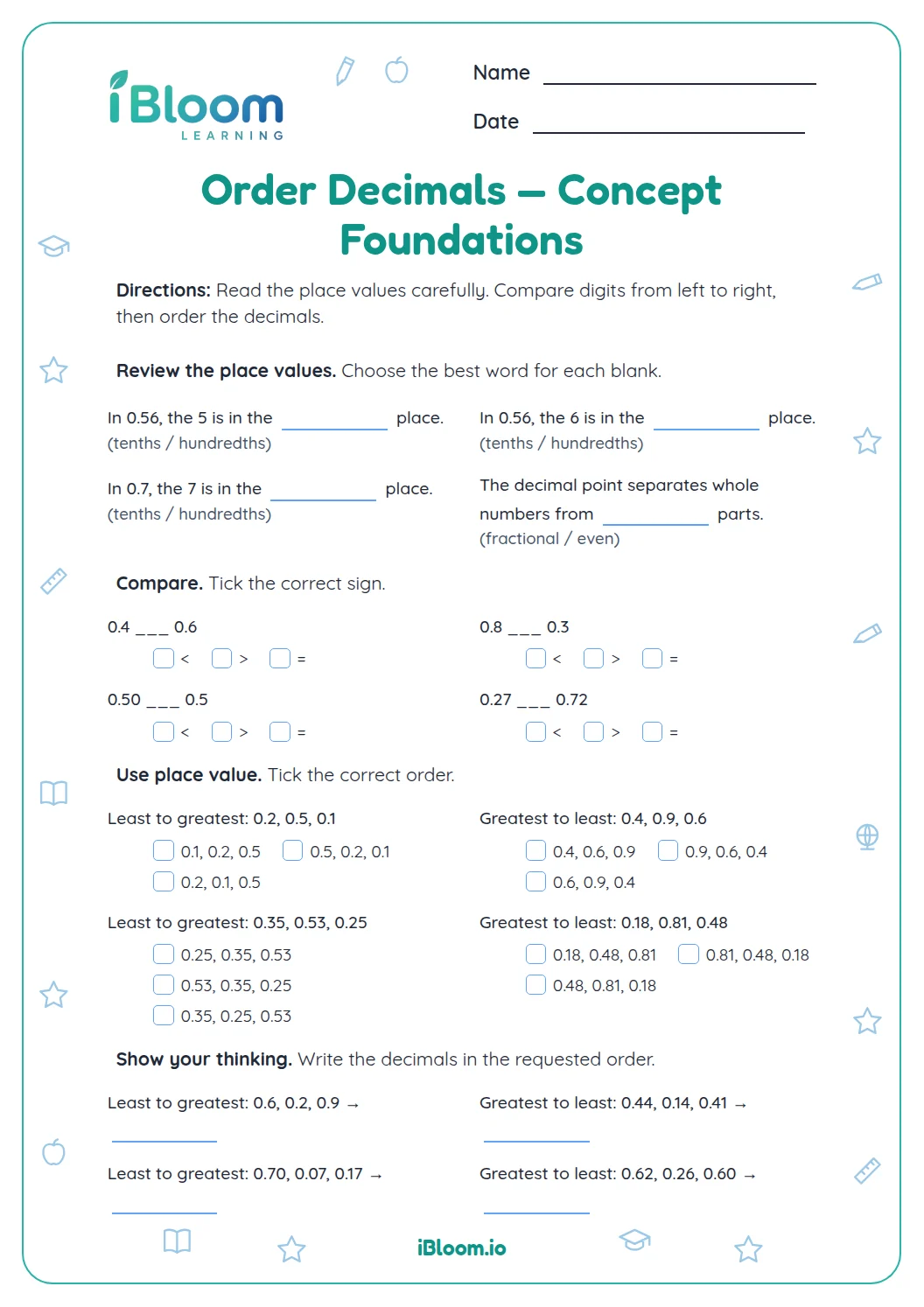
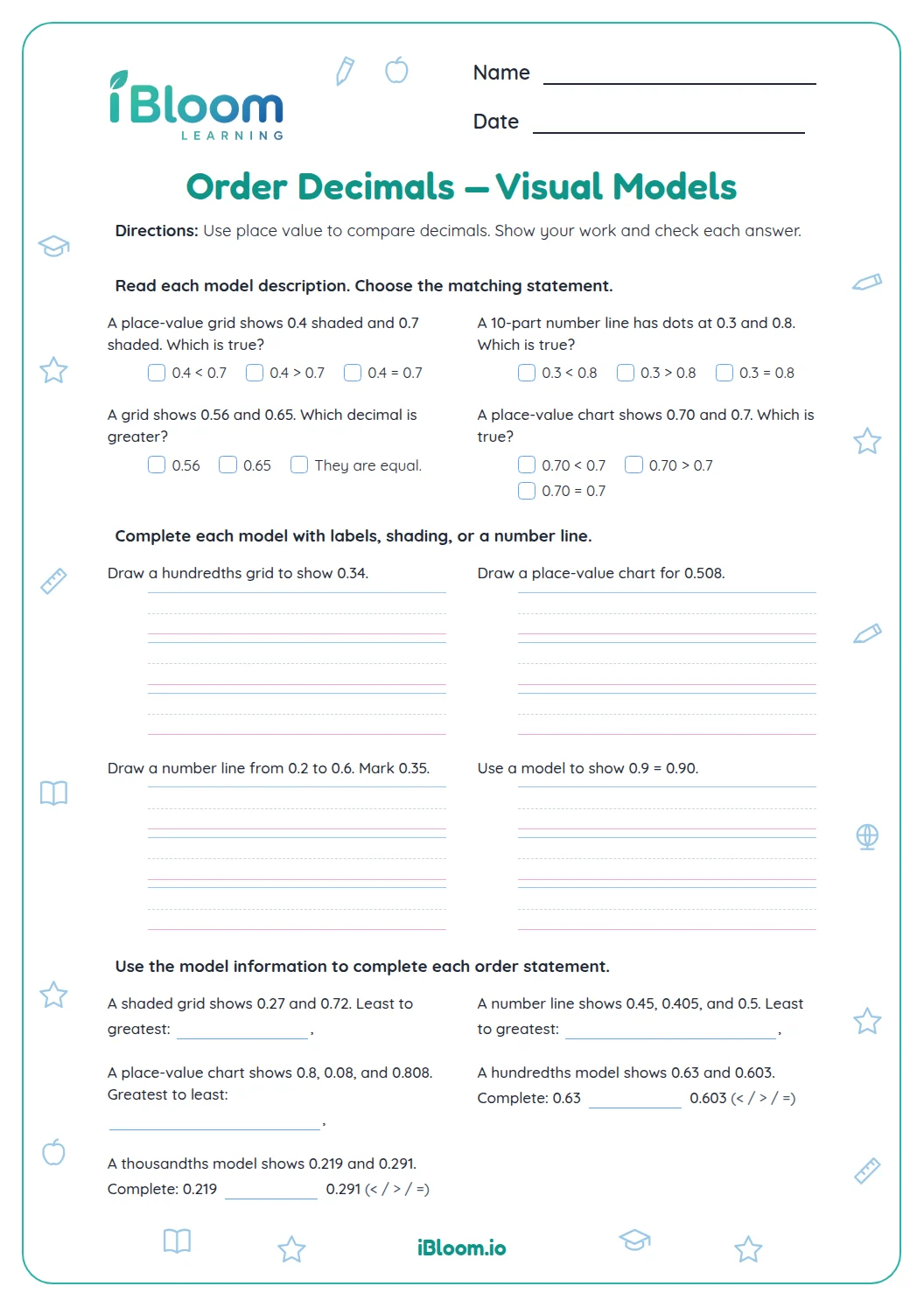
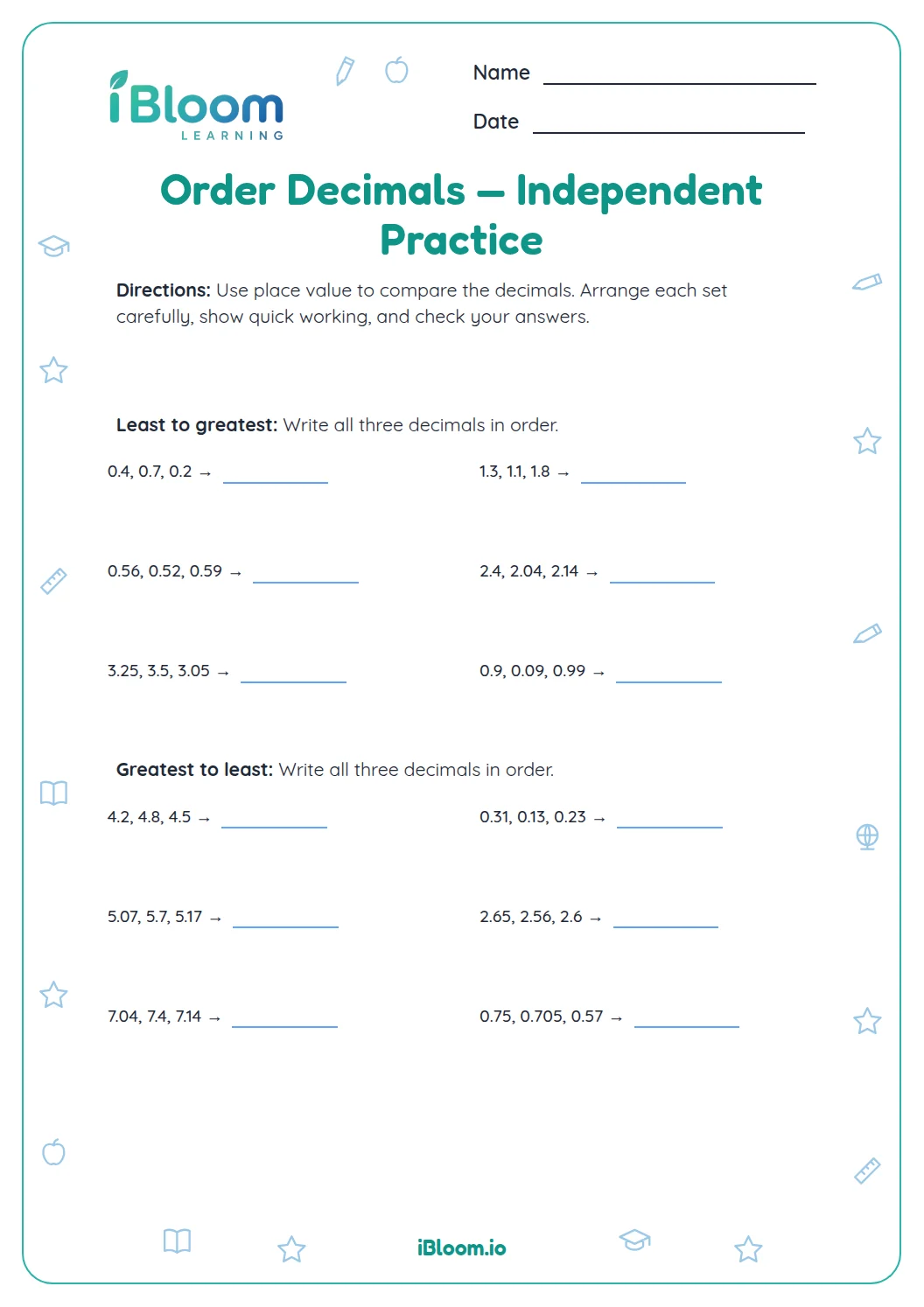
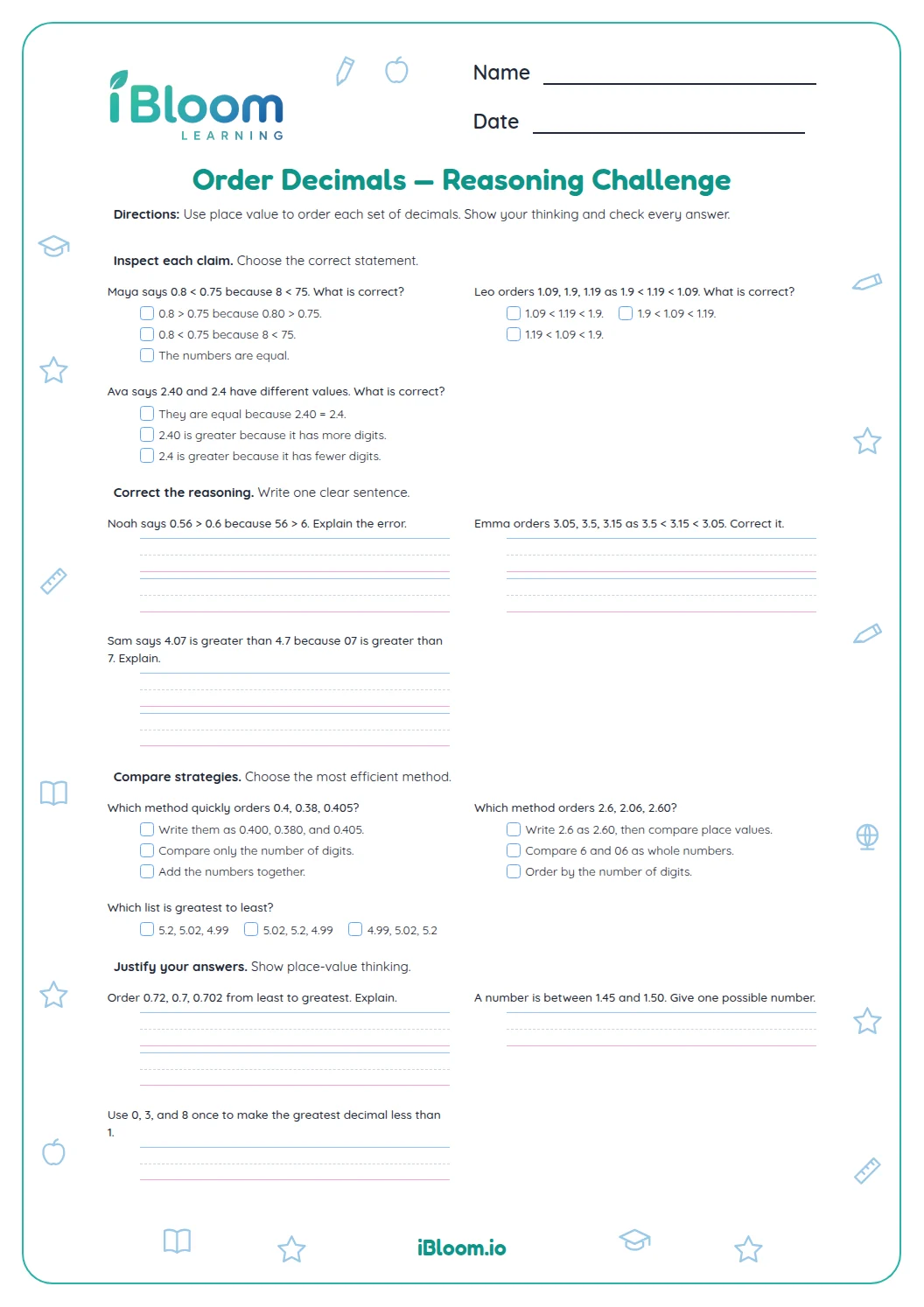


About this worksheet
This free Grade 4 worksheet puts decimal ordering into everyday decisions: comparing prices, sorting lengths and ranking race times. Its 13 questions include two symbol comparisons, seven ordered lists, two missing-value choices and two written explanations. Values use tenths and hundredths, with a shared unit within each question. Children order both three and four amounts and explain why $1.9 and $1.90 tie. The sheet practices Common Core 4.NF.C.7 through comparisons and place-value reasoning. A separate answer key supplies every symbol, list and choice, plus sample explanations.
Aligned to 4.NF.C.7
How do tenths and hundredths help you order values?
Decimals with different numbers of digits can still be compared place by place. Rename 0.8 as 0.80 so the hundredths line up with 0.75. Eight tenths are greater than seven tenths, making 0.80 greater even though 75 is a larger whole number than 8.
Part A also includes equal values, 0.5 kg and 0.50 kg. A zero added at the end of a decimal does not change its value.
Which ribbon is shortest in question 4?
Compare the three ribbon lengths in meters. All have zero whole meters, so the tenths decide the order: seven tenths, eight tenths, then nine tenths.
- 1Ribbon lengths: 0.8 m, 0.75 m, 0.9 m
- 2Rename 0.8 as 0.80 and 0.9 as 0.90.
- 3Compare: 0.75 < 0.80 < 0.90.
- 4Shortest to longest: 0.75 m, 0.8 m, 0.9 m.
Does the smallest decimal always come first?
The instruction determines the direction. Part B mixes cheapest to most expensive, shortest to longest, tallest to shortest and greatest to least. Read each question before choosing the first value. Part C asks for the one missing amount that keeps a list in order.
Part D connects comparison to meaning. Over the same distance, a smaller time means a faster runner. The final question orders four juice prices and explains the tie between $1.9 and $1.90; either equal price can be written first.
Use the unit and the direction
- 1Read the context and identify the shared unit, such as meters or seconds.
- 2Compare whole-number parts, then tenths, then hundredths.
- 3Add a trailing zero on scrap paper when it helps align places.
- 4For each list, check the direction and include every value. For a missing amount, compare it with both neighbors.
- 5Read the completed order back in context and check the key.
Decimal ordering slips
The mistake
Placing 0.8 before 0.75 in increasing order because 8 is less than 75.
The fix
Write 0.8 as 0.80; 80 hundredths is greater than 75 hundredths.
The mistake
Using < between 0.5 kg and 0.50 kg.
The fix
Both represent five tenths of a kilogram. Use =.
The mistake
Naming the runner with 9.85 seconds as faster than the runner with 9.8 seconds.
The fix
A shorter time means a faster finish over the same distance. Compare 9.80 with 9.85.
Common Core alignment
Compare and order decimal amounts; justify a race result and equal prices.
On this sheet: Children use comparison symbols, order amounts in consistent units, and explain unequal times and equal prices.
Show the official wordingHide the official wording
Compare two decimals to hundredths by reasoning about their size. Recognize that comparisons are valid only when the two decimals refer to the same whole. Record the results of comparisons with the symbols >, =, or <, and justify the conclusions, e.g., by using a visual model.
What to practice next
Make more practice
Further reading
Questions parents and teachers ask
What real-world situations are included?
The questions use prices, ribbon lengths, bag masses, plant heights, walking distances, rainfall and race times. Each comparison or list keeps one unit throughout. Children focus on the decimal values, the requested direction and what words such as cheapest, tallest and fastest mean in context.
Should children add zeros before comparing?
They may add a trailing zero when it helps line up decimal places. In question 4, 0.8 m becomes 0.80 m, making it easier to compare with 0.75 m. The amount stays the same, so either equivalent form is acceptable in the ordered list.
Does this sheet include equal decimals?
Yes, question 2 compares 0.5 kg with 0.50 kg. Children write an equals sign because both values describe the same mass. This item checks whether they understand that an extra trailing zero changes the way a decimal is written without changing its size.
How should the two explanations be marked?
Accept a race explanation that names Mia and connects 9.80 < 9.85 to a faster finish over the same distance. For the juice prices, look for $1.90 and $1.9 together before $1.19 and $1.09, with an explanation that a trailing zero leaves the price unchanged.
What should children write for ordering questions?
Children should include every value and identify the unit or currency. Most Part B lists have three amounts; the walking-distance list has four. Check the direction in each question. In the final price problem, either of the two equal prices may come first.