




About this worksheet
This free Grade 4 worksheet connects one-digit decimal subtraction to equal tenths. Part A names fractions and shaded tenths as decimals. Part B subtracts within one whole. Part C asks children to line up decimal points, subtract amounts above one, regroup when needed, and check by adding. Part D applies subtraction to juice and ribbon. The sixteen questions practice decimal notation and separating equal parts under Common Core 4.NF.C.6 and 4.NF.B.3.a. A separate answer key gives every result, including units for the two measurements.
Aligned to 4.NF.C.6 and 4.NF.B.3.a
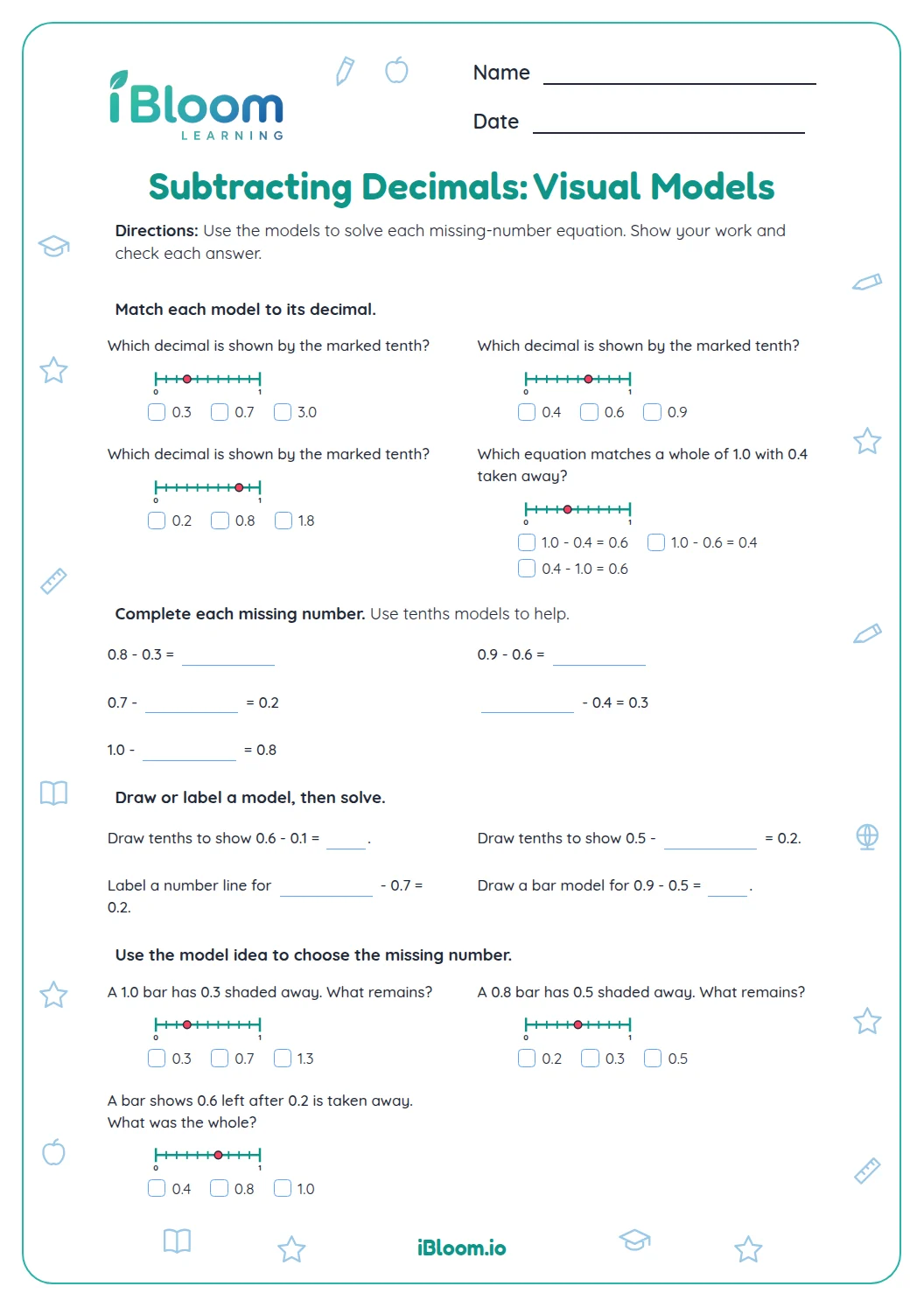
What do the two shaded strips represent?
Each strip contains ten equal parts. Eight shaded parts represent 8/10, written 0.8; six shaded parts represent 6/10, written 0.6. The unshaded spaces complete the same whole.
The next two blanks keep the fraction-to-decimal connection visible without a drawing. Ten tenths equals one whole, which can be written 1.0.
Why do 8/10 − 3/10 and 0.8 − 0.3 have the same answer?
Both number sentences remove three tenths from eight tenths. The notation changes, but the amount and the size of each part stay the same. Reading each expression aloud as tenths makes that connection clear.
- 1Question 5: 8/10 − 3/10 = ___
- 28 tenths − 3 tenths = 5 tenths.
- 35/10 = 0.5, so write 0.5.
- 4Question 6 records the same subtraction as 0.8 − 0.3 = 0.5.
How do children subtract tenths from one whole?
Rename 1.0 as ten tenths. In question 9, removing four tenths leaves six tenths, so 1.0 − 0.4 = 0.6. A pencil sketch of ten equal boxes can help a child track those parts.
Part C extends this idea to amounts above one whole. Line up the decimal points before subtracting. Part D uses liters and meters; adding the answer to the amount removed should recover the starting measurement.
How do children regroup when the top tenths digit is smaller?
In Part C, write each subtraction in columns, with decimal points directly beneath each other. Exchange one whole for ten tenths when there are too few tenths in the top number. Keep the decimal point in the same column in the answer.
- 11.2 − 0.7
- 2Rename 1 whole and 2 tenths as 0 wholes and 12 tenths.
- 312 tenths − 7 tenths = 5 tenths, so the answer is 0.5.
- 4Check: 0.5 + 0.7 = 1.2.
How to use this worksheet
- 1Point to the ten equal parts in the first strip and name the eight shaded parts.
- 2Complete Part A by writing decimals for all four fractions.
- 3Solve questions 5 and 6 together and explain why they match.
- 4For subtraction from 1.0, say “ten tenths” before removing any parts.
- 5In Part C, write each calculation in columns. Exchange one whole for ten tenths when needed, then check by adding.
- 6Write a number sentence for each measurement problem and check by adding back.
Mistakes to notice and fix
The mistake
Writing 5 instead of 0.5 after subtracting eight tenths and three tenths.
The fix
Name the answer as five tenths and write the 5 in the tenths place.
The mistake
Writing 1.2 − 0.7 = 1.5 by subtracting the smaller tenths digit from the larger one.
The fix
Keep the subtraction order. Rename 1.2 as twelve tenths; twelve minus seven leaves five tenths, or 0.5.
The mistake
Changing the denominator in 8/10 − 3/10.
The fix
The pieces remain tenths. Subtract how many pieces, then write 5/10 as 0.5.
Common Core alignment
Connect tenths fractions and shaded strips to decimal notation.
On this sheet: Part A translates tenths fractions into decimals, and Part B uses both notations.
Show the official wordingHide the official wording
Use decimal notation for fractions with denominators 10 or 100. For example, rewrite 0.62 as 62/100; describe a length as 0.62 meters; locate 0.62 on a number line diagram.
Understand subtraction as removing equal tenths from the same whole.
On this sheet: The subtraction questions remove tenths from amounts represented as parts of a whole.
Show the official wordingHide the official wording
Understand addition and subtraction of fractions as joining and separating parts referring to the same whole.
What to practice next
Make more practice
Further reading
Questions parents and teachers ask
What does one-digit decimal subtraction mean here?
It means subtracting numbers with one digit after the decimal point, such as 0.8 − 0.3. That digit counts tenths. The sheet begins by naming shaded tenths, connects tenths fractions to decimals, and then asks children to subtract tenths in number sentences and two short measurement problems.
How do the shaded strips help with subtraction?
Each strip is one whole divided into ten equal parts. The first strip has eight shaded parts, representing eight tenths or 0.8. Children can use that same idea to imagine removing three tenths from eight tenths. Five equal parts remain, so 0.8 − 0.3 is 0.5.
Why does 1.0 − 0.4 equal 0.6?
One whole is ten tenths, so removing four tenths leaves six tenths. Say “ten tenths minus four tenths” before writing 0.6. This keeps the size of each part clear. Adding the answer back to the amount removed gives 0.6 + 0.4 = 1.0, which checks the subtraction.
Should my child write 0.5 or just 5?
Write 0.5 when the answer is five tenths. The decimal point tells the reader that the 5 names tenths rather than whole units. Question 5 makes this connection directly: 8/10 − 3/10 gives 5/10, which is written as 0.5 in the answer blank.
What units belong in the word problem answers?
Use liters for the juice problem and meters for the ribbon problem. The juice answer is 0.5 L, and the ribbon answer is 0.6 m. Have your child write the subtraction sentence first, then check that the answer uses the same unit as the starting amount and the amount removed.