




About this worksheet
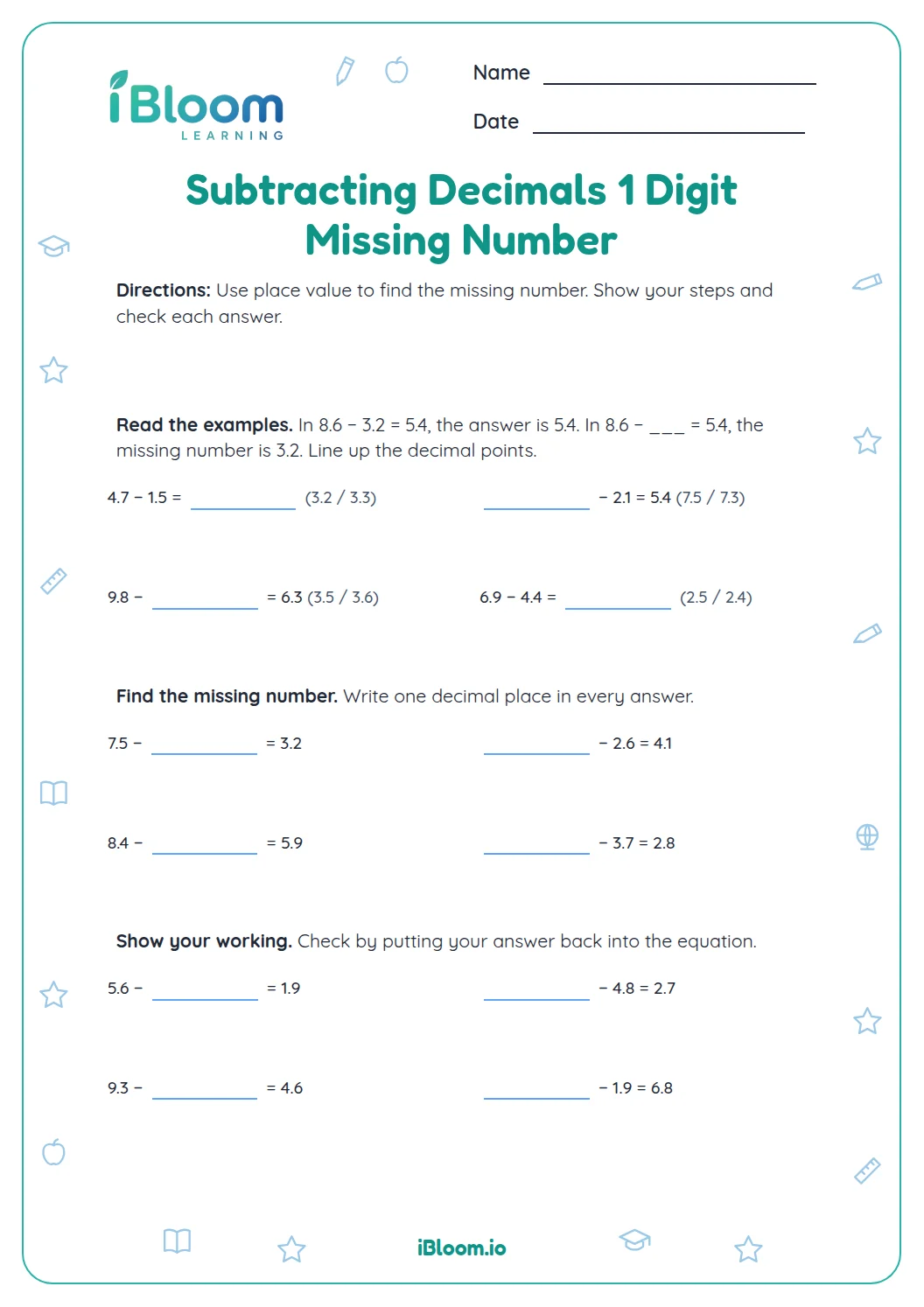
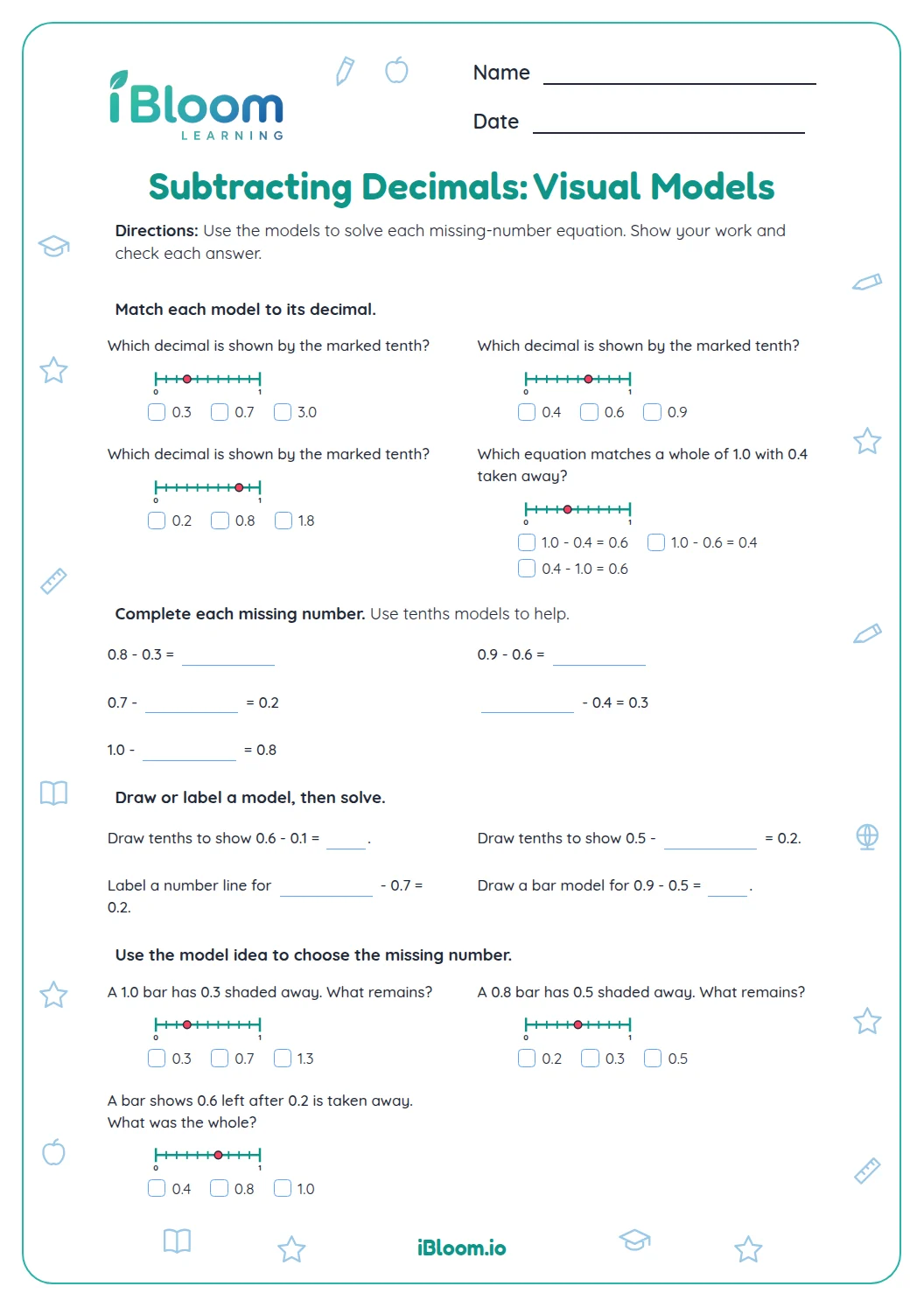
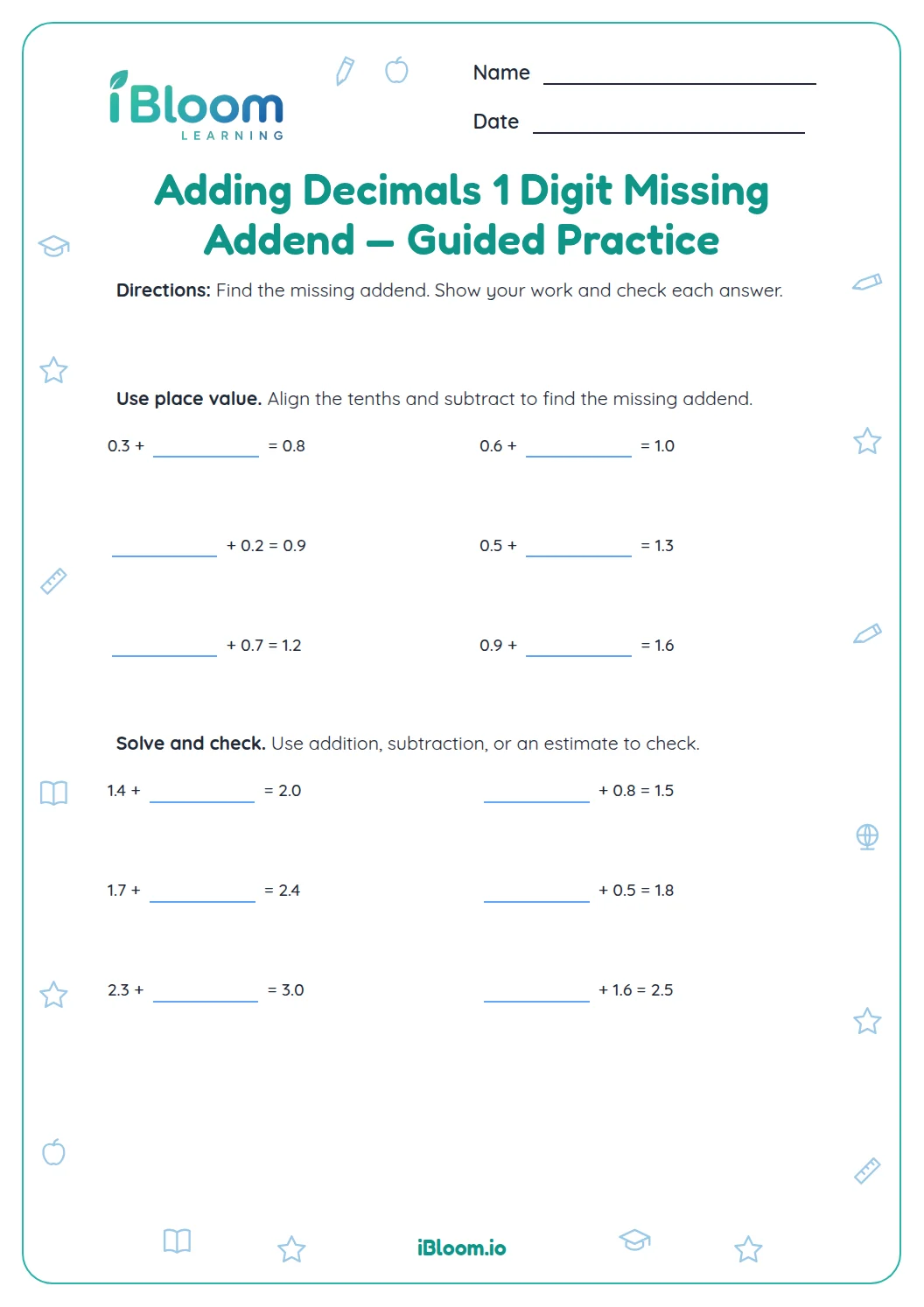
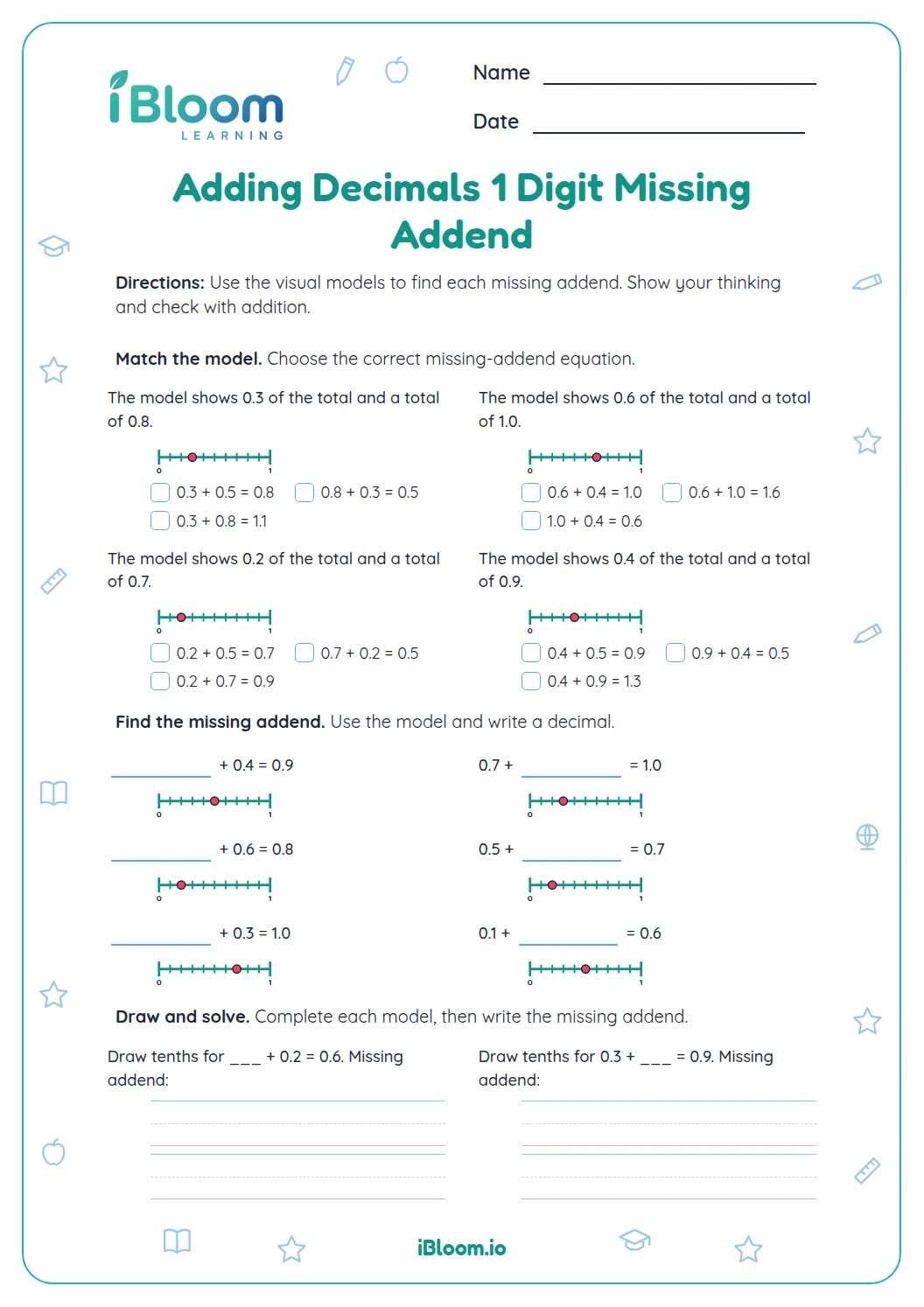
This independent-practice worksheet asks learners to find a missing number in decimal subtraction equations. The missing value may be the starting amount, the amount subtracted, or the difference. Later problems place the same relationships in short measurement situations. Each decimal has one digit after the decimal point, and children can check their result with addition. The answer key lists all 16 values. This page practices the decimal addition and subtraction method described in Common Core 5.NBT.B.7 for the specific subtraction skill named in the worksheet.
Aligned to 5.NBT.B.7
What kinds of missing numbers appear?
The first eight items vary the location of the blank. In ___ − 2.4 = 5.1 the starting amount is missing; in 8.6 − ___ = 3.2 the amount taken away is missing; in 9.7 − 4.5 = ___ the difference is missing.
For the first item, combine the known difference and subtracted amount: 5.1 + 2.4 = 7.5. Then check 7.5 − 2.4 = 5.1.
How are decimals used in the story problems?
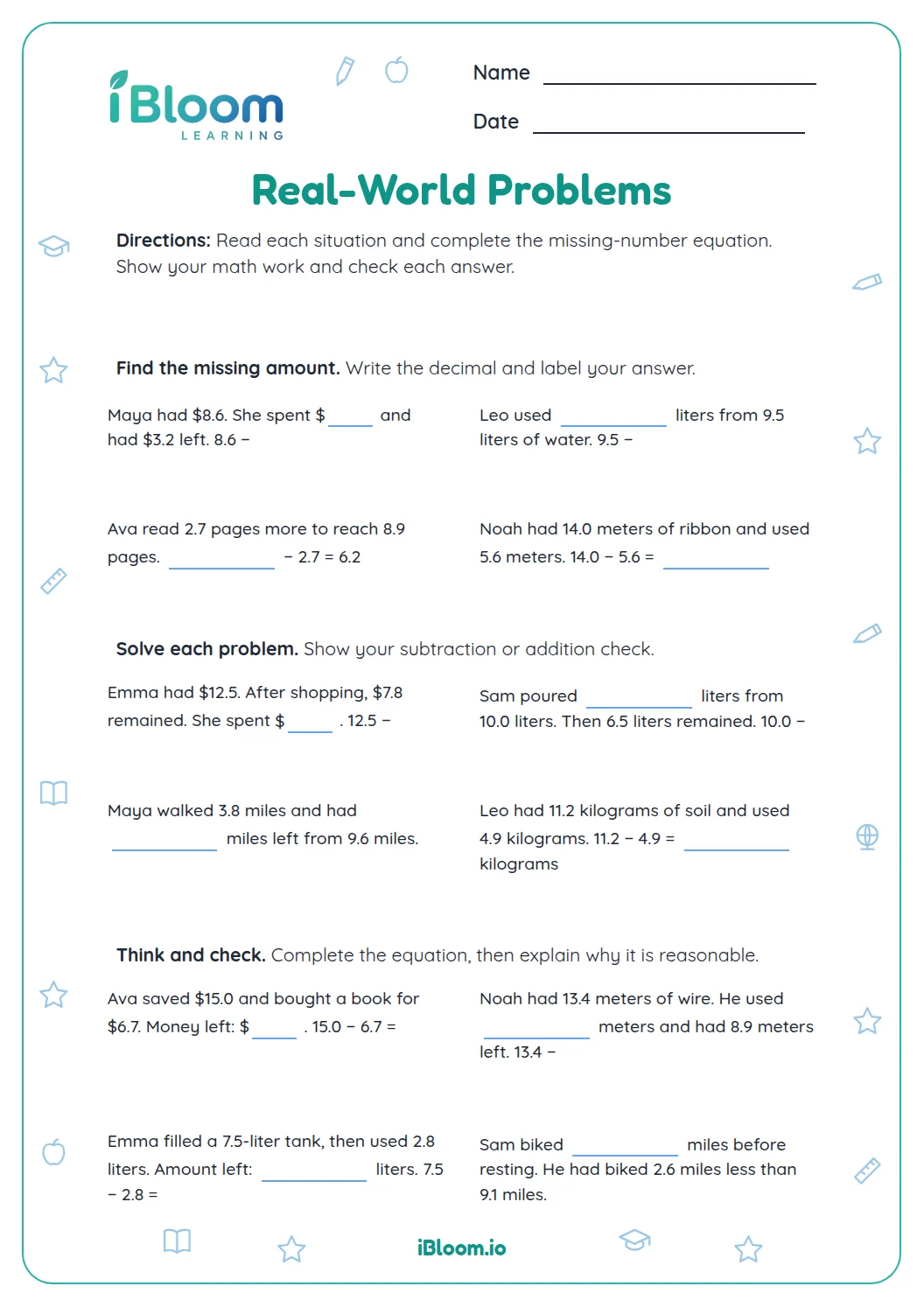
The second part uses lengths, water, distance, and growth. Read which quantity is known and which is unknown, then write a matching subtraction equation. Keep the unit from the story with the answer when recording work.
Why check with addition?
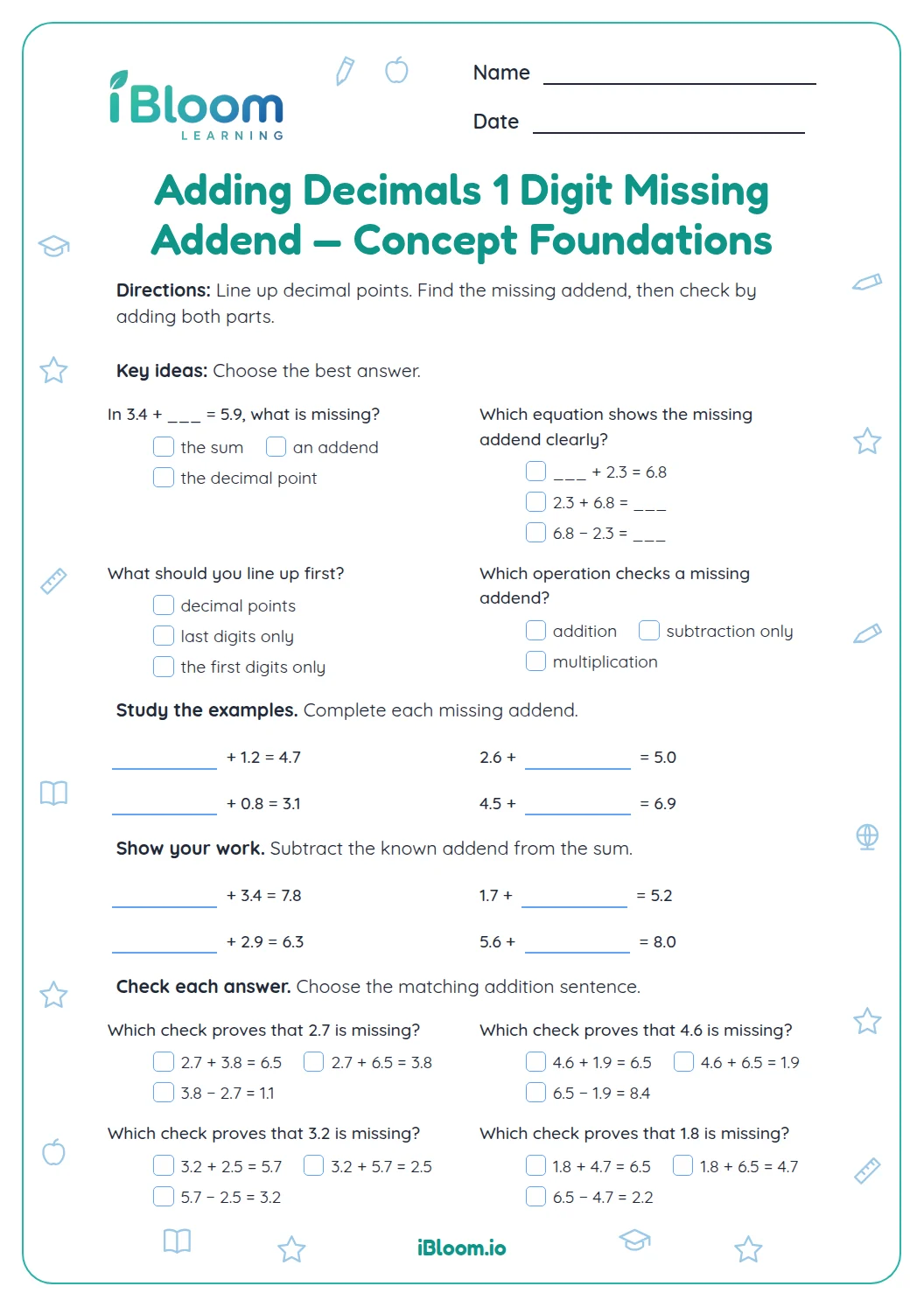
Addition reverses subtraction. Add the difference to the amount removed to recover the starting amount, or add the remaining amount to the removed amount when the start is unknown.
How to use this worksheet
- 1Mark the two known numbers and identify the blank’s place.
- 2Decide whether to add or subtract the known values to find the blank.
- 3Line up decimal points when calculating.
- 4Write the missing value to tenths.
- 5Substitute it back into the original equation and check.
What should children check?
The mistake
Subtracting the smaller decimal from the larger without considering the blank’s position.
The fix
First name what the blank represents: start, amount removed, or difference.
The mistake
Misaligning tenths while calculating.
The fix
Write each decimal point directly under the other before working.
The mistake
Leaving off a unit in a measurement story.
The fix
Keep the same unit named in the question, such as meters or liters.
Common Core alignment
These decimal equations practice place-value subtraction and its relationship to addition.
Add and subtract decimals to hundredths using place value.
On this sheet: The worksheet explicitly practices subtraction with tenths and addition checks to find unknowns.
Show the official wordingHide the official wording
Add, subtract, multiply, and divide decimals to hundredths, using concrete models or drawings and strategies based on place value, properties of operations, and/or the relationship between addition and subtraction; relate the strategy to a written method and explain the reasoning used.
What to practice next
Make more practice
Further reading
Questions parents and teachers ask
Can the blank be in different places?
Yes. The first part includes a missing starting amount, a missing amount subtracted, and a missing difference. Children should decide what the blank represents before calculating. Line up decimal points when checking on paper. This makes the place value in each step easier to see.
How can addition help solve these equations?
Addition and subtraction undo each other. If the starting amount is missing, add the amount removed to the difference. If the amount removed is missing, subtract the known difference from the starting amount. Subtract tenths as well as whole numbers.
How many decimal places are used?
Every decimal is written to tenths, with one digit after the decimal point. The practice focuses on aligning place values and using the inverse operation to check. Use the key to verify the missing value. This makes the place value in each step easier to see.
Are measurement units included?
Yes. The word problems use meters, liters, kilometers, feet, gallons, miles, centimeters, and centimeters for growth. The answer should use the unit named in its question. Write the decimal point in the same place in each number. This makes the place value in each step easier to see.
How many questions are there?
There are 16 items: eight direct equations and eight short application problems. The answer key gives a value for each one. Check that the result has the unit used in the question. This makes the place value in each step easier to see.
Is this a grade-level Common Core standard?
The page practices the decimal subtraction method stated in 5.NBT.B.7, while retaining the worksheet’s Grade 4 label. It uses tenths and a single missing value in each problem. Use addition to check a missing starting amount. This makes the place value in each step easier to see.