


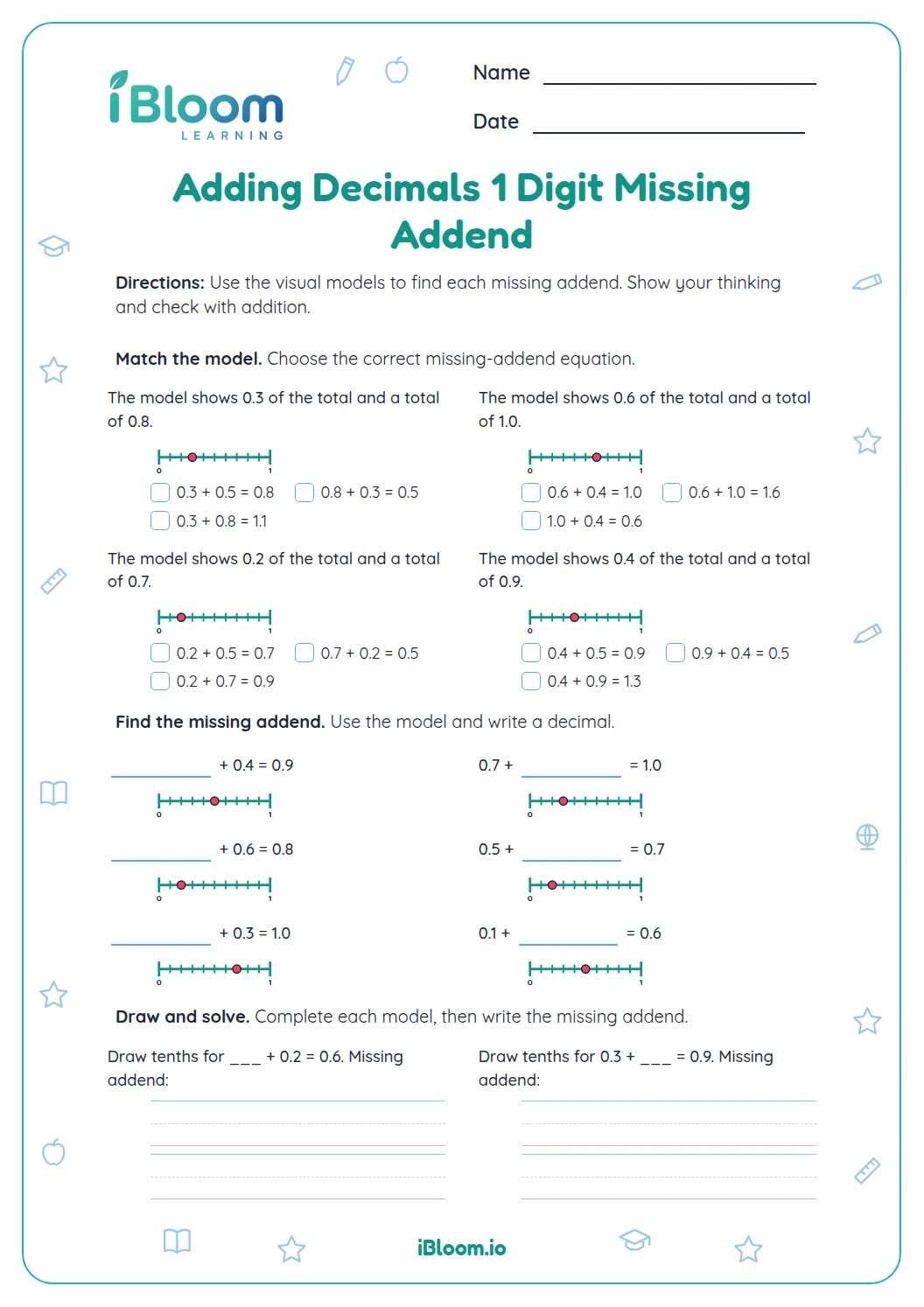


About this worksheet
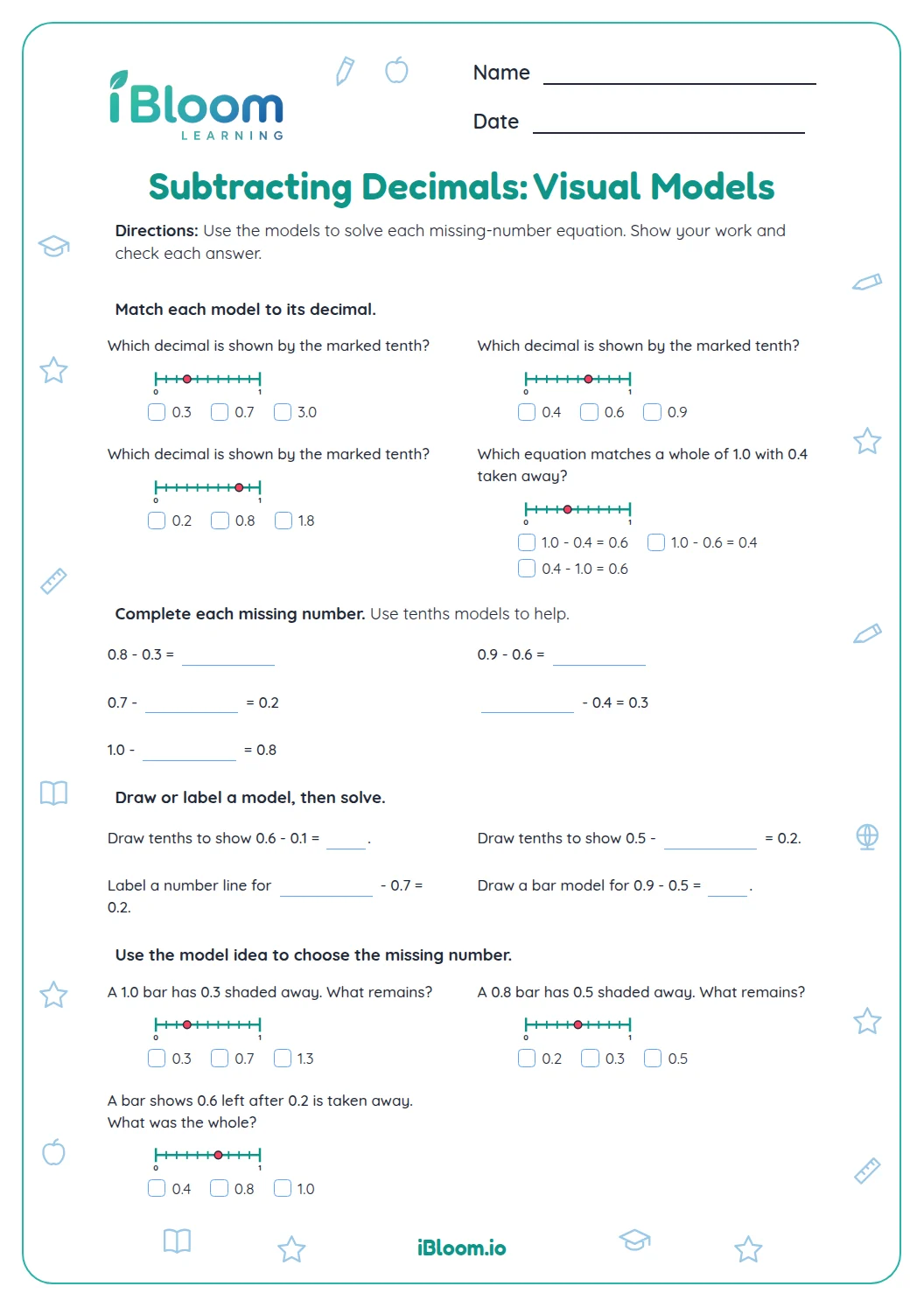
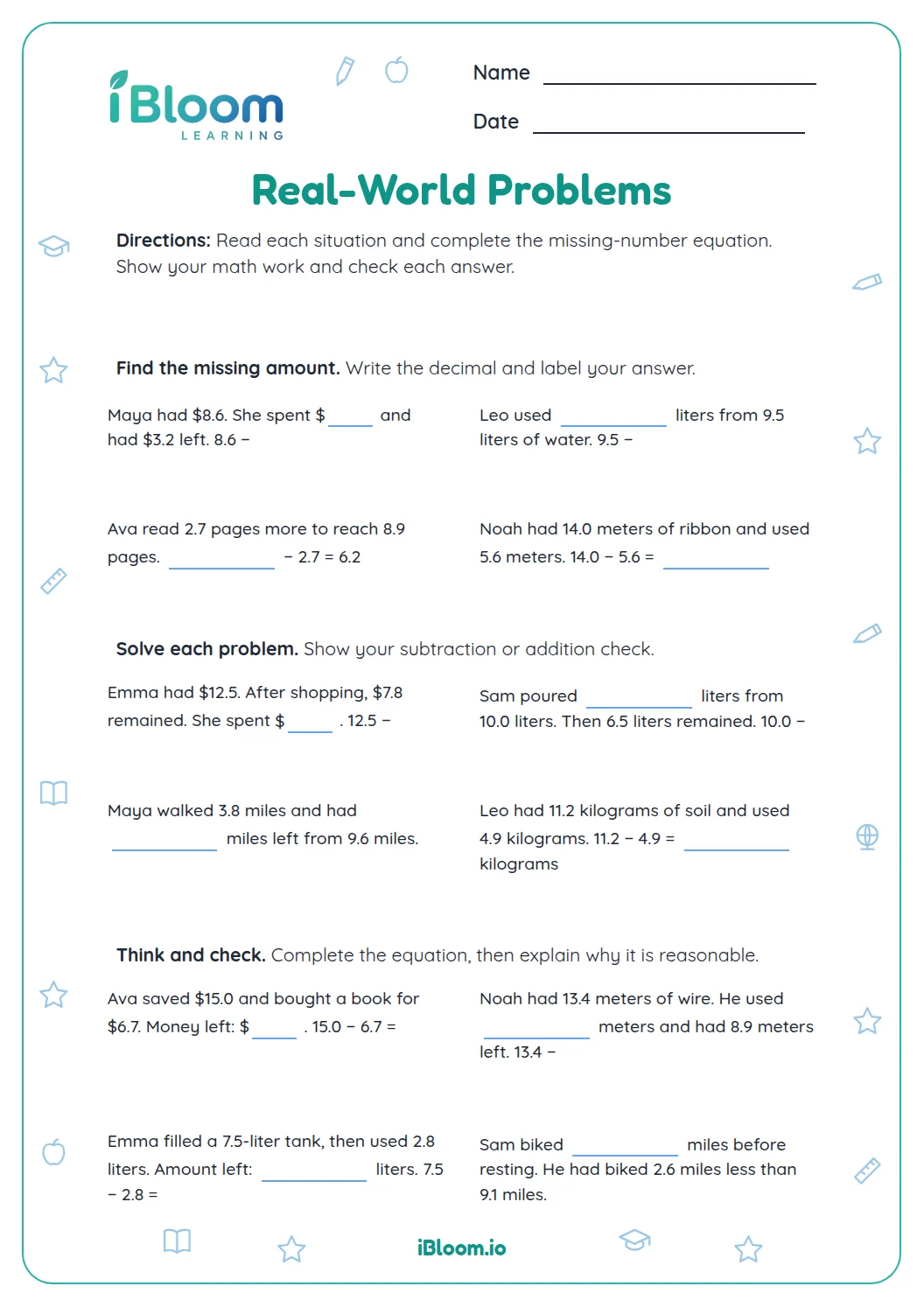
This free printable Grade 4 worksheet builds decimal subtraction reasoning through four routines: inspect worked answers, find missing values, compare useful calculations, and apply the relationship in short questions. All decimals use tenths. Students check claims by substituting a value into the equation and relating subtraction to addition. The sequence follows the original sheet’s error analysis and strategy comparison. A separate answer key lists each answer.
How can a student inspect subtraction work?
Put the proposed value back into the original equation and calculate. If the result does not match the stated difference, the value or work is wrong. The first questions ask children to judge worked answers and spot a decimal subtraction error.
For 4.7 − 2.9, regroup one whole as ten tenths: 4.7 becomes 3 ones and 17 tenths. Subtracting gives 1.8.
What does the blank’s position tell you?
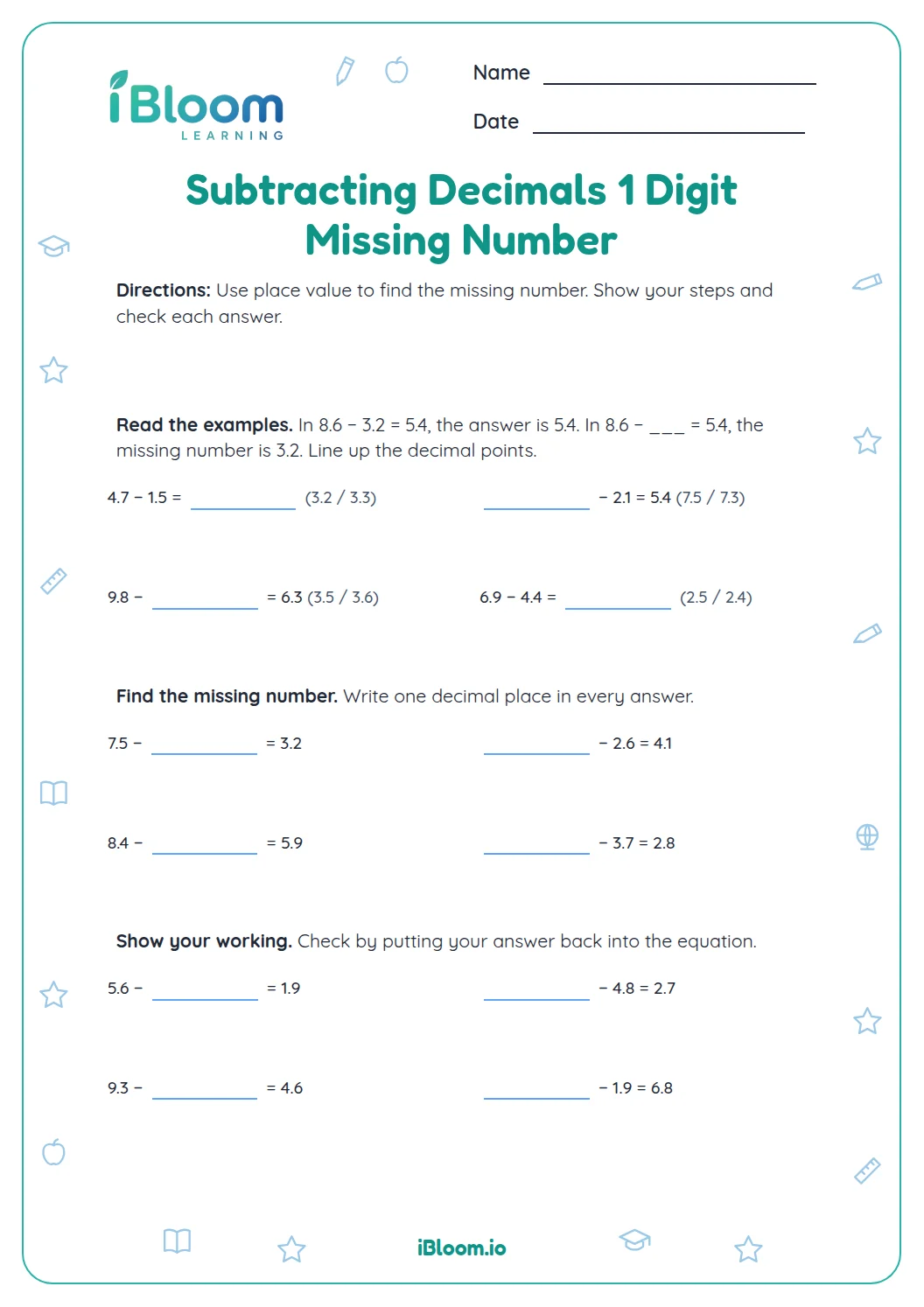
If the starting number is missing, add the amount taken away to the amount left. If the amount taken away is missing, subtract the amount left from the start. The equation section alternates between these positions so students choose the operation that fits.
- 1___ − 1.8 = 4.6
- 2Add 4.6 + 1.8 to find the start: 6.4.
- 3Check: 6.4 − 1.8 = 4.6.
Which calculation finds the blank?
In 9.3 − ___ = 5.8, subtract 5.8 from 9.3 to find what was taken away. In ___ − 2.6 = 4.9, add 2.6 to 4.9 to rebuild the starting amount.
The last questions apply these choices to a liquid amount and to an equation with a missing number of 2.4.
How should children check each answer?
For a missing value, substitute it into the equation and calculate with decimal points aligned. For a choice about strategy, ask whether the calculation reverses the given subtraction. The key shows the selected answer for each problem.
Inspect, solve and check
- 1Read the full equation and identify what the blank represents.
- 2Test a proposed answer by substituting it and calculating.
- 3Add to find a missing start; subtract to find a missing amount taken away.
- 4Line up decimal points when subtracting tenths.
- 5Use the answer key to review any calculation that does not make the equation true.
Decimal reasoning errors to revisit
The mistake
Using subtraction to find a missing starting number.
The fix
Add the amount taken away to the amount left, then substitute.
The mistake
Subtracting each smaller digit from the larger without regrouping.
The fix
Regroup one whole as ten tenths before subtracting.
The mistake
Accepting a proposed value without testing the original equation.
The fix
Put the number back and calculate; the result must match.
What to practice next
Make more practice
Questions parents and teachers ask
How many decimal places are used?
Each decimal on this worksheet is written to the tenths place, such as 4.7 or 2.9. Students inspect calculations, find missing values and use tenths when checking. Writing a zero in a value such as 6.0 can help keep the place value visible.
When should a student add to find the blank?
Add when the starting number is missing. In ___ − 1.8 = 4.6, the start is 4.6 + 1.8, or 6.4. Substituting gives 6.4 − 1.8 = 4.6, which confirms the answer. Line up decimal points when writing the check so the tenths stay clear.
What is the correct difference for 4.7 − 2.9?
The difference is 1.8. Regroup 4.7 as 3 ones and 17 tenths, then subtract 2 ones and 9 tenths. Students use this kind of place-value reasoning when inspecting the worked subtraction on the page and deciding whether the proposed result matches.
Which calculation finds the missing starting amount?
Add the amount taken away to the amount left. For ___ − 2.6 = 4.9, calculate 4.9 + 2.6 to get 7.5. Substituting confirms 7.5 − 2.6 = 4.9. The worksheet asks students to choose the useful calculation before doing the subtraction.
What is the answer to the final equation choice?
The equation is 5.8 − ___ = 3.4. The missing number is 2.4 because 5.8 − 2.4 = 3.4. Students choose this equation from three options and can check the answer by putting 2.4 into the blank. The printed choices help children compare the equations. The printed choices help children compare the equations.