




About this worksheet
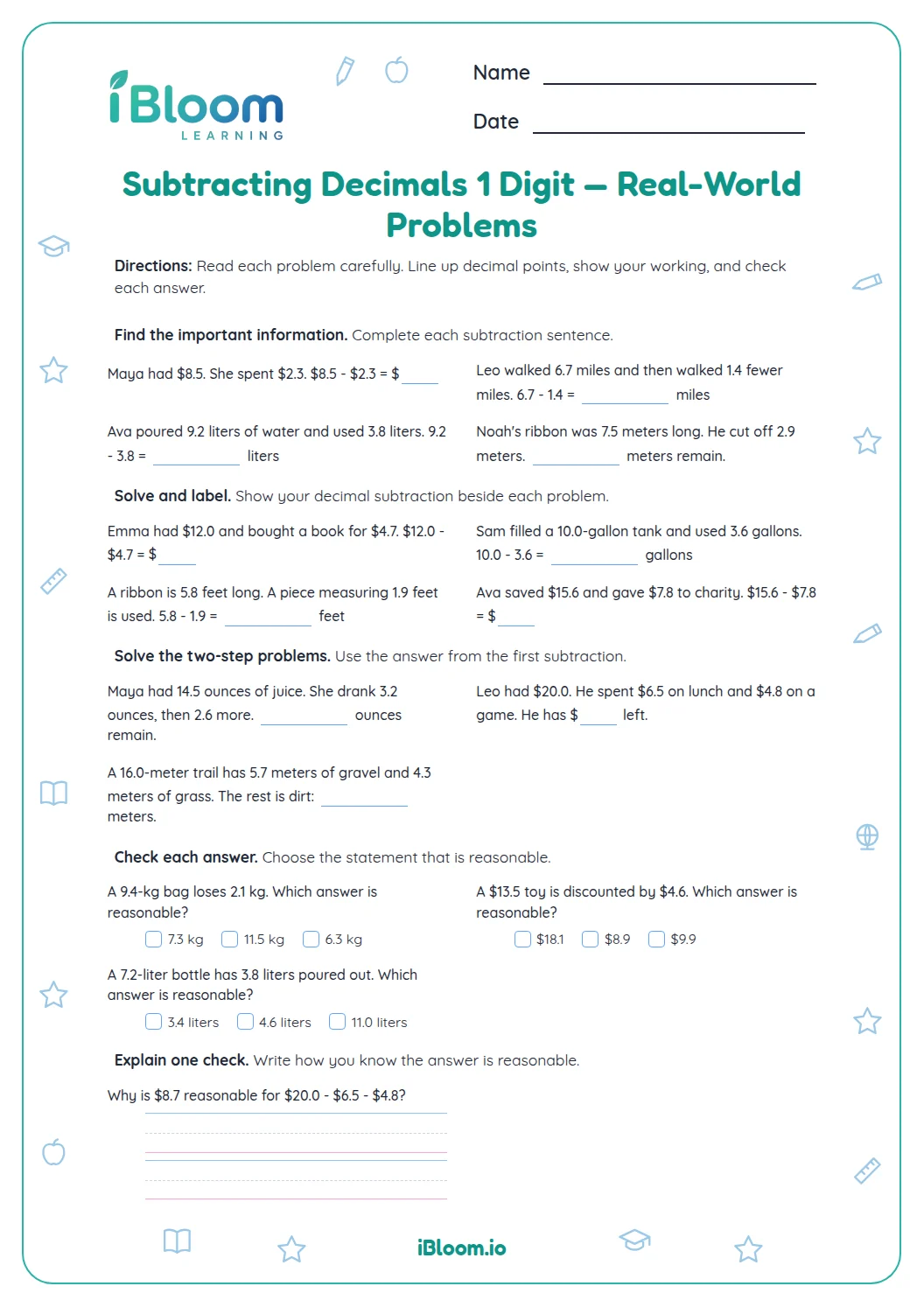
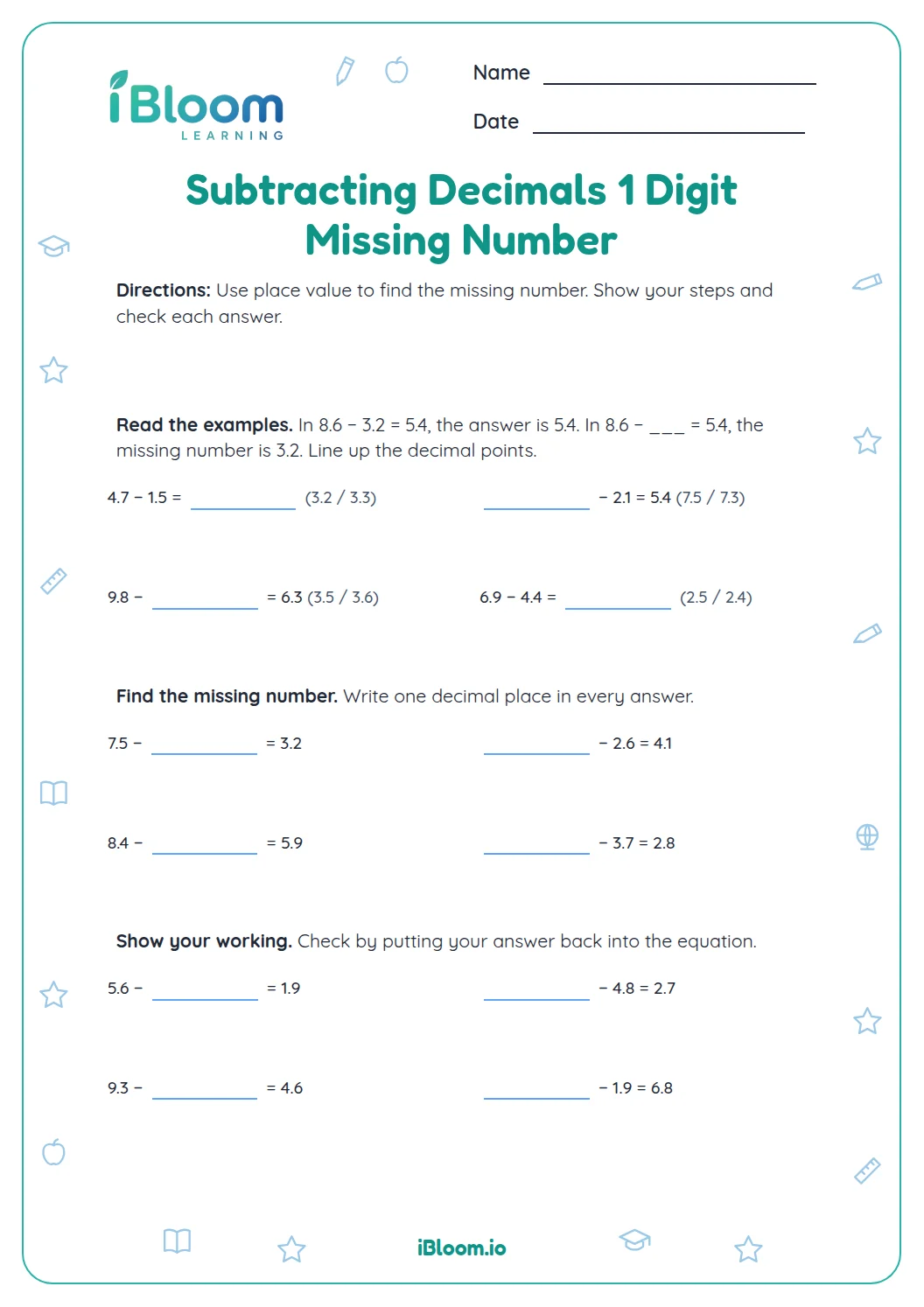
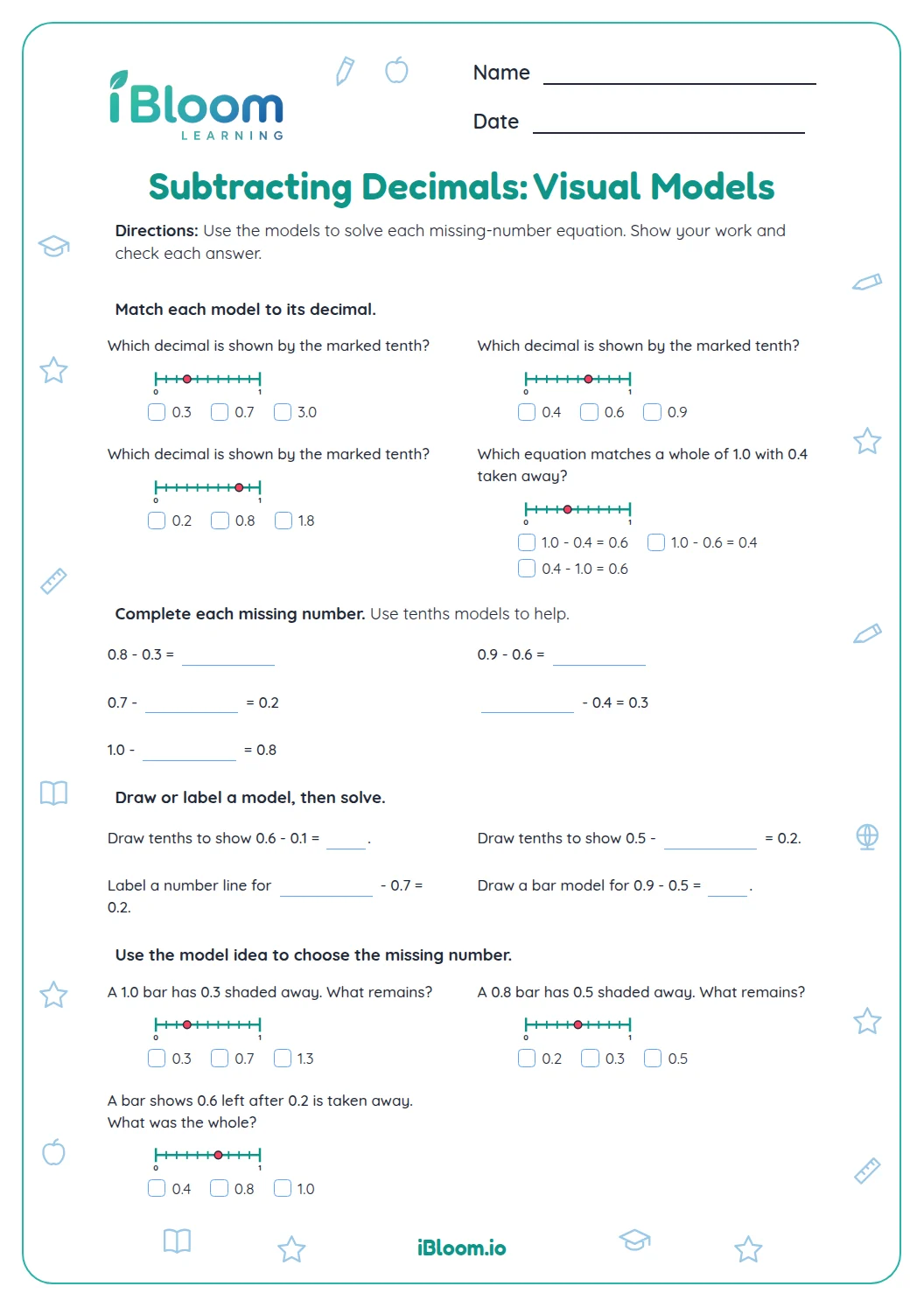
This Grade 4 printable builds reasoning with tenths subtraction through missing numbers, comparisons, error checks, and a ribbon measurement problem. The 14 questions use one decimal place and include a separate key. Learners practice place-value strategies for decimal subtraction and explain their reasoning, as described in CCSS 5.NBT.B.7.
Aligned to 5.NBT.B.7
How can regrouping help with tenths?
A whole is equal to ten tenths. In 6.5 − 0.8, there are only 5 tenths to subtract 8 tenths, so regroup one whole: 6.5 becomes 5 ones and 15 tenths.
Then subtract 15 tenths − 8 tenths = 7 tenths, leaving 5.7. This is the same thinking needed for question 3.
- 16.5 − 0.8
- 2Regroup: 6.5 = 5 + 15/10
- 315 tenths − 8 tenths = 7 tenths
- 4Answer: 5.7
How do comparisons use subtraction sense?
Part B compares expressions that start with the same number. Taking away less leaves more, so learners can compare 3.6 − 1.2 and 5.2 − 1.8 with the competing expressions.
How can a missing value be found?
Part C asks learners to check two incorrect differences and solve a measurement problem. For the ribbon problem, 7.2 m − 3.5 m = 3.7 m; adding the used and remaining lengths checks the result.
How to use this worksheet
- 1Keep tenths aligned under tenths.
- 2Regroup one whole as ten tenths when needed.
- 3Estimate the difference before calculating.
- 4For a missing term, use the inverse relationship.
- 5Compare expressions by considering how much is taken away.
- 6Include units in measurement answers.
Common mistakes and quick fixes
The mistake
Subtracting each decimal digit without regrouping
The fix
Trade one whole for ten tenths before subtracting.
The mistake
Forgetting that the decimal point stays aligned
The fix
Write the points in one column, then subtract by place.
The mistake
Choosing the larger subtraction result incorrectly
The fix
With the same starting number, subtracting less leaves more.
Common Core alignment
This worksheet gives focused practice with the standard below.
Subtract tenths using place-value strategies and explain how regrouping works.
On this sheet: The subtraction and explanation items use place-value reasoning with tenths.
Show the official wordingHide the official wording
Add, subtract, multiply, and divide decimals to hundredths, using concrete models or drawings and strategies based on place value, properties of operations, and/or the relationship between addition and subtraction; relate the strategy to a written method and explain the reasoning used.
What to practice next
Make more practice
Further reading
Questions parents and teachers ask
How do I subtract tenths?
Line up the decimal points so tenths stay beneath tenths. If the top tenths digit is too small, regroup one whole as ten tenths. For 6.5 − 0.8, rename 6.5 as 5 ones and 15 tenths; subtracting leaves 5.7, which you can check by adding 0.8.
Why does taking away less leave more?
Both expressions in a comparison begin with the same number. Subtracting 1.2 from 3.6 leaves more than subtracting 2.1, so 3.6 − 1.2 is greater. This reasoning can help before calculating either difference. This is a quick way to compare the results without doing both calculations first.
What does a missing-number equation ask?
It asks you to find the value that makes the sentence true. For 4.0 − ___ = 2.6, compare 4.0 and 2.6 to find the missing amount, 1.4. Check by substituting: 4.0 − 1.4 = 2.6. Addition provides a useful way to check subtraction.
How many questions are included?
There are 14 questions over two worksheet pages. They include decimal differences, missing terms, comparisons, an error-analysis item, and a measurement situation. A separate answer key lists each result and includes the unit for the measurement answer. Learners can show a check beside each result.
What is the answer key for?
Use the separate key to check differences, missing values, and comparisons. For word problems, it includes the amount and unit so the answer can be checked completely. Learners can also revisit regrouping steps when an answer does not match. It can help learners locate the step where a decimal point or regrouping decision changed the result.