






About this worksheet
This Grade 4 worksheet helps learners use digit patterns to decide whether whole numbers are divisible by common single-digit divisors. It includes multiple-choice checks, yes/no decisions, missing-digit reasoning, and a grouping situation. Sixteen questions build from familiar endings and digit sums toward applying more than one test, with a separate answer key.
Aligned to 4.OA.B.4
How do divisibility rules work?
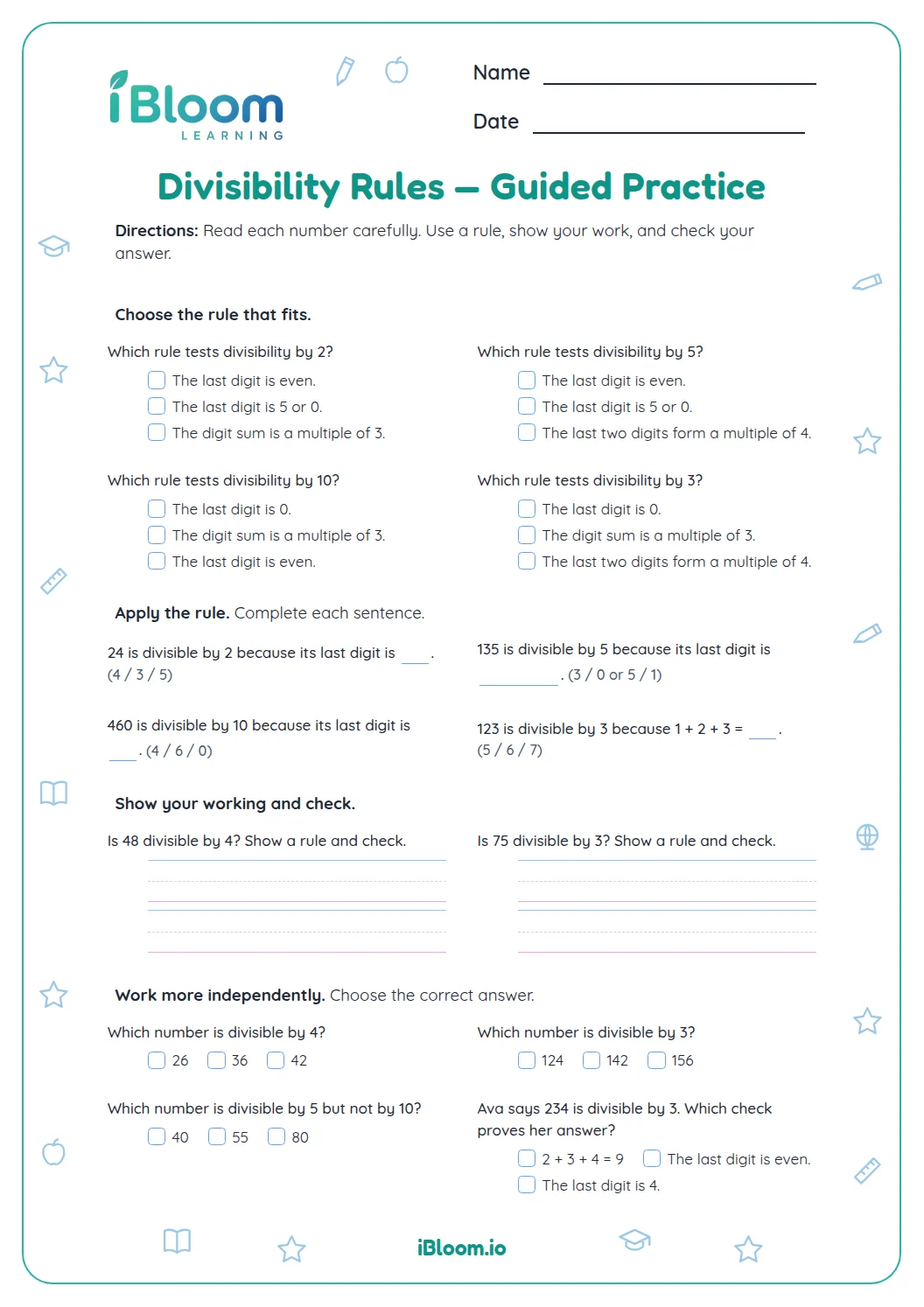
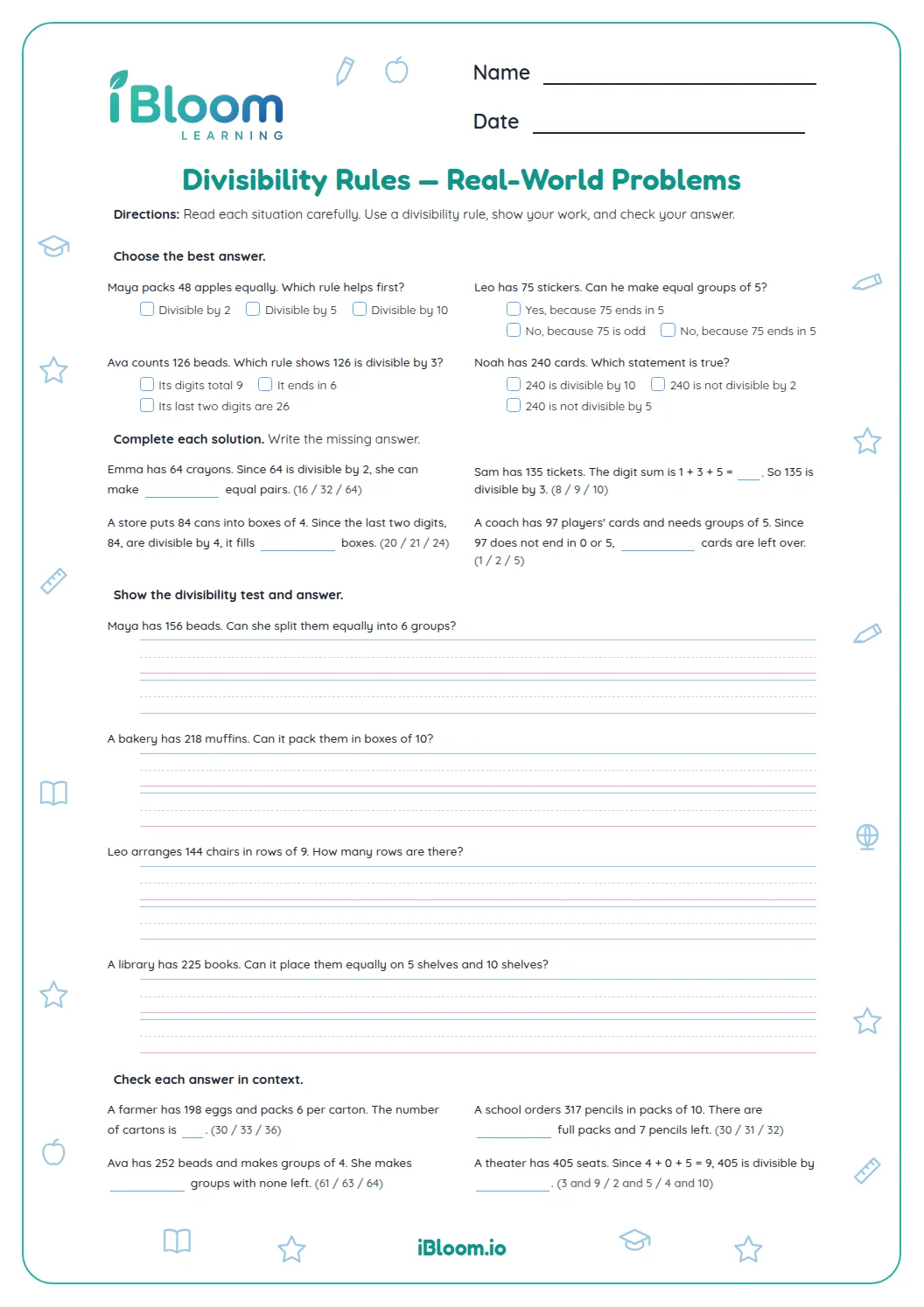
A divisibility rule is a quick pattern that tells whether a number divides evenly. For 2, look for an even last digit. For 5, look for 0 or 5. For 10, look for 0. For 3 or 9, add the digits and test that sum.
How do you use more than one rule?
A number can pass more than one test. A number divisible by both 2 and 5 ends in 0. To test 6, check divisibility by both 2 and 3.
- 1246 ends in 6, so it is divisible by 2.
- 22 + 4 + 6 = 12, and 12 is divisible by 3.
- 3So 246 is divisible by 6.
What does this worksheet practice?
Part A asks learners to choose numbers that pass a rule. Part B asks them to decide, find possible digits, and connect divisibility to equal groups.
How can you use this worksheet?
- 1Read the divisor named in the question.
- 2Choose the matching digit pattern.
- 3For 3 or 9, add the digits and test the sum.
- 4For a combined rule such as 6, check each required rule.
- 5Verify with multiplication or division when useful.
What mistakes should learners watch for?
The mistake
Testing only the last digit for 3 or 9.
The fix
Add all digits, then test that total.
The mistake
Thinking every even number is divisible by 4.
The fix
Check whether the last two digits form a multiple of 4.
The mistake
Checking only one part of the rule for 6.
The fix
A number must pass both the 2 test and the 3 test.
Common Core alignment
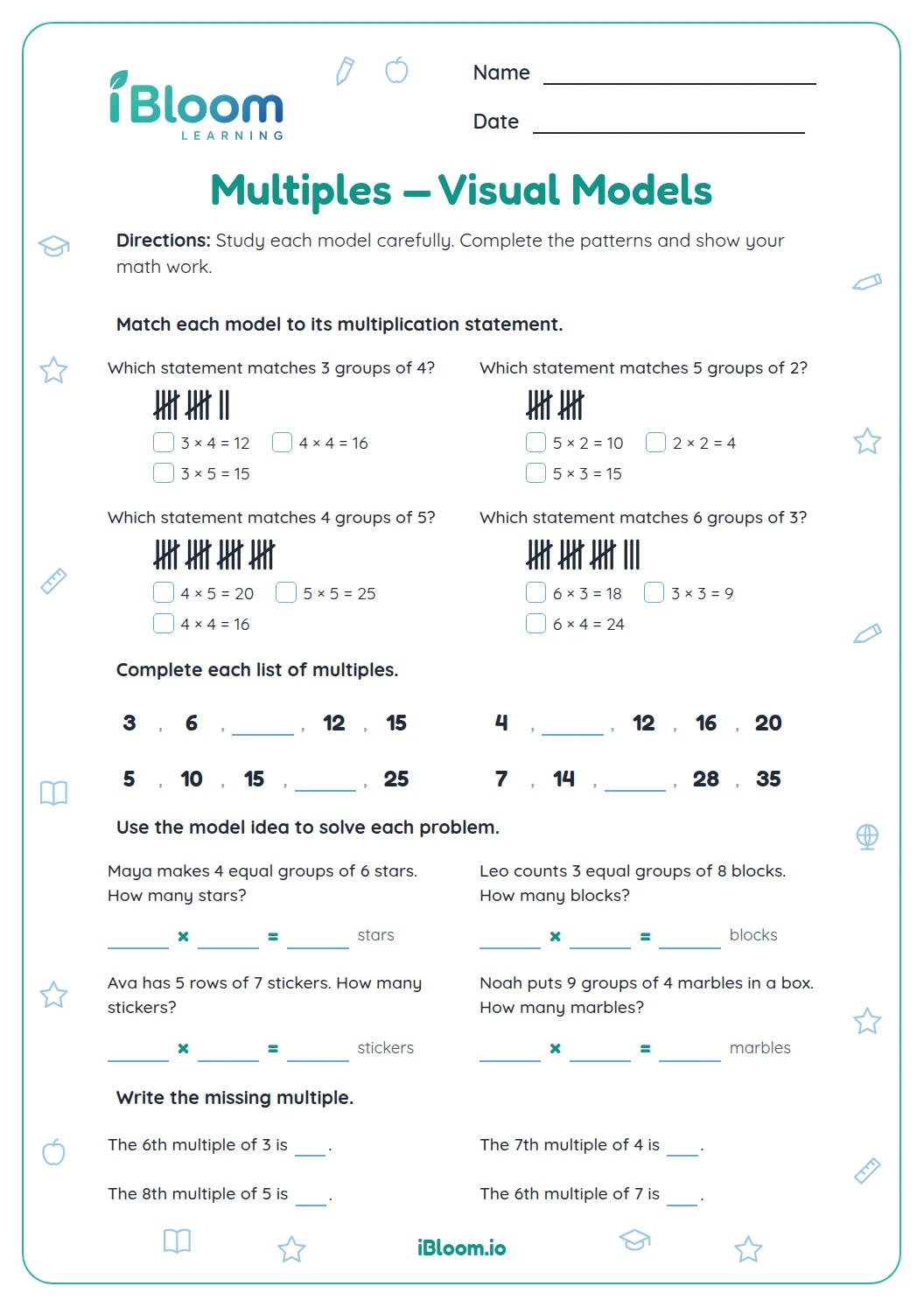
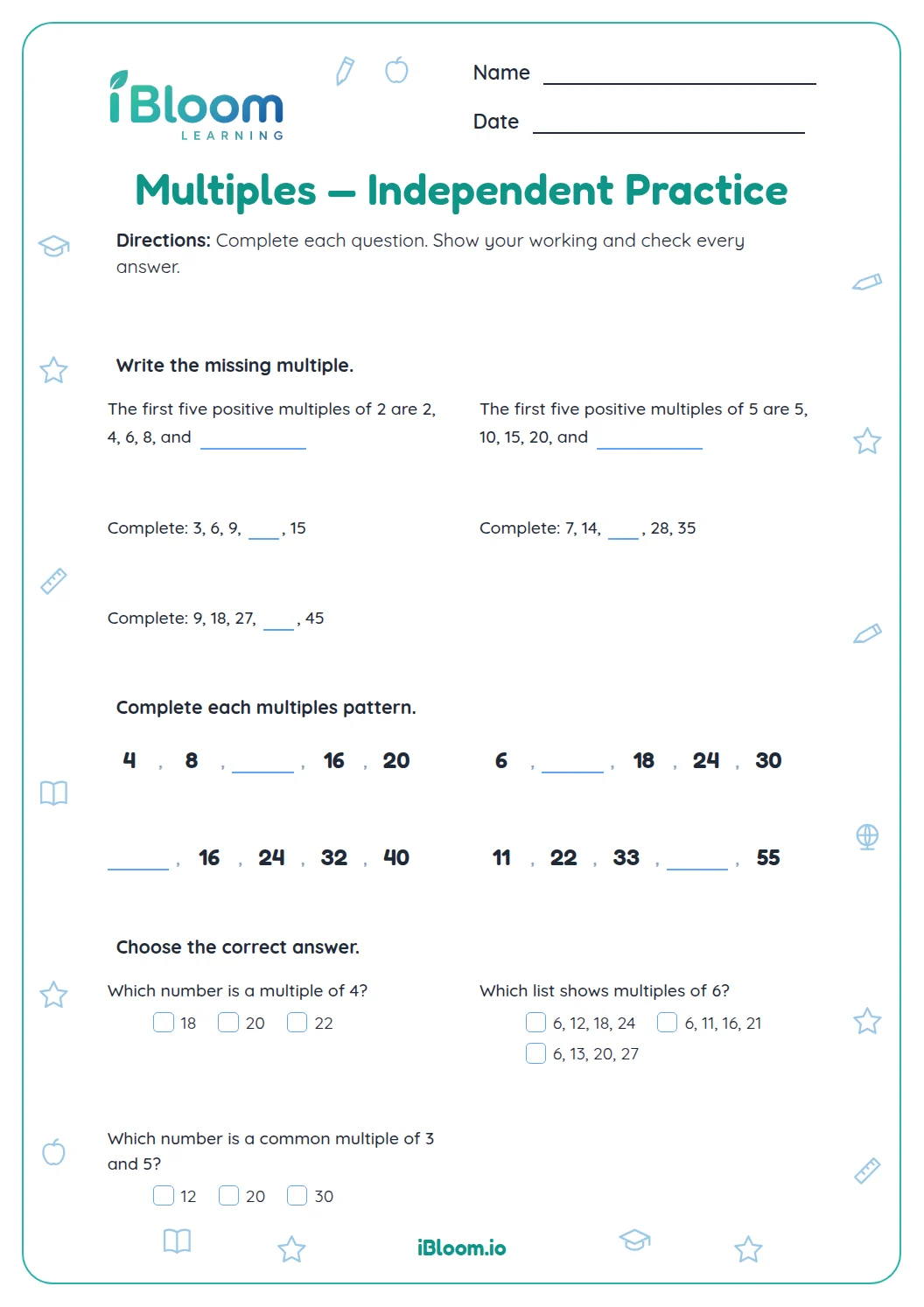
The questions connect divisibility patterns to factors and multiples.
Find factor pairs and identify multiples in whole-number problems.
On this sheet: Learners test whether whole numbers from 1 to 100 are multiples of one-digit divisors.
Show the official wordingHide the official wording
Find all factor pairs for a whole number in the range 1-100. Recognize that a whole number is a multiple of each of its factors. Determine whether a given whole number in the range 1-100 is a multiple of a given one-digit number. Determine whether a given whole number in the range 1-100 is prime or composite.
What to practice next
Make more practice
Further reading
Questions parents and teachers ask
Which divisibility rules appear?
The sheet practices divisibility by 2, 3, 4, 5, 6, 8, 9, and 10. Learners use last-digit patterns, digit sums, and combined checks to decide whether a whole number divides evenly. The answer key makes it easy to review which pattern applies to each number.
How do you test a number for divisibility by 3?
Add the digits. If their sum is divisible by 3, the original number is divisible by 3. For example, 231 has digit sum 6, and 6 is divisible by 3, so 231 passes the test. Try explaining the check aloud before moving to the next item.
How does the 4 rule work?
Look at the last two digits. If that two-digit number is divisible by 4, the whole number is divisible by 4. For 624, the last two digits are 24, and 24 divides evenly by 4. A quick multiplication check can confirm that a divisor divides evenly.
Why test divisibility by 6 twice?
A number is divisible by 6 when it is divisible by both 2 and 3. Check that the number is even, then add its digits and test the sum for divisibility by 3. Learners can use the rule and then verify with a related fact.
How many questions are there?
There are 16 questions in two parts, including eight multiple-choice questions and eight short-answer questions. A separate answer-key page provides the correct choices and responses. Discuss the digit pattern that makes a number pass or fail its test. The answer key makes it easy to review which pattern applies to each number.