





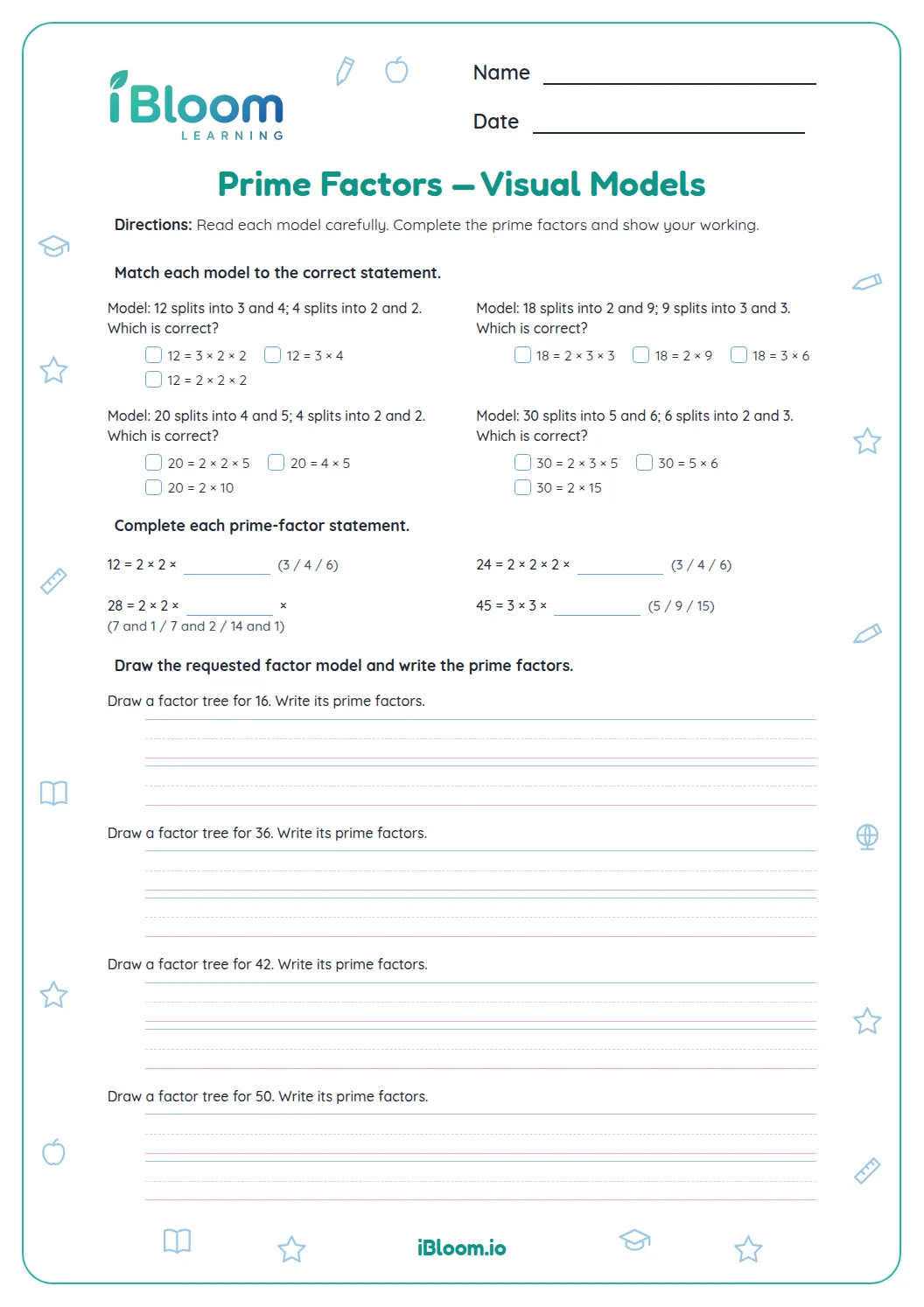
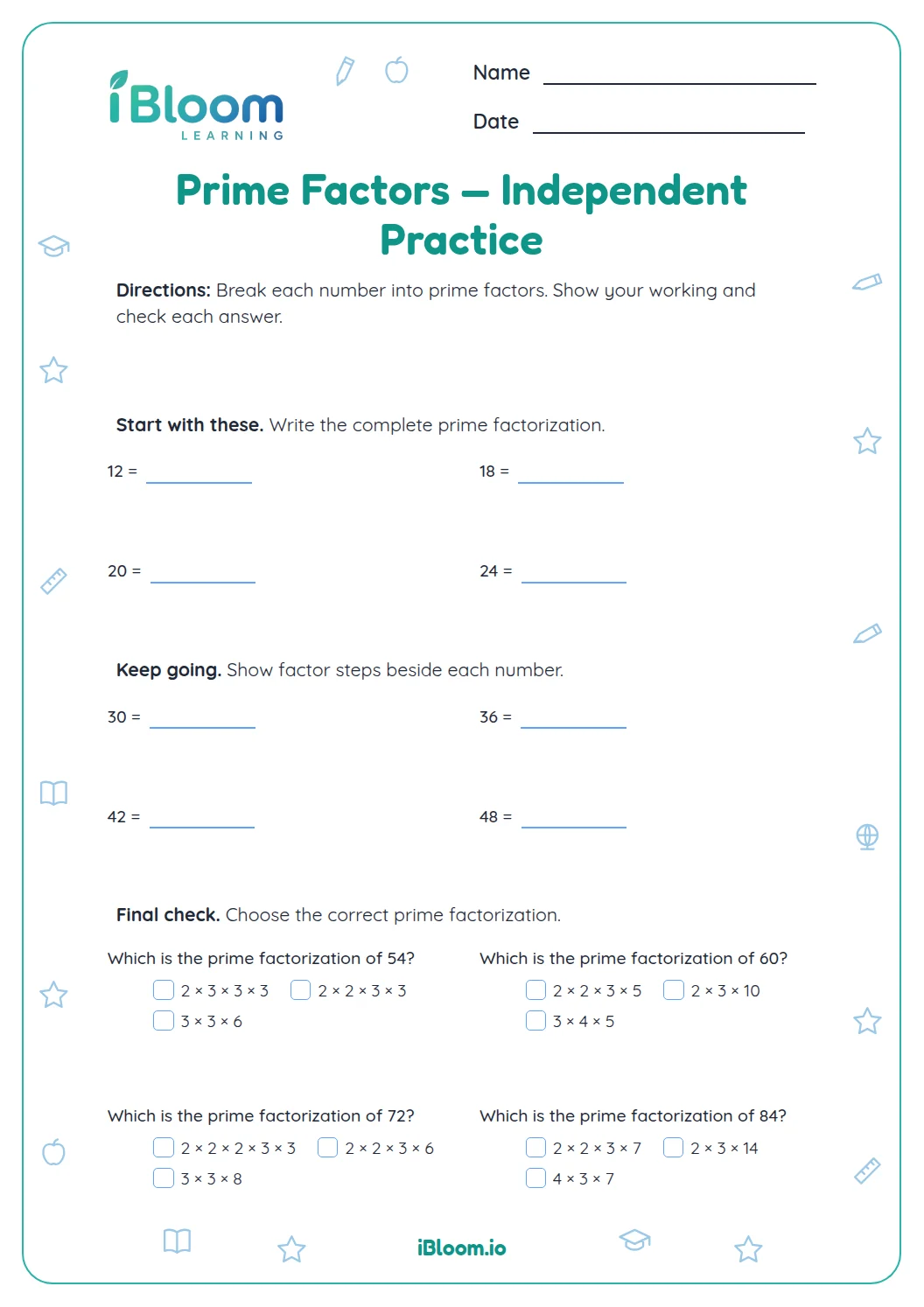
About this worksheet
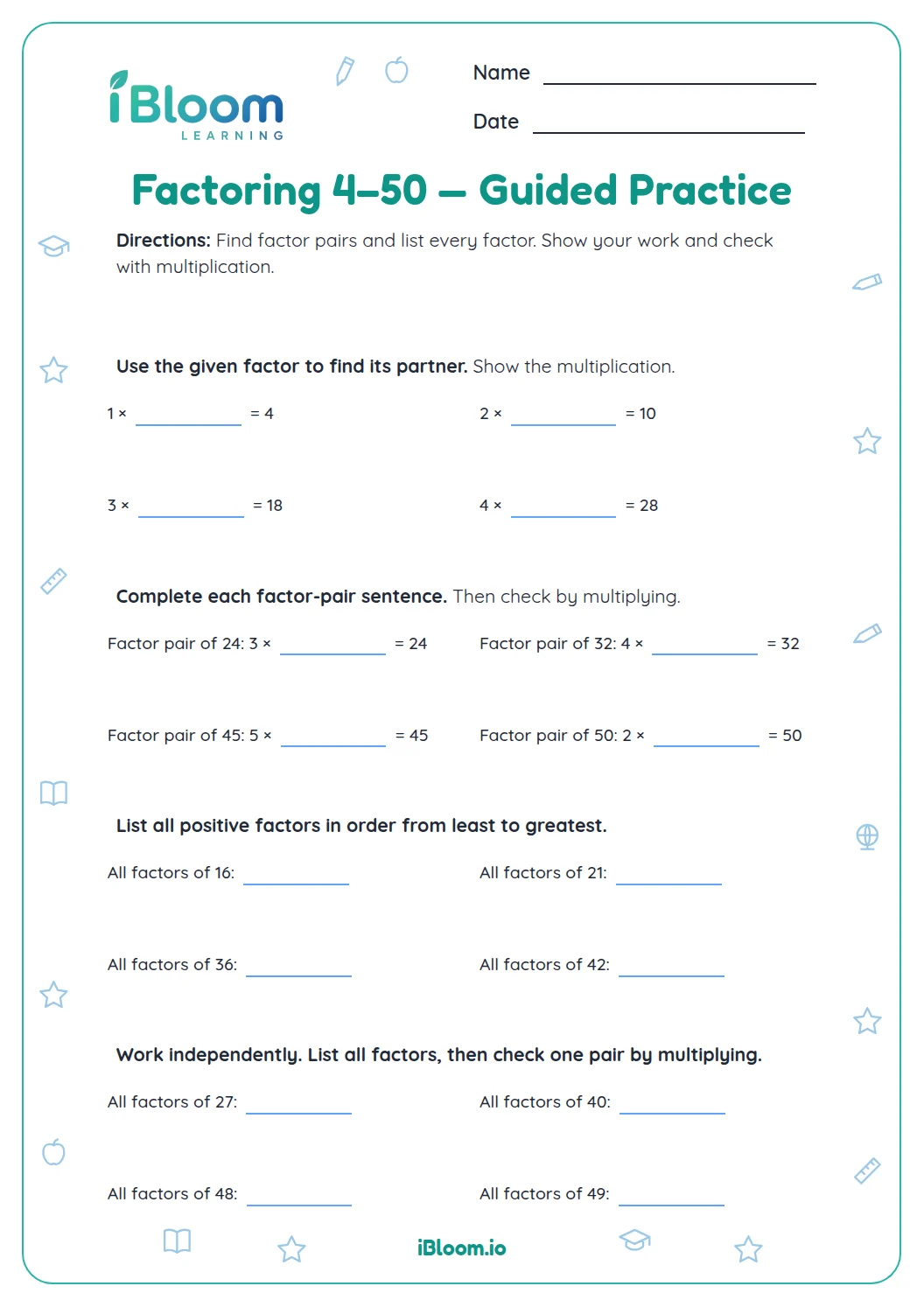
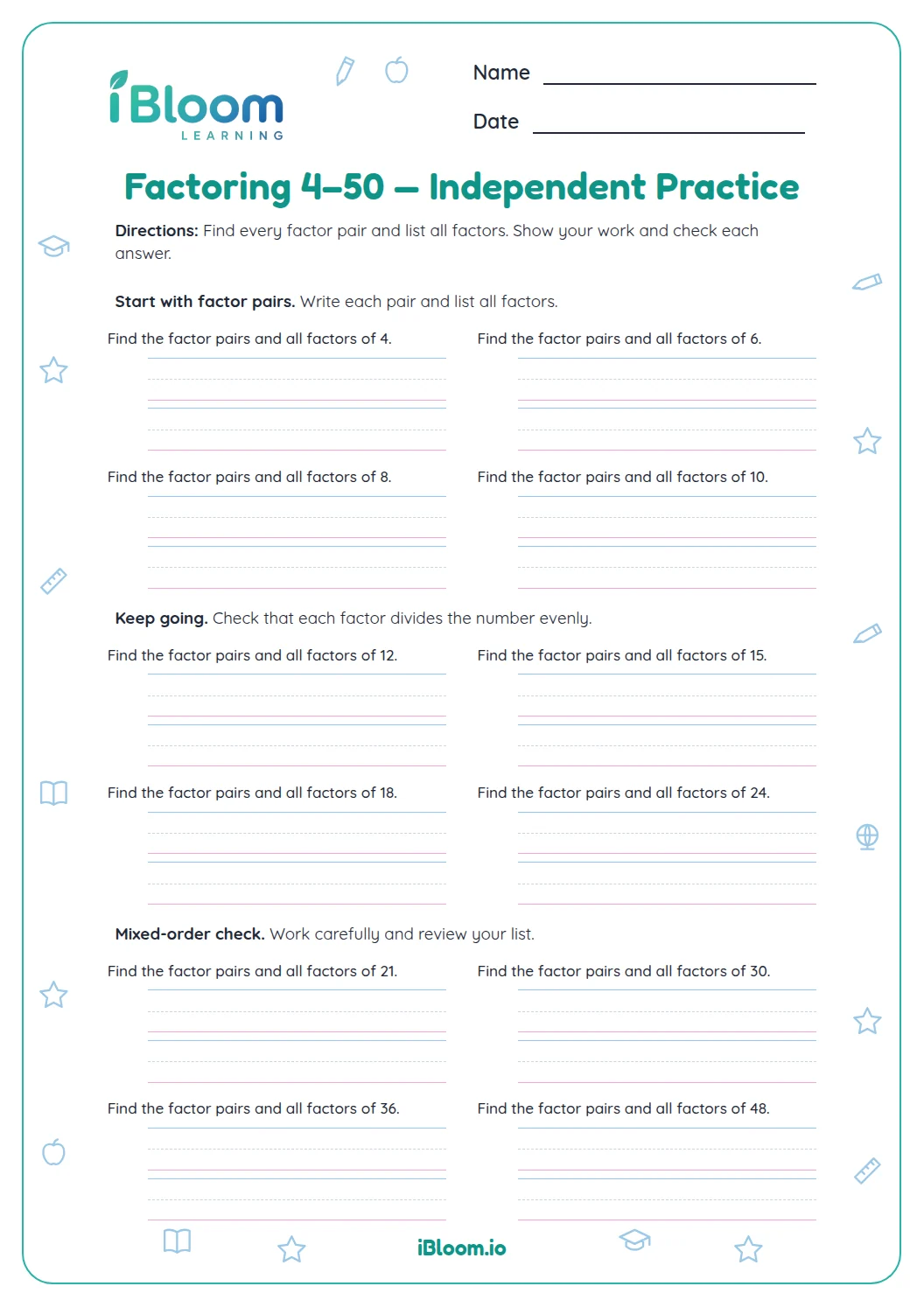
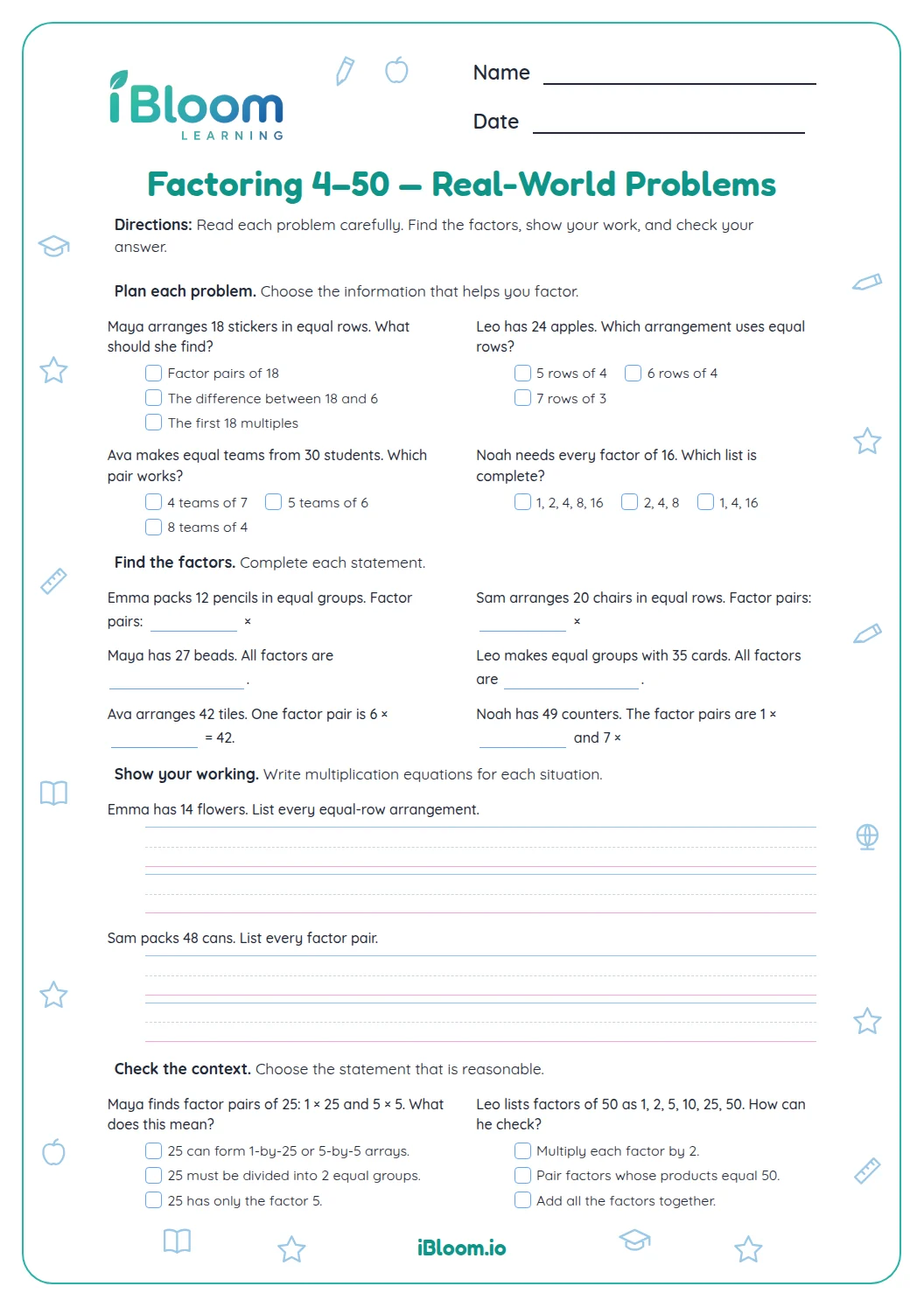
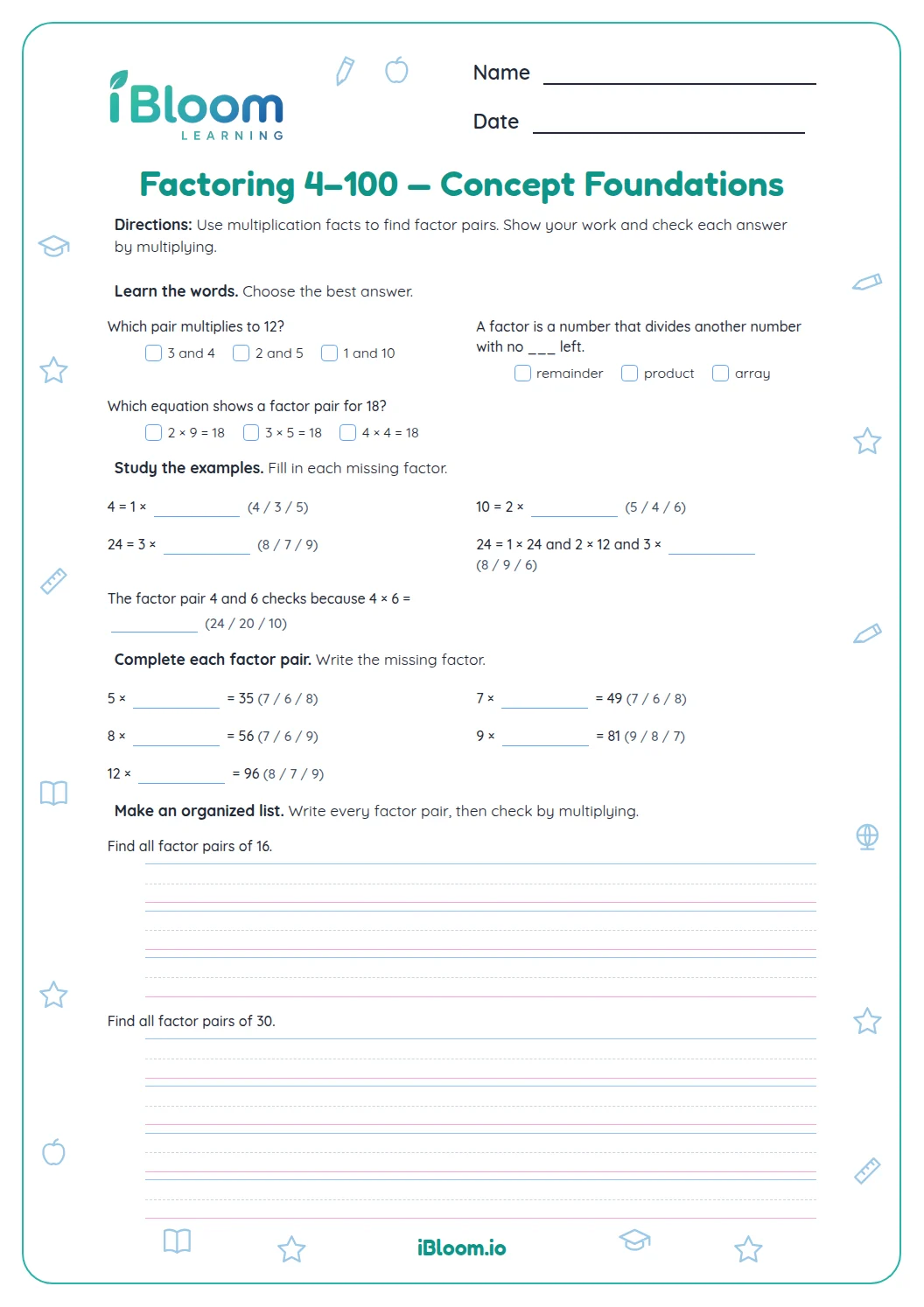
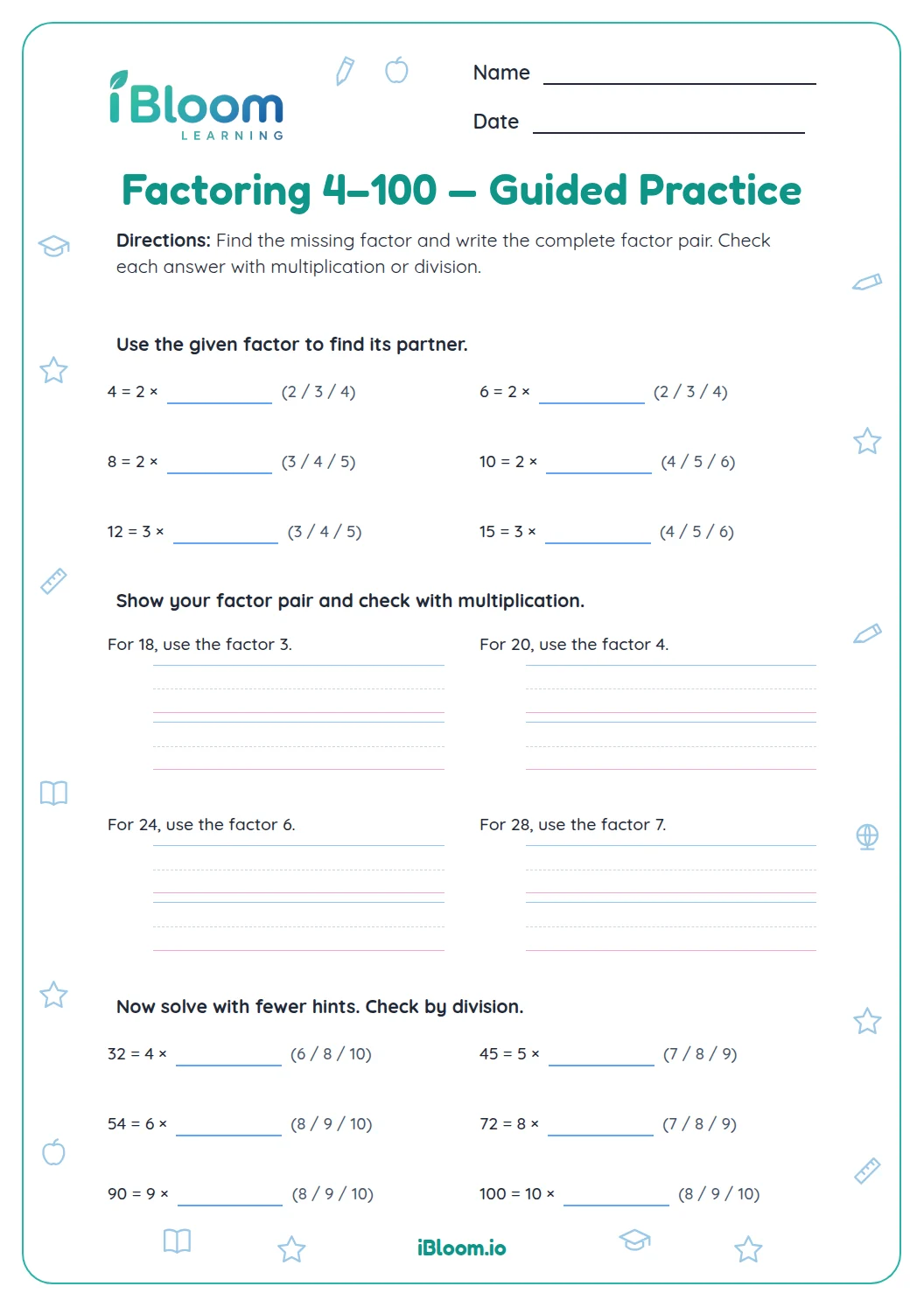
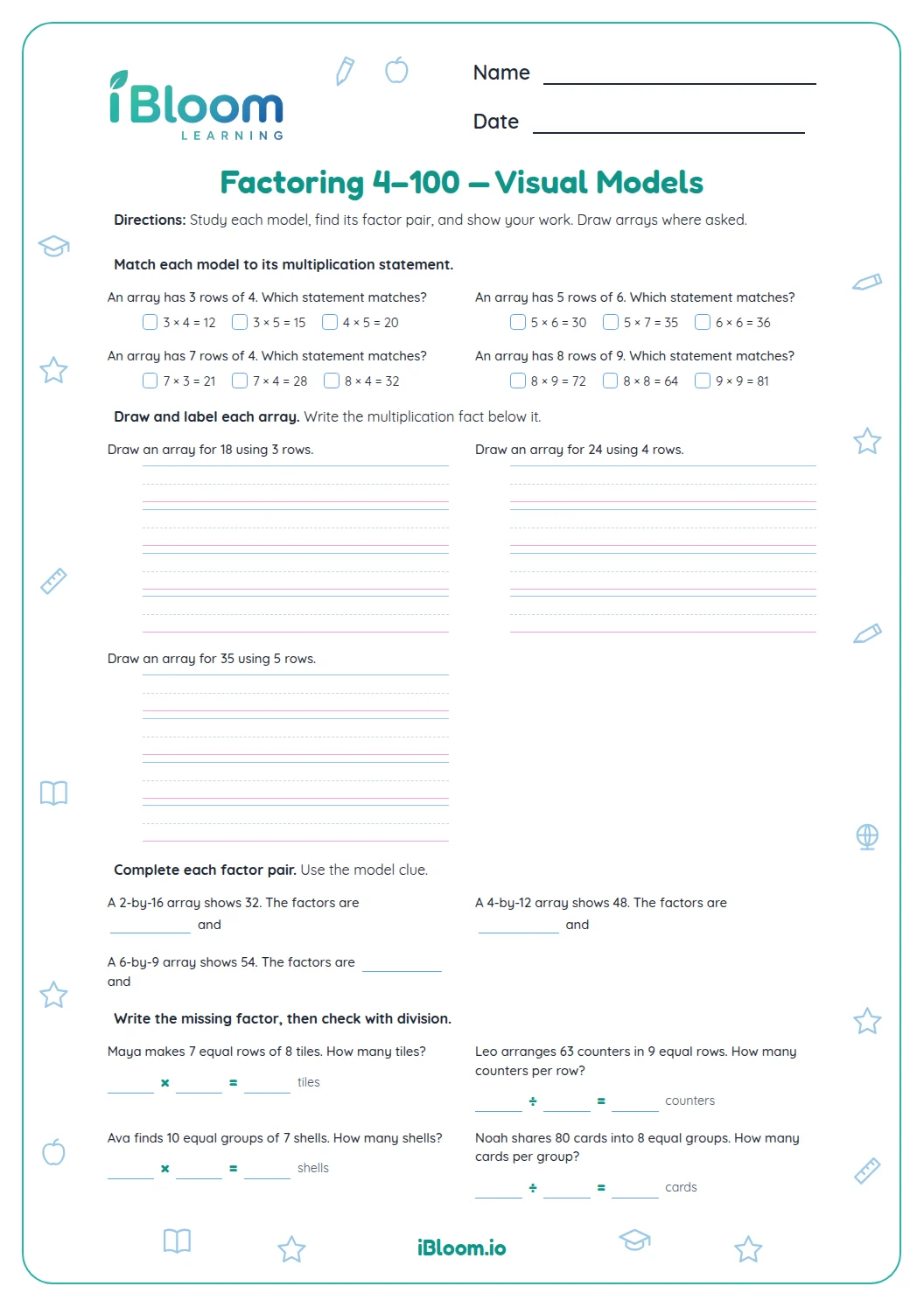
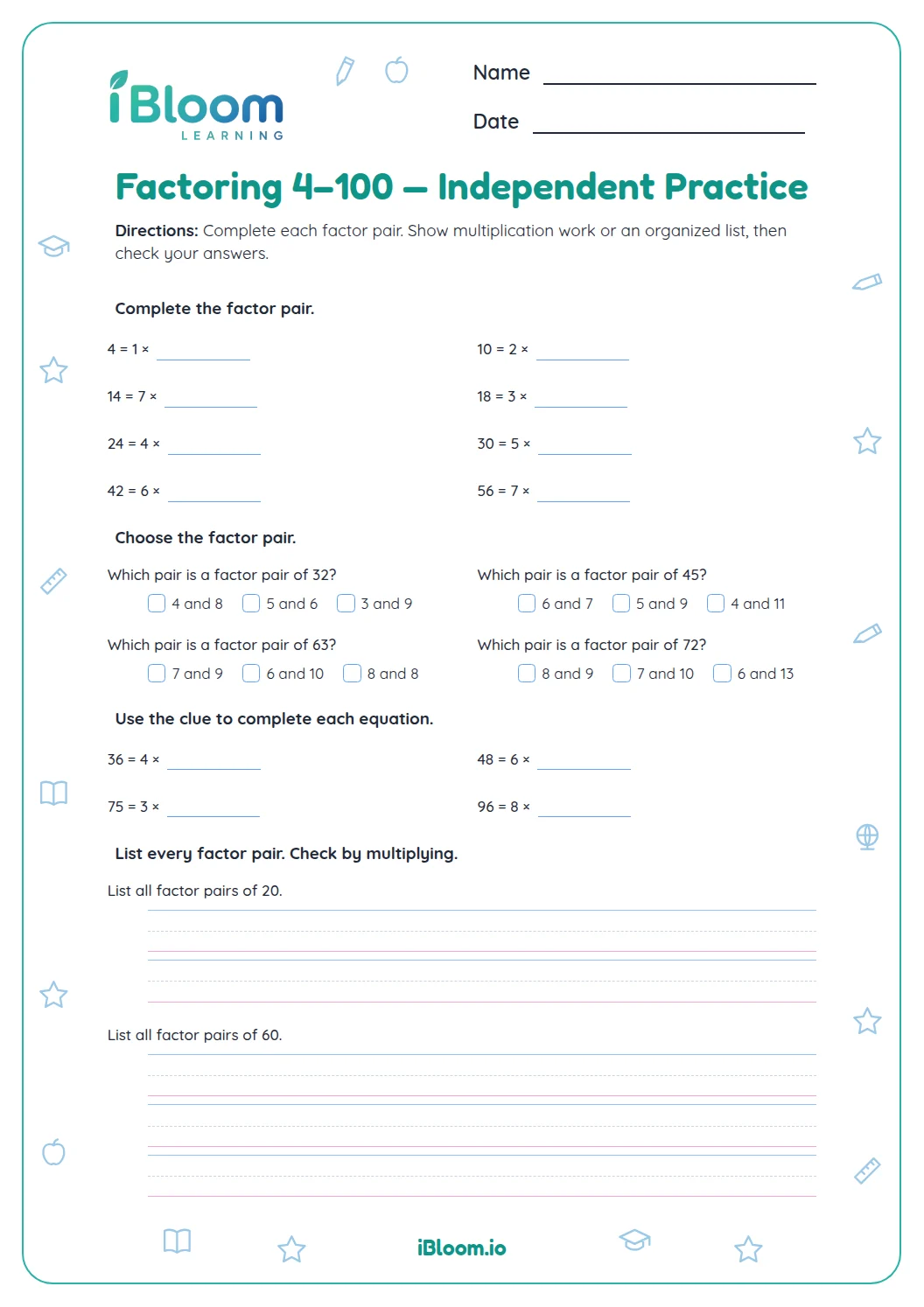
This free printable Grade 4 worksheet builds the meaning of a factor through 20 questions. In Parts A and B, children check small sets that together include every whole number from 4 through 50. They write the numbers that have a given factor, using multiplication or exact division. Part C asks for all factor pairs of 12, 24, 36 and 50. Part D uses factor pairs to list every factor of 16, 21, 30 and 42 in order. The practice supports Common Core 4.OA.B.4, connecting factors with multiples and complete factor-pair lists. The answer key gives each selected set and all eight lists of pairs or factors for checking.
Aligned to 4.OA.B.4
What makes a number a factor?
A factor is a whole number that multiplies by another whole number to make a target number. For example, 2 is a factor of 6 because 2 × 3 = 6. That also means 6 is a multiple of 2.
Parts A and B ask children to test every number in each short list. More than one number can work. For 4, 5, 6 and 7, the numbers with 2 as a factor are 4 and 6. Five and seven leave a remainder when divided by 2.
How can children find all the factor pairs?
Start with 1 times the target number, then test 2, 3 and the next whole numbers in order. Write a pair whenever the division is exact. A systematic list makes skipped factors easier to catch.
Question 13 uses 12. Its pairs are 1 × 12, 2 × 6 and 3 × 4. Testing 4 gives 4 × 3, a reversed pair already in the list. Stop when the pairs begin to repeat. For any number, stop when the next possible smaller factor would be larger than its partner.
- 112 ÷ 1 = 12 → 1 × 12
- 212 ÷ 2 = 6 → 2 × 6
- 312 ÷ 3 = 4 → 3 × 4
- 4All pairs: 1 × 12; 2 × 6; 3 × 4
Which numbers and factor checks are included?
Questions 1–8 test factors 2 and 3 in sets covering 4–35. Questions 9–12 test factors 4, 5 and 7 in sets covering 36–50. Together these questions include every integer in the title range. Each list asks for all numbers that work.
Questions 13–16 move to complete factor-pair lists for 12, 24, 36 and 50. The square number 36 includes 6 × 6; the repeated factor belongs in the list once. Children can check every pair by multiplying it back to the target. Part D returns to 16, 21, 30 and 42 to list all their factors from least to greatest.
How do factor pairs become a list of factors?
Take the numbers from every pair and put them in order, writing each factor once. For 16, the pairs 1 × 16, 2 × 8 and 4 × 4 give the list 1, 2, 4, 8, 16. The factor 4 appears once in the list even though both numbers in its pair are 4.
How to use this worksheet
- 1Explain a factor using 2 × 3 = 6, naming both factors and the product.
- 2Check each number in every Part A list; write all that divide evenly by the given factor.
- 3Use known facts for 4, 5 and 7 to complete Part B.
- 4For Part C, begin with 1 and test possible factors in increasing order.
- 5In Part D, collect the factors from each pair and write them from least to greatest, without repeats.
- 6Multiply every listed pair and compare with the key, including 6 × 6 for 36.
Mistakes to check together
The mistake
Writing 2 as the answer to question 1 because 2 is the factor named in the question.
The fix
The question asks which listed numbers have that factor. Write 4 and 6 because both divide evenly by 2.
The mistake
Leaving out 1 × 24 from the factor pairs of 24.
The fix
One is a factor of every positive whole number. Begin each list with 1 × the target.
The mistake
Listing 3 × 4 and 4 × 3 as two different pairs for 12.
The fix
Those are the same pair in reverse order. List each pair once, with the smaller factor first.
Curriculum alignment
Test factors across 4–50, find complete factor pairs and list factors in order.
On this sheet: Children test one-digit factors, identify their multiples, and use complete factor pairs to list all factors.
Show the official wordingHide the official wording
Find all factor pairs for a whole number in the range 1-100. Recognize that a whole number is a multiple of each of its factors. Determine whether a given whole number in the range 1-100 is a multiple of a given one-digit number. Determine whether a given whole number in the range 1-100 is prime or composite.
What to practice next
Make more practice
Further reading
Questions parents and teachers ask
Does the sheet include every number from 4 through 50?
Yes, the first 12 questions include every whole number from 4 through 50 in short lists. Children test each number for the named factor. Four questions then find complete factor-pair lists, and the final four use pairs to list all factors of 16, 21, 30 and 42.
Can more than one number be correct in Parts A and B?
Yes, children must write every number in the list that has the given factor. In question 1, both 4 and 6 work for a factor of 2. Encourage your child to check each listed number separately before moving on, even after finding the first correct choice.
Should children include reversed factor pairs?
Each factor pair only needs to appear once. For 12, the pair 3 × 4 already includes the factors in 4 × 3. The key writes the smaller factor first and lists pairs in increasing order, which makes it easier to check that every distinct pair has been found.
Why does 36 have a pair with two sixes?
Six times six equals 36, so 6 × 6 is a valid factor pair. A pair can contain the same number twice. Ask your child to multiply the pair to check it, then keep it once in the list alongside 1 × 36, 2 × 18, 3 × 12 and 4 × 9.
How can I help if my child misses a factor pair?
Have your child restart the list at 1 and test one whole number at a time. Use division to check whether each candidate fits evenly. For 24, testing 1, 2, 3 and 4 finds its four distinct pairs; the answer key can then confirm the complete list together.