



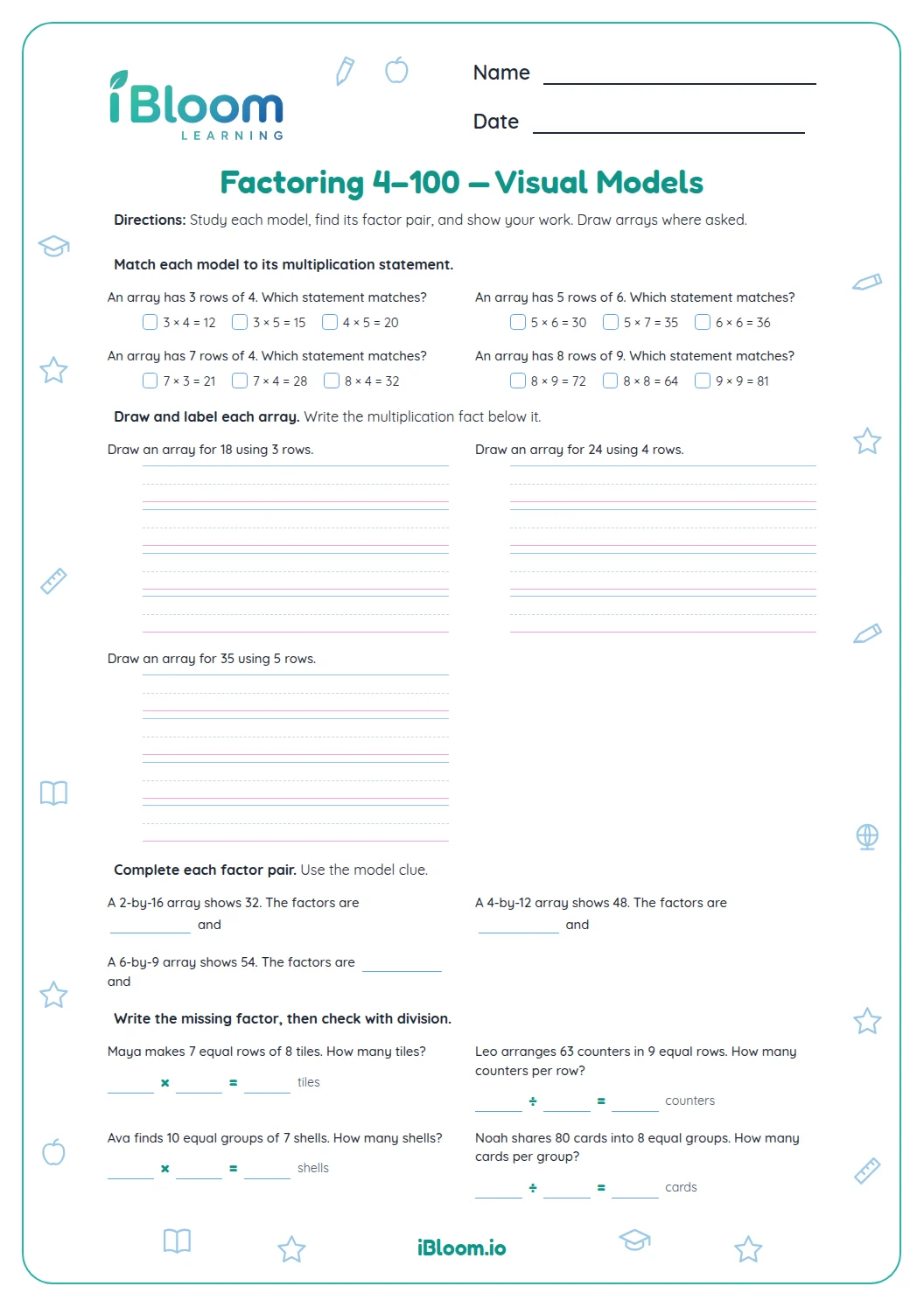
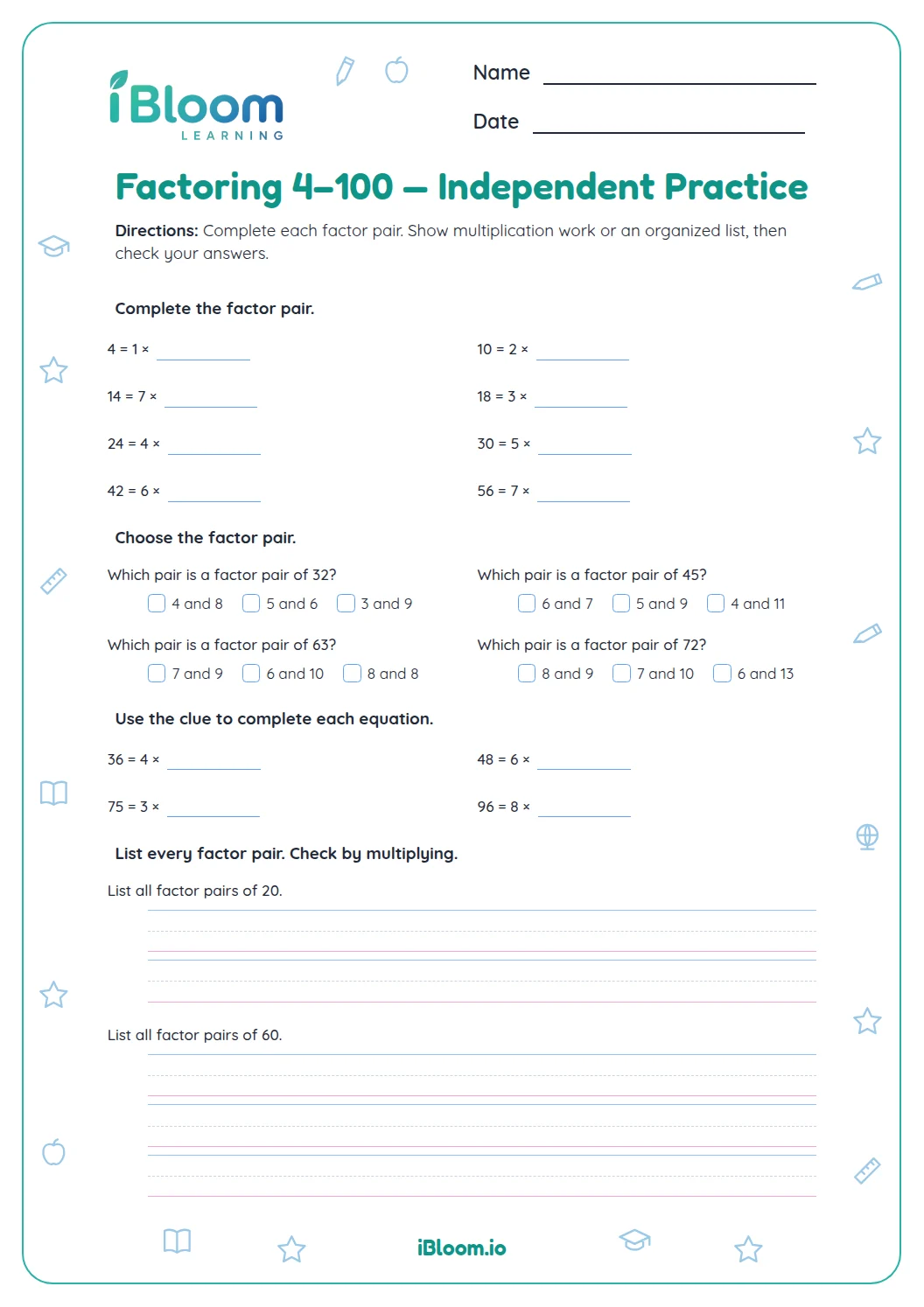
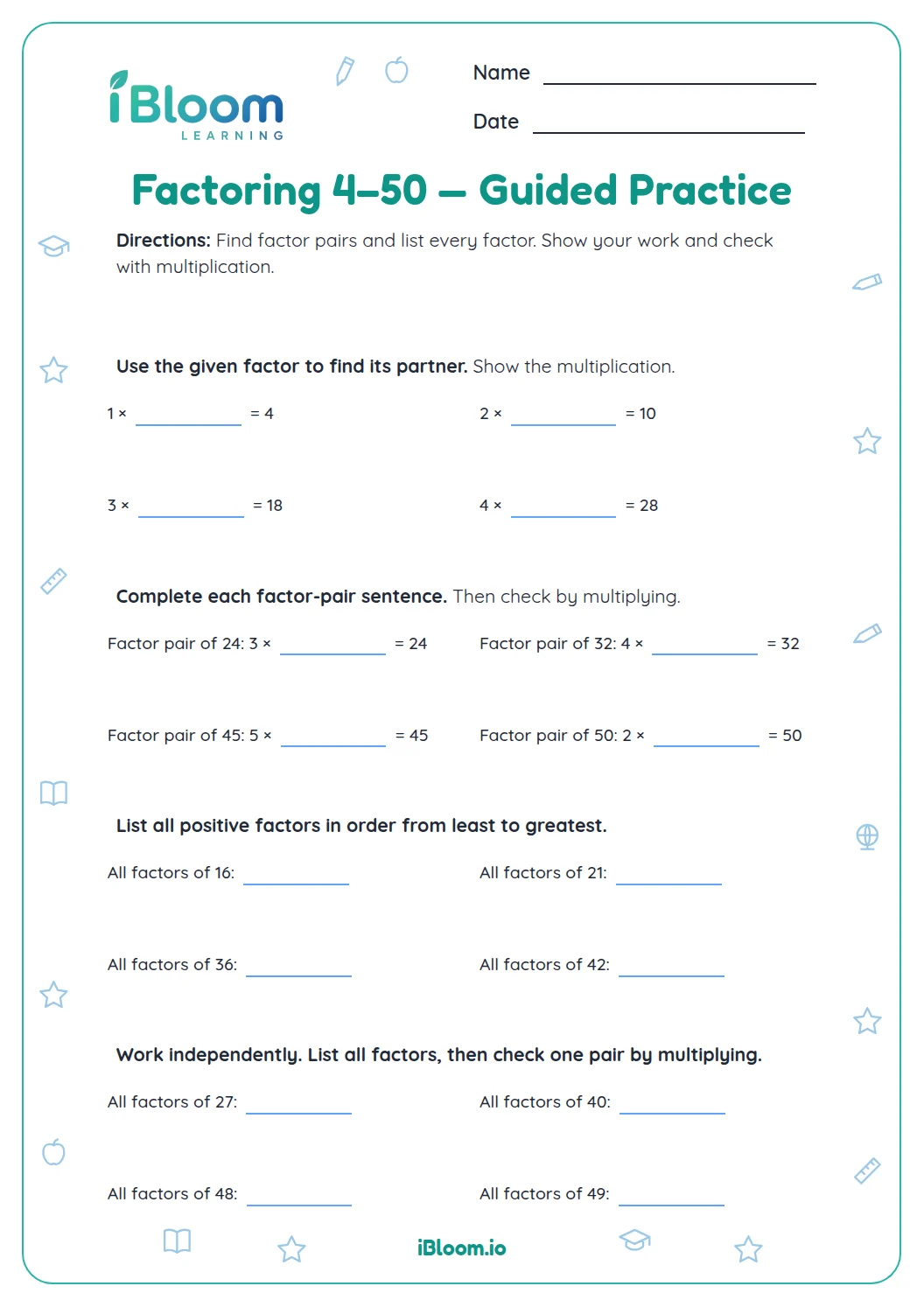

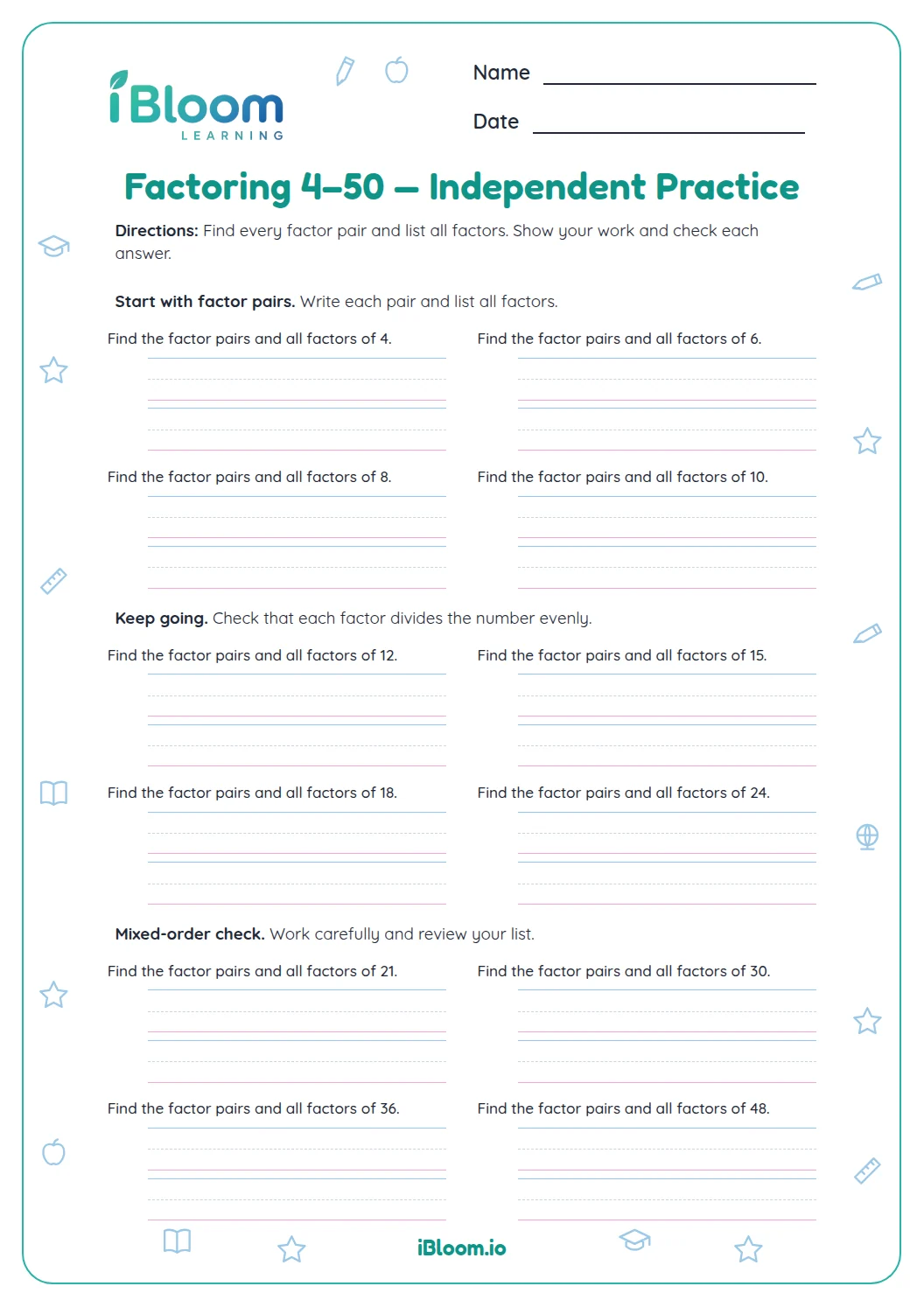


About this worksheet
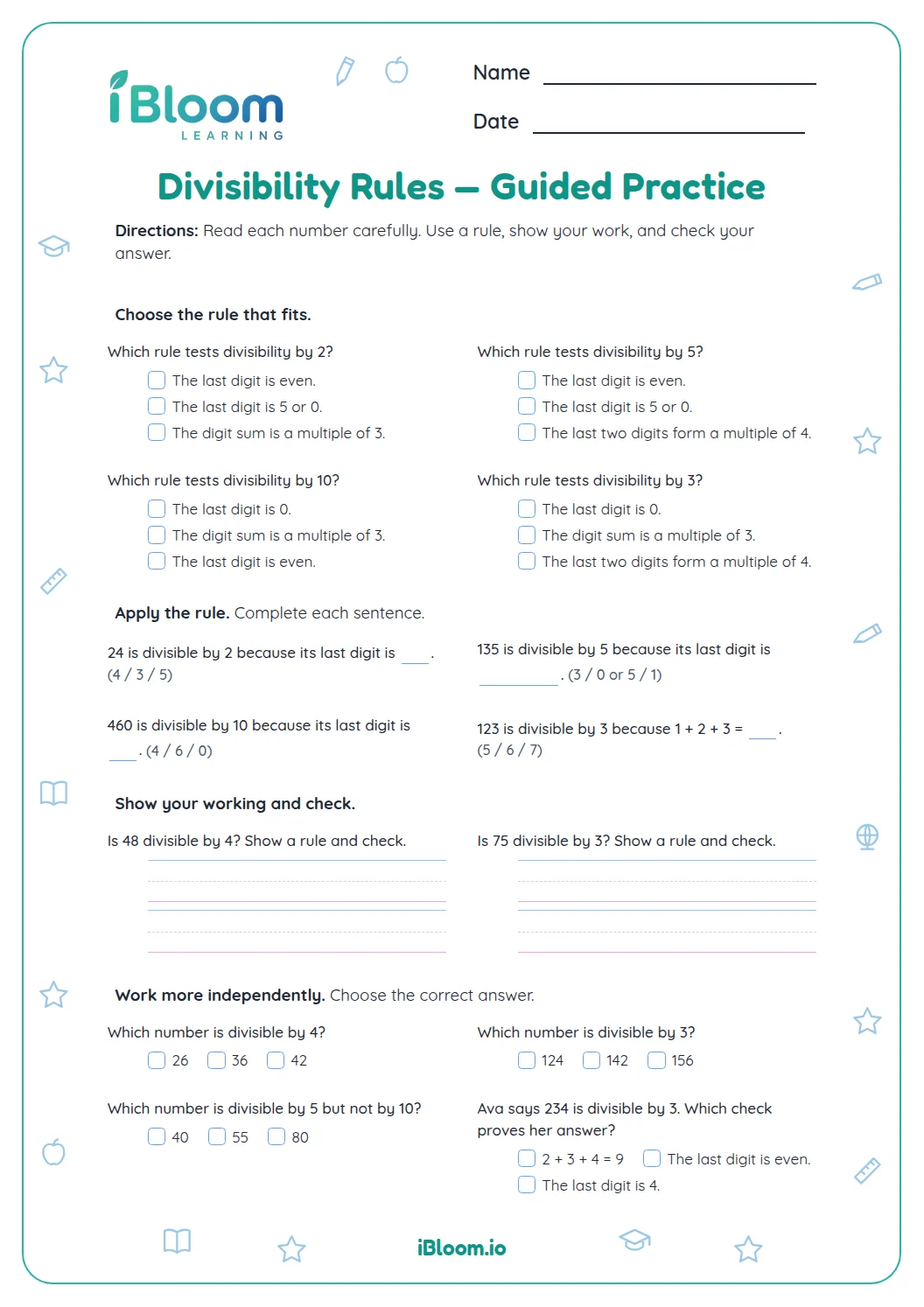
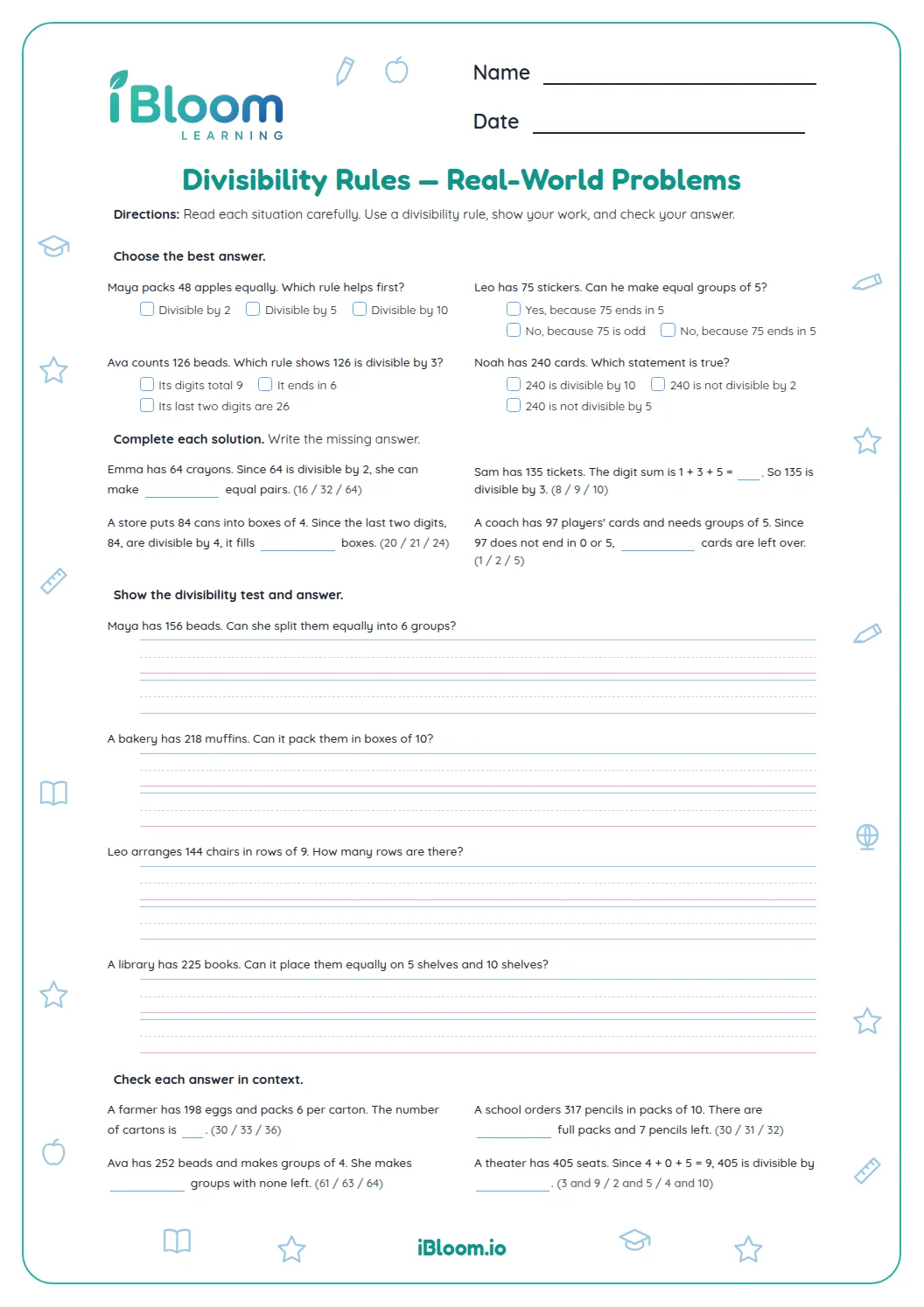
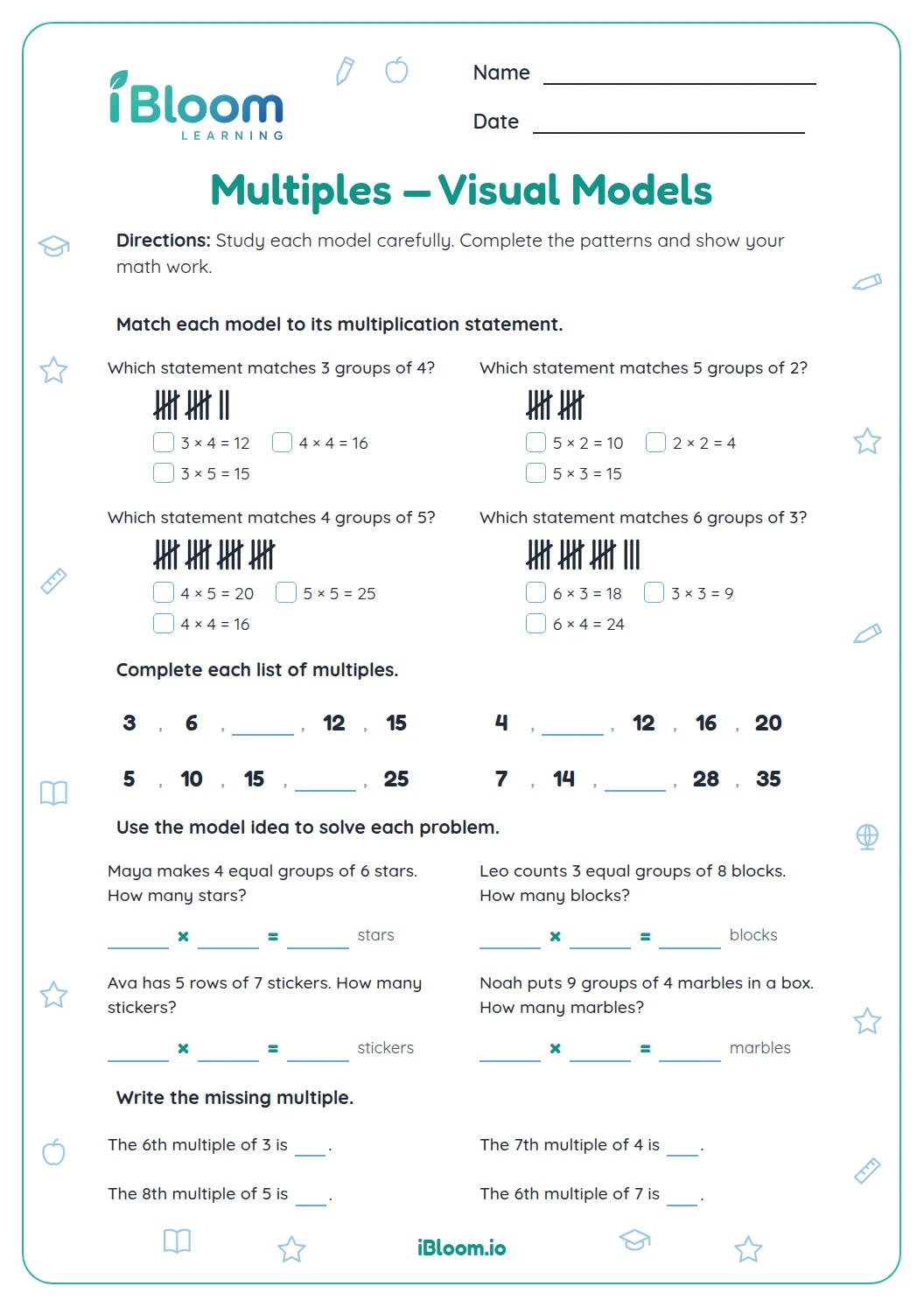
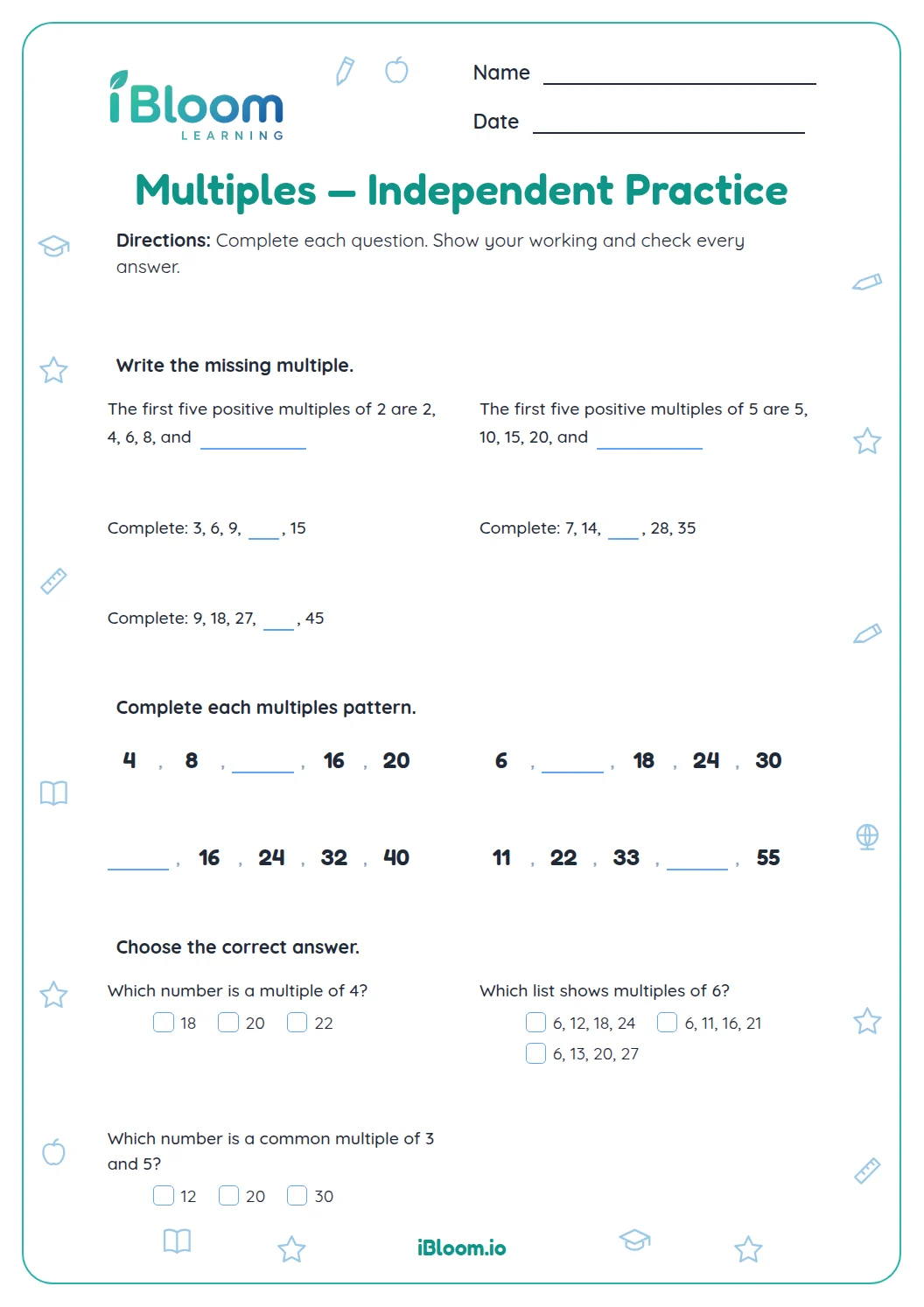
This Grade 4 worksheet connects divisibility rules to equal groups. Children use four arrays, then test number clues for 2, 3, 4, 5, and 10 across 15 questions in three parts. The practice builds factor and multiple reasoning aligned with CCSS 4.OA.B.4, with an answer key on a separate page.
Aligned to 4.OA.B.4
How do equal groups show divisibility?
A number is divisible by a group size when it can be split into equal groups with none left over. The first four questions show arrays; for example, 24 objects arranged in 4 equal rows also make groups of 3 because 24 can be partitioned evenly into 3s.
- 1The array has 24 objects.
- 2Twenty-four can be split into 3 equal groups of 8.
- 3So 24 is divisible by 3.
Which digit clues help?
An even ones digit tests divisibility by 2. A final 0 or 5 tests divisibility by 5, and a final 0 tests 10. For 3, add every digit. For 4, check whether the number formed by the last two digits is divisible by 4.
What does this worksheet ask children to do?
Questions 1–4 connect arrays with equal groups. The next questions apply digit rules, then use those clues in a sharing situation. The answer key lists the selected answer for each of the 15 questions.
How to use this worksheet
- 1Build or inspect each equal group before deciding.
- 2For a digit rule, read the ones digit or add all digits as needed.
- 3Check that equal groups have no leftovers.
- 4Use the answer key to revisit any rule that was mixed up.
Common mistakes and quick fixes
The mistake
Treating every even number as divisible by 10.
The fix
Check the ones digit: it must be 0 for divisibility by 10.
The mistake
Adding only the last two digits for the rule of 3.
The fix
Add every digit, then test whether the sum is a multiple of 3.
The mistake
Assuming one array orientation is the only way to group objects.
The fix
Rearrange the same total into another equal number of rows or groups.
Common Core alignment
This page practices 4.OA.B.4 through its worksheet questions.
Use the skill practiced in these 15 questions.
On this sheet: Questions connect factor and multiple reasoning with whole-number divisibility tests.
Show the official wordingHide the official wording
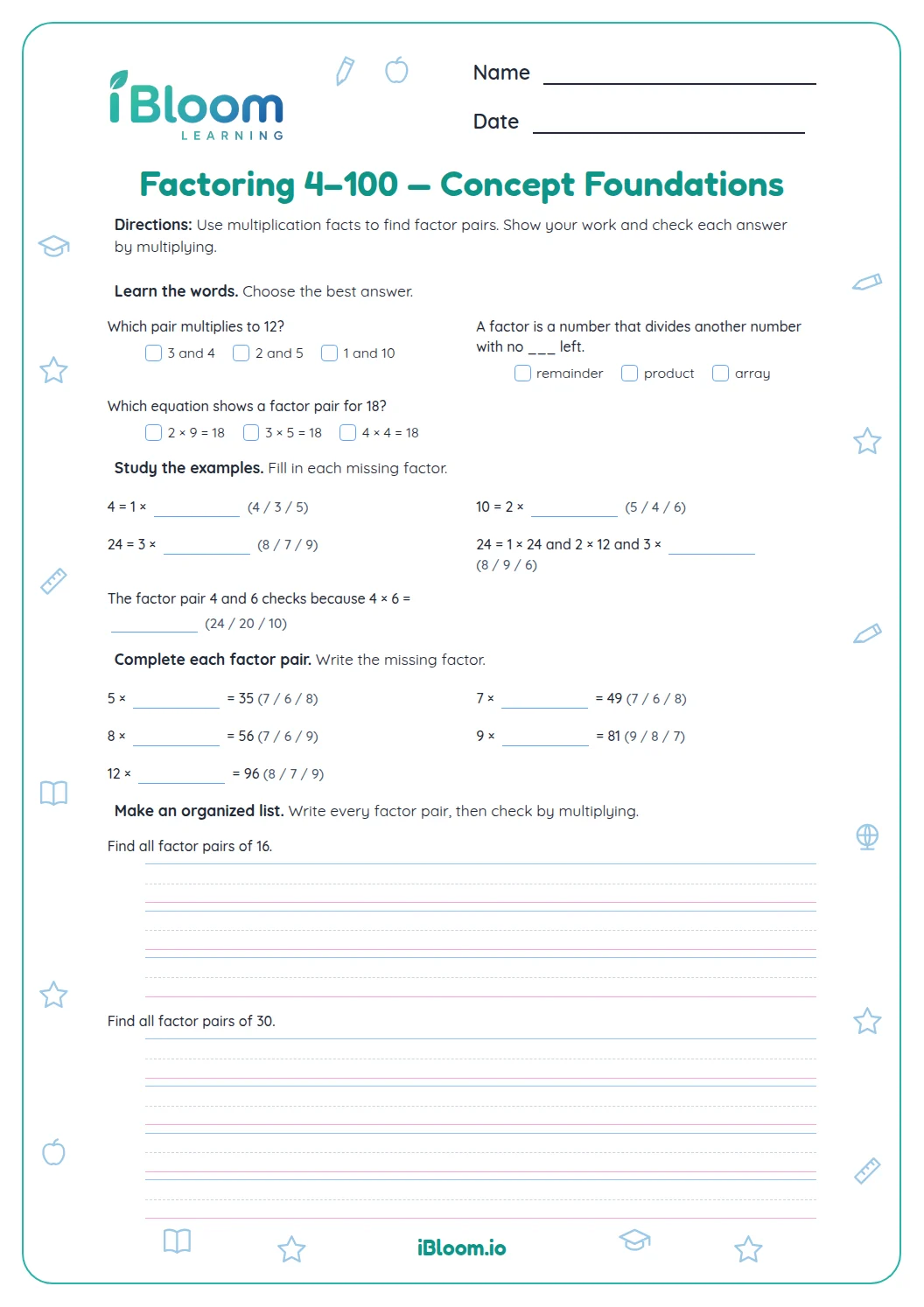
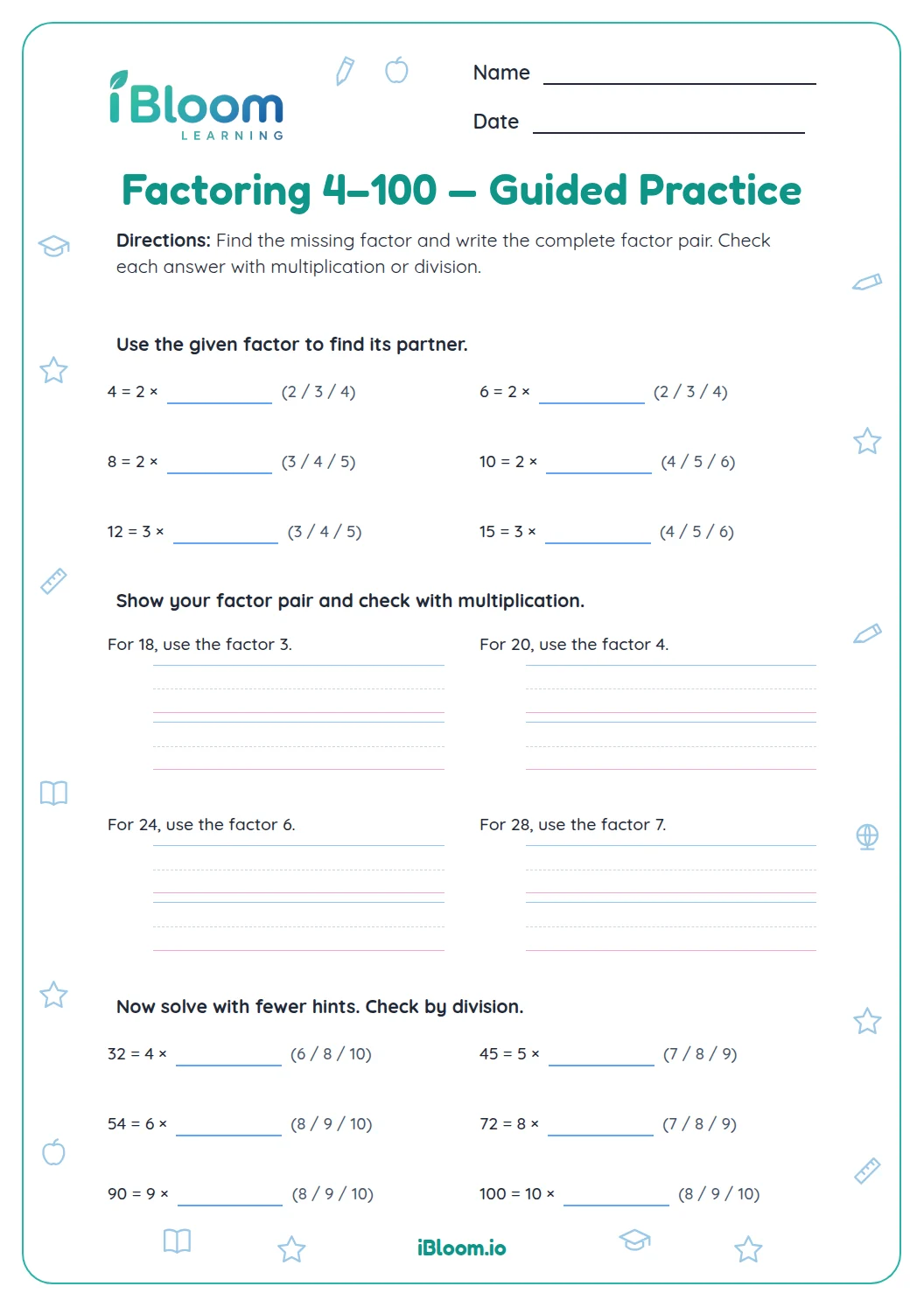
Find all factor pairs for a whole number in the range 1-100. Recognize that a whole number is a multiple of each of its factors. Determine whether a given whole number in the range 1-100 is a multiple of a given one-digit number. Determine whether a given whole number in the range 1-100 is prime or composite.
What to practice next
Make more practice
Further reading
Questions parents and teachers ask
How do arrays show divisibility?
An array arranges objects in equal rows and columns. If the objects can be split into the required number of equal groups with none left over, the number is divisible by that group size. Questions 1–4 use arrays so children can connect the rule to visible groups.
Which divisibility rules appear?
The questions use rules for 2, 3, 4, 5, and 10. Children check an even ones digit, add digits for divisibility by 3, inspect the last two digits for 4, and look for a final 0 or 5 for 5 and 10.
How do you test a number for divisibility by 3?
Add all its digits, then ask whether that sum is divisible by 3. For example, 273 has a digit sum of 12, and 12 is divisible by 3, so 273 is divisible by 3. The worksheet asks children to use this reasoning more than once.
Can a whole number be divisible by 2 and 5 but not 10?
No. A whole number divisible by 2 ends in an even digit, and one divisible by 5 ends in 0 or 5. To meet both rules it must end in 0, which also makes it divisible by 10.
How many questions are on the worksheet?
There are 15 questions in three parts: four array questions, seven digit rule questions, and four application questions. The separate answer key gives a response for every item. Plan about 25 minutes if children pause to explain how each clue works.