





About this worksheet
This Grade 4 worksheet uses the same two moves as the original page: connect an equal-groups story to a factor pair, then find every factor pair for a target number. Six stories give one known group count; eight short-response items ask for all pairs. The answer key lists each pair in order. The practice uses products from 16 to 100 and supports CCSS 4.OA.B.4.
Aligned to 4.OA.B.4
How do equal groups reveal a factor pair?
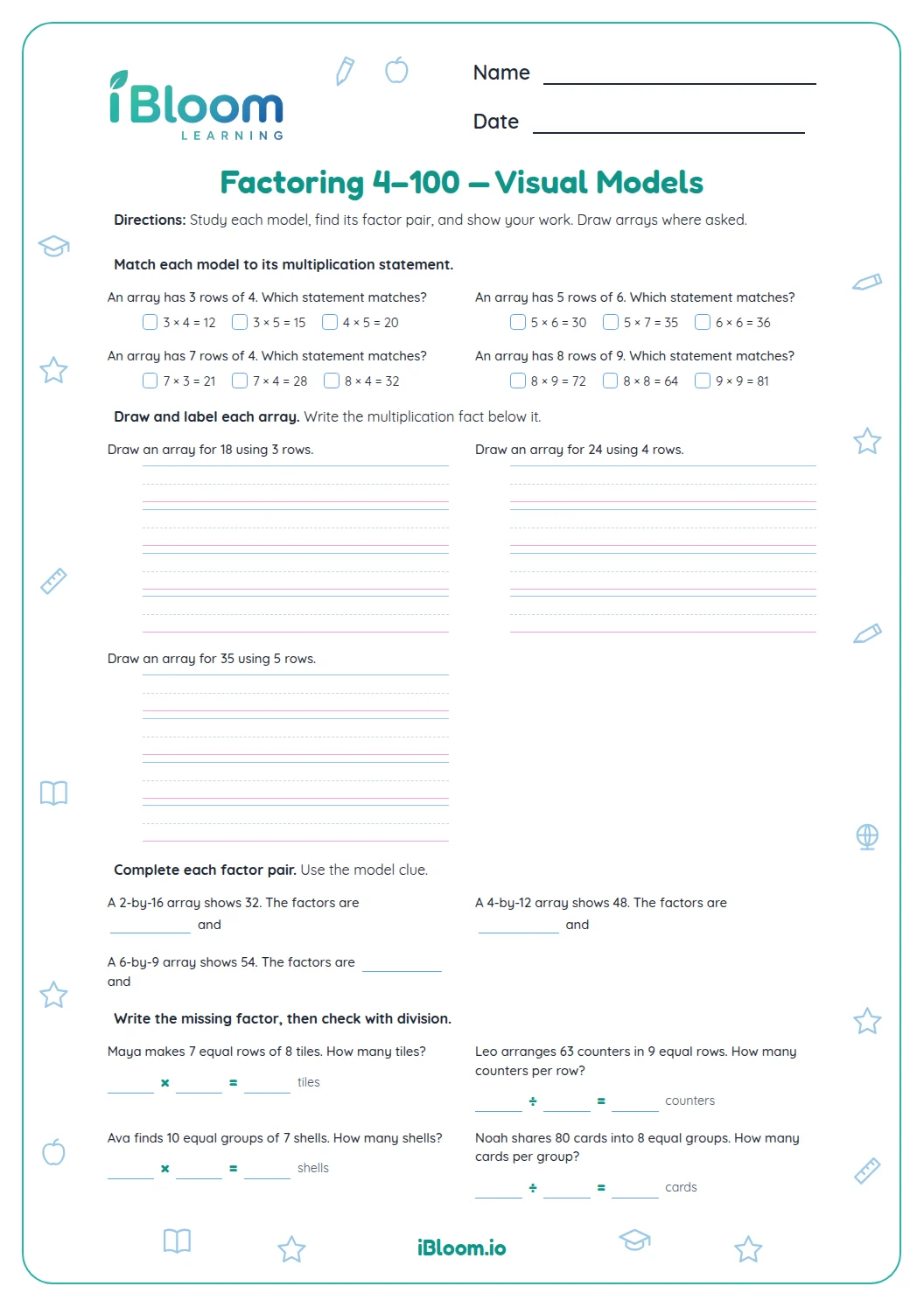
Question 1 gives 24 markers and 6 equal boxes. Divide 24 by 6 to find 4 markers per box; the matching pair is 6 and 4. The first part asks you to make that connection in a real situation.
- 124 markers ÷ 6 boxes = 4 markers per box
- 26 × 4 = 24, so 6 and 4 are factors of 24.
How can you find every pair for a number?
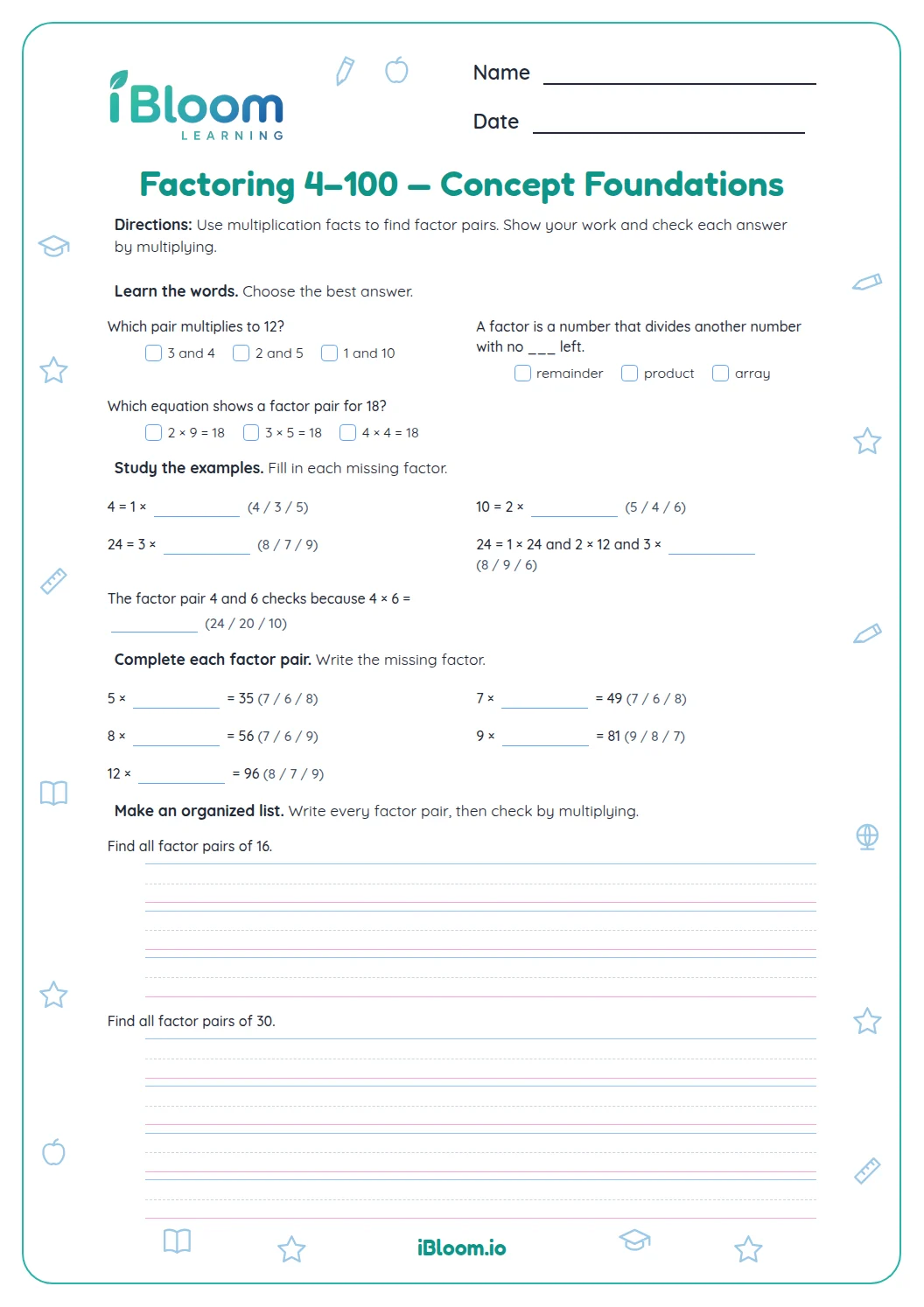
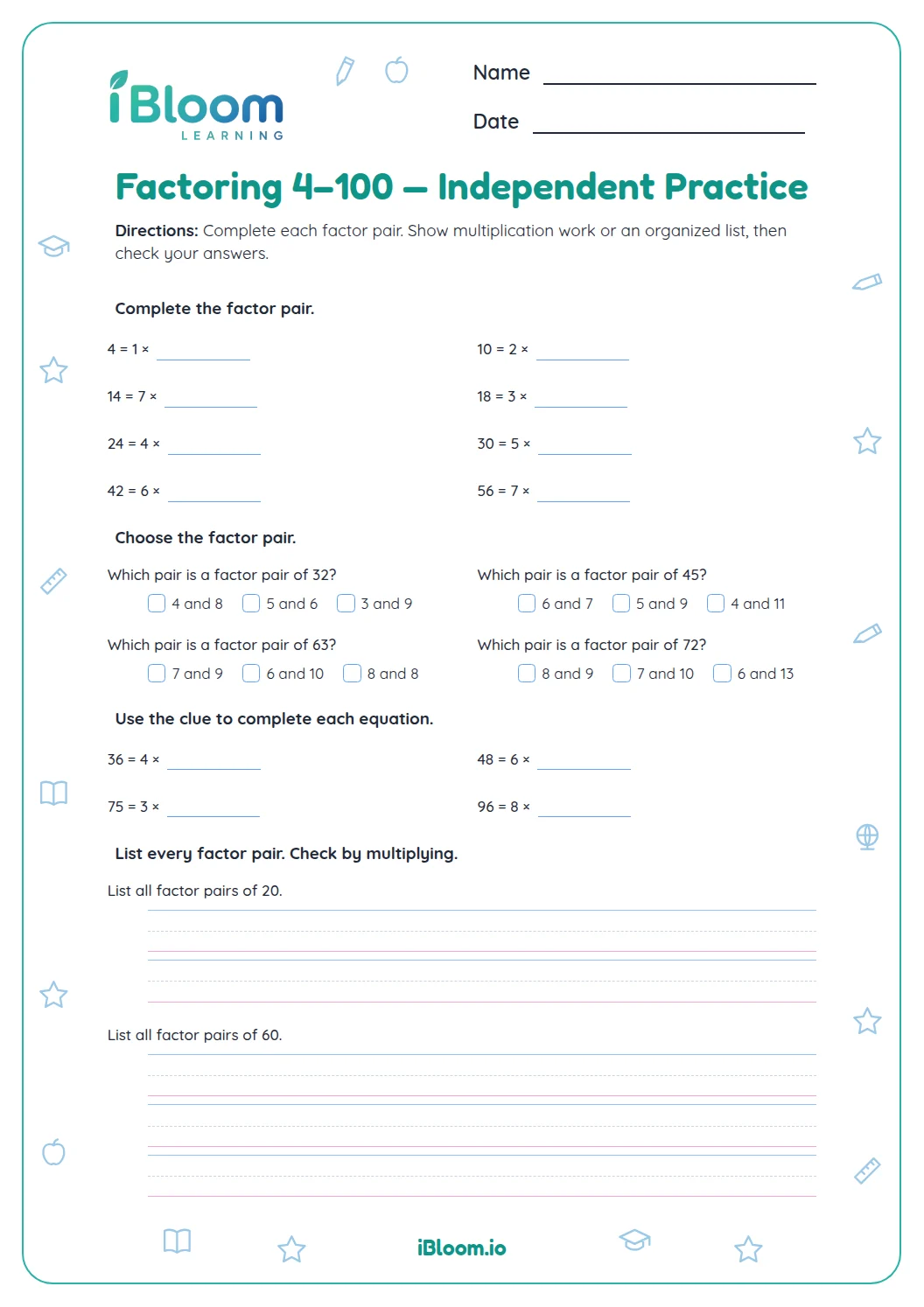
Start with 1 and test whole-number divisors in order. When a division has no remainder, record the divisor and quotient as a pair. Stop when the pairs meet or reverse; question 11, for example, has 4 and 12 as one of the pairs for 48.
How can a child check a factor list?
Multiply each pair to see whether it makes the target, and check that no divisor below the square root was skipped. The square pair 4 × 4 appears once for 16, not twice.
How to work through the page
- 1Read the total and known group count in each story.
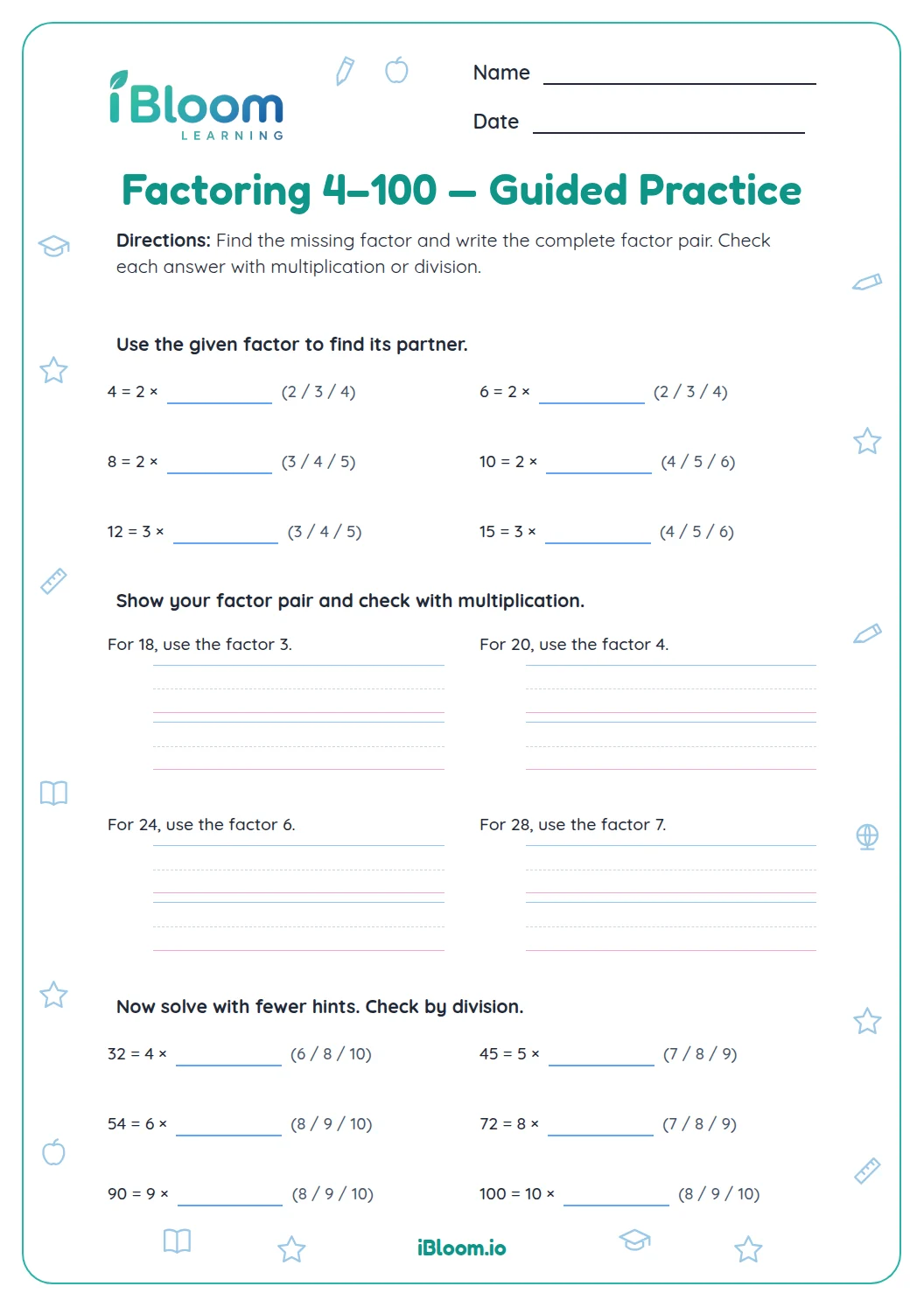
- 2Divide the total by the known count to find the missing factor.
- 3For a full list, test divisors from 1 upward and record each matching pair.
- 4Multiply each pair to check its product.
- 5Use the key to find any missing pair, then retest the divisor you skipped.
Factor-pair errors to watch for
The mistake
Listing 4 × 4 twice when finding pairs for 16.
The fix
A matching pair is written once when both factors are the same.
The mistake
Stopping after finding 1 and the number.
The fix
Test the divisors between them; 48 also has 2 × 24, 3 × 16, 4 × 12 and 6 × 8.
The mistake
Switching the number of groups and the group size in a story.
The fix
Label both quantities, then multiply them to check that their product is the total.
Common Core alignment
The worksheet practices finding factor pairs for whole numbers in the stated range.
Find factor pairs for whole numbers from 1 to 100.
On this sheet: The story choices connect equal groups to factors, and Part B lists every factor pair for eight numbers.
Show the official wordingHide the official wording
Find all factor pairs for a whole number in the range 1–100. Recognize that a whole number is a multiple of each of its factors. Determine whether a given whole number in the range 1–100 is a multiple of a given one-digit number. Determine whether a given whole number in the range 1–100 is prime or composite.
What to practice next
Make more practice
Further reading
Questions parents and teachers ask
What is a factor pair?
A factor pair is two whole numbers whose product is a target number. For example, 6 and 4 make 24 because 6 × 4 = 24. Either number can name the groups or the amount in each group. The full list shows both orderings only once, with the smaller factor first.
How does division help with question 1?
Question 1 has 24 markers and 6 boxes. Divide 24 by 6 to find 4 markers in each box, then write the pair 6 and 4. Multiplication checks the result: 6 × 4 equals 24. That quotient identifies the second whole-number factor, not another box.
Does the order of a factor pair matter?
The factors can be said in either order, but write a pair only once. The key lists each pair from the smaller factor to the larger factor so children can check their work consistently. This ordering makes it easier to compare each response with the key.
Why does the factor list stop at a square pair?
After the two factors meet or switch order, the remaining products would repeat pairs already found. For 16, the pair 4 and 4 is the middle pair, so the list is complete. Testing each smaller divisor ensures you have not missed a middle pair.
What is on the answer key?
The separate key gives the correct group pair for each of the six stories and every factor pair for the eight numbers in Part B. Compare the complete list, not only its first and last pair. The key uses multiplication notation, but equivalent factor pairs are correct.