




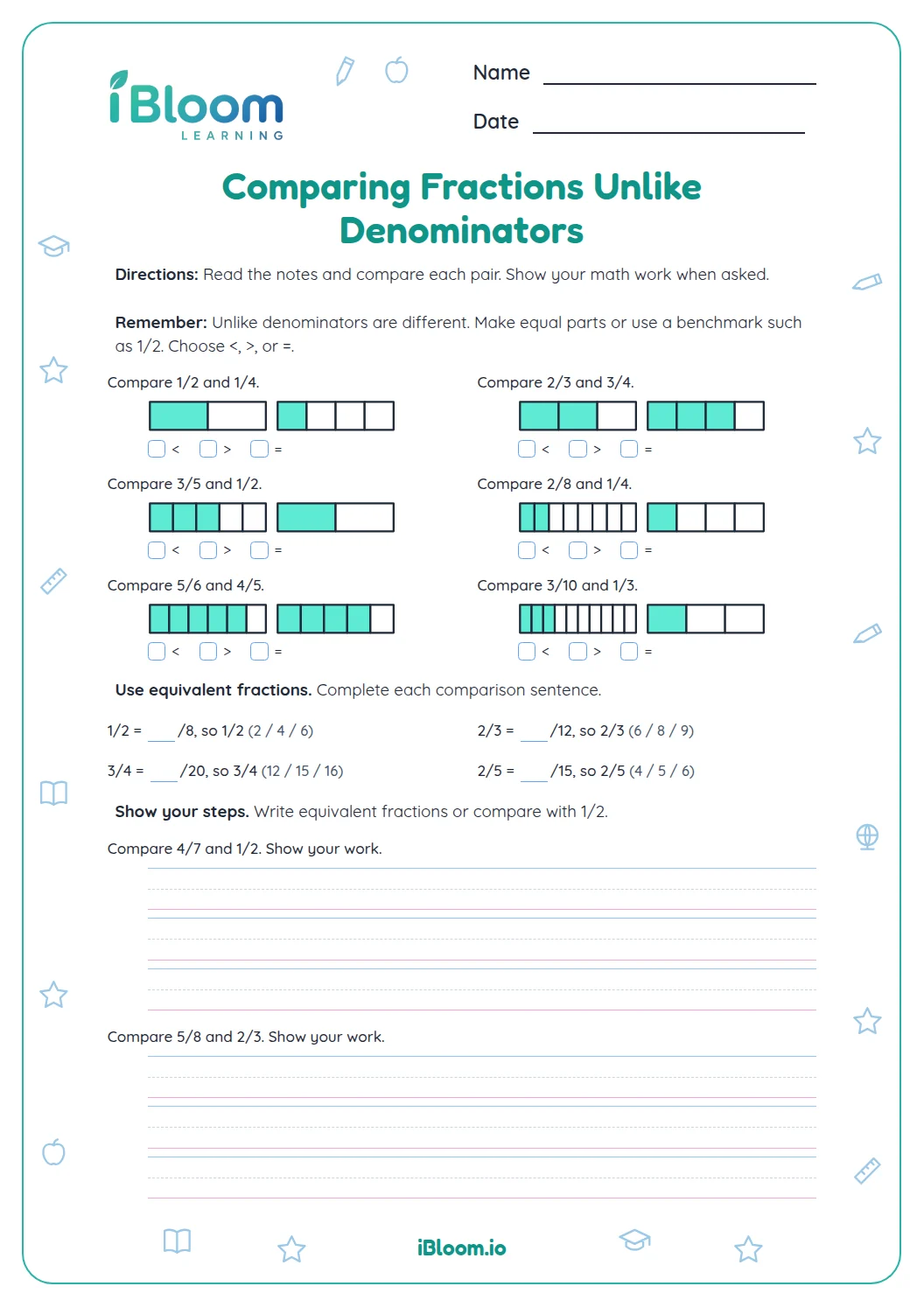

About this worksheet
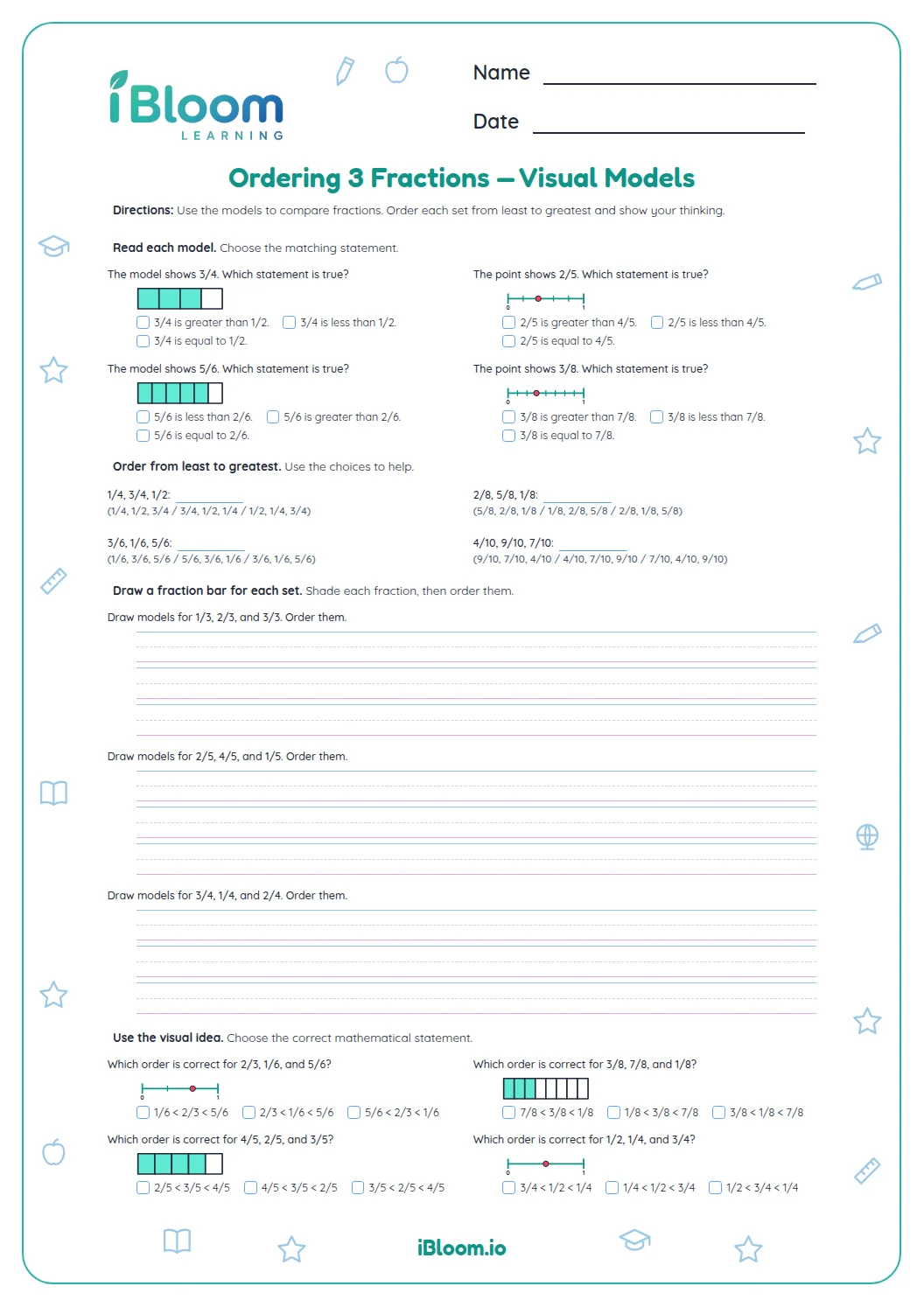
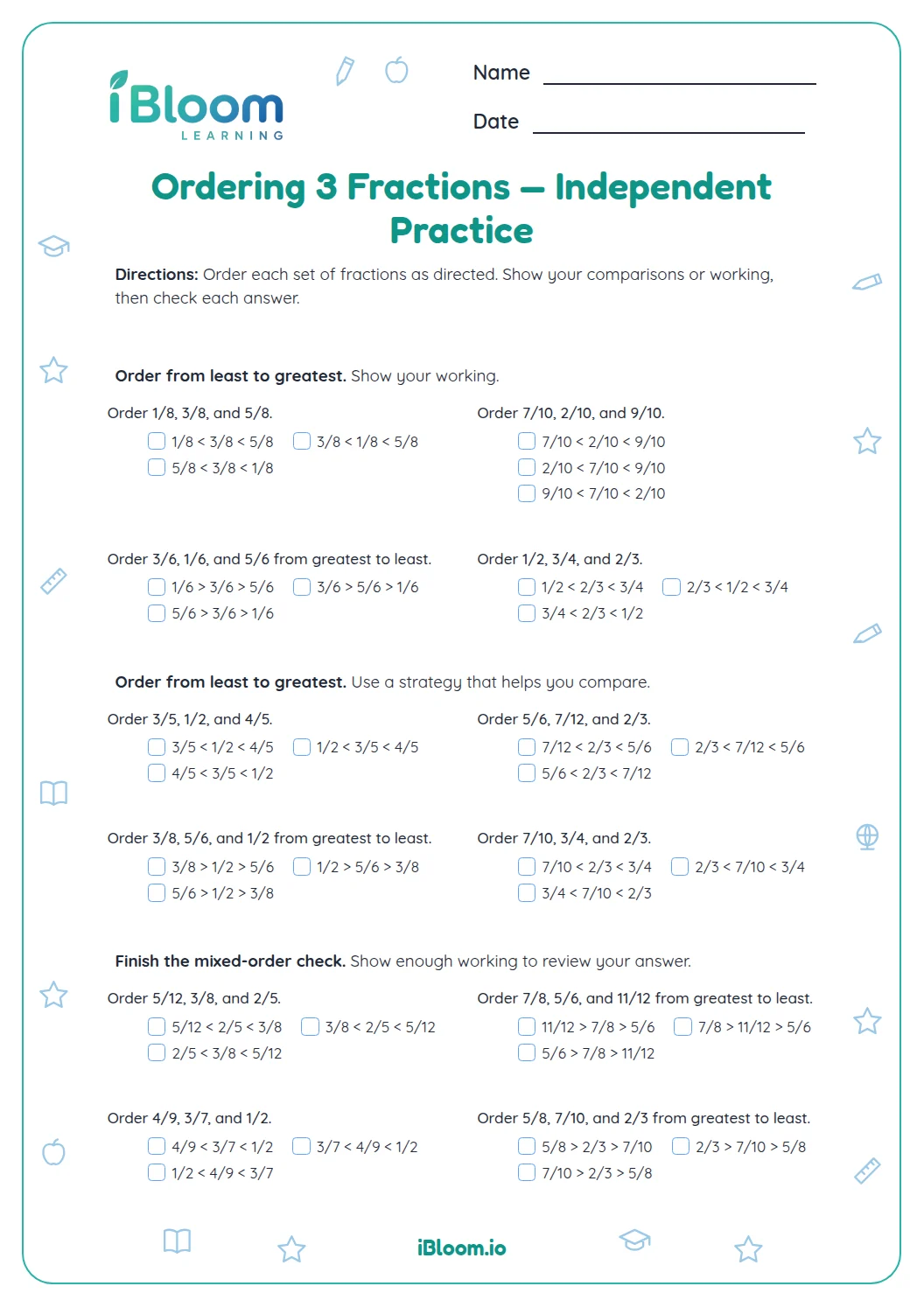
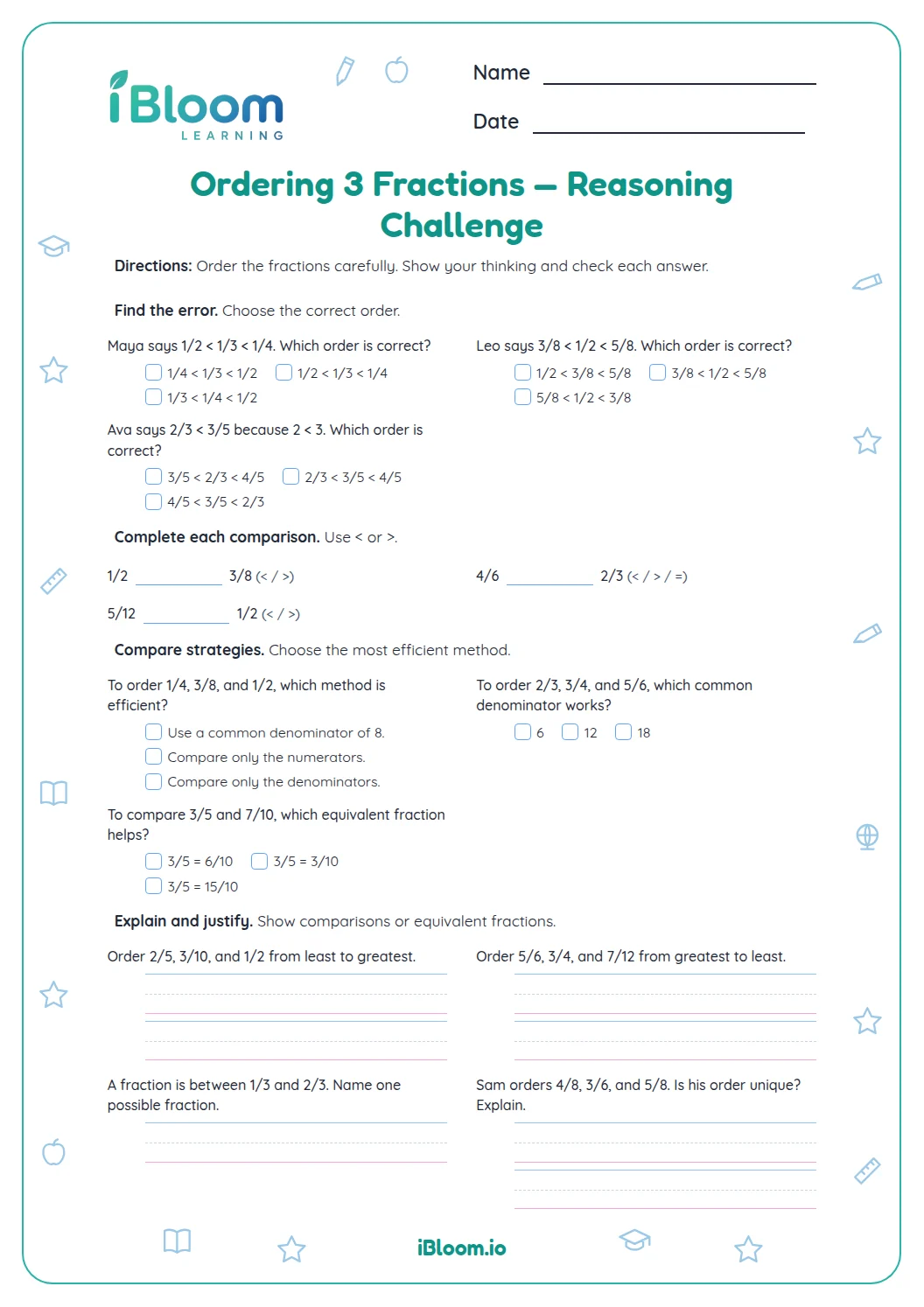
This Grade 4 worksheet applies fraction comparison to familiar settings such as recipes, distances, containers, and garden supplies. Children order three fractions from least to greatest or greatest to least, using common benchmarks or equivalent fractions as helpful strategies. Each situation makes clear that the fractions refer to the same kind of whole or unit. The sheet aligns with CCSS 4.NF.A.2 and comes with a separate answer key.
Aligned to 4.NF.A.2
How can one half help compare fractions?
A benchmark such as 1/2 can quickly sort fractions above and below the middle. For example, 1/4 is below 1/2 and 3/4 is above it, so the order is clear.
- 11/4, 3/4, 1/2
- 2Below 1/2: 1/4
- 3Above 1/2: 3/4
- 4Order: 1/4, 1/2, 3/4
When should I use equivalent fractions?
If two fractions are close or share a useful denominator, rename them with equivalent fractions. In a water bottle problem, 2/8 equals 1/4, which helps compare it with 1/2 and 3/4.
Why does the story name the whole or unit?
Comparisons are meaningful when fractions refer to the same whole or unit. The problems specify the same recipe ingredient, mile, meter, container size, or project so all three amounts can be compared fairly.
How to use this worksheet
- 1Underline the three fractions and the requested direction.
- 2Check that they refer to the same unit or whole.
- 3Use a benchmark or equivalent fractions to compare them.
- 4Write every fraction once in the correct order.
- 5Check from left to right against the requested direction.
Mistakes to watch for
The mistake
Ordering by denominator size alone.
The fix
Compare the fraction values; a larger denominator can mean smaller pieces.
The mistake
Forgetting the requested direction.
The fix
Circle “least to greatest” or “greatest to least” before listing.
The mistake
Comparing different-sized wholes.
The fix
Use the unit and context to confirm all fractions refer to the same size whole.
Curriculum alignment
This page connects the practice to the Common Core standard below.
Compare fractions with different numerators and denominators.
On this sheet: The contexts identify a shared whole or unit as children compare and order three fractions.
Show the official wordingHide the official wording
Compare two fractions with different numerators and different denominators, e.g., by creating common denominators or numerators, or by comparing to a benchmark fraction such as 1/2. Recognize that comparisons are valid only when the two fractions refer to the same whole. Record the results of comparisons with symbols >, =, or <, and justify the conclusions, e.g., by using a visual fraction model.
What to practice next
Make more practice
Further reading
Questions parents and teachers ask
What is a good first strategy for ordering fractions?
Compare each fraction with a benchmark such as 1/2. Fractions below one half go on one side and those above it go on the other. If that does not settle the order, use equivalent fractions with a common denominator. Have your child show which fraction is below or above the benchmark.
Why do some problems use different denominators?
The worksheet asks children to compare fractions with different numerators and denominators, as in CCSS 4.NF.A.2. Children can use common denominators or familiar benchmarks to decide which amount is smaller or larger. The denominators are varied so children practice comparing actual values.
How do I know whether to order least to greatest?
Read the direction in each problem before writing. Least to greatest starts with the smallest fraction; greatest to least starts with the largest. The worksheet includes both directions so children practice attending to the wording. A quick check from smallest to largest catches a reversed order.
Can equivalent fractions help with 2/8 and 1/2?
Yes. Since 2/8 equals 1/4, it is less than 1/2. Rewriting a fraction in an equivalent form can make a comparison easier, especially when the fractions do not share a denominator. Equivalent fractions are another way to confirm a close comparison.
Do the fractions refer to the same whole?
Each context describes a shared unit, such as the same kind of bottle, the same distance unit, or portions of a comparable recipe. That makes the three fractions appropriate to compare in that situation. Check that the units name the same whole before comparing the values.
What does the answer key show?
The separate key lists each three-fraction order. It is useful to ask children to explain one comparison with a benchmark or equivalent fraction, even though the worksheet response can be a concise ordered list. Ask the child to explain one pair in the ordered list.