






About this worksheet
This Grade 4 worksheet builds reasoning with subtraction of mixed numbers that have like denominators. Students inspect claims, choose valid regrouping strategies, solve subtraction problems and explain or check answers. A separate answer key supports review. The page practices CCSS 4.NF.B.3.c.
Aligned to 4.NF.B.3.c
When do you regroup to subtract mixed numbers?
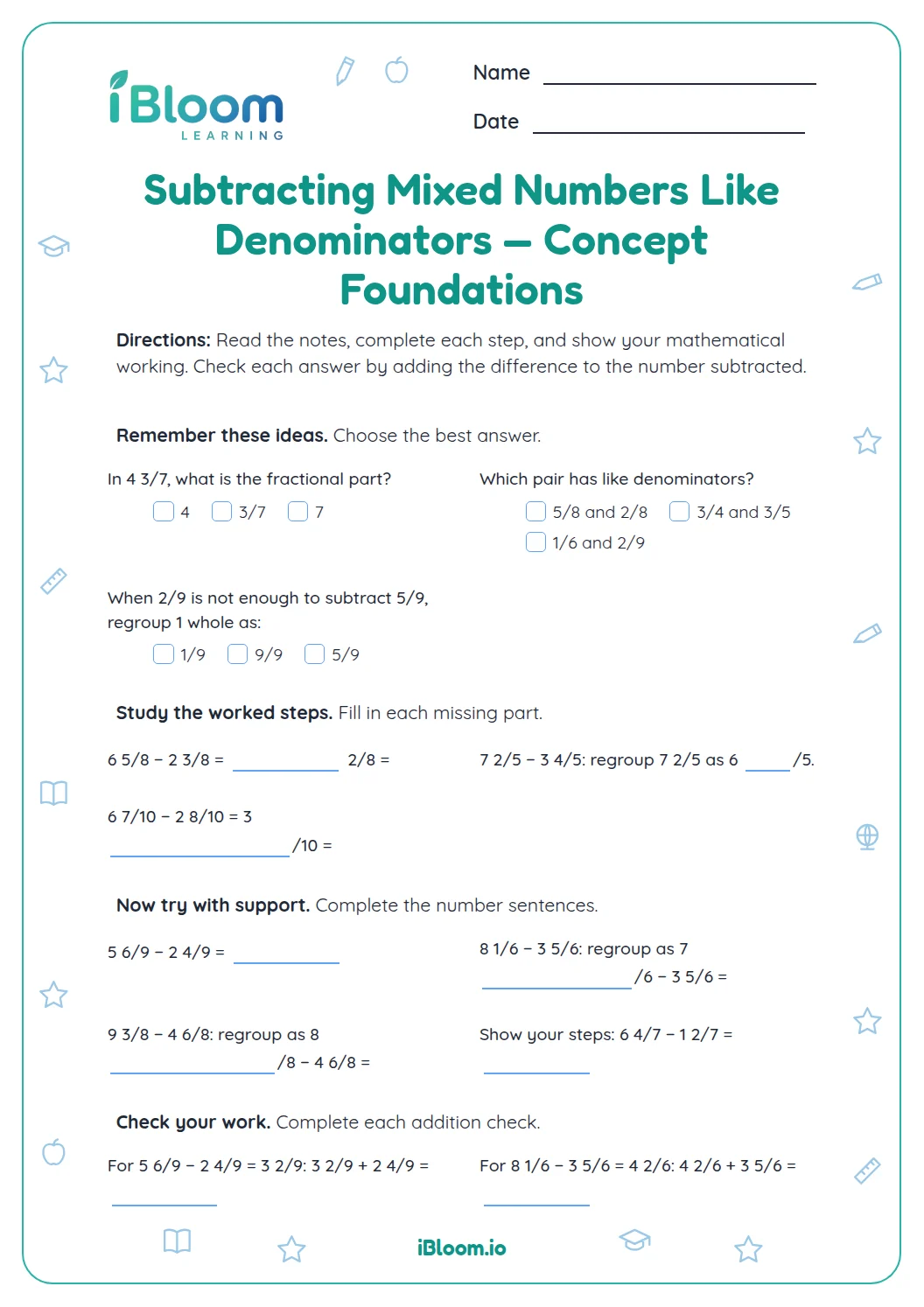
Regroup when the fractional part of the first number is smaller than the fractional part being subtracted. For 8 1/6 − 4 5/6, rename one whole as 6/6: 8 1/6 becomes 7 7/6. Then subtract the whole numbers and sixths.
- 18 1/6 − 4 5/6
- 2Rename: 8 1/6 = 7 7/6
- 37 − 4 = 3; 7/6 − 5/6 = 2/6
- 4Difference: 3 2/6
What reasoning is included?
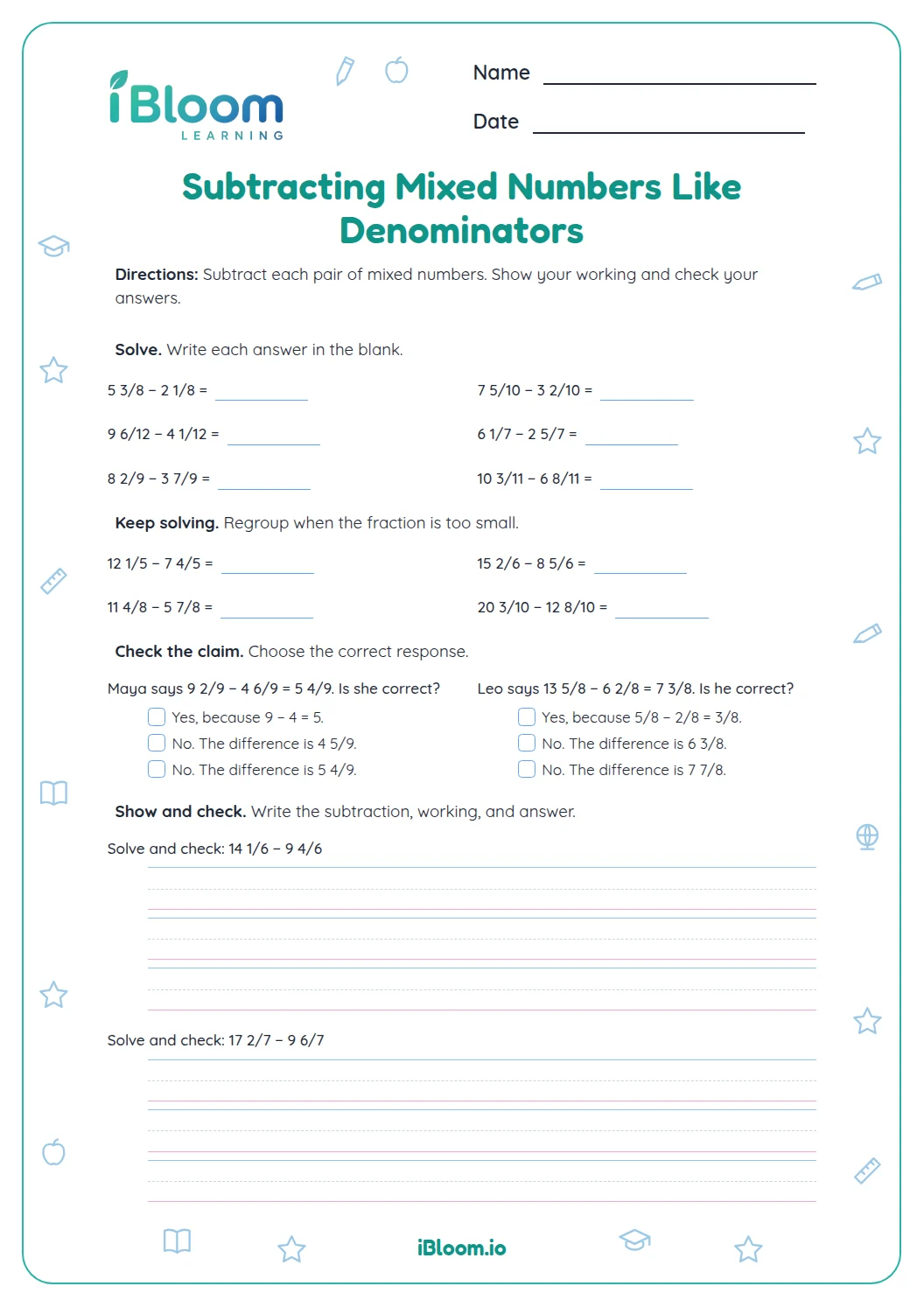
Children inspect a regrouping claim, compare methods, solve missing-number prompts and explain corrections. The final real-world question uses the same like-denominator subtraction skill.
How can I use this worksheet?
- 1Compare the fractional parts before subtracting.
- 2If the first fraction is smaller, rename one whole using the shared denominator.
- 3Subtract the fractions and whole numbers, then simplify when appropriate.
- 4Check a difference by adding it to the number subtracted.
Common mistakes and quick fixes
The mistake
Subtracting a larger fraction from a smaller one without regrouping.
The fix
Rename one whole as a fraction with the same denominator first.
The mistake
Changing the denominator while regrouping.
The fix
Keep the denominator; add its numerator count to the fractional part.
The mistake
Stopping after subtracting the whole numbers.
The fix
Subtract both parts and check by addition.
Common Core alignment
Subtract mixed numbers with like denominators, regrouping when needed.
On this sheet: Subtract mixed numbers with like denominators, regrouping when needed.
Show the official wordingHide the official wording
Add and subtract mixed numbers with like denominators, e.g., by replacing each mixed number with an equivalent fraction, and/or by using properties of operations and the relationship between addition and subtraction.
What to practice next
Make more practice
Further reading
Questions parents and teachers ask
Who is this worksheet for?
This worksheet is for Grade 4 learners practicing mixed-number subtraction. It has 16 questions across the printed practice pages and a separate answer key. A parent or teacher can review one example, then let the learner work through the parts.
How many questions are included?
There are 16 questions. Learners inspect regrouping claims, compare subtraction strategies, solve missing-value items, explain or check differences, and apply the skill to a ribbon problem. The separate answer key follows the practice pages and shows expected answers.
Does it include an answer key?
Yes. A separate answer key follows the practice pages. Use it to check selected or computed answers after the learner finishes. For questions where the wording can vary, the key provides a sample response that shows the expected idea and reasoning.
How can I help with a missed answer?
Ask the learner to point to the part of the question that determines the answer, then work through that step together. Compare the result with the answer key and have the learner explain any correction in their own words.
Can I print the worksheet and key separately?
Yes. The worksheet and answer key are arranged on separate pages, so you can print the practice pages for the learner and keep the answers for checking. The learner can write directly on the worksheet, then review missed items with an adult.
When should a mixed-number subtraction problem be regrouped?
Add the difference to the number subtracted. The sum should equal the starting mixed number. For example, 3 2/6 + 4 5/6 = 8 1/6 checks the subtraction 8 1/6 − 4 5/6. The worksheet includes several prompts to use this check.
How can a child check a difference?
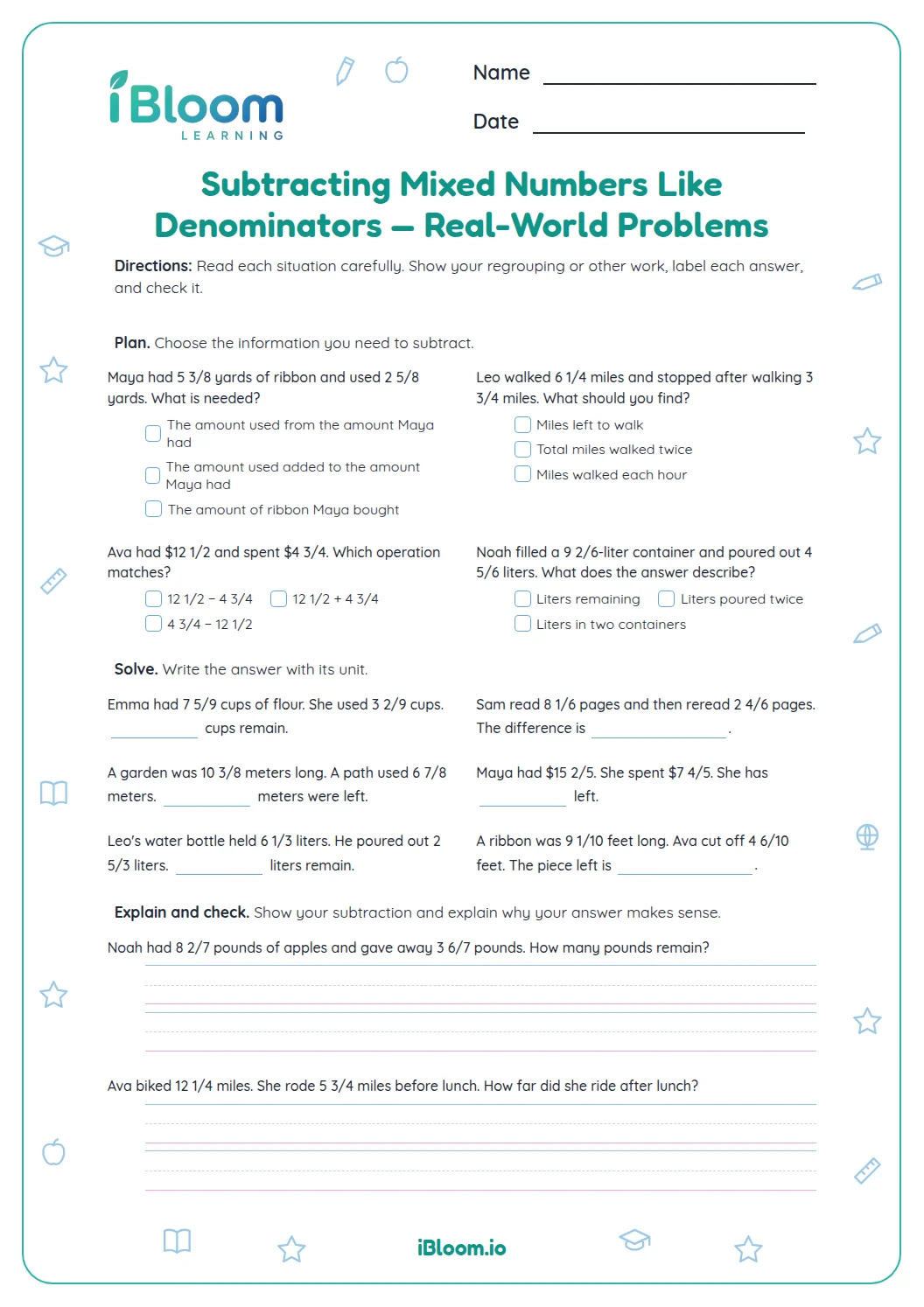
The ribbon problem asks how much remains after a piece is cut from the starting length. Subtract 4 3/4 from 9 1/2, regrouping the half as fourths. Use the answer key to check the exact remaining length and its unit.