


About this worksheet
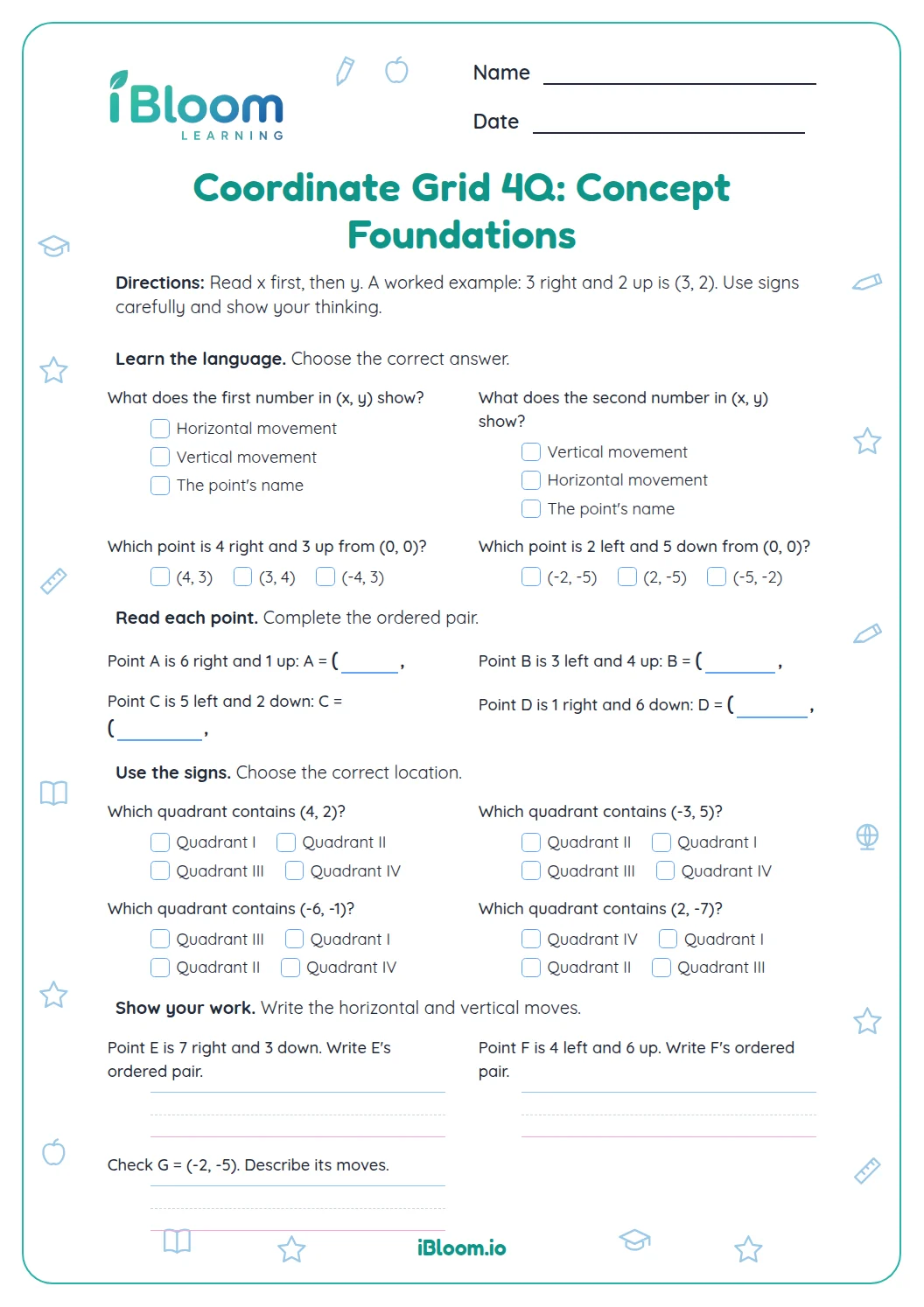
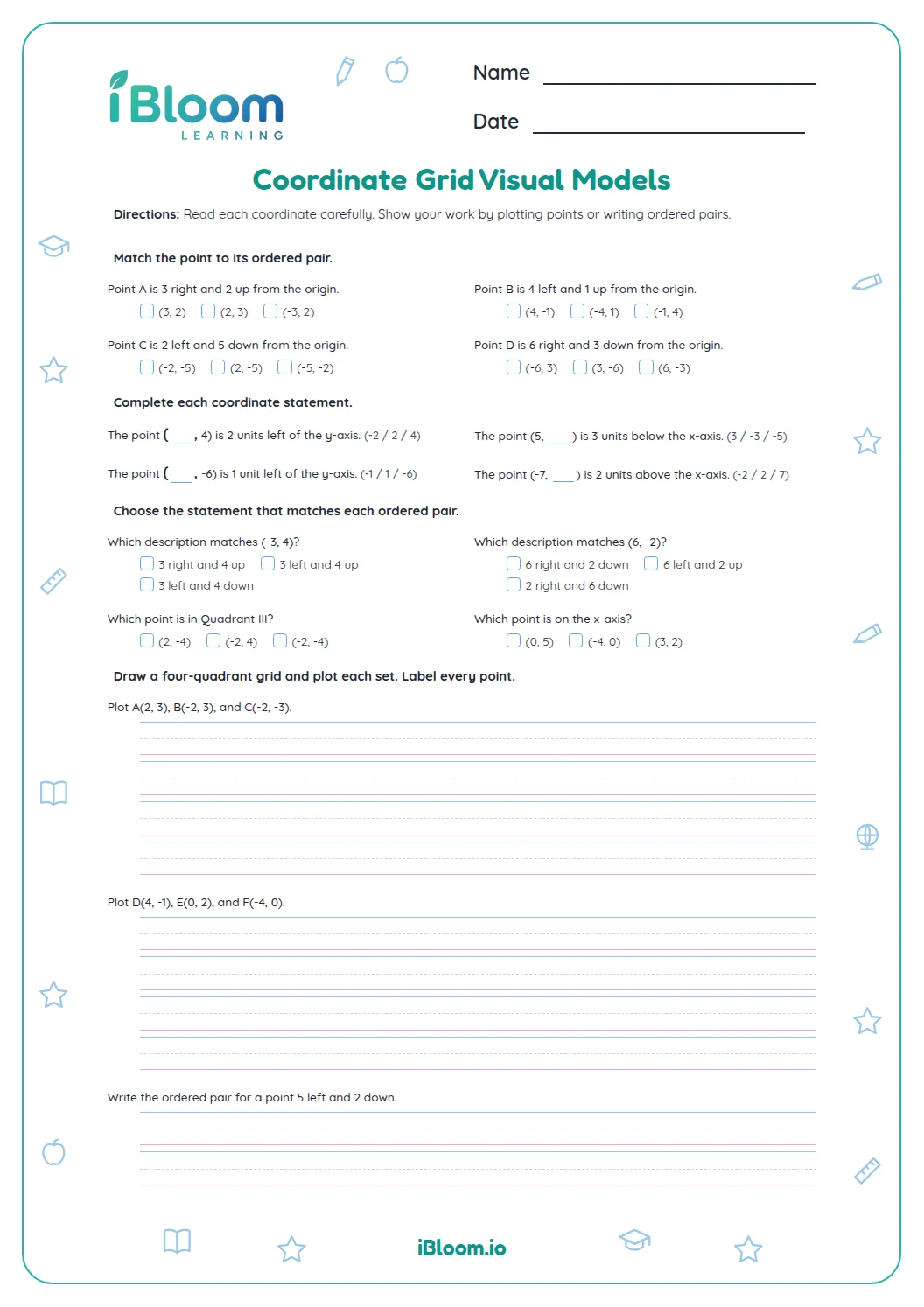
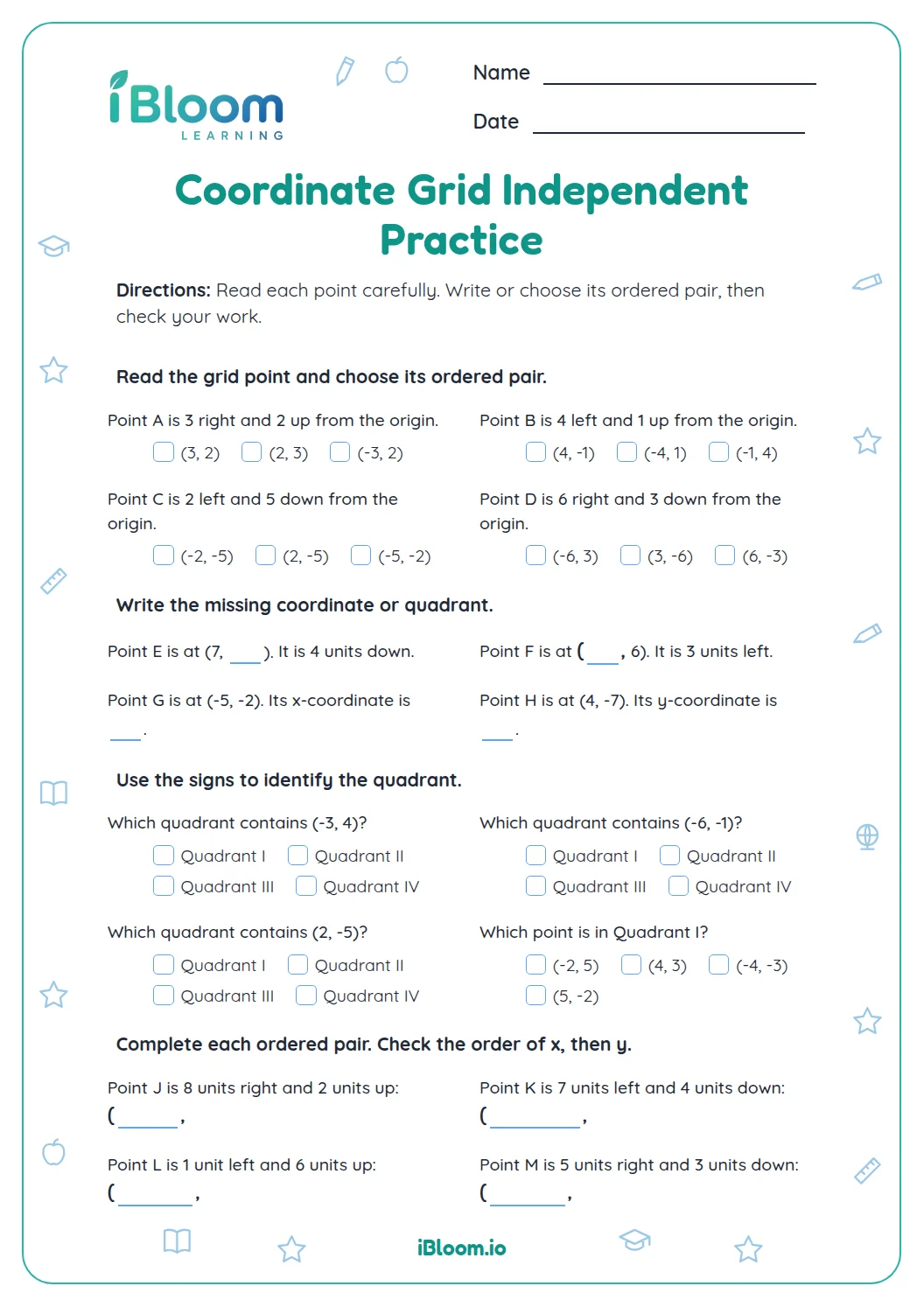
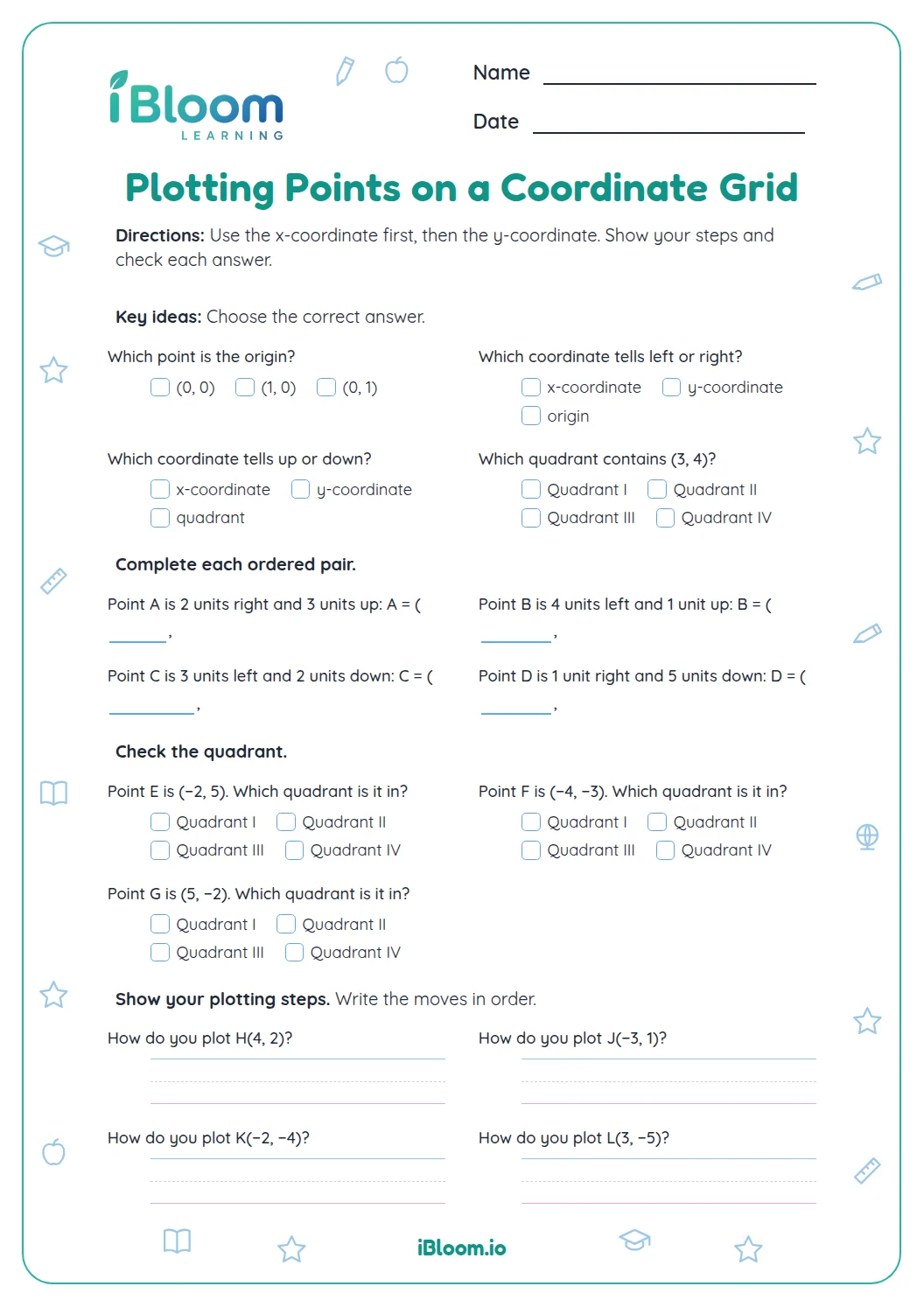
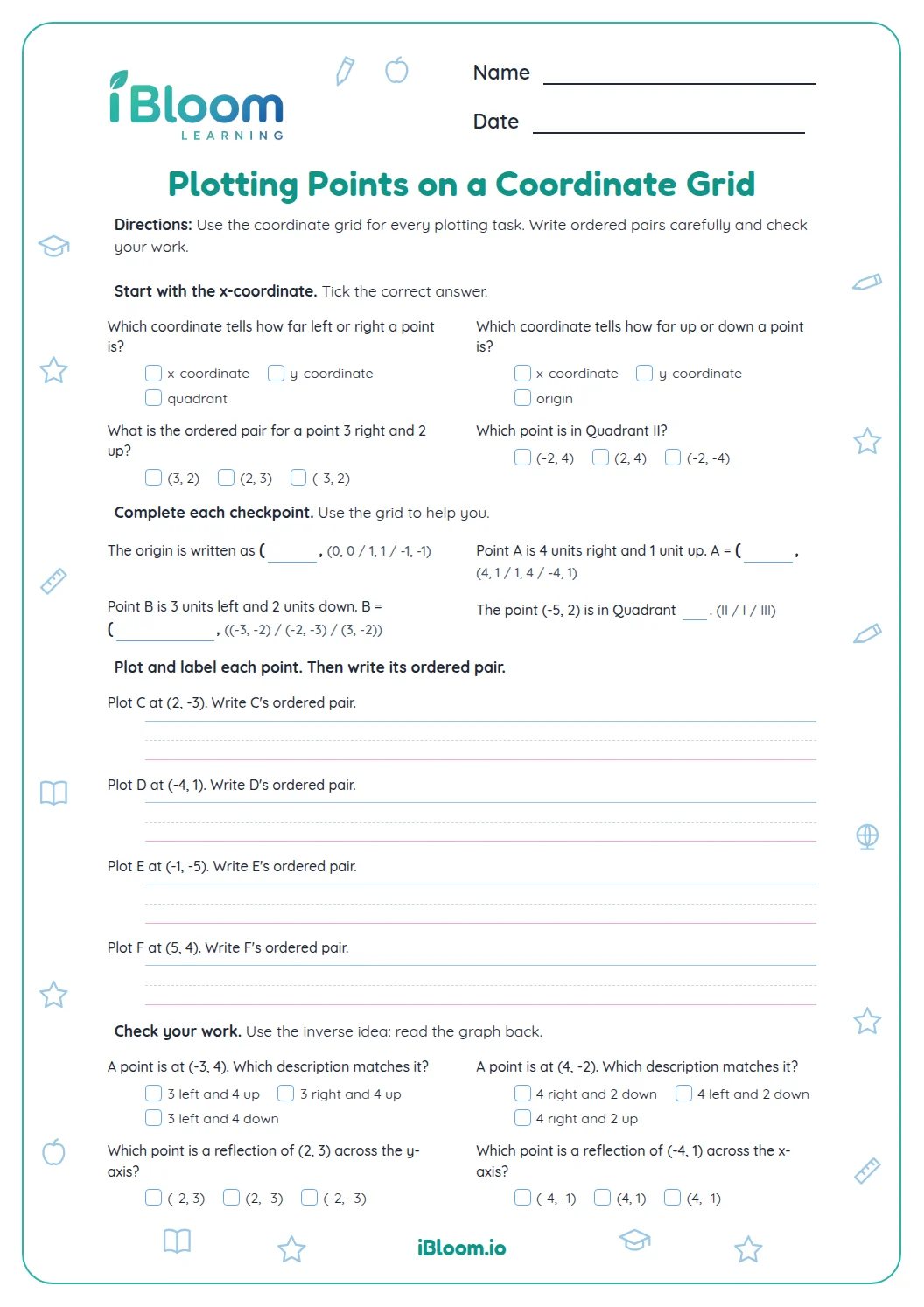
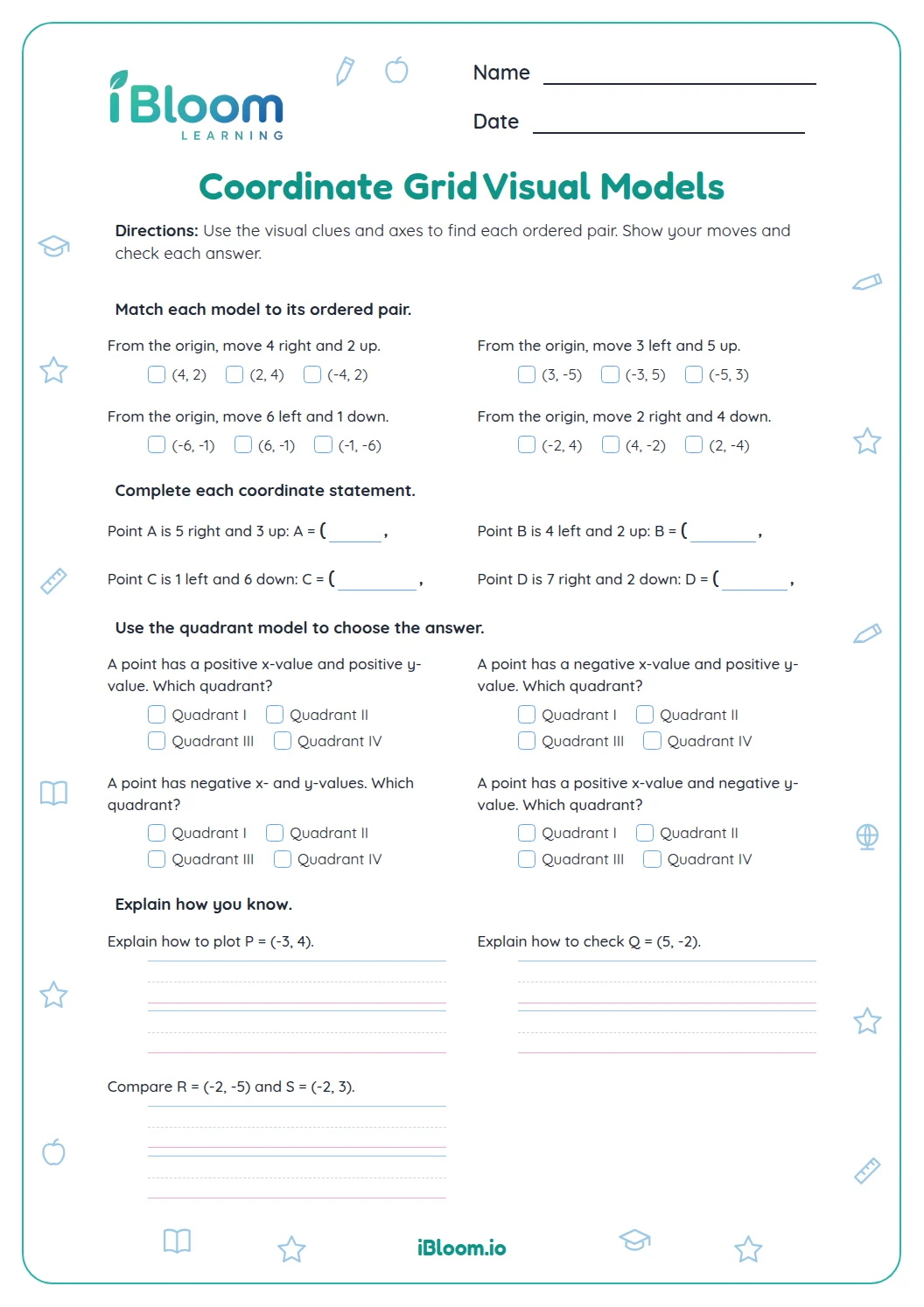
This Grade 4 printable has 14 questions on reading signed ordered pairs and reasoning about points on a coordinate plane. Students inspect coordinate claims, compare strategies, fill in missing coordinates, and explain locations in all four quadrants. The sequence follows the saved sheet’s error analysis, strategy comparison, missing-information, and explanation tasks. It practices the signed-coordinate reasoning in Common Core 6.NS.C.6b and includes a separate answer key.
Aligned to 6.NS.C.6b
How can you check coordinate reasoning?
Check the x-coordinate first, then the y-coordinate. A negative x is left and a negative y is down. For example, (−3, 5) is in Quadrant II because x is negative and y is positive.
- 1For (−3, 5), x is negative and y is positive.
- 2That sign pair identifies Quadrant II.
Which strategy helps read a point accurately?
Read horizontally for x, then vertically for y. Compare y-values to decide which point is higher. A zero coordinate places a point on an axis, outside the four quadrants.
How can an axis clue reveal a missing coordinate?
A point in Quadrant III and two units from the x-axis has y = −2. A point in Quadrant II and three units from the y-axis has x = −3. Use the quadrant and distance to complete each ordered pair.
How do you explain an axis location?
For (0, 5), x is zero, so the point lies on the y-axis rather than inside a quadrant.
How to use this worksheet
- 1Read the claim or subtraction equation carefully.
- 2Subtract the ones, regrouping one ten when needed.
- 3Subtract the tens after regrouping.
- 4Add the difference to the subtrahend to check.
Mistakes to check
The mistake
Subtracting the smaller ones digit from the larger one without regrouping.
The fix
Trade one ten for ten ones first, then subtract the ones.
The mistake
Forgetting to reduce the tens after regrouping.
The fix
After trading a ten, subtract one fewer ten in the tens column.
The mistake
Checking by adding the difference to the starting number.
The fix
Add the difference to the subtrahend; the sum should return to the starting number.
Curriculum alignment
Use coordinate signs to identify quadrants and reflections across axes.
On this sheet: Students inspect coordinate claims, compare strategies, fill in signed coordinates, and explain locations in all four quadrants.
Show the official wordingHide the official wording
Understand signs of numbers in ordered pairs as indicating locations in quadrants of the coordinate plane; recognize that when two ordered pairs differ only by signs, the locations of the points are related by reflections across one or both axes.
What to practice next
Make more practice
Further reading
Questions parents and teachers ask
How do you read an ordered pair?
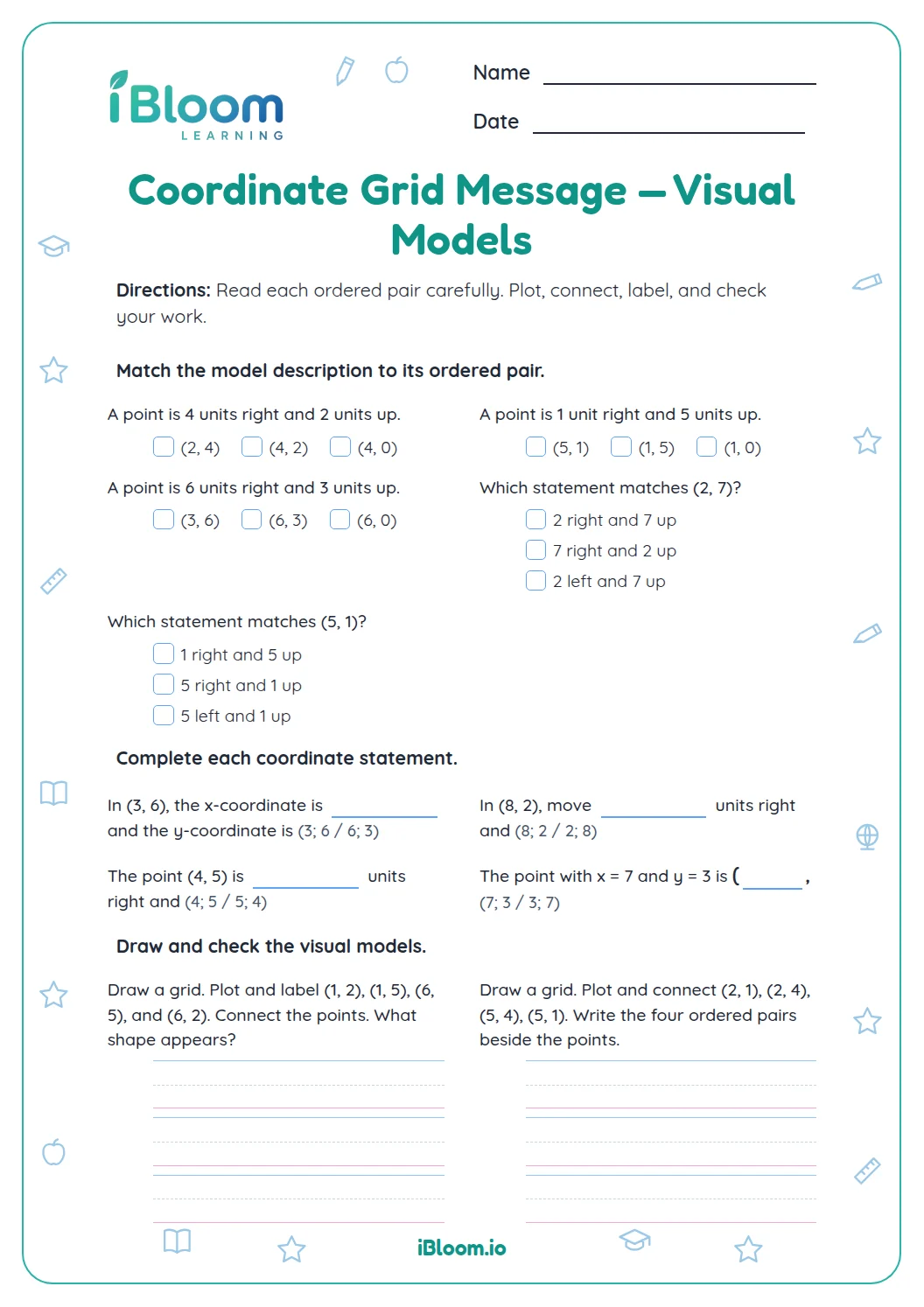
Read the x-coordinate first and the y-coordinate second. Starting at the origin, move horizontally for x and vertically for y. For example, (−3, 2) means three units left and two up. The signs show direction, while the numbers give each distance from the axes.
Which signs belong to each quadrant?
Quadrant I has (+, +), Quadrant II has (−, +), Quadrant III has (−, −), and Quadrant IV has (+, −). The axes are boundaries, so a point with either coordinate equal to zero lies on an axis rather than inside a quadrant.
What does a zero coordinate mean?
If x is zero, the point lies on the y-axis. If y is zero, the point lies on the x-axis. The origin is (0, 0). This worksheet includes an axis question so students practice distinguishing points on an axis from points inside the four quadrants.
How do you compare two points on a coordinate plane?
Compare the coordinate that answers the question. To find which point is higher, compare y-values; to find which is farther left, compare x-values. The strategy section gives learners examples to check, including a pair with different x- and y-coordinates Use the signs in the ordered pair to verify the direction.
How many questions and pages are included?
The worksheet has 15 questions across two practice pages and an answer key. Students inspect four claims, compare five strategies, fill in three missing-coordinate items, and write three short explanations. Allow about 20 minutes to complete and check the full set.