


About this worksheet
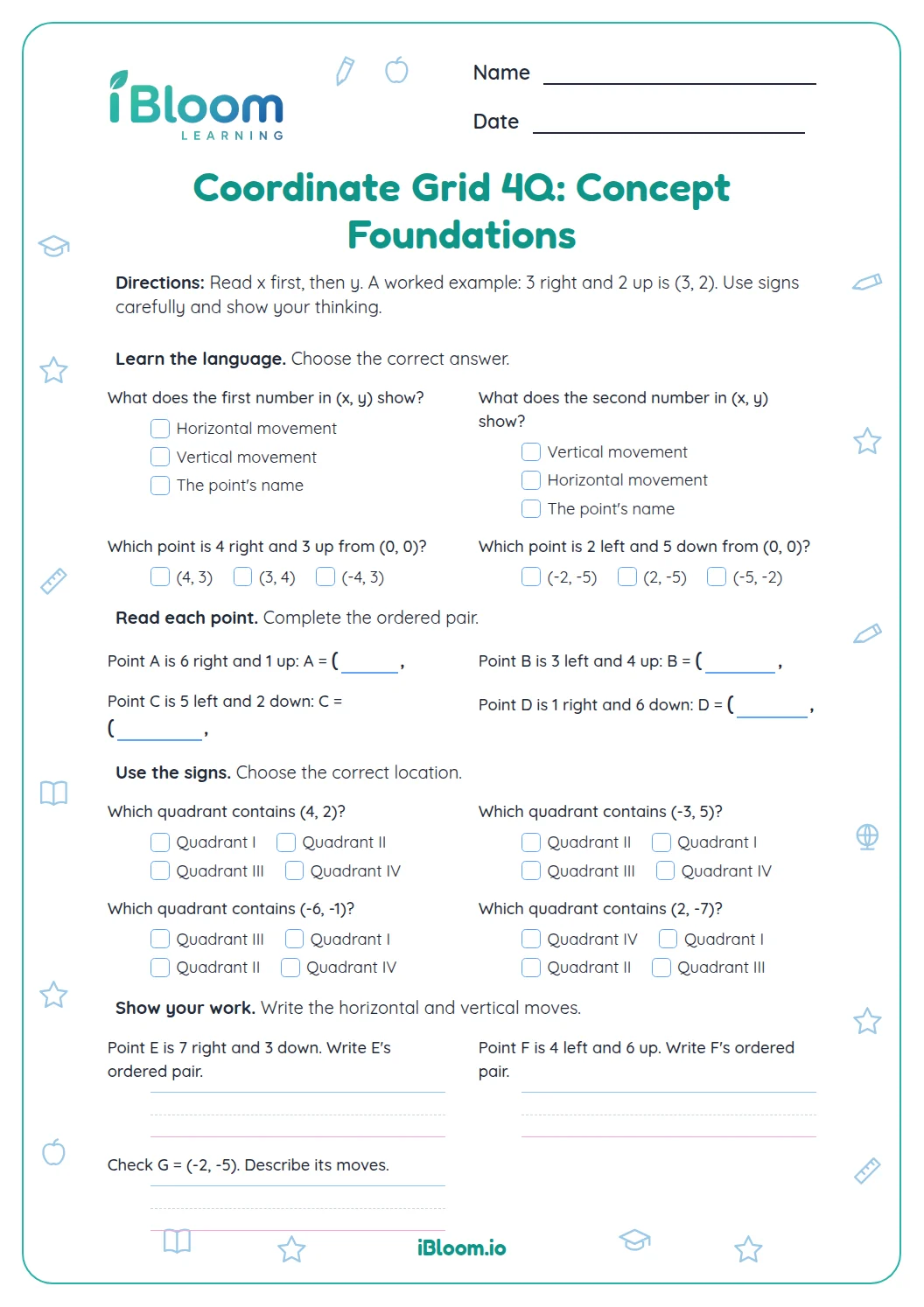
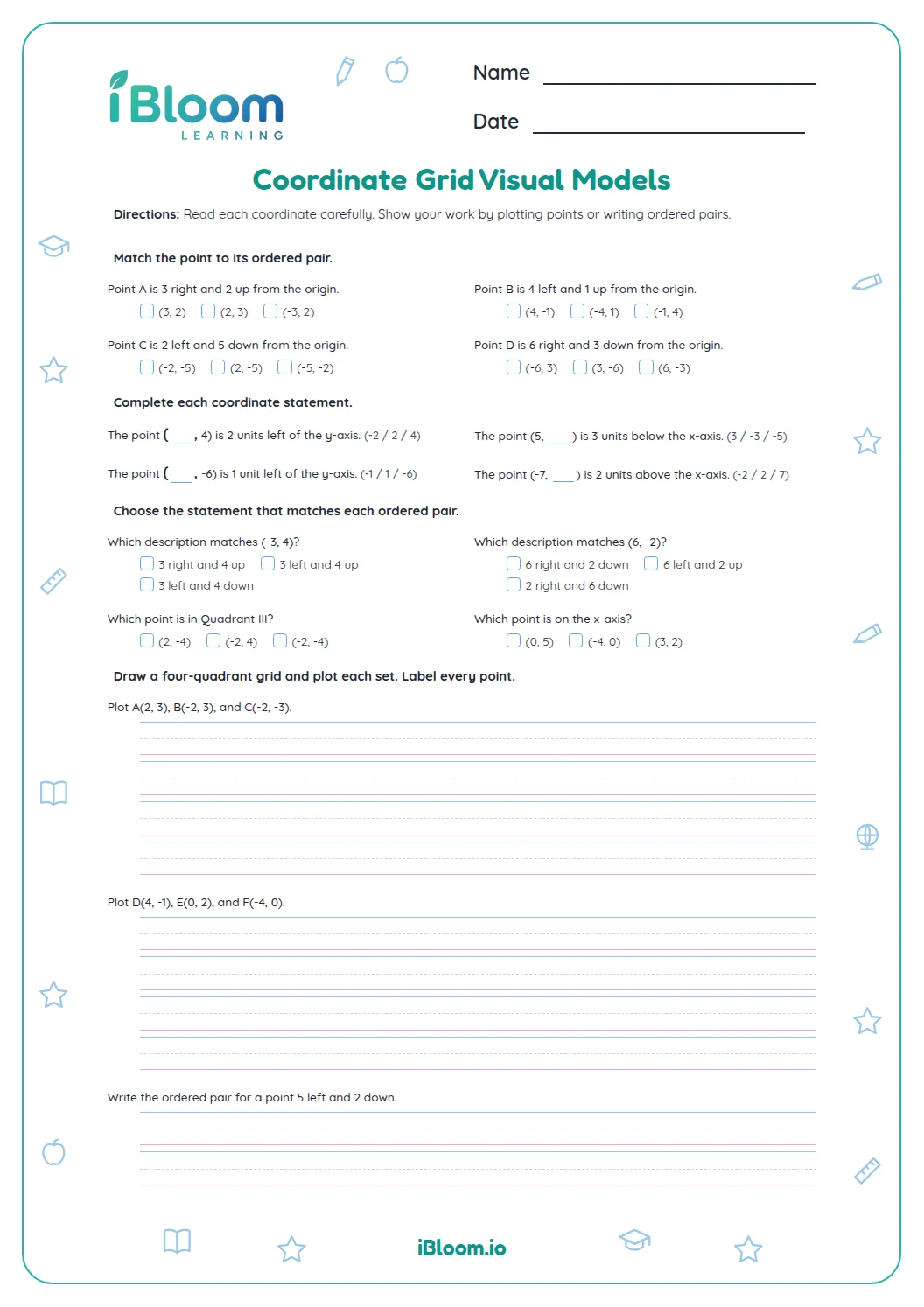
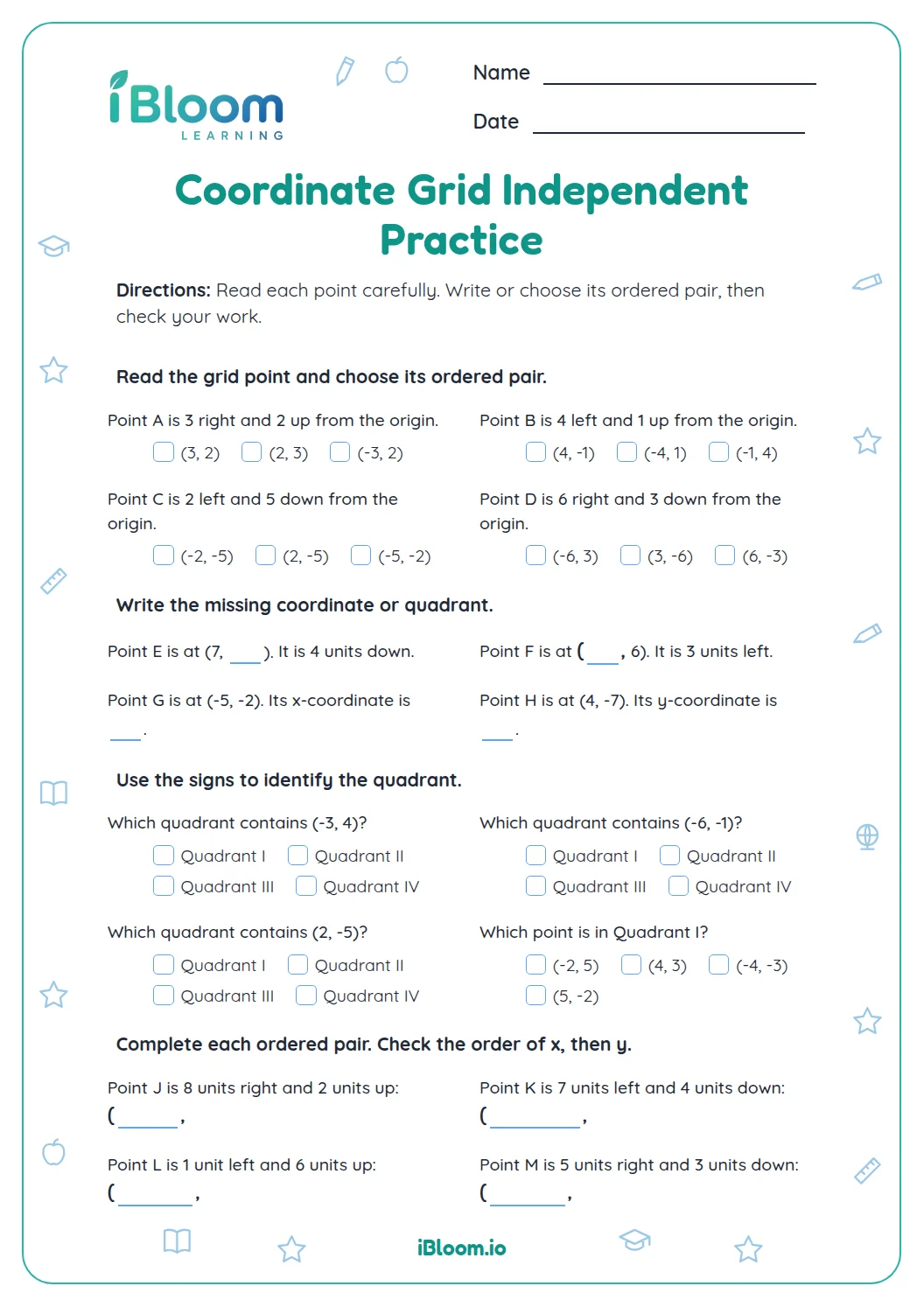
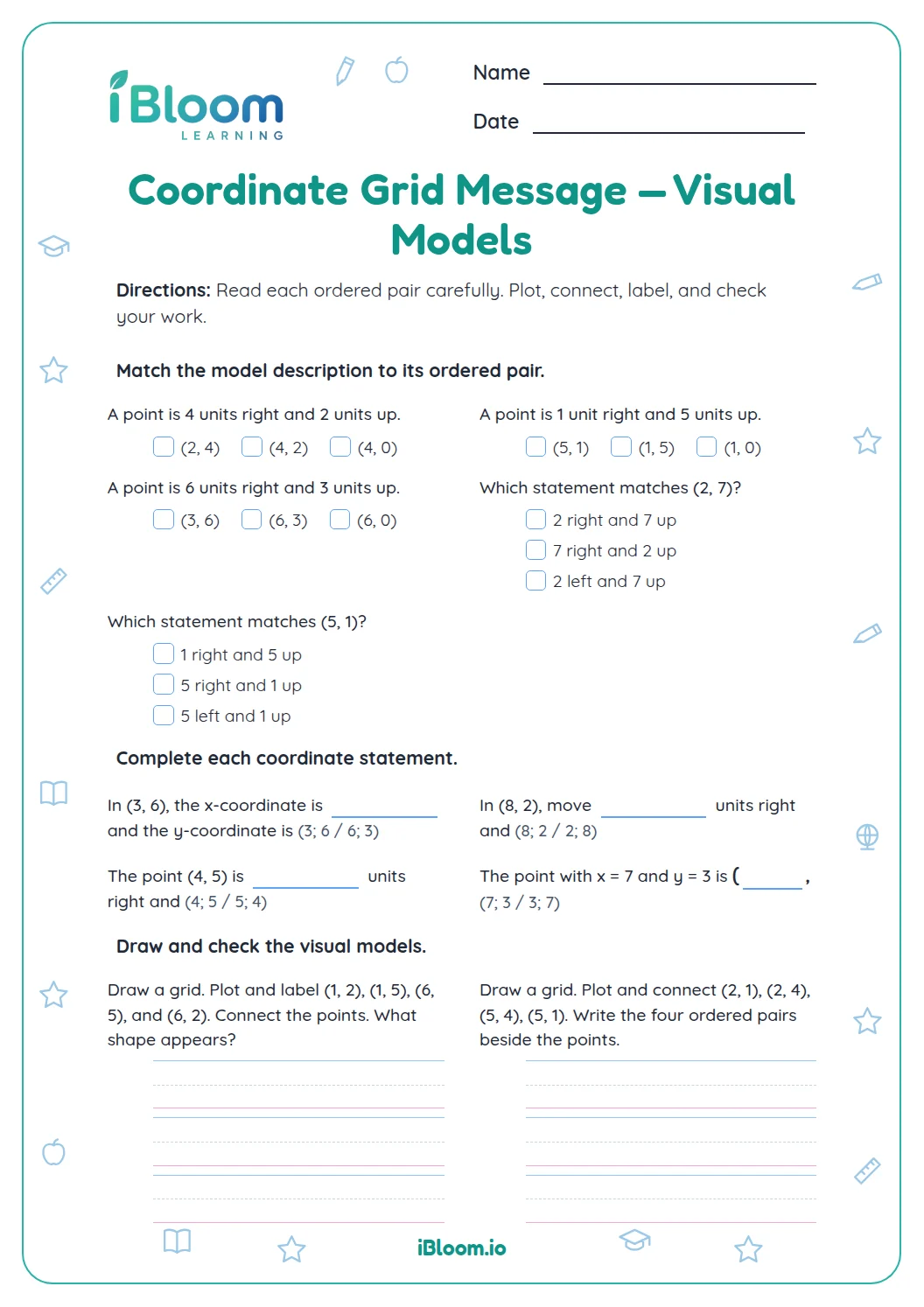
This printable Grade 4 worksheet practices reading signed coordinates, naming quadrants, and tracking movement. It has 16 questions that move from direct practice to a short reasoning task, plus a separate answer key for checking each response.
How do you work through reading signed coordinates, naming quadrants, and tracking movement?
For q16, moving 2 units right adds 2 to x: -3 + 2 = -1. The y-coordinate stays 5, so the new point is (-1, 5).
What does the practice include?
The 16 items are grouped by task so students can settle into one method, then apply it to a new form of the same skill. Each direction names the information to use.
How should students check their work?
After finishing, compare each answer with the key. For a mismatch, reread the exact prompt, redo the step, and explain which clue supports the corrected answer.
A simple way to use this page
- 1Read x first and y second.
- 2For a quadrant, check both signs: (+,+), (-,+), (-,-), (+,-).
- 3For a movement, change only the coordinate named by the direction.
- 4Write ordered pairs with x first, then y.
- 5Check signs and coordinates against the clue.
Common mistakes and quick fixes
The mistake
Reversing x and y.
The fix
Write x first and y second in every ordered pair.
The mistake
Using only one sign to name a quadrant.
The fix
Check both coordinates before choosing the quadrant.
The mistake
Changing both coordinates during a horizontal move.
The fix
A left or right move changes x; y stays fixed.
What to practice next
Make more practice
Questions parents and teachers ask
How many questions are on the worksheet?
There are 16 questions in four parts: five quadrant identifications, five coordinate reads, five ordered pairs, and one movement problem. The separate answer key lists all answers. The questions use signed coordinates and include points on an axis.
How do you name a quadrant?
Look at the signs of x and y together. For example, (-3, 4) has a negative x-coordinate and positive y-coordinate, so it lies in Quadrant II. Points with a zero coordinate lie on an axis, not inside a quadrant.
What changes when a point moves right?
Complete the first coordinate as x and the second as y. For the point (-4, 0), x is -4 and y is 0. Keep the signs with their coordinates when copying or reading a point. An ordered pair always follows the same x-then-y convention.
What is the order in an ordered pair?
Yes. The four parts let a student focus on one task at a time: naming quadrants, reading a coordinate, writing a pair, and reasoning about movement. Use one part for a short session or complete both worksheet pages before checking the key. An adult can review the movement question together.
Can I use this for a quick review?
Yes. The four parts let a student focus on one task at a time: naming quadrants, reading a coordinate, writing a pair, and reasoning about movement. Use one part for a short session or complete both worksheet pages before checking the key.