

About this worksheet
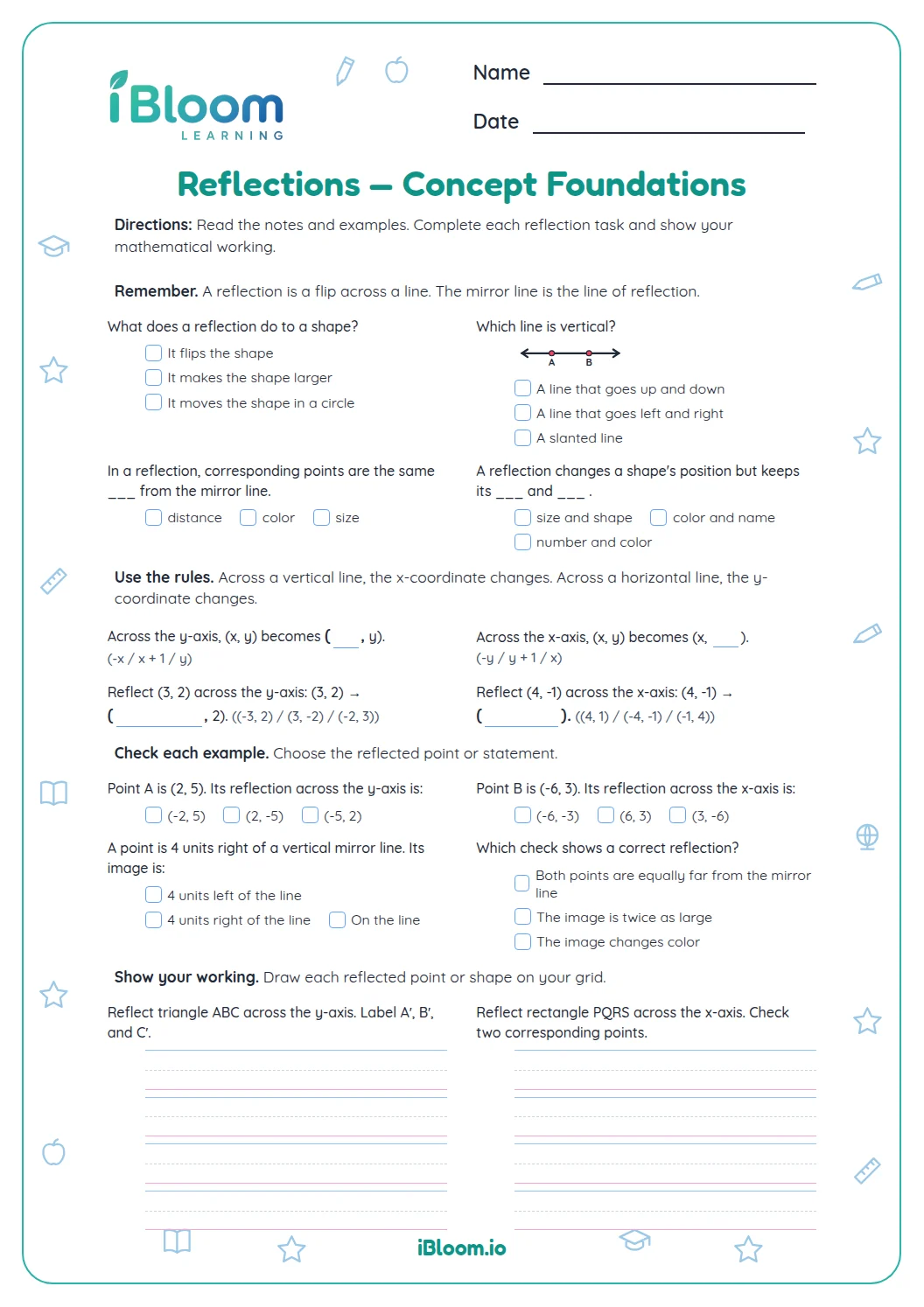
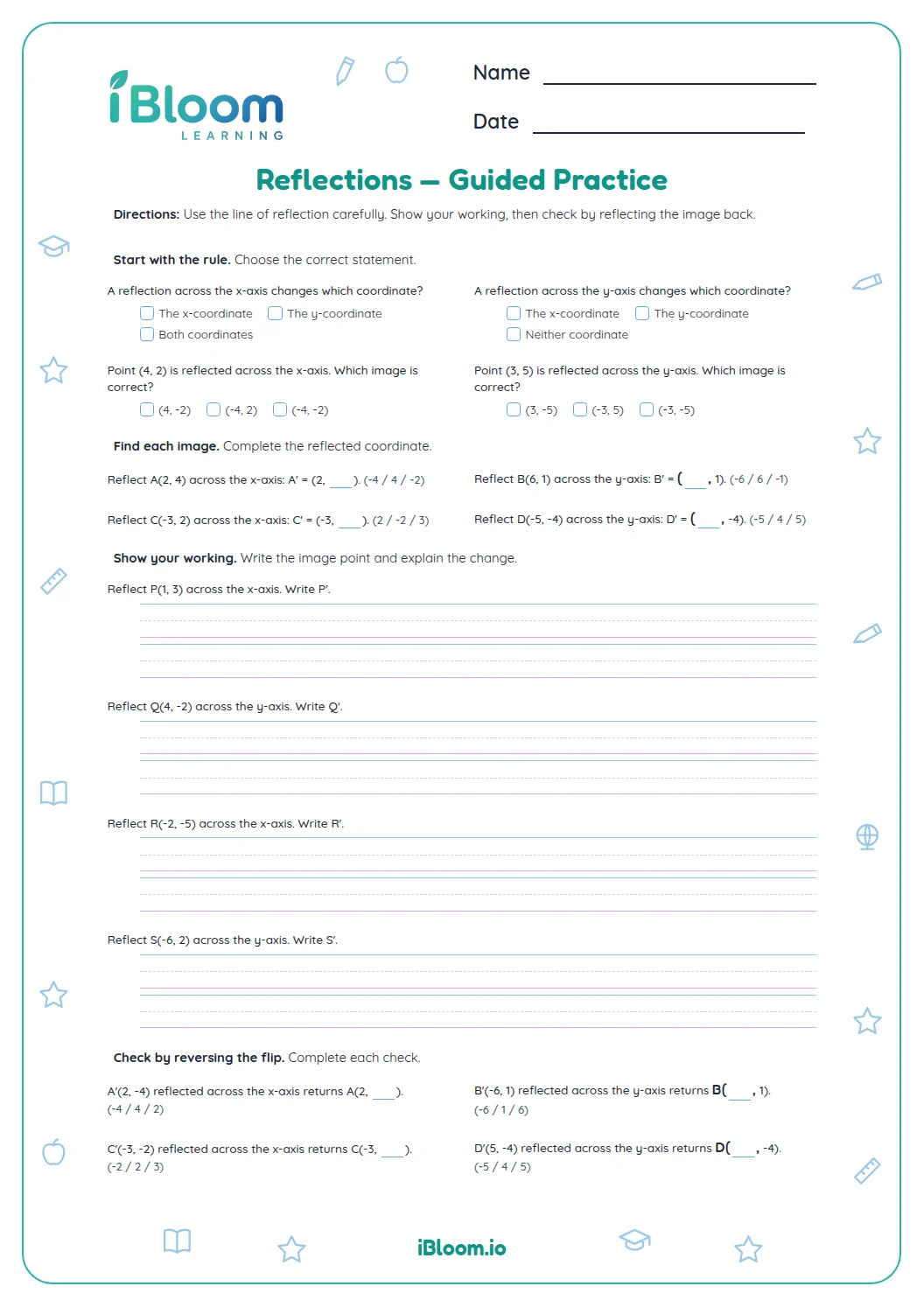
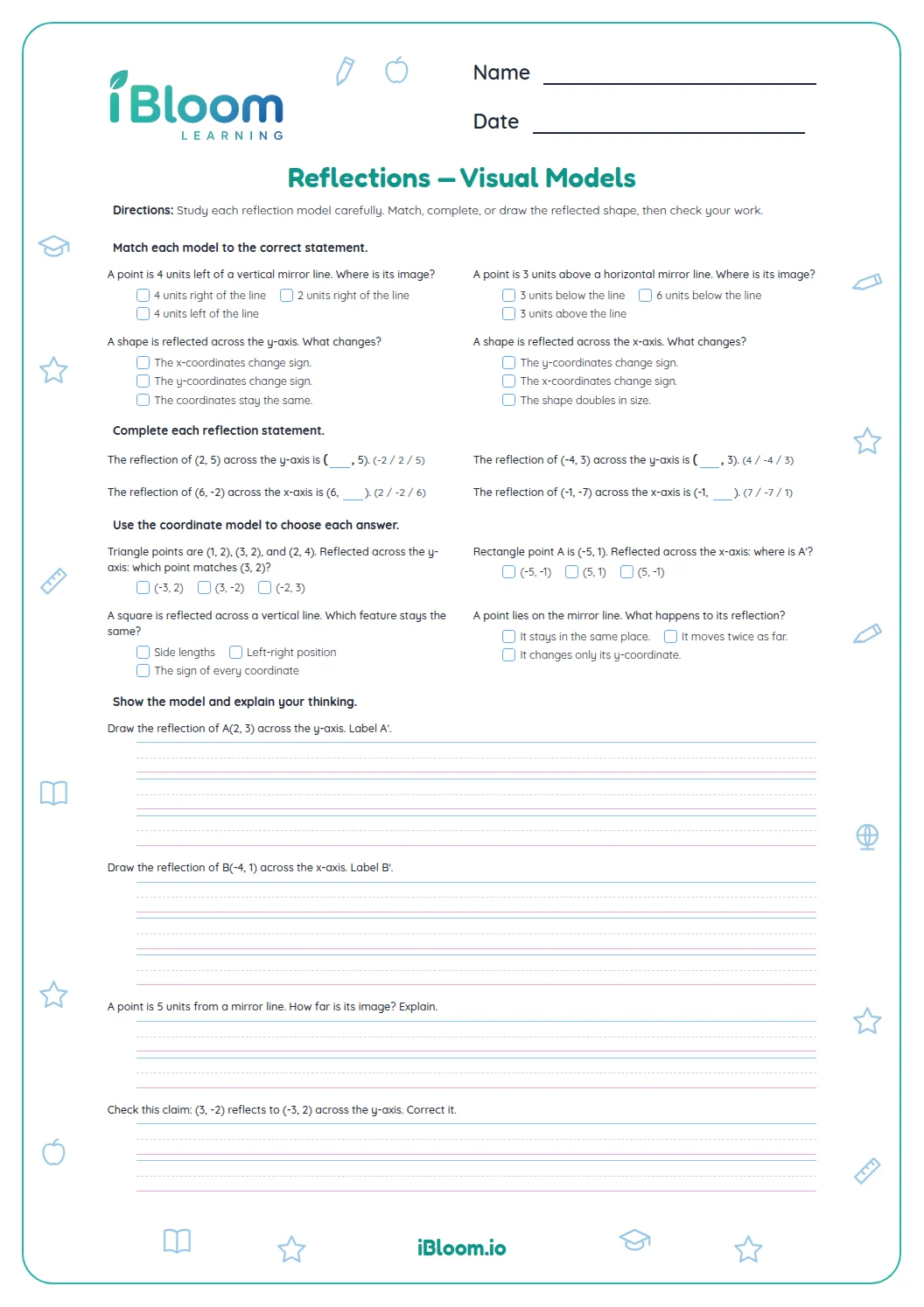
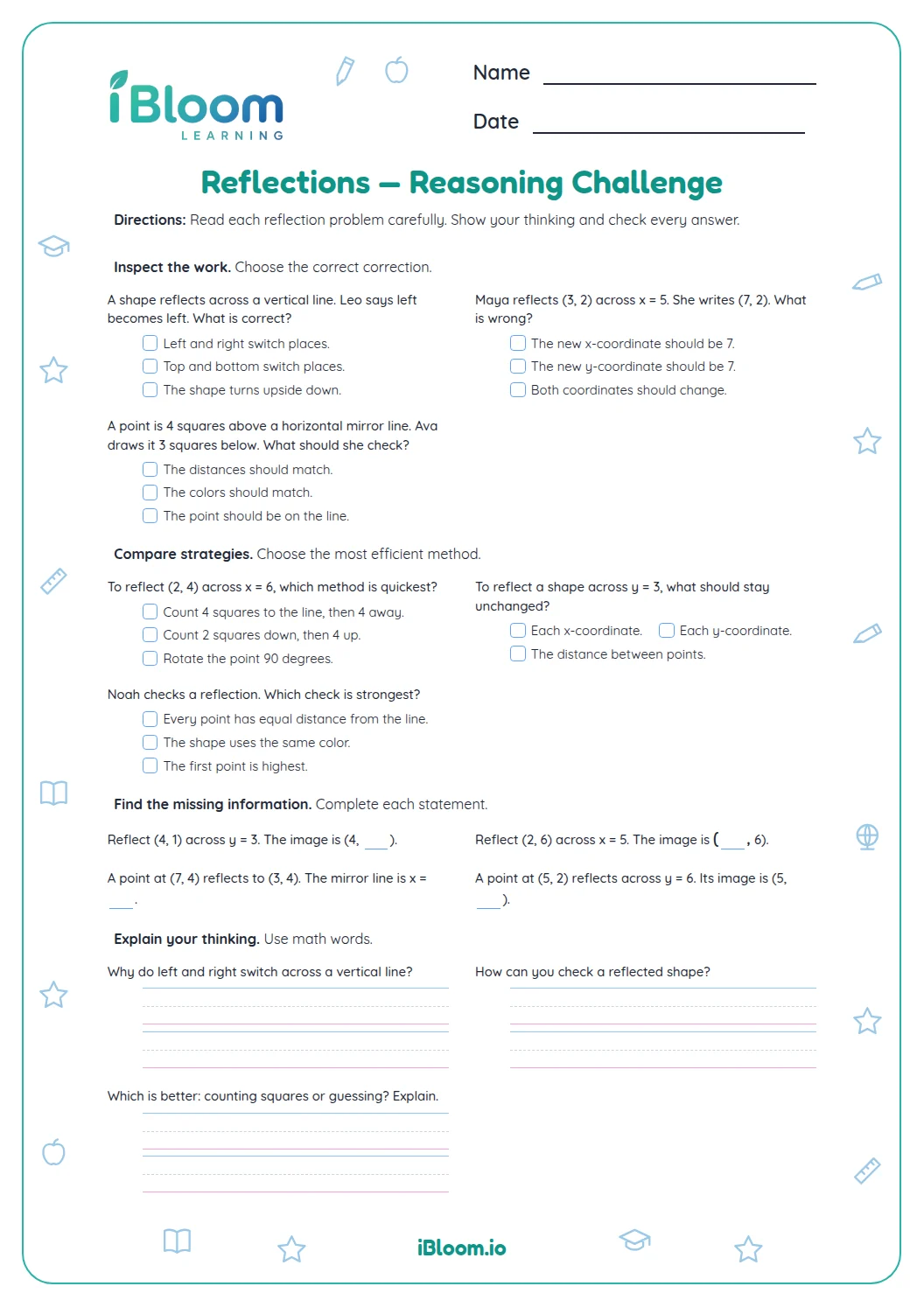
This free Grade 4 independent-practice sheet uses ordered pairs to describe reflections across the x-axis and y-axis. Students first choose reflected points, then write four image points. They next name the vertices of a reflected triangle and rectangle, and finish by explaining two reflection rules. The twelve tasks include negative coordinates and a point on an axis. The work practices Common Core 6.NS.C.6b through the relationship between coordinate signs and reflections. A separate answer key includes the ordered pairs and short model explanations.
Aligned to 6.NS.C.6b
How do the two axis rules differ?
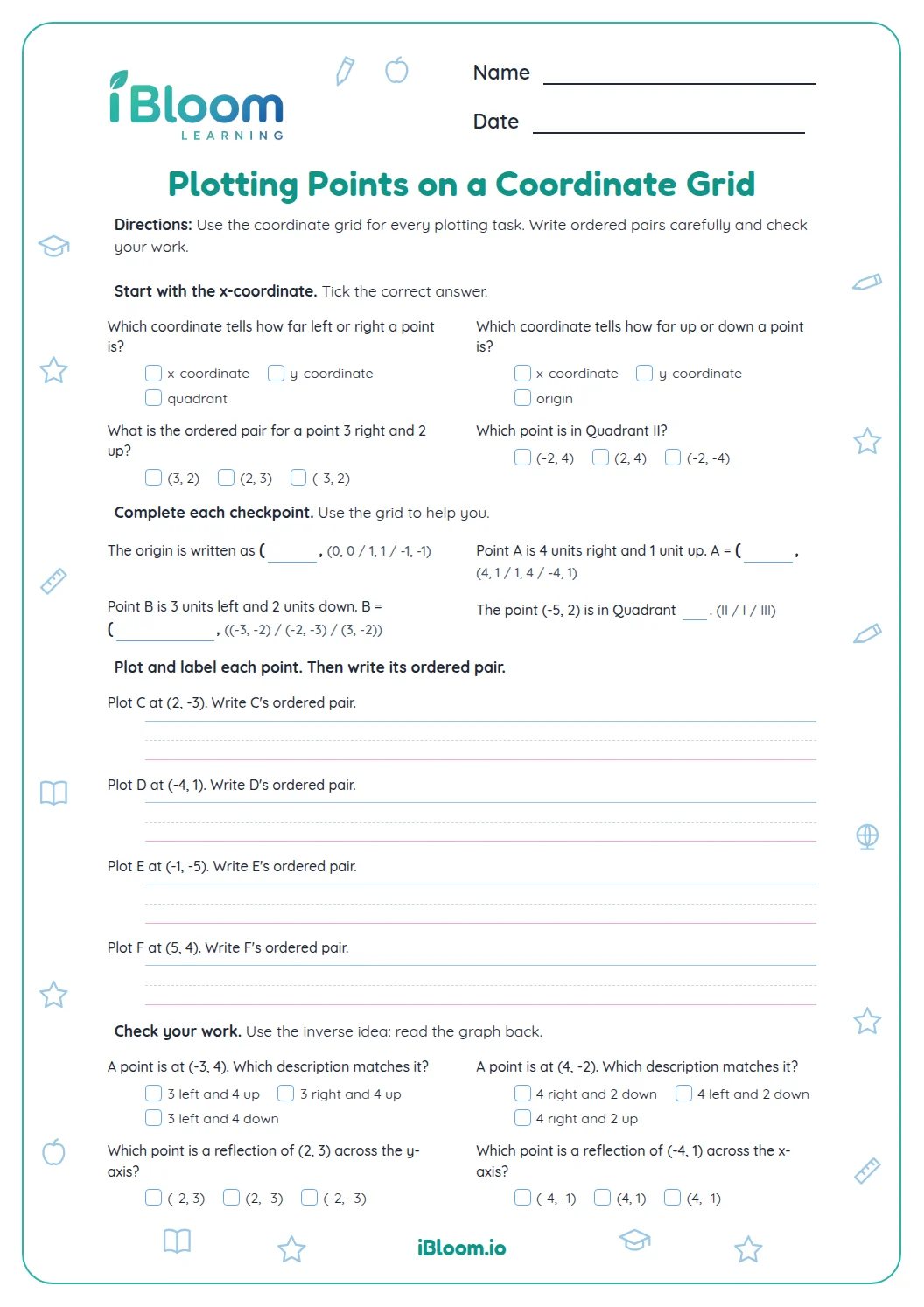
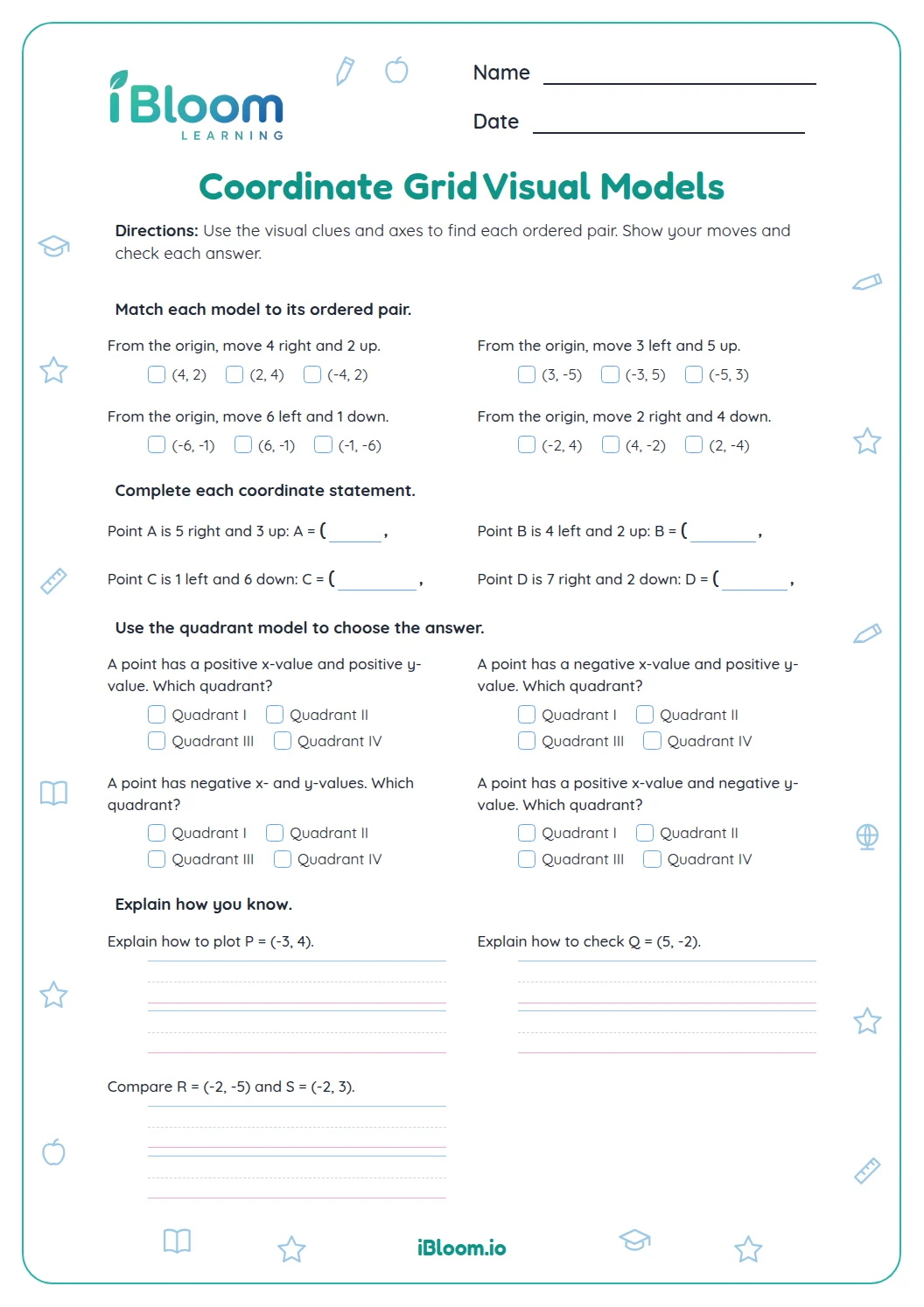
An ordered pair lists x first and y second. The x-coordinate gives the horizontal location; the y-coordinate gives the vertical location. Reflecting across the vertical y-axis reverses the horizontal location, so x changes sign.
Reflecting across the horizontal x-axis reverses the vertical location, so y changes sign. The other coordinate stays the same, and the point remains the same distance from the named axis.
- 1Start with (−7, −2). Reflect across the x-axis.
- 2Keep x = −7. Change y from −2 to 2.
- 3The image is (−7, 2), equally far above the x-axis.
How do students reflect a whole shape?
Apply the same rule separately to every vertex. In Part C, each shape is specified by a list of labeled coordinates. Students write the corresponding image points in the same order, keeping each label attached to its point.
For the triangle, P(1, 2) becomes P′(−1, 2). The same y-axis rule gives Q′(−4, 2) and R′(−4, 5). The prime mark names the reflected image of the original vertex.
What should students look for when checking?
Check the named axis first, then compare the two coordinates one at a time. A y-axis reflection keeps every y-coordinate; an x-axis reflection keeps every x-coordinate. Changing both signs does not follow either single-axis rule.
A point on the reflection axis stays where it is. In question 4, (3, 0) lies on the x-axis. Its y-coordinate remains zero when reflected, so its coordinates do not change.
How to use this worksheet
- 1Read the named axis before changing any signs.
- 2Identify the first coordinate as x and the second as y.
- 3Change x for a y-axis reflection, or y for an x-axis reflection.
- 4Write the full ordered pair and retain the unchanged coordinate.
- 5For each shape, apply the same rule to every labeled vertex in order.
- 6Use the final explanations to check whether the child can state why a coordinate stays fixed.
Mistakes to check
The mistake
Changing y because the prompt says y-axis.
The fix
Remember that the y-axis is vertical: reflecting across it changes horizontal position, or x.
The mistake
Changing both signs in a single-axis reflection.
The fix
Underline the coordinate that stays fixed before changing the other sign.
The mistake
Turning (3, 0) into a different point across the x-axis.
The fix
Zero is its own opposite; a point on the axis stays in place.
Common Core alignment
Use signs in ordered pairs to describe reflections across the x-axis and y-axis.
On this sheet: Students reflect ordered pairs across the axes and explain which coordinate changes sign.
Show the official wordingHide the official wording
Understand signs of numbers in ordered pairs as indicating locations in quadrants of the coordinate plane; recognize that when two ordered pairs differ only by signs, the locations of the points are related by reflections across one or both axes.
What to practice next
Make more practice
Further reading
Questions parents and teachers ask
What do students write for an image point?
Students write the complete ordered pair in parentheses, with x first and y second. For example, the reflection of (6, 2) across the y-axis is (−6, 2). Keeping both coordinates visible makes it possible to check the changed sign and the coordinate that stays fixed.
Why does the y-axis reflection change x?
The y-axis is a vertical line, so a reflection across it moves a point horizontally to the other side. Horizontal position is recorded by x. The point stays at the same height, so y stays the same. Question 1 changes (2, 1) to (−2, 1).
What happens to a point on the reflection axis?
A point on the axis stays fixed because its distance from that axis is zero. In question 4, (3, 0) lies on the x-axis. Reflecting it across the x-axis keeps x equal to 3, and the opposite of zero is still zero.
How should I check the triangle and rectangle answers?
Check each corresponding vertex separately using the axis named in the prompt. The triangle reflects across the y-axis, so all three x-coordinates change sign. The rectangle reflects across the x-axis, so all four y-coordinates change sign. Labels and the other coordinates should stay paired correctly.
Do the explanations have to match the key exactly?
No, a correct explanation may use different words. It should identify the named axis, state which coordinate changes sign, and preserve the other coordinate. For Mia’s error in question 12, the corrected point must be (2, 4), with y kept equal to 4.