
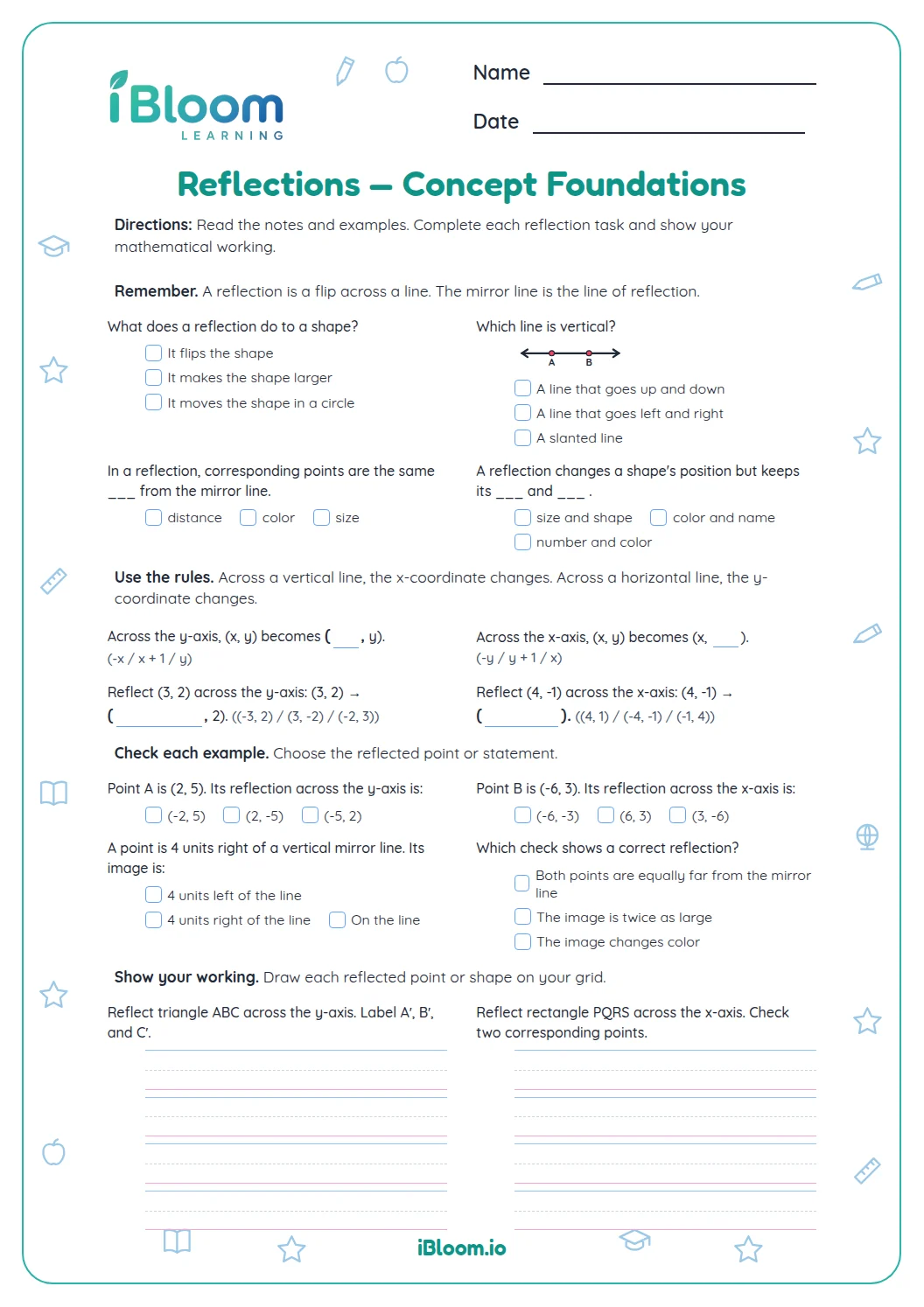
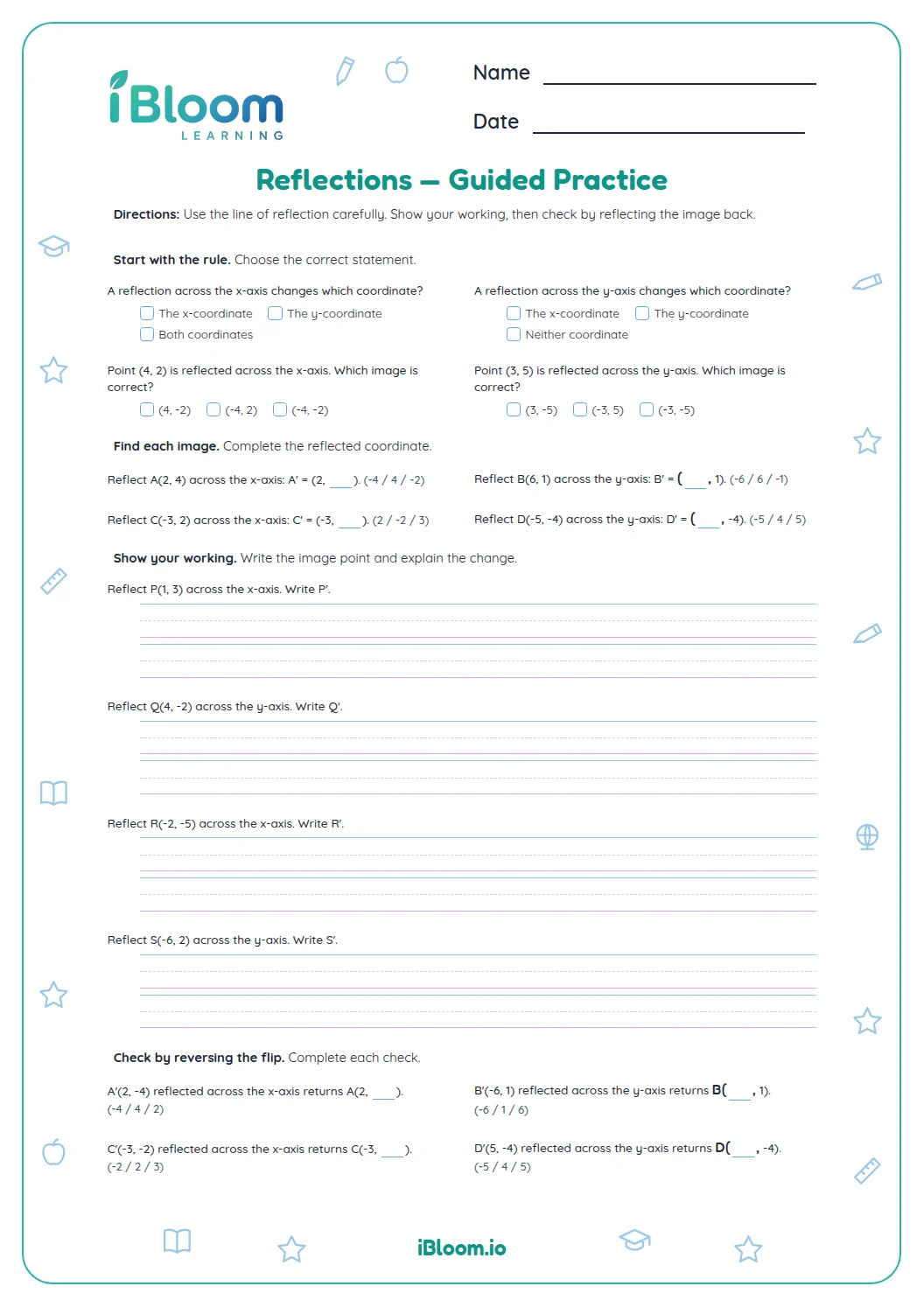
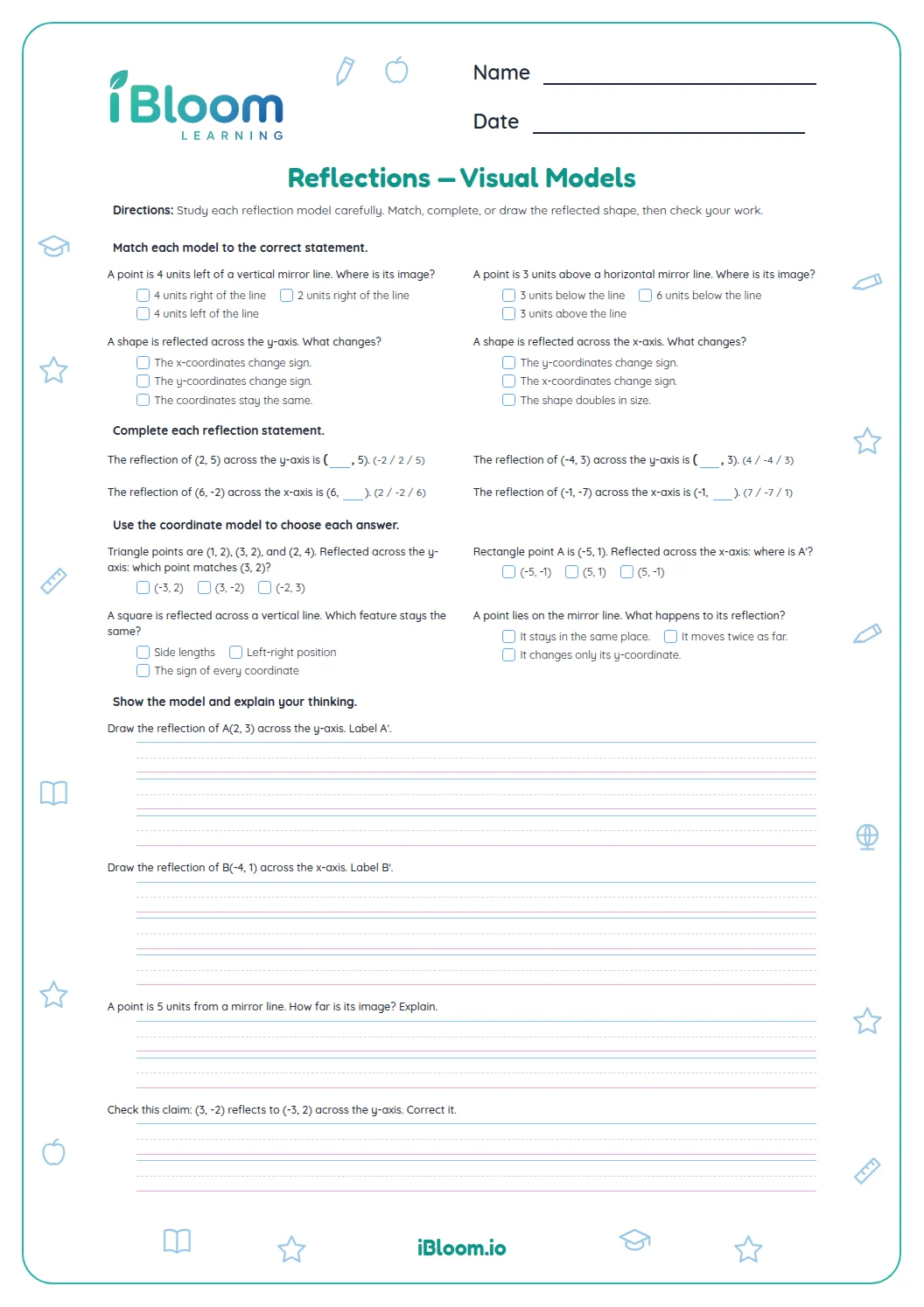
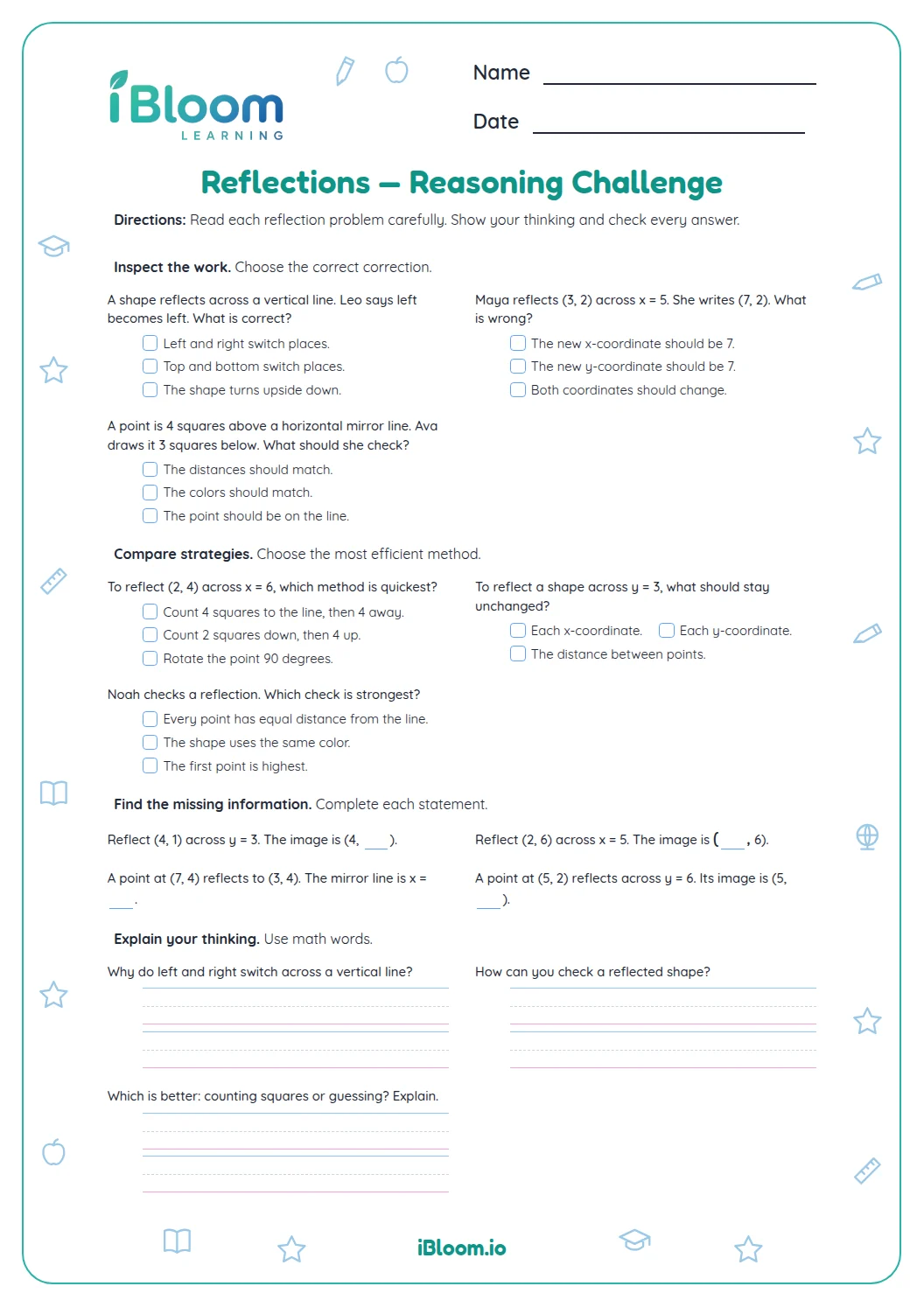
About this worksheet
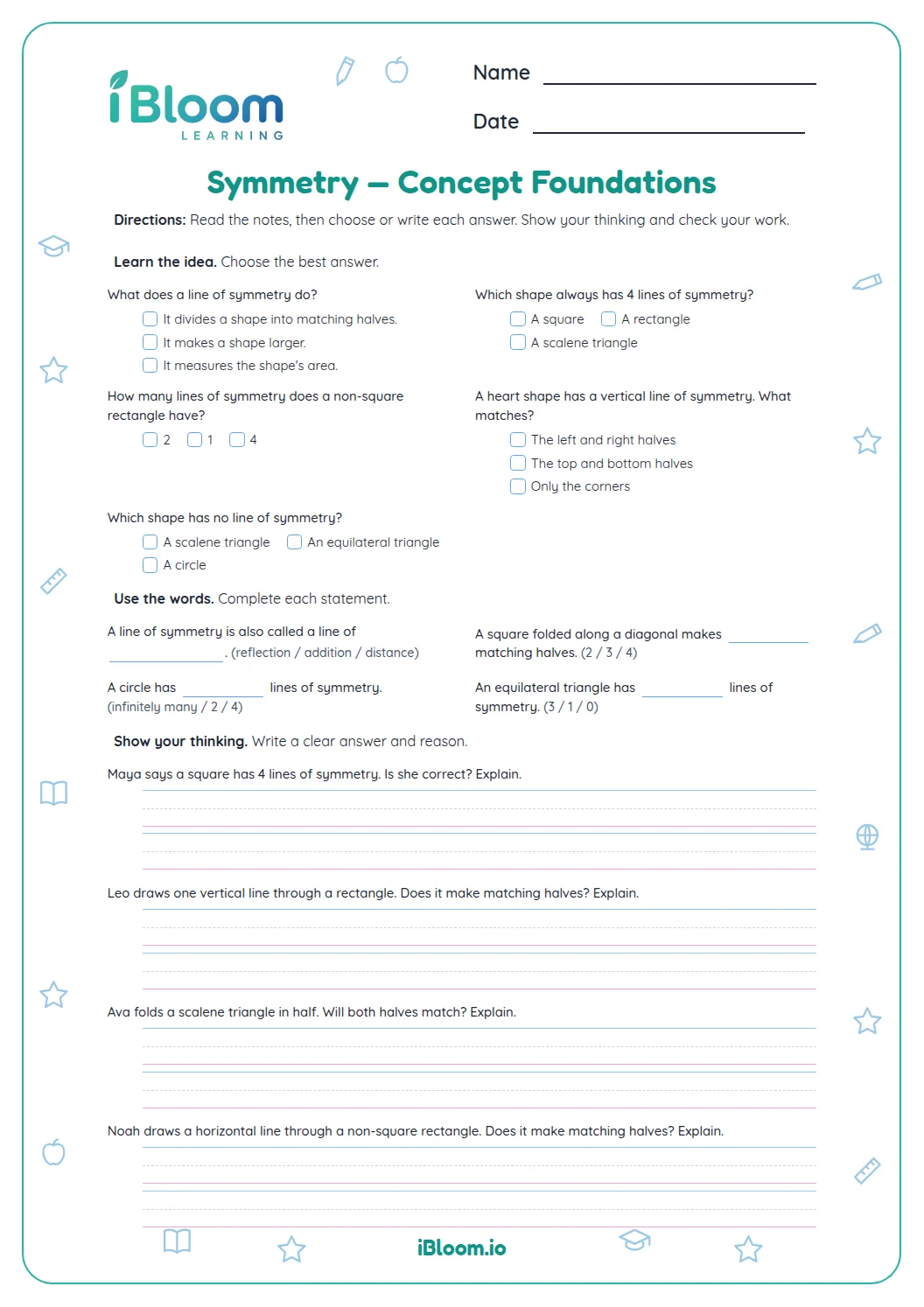
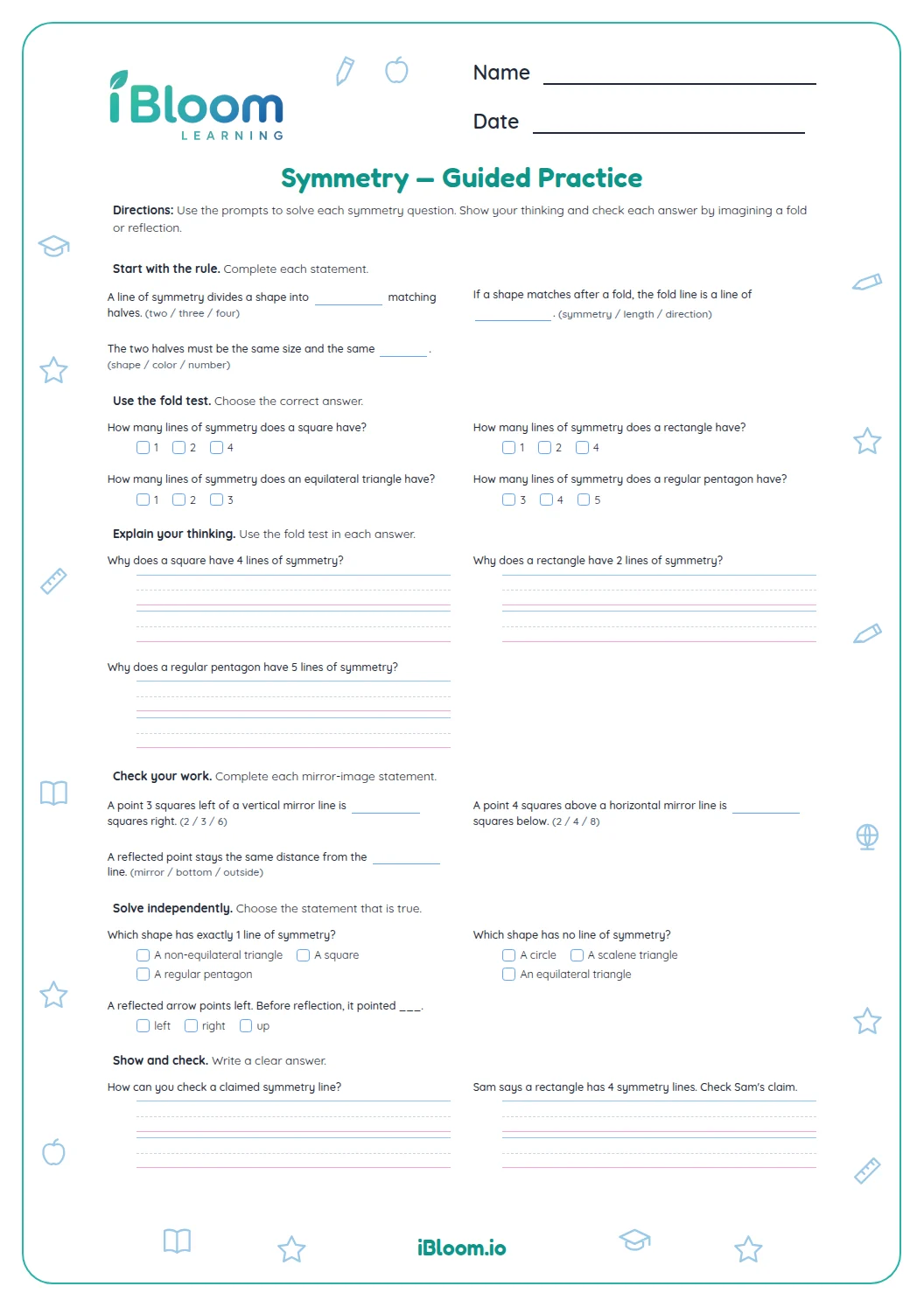
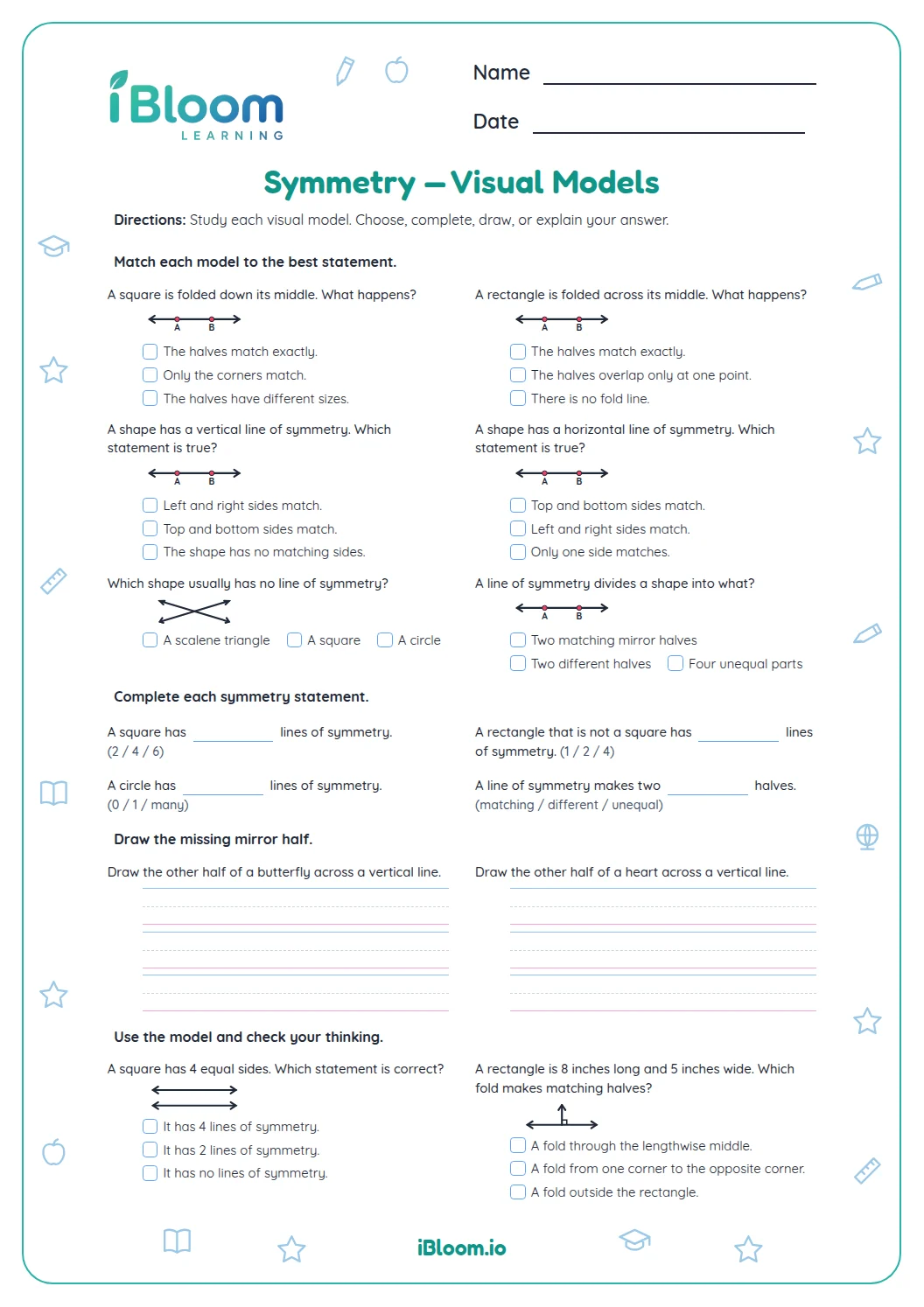
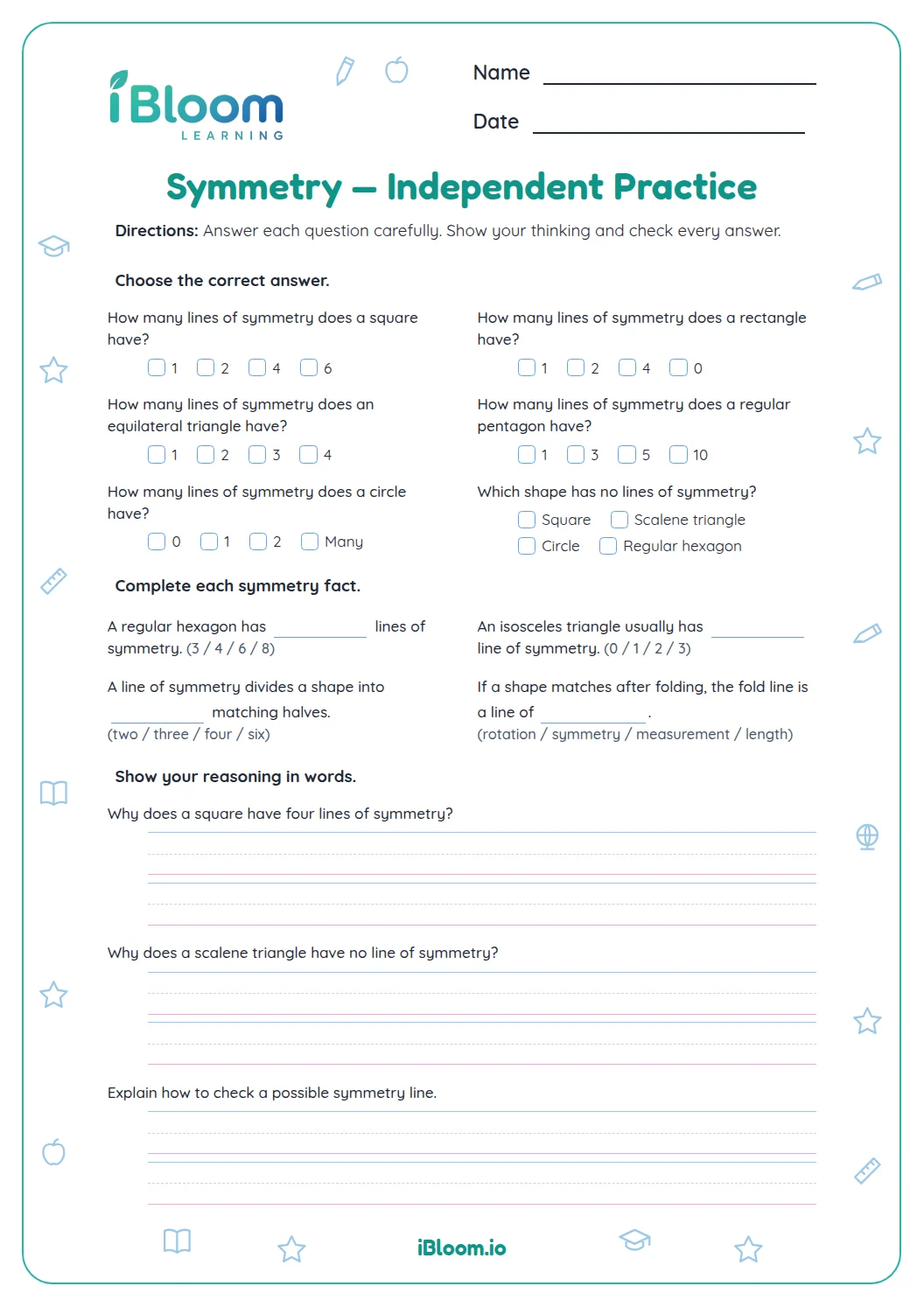
This free printable Grade 4 worksheet uses mirrors, folded cards and matching designs to explore reflections. Part A has four choices about size, useful information, a reflected dot and a card fold. Part B has six real-world calculation problems, including mirror distances and a border on a mirror. Part C reflects three design points across coordinate axes. Part D asks children to draw a symmetry line on three polygon outlines. These drawing activities practice Common Core 4.G.A.3. The 14 questions come with a separate answer key showing choices, distances, coordinates and sample fold-line descriptions.
Aligned to 4.G.A.3
What real situations are on this sheet?
Children think about a reflected logo, a person facing a mirror, a folded card, marks, stickers and stars in matching halves. The mirror-border problem asks for the uncovered width after both side borders are counted.
Part C uses ordered pairs for design points. Part D provides square, rectangle and kite outlines, with space to mark a reflection line directly on each shape.
How do we calculate a mirror distance?
A point and its reflection are the same perpendicular distance from the mirror line, on opposite sides. Add those equal distances to find the distance between them. If the full distance is given, divide it by two to find the distance to the line.
- 1The mark is 3 cm from the fold.
- 2Its reflected mark is 3 cm away on the other side.
- 3Distance between the marks: 3 + 3 = 6 cm.
What changes when a design point crosses an axis?
Across the vertical y-axis, the horizontal coordinate changes sign while the vertical coordinate stays the same. Question 11 reflects (3, 2) to (−3, 2): three units right becomes three units left, at the same height.
Across the horizontal x-axis, the vertical coordinate changes sign. Question 13 reflects (2, −5) to (2, 5). Read each ordered pair as horizontal position first, then vertical position.
How do we check a line drawn on a shape?
Imagine folding along the line. Every edge and corner on one side should land on a matching edge or corner on the other side. Equal areas alone do not guarantee matching halves.
The square allows either diagonal or either line through opposite side midpoints. The rectangle allows the two lines through opposite side midpoints. The kite has one line through its top and bottom vertices. Children draw one line on each shape.
How to use this worksheet
- 1Read Part A and identify what a reflection keeps the same.
- 2For Part B, sketch each pair of reflected positions and mark equal distances from the mirror line.
- 3Work on separate paper, then fill each blank; count both borders in question 10.
- 4In Part C, change the sign of the coordinate perpendicular to the named axis.
- 5Draw one line of symmetry on each Part D outline, then compare answers with the key.
Mistakes to check and how to fix them
The mistake
Putting the reflected dot 4 cm from the fold.
The fix
Keep it 2 cm from the fold; 4 cm is the distance between the original dot and its image.
The mistake
Subtracting only one 3-foot border from the 8-foot mirror.
The fix
Both side borders take space: 8 − 3 − 3 = 2 feet remains.
The mistake
Changing both coordinates when reflecting across the y-axis.
The fix
Change only the horizontal coordinate: (3, 2) becomes (−3, 2). The height stays 2.
Common Core alignment
Use matching reflected halves to recognize and mark lines of symmetry.
On this sheet: The card-fold choice and three polygon activities identify and draw matching fold lines.
Show the official wordingHide the official wording
Recognize a line of symmetry for a two-dimensional figure as a line across the figure such that the figure can be folded along the line into matching parts. Identify line-symmetric figures and draw lines of symmetry.
What to practice next
Make more practice
Further reading
Questions parents and teachers ask
How are reflection and symmetry connected here?
A line of symmetry reflects a shape onto itself, making matching halves. The card-fold question and Part D use that idea. The distance questions place matching points or objects on opposite sides of a mirror line, with equal distances from the line and unchanged size.
How far apart are the mark and its reflection?
They are 6 cm apart. Question 5 places each mark 3 cm from the fold on opposite sides. Add 3 cm and 3 cm to find the full distance. Question 6 reverses that reasoning: matching sticker centers 10 cm apart are each 5 cm from the fold.
How do the coordinate questions work?
Across the y-axis, change the sign of the first coordinate and keep the second coordinate. Across the x-axis, keep the first coordinate and change the sign of the second. For example, question 13 changes (2, −5) to (2, 5), placing the point above the horizontal axis.
Can children draw different correct lines in Part D?
Yes, the square and rectangle each allow more than one correct line. Children draw only one line per outline. Accept a line if folding along it would make all edges and corners match. The kite has one symmetry line joining its top and bottom vertices.
What does the answer key provide?
The key marks the planning and coordinate choices, gives the six calculation answers with units, and describes suitable lines on the three shapes. Use the descriptions to check the drawn lines. Other symmetry lines are valid for the square and rectangle, so compare the matching halves when checking.