



About this worksheet
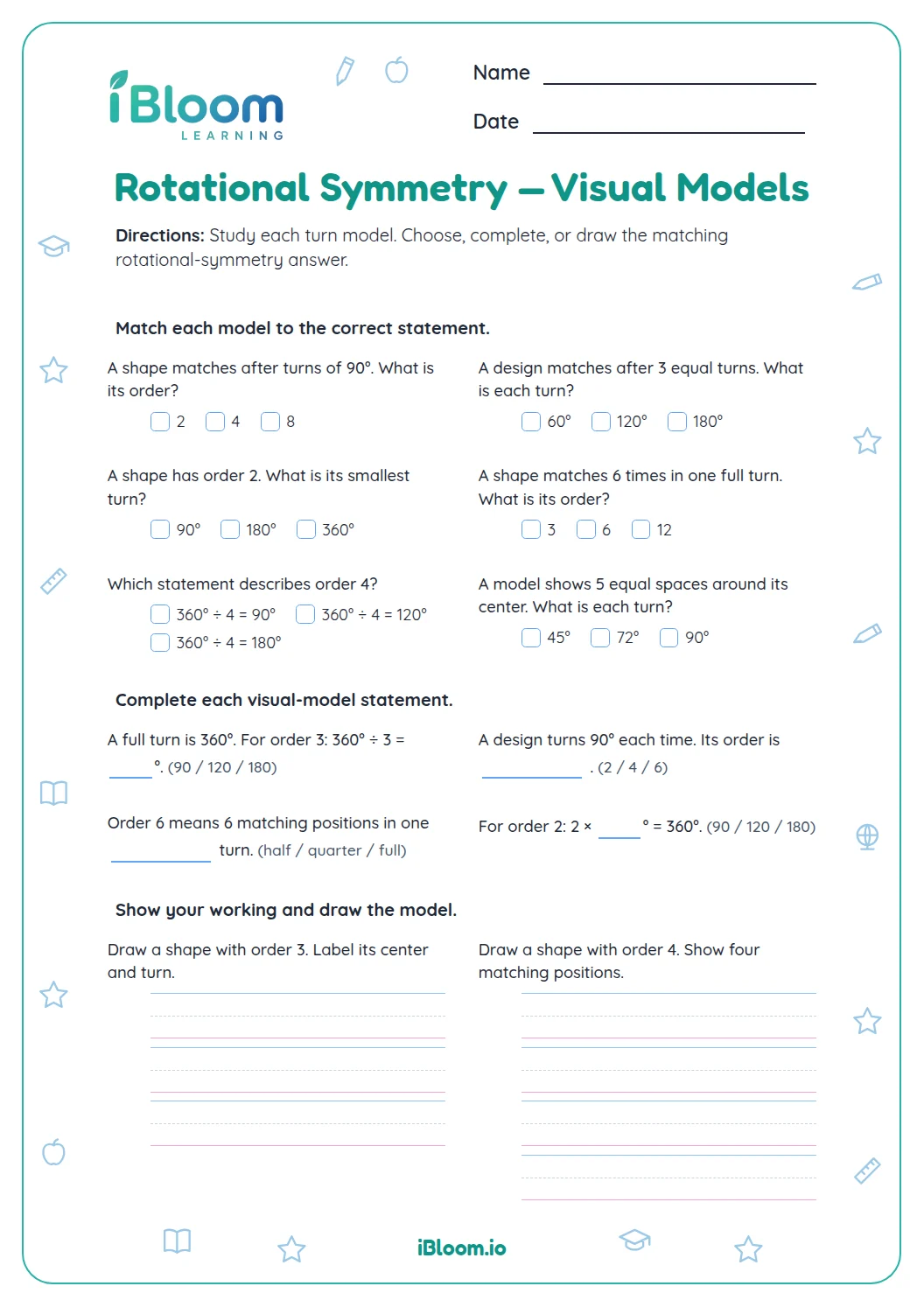
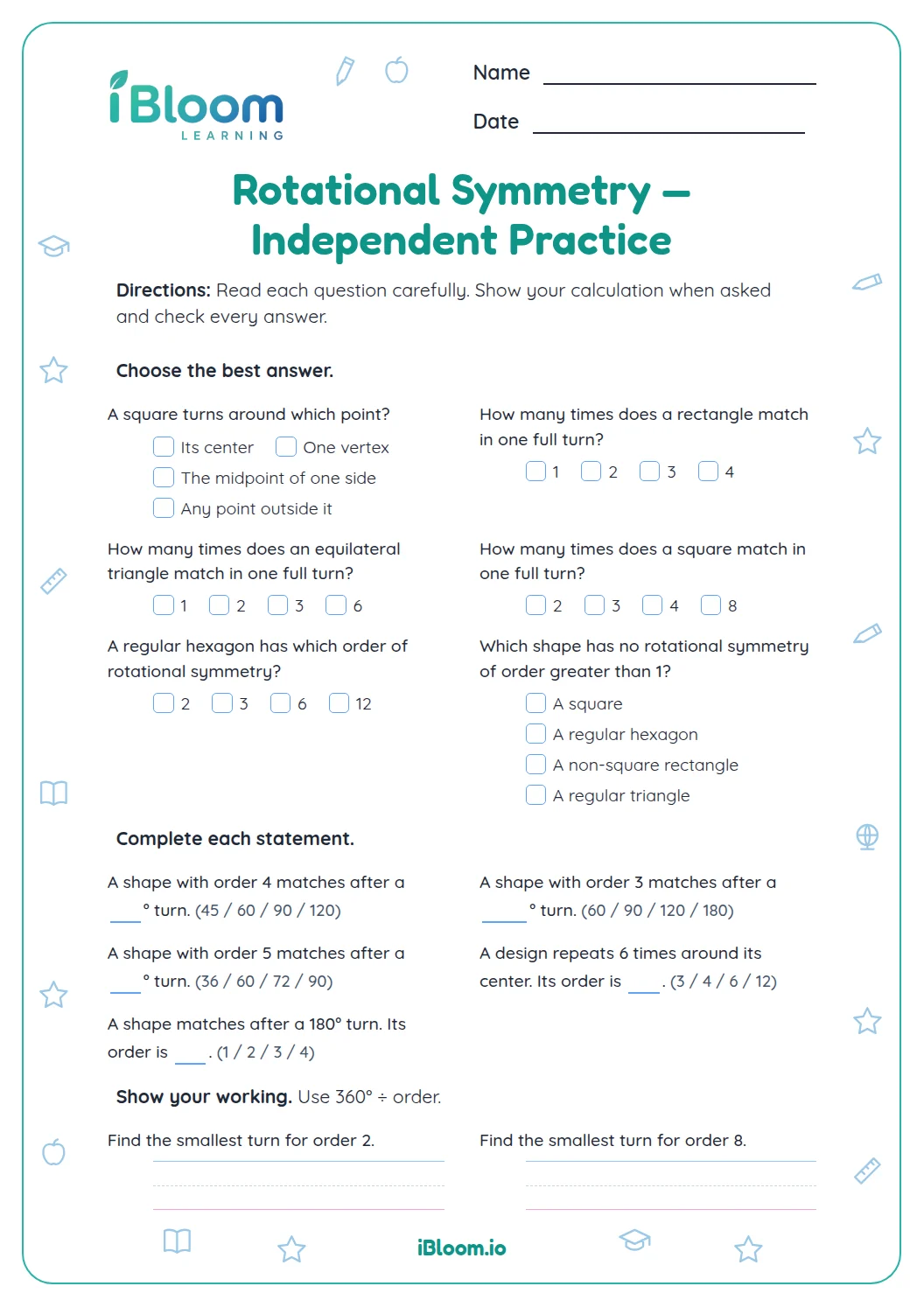
This Grade 4 geometry worksheet builds rotational symmetry through concrete shape examples and short calculations. Students identify the smallest turn for three shapes, state symmetry orders, and use 360° to connect order with turn size. The 16 questions are arranged in two parts with a separate answer key.
How do I find a shape’s smallest matching turn?
Find the first positive turn that returns a shape to its starting position. Part A uses three shape drawings and asks for each smallest matching turn; a square matches at 90°, while a rectangle matches at 180°.
- 1Question 1 shows a square. Its smallest matching turn is 90°.
What does the order of rotational symmetry count?
The order counts the matching positions during one full 360° turn. Part B asks for symmetry orders and uses those orders to calculate matching turn sizes. A regular triangle has order 3.
- 1Question 6 asks for a regular hexagon’s order: 6.
How are turn size and order connected?
Divide 360° by the order to find the smallest matching turn. A regular hexagon has order 6, and 360° ÷ 6 = 60°.
- 1Question 16: 360° ÷ 6 = 60°.
How to use this worksheet
- 1Use the three shape drawings in Part A to find each smallest matching turn.
- 2For each Part B shape, count matching positions in one full turn.
- 3Fill in the order for each shape.
- 4Use 360° ÷ order to find the matching turn size.
- 5Multiply the turn by the order to check your result.
Common mistakes and quick fixes
The mistake
Using a half-turn for every shape.
The fix
Check how many equal matching positions fit into the full 360° turn.
The mistake
Confusing the number of sides with symmetry order.
The fix
Count matching positions; an equilateral triangle has three, a square has four.
The mistake
Multiplying instead of dividing to find turn size.
The fix
Use 360° ÷ order, then multiply to verify.
What to practice next
Make more practice
Questions parents and teachers ask
How many questions are on this worksheet?
There are 16 questions across two parts. Part A asks for the smallest matching turn in three shape drawings and the order of a rhombus. Part B practices symmetry orders and turn calculations. The answer key lists the expected degree or order for each question.
What does order of rotational symmetry mean?
The order is the number of times a shape matches its starting position during one complete 360° rotation. A square has order 4 because it matches at 90°, 180°, 270°, and 360°. The worksheet asks students to name orders for common shapes.
How can a child calculate the smallest turn?
Divide 360° by the rotational order. For example, a regular hexagon has order 6, so 360° ÷ 6 = 60°. Multiplying the result by the order gives 360°, which is a useful check for the turn calculations in Part B.
Does a rectangle have rotational symmetry?
Yes. A rectangle maps onto itself after a half turn, or 180°, so its rotational order is 2. It does not match after a 90° turn unless it is a square. Question 2 uses a rectangle to make that distinction visible.
Can I use this worksheet with a ruler or protractor?
No tool is needed for the questions. The shapes are shown as visual references, and students use familiar facts about their turns and symmetry orders. A paper shape can be cut out and rotated as an optional hands-on demonstration before independent practice.