
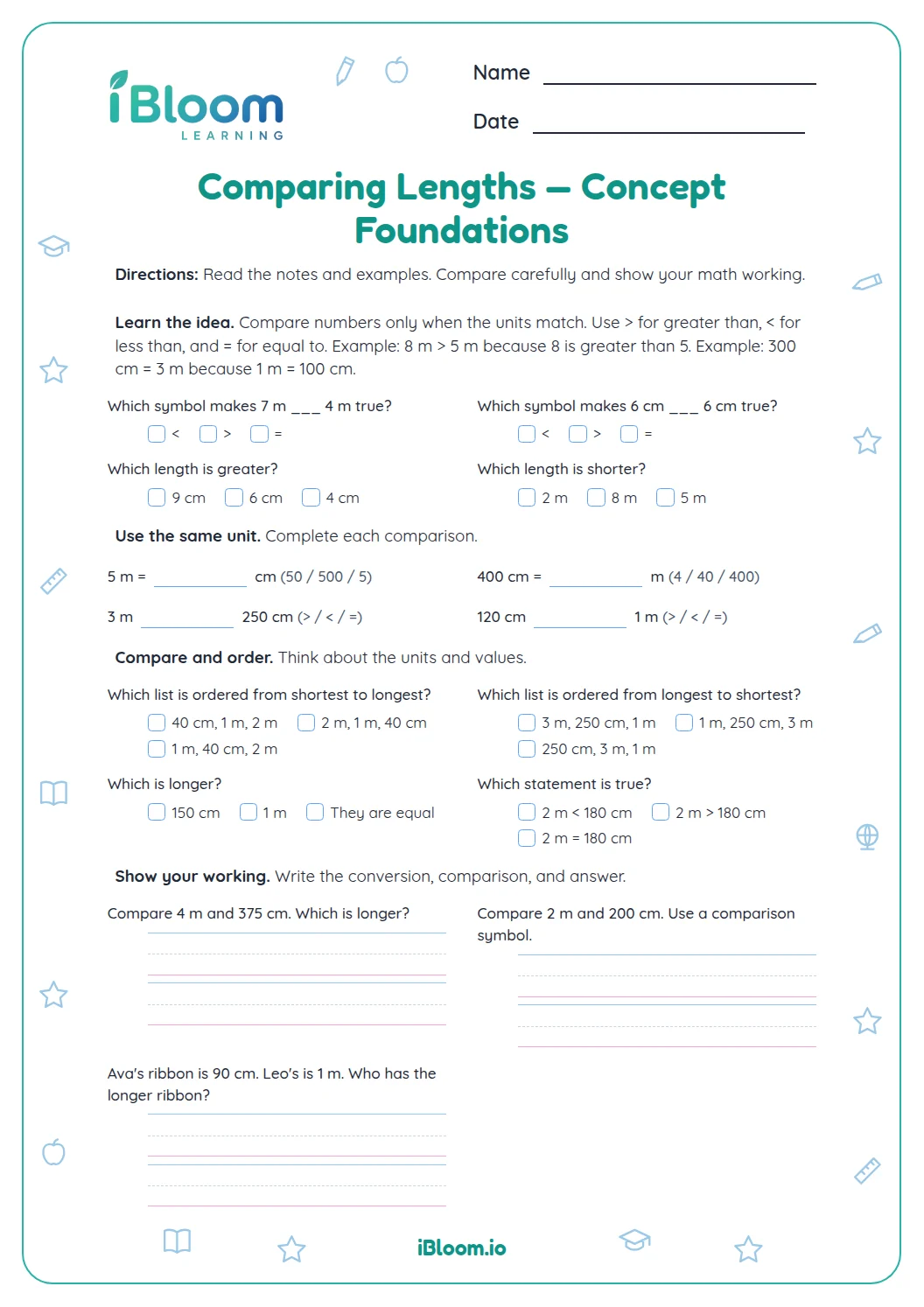

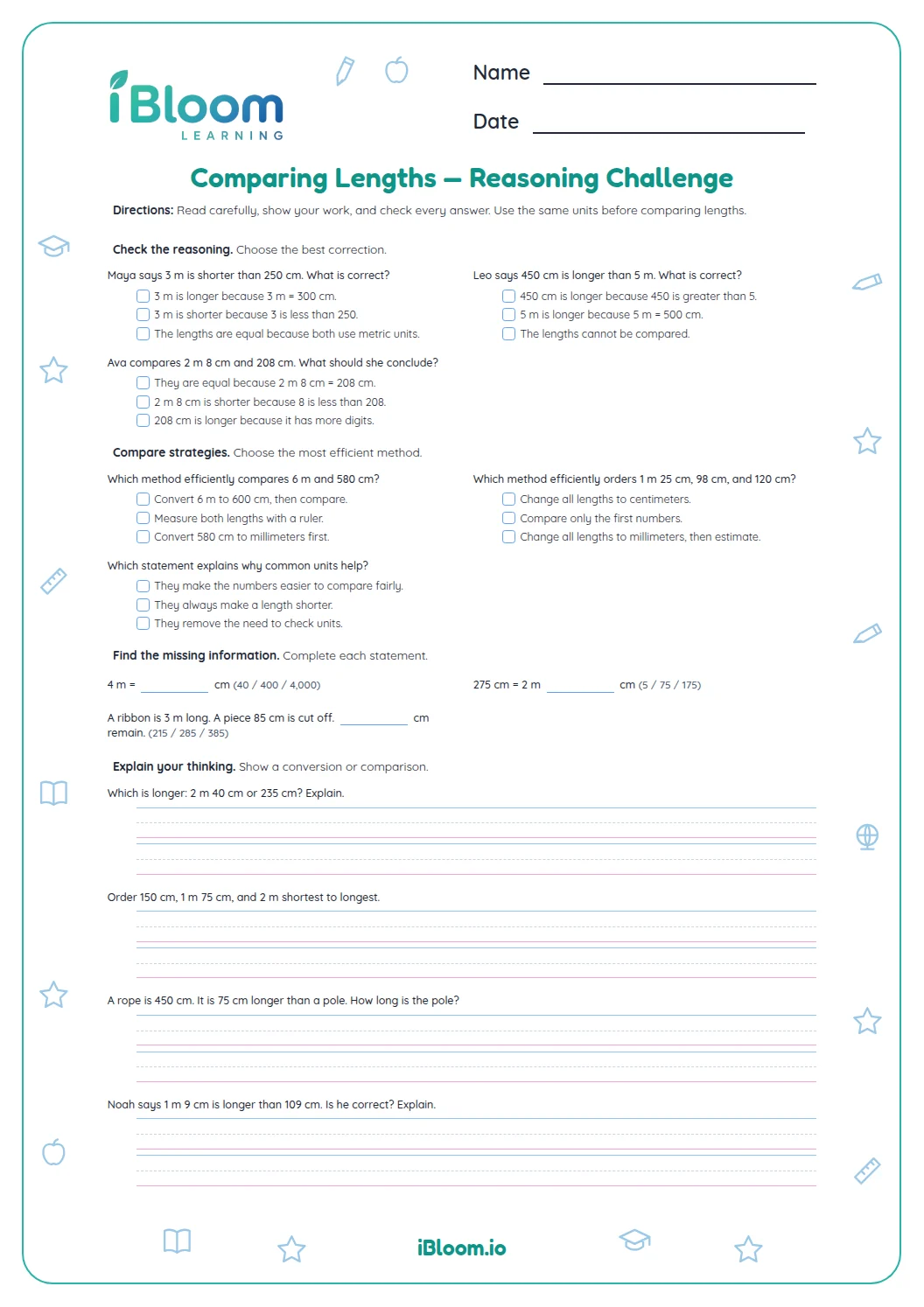
About this worksheet
All 16 questions compare mixed customary units, so students must convert before deciding. Values use feet, inches, and yards, with no nonstandard mixed-unit form.
Aligned to 4.MD.A.1
How do you compare mixed lengths?
Convert each length to inches. Use 12 inches in a foot and 36 inches in a yard, then compare the totals.
Can you compare a yard and feet?
For 1 yd 2 ft and 60 in, convert 1 yd 2 ft to 36 + 24 = 60 in. The lengths are equal.
What does the guided practice include?
All 16 comparisons use mixed units, so each item requires converting at least one length before comparing.
What if the units already match?
Compare the numbers directly when both measurements use the same unit. In question 1, 3 inches is less than 5 inches.
How do you compare feet and inches?
Use 12 inches in a foot. For question 5, 2 ft 8 in is 32 inches, while 3 ft 1 in is 37 inches. The second ribbon is longer.
- 12 ft 8 in = 32 in
- 23 ft 1 in = 37 in
- 337 in > 32 in
How can you find how much longer?
Convert first, then subtract the shorter length from the longer one. Keep the unit in the answer.
Common mistakes and quick fixes
The mistake
Check the operation or unit before answering.
The fix
Reread the prompt and keep the unit with the result.
The mistake
Skip a step in the process.
The fix
Write each step clearly before checking the answer.
The mistake
Use one detail to describe the whole task.
The fix
Check that your answer fits the full question.
Common Core alignment
This sheet practices the listed skill through its worksheet questions.
Convert lengths to a common unit and compare their sizes.
On this sheet: Grade 4
Show the official wordingHide the official wording
Know relative sizes of measurement units within one system of units including km, m, cm; kg, g; lb, oz; l, ml; hr, min, sec. Within a single system of measurement, express measurements in a larger unit in terms of a smaller unit.
What to practice next
Further reading
Questions parents and teachers ask
Which conversions are used on this worksheet?
Use 12 inches per foot and 36 inches per yard. Convert each measurement into inches, including mixed lengths such as feet and inches, before comparing the totals. The answer choices name the longer length or show when both amounts are equal.
How many questions are included?
There are 16 comparison questions across two worksheet pages, followed by a separate answer key. Every pair uses mixed customary units, so students practice converting instead of repeating simple same-unit comparisons. Students can use these conversions to explain why their selected measurement is greater.
Why convert before comparing lengths?
Numbers with different units cannot be compared directly. Rename each length in inches first, then compare the totals. For example, 3 feet becomes 36 inches, which can be compared fairly with a measurement already given in inches. Then check the chosen option against the two converted totals.
How can a student check a comparison?
Convert both measurements to inches and verify the arithmetic: multiply yards by 36, feet by 12, then add any extra inches. Check the two totals and select the longer amount. The key gives the correct choice for each item.