

About this worksheet
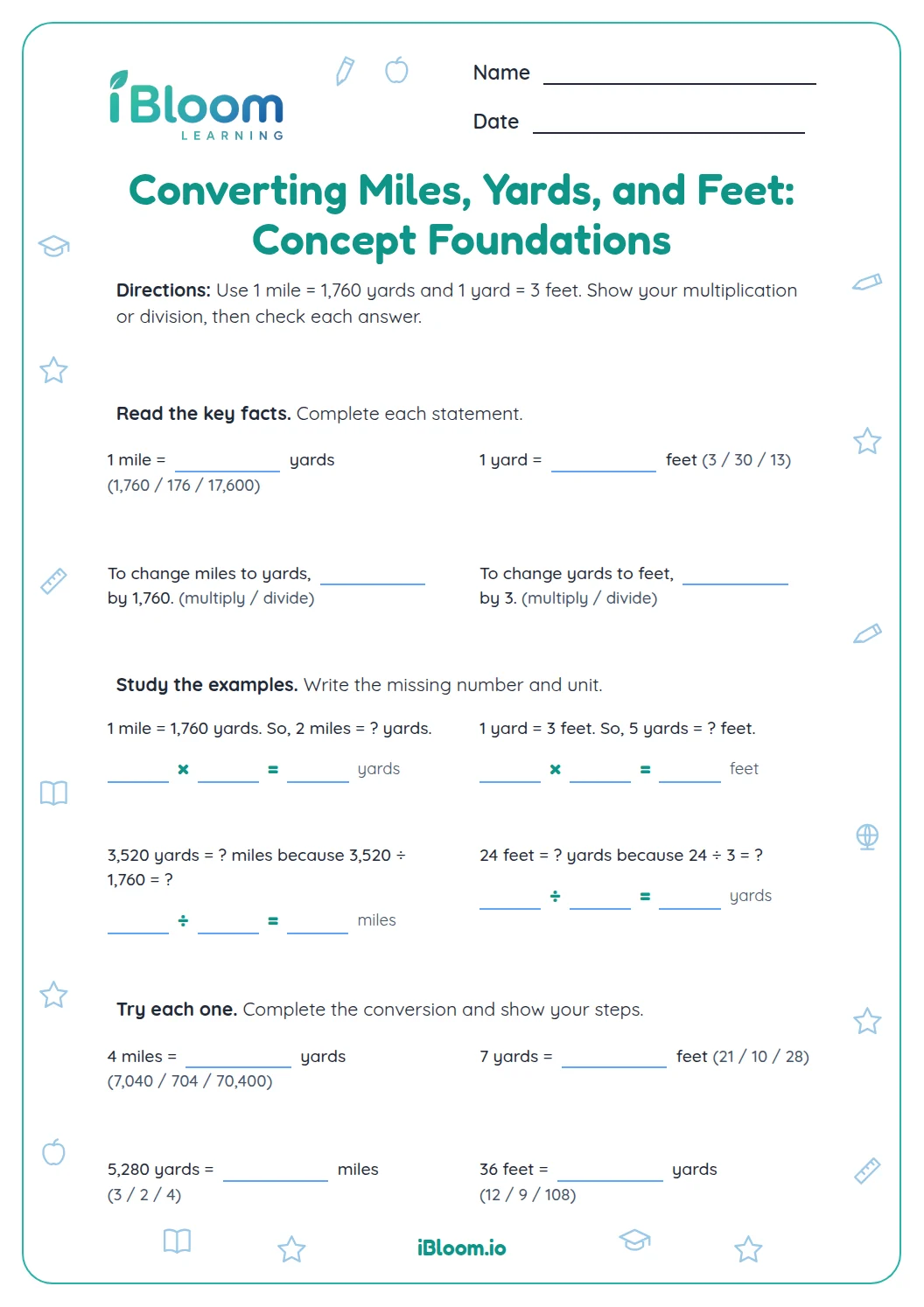
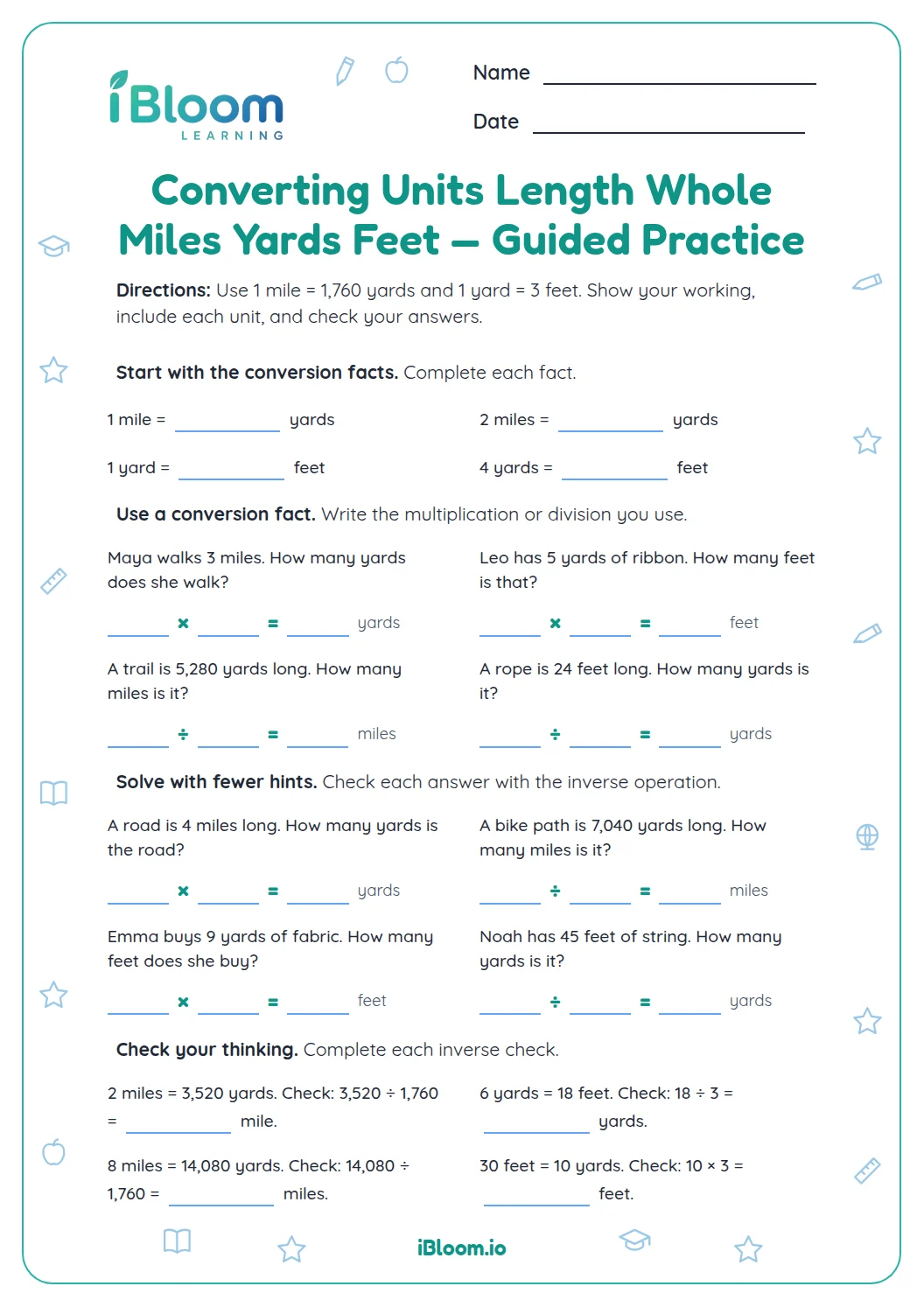
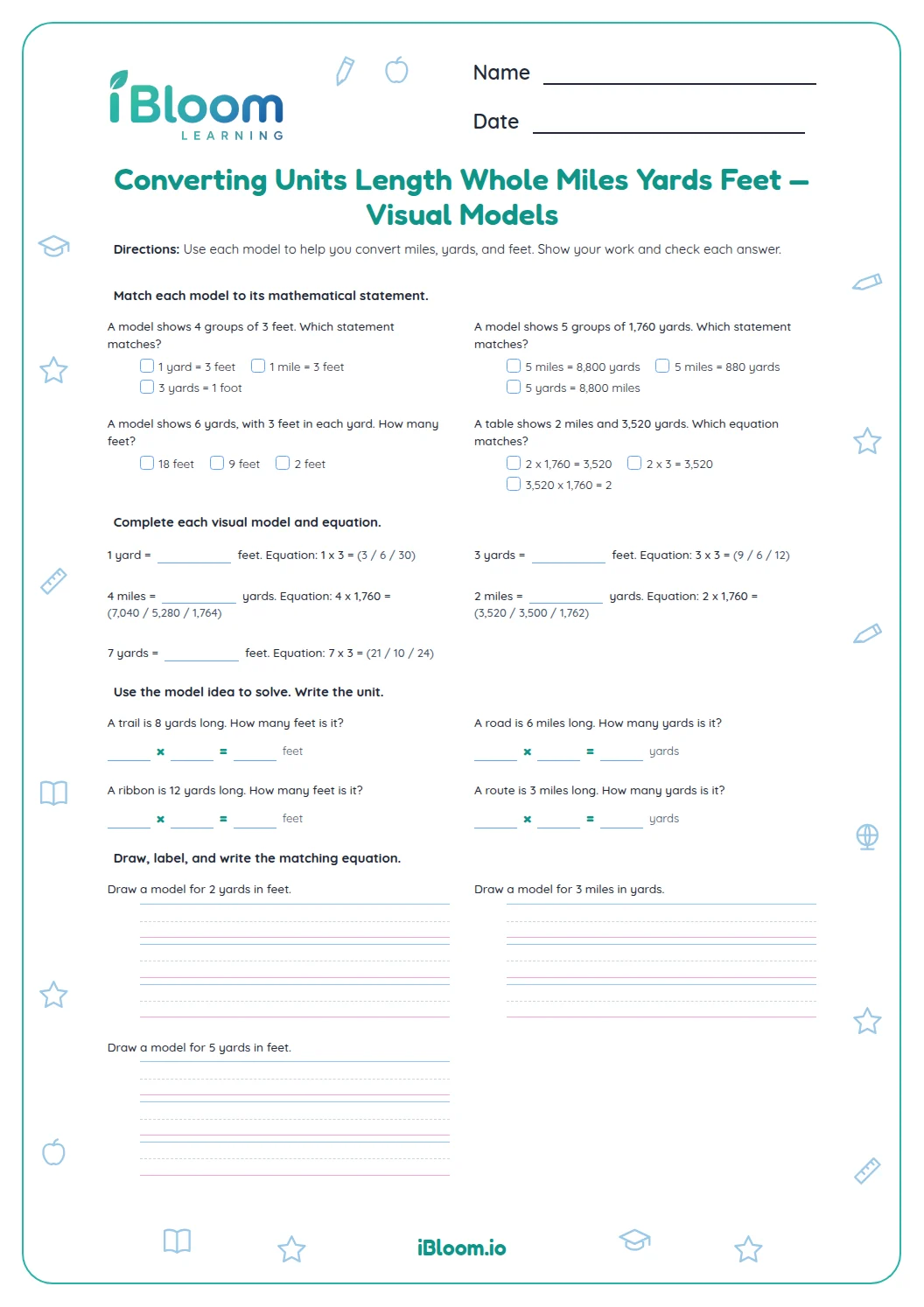
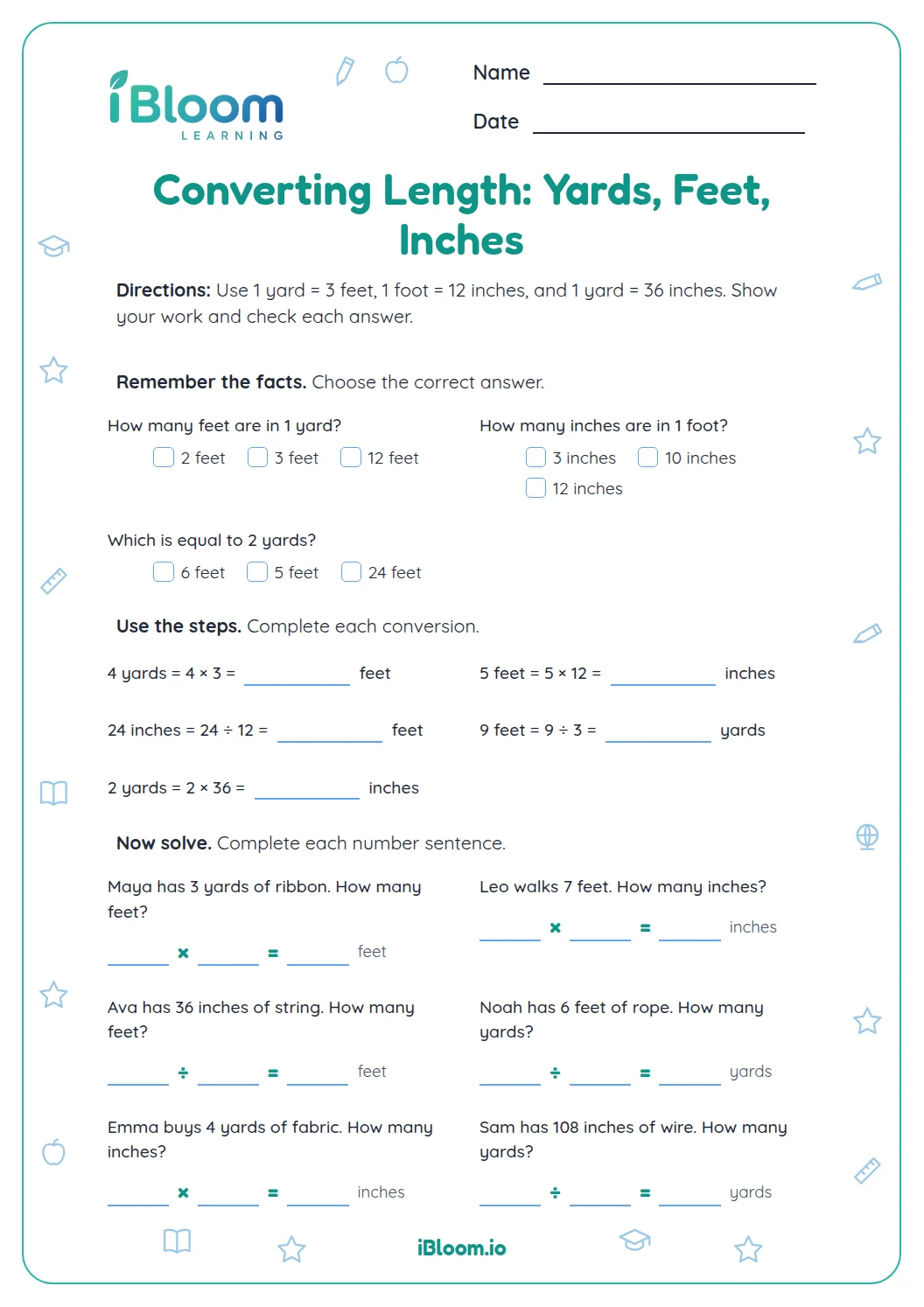
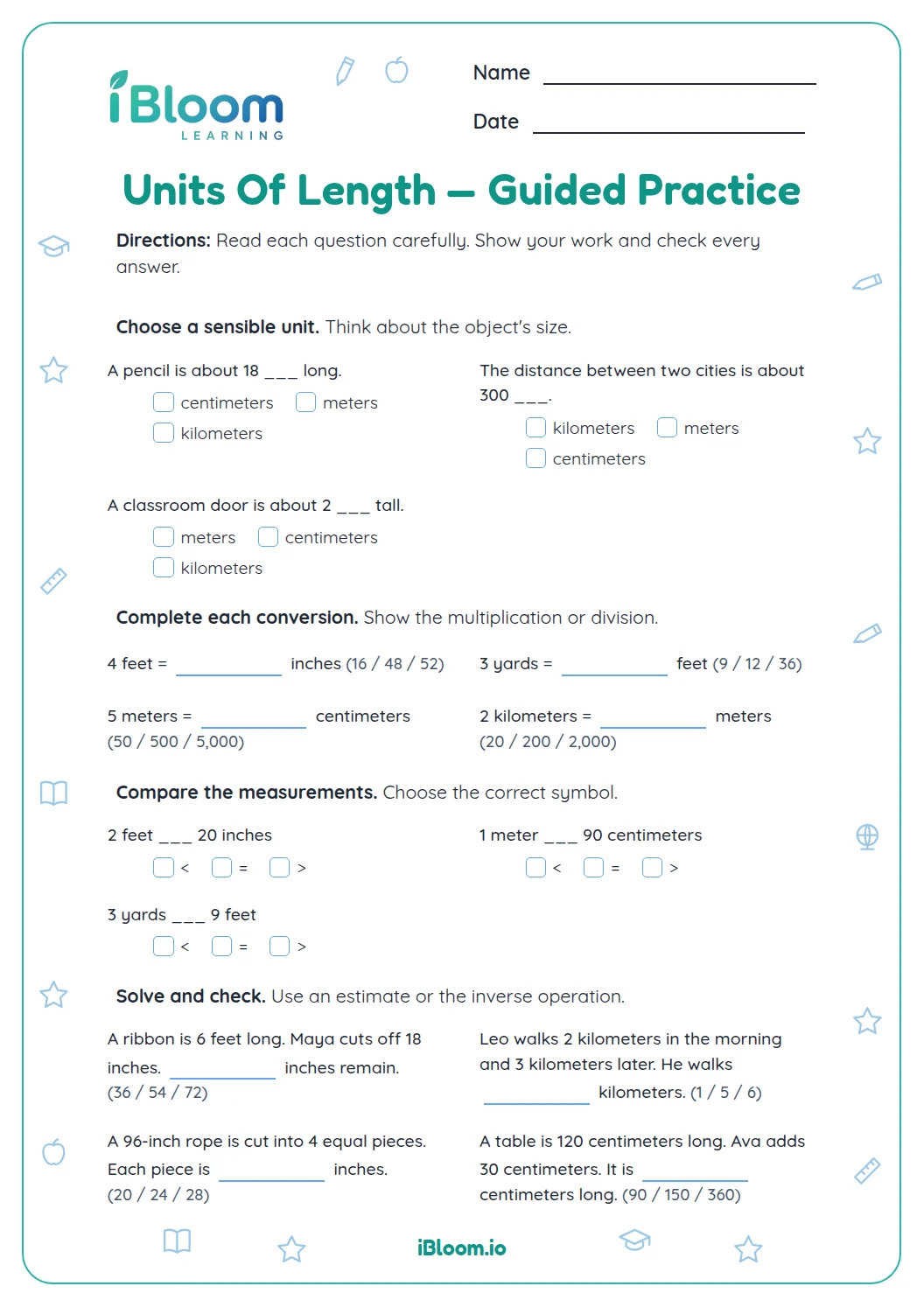
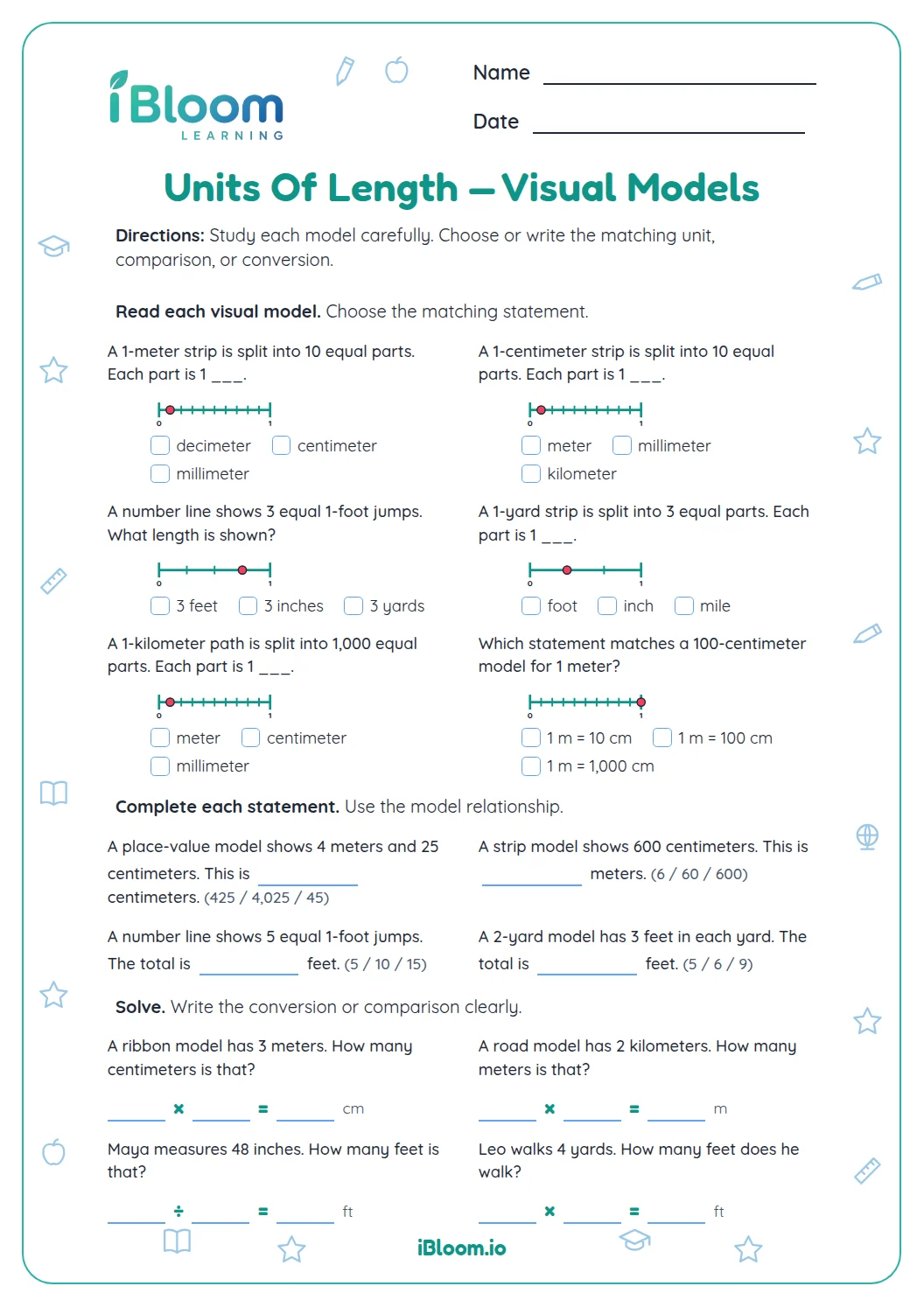
This Grade 4 worksheet builds reasoning with two customary length relationships: 1 mile equals 1,760 yards, and 1 yard equals 3 feet. Children first choose valid conversions, then fill in unit changes, solve word problems, and explain a comparison. The answer key includes units and sample reasoning so a child can check both the computation and the conversion fact used.
Aligned to 4.MD.A.1
Which facts connect these units?
One mile equals 1,760 yards. One yard equals 3 feet. To change miles to feet, children can convert miles to yards and then yards to feet; 1,760 × 3 = 5,280 feet in a mile.
How do you compare unlike units?
Convert one length so both measurements use the same unit. For example, 7 yards is 21 feet, which makes it possible to compare with 20 feet. Keep the unit beside each number so the comparison stays clear.
What reasoning appears on the sheet?
Parts A and B check conversion facts and straightforward unit changes. Part C applies them to routes and a rope comparison. In Part C, a short explanation should name the conversion fact or show an equation.
How to use this worksheet
- 1Write the two conversion facts at the top of your work area.
- 2Choose the valid conversion or comparison in Part A.
- 3Complete each one-step conversion in Part B.
- 4For each story in Part C, write an equation before adding the unit.
- 5Use a fact or calculation to support each explanation in Part C.
- 6Check the key and compare your units as well as your numbers.
Common mistakes and quick fixes
The mistake
Multiplying by 3 when converting miles to yards.
The fix
Use 1,760 yards per mile; the factor 3 converts yards to feet.
The mistake
Comparing 7 yards directly with 20 feet.
The fix
Convert 7 yards to 21 feet first, then compare.
The mistake
Dropping the unit in a multistep problem.
The fix
Write the unit after each conversion so the next step is clear.
Curriculum alignment
This worksheet practices 4.MD.A.1 by converting customary lengths with known unit relationships, then applying those conversions to comparisons and problems.
Convert customary measurements using known relationships among miles, yards, and feet.
On this sheet: Children convert customary lengths and use those conversions to compare and solve problems.
Show the official wordingHide the official wording
Know relative sizes of measurement units within one system of units including km, m, cm; kg, g; lb, oz.; l, ml; hr, min, sec. Within a single system of measurement, express measurements in a larger unit in terms of a smaller unit. Record measurement equivalents in a two-column table. For example, know that 1 ft is 12 times as long as 1 in. Express the length of a 4 ft snake as 48 in. Generate a conversion table for feet and inches listing the number pairs (1, 12), (2, 24), (3, 36), ...
What to practice next
Make more practice
Further reading
Questions parents and teachers ask
How many feet are in one mile?
One mile is 1,760 yards, and each yard is 3 feet. Therefore, 1 mile is 5,280 feet. A child can check by converting back: 5,280 feet divided by 3 gives 1,760 yards, which is one mile. This confirms both conversion steps.
What conversion facts does this sheet use?
It uses 1 mile = 1,760 yards and 1 yard = 3 feet. The first fact changes miles into yards; the second changes yards into feet. Keeping the stages separate helps children choose the right factor and unit.
How should a child compare yards and feet?
Change one measurement so both use the same unit. For example, convert yards to feet before comparing. After converting, 7 yards becomes 21 feet, which is greater than 20 feet. Comparing the same unit makes the decision clear without estimating.
What should an explanation include?
A short explanation should name a conversion fact or show a correct equation that supports the answer. For a multistep result, label the unit after each calculation so the next step is clear. The final answer should use the unit requested in the problem.
How many problems are on the worksheet?
There are 14 problems in three parts: conversion facts and comparisons, unit changes, and applied length problems. The answer key is separate and includes units for the story problems. Children can use it to check both the number and the unit.