
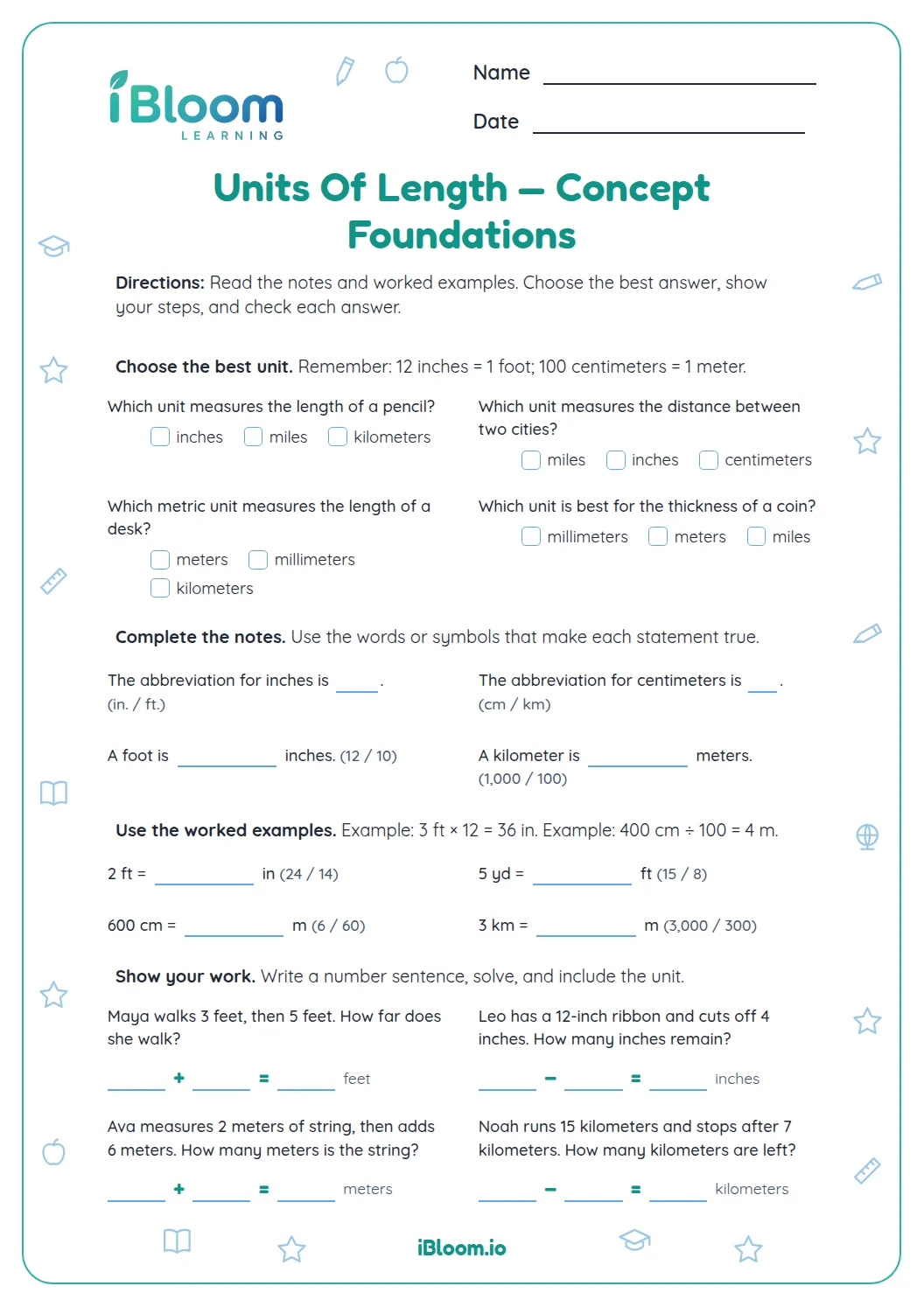
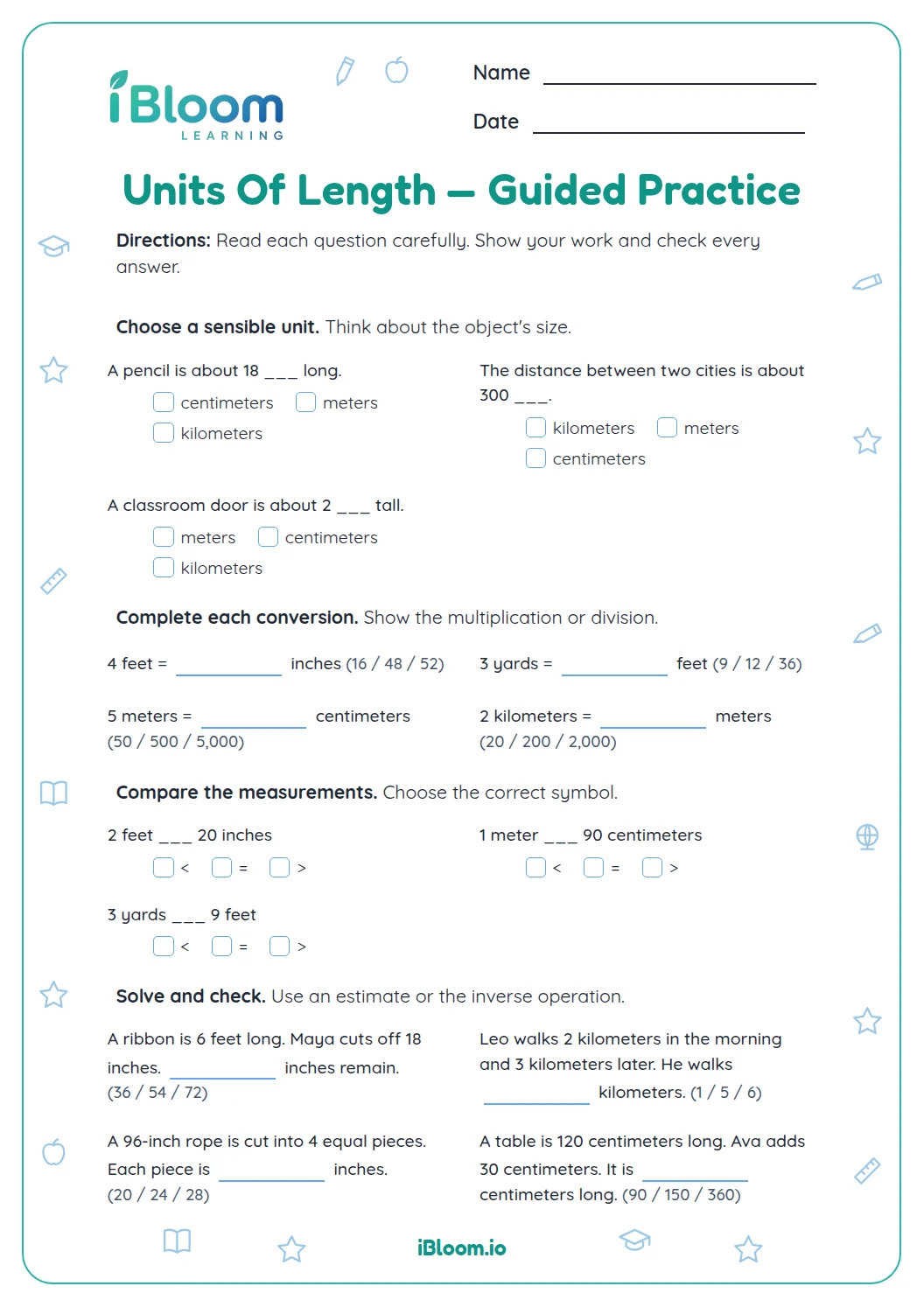
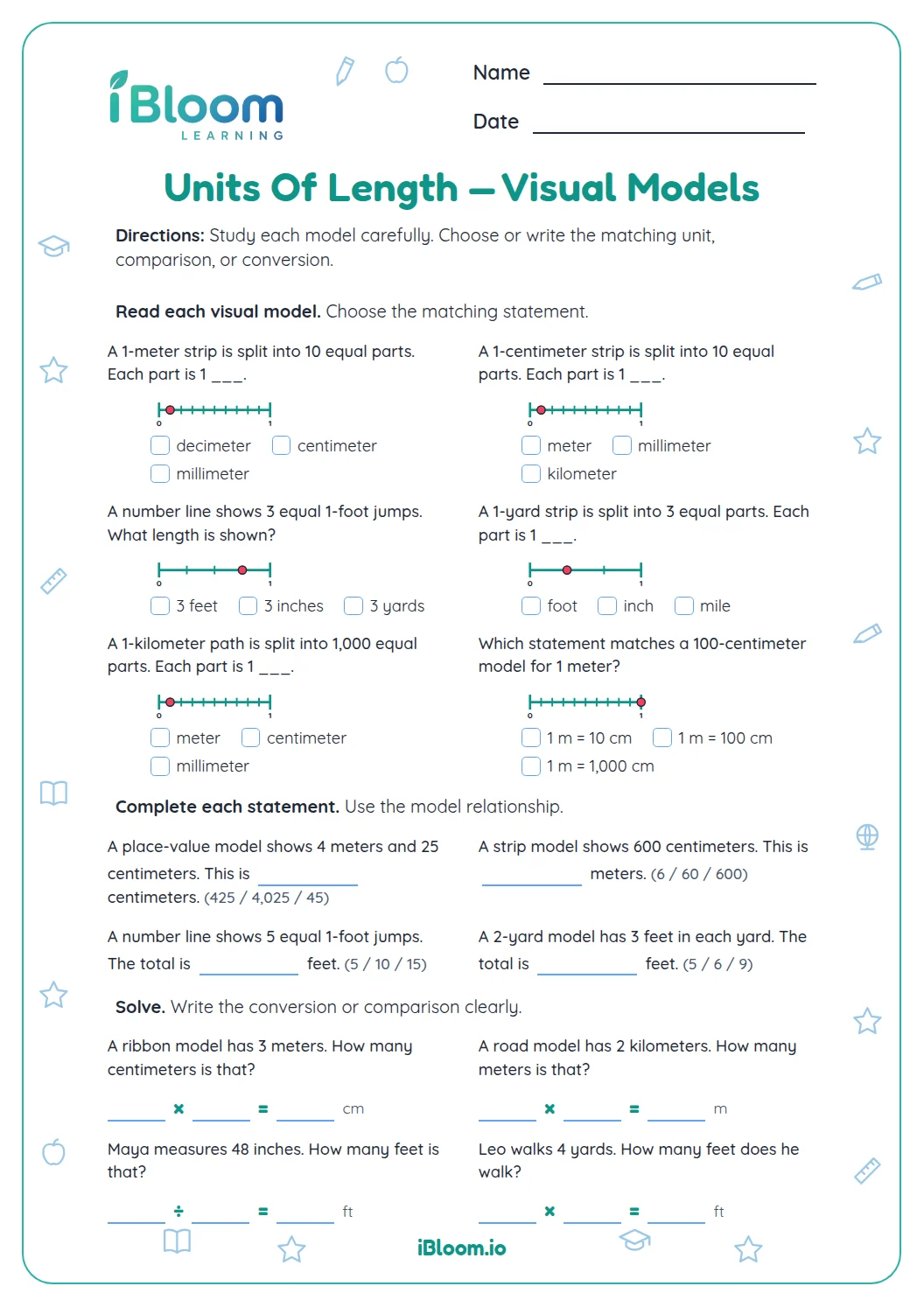
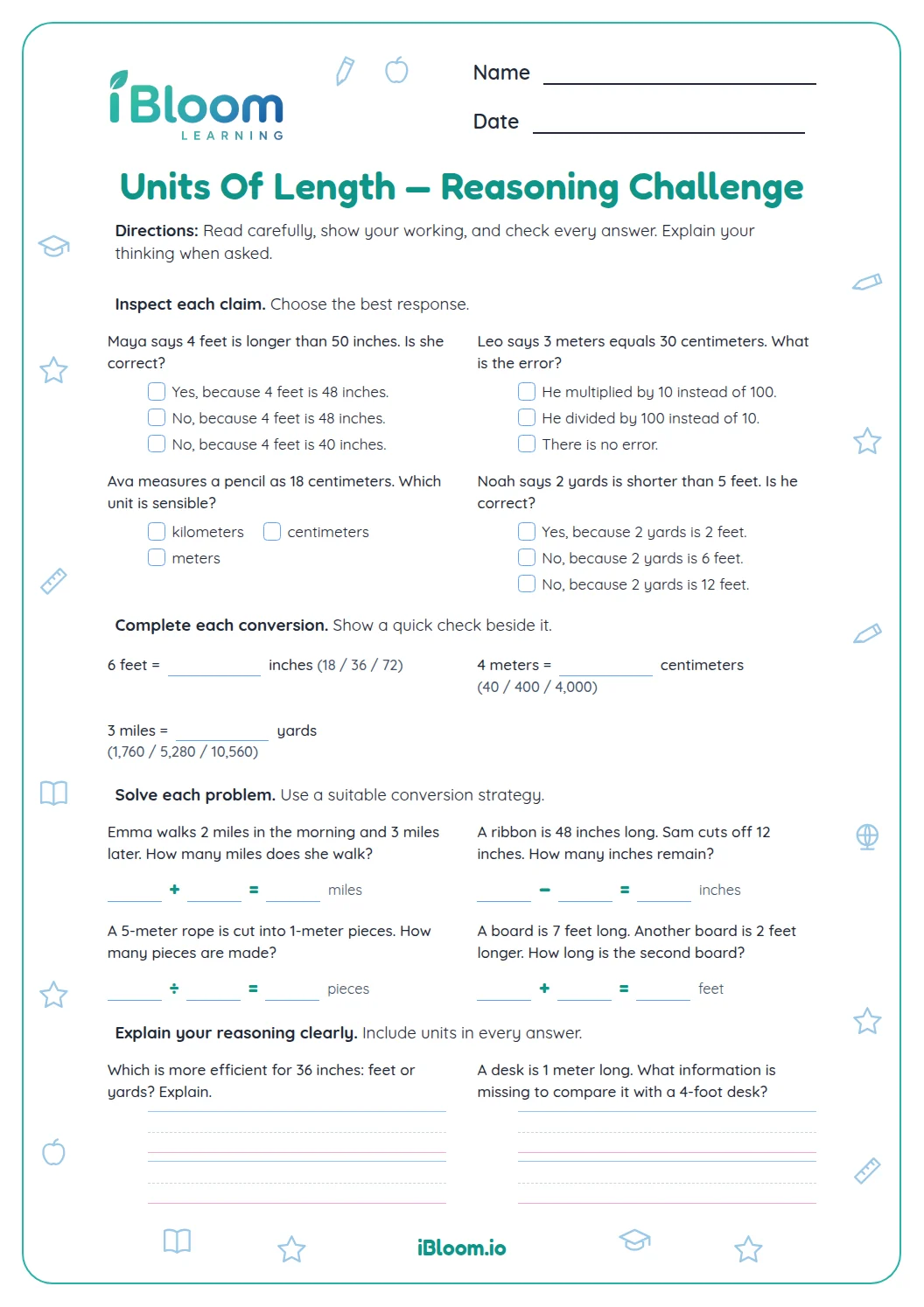
About this worksheet
This Grade 4 worksheet gives students 16 independent length-conversion problems using customary and metric units. It moves from single-unit conversions to mixed lengths, such as meters with centimeters, and includes a separate answer key. The problems practice multiplying or dividing by the relationship between larger and smaller units.
Aligned to 4.MD.A.1
How do you convert a length?
A larger unit contains a set number of smaller units. Since 1 foot = 12 inches, 3 feet = 3 × 12 = 36 inches.
- 13 ft = ___ in
- 23 × 12 = 36 in
Which unit relationships appear?
The sheet has 16 questions in 2 parts. Work in order and use the answer key to check each response.
How to use this worksheet
- 1Read the direction for each part before starting.
- 2Work from left to right and keep place values or units aligned.
- 3Use a known relationship to check each answer.
- 4Compare completed work with the answer key.
Common mistakes and quick fixes
The mistake
Skipping a place value or unit while working.
The fix
Name each place or unit before writing the answer.
The mistake
Changing the operation or relationship in the prompt.
The fix
Reread the symbols and check the result in the original question.
The mistake
Copying an answer without checking it.
The fix
Use the inverse operation or a second method to verify.
Common Core alignment
This page practices the stated Common Core skill.
Use conversion relationships among feet, inches, meters, and centimeters.
On this sheet: Use conversion relationships among feet, inches, meters, and centimeters.
Show the official wordingHide the official wording
Know relative sizes of measurement units within one system of units including km, m, cm; kg, g; lb, oz.; l, ml; hr, min, sec.
What to practice next
Make more practice
Further reading
Questions parents and teachers ask
What skill does this page help children practice?
This printable page gives focused practice with units of length. The questions are organized into parts, so children can build the skill in a clear sequence and check their completed work with the answer key. This focused practice also helps adults notice which steps feel secure and which ones need another example.
Does the worksheet include an answer key?
Yes. A separate answer key is included with the printable pages. Children can first solve each item independently, then compare their work with the key and return to any item that needs another attempt. The learner can mark a difficult item and return to it after reviewing the worked example.
How can an adult support the practice?
Read the directions together and ask the learner to explain one answer aloud. That brief check helps reveal whether the learner understands the place value, unit relationship, or writing choice behind the response. A brief explanation in the learner’s own words can make the strategy easier to remember next time.
Can I use this worksheet in a classroom?
Yes. It can support independent seatwork, a small group lesson, or review at home. The parts provide a natural stopping point if you prefer to split the practice across two sessions. Give the learner room to work at a steady pace and check each response before moving on.
How much time should I allow?
Allow about 20 minutes for the worksheet, with extra time for learners who show each step or revise their writing carefully. The answer key makes it easy to check the work afterward. Use the final review to celebrate careful reasoning and identify one useful next practice step.