


About this worksheet
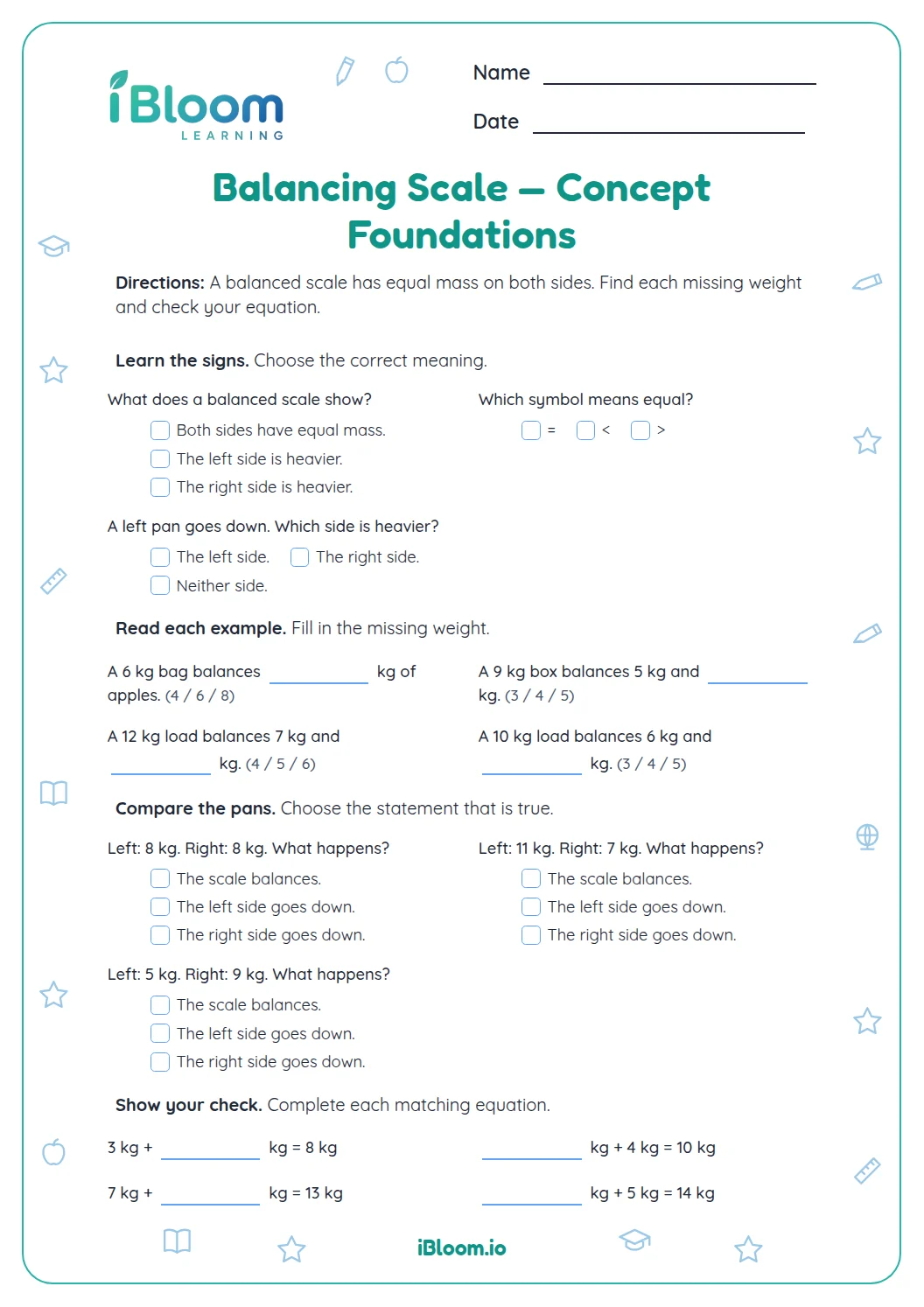
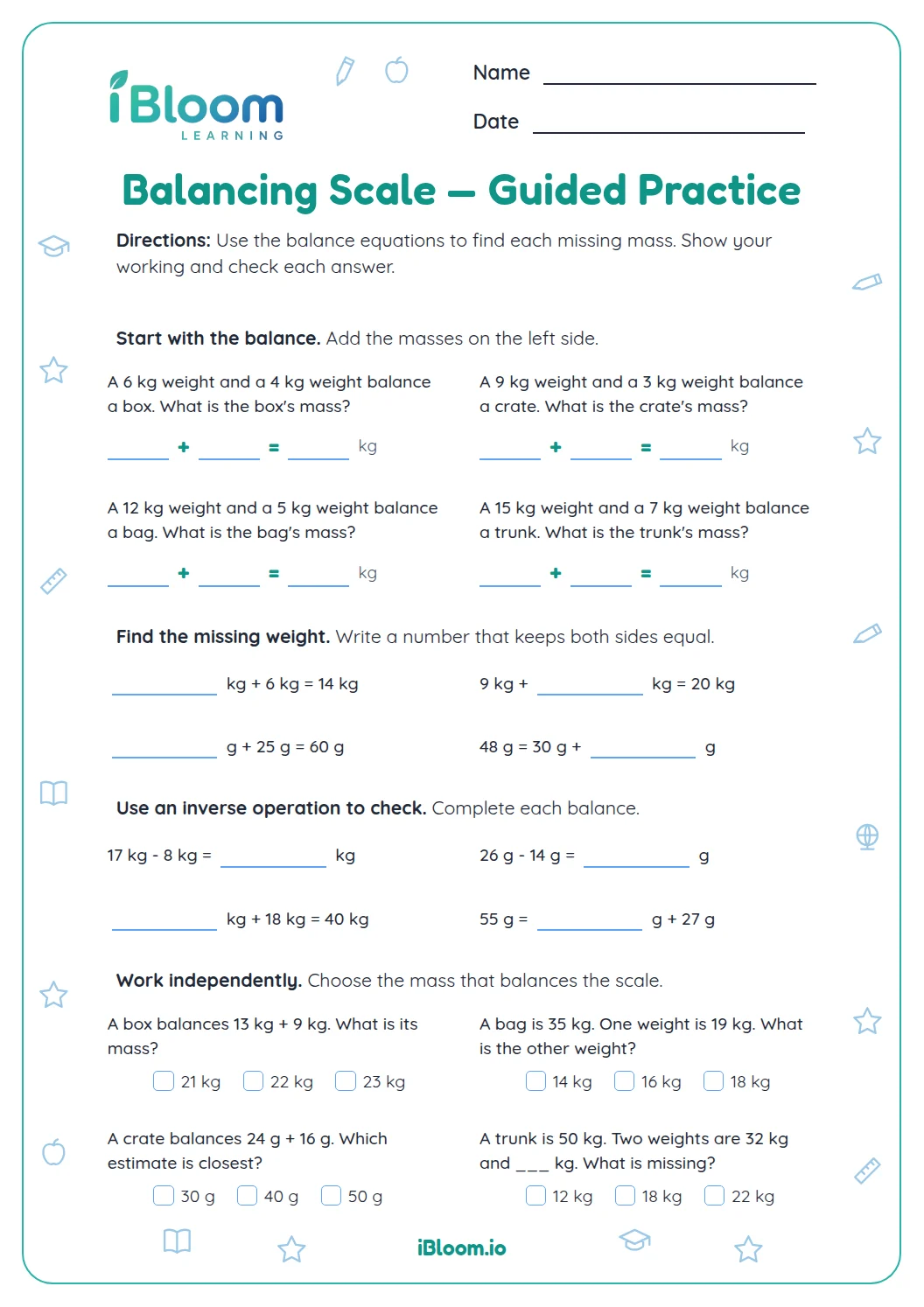
This Grade 4 worksheet uses gram amounts and equality statements to model a balancing scale. Children find missing masses, translate short balance stories into equations, compare equal totals, and create a pair of masses that makes 16 g. The scale drawings from the earlier sheet are recast as number sentences and mass stories, so students still reason about equal mass on both sides. A separate key lists the missing values and sample mass pair.
How does an equation show a balanced scale?
A balanced scale has the same total mass on both sides. In question 3, 5 g + 4 g = ___ g + 3 g. The left side totals 9 g, so the missing mass is 6 g because 6 g + 3 g also totals 9 g.
How can a balance story become an equation?
Name the unknown mass, then make both sides equal. In question 5, a bag and 2 g balance 9 g, so the equation is bag + 2 = 9. Subtracting 2 g gives a bag mass of 7 g.
How can students check two sides quickly?
Find each side’s total and compare. Question 11 is true because 9 g + 3 g and 8 g + 4 g both equal 12 g. In question 12, the totals are 13 g and 14 g, so the scale would tip.
How to solve a balance problem
- 1Label the unknown mass with a letter or a blank.
- 2Add the known masses on each side.
- 3Use equality to make the totals match.
- 4Find a missing addend by subtracting the known mass from the total.
- 5Check by adding both sides and comparing the totals.
Common balance-equation mistakes
The mistake
Adding masses from opposite sides together.
The fix
Keep each side’s total separate, then compare the two totals.
The mistake
Changing only one side when rewriting an equal equation.
The fix
Check that both sides still have the same total after filling the blank.
The mistake
Reporting the total instead of the unknown object’s mass.
The fix
Write the equation first, then solve for the object or missing mass alone.
What to practice next
Make more practice
Questions parents and teachers ask
What does a balanced scale mean in these problems?
It means the total mass on the left equals the total mass on the right. The worksheet writes that idea with grams and equations, such as 3 g + ___ g = 8 g. A missing mass must make both sides total the same amount.
How do you find the missing mass in 3 g + ___ g = 8 g?
Subtract the known 3 g from the total of 8 g. The missing mass is 5 g because 3 g + 5 g equals 8 g. Students use this same missing-addend reasoning in the first group of equation problems. Have the student explain the reasoning aloud before moving to the next item.
What units does the worksheet use?
All masses are given in grams, abbreviated g. Keep that unit with each answer: for example, the bag in question 5 has a mass of 7 g. The values are small whole-number masses so students can focus on equality. Have the student explain the reasoning aloud before moving to the next item.
Can students draw a balance scale on the page?
The redesigned worksheet represents the balance with equations and short stories instead of scale illustrations. Children find missing masses and compare totals, which uses the same equal-mass reasoning in a format that leaves room for more practice. Have the student explain the reasoning aloud before moving to the next item.
How many problems are included?
There are 14 questions in four parts: missing-mass equations, balance stories, equal-total choices, and one open-ended pair totaling 16 g. The key includes a sample for the final question; other pairs that add to 16 g are also correct. Have the student explain the reasoning aloud before moving to the next item.
How can I check an answer with my child?
Substitute the proposed mass into the equation and calculate both sides. If both sides have the same total, the scale is balanced. For an open-ended pair, add the two masses and confirm that they total 16 g. Have the student explain the reasoning aloud before moving to the next item.