


About this worksheet
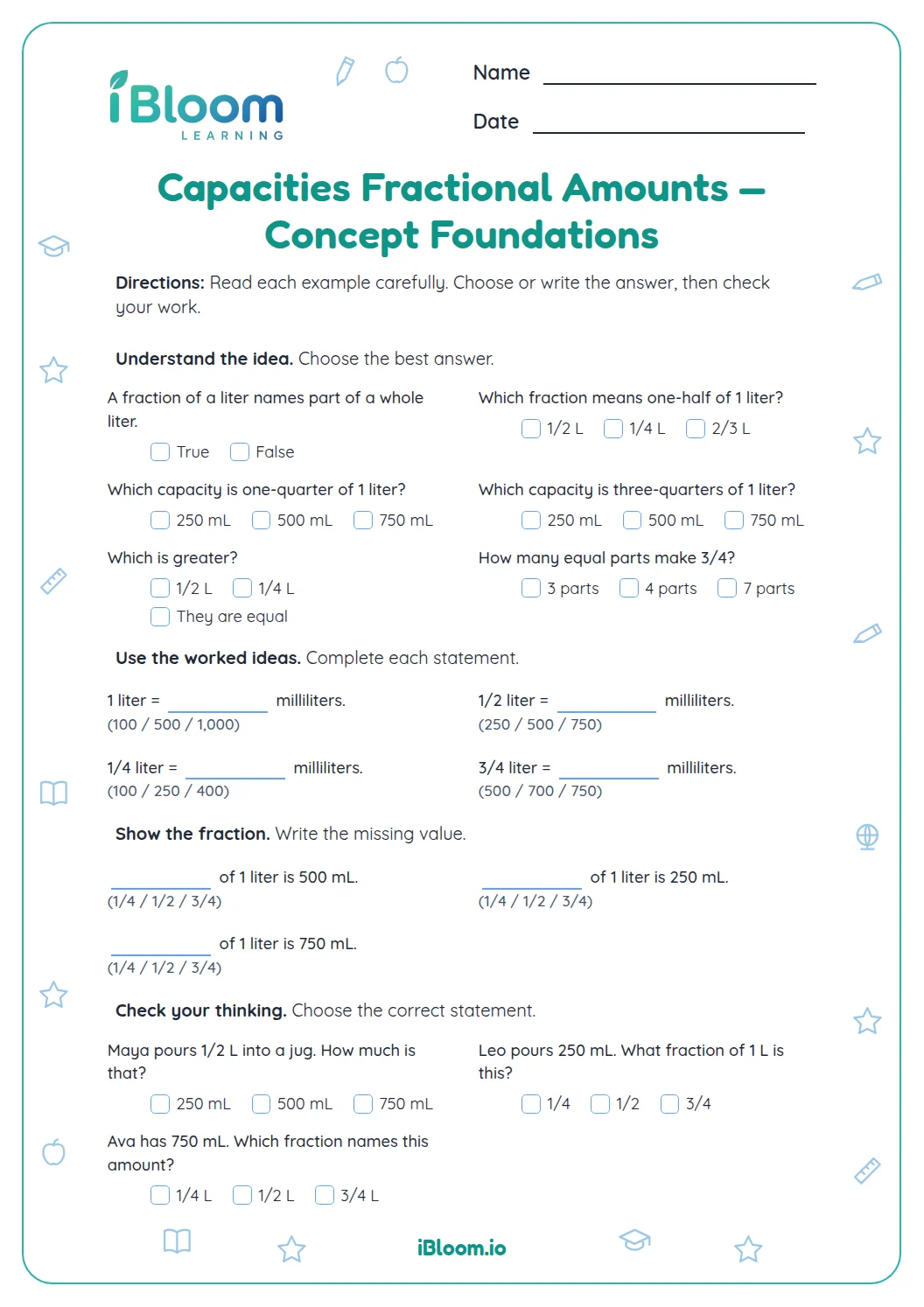
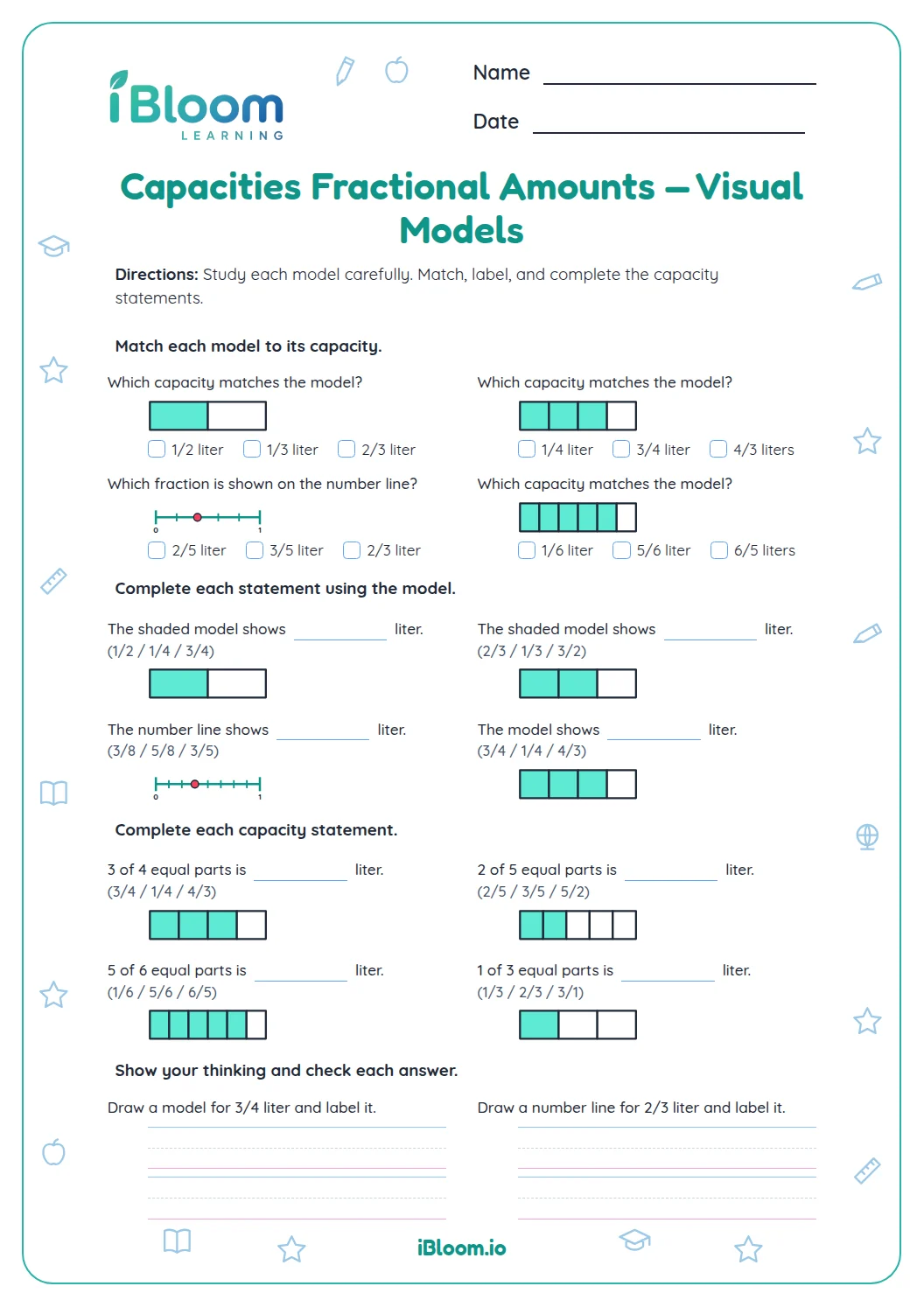
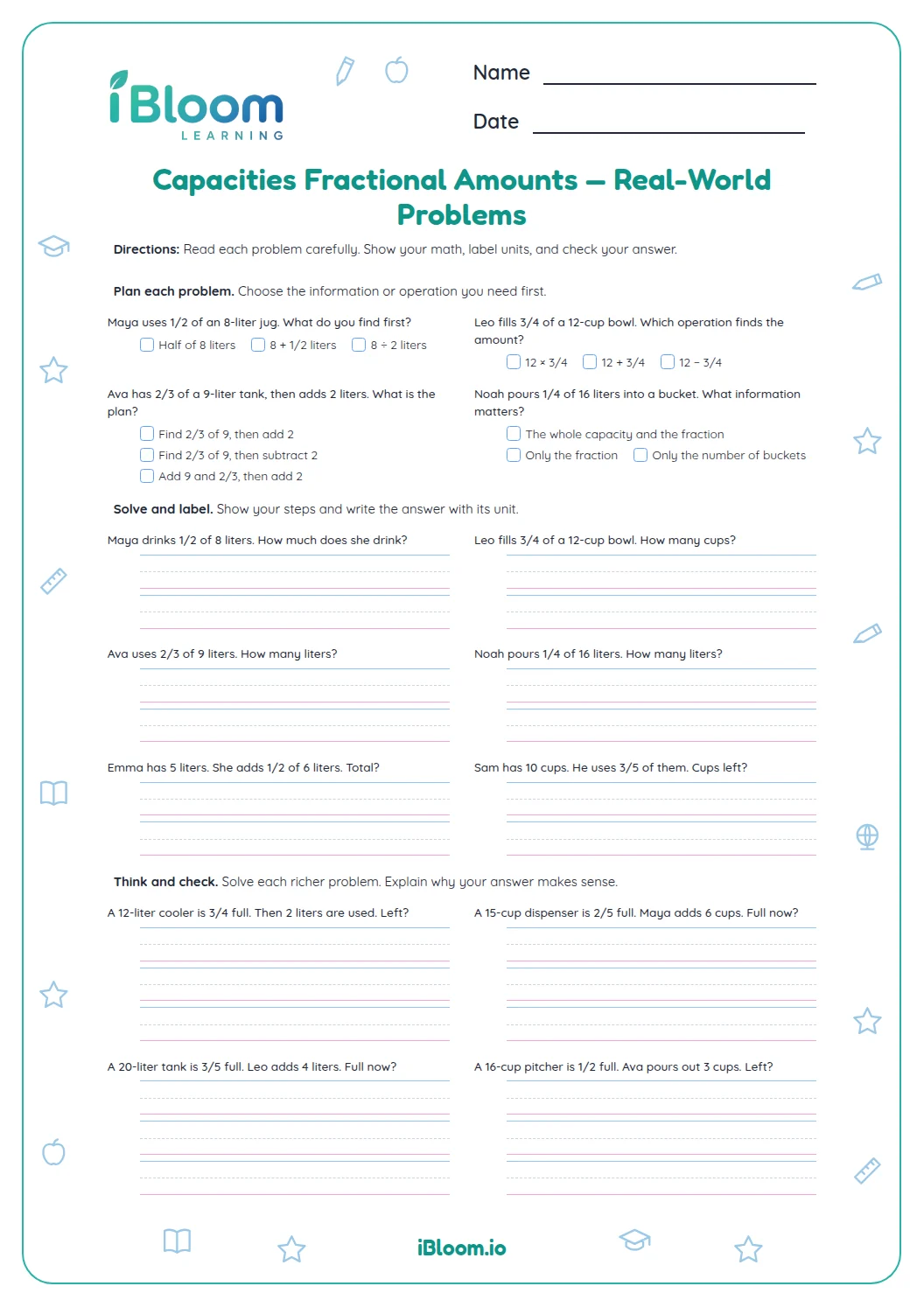
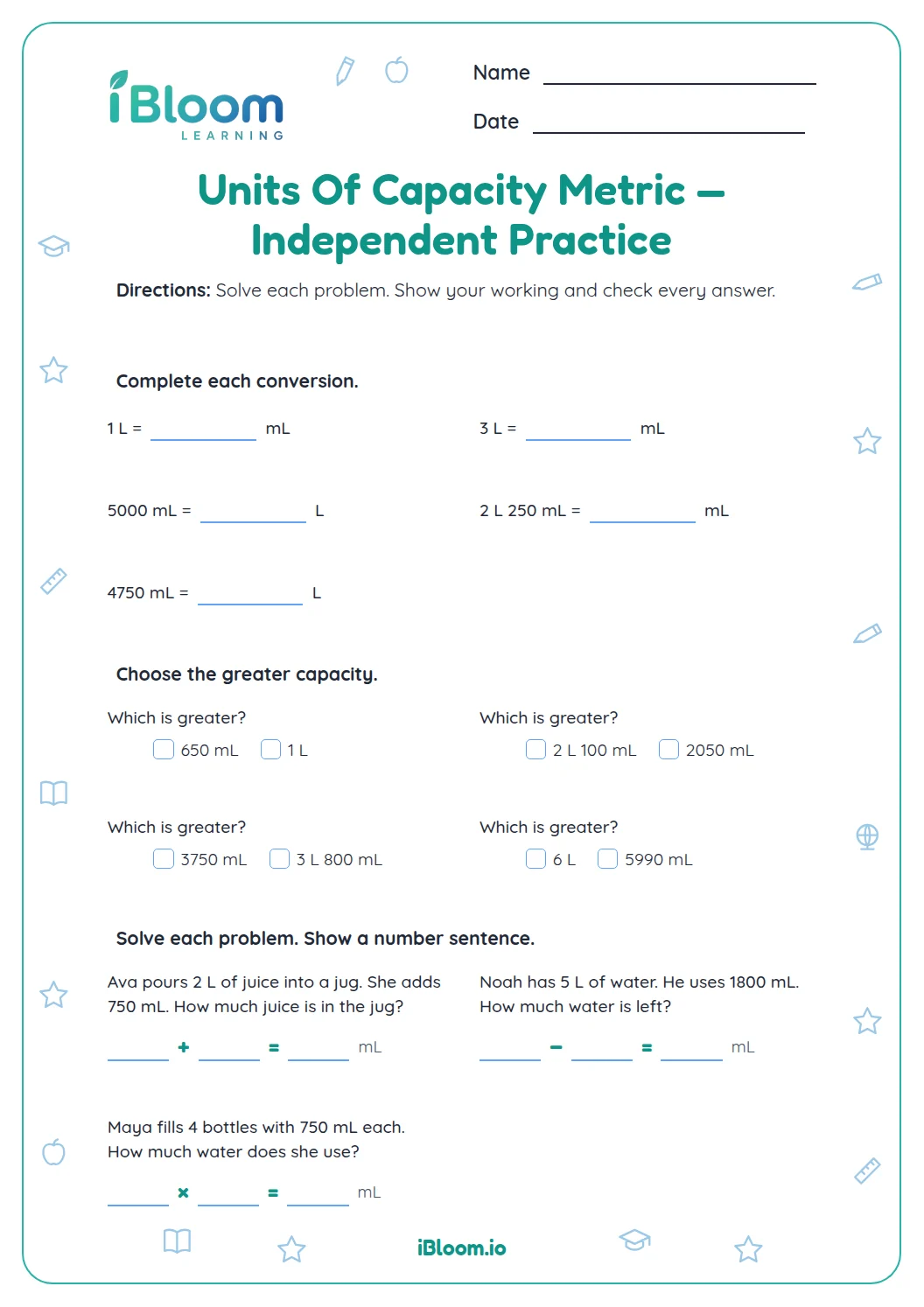
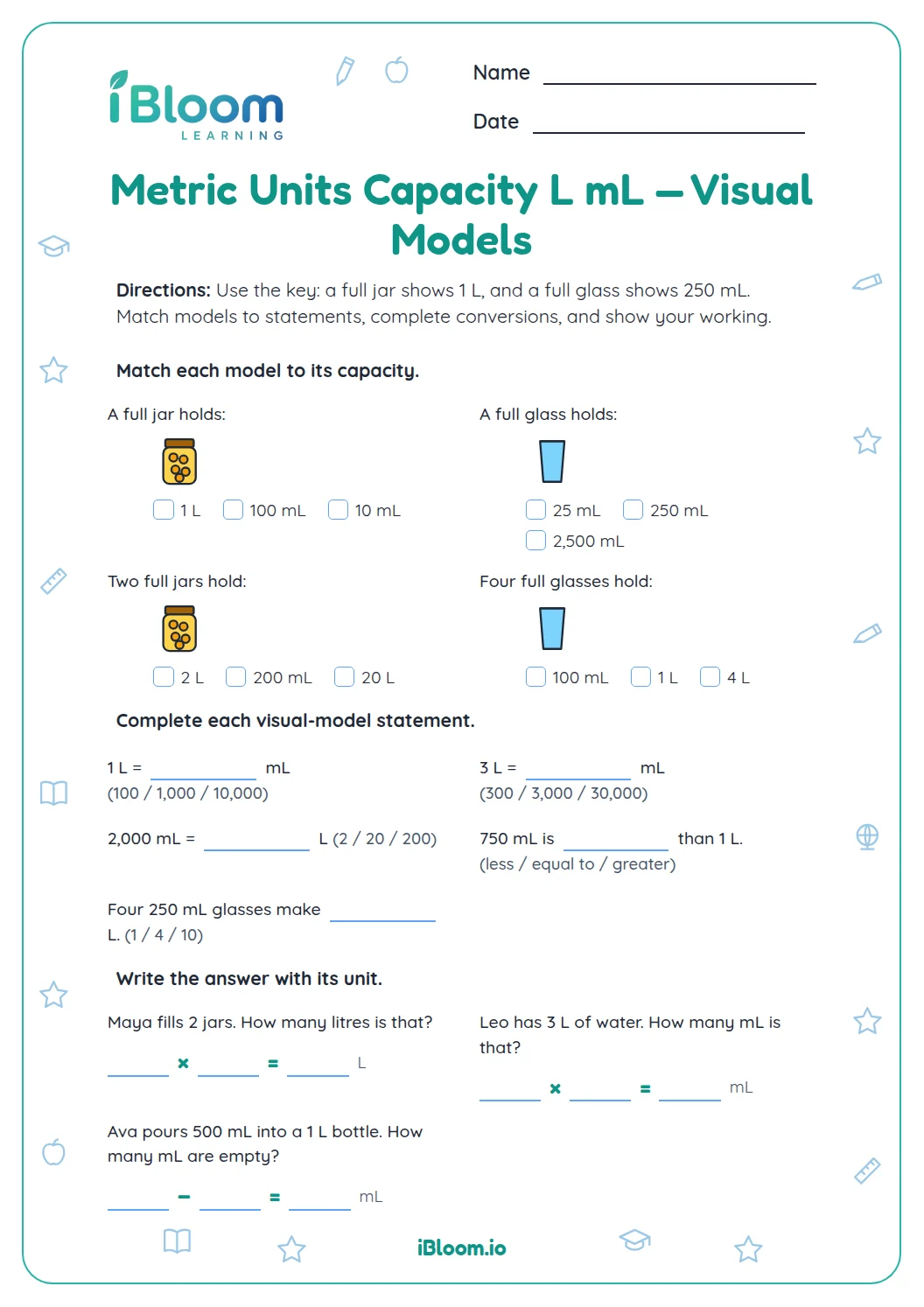
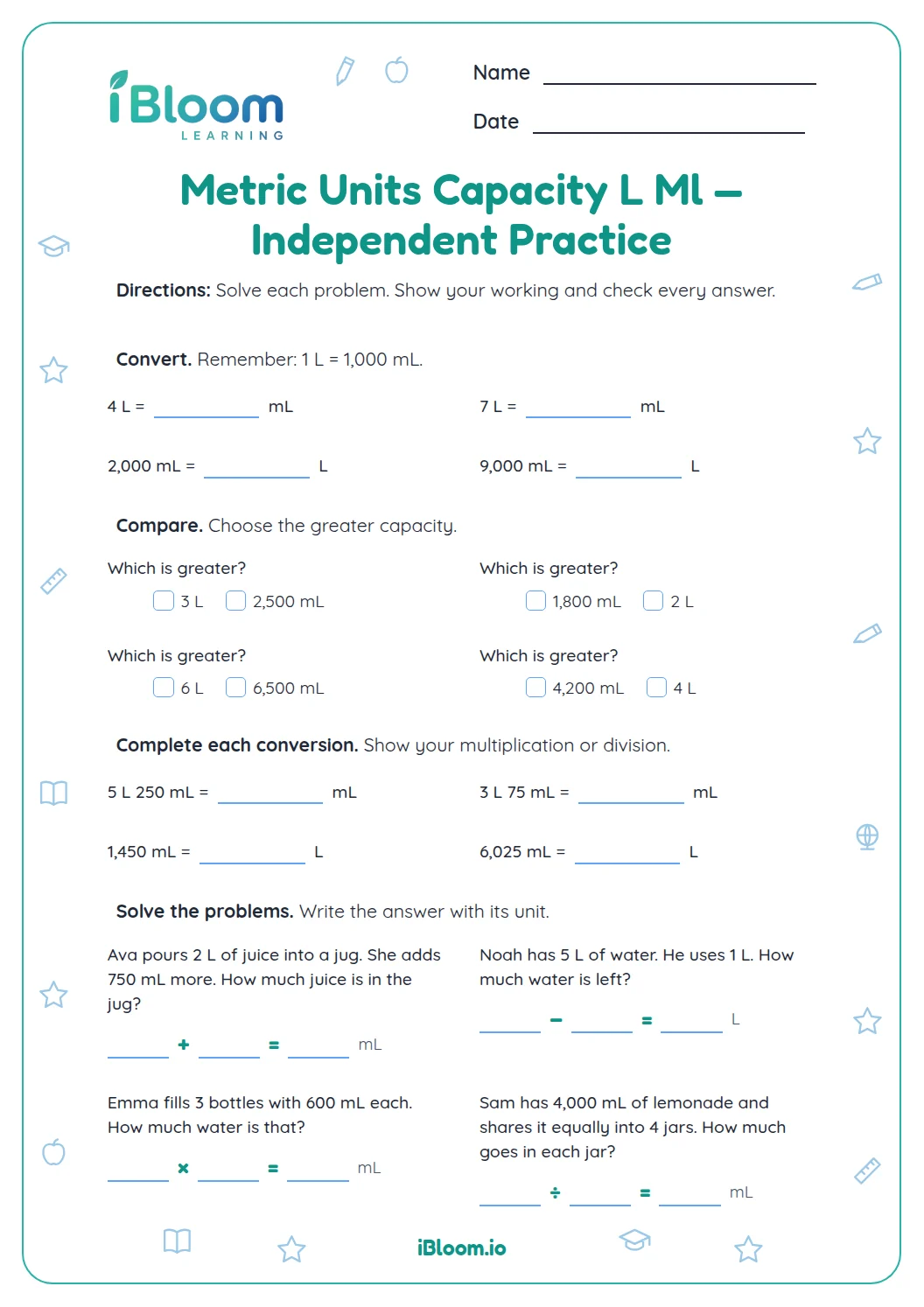
This free Grade 4 worksheet practices fractional capacities in liters and milliliters. Part A shows three bars, each representing one liter, with a half or fourths shaded. Part B gives a worked example and the liter-to-milliliter fact before six missing-amount questions. Part C asks students to find fractions of several liters in four independent capacity stories. There are 13 questions and a separate answer key. Common Core 4.MD.A.2 connects the practice to liquid-volume problems involving simple fractions and changes from larger units to smaller units.
Aligned to 4.MD.A.2
What do the shaded bars represent?
Each full bar in Part A represents one liter. Count all the equal parts to find the denominator, then count the shaded parts to find the numerator. One of four parts represents 1/4 liter; three of four represent 3/4 liter.
These models show fractional amounts of liquid without requiring a real measuring jug. The whole is labeled in every question so children know what the fraction measures.
How do students find a fraction of more than one liter?
Use the whole amount given in the question. Finding 3/4 of 2 liters means splitting two liters into four equal portions and taking three portions. Each portion is half a liter.
- 1Find 3/4 of 2 L.
- 22 L ÷ 4 = 1/2 L in each equal part.
- 33 × 1/2 L = 1 1/2 L.
- 4Three fourths of 2 liters is 1 1/2 liters.
When should students use milliliters?
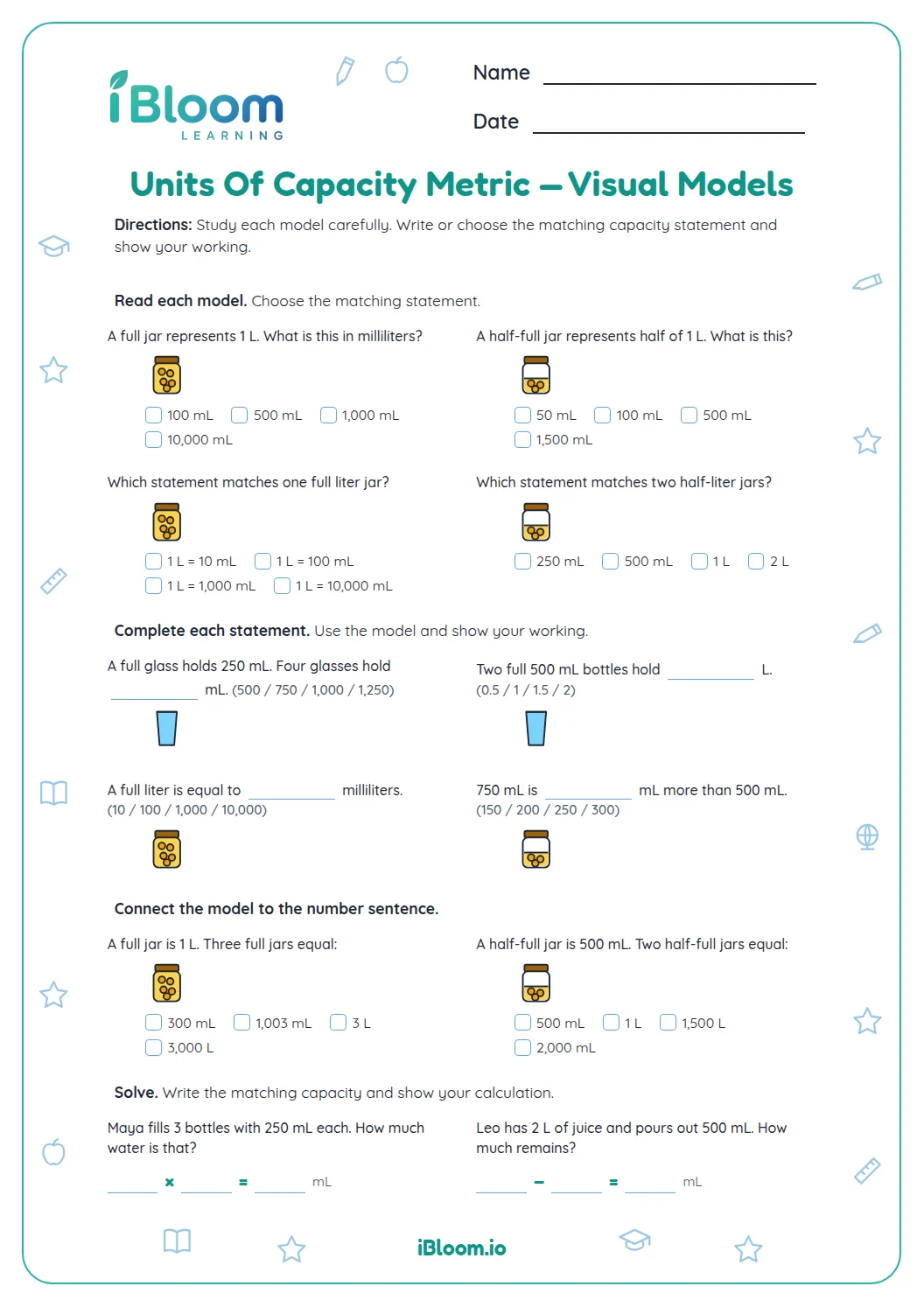
Questions 5, 6, 7 and 9 ask for milliliters. Use the printed fact 1 L = 1,000 mL. A quarter of one liter is 250 mL; a quarter of two liters is 500 mL because the whole amount is twice as large.
In Part C, distinguish a fraction of a whole amount from a measured amount to subtract. Question 10 uses half of six liters. Question 12 removes one quarter of a liter from two liters.
How to use this worksheet
- 1Read the one-liter label on each bar before choosing the shaded amount.
- 2Review the example showing that half of four liters is two liters.
- 3For each Part B item, divide the whole amount into equal parts and count the needed parts.
- 4Use 1 L = 1,000 mL whenever an answer blank asks for milliliters.
- 5In Part C, decide whether the fraction names part of an amount or a quantity being added or removed.
- 6Check the key and ask the child to explain why a quarter of two liters is 500 mL.
Mistakes to check
The mistake
Calling one shaded part out of four 1/3 liter.
The fix
Count all four equal parts, including the shaded part. The amount is 1/4 liter.
The mistake
Answering 1/4 of 2 L as 250 mL.
The fix
The whole amount is 2,000 mL. Divide that amount into four equal parts to get 500 mL.
The mistake
Treating 2 L − 1/4 L as one quarter of 2 L.
The fix
Question 12 removes a measured 1/4 liter. Subtract it from 2 liters to get 1 3/4 liters.
Common Core alignment
Use liter models, fractional amounts and milliliter conversions to solve capacity problems.
On this sheet: Students read shaded liter models, find fractional liquid amounts and convert liters to milliliters.
Show the official wordingHide the official wording
Use the four operations to solve word problems involving distances, intervals of time, liquid volumes, masses of objects, and money, including problems involving simple fractions or decimals, and problems that require expressing measurements given in a larger unit in terms of a smaller unit. Represent measurement quantities using diagrams such as number line diagrams that feature a measurement scale.
What to practice next
Make more practice
Further reading
Questions parents and teachers ask
Which capacity units appear on this sheet?
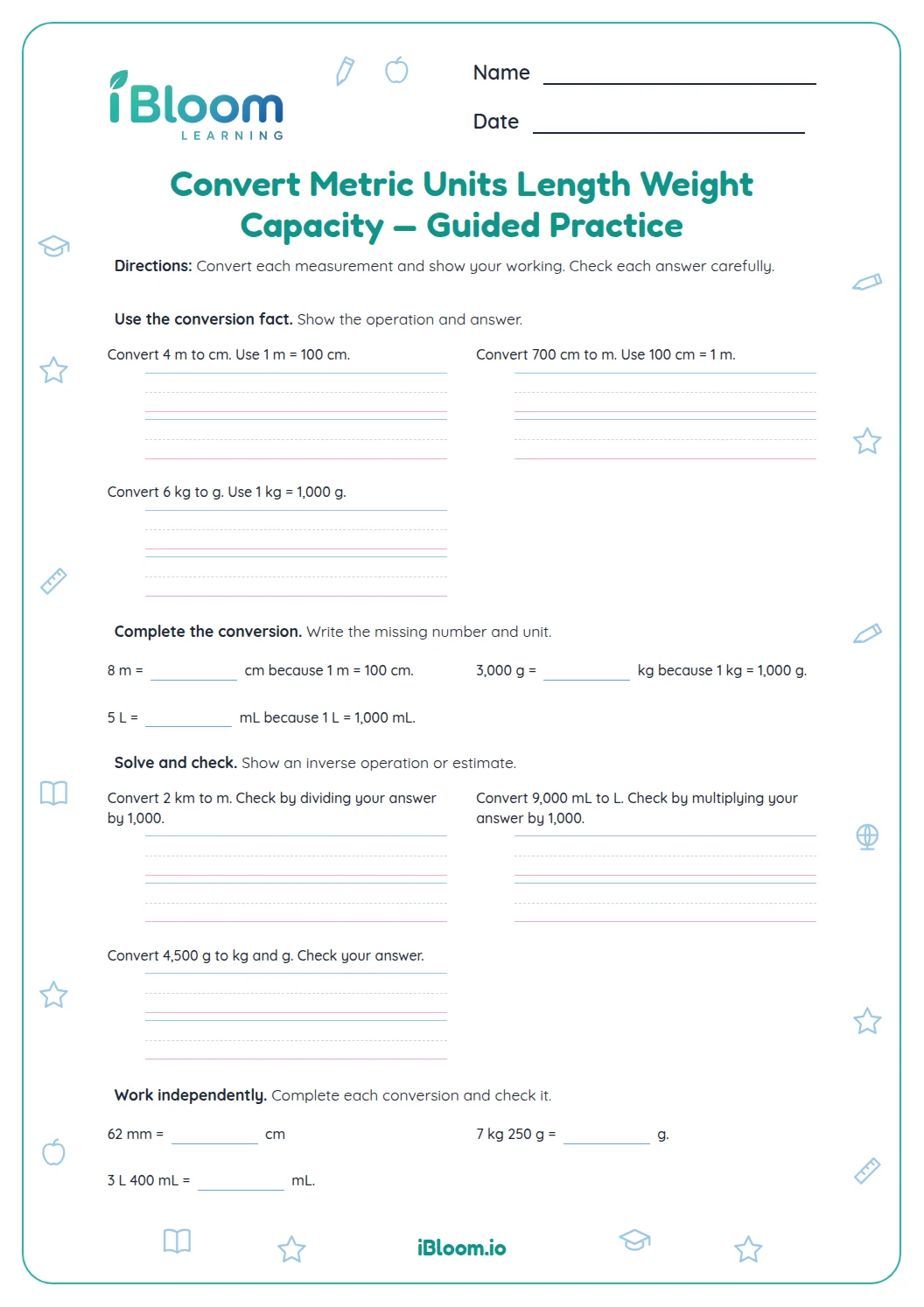
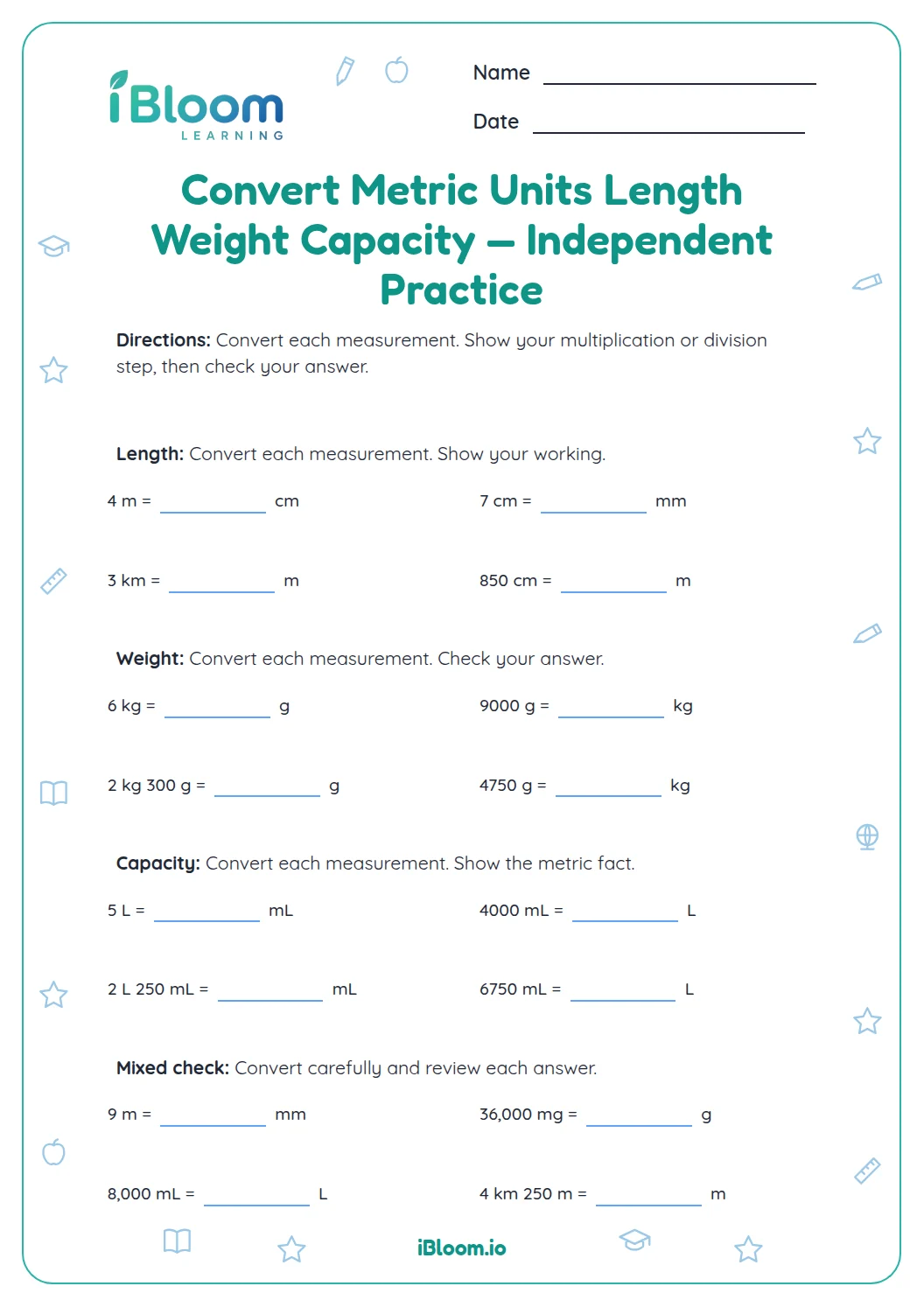
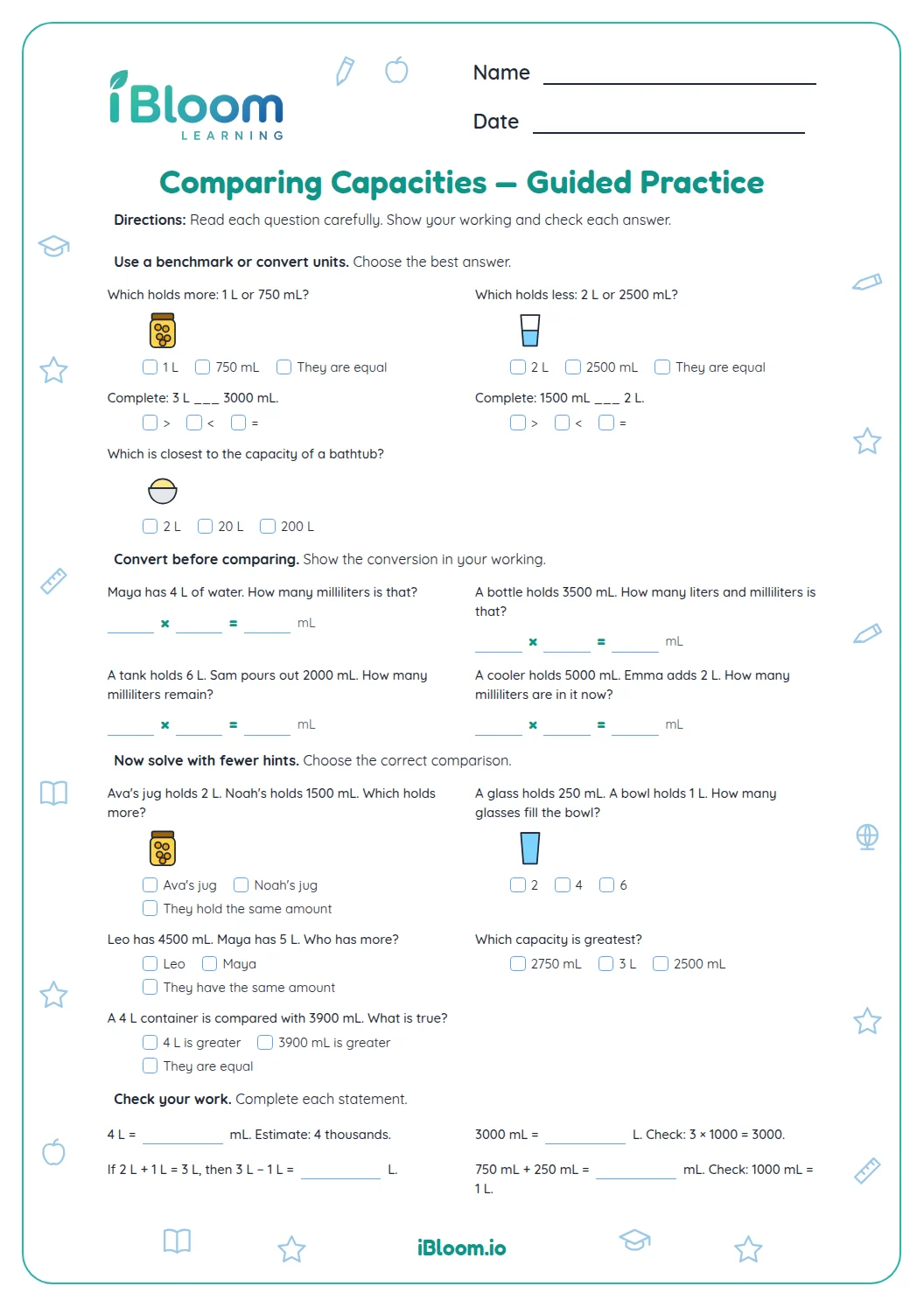
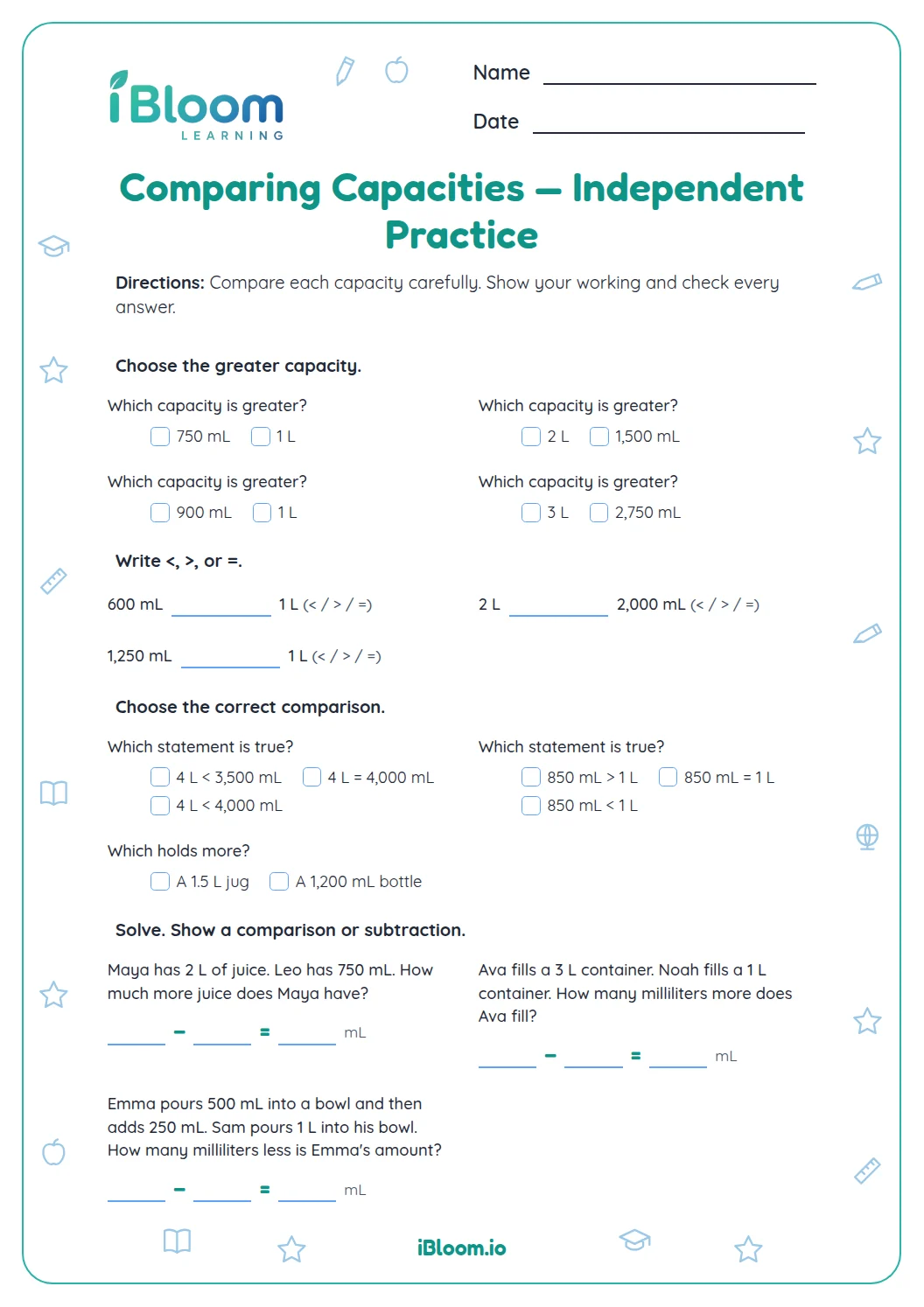
The worksheet uses liters and milliliters. Each model in Part A represents one liter, and Part B prints the fact that one liter equals 1,000 milliliters. Some blanks ask for liters and others ask for milliliters, so children need to read the requested unit before answering.
What makes this guided practice?
Part A begins with shaded bars, and Part B supplies a worked half-of-four-liters example plus the conversion fact. These supports help children connect fractions to actual amounts. Part C then asks for equations without giving the operation, so children choose how to use the earlier ideas.
Do we need a measuring jug?
A measuring jug is optional because the printed models and facts supply the information needed. If you have a one-liter container marked in milliliters, you can point out 250 mL, 500 mL and 750 mL after Part A to connect the shaded fractions to real measurements.
Why is a quarter of two liters 500 milliliters?
Two liters equal 2,000 milliliters, and one quarter means one of four equal parts of that amount. Dividing 2,000 by four gives 500 milliliters. Question 7 uses this relationship. Compare it with question 5, where the smaller one-liter whole has a 250-milliliter quarter.
What answers should I accept for the stories?
Accept equivalent fractions with the requested unit. In question 12, 1 3/4 liters and 7/4 liters describe the same remaining amount. In the conversion blanks, children write only the number because the unit is already printed. The story answers should include liters with the number.