




About this worksheet
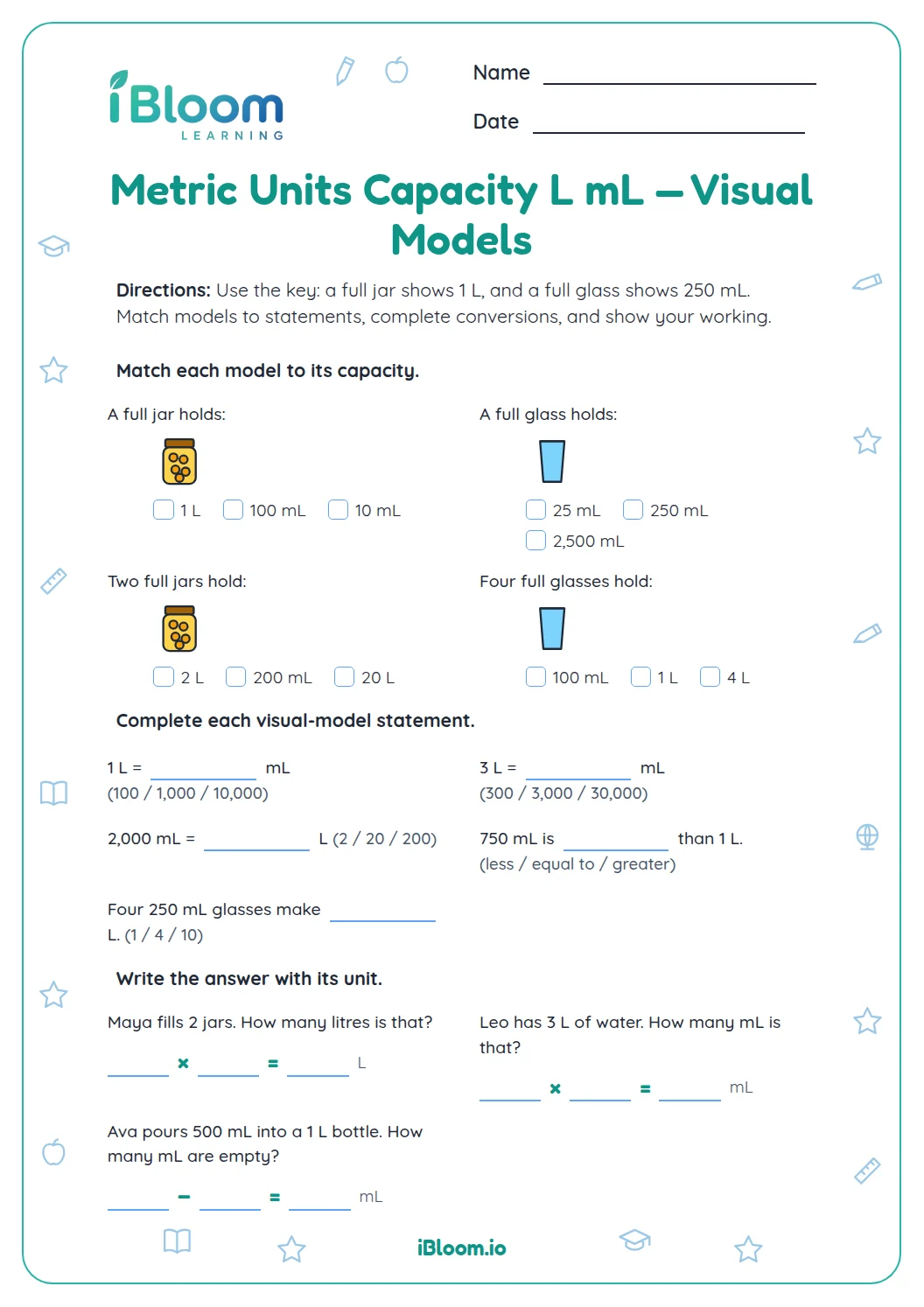
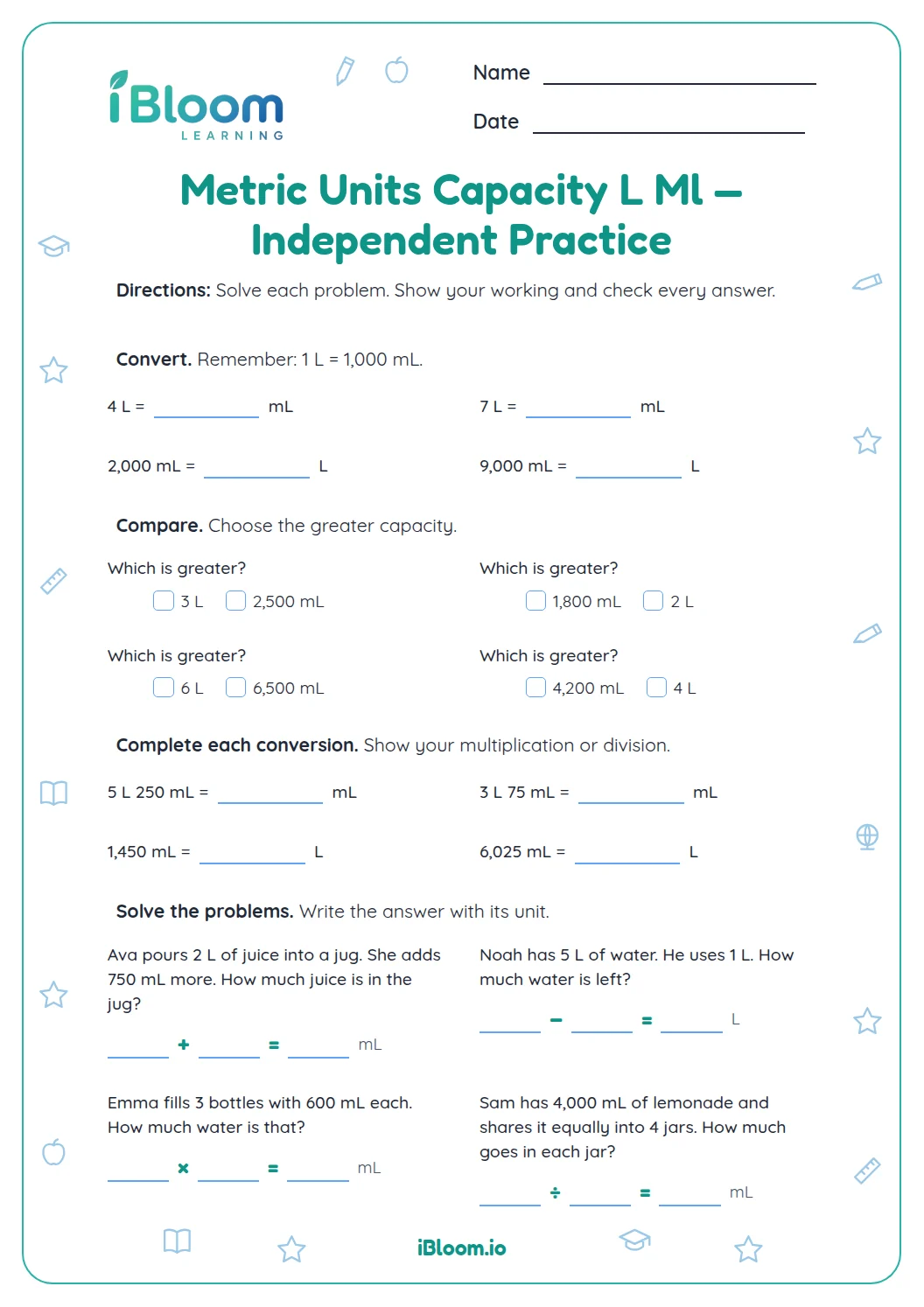
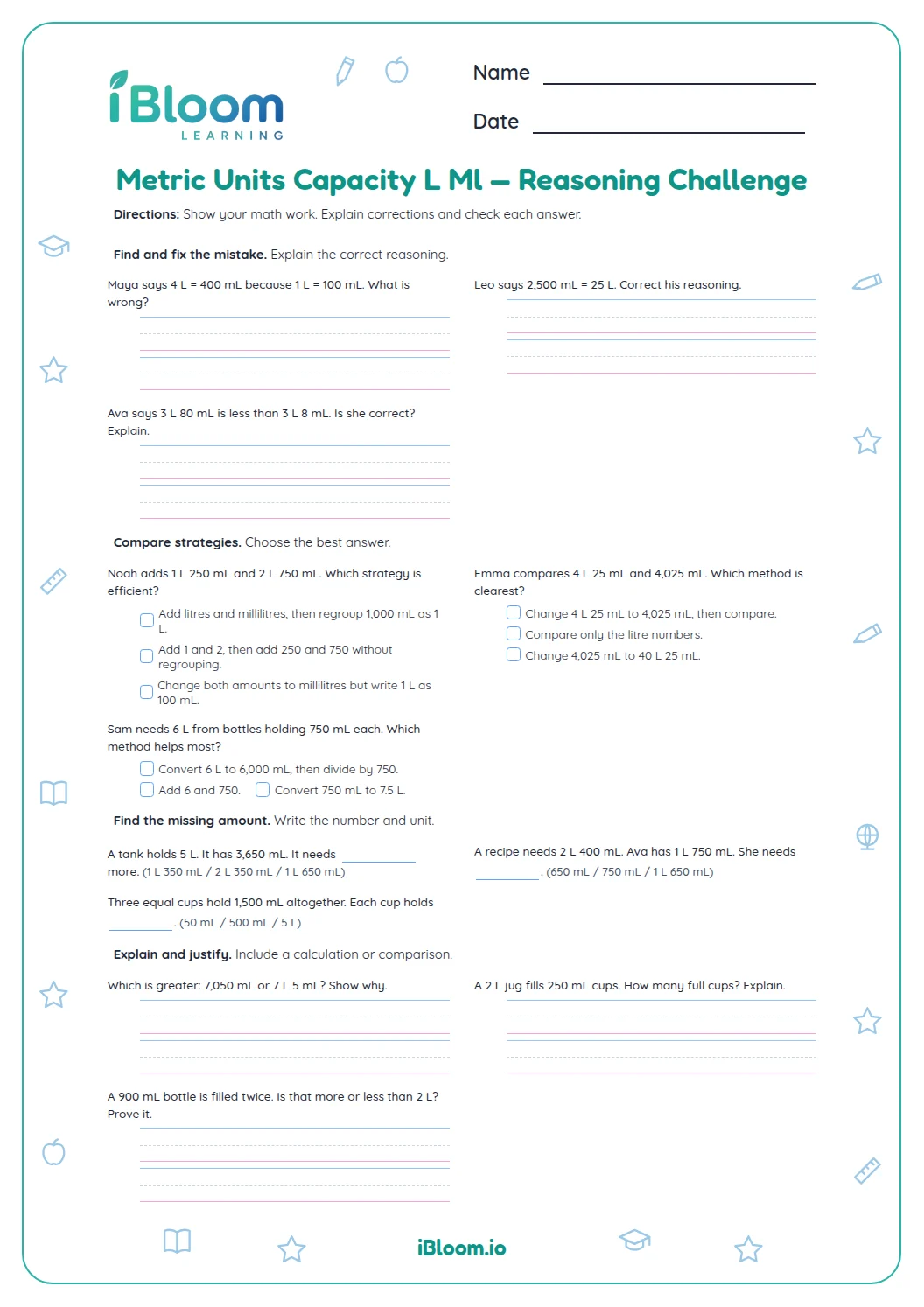
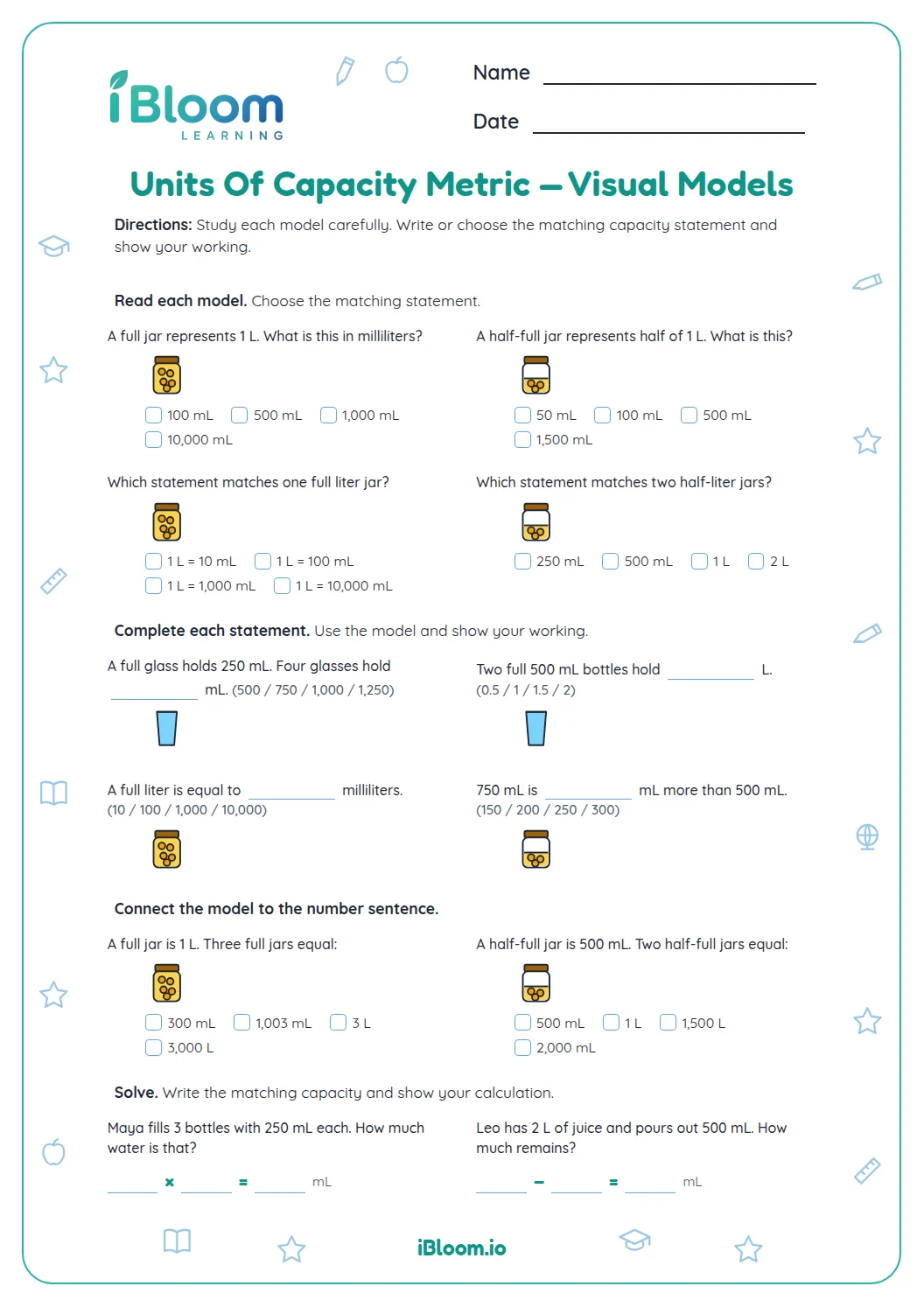
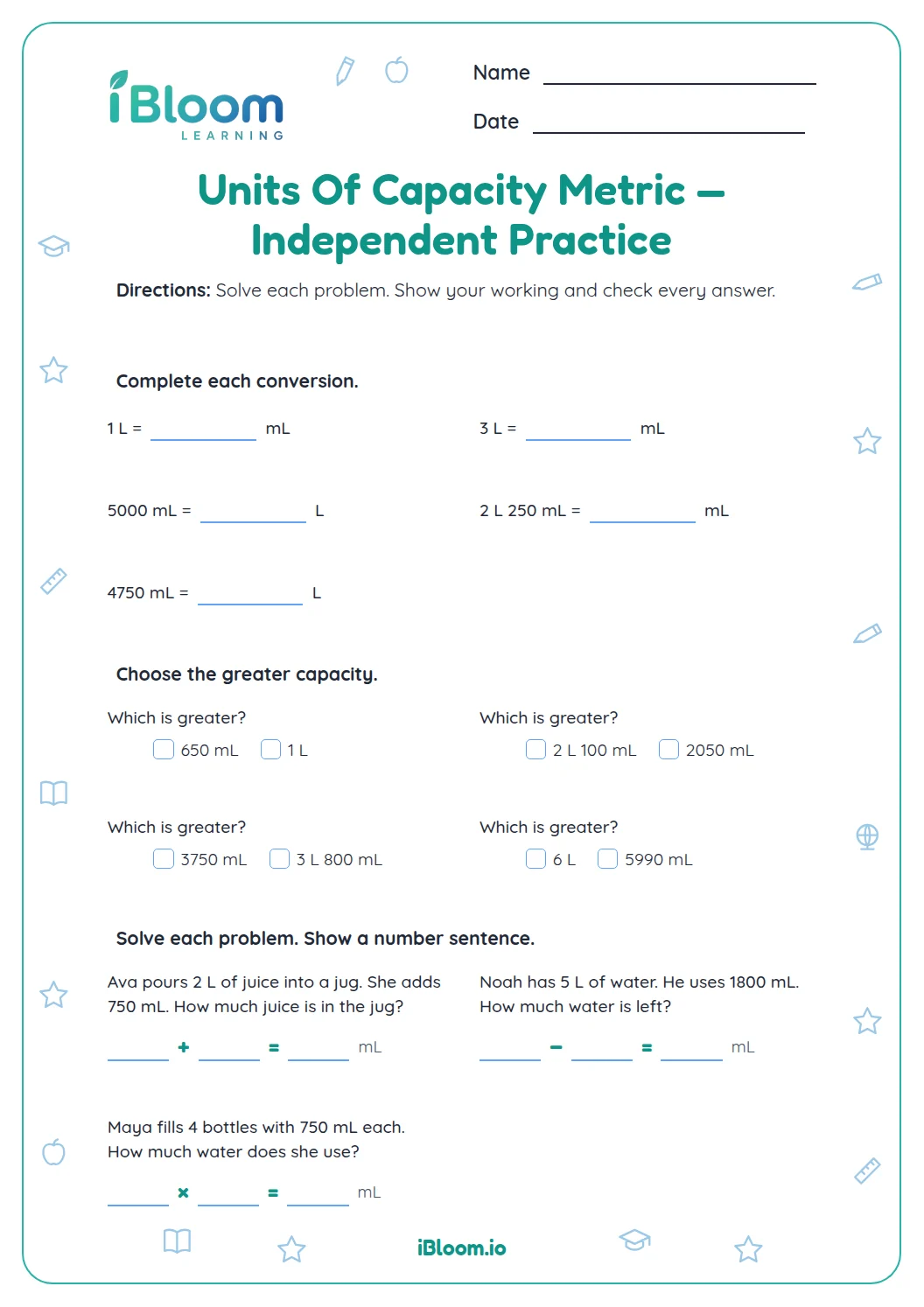
This free Grade 4 metric capacity worksheet builds the liter–milliliter relationship with direct equivalents, mixed amounts, comparisons, and everyday situations. Children use 1 L = 1,000 mL to convert values such as 2 L 250 mL, order capacities, and solve bottle and pitcher questions. The answer key includes units and mixed forms. The work aligns with Common Core 4.MD.A.1, which names liters and milliliters as related units within one measurement system and calls for recording equivalents.
Aligned to 4.MD.A.1
How do liters and milliliters relate?
One liter is the same capacity as 1,000 milliliters. Multiply liters by 1,000 to rename them in milliliters; divide milliliters into groups of 1,000 to find liters.
How do you rename a mixed capacity?
Keep the 1,000 milliliters in each liter together, then write any leftover milliliters after it.
- 14 L 8 mL = 4,000 mL + 8 mL = 4,008 mL.
How can you compare two capacities fairly?
Rename both values with the same unit before comparing. In question 10, 1 L 20 mL is 1,020 mL, so it falls between 980 mL and 1,200 mL. Question 16 asks which familiar object is closest to a liter.
How to use this worksheet
- 1Keep the conversion fact 1 L = 1,000 mL visible.
- 2Multiply a liter amount by 1,000 to express it in milliliters.
- 3For mixed units, add the remaining milliliters after the thousands.
- 4Convert both amounts to milliliters before ordering them.
- 5Include mL or L in each word-problem answer.
Common mistakes and quick fixes
The mistake
Writing 100 instead of 1,000 milliliters for a liter.
The fix
Check the three zeros in 1,000 and test by grouping milliliters into thousands.
The mistake
Dropping the leftover milliliters in a mixed amount.
The fix
Write the thousands first, then add the stated remainder: 4,000 + 8.
The mistake
Comparing 1 L 20 mL with 980 mL without converting.
The fix
Rename 1 L 20 mL as 1,020 mL before deciding which is greater.
Common Core alignment
The problems use one metric system and record equivalent capacity amounts.
Relate liters and milliliters and express larger units in smaller units.
On this sheet: Questions convert and compare liters and milliliters and record equivalent amounts.
Show the official wordingHide the official wording
Know relative sizes of measurement units within one system of units including km, m, cm; kg, g; lb, oz.; l, ml; hr, min, sec. Within a single system of measurement, express measurements in a larger unit in terms of a smaller unit. Record measurement equivalents in a two-column table. For example, know that 1 ft is 12 times as long as 1 in. Express the length of a 4 ft snake as 48 in. Generate a conversion table for feet and inches listing the number pairs (1, 12), (2, 24), (3, 36), ...
What to practice next
Make more practice
Further reading
Questions parents and teachers ask
How many milliliters are in one liter?
One liter equals 1,000 milliliters. Remembering the three zeros helps students convert liters to milliliters and check whether a result is reasonable. The worksheet uses this relationship in direct conversions, comparisons, mixed amounts, and everyday capacity situations involving bottles, pitchers, and tanks.
How do you change milliliters to liters?
Group the milliliters into thousands because each group of 1,000 mL is one liter. For example, 2,430 mL is 2 L 430 mL. The remaining 430 milliliters stays after the whole number of liters, so the mixed amount remains exact and easy to interpret.
How can I compare values in different units?
Rename both values using the same unit before comparing them. For example, change 1 L 20 mL to 1,020 mL, then compare 1,020 with 980. Converting first prevents a larger-looking numeral from misleading the comparison when the measurements use different units.
Does the answer key include units?
Yes. The key gives milliliters or liters with each result and writes mixed capacities as liters plus leftover milliliters. This makes it easier to notice whether a student has converted the number but forgotten the unit or placed a remainder in the wrong unit.
What is close to one liter?
A large water bottle is a reasonable example of a capacity near one liter. Question 16 asks students to compare it with a teaspoon and a bathtub. The answer key identifies the best estimate, while the other questions use exact liter and milliliter relationships.