
About this worksheet
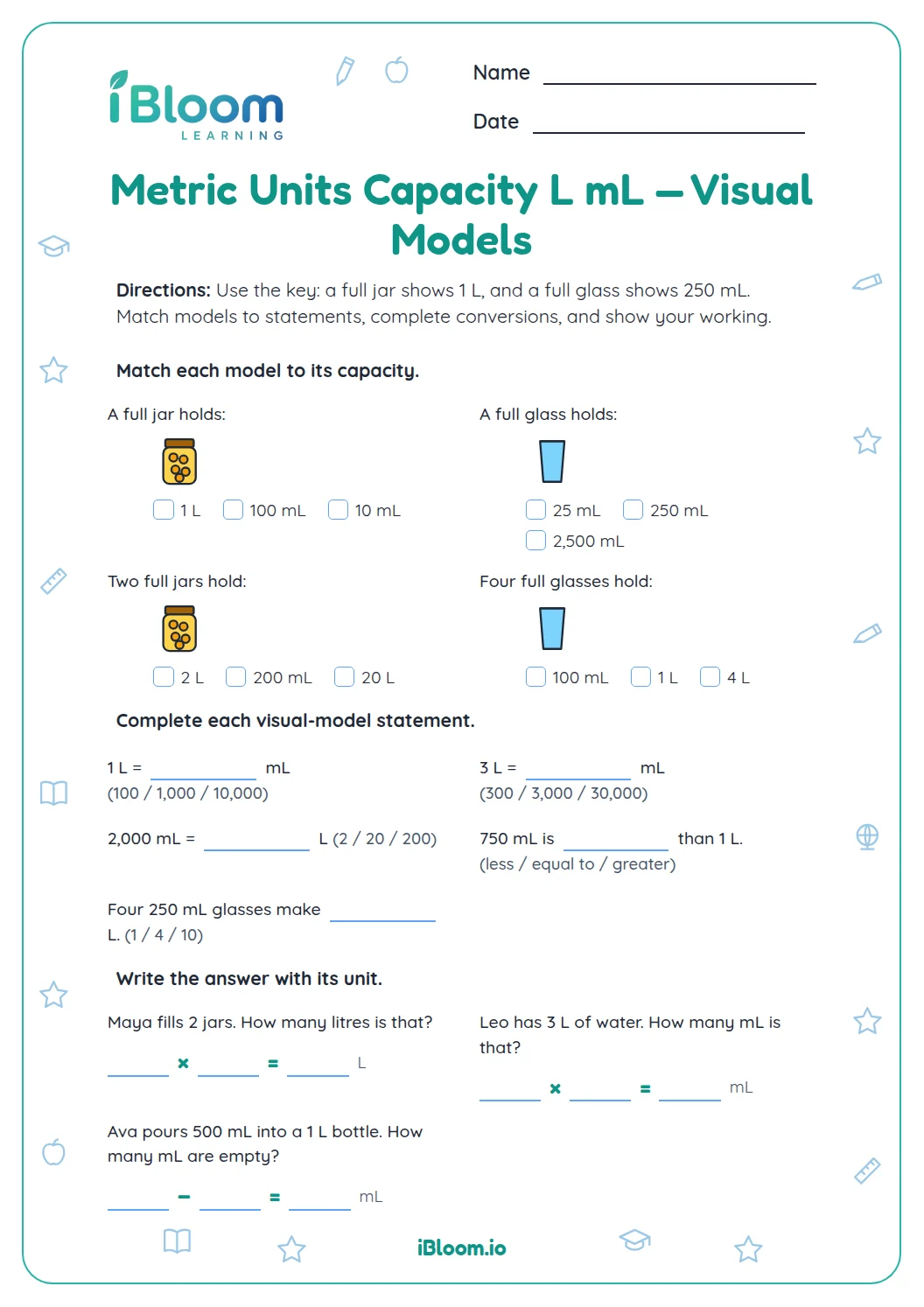
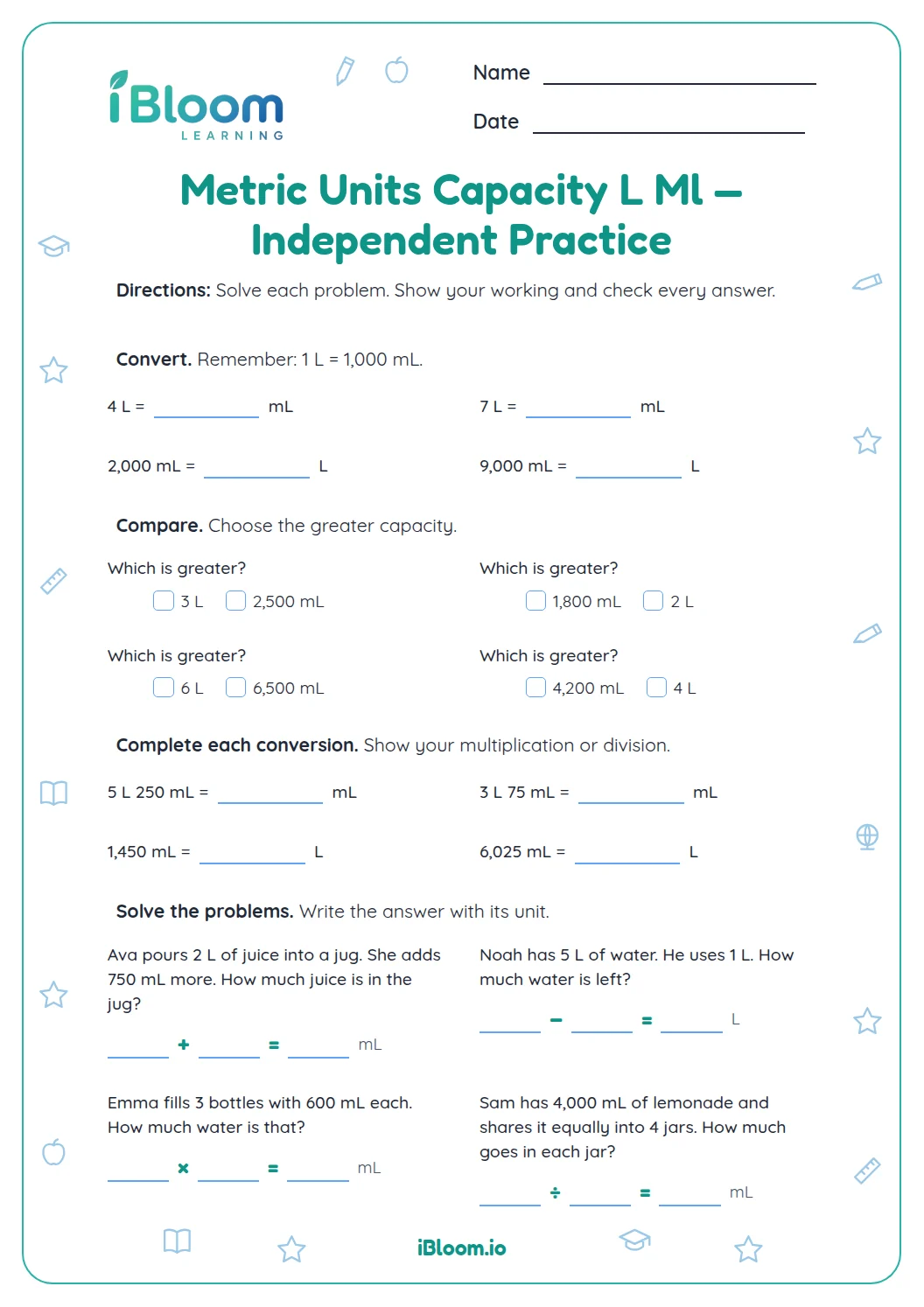
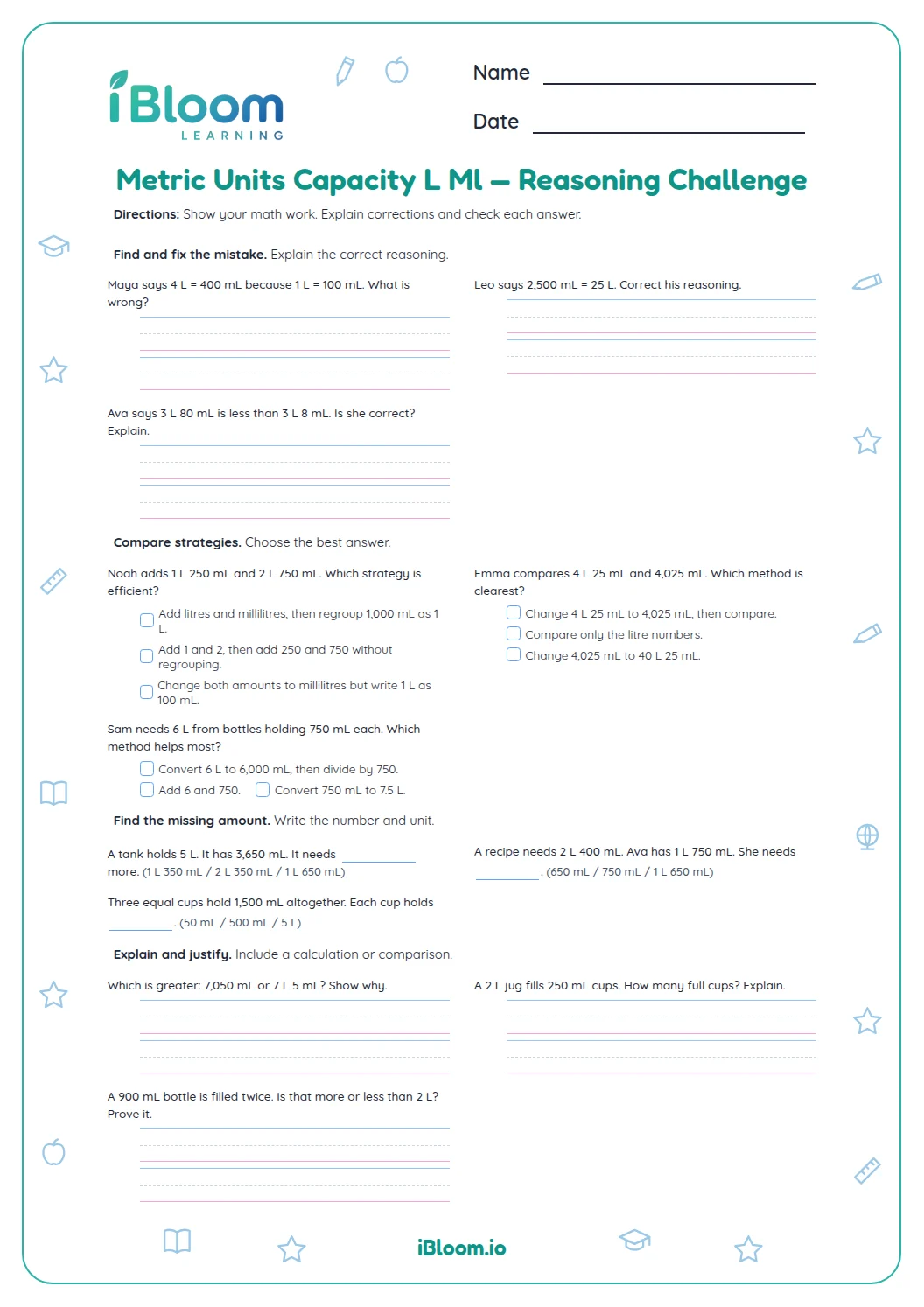
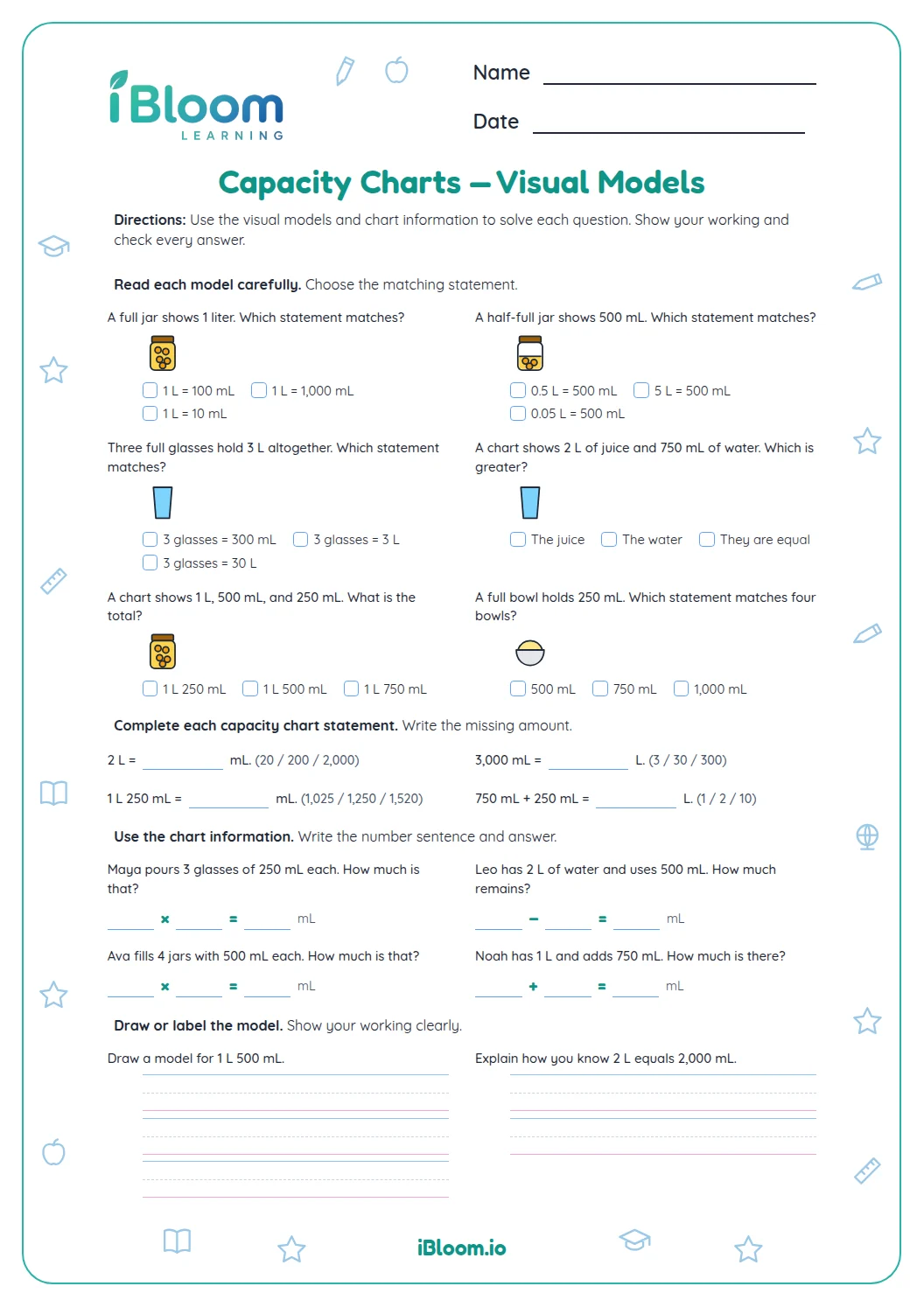
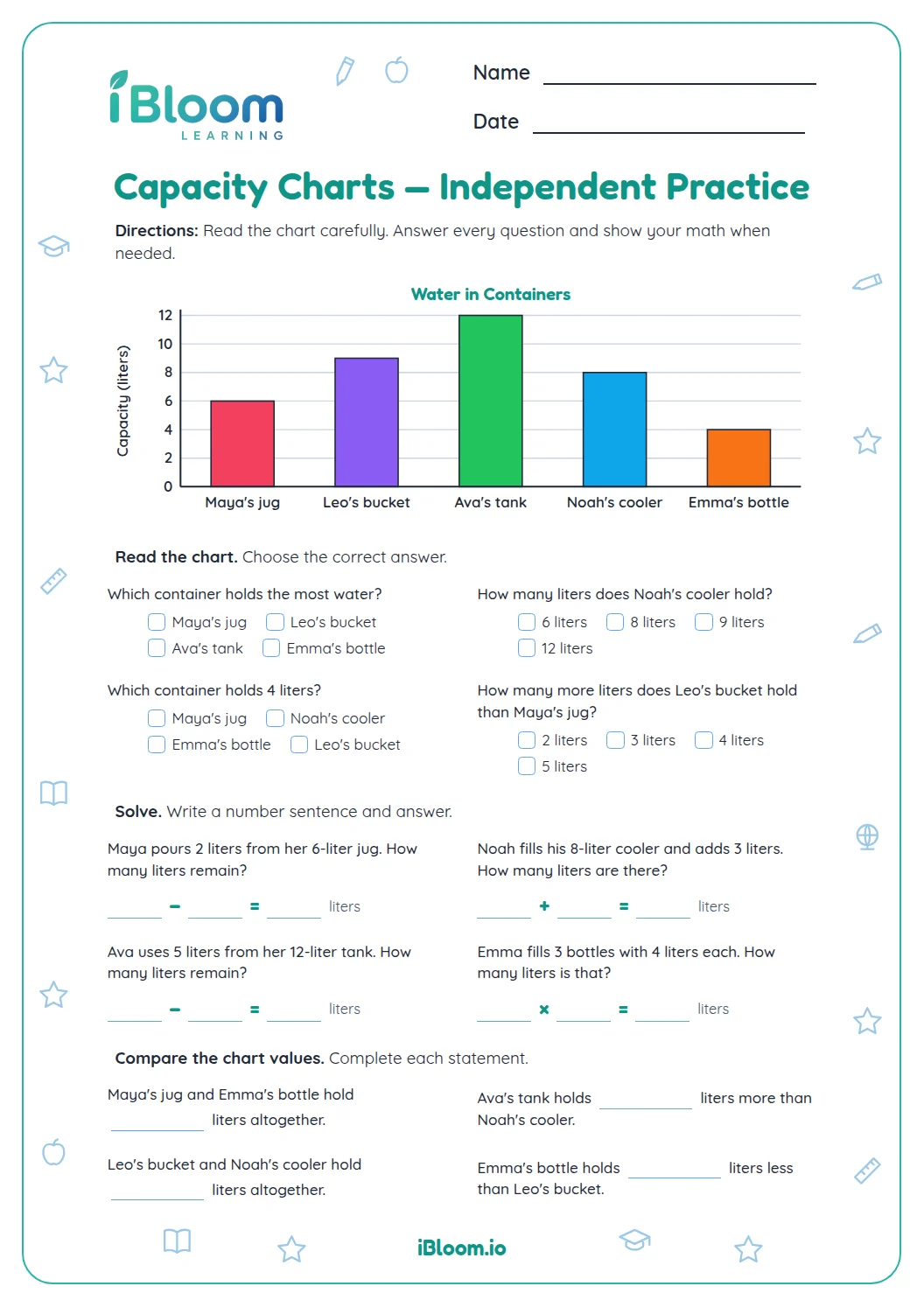
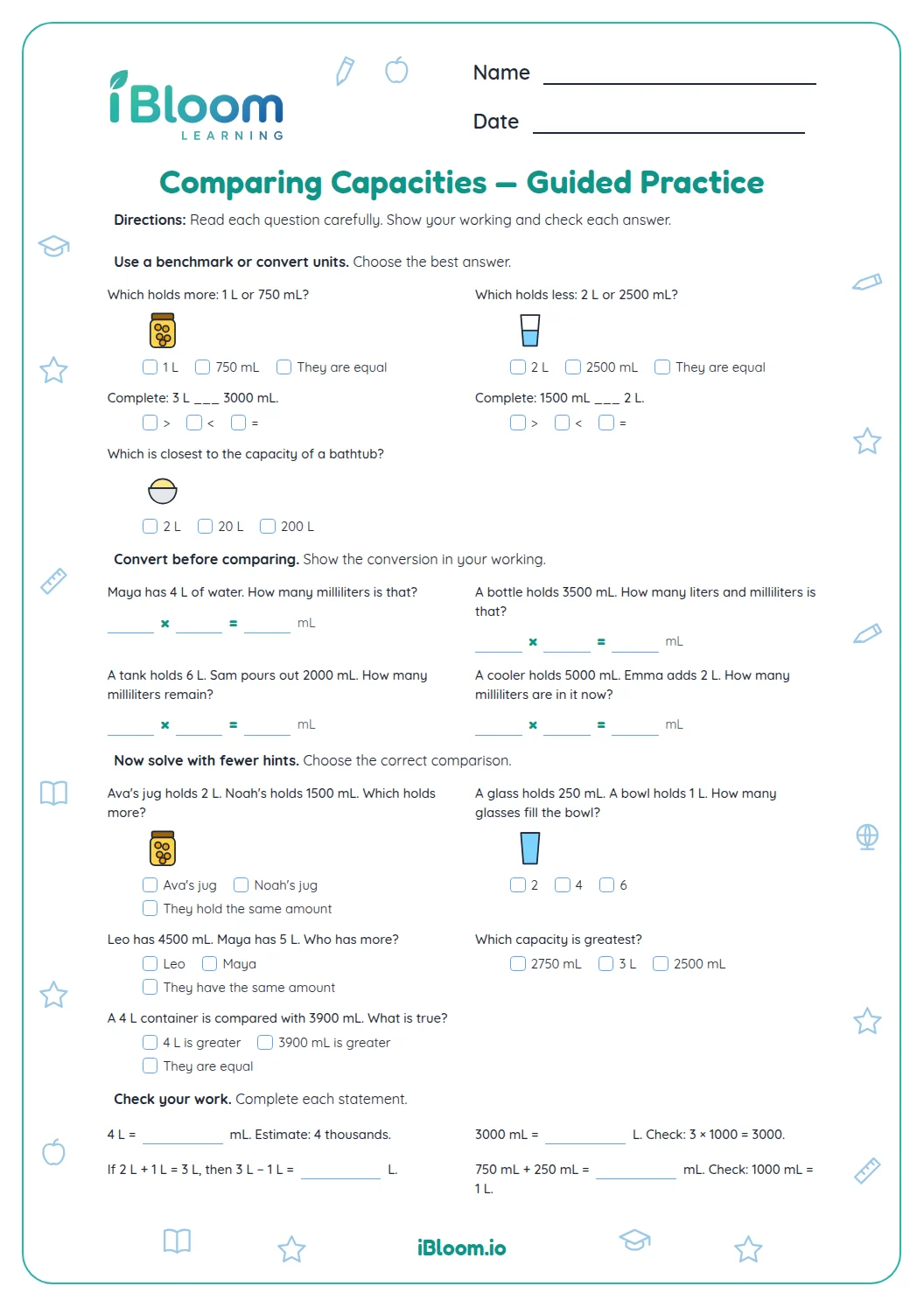
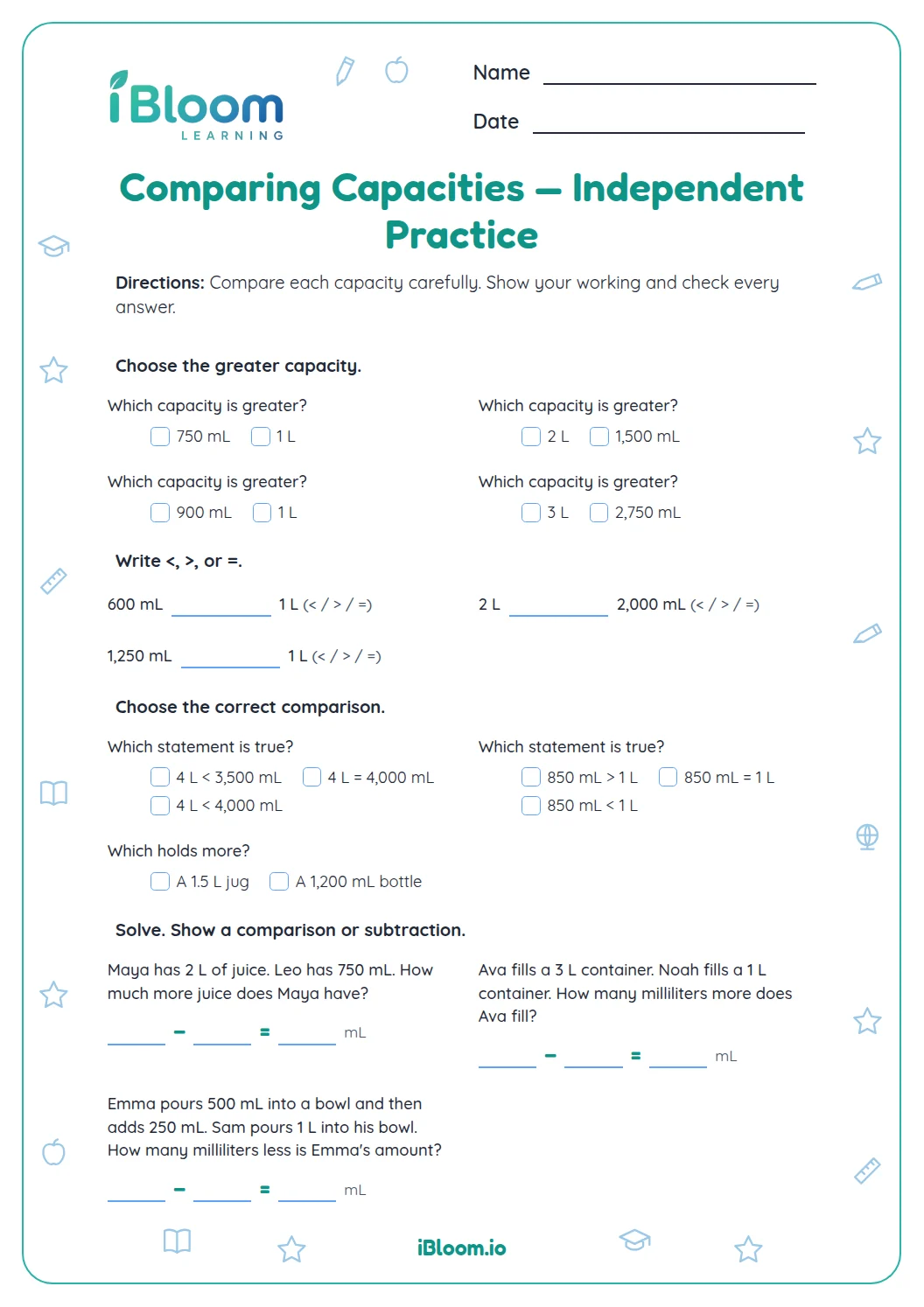
This free printable worksheet is for Grade 4 learners practicing converting liters and milliliters. It focuses on 1 L = 1,000 mL, mixed capacities, comparisons and volume situations. Across two parts, children work through 14 conversion and capacity problems. The prompts are specific to this skill, and a separate answer key supports quick checking. The page aligns with 4.MD.A.1.
Aligned to CCSS.Math.Content.4.MD.A.1
What conversions appear on the sheet?
Part A has seven conversions between liters and milliliters, including mixed capacities. Part B has one comparison and six capacity situations involving combining, subtracting, multiplying, or sharing amounts.
- Part A: 7 equivalent-capacity conversions.
- Part B: 1 comparison and 6 capacity situations.
- A separate answer key lists all 14 answers.
How do you compare two capacities?
Express both amounts in the same unit before comparing them. For example, 2 L 90 mL is 2,090 mL, which is greater than 2,009 mL. Converting first makes the extra 90 mL easy to compare.
- 1To write 2 L 450 mL in milliliters, convert 2 L to 2,000 mL and add 450 mL: 2,450 mL.
How does conversion help solve a capacity problem?
Convert to milliliters before combining or subtracting quantities. If a pitcher has 1,250 mL and a bottle has 800 mL, add 1,250 + 800 to get 2,050 mL altogether.
How to use this worksheet
- 1Write the unit you are starting with.
- 2Use 1 L = 1,000 mL for each liter.
- 3Add any leftover milliliters to the converted amount.
- 4For comparisons, rewrite both capacities in one unit.
- 5Check that the final unit matches what the question asks.
Common mistakes and quick fixes
The mistake
Writing 2 L 450 mL as 2,450 L.
The fix
Keep liters as the larger unit; the combined amount in milliliters is 2,450 mL.
The mistake
Adding 1,000 to the milliliters instead of multiplying liters by 1,000.
The fix
Count how many groups of 1,000 mL are in the number of liters.
The mistake
Comparing 2 L 90 mL with 2,009 mL without converting.
The fix
Rewrite 2 L 90 mL as 2,090 mL before comparing.
Common Core alignment
This worksheet practices converting liters and milliliters through focused Grade 4 activities.
Convert liters to milliliters and record equivalent capacities.
On this sheet: Convert liters to milliliters and record equivalent capacities.
Show the official wordingHide the official wording
Know relative sizes of measurement units within one system of units including km, m, cm; kg, g; lb, oz.; l, ml; hr, min, sec. Within a single system of measurement, express measurements in a larger unit in terms of a smaller unit. Record measurement equivalents in a two-column table. For example, know that 1 ft is 12 times as long as 1 in. Express the length of a 4 ft snake as 48 in. Generate a conversion table for feet and inches listing the number pairs (1, 12), (2, 24), (3, 36), ...
What to practice next
Make more practice
Further reading
Questions parents and teachers ask
What is the key fact for liters and milliliters?
One liter equals 1,000 milliliters. The worksheet uses that relationship to convert whole liters, mixed liter-and-milliliter amounts, and milliliters back into liters and milliliters. The answer key gives each result with the requested unit. These examples use the same conversion fact.
How many questions are included?
There are 14 questions in two parts. Seven ask for equivalent capacities; the remaining seven ask children to compare amounts or solve capacity situations. The two-page answer key lists the conversion results, comparison, and calculations. Each answer includes its matching unit.
Why convert before comparing capacities?
Liters and milliliters use different sized units, so the written numbers alone can be misleading. Converting both amounts to milliliters gives a like-unit comparison. For example, 2 L 90 mL becomes 2,090 mL before you compare it with 2,009 mL.
How should a child solve a mixed-unit problem?
First rewrite each capacity in milliliters. Then add or subtract the milliliter amounts and include the unit in the answer. For example, 1 L 250 mL becomes 1,250 mL; combined with 800 mL, the total is 2,050 mL. This gives a child one more clear way to use the page’s target skill.
Does the worksheet include a conversion table?
The worksheet includes conversion, comparison, addition, subtraction, multiplication, and sharing questions. It does not use a conversion table; instead, children apply 1 L = 1,000 mL directly to each amount and choose the requested unit for the answer. The varied contexts include both single steps and combined operations.
What can we practice after this page?
Children can move to other metric measurement worksheets for length, mass, or mixed conversions. The linked Grade 4 measurement pages connect this capacity work to other units and provide additional contexts for using conversion facts. This gives a child one more clear way to use the page’s target skill.