


About this worksheet
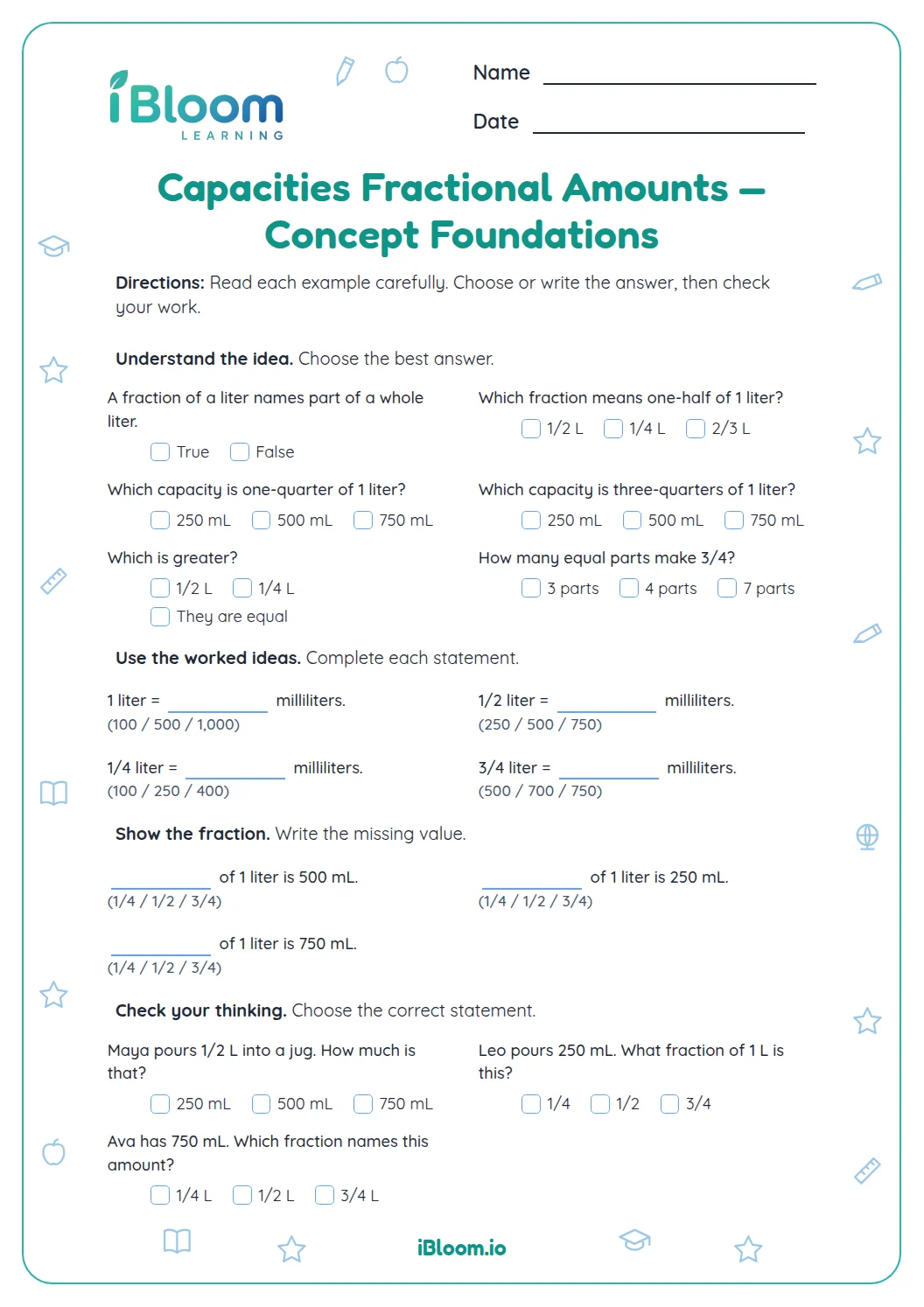
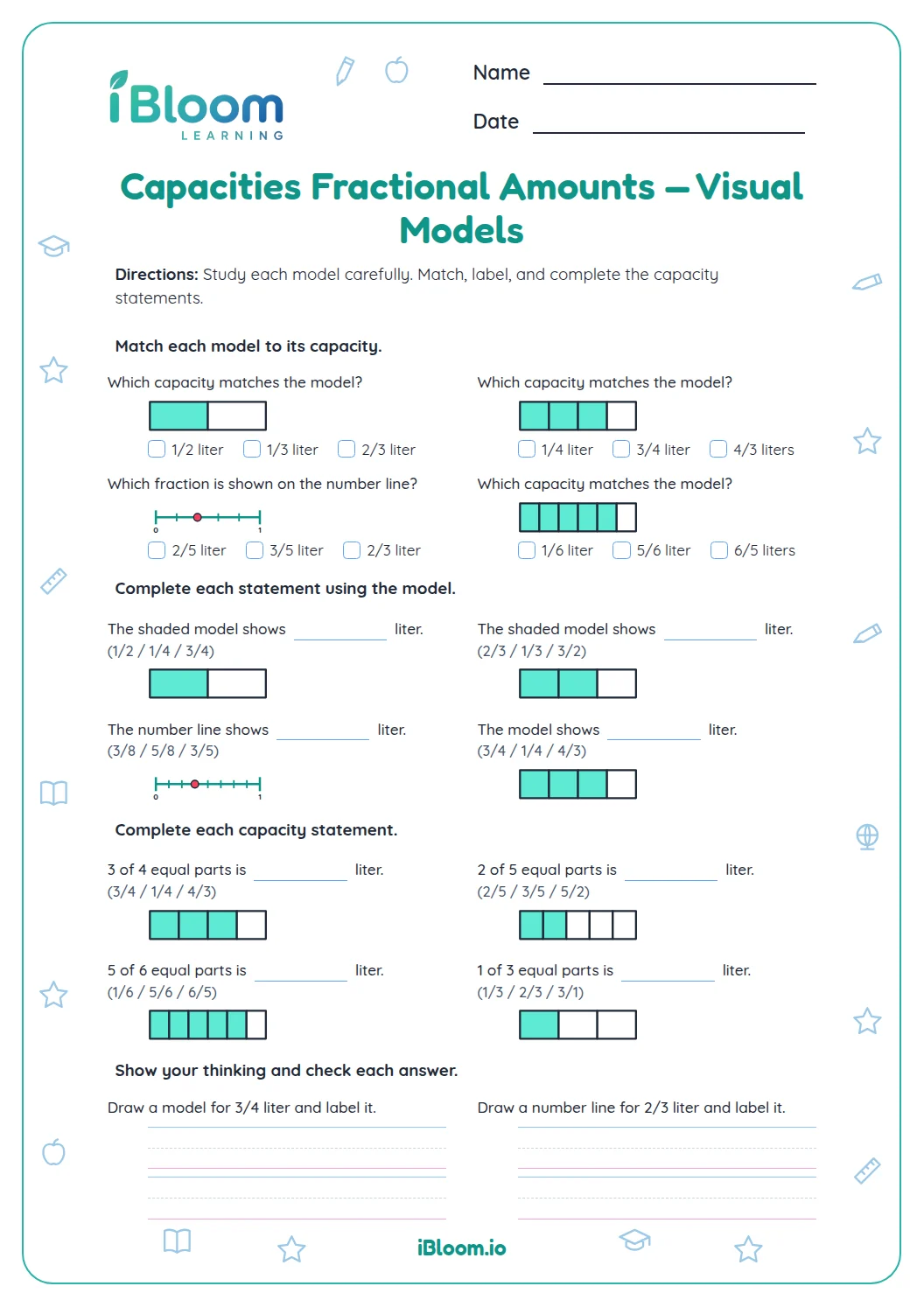
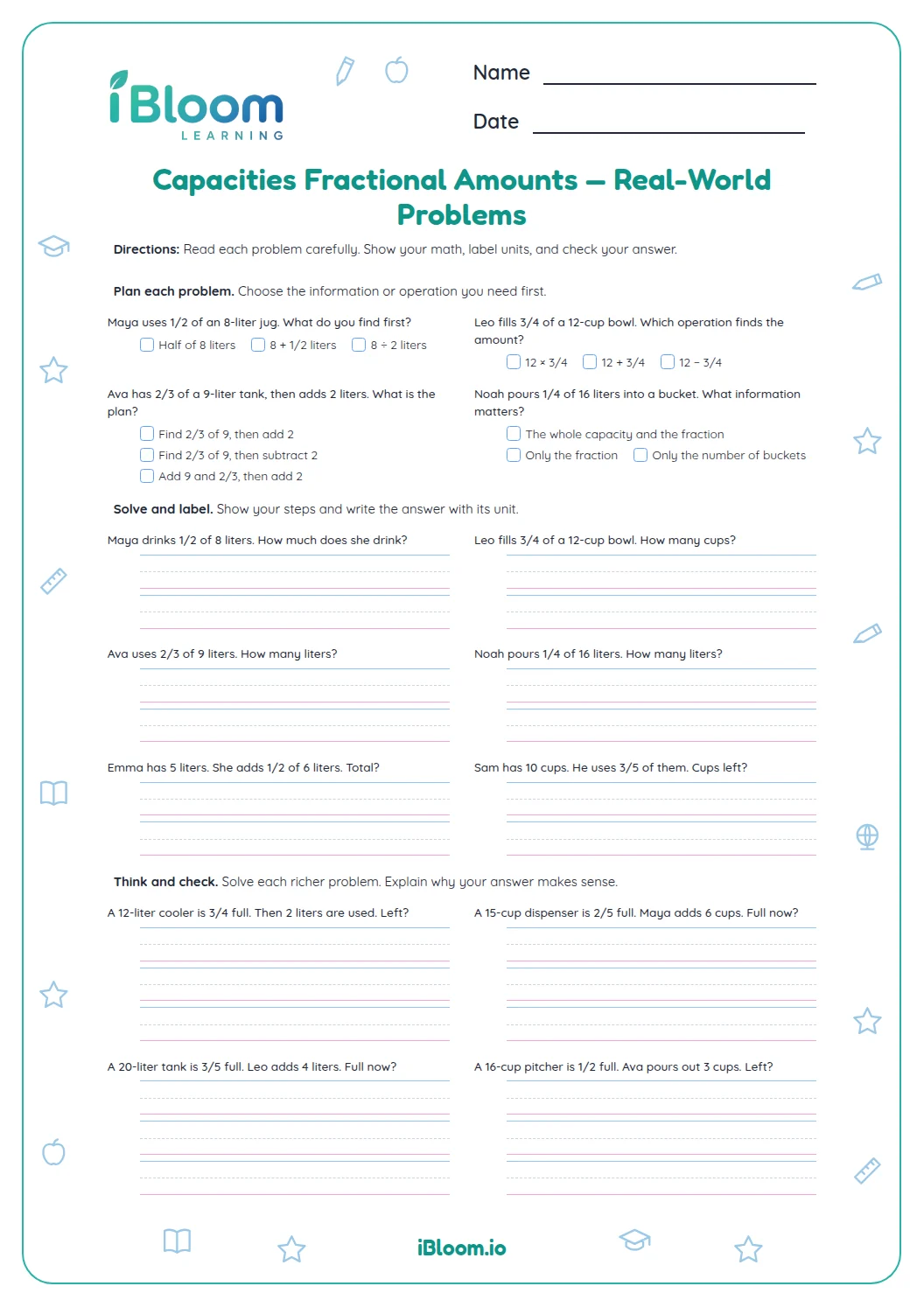
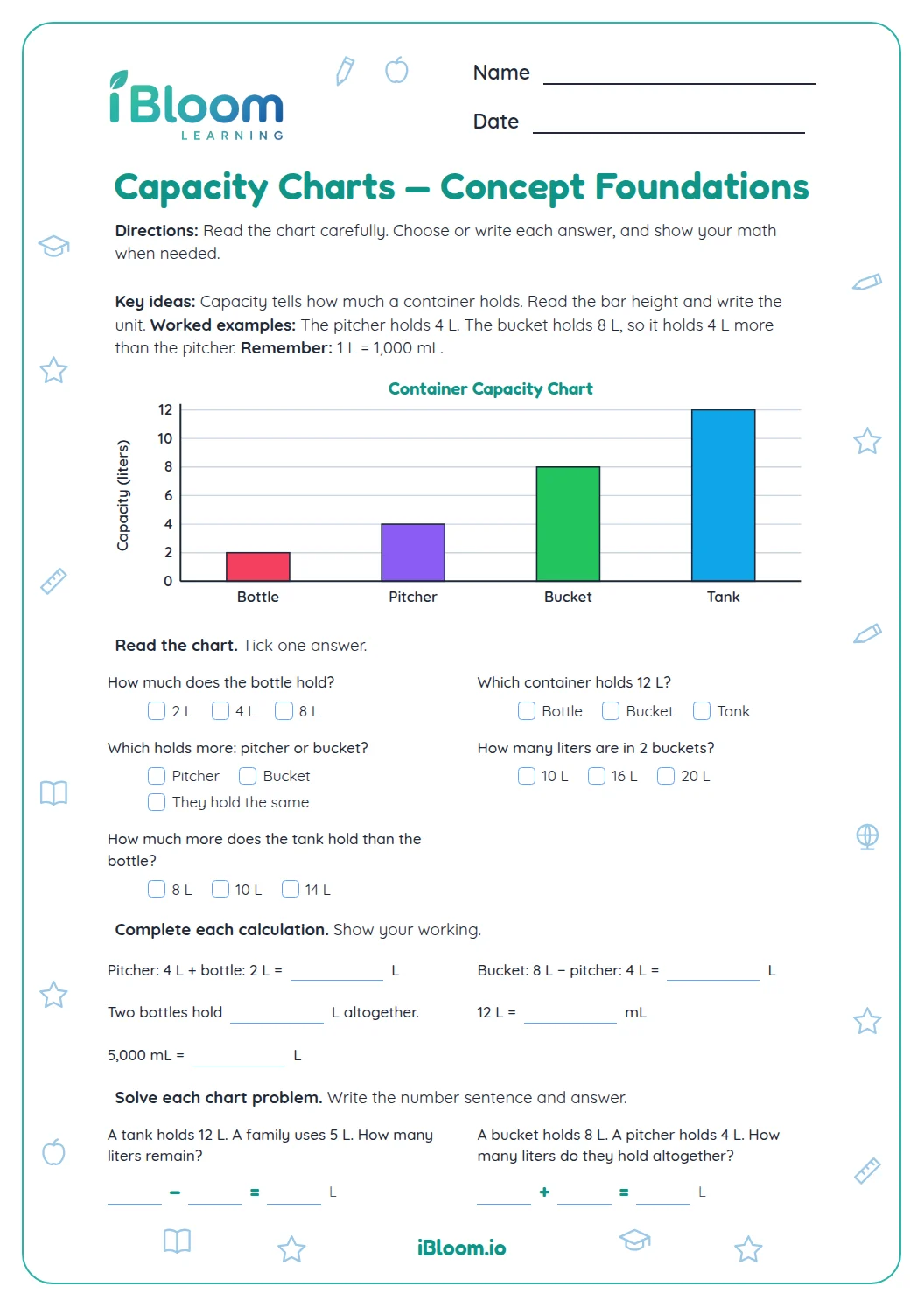
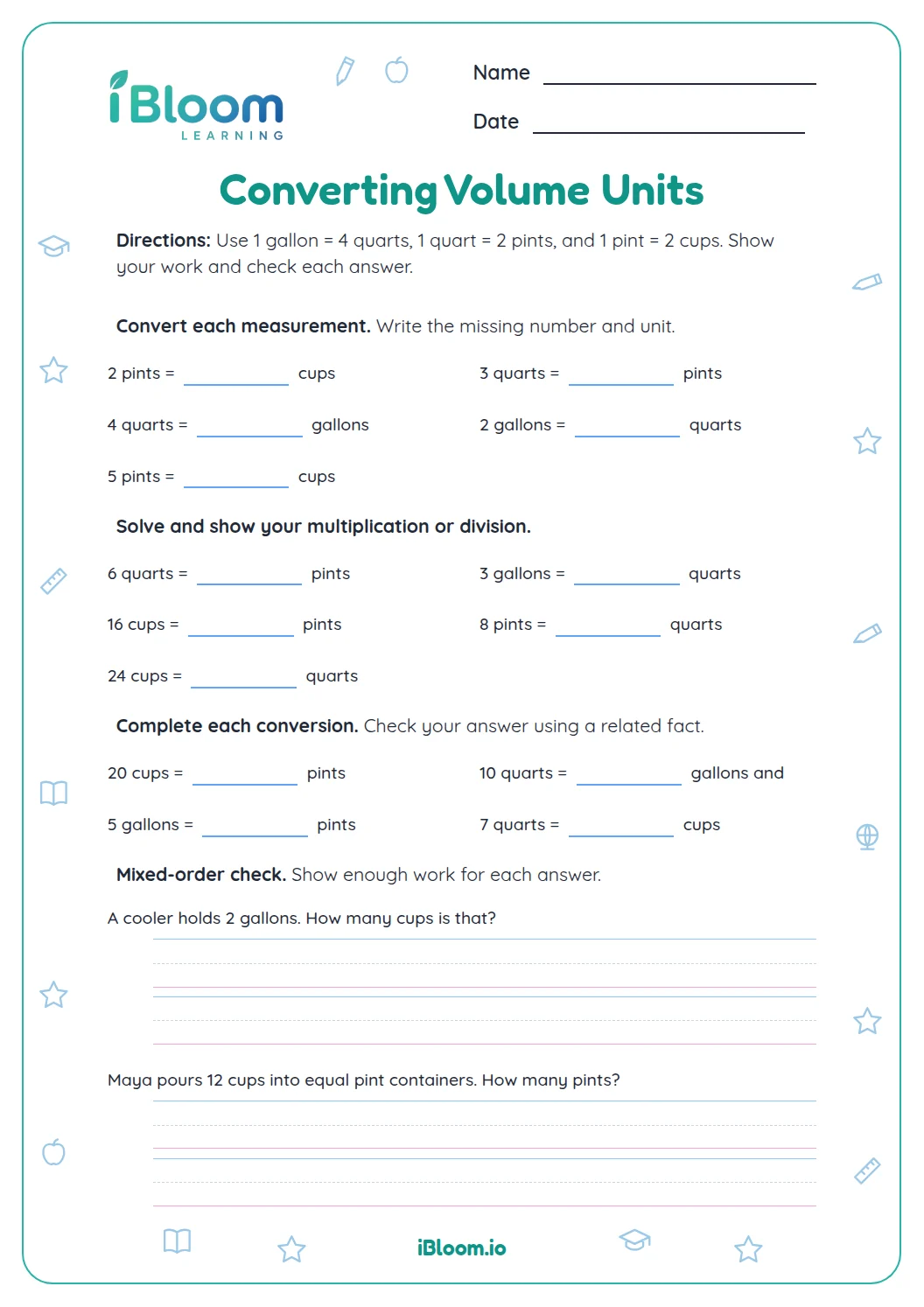
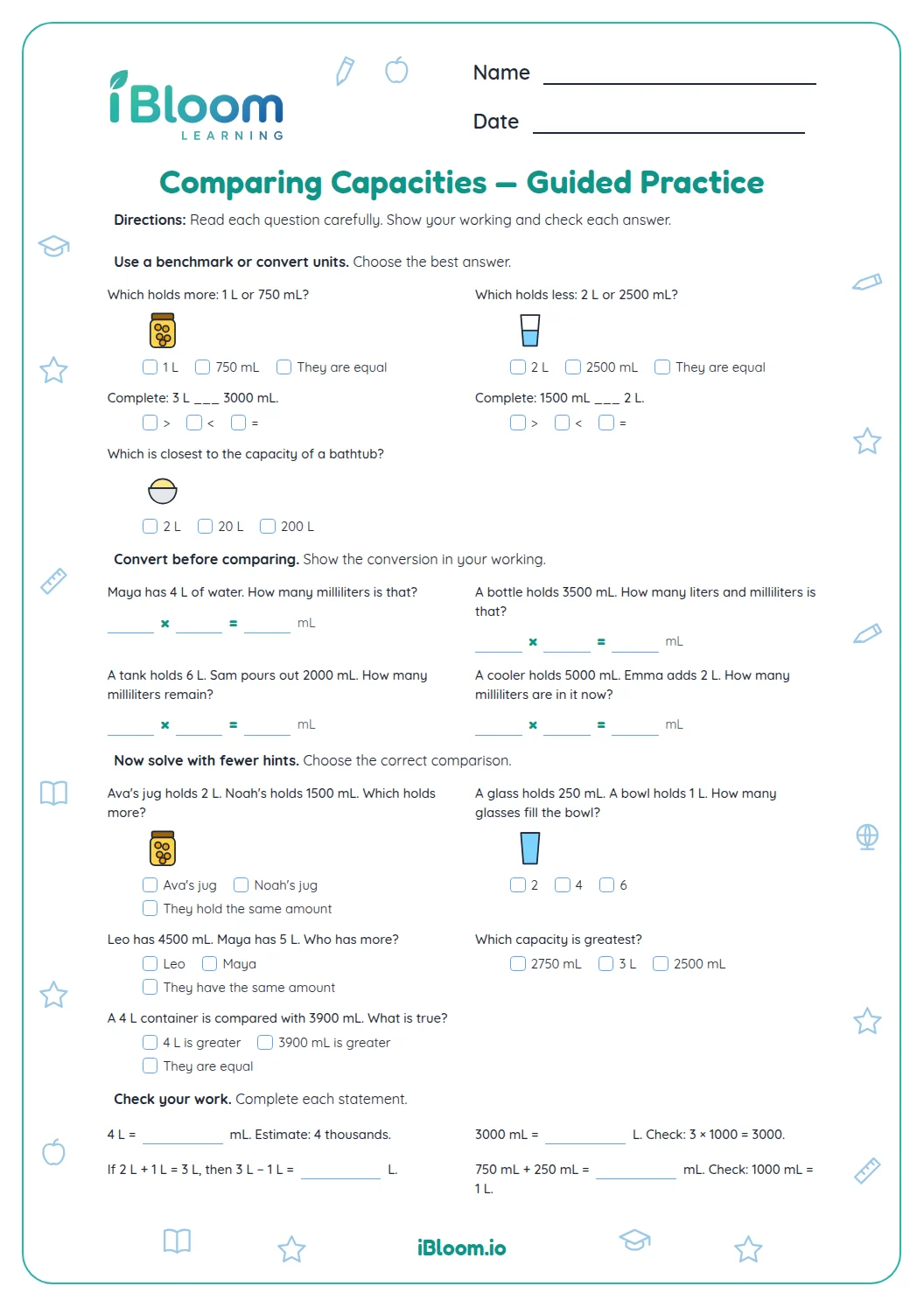
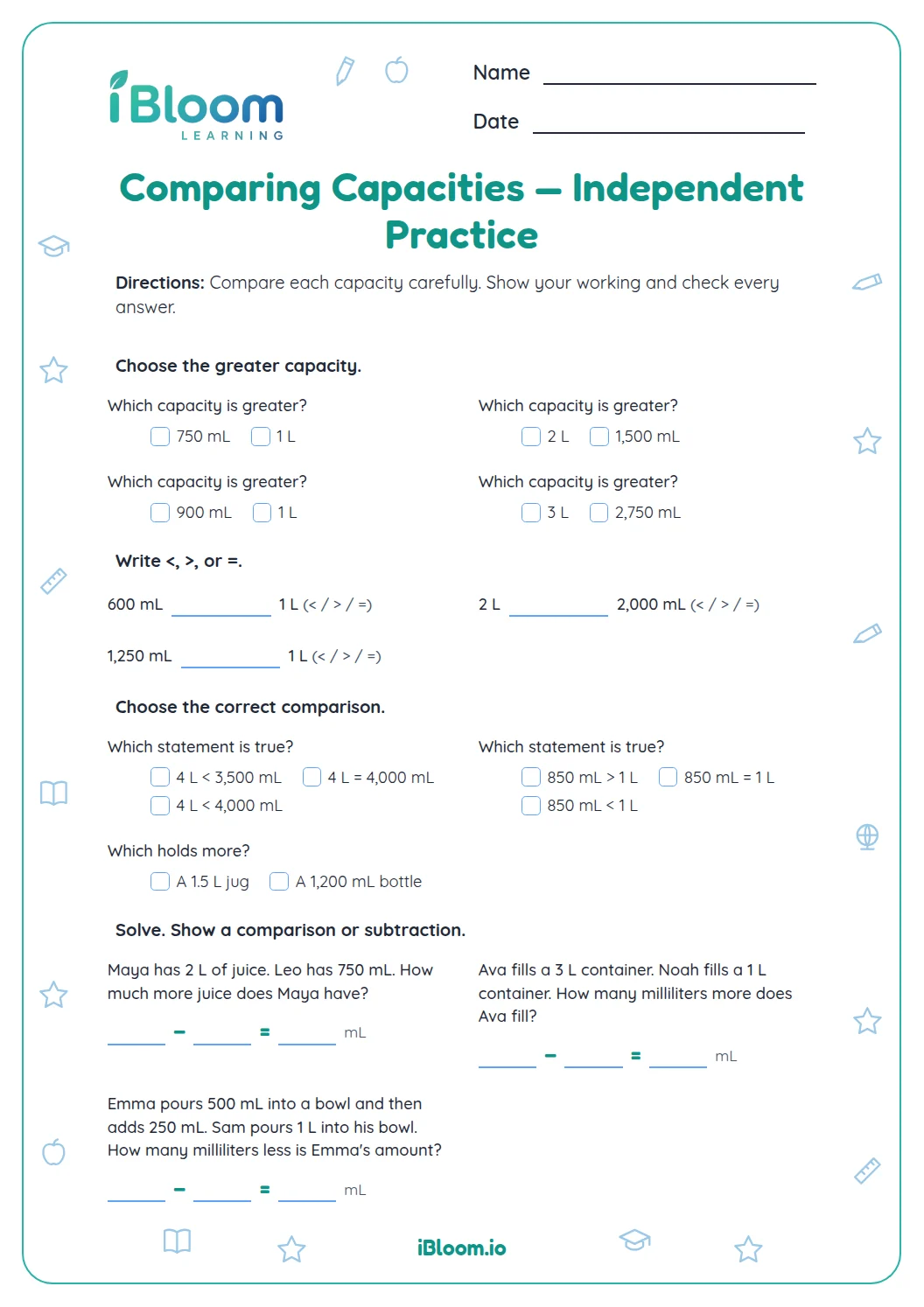
This free Grade 4 printable gives students 16 questions about fractional metric capacities. Children find fractions of liter amounts, work with milliliters, convert fractional liters to milliliters, and choose answers to short real-world problems. The amounts include unit labels so students can focus on finding a fraction of a measured quantity and checking whether the result is sensible. A separate answer key shows each result. The page aligns with Common Core 4.MD.A.2, which includes liquid-volume problems with simple fractions and measurement conversions.
Aligned to 4.MD.A.2
What does the worksheet ask students to practice?
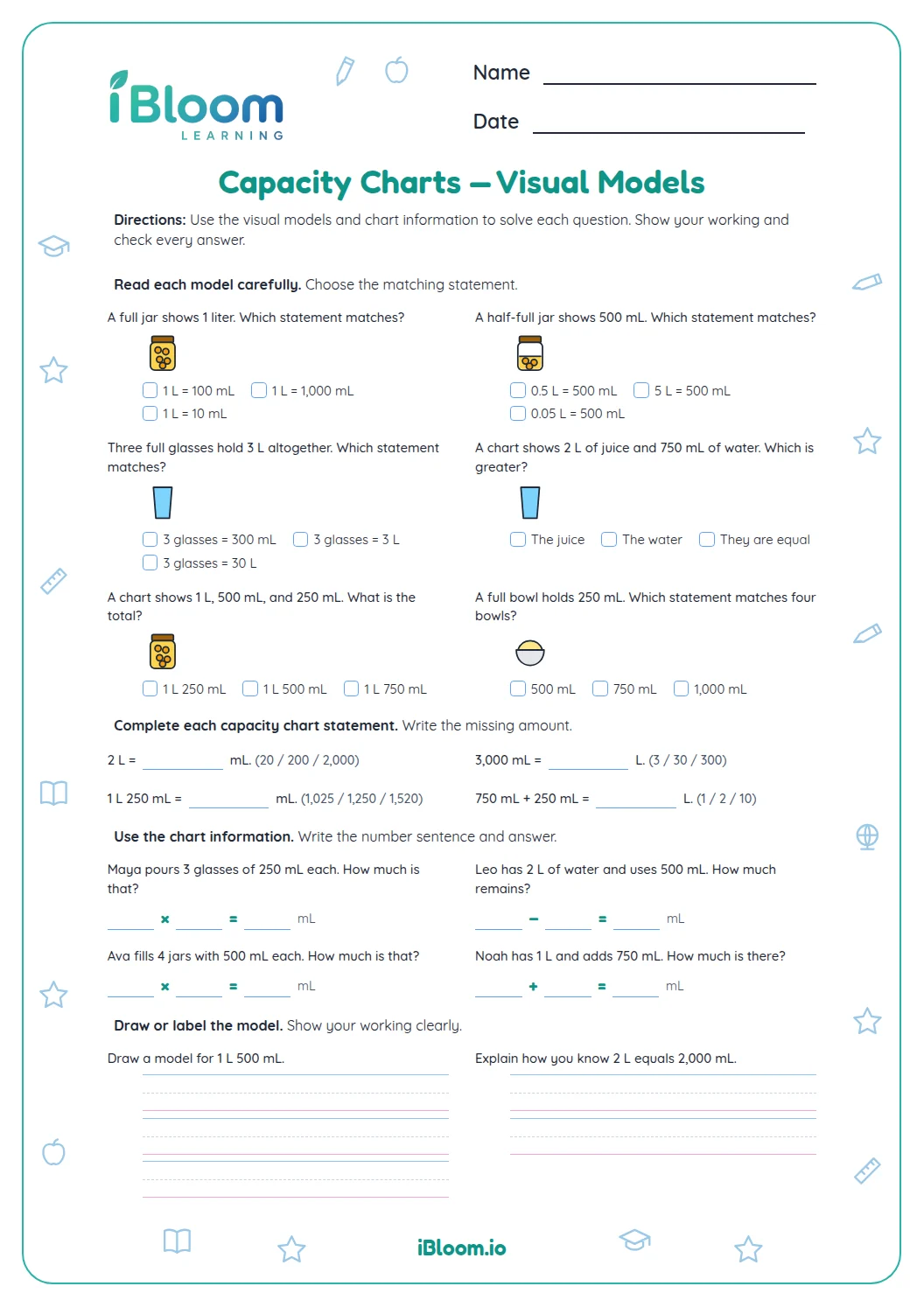
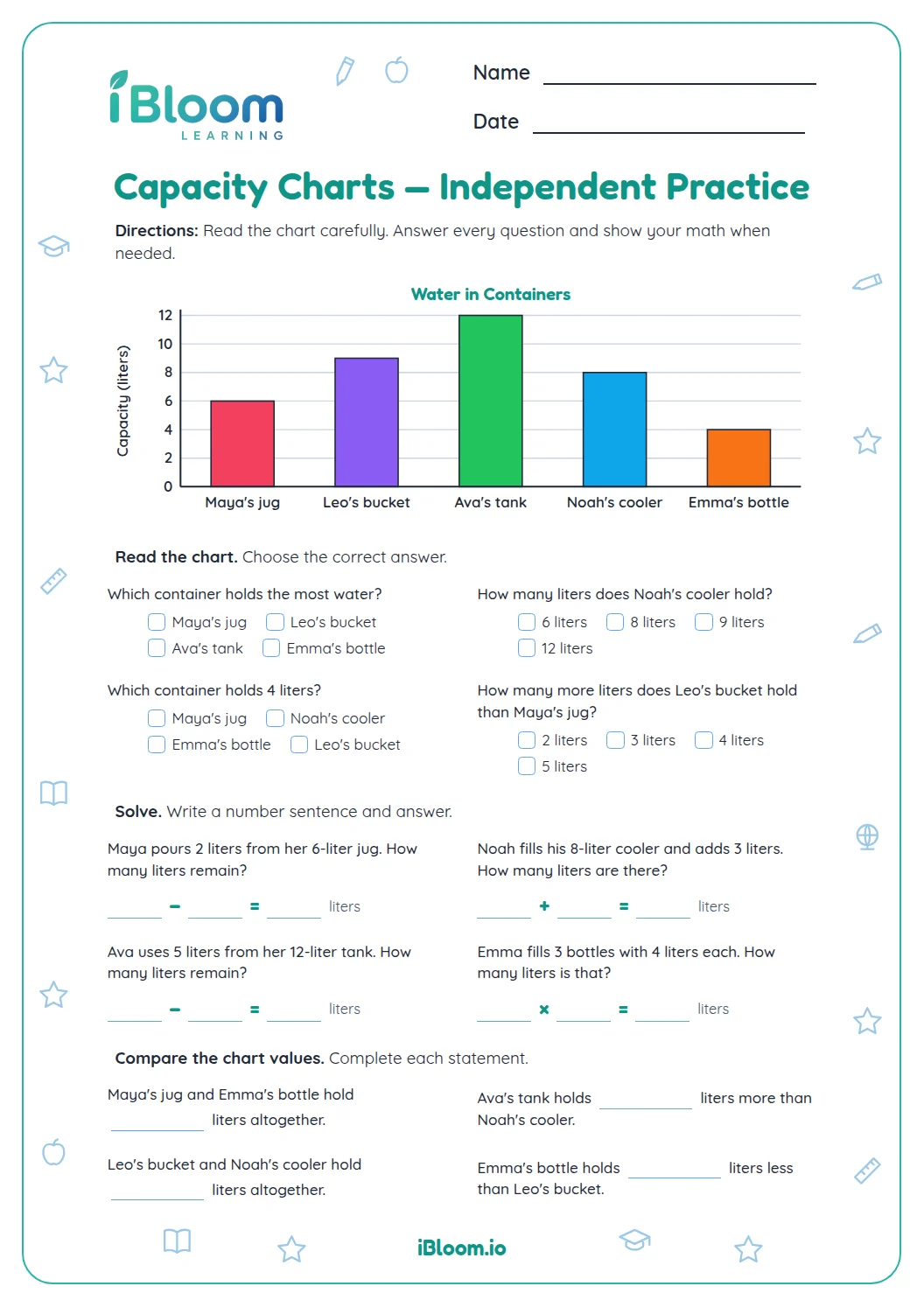
Part A finds fractions of liter amounts. Part B moves to milliliters and includes two conversions between liters and milliliters. Part C asks students to choose a sensible result for short capacity situations.
- Find unit fractions and non-unit fractions of liter amounts
- Calculate fractions of milliliter amounts
- Use 1 L = 1,000 mL for metric conversions
- Include the unit when an item asks for a measurement
How do you find a fraction of a capacity amount?
Find the fraction of the number, then keep the same unit unless the question asks for a conversion. For a unit conversion, use 1 L = 1,000 mL.
- 1Find 3/4 of 16 L.
- 216 ÷ 4 = 4 L in each fourth.
- 34 × 3 = 12 L.
- 4So 3/4 of 16 L is 12 L.
When should you convert liters to milliliters?
Convert when the question asks for the answer in the smaller unit. Since 1 L is 1,000 mL, 3/4 L is 3/4 of 1,000 mL, or 750 mL. Keep the requested unit in the final answer.
How to use this worksheet
- 1Read the amount and unit before calculating.
- 2Divide by the denominator to find one equal part.
- 3Multiply by the numerator to find the requested fraction.
- 4For liters to milliliters, use 1 L = 1,000 mL.
- 5Write the unit when the prompt asks for a complete measurement.
- 6Check that a fraction less than one gives an amount smaller than the whole.
Common mistakes and quick fixes
The mistake
Multiplying by the denominator instead of dividing into equal parts.
The fix
Find one part first by dividing the whole amount by the denominator, then count the requested parts.
The mistake
Changing liters to milliliters without using 1,000 mL in one liter.
The fix
Write 1 L = 1,000 mL beside the question before converting.
The mistake
Giving a value larger than the whole for a fraction less than one.
The fix
Estimate first: one-half or three-fourths of an amount must be smaller than the whole.
Common Core alignment
Solve liquid-volume problems with simple fractions and measurement conversions.
On this sheet: Questions use fraction amounts of customary liquid capacity units and convert larger units to smaller units.
Show the official wordingHide the official wording
Use the four operations to solve word problems involving distances, intervals of time, liquid volumes, masses of objects, and money, including problems involving simple fractions or decimals, and problems that require expressing measurements given in a larger unit in terms of a smaller unit. Represent measurement quantities using diagrams such as number line diagrams that feature a measurement scale.
What to practice next
Make more practice
Further reading
Questions parents and teachers ask
Which metric units appear on this worksheet?
The questions use liters (L) and milliliters (mL). Students find fractions of amounts such as 8 L or 600 mL, then use 1 L = 1,000 mL when an item asks for a conversion. The unit is printed in each prompt so students can keep the measurement clear.
How do you find a fraction of a liter amount?
Divide the amount by the denominator to find one equal part, then multiply that part by the numerator. For example, 3/4 of 16 L is 4 L three times, or 12 L. The worksheet uses the same process for liters and milliliters.
How many questions are included?
There are 16 questions: eight fraction calculations with liters, five milliliter calculations or conversions, and three multiple-choice capacity situations. The first items build the calculation routine, while the last part asks students to apply it and judge whether a result makes sense.
When should students convert from liters to milliliters?
Convert when the question requests milliliters or combines an amount given in liters with an answer in milliliters. Use 1 L = 1,000 mL, so 3/4 L equals 750 mL. Keep the requested unit in the final answer, and check that the amount is smaller than one liter.
Is an answer key included?
Yes. The separate key shows the result for all 16 items. For the calculation questions, have students show how they divided by the denominator and multiplied by the numerator. For conversion questions, check that they used 1,000 mL for each liter.