

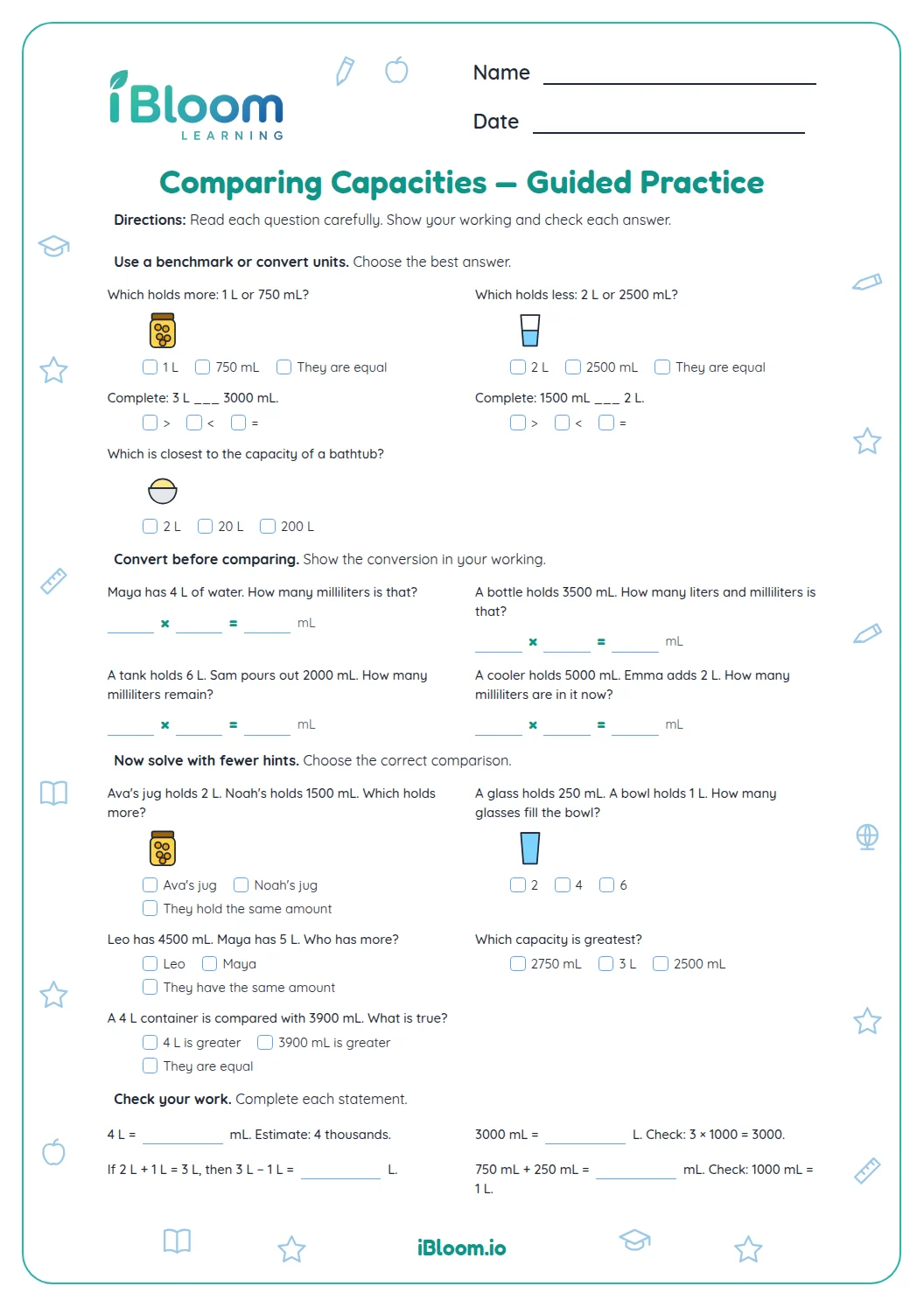
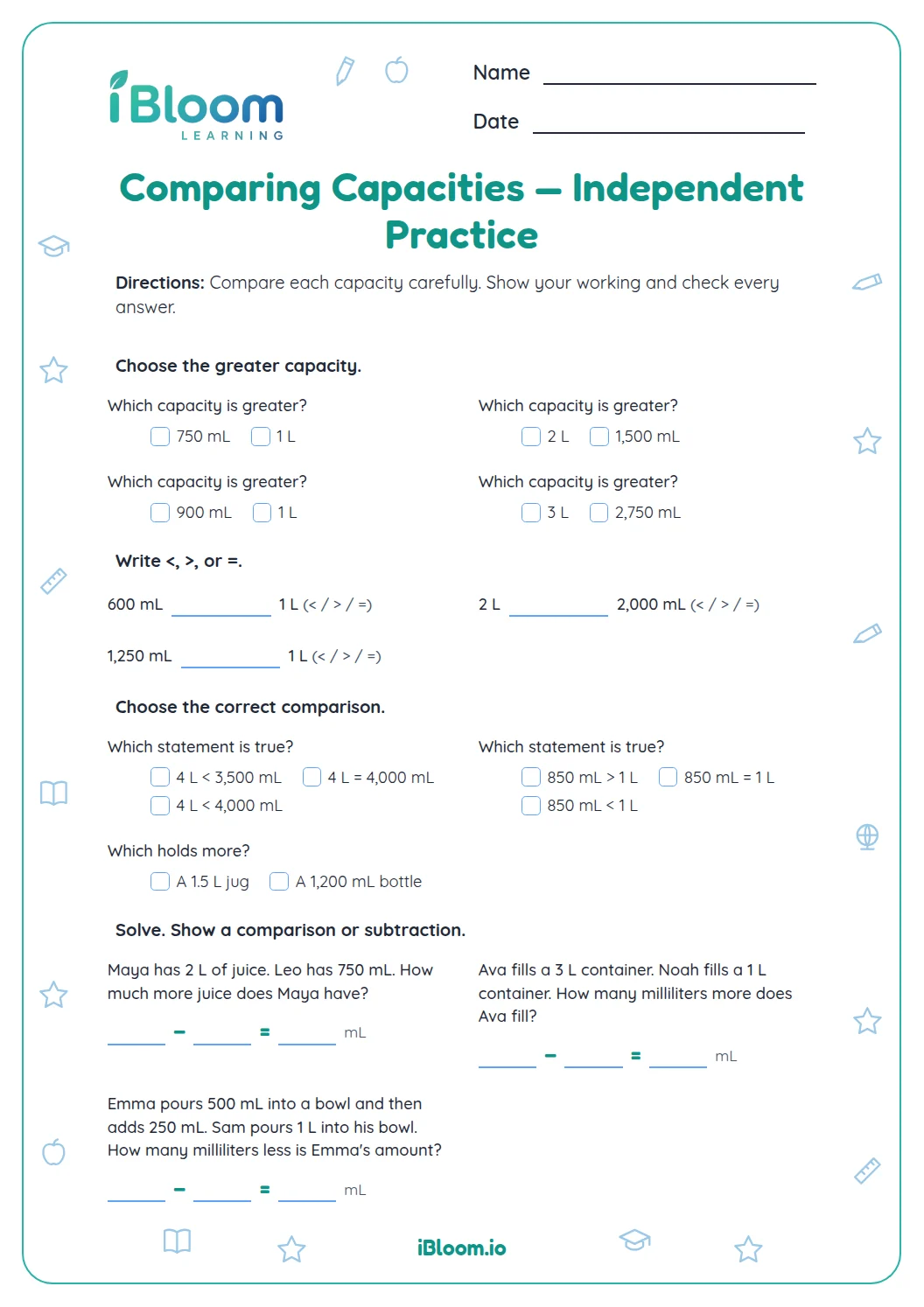
About this worksheet
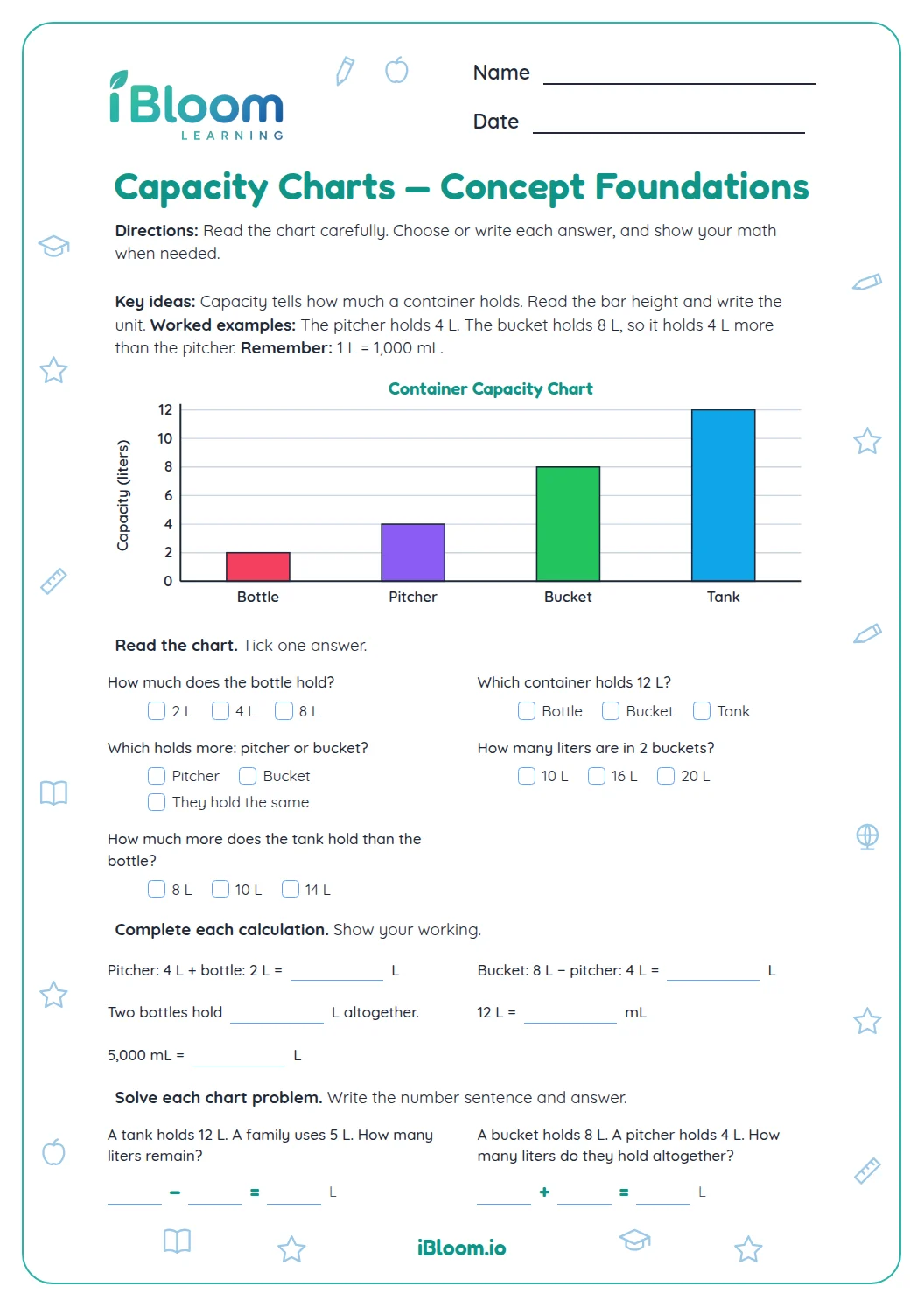
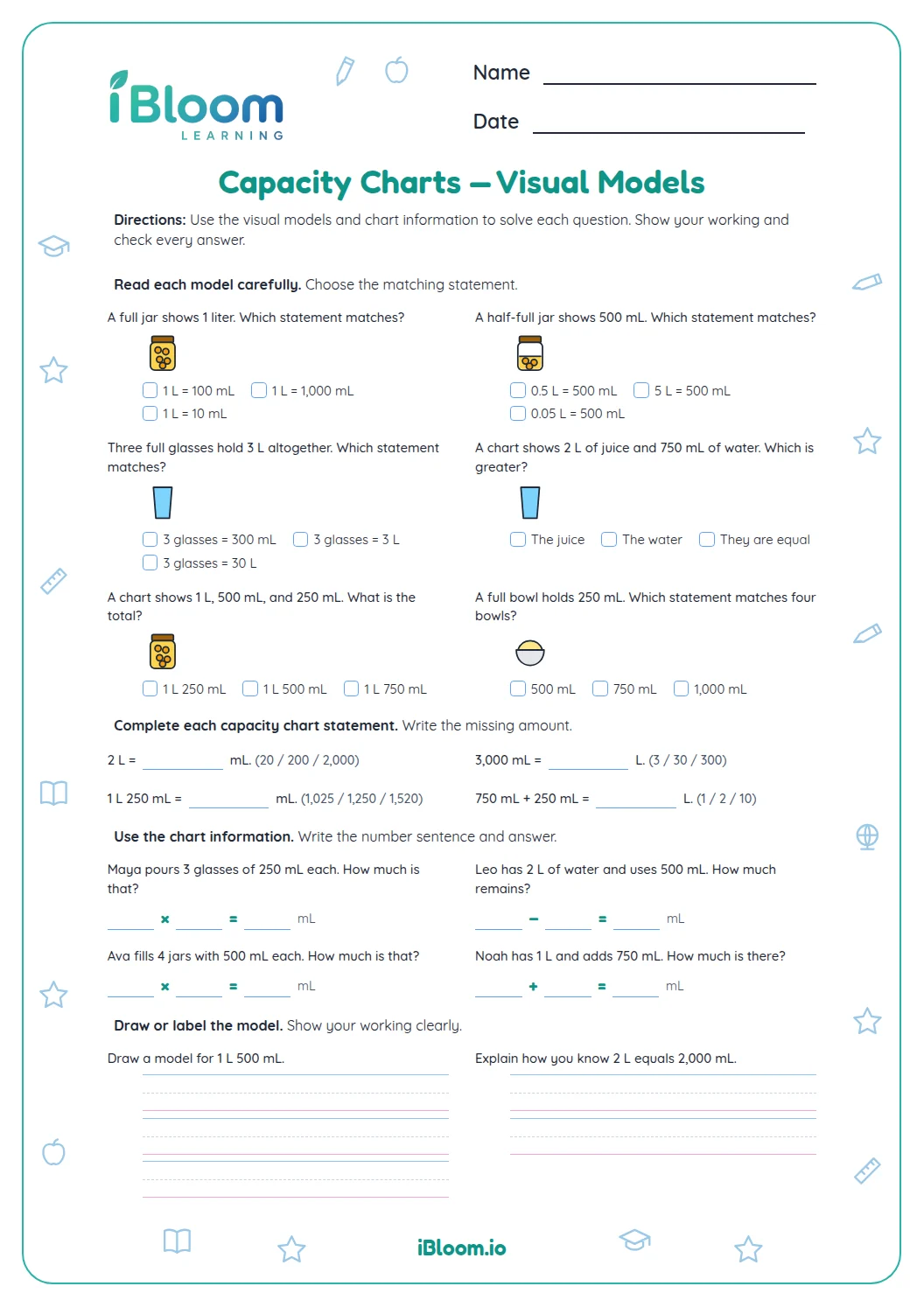
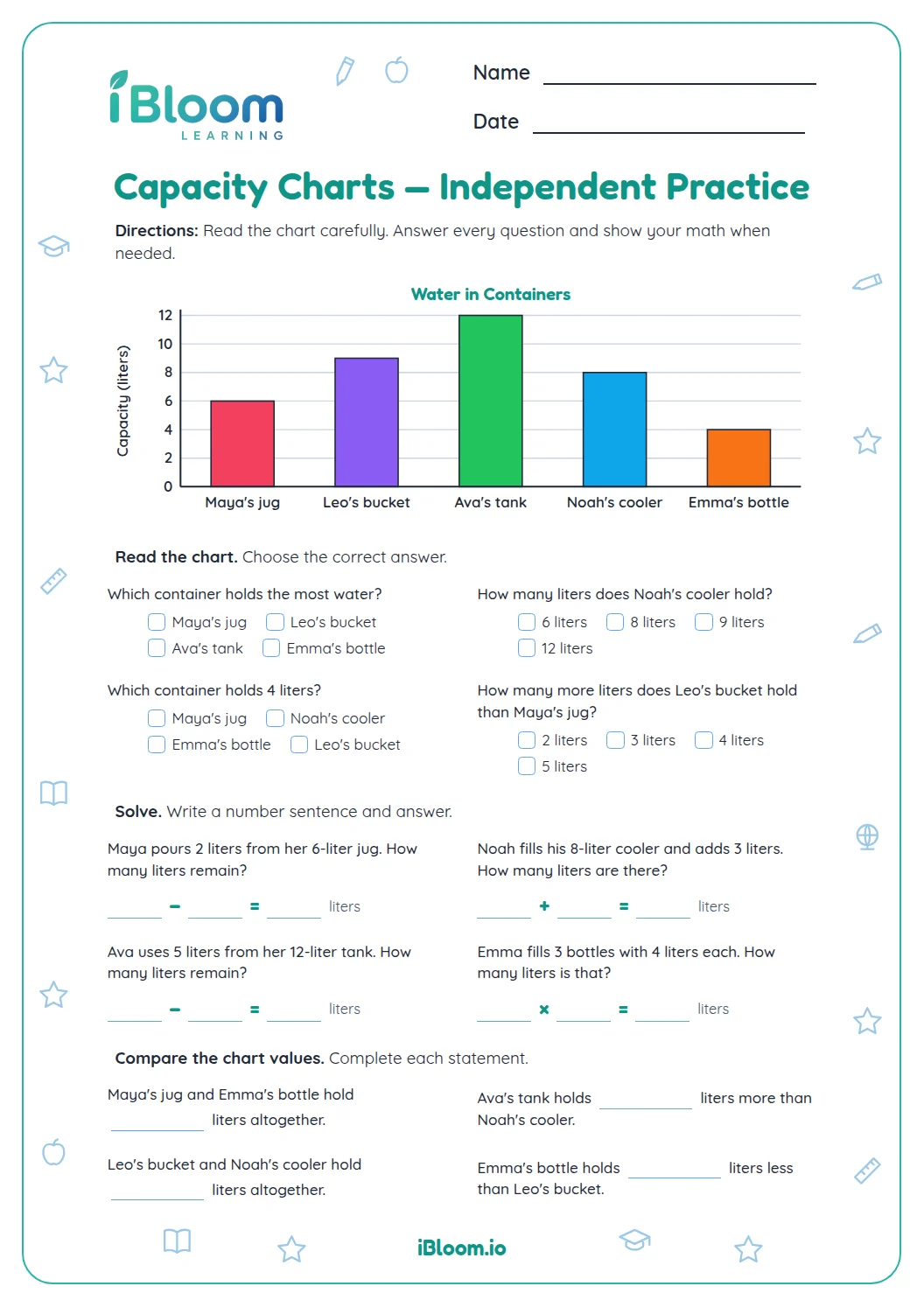
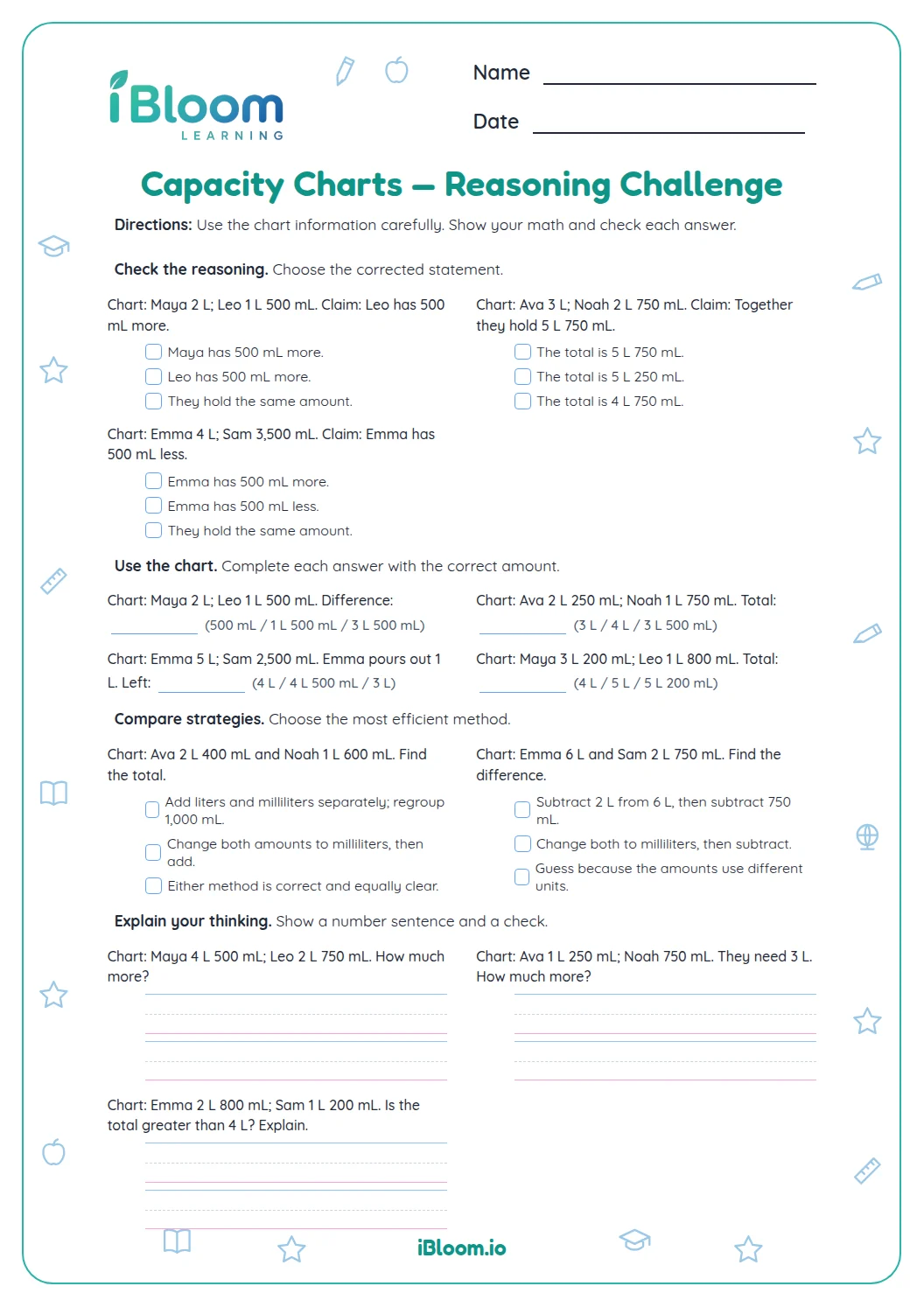
This Grade 4 printable uses a capacity chart to practice customary conversions among cups, pints, quarts, and gallons. Learners complete direct conversions, solve short capacity situations, and compare amounts after expressing them in a common unit. The worksheet pages include 14 questions and a visible reference chart; a separate answer key follows. The work practices CCSS 4.MD.A.1 by expressing measurements in equivalent units within one system.
Aligned to 4.MD.A.1
How can the capacity chart guide a conversion?
The chart pairs gallons with quarts, quarts with pints, and pints with cups. For 3 gallons = ___ quarts, use 1 gallon = 4 quarts: 3 groups of 4 make 12 quarts.
How do capacity facts solve a story?
Name the given unit and the unit asked for, then choose the matching fact. Four quarts equal 8 pints because each quart contains 2 pints. Write the equation before recording the answer with its unit.
How can two amounts be compared?
Convert one amount so both are in the same unit. Since 3 pints equal 6 cups, 3 pints is greater than 7 cups.
How to use this worksheet
- 1Read the unit named in the question.
- 2Find its matching relationship in the chart.
- 3Multiply or divide by the number of equal groups.
- 4Write the requested unit with every story answer.
- 5Compare amounts only after converting them to one unit.
- 6Use the answer key to check both number and unit.
Common mistakes and quick fixes
The mistake
Multiplying when changing to a larger unit.
The fix
Use the chart direction: fewer larger units means divide.
The mistake
Using the wrong pair of units.
The fix
Trace the relationship one step at a time: cups to pints to quarts to gallons.
The mistake
Leaving off the unit.
The fix
Copy the unit asked for after the number.
Common Core alignment
This worksheet practices 4.MD.A.1 through the questions on the printable.
The questions apply 4.MD.A.1 to capacity charts practice.
On this sheet: The worksheet items directly practice capacity charts.
Show the official wordingHide the official wording
Know relative sizes of measurement units within one system of units including km, m, cm; kg, g; lb, oz.; l, ml; hr, min, sec. Within a single system of measurement, express measurements in a larger unit in terms of a smaller unit. Record measurement equivalents in a two-column table.
What to practice next
Make more practice
Further reading
Questions parents and teachers ask
What unit relationships appear here?
The problems use customary capacity facts: 2 cups equal 1 pint, 2 pints equal 1 quart, and 4 quarts equal 1 gallon. Learners use these equalities to move between units and solve short situations. The conversion chart on the sheet keeps the relationships visible during practice.
How does the chart help with a conversion?
Read the pair of units in the question, then follow the chart from the given unit to the requested one. For example, a quart is 2 pints, so 4 quarts make 8 pints. Multiplying by the number of equal groups works when changing to a smaller unit.
Does the sheet include word problems?
Yes. Four questions ask learners to use capacity facts in short situations, such as converting a cooler’s gallons to quarts. Each gives space to write a number sentence and the requested unit, so the relationship is recorded along with the result.
How many questions and pages are included?
There are 14 questions. The printable has worksheet pages followed by a separate answer key, giving room for conversions, capacity stories, and comparisons without crowding each item. The key also shows the expected units for story answers, which makes it easy to spot a correct number with an incomplete label.
What should I check in an answer?
Check both the number and the unit. A correct conversion can still be incomplete if it says 8 without identifying pints or quarts. For a comparison, make sure the selected amount is greater or less as the prompt requests. Point to the chart relationship before calculating.