
About this worksheet
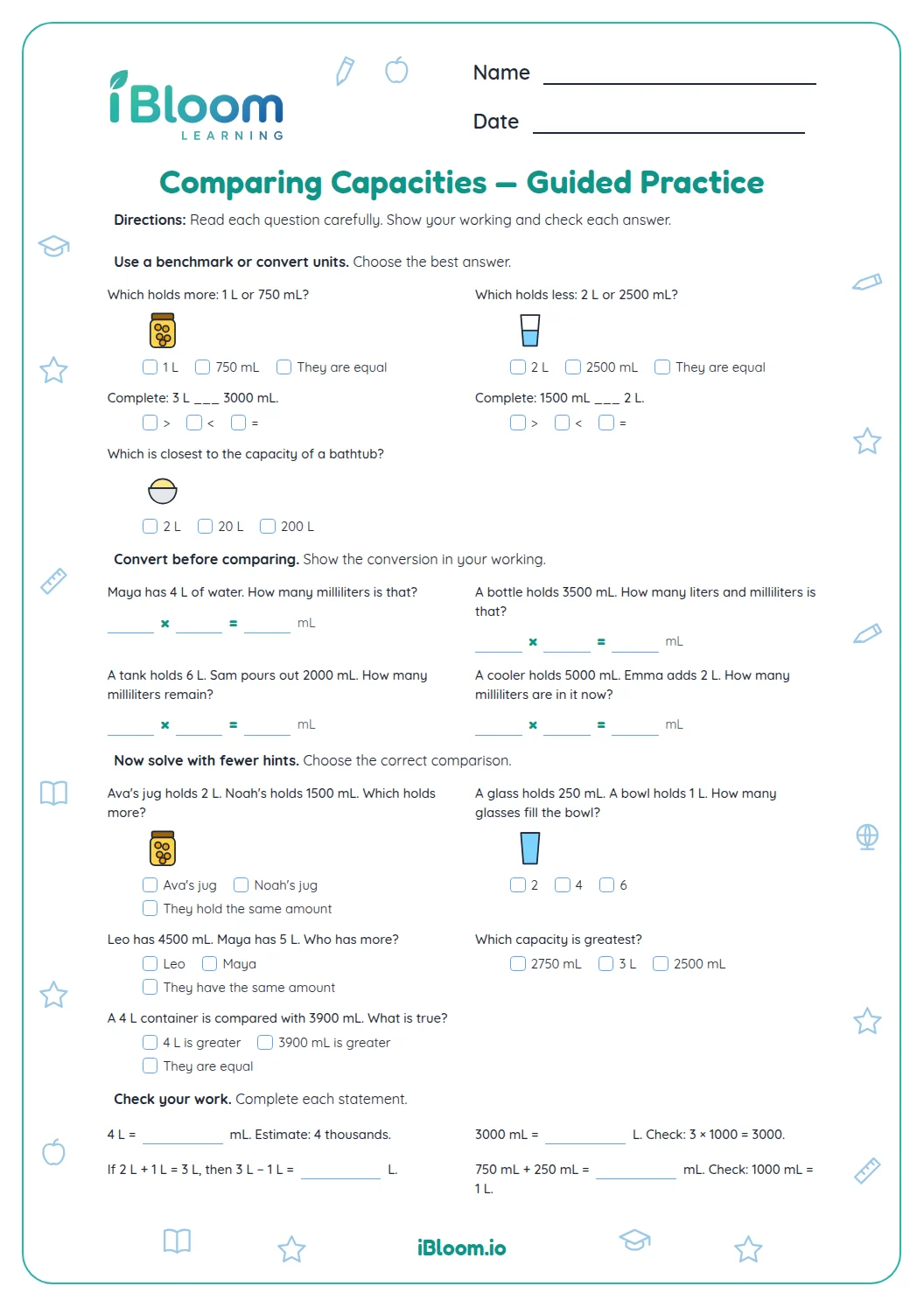
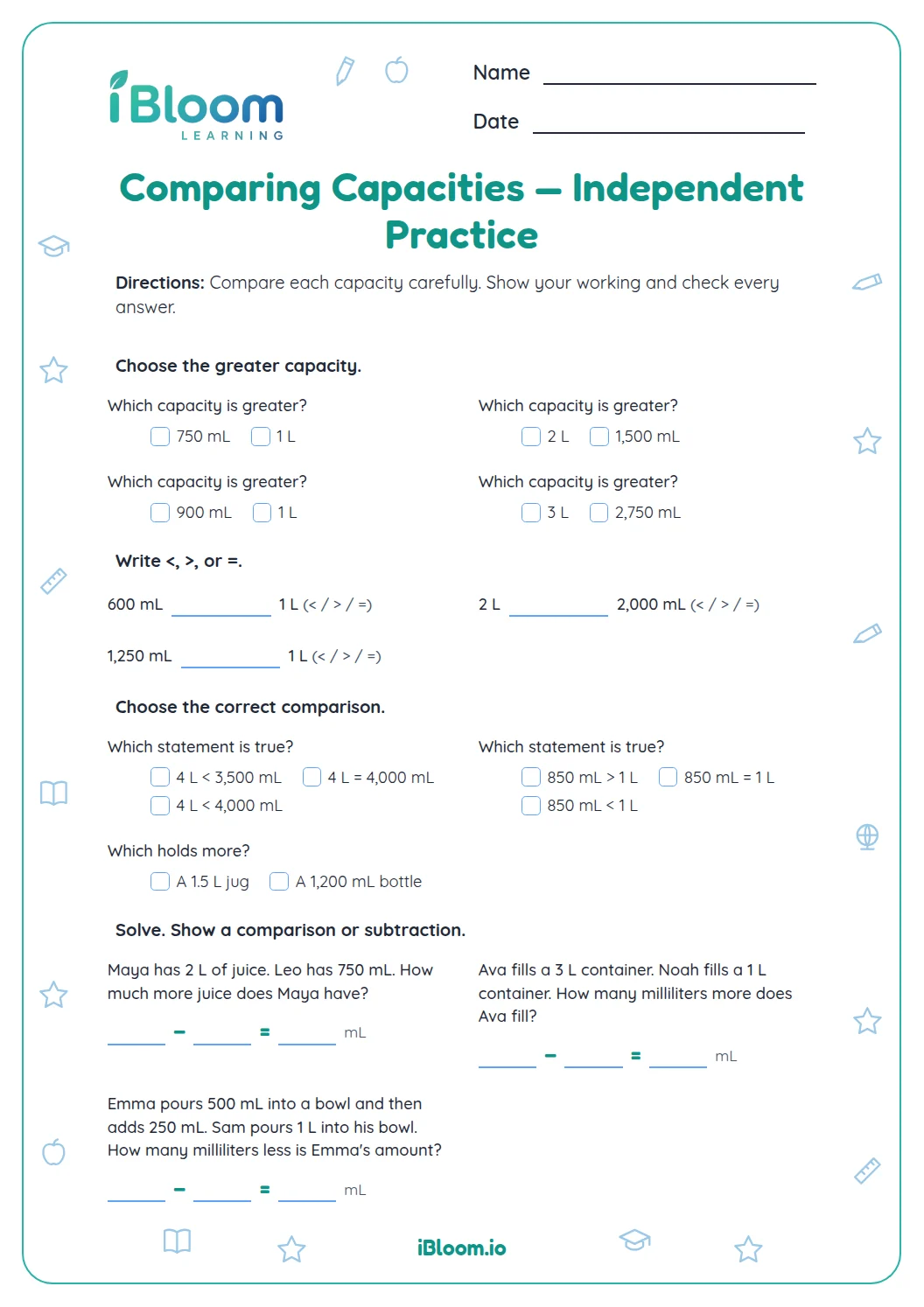
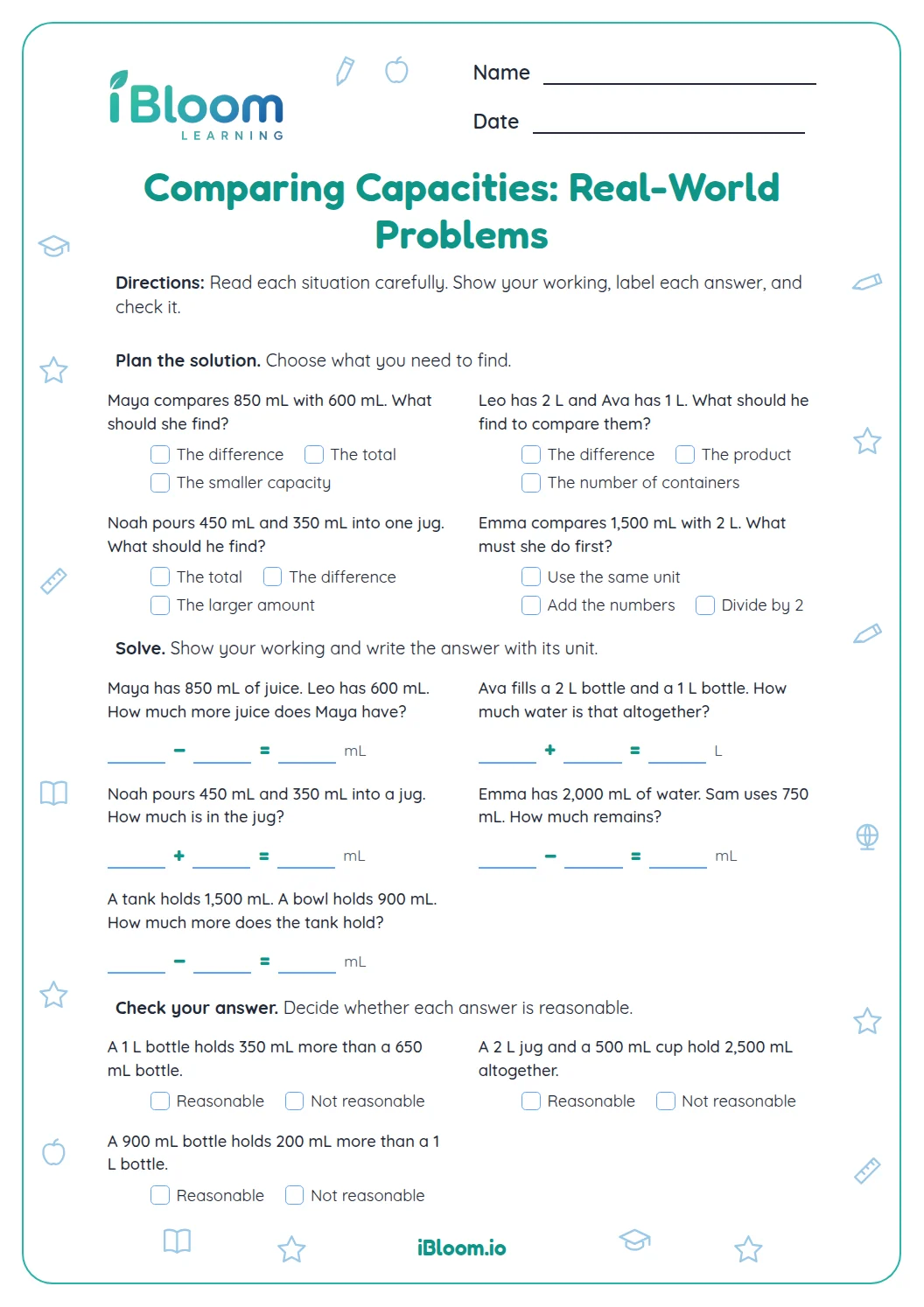
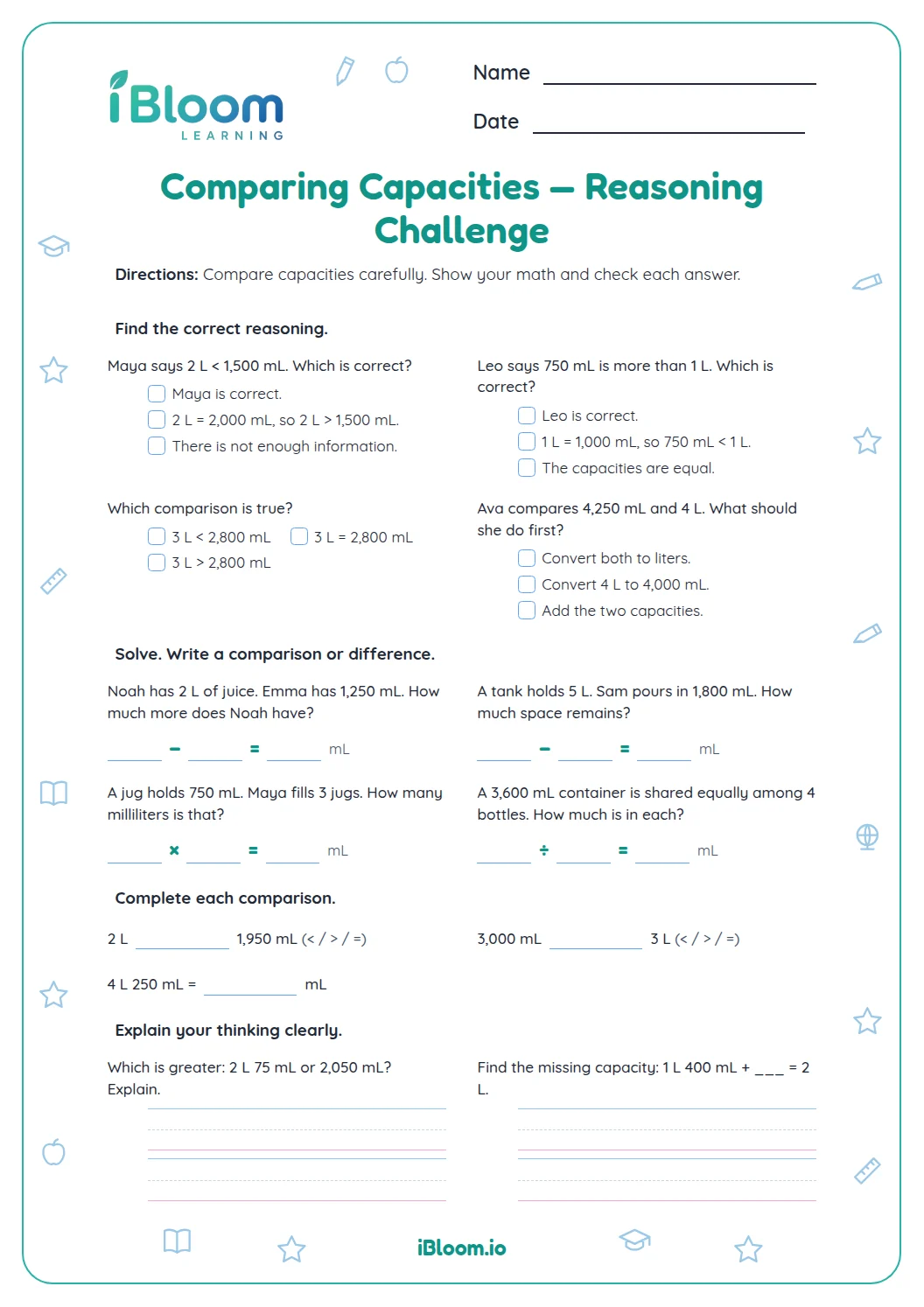
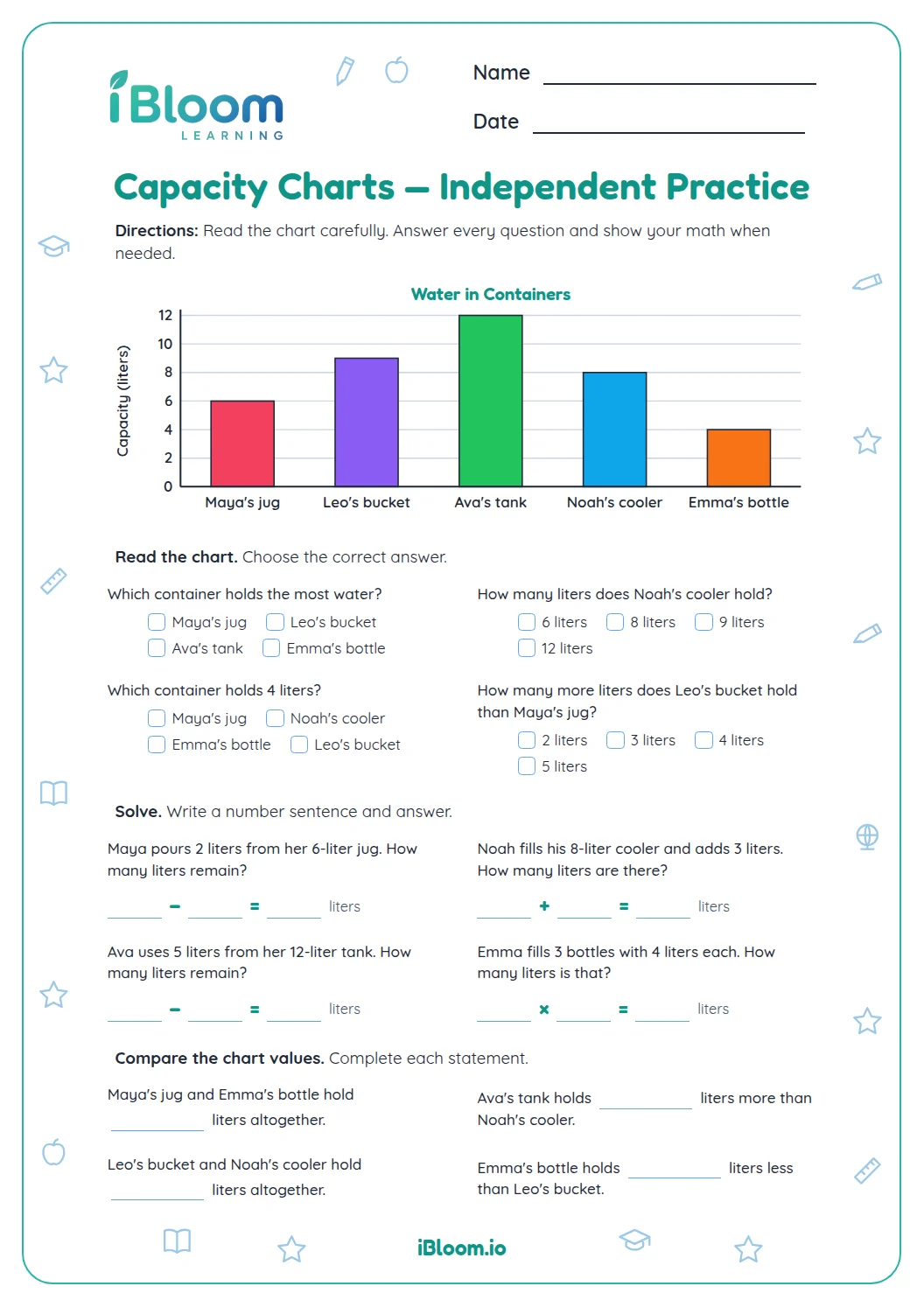
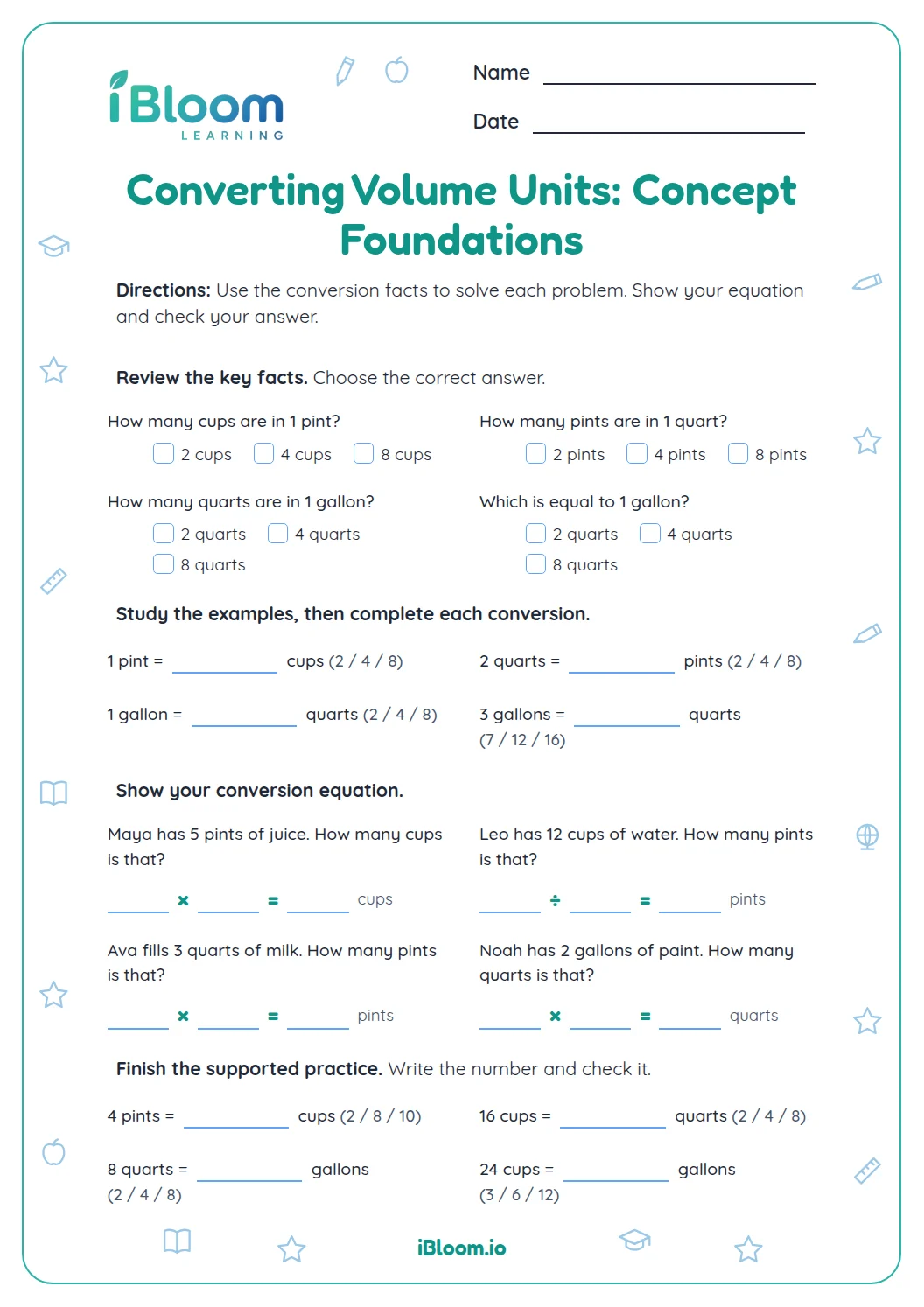
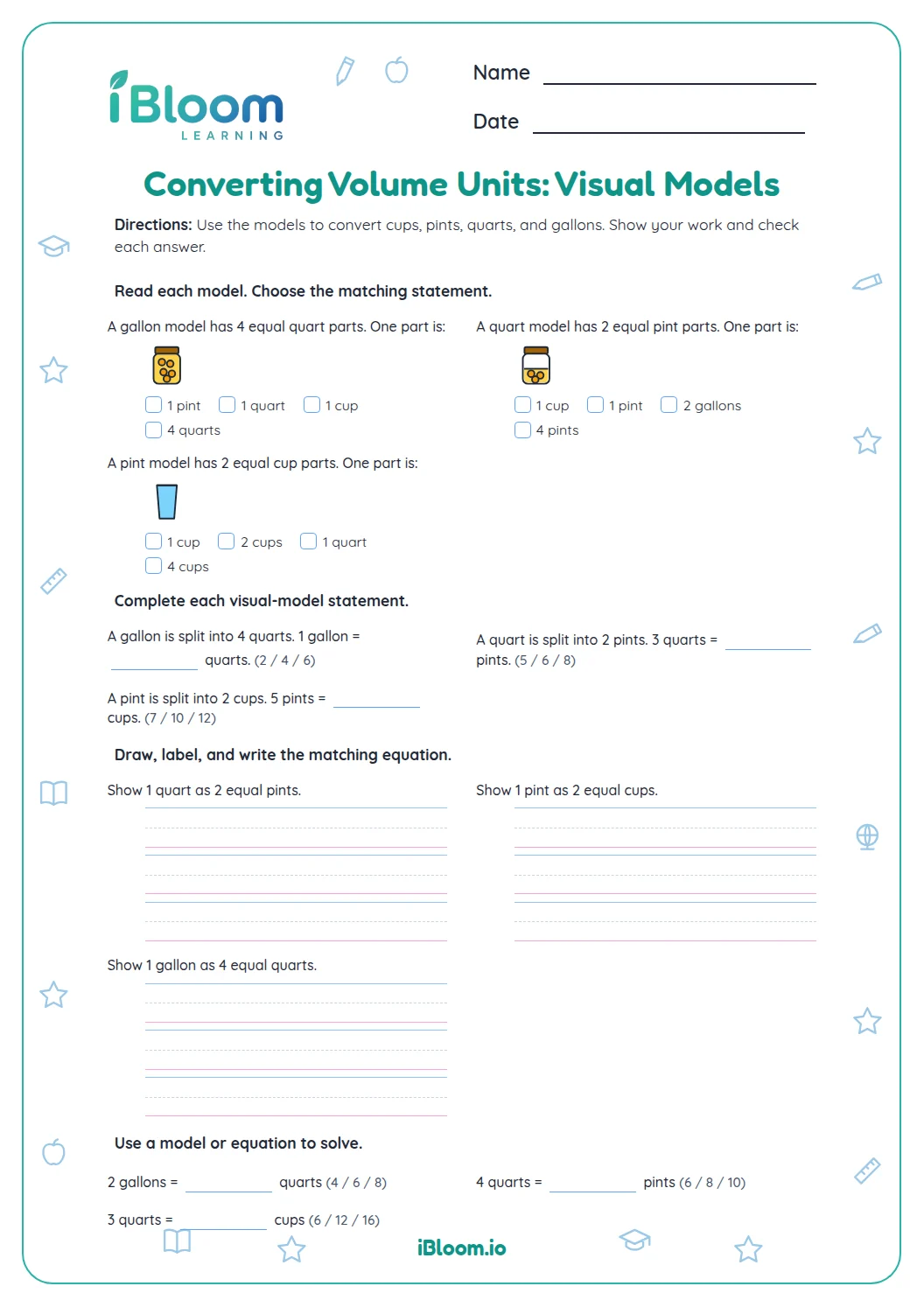
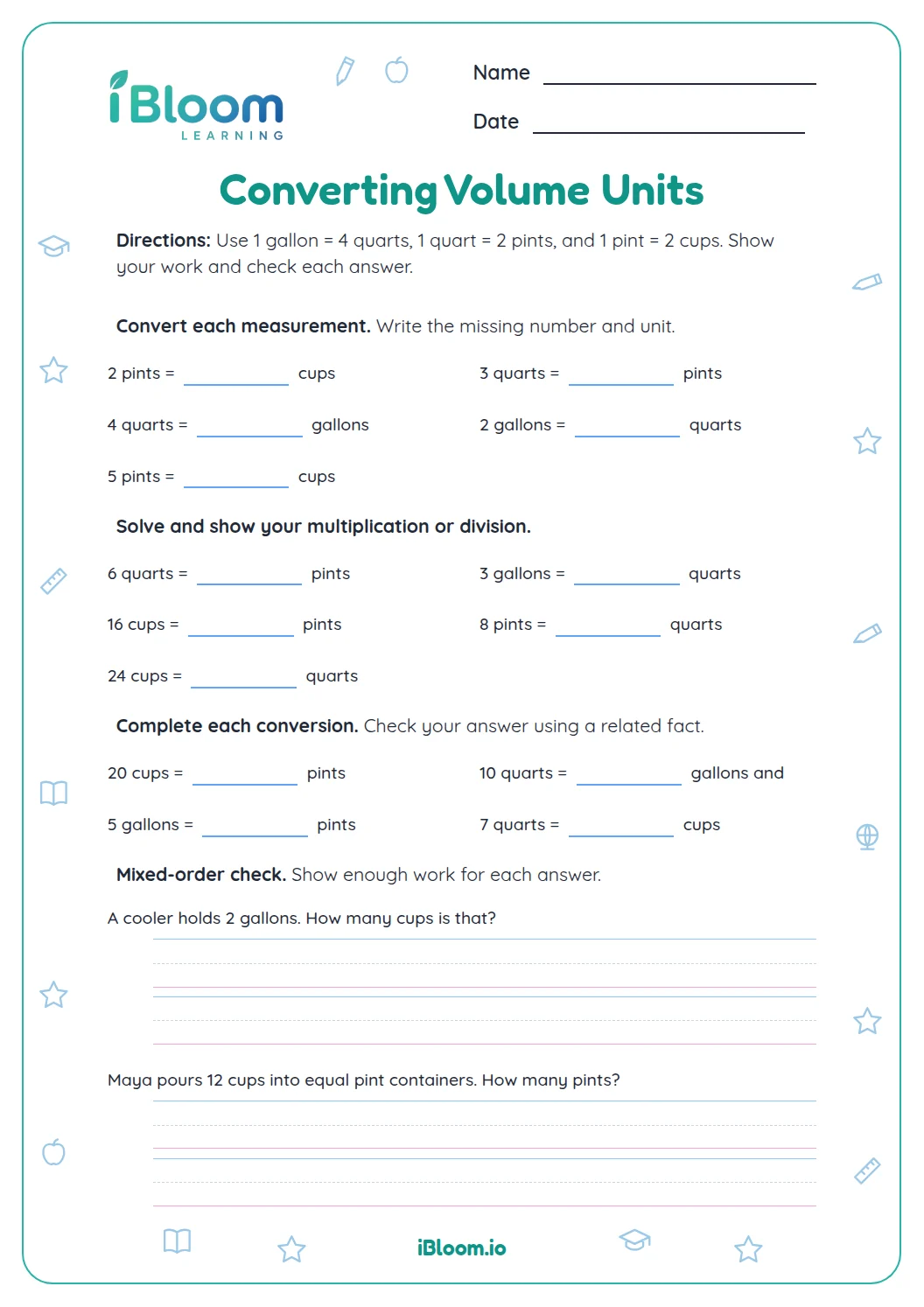
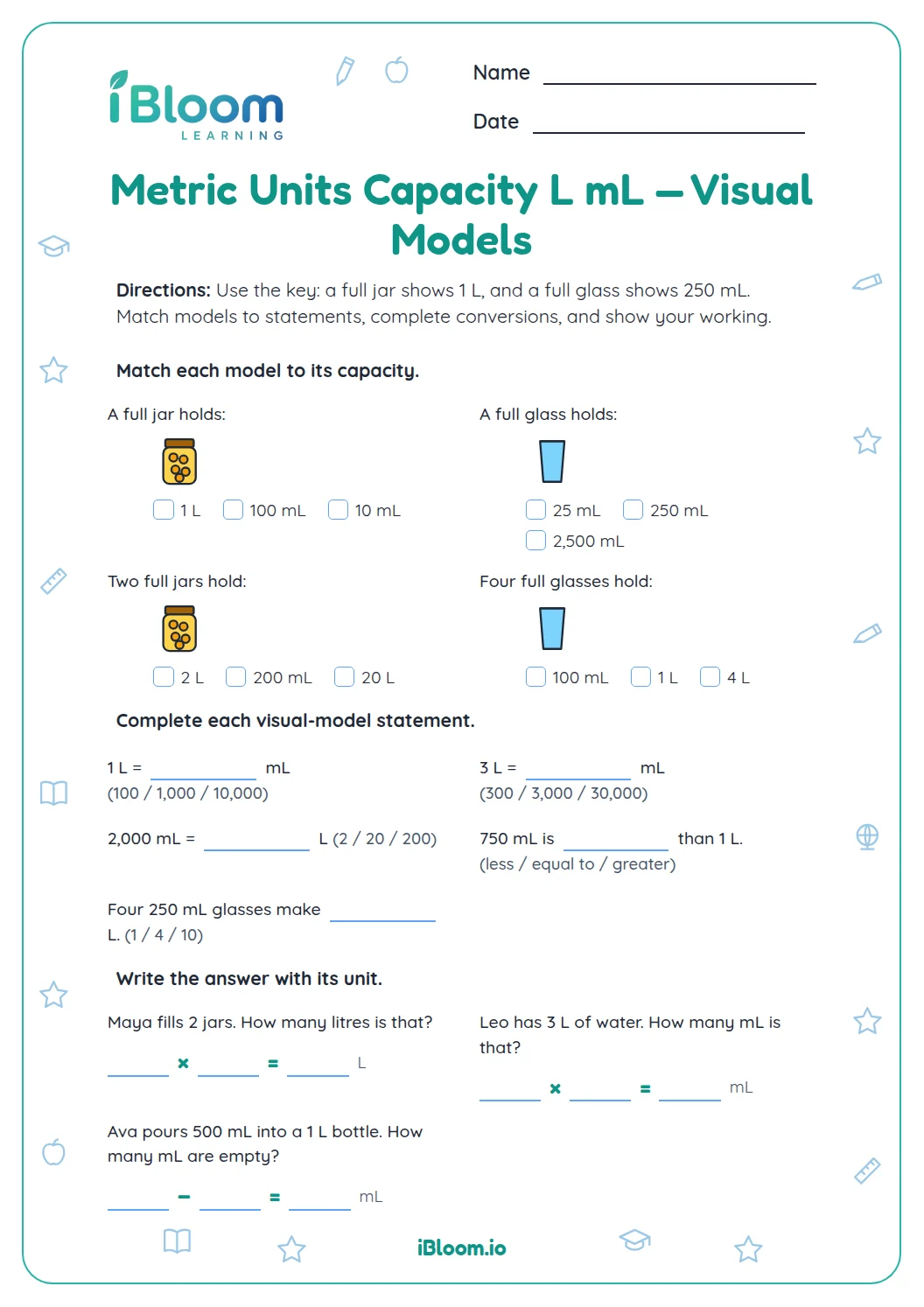
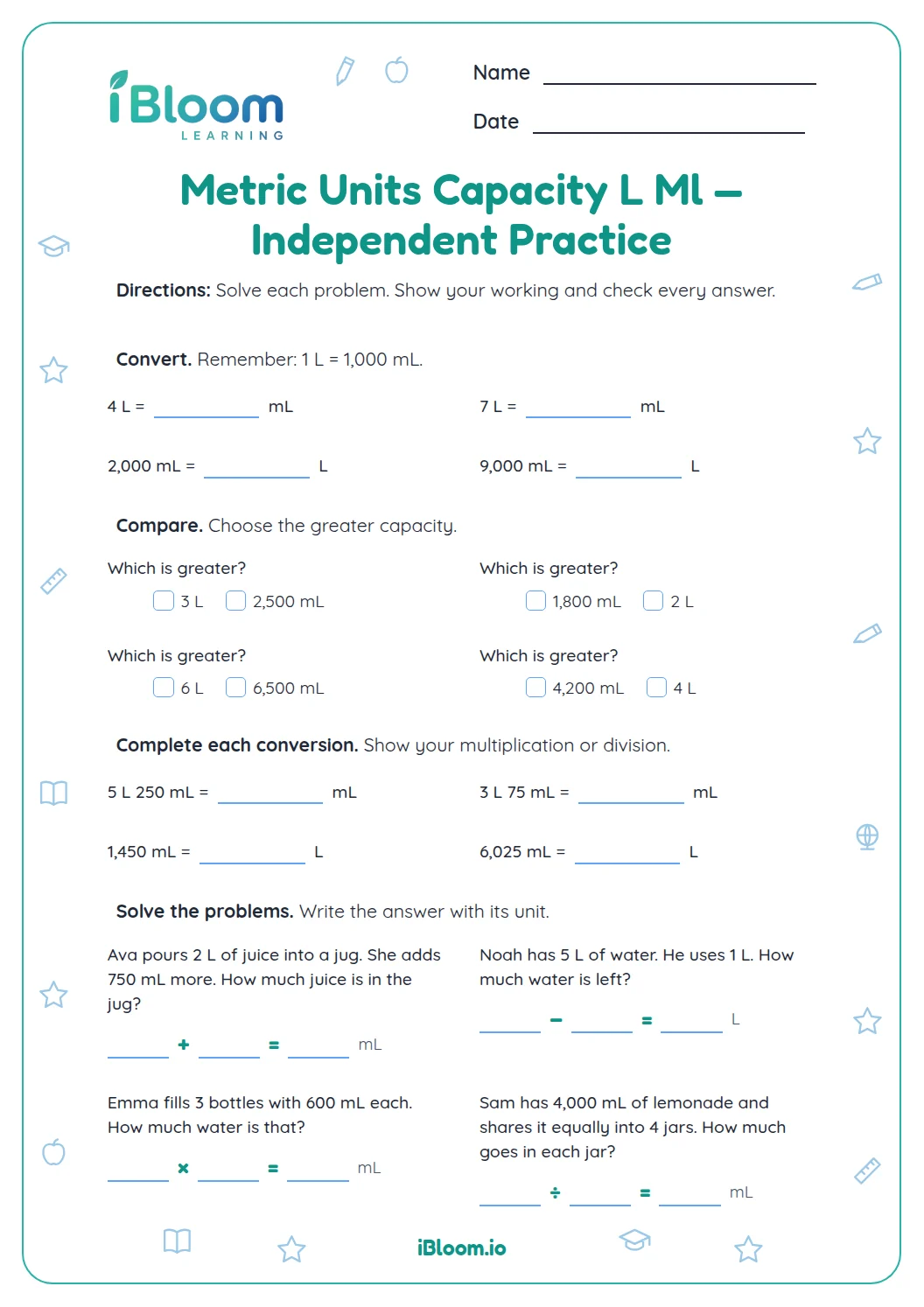
This printable Grade 4 worksheet builds a method for comparing liquid capacities. Students compare customary and metric amounts, complete unit equivalents, order capacities, and solve container problems. Its 14 questions move from direct comparisons to short applications, with a separate answer key for checking.
Aligned to 4.MD.A.1
How do equivalent units help?
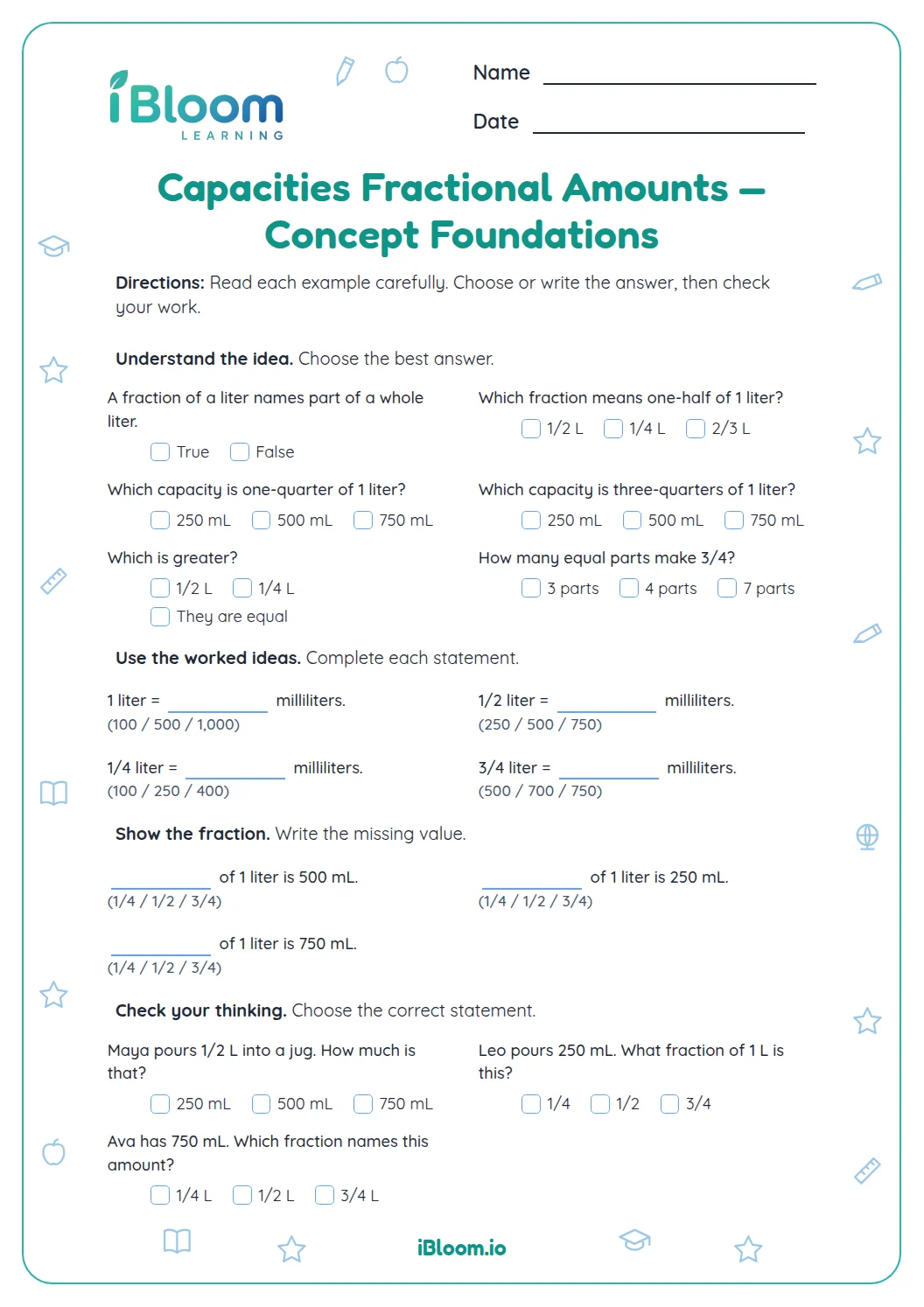
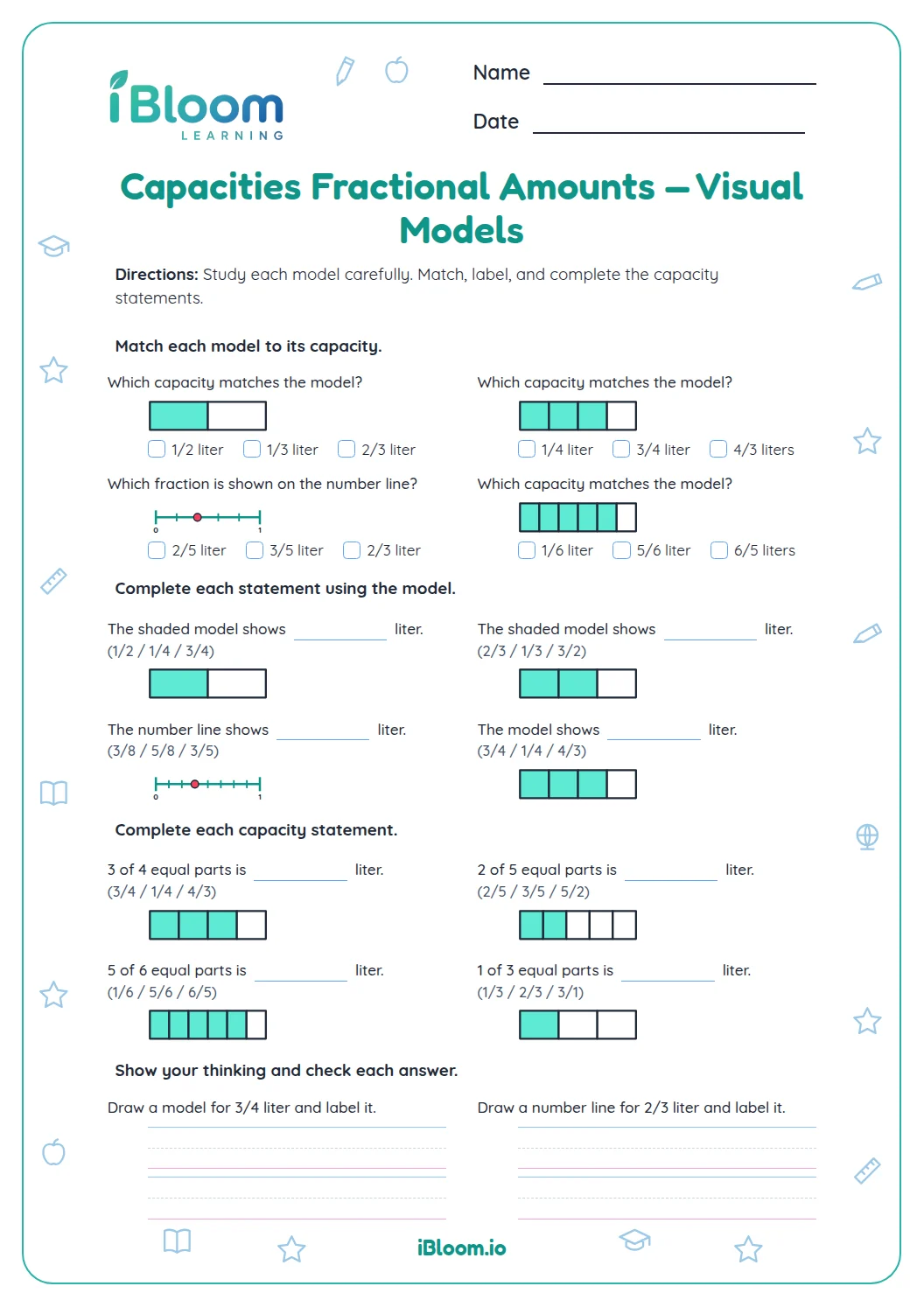
Rename amounts in the same unit before comparing. One quart equals 4 cups, so 1 quart holds more than 3 cups.
How do you compare metric capacities?
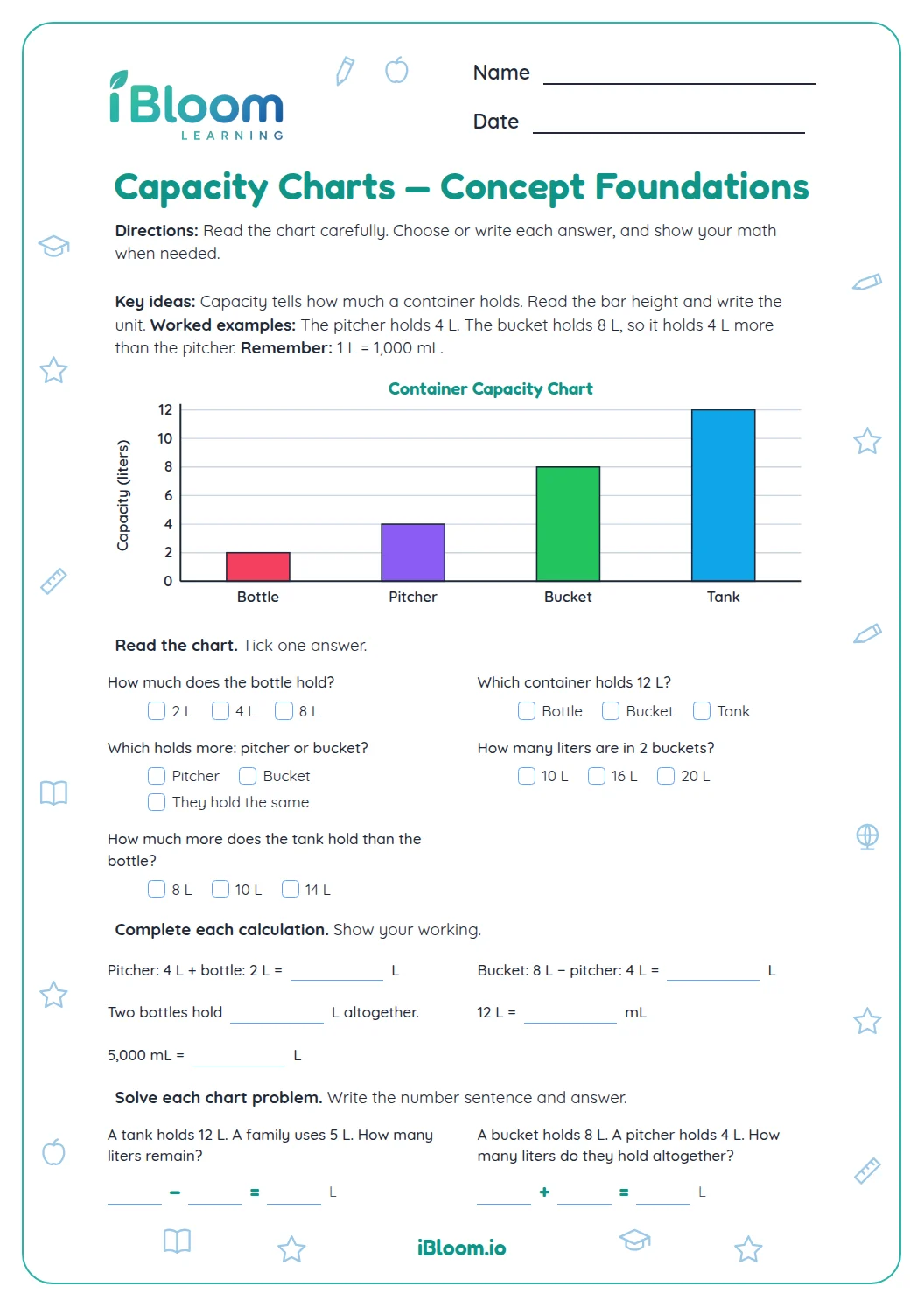
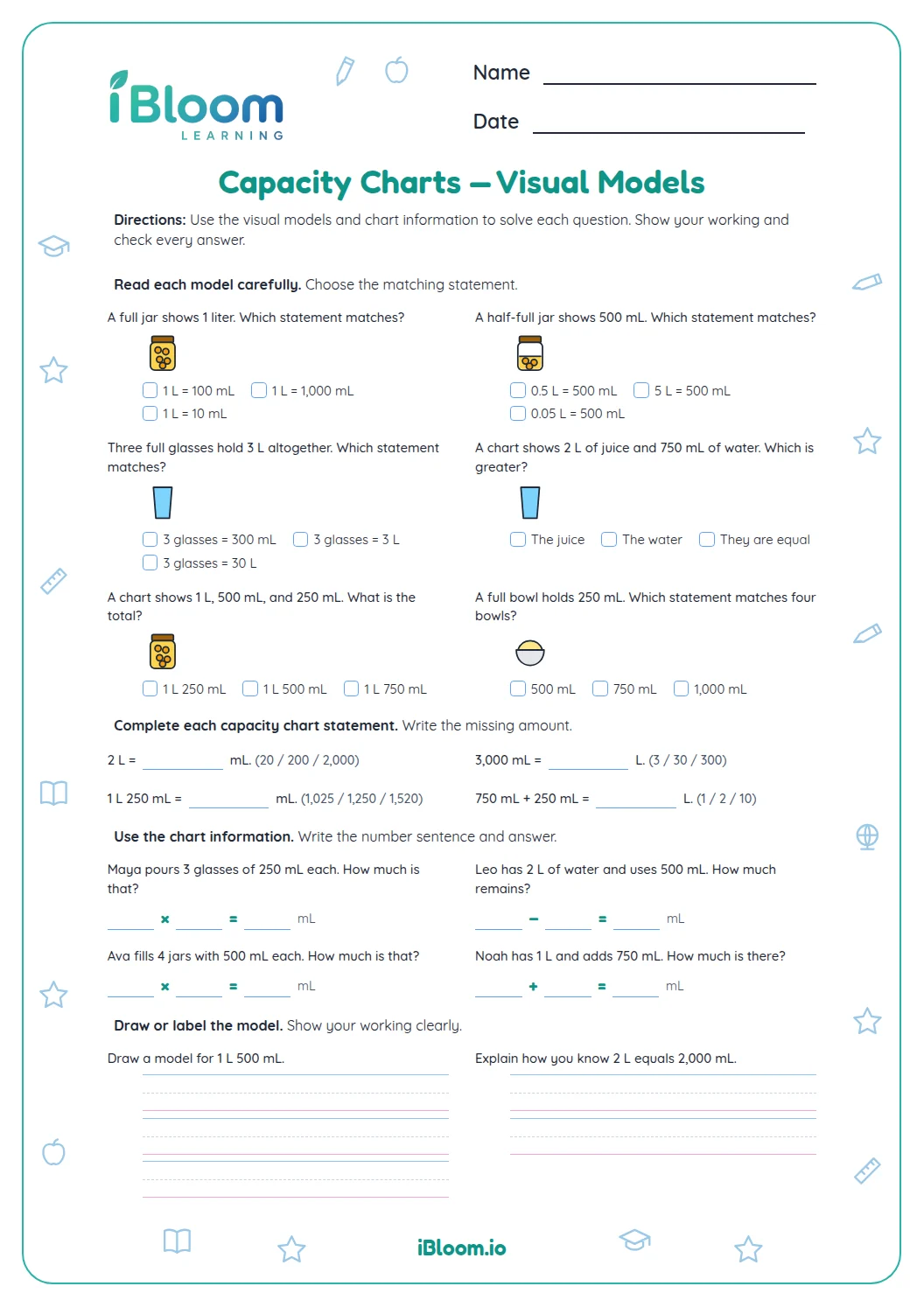
One liter equals 1,000 milliliters. A 1 L jug holds 400 mL more than a 600 mL bottle.
What will students practice?
Fourteen questions move from direct comparisons and unit facts to ordering and short capacity problems.
How to use this worksheet
- 1Read the unit names in both amounts.
- 2Use a known equivalence to rewrite one amount.
- 3Compare or calculate with matching units.
- 4Write the unit in every answer.
- 5Check by estimating which amount should be larger.
Common mistakes and quick fixes
The mistake
Calling 3 cups more than 1 quart.
The fix
Convert 1 quart to 4 cups; 3 cups is less.
The mistake
Treating 1 L as 100 mL.
The fix
Remember that one liter contains 1,000 milliliters.
The mistake
Subtracting numbers with unlike units.
The fix
Convert both amounts to cups, quarts or milliliters first.
Common Core alignment
Use relationships among capacity units and record equivalent measures.
On this sheet: Questions compare and convert liquid capacity units within customary and metric systems.
Show the official wordingHide the official wording
Know relative sizes of measurement units within one system of units including km, m, cm; kg, g; lb, oz.; l, ml; hr, min, sec. Within a single system of measurement, express measurements in a larger unit in terms of a smaller unit. Record measurement equivalents in a two-column table.
What to practice next
Make more practice
Further reading
Questions parents and teachers ask
How many cups are in a quart?
One quart equals 4 cups. Use this relationship to compare amounts, order capacities, or find how much more a container can hold. When two customary measures use different units, rename them in cups or quarts first so the comparison is fair.
How many questions are on the capacity worksheet?
There are 14 questions across two worksheet pages, followed by a separate two-page answer key. The practice includes customary and metric comparisons, unit facts, an ordering question, and short capacity problems. Students move from simple unit facts toward applied comparison and subtraction situations.
What does 1 liter equal in milliliters?
One liter equals 1,000 milliliters. To compare metric capacities, express both amounts in milliliters. For example, 1 L is greater than 750 mL, and subtracting 600 mL from 1,000 mL gives a difference of 400 mL. These examples use customary and metric units but keep each conversion relationship direct and familiar.
How should students solve the word problems?
Identify the unit facts first, then convert both amounts to the same unit. Subtract to find a difference or amount remaining, and include the unit in the answer. The answer key lists the expected value for every problem.