
About this worksheet
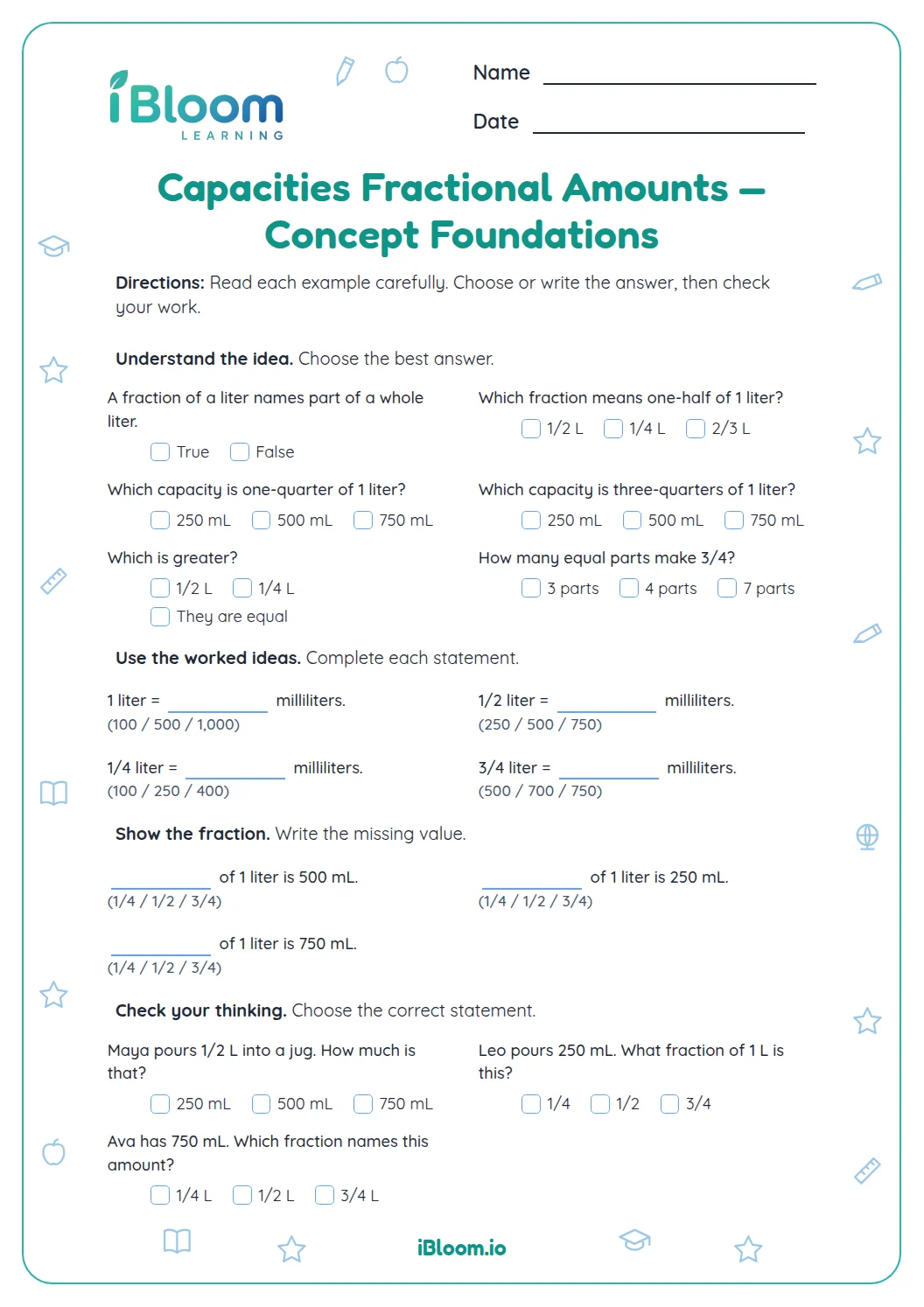
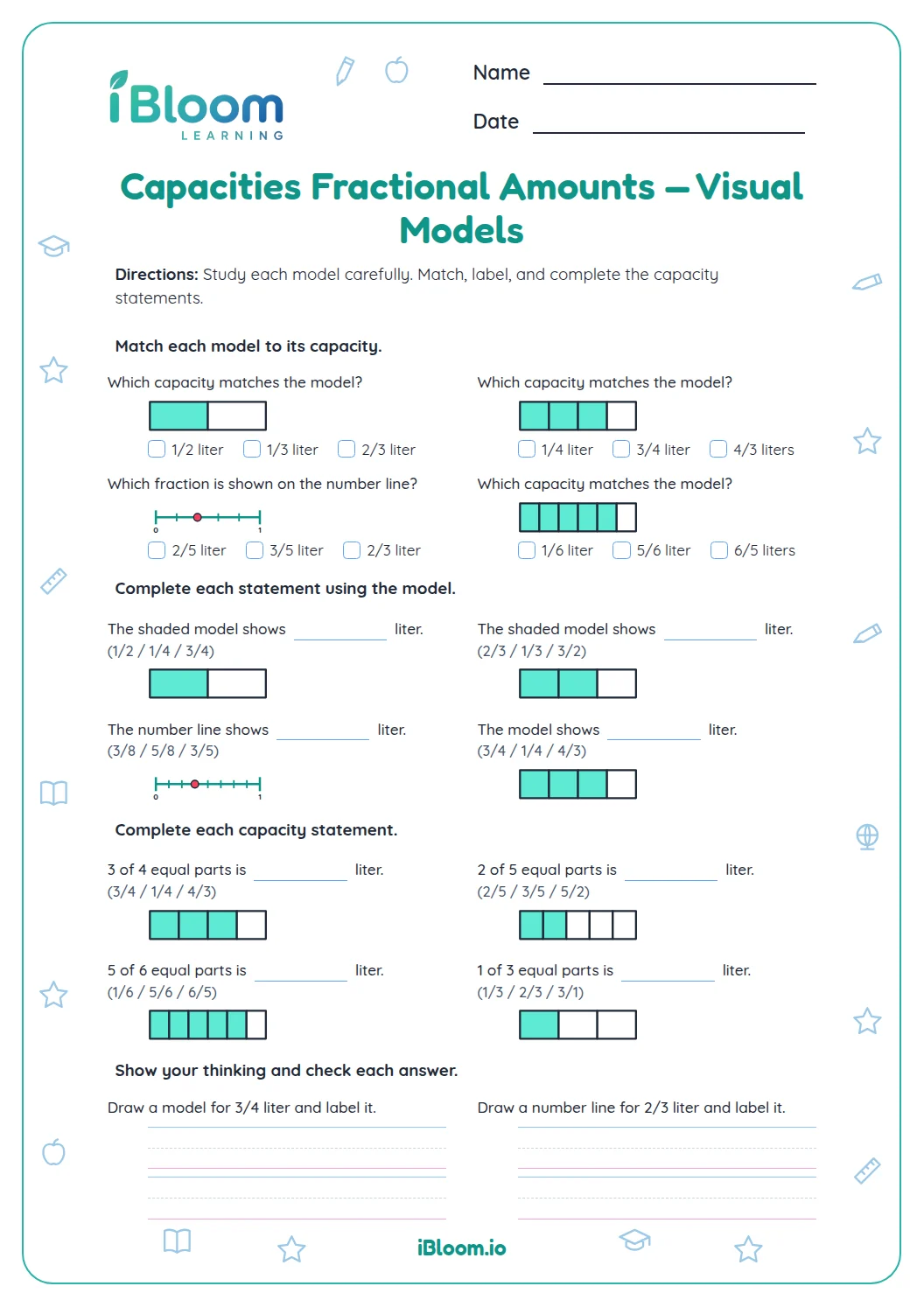
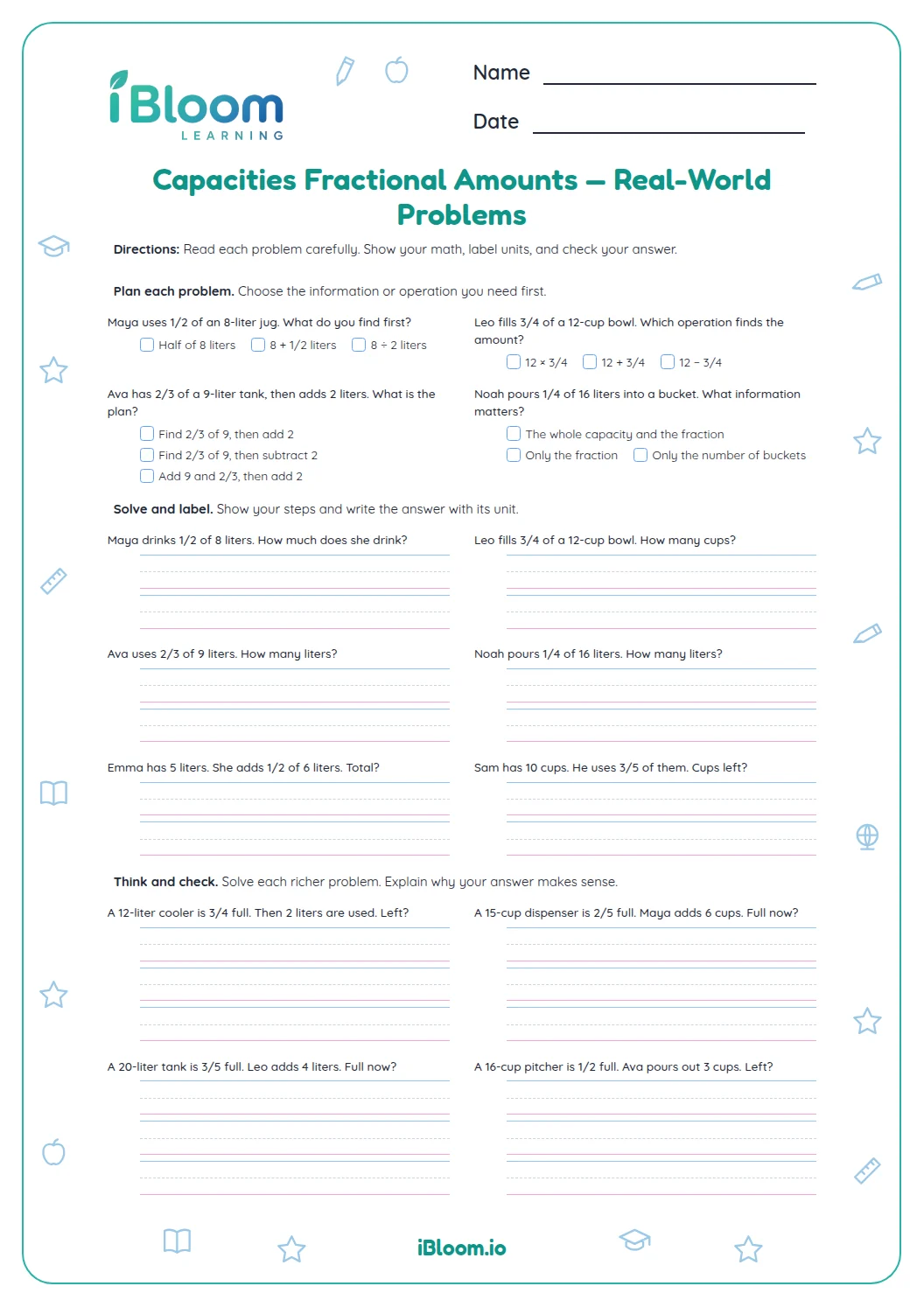
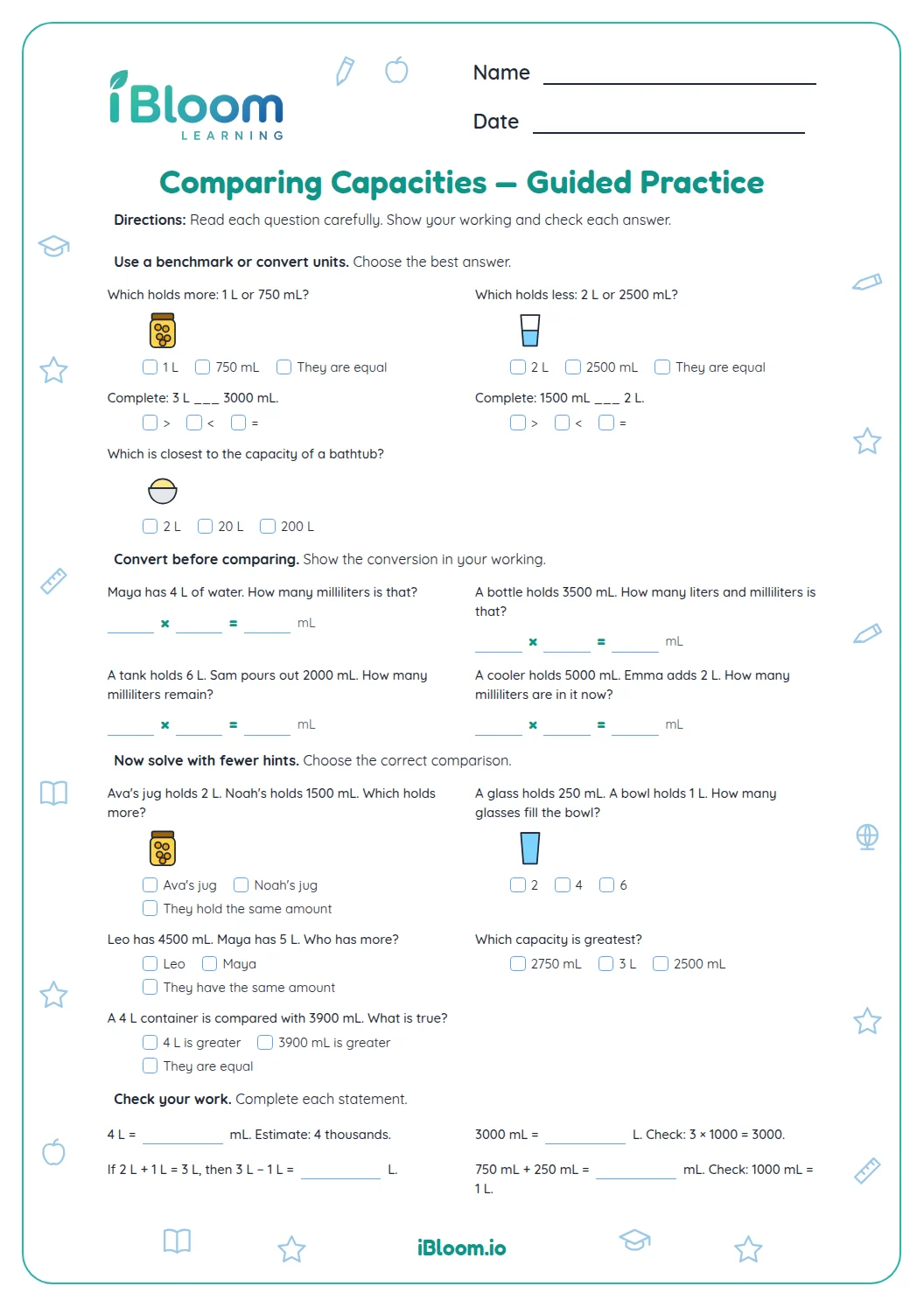
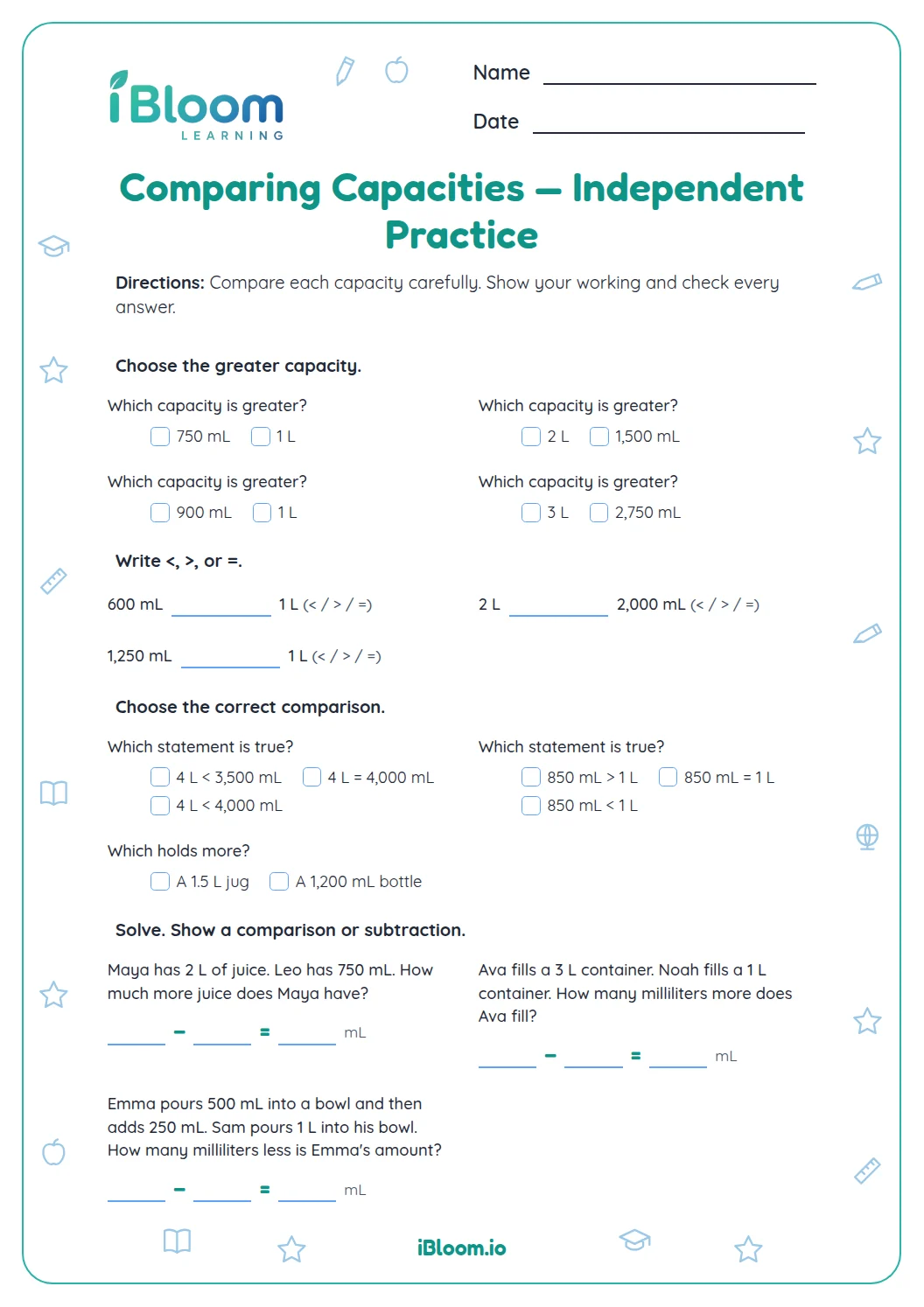
This Grade 4 capacity worksheet has 14 problems about liters, milliliters, fractional amounts, and everyday situations. Students convert between units, compare capacities, and calculate amounts poured, used, or left in a container. A separate answer key gives the results with units. The work practices Common Core 4.MD.A.2.
Aligned to 4.MD.A.2
How do liters and milliliters connect?
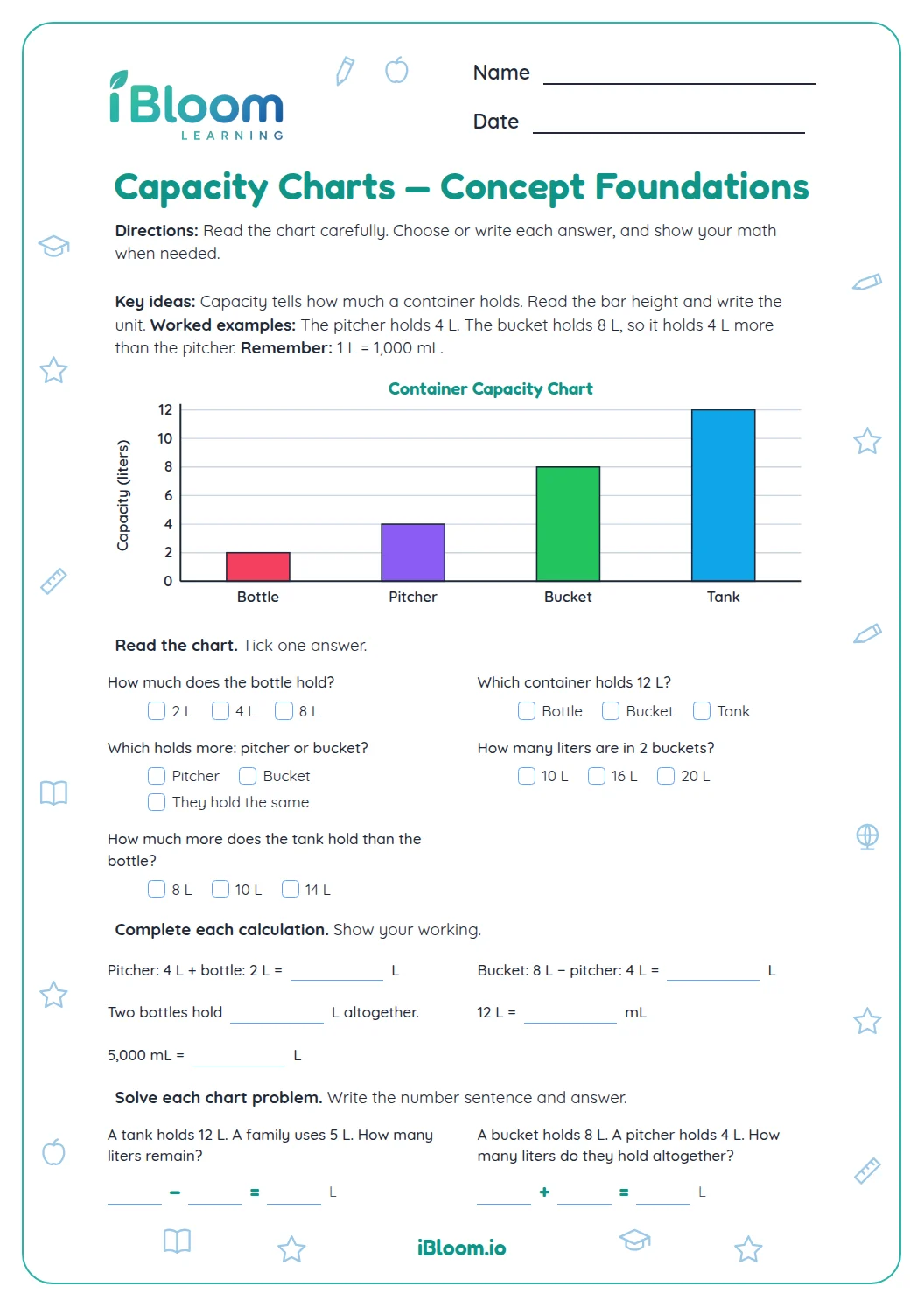
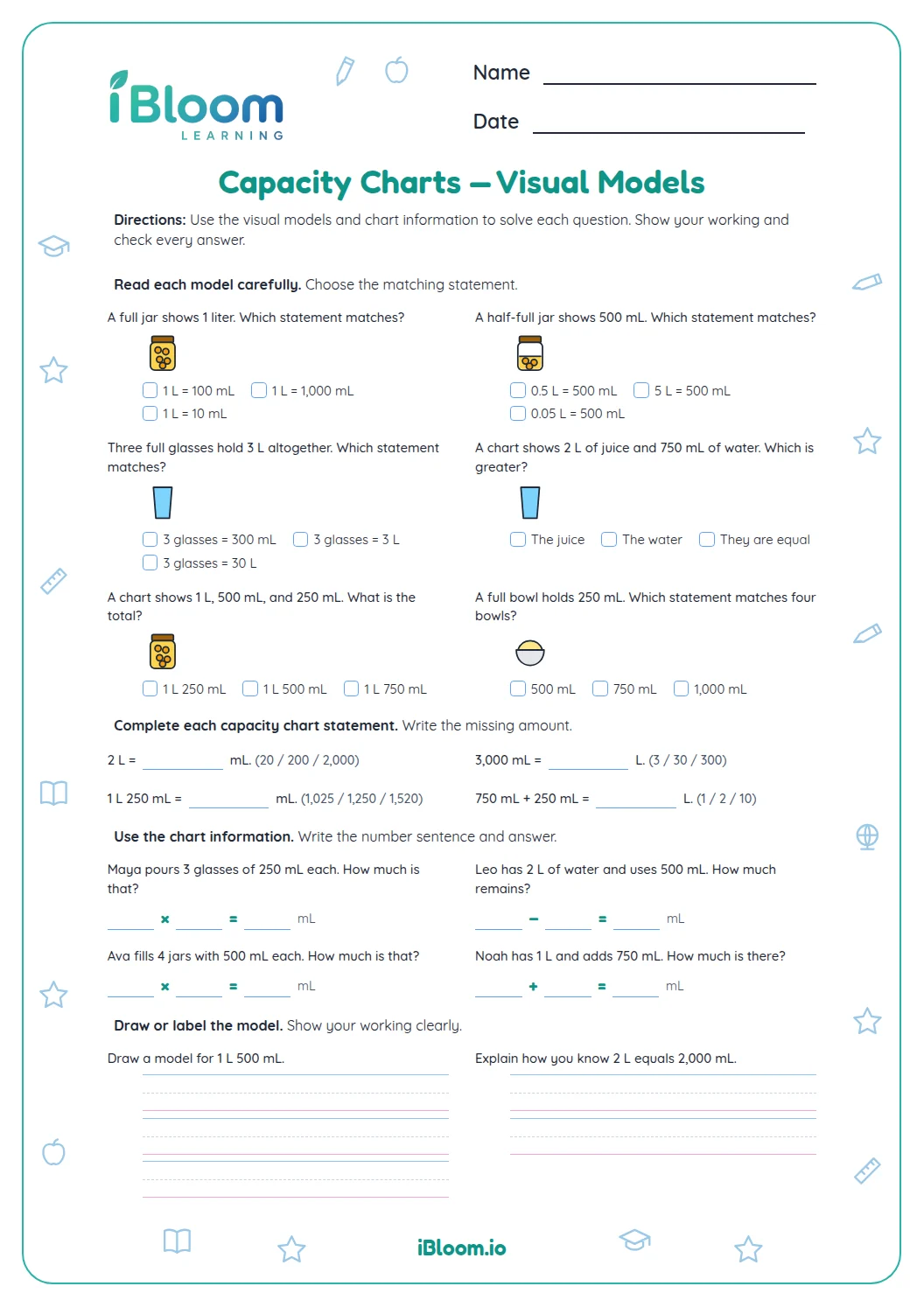
Use 1 L = 1,000 mL. To convert liters to milliliters, multiply by 1,000; to convert milliliters to liters, divide by 1,000.
- 1750 mL = ___ L
- 2750 ÷ 1,000 = 0.75
- 3So 750 mL = 3/4 L.
How do fractions describe capacity?
Put both amounts in the same unit before comparing. For 1 1/4 L and 1,200 mL, convert 1 1/4 L to 1,250 mL, then compare 1,250 with 1,200.
How do students reason through a capacity story?
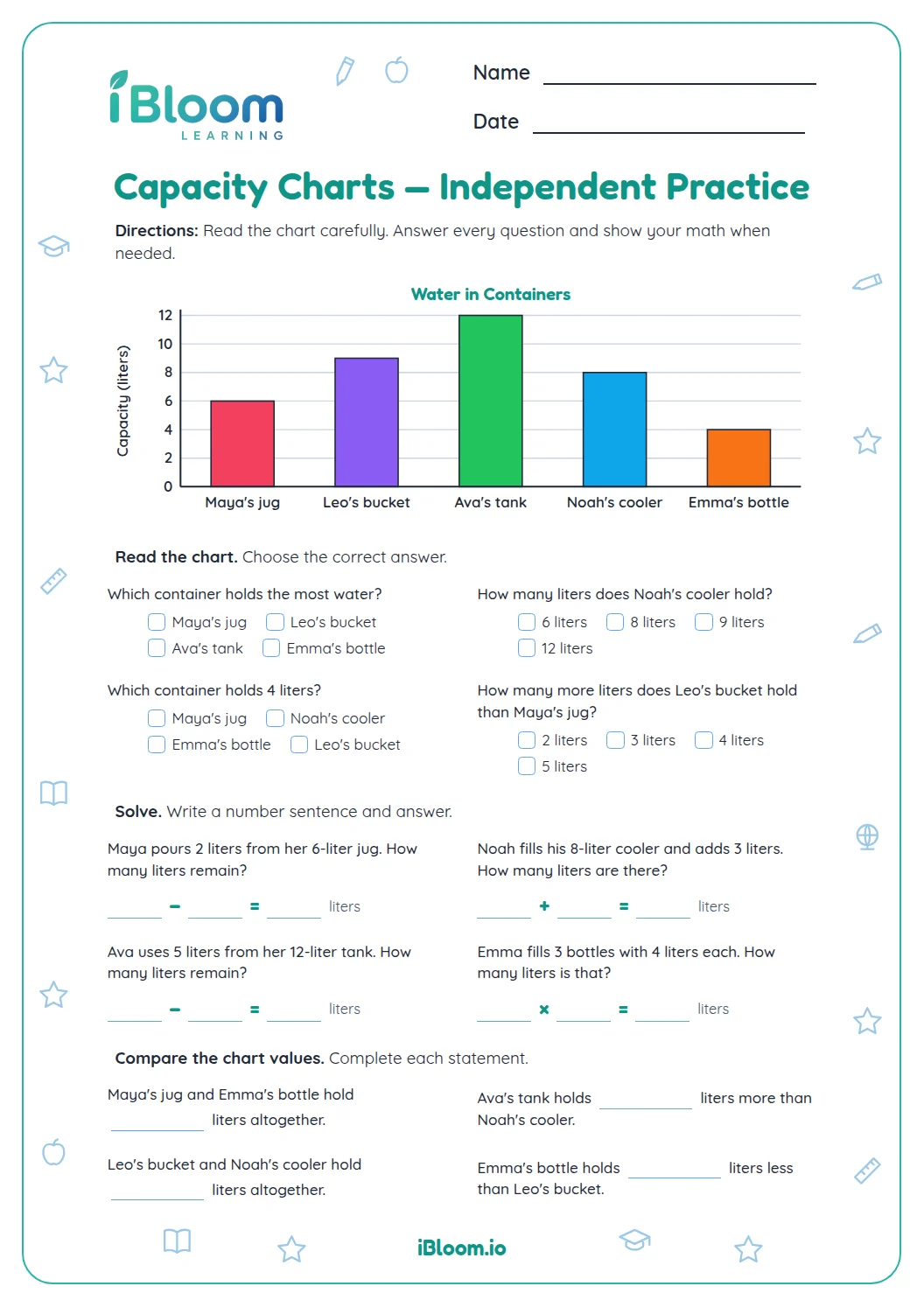
For a fill or remaining-capacity problem, identify the container’s total capacity and the amount already used or inside. Subtract when finding what remains or how much more will fit.
How to use the worksheet
- 1Review that 1 L equals 1,000 mL.
- 2Convert mixed liter and milliliter amounts to milliliters.
- 3For a fraction of a liter, find the matching milliliter amount.
- 4Write the operation before calculating.
- 5Add a unit to each final answer and check whether its size makes sense.
Common capacity mistakes
The mistake
Adding liters directly to milliliters.
The fix
Convert both amounts to the same unit first.
The mistake
Treating 1/2 L as 50 mL.
The fix
Remember that half of 1,000 mL is 500 mL.
The mistake
Reporting a number without a unit.
The fix
Label the final amount in liters or milliliters as requested.
Common Core alignment
Students apply measurement conversions to capacity situations.
Solve measurement word problems using conversions and the four operations.
On this sheet: Solve measurement word problems using conversions and the four operations.
Show the official wordingHide the official wording
Use the four operations to solve word problems involving distances, intervals of time, liquid volumes, masses of objects, and money, including problems involving simple fractions or decimals, and problems that require expressing measurements given in a larger unit in terms of a smaller unit.
What to practice next
Make more practice
Further reading
Questions parents and teachers ask
How many milliliters are in one liter?
One liter equals 1,000 milliliters. Multiply liters by 1,000 to find milliliters, or divide milliliters by 1,000 to express the amount in liters. The worksheet uses this relationship in conversions and practical capacity problems. Students use the relationship in both directions throughout the practice.
How do students convert a fraction of a liter?
Start with 1 L = 1,000 mL, then find the stated fraction of 1,000. For example, half of 1,000 mL is 500 mL, and three-fourths is 750 mL. The same relationship helps compare fractional liters with milliliters. The familiar liter-to-milliliter relationship makes fractional amounts easier to compare.
What kinds of problems are on the worksheet?
The 14 problems include unit conversions, comparisons, and situations involving a dispenser, tank, cups, recipe, bottle, tub, and barrel. Each asks for one capacity amount, and the answer key includes the unit when needed. These examples ask students to reason about capacity in practical contexts.
How should students compare two capacities?
First express both capacities in the same unit. For example, change 1 1/4 L to 1,250 mL before comparing it with 1,200 mL. Matching units makes the larger amount clear. Converting first avoids comparing unlike units such as liters and milliliters.
Does the printable include an answer key?
Yes. A separate answer key lists the result for each problem. Students can check the conversion or operation and confirm that the final unit matches the question. Checking the units is a useful final step for each capacity result.