



About this worksheet
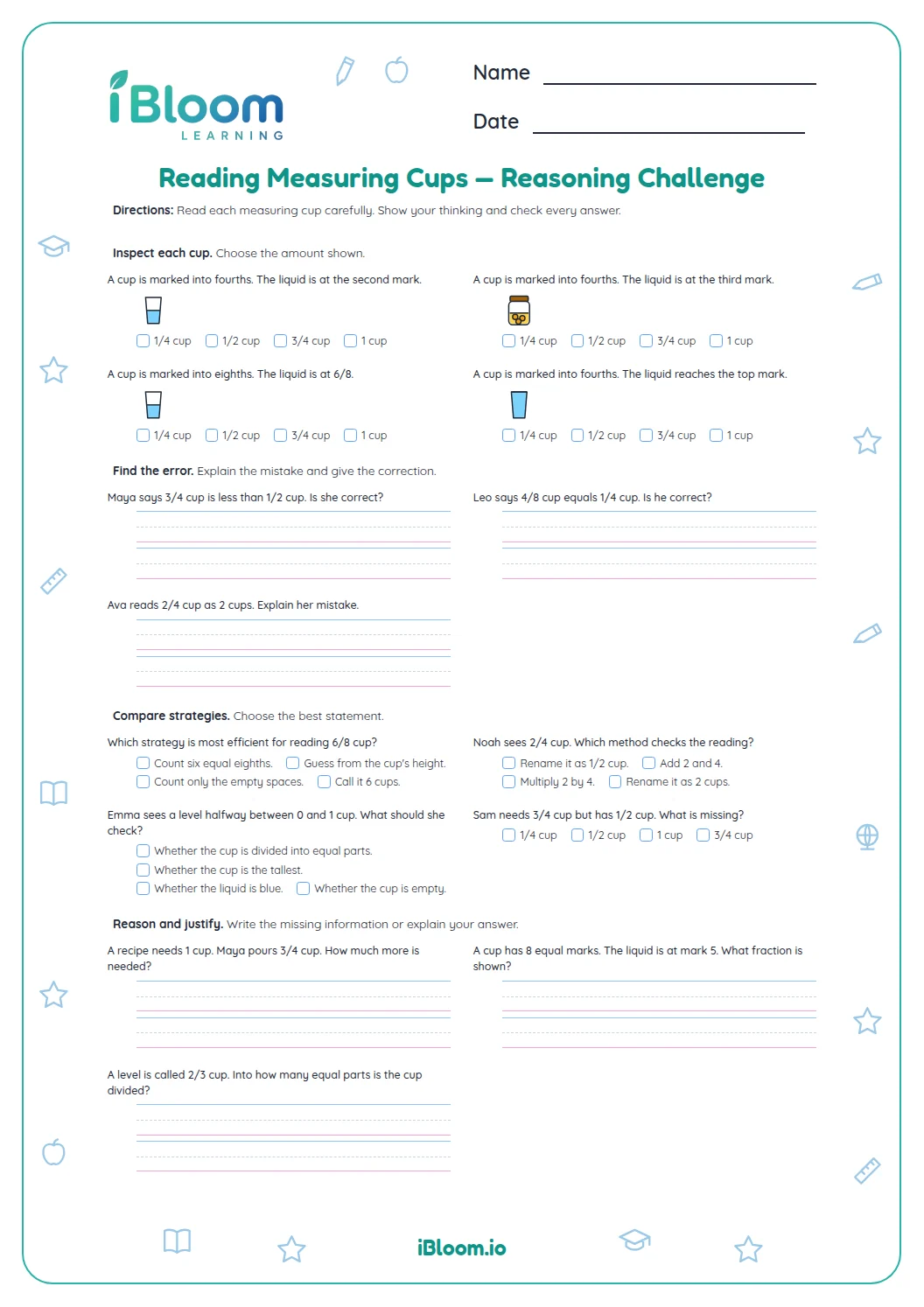
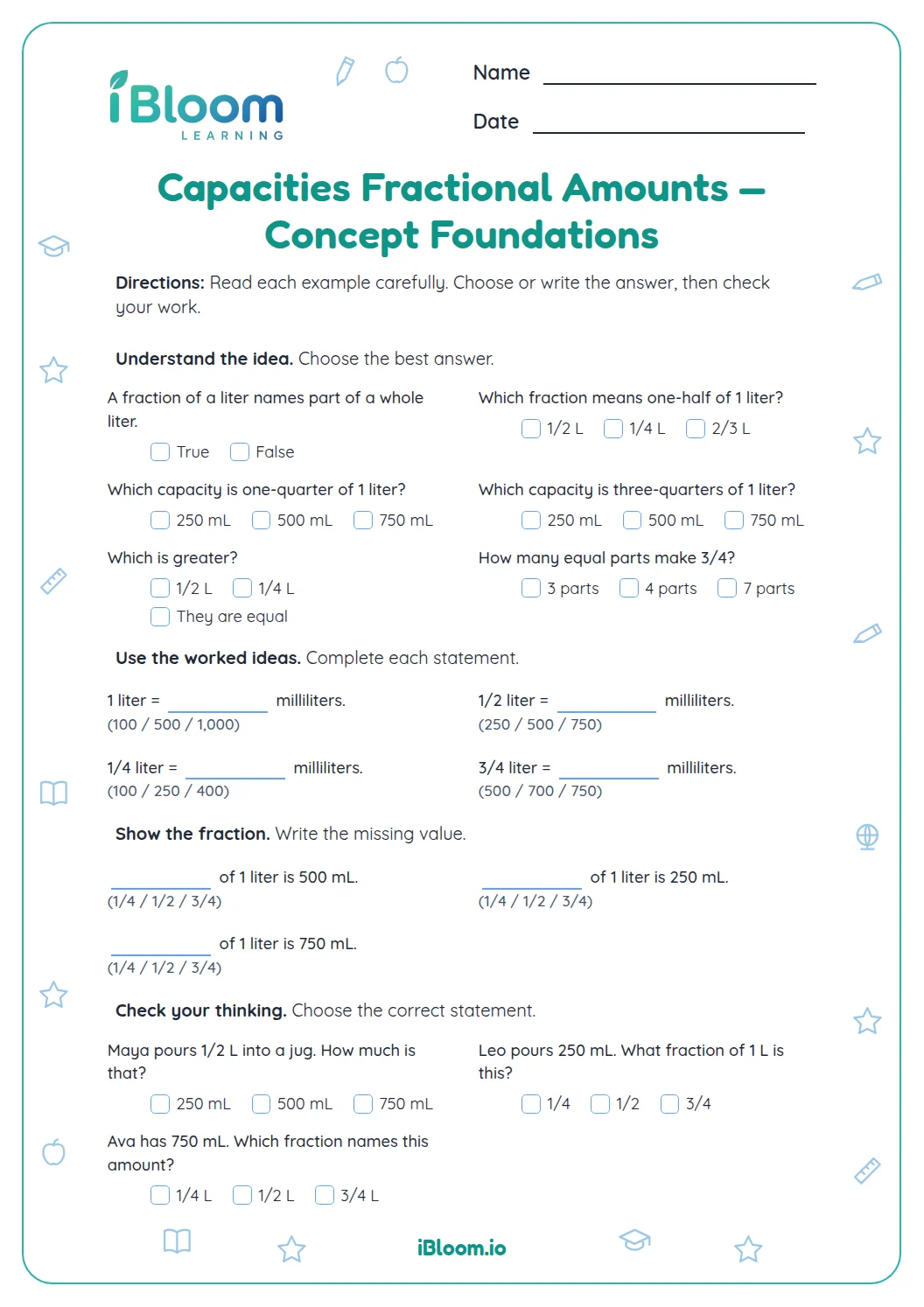
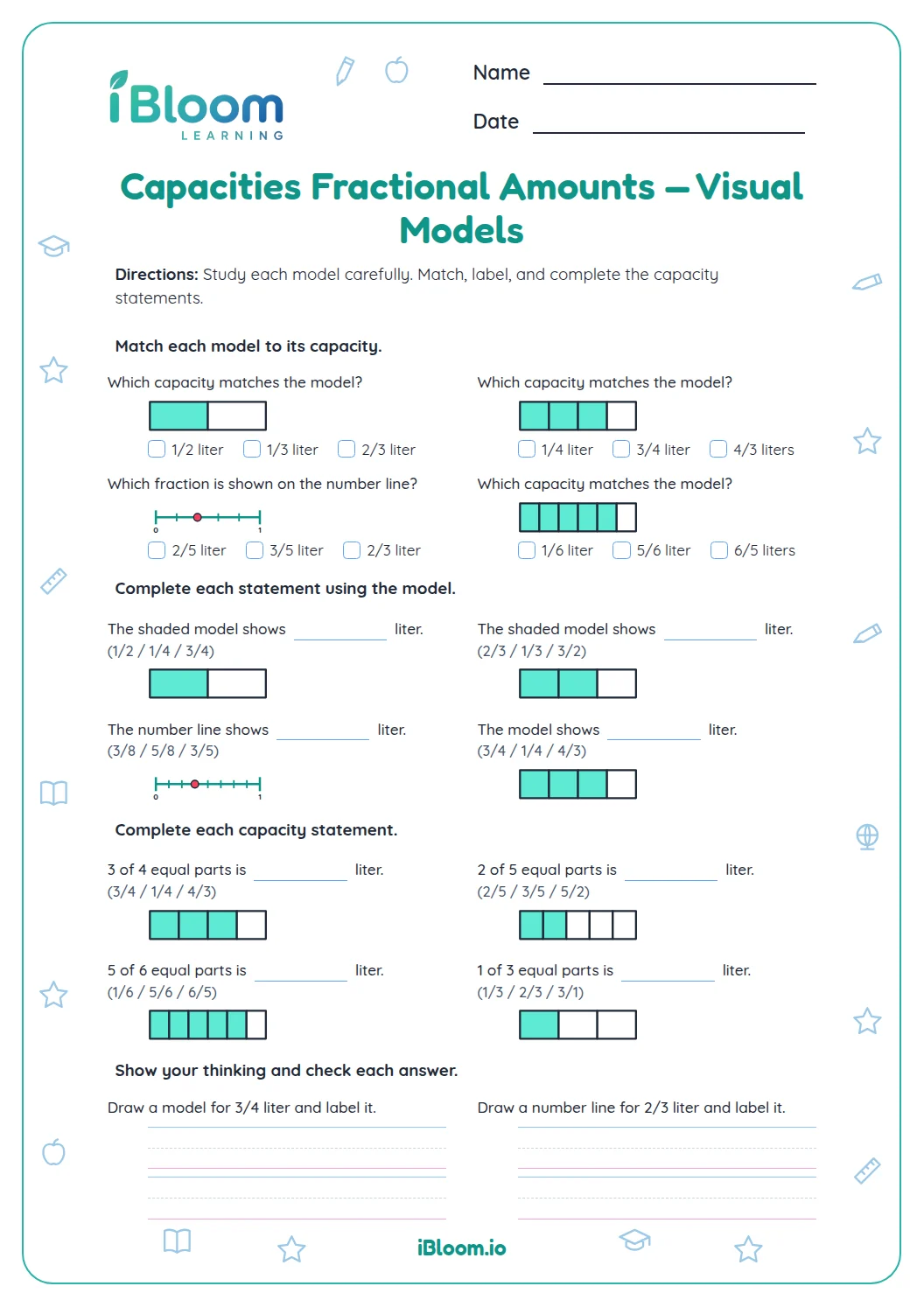
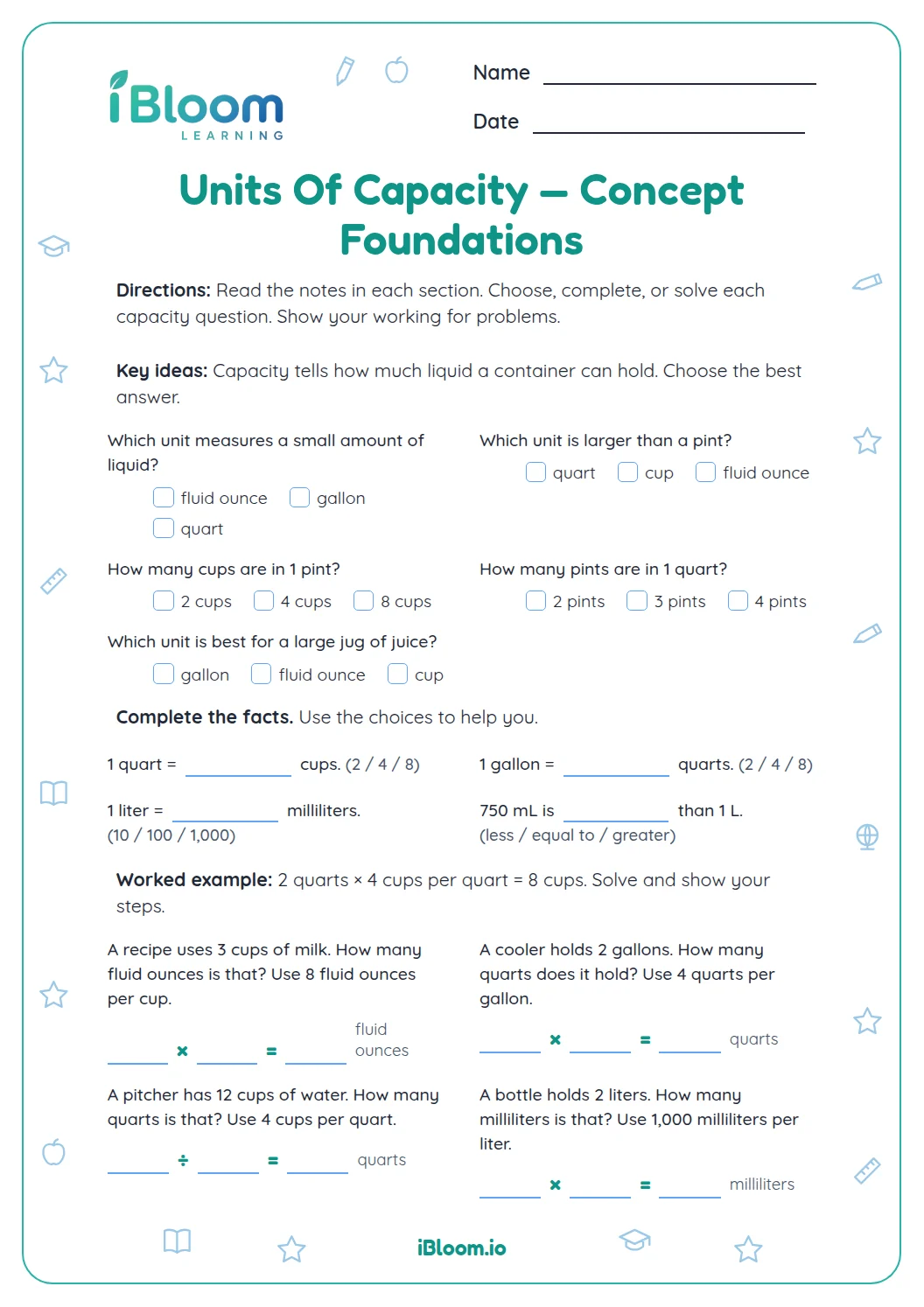
This Grade 4 worksheet gives students 15 concise questions about measuring cups. Read marked fill levels, add fractional cup amounts, and find the missing amount that completes one cup. Cup drawings support several level-reading and addition items, while number sentences keep the remaining practice compact. The questions practice solving measurement problems with fractional amounts under CCSS 4.MD.A.2.
Aligned to 4.MD.A.2
How do you read a cup level?
The first five models ask students to read a fill line. The remaining questions combine cup amounts or find a missing addend that completes one cup.
How can you combine cup amounts?
Add the fractional amounts and keep the unit. For question 8, 3/4 cup + 1/2 cup = 1 1/4 cups.
- 13/4 cup + 1/2 cup
- 26/8 cup + 4/8 cup = 10/8 cups
- 310/8 cups = 1 1/4 cups
How can you complete one cup?
Find the amount that makes the total 1 cup. For example, 1/2 cup + 1/2 cup = 1 cup.
How to use this worksheet
- 1Read a drawn cup from its bottom mark to the fill line.
- 2Add the two cup amounts when the equation uses addition.
- 3For a missing amount, ask what completes 1 cup.
- 4Keep the unit cups in your response and check with the key.
Common mistakes and quick fixes
The mistake
Counting the marks instead of the spaces between them.
The fix
Count each equal interval from zero; four intervals make one cup.
The mistake
Adding unlike fractions without renaming them.
The fix
Rename halves as fourths or eighths when needed before adding.
The mistake
Giving the amount already present for a missing-amount equation.
The fix
Find the addend that makes the total exactly 1 cup.
Curriculum alignment
This worksheet practices the following Common Core skill.
Solve liquid-volume problems with fractional measurements and operations.
On this sheet: Students read fractional cup amounts, combine measured volumes, and find what completes one cup.
Show the official wordingHide the official wording
Use the four operations to solve word problems involving distances, intervals of time, liquid volumes, masses of objects, and money, including problems involving simple fractions or decimals, and problems that require expressing measurements given in a larger unit in terms of a smaller unit.
What to practice next
Make more practice
Further reading
Questions parents and teachers ask
What does the full cup mark mean?
The top mark represents 1 cup. Smaller marks divide it into equal parts, such as fourths. Count spaces from zero to the fill line, then name the amount in cups. Work one step at a time and compare the final unit and value with the answer key.
How do I add fractional cup amounts?
Rename fractions with a common denominator when needed, then add. For example, 3/4 cup plus 1/2 cup equals 1 1/4 cups. Keep the cup unit and check the separate key. Work one step at a time and compare the final unit and value with the answer key.
How do I find a missing amount?
Find the amount that combines with the given amount to make 1 cup. If 1/4 cup is present, 3/4 cup is missing because the two amounts total one whole cup. Work one step at a time and compare the final unit and value with the answer key.
Are cup drawings included?
Yes. Three questions use measuring-cup drawings so students can read fill levels. The other 12 use short equations to practice adding fractional amounts or completing one cup. Work one step at a time and compare the final unit and value with the answer key.
How many questions are included?
There are 15 questions: three illustrated level readings and 12 addition or missing-amount equations. Students use cups as the unit, and the separate answer key lists each amount. Work one step at a time and compare the final unit and value with the answer key.