


About this worksheet
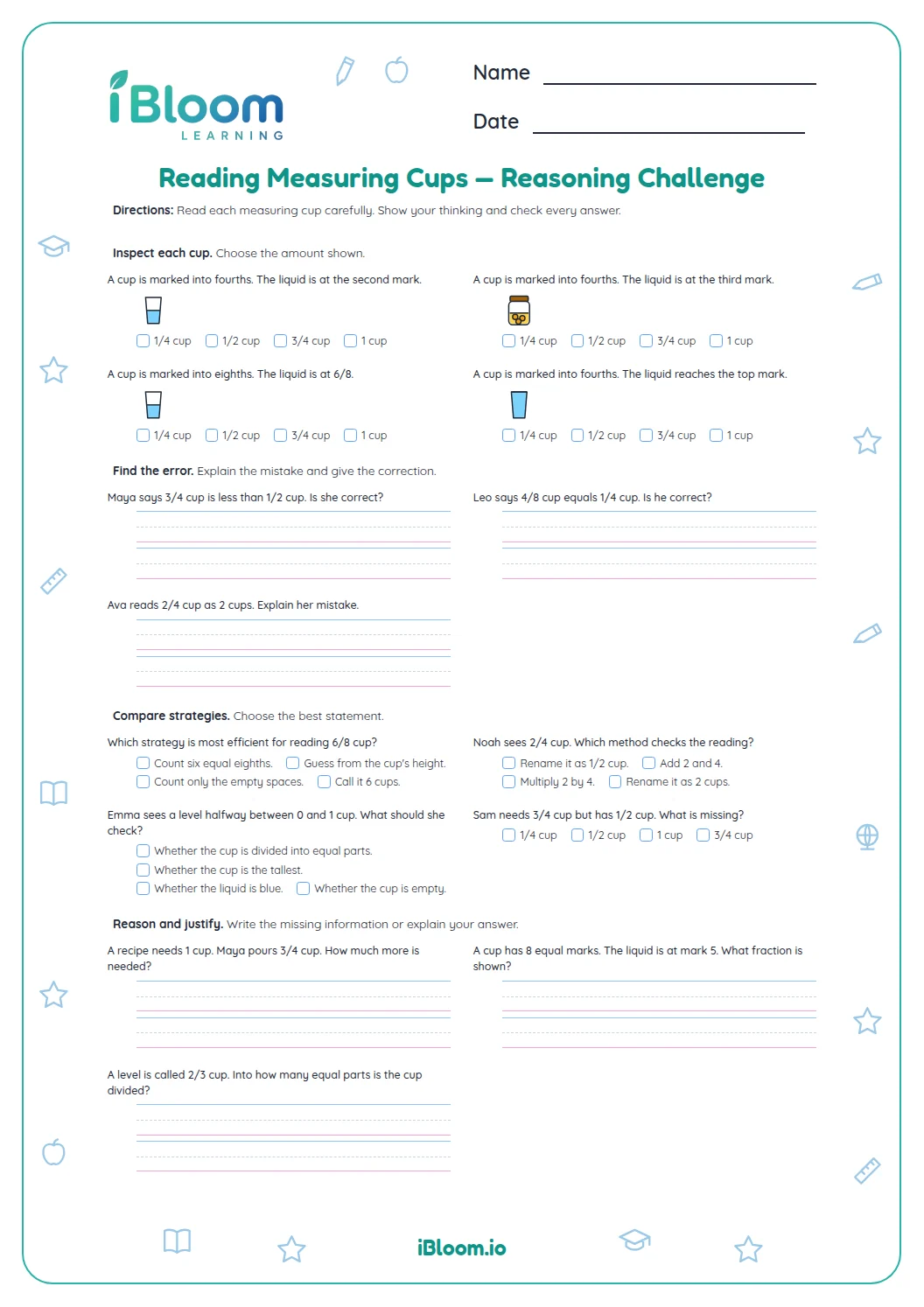
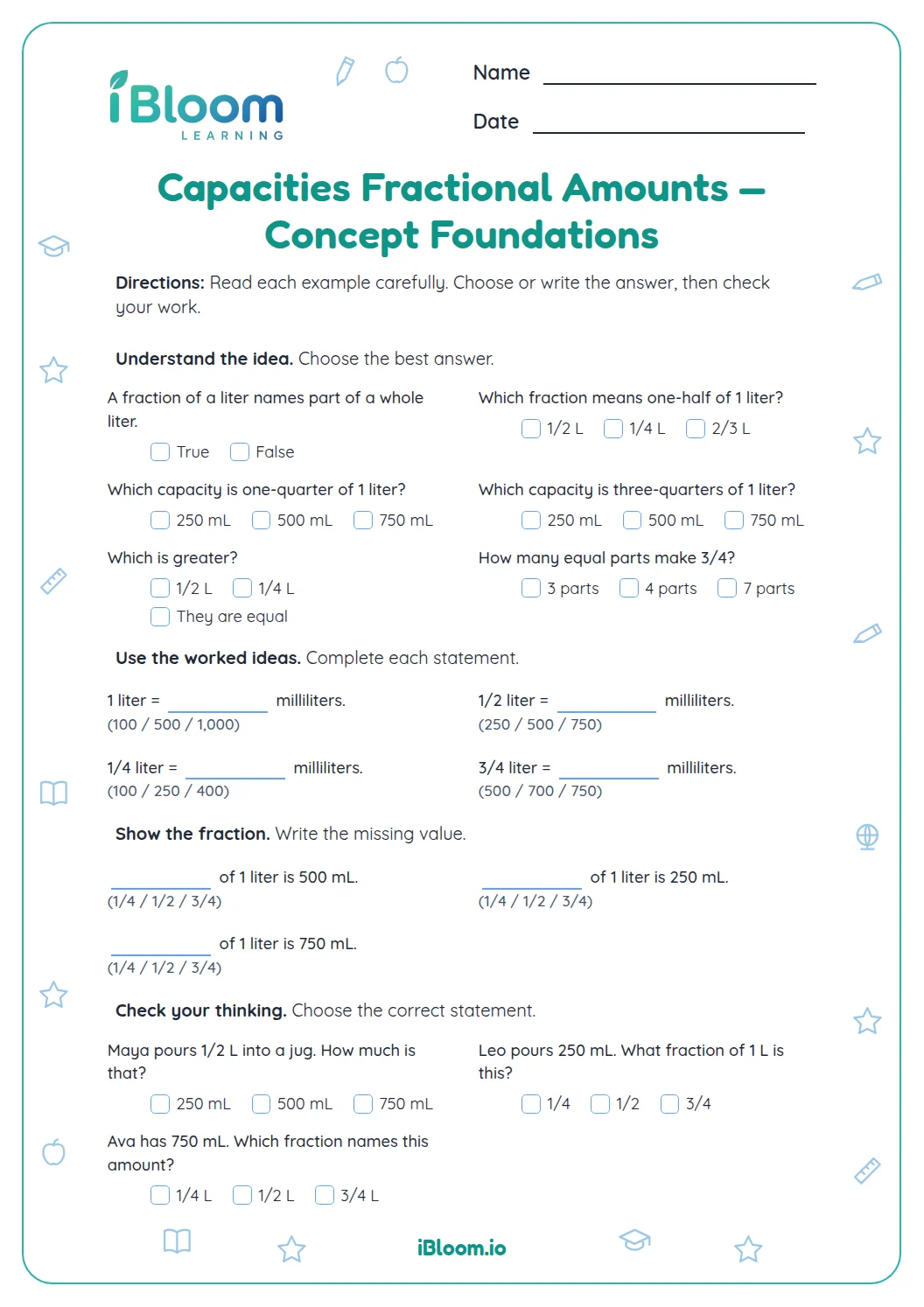
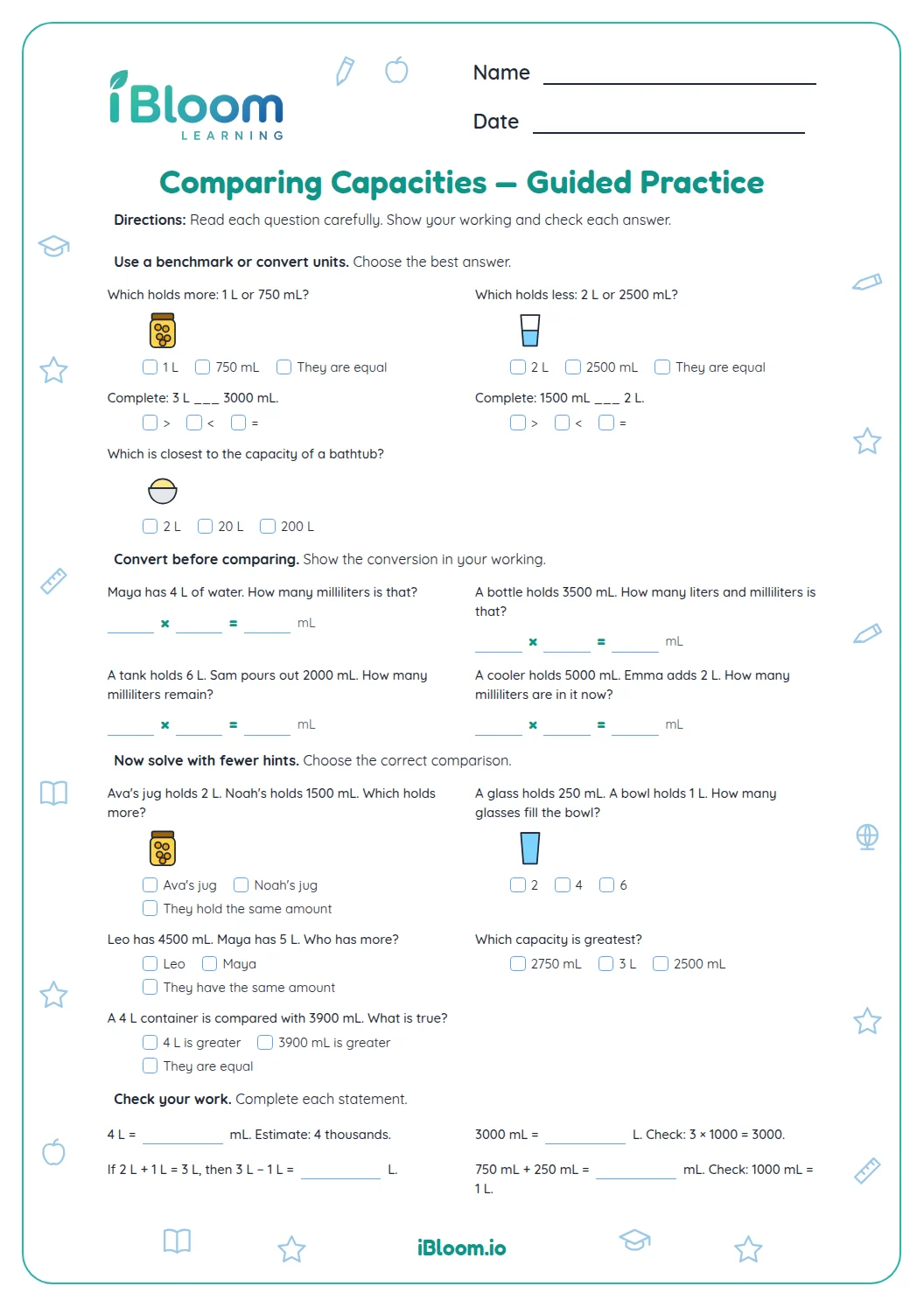
This Grade 4 printable builds practice reading a one-cup measure and naming fractional amounts. It practices CCSS 4.MD.A.2 through liquid-volume amounts and diagrams. Learners read quarter-level fills, compare or combine two cup amounts, and connect fifths to one whole cup across 16 questions. The worksheet includes container drawings and a separate answer key.
Aligned to 4.MD.A.2
How do you read a one-cup fill level?
Treat the top of the container as one whole cup. A level at one-fourth, one-half, three-fourths, or the top represents 1/4, 1/2, 3/4, or 1 cup.
For example, a cup filled to the halfway level holds 1/2 cup.
How can two cup amounts be compared?
Compare each fill with the same one-cup whole. A cup filled to 3/4 holds more than one filled to 1/4; together, those amounts make one cup.
How do fifths describe a cup?
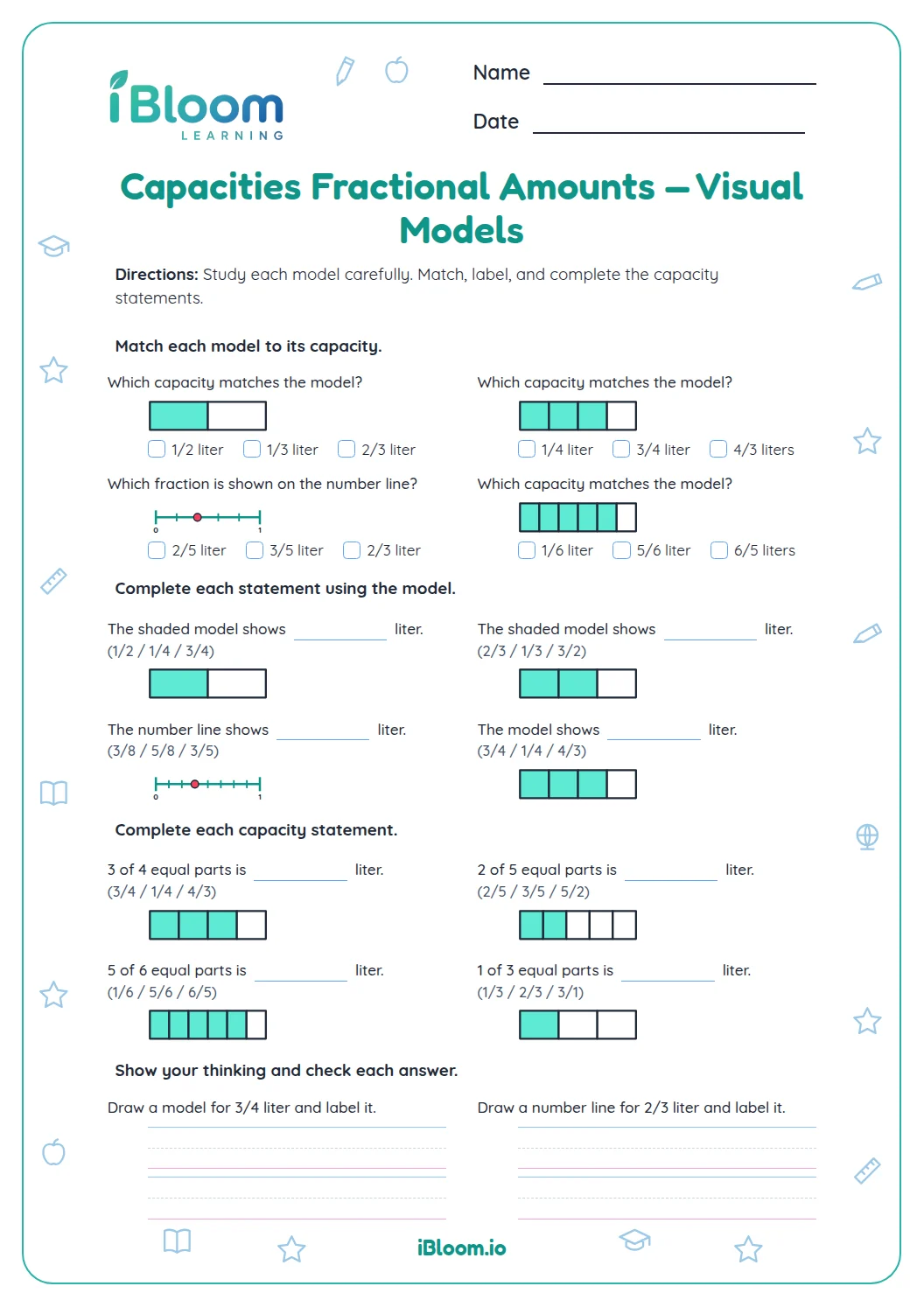
Divide one cup into five equal parts. One such part is 1/5 cup, and four parts are 4/5 cup. The number lines in Part C locate amounts between zero and one cup; count the fifths from zero.
How to use this worksheet
- 1Point out the top of the container as one full cup.
- 2Look at the fill height and estimate the fraction.
- 3Name the equal parts that make one whole.
- 4Count how many parts are filled.
- 5Check each answer with the answer key.
Common measuring cup mix-ups
The mistake
Reading the empty part instead of the filled part.
The fix
Count upward from the bottom to the liquid level.
The mistake
Using the fill percent as the fraction numerator.
The fix
Translate 25% to one-fourth rather than 25 cups.
The mistake
Calling three of five parts 3/4.
The fix
Count all equal parts in the whole container for the denominator.
Common Core alignment
This worksheet uses cup drawings and fractional amounts to practice measurement problem solving.
Use fraction amounts in liquid-volume situations.
On this sheet: Learners interpret liquid-volume amounts from one-cup drawings and solve related comparisons.
Show the official wordingHide the official wording
Use the four operations to solve word problems involving distances, intervals of time, liquid volumes, masses of objects, and money, including problems involving simple fractions or decimals, and problems that require expressing measurements given in a larger unit in terms of a smaller unit. Represent measurement quantities using diagrams such as number line diagrams that feature a measurement scale.
What to practice next
Make more practice
Further reading
Questions parents and teachers ask
What does a full container represent?
Each container drawing represents a one-cup measure when filled to the top. Read the liquid height as a fraction of that one cup, such as 1/2 cup at the halfway level or 3/4 cup at the three-quarter level. Ask the learner to name the fraction and unit aloud.
What kinds of questions are included?
The 16 questions include single-cup readings, comparisons between two cups, combining or finding the difference between amounts, and fraction questions about fifths. A separate answer key shows the amount or comparison for each item. Ask the learner to name the fraction and unit aloud.
How do the two-cup questions work?
Read both lettered fills against the same one-cup whole. If one cup is at 1/4 and another at 3/4, the second holds more; together, the two amounts make one full cup. Ask the learner to name the fraction and unit aloud.
Why do some questions use fifths?
Fifths divide one whole cup into five equal parts. The worksheet asks learners to connect a fractional amount, such as 3/5, with that equal-part relationship and the capacity of one cup. Ask the learner to name the fraction and unit aloud.
Is an answer key included?
Yes. A separate key gives the correct cup amount, comparison, or fraction for all 16 questions. Use it after the learner has read the drawings and completed the fraction items, then revisit any level that was difficult to interpret. Ask the learner to name the fraction and unit aloud.