


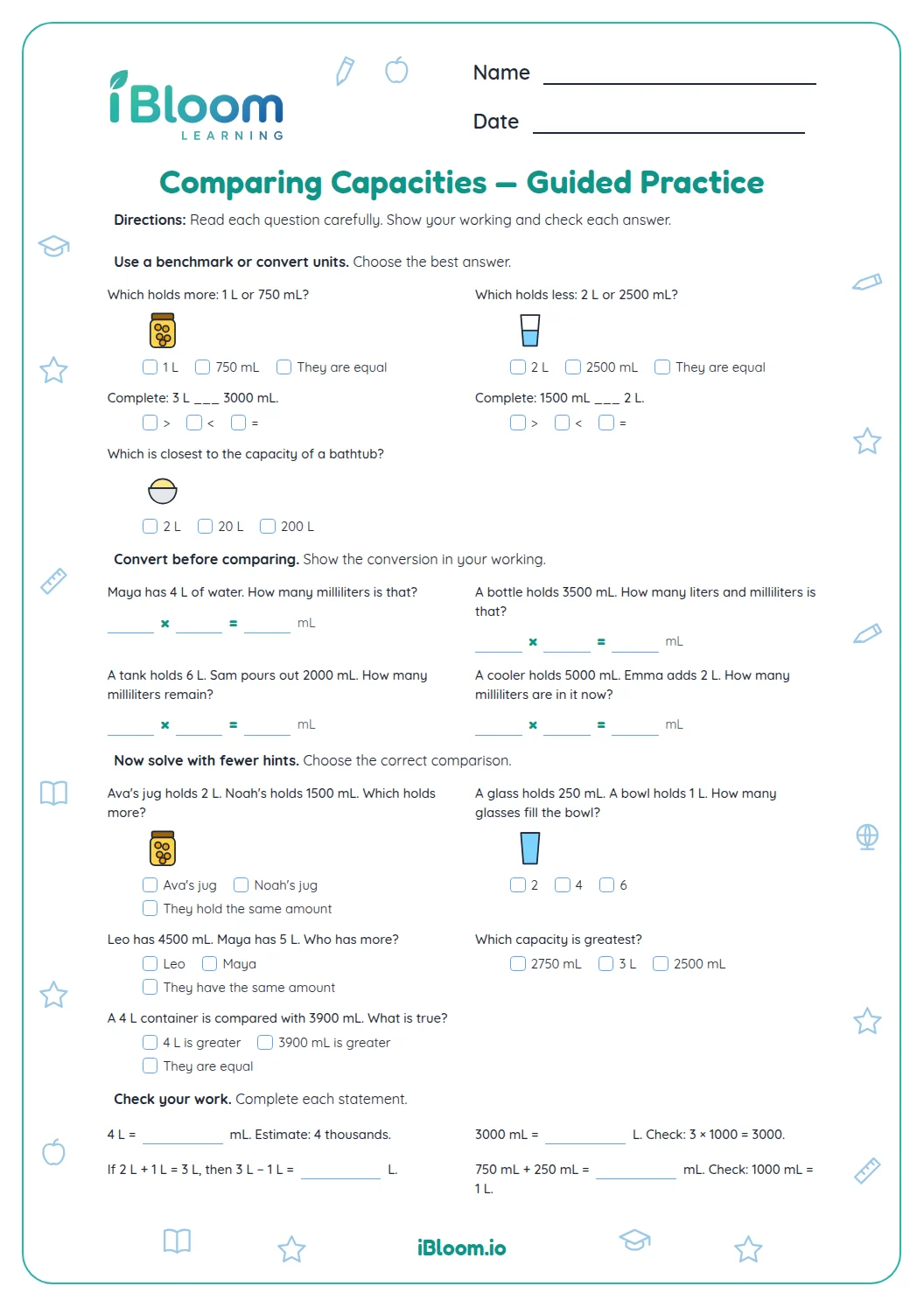
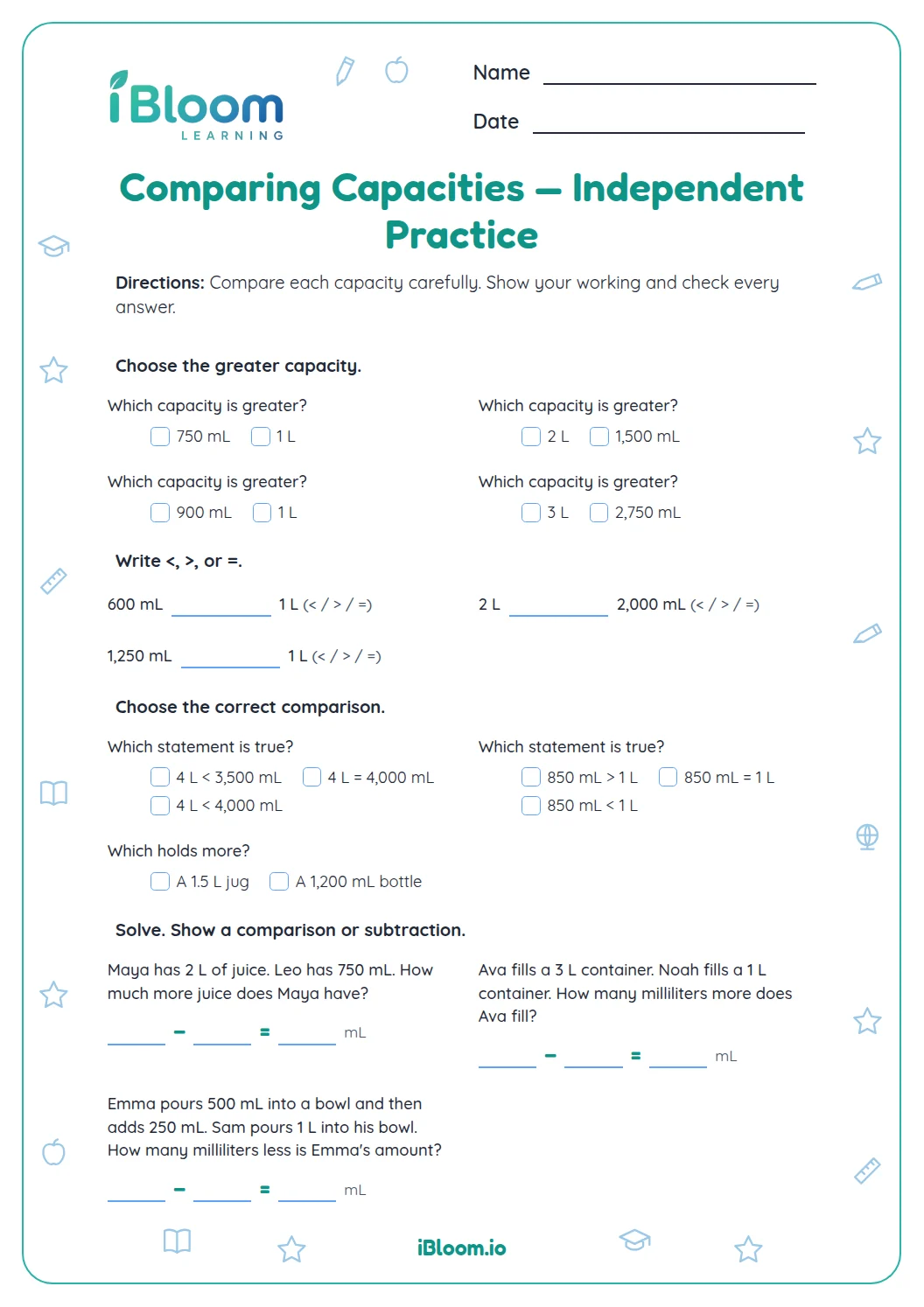
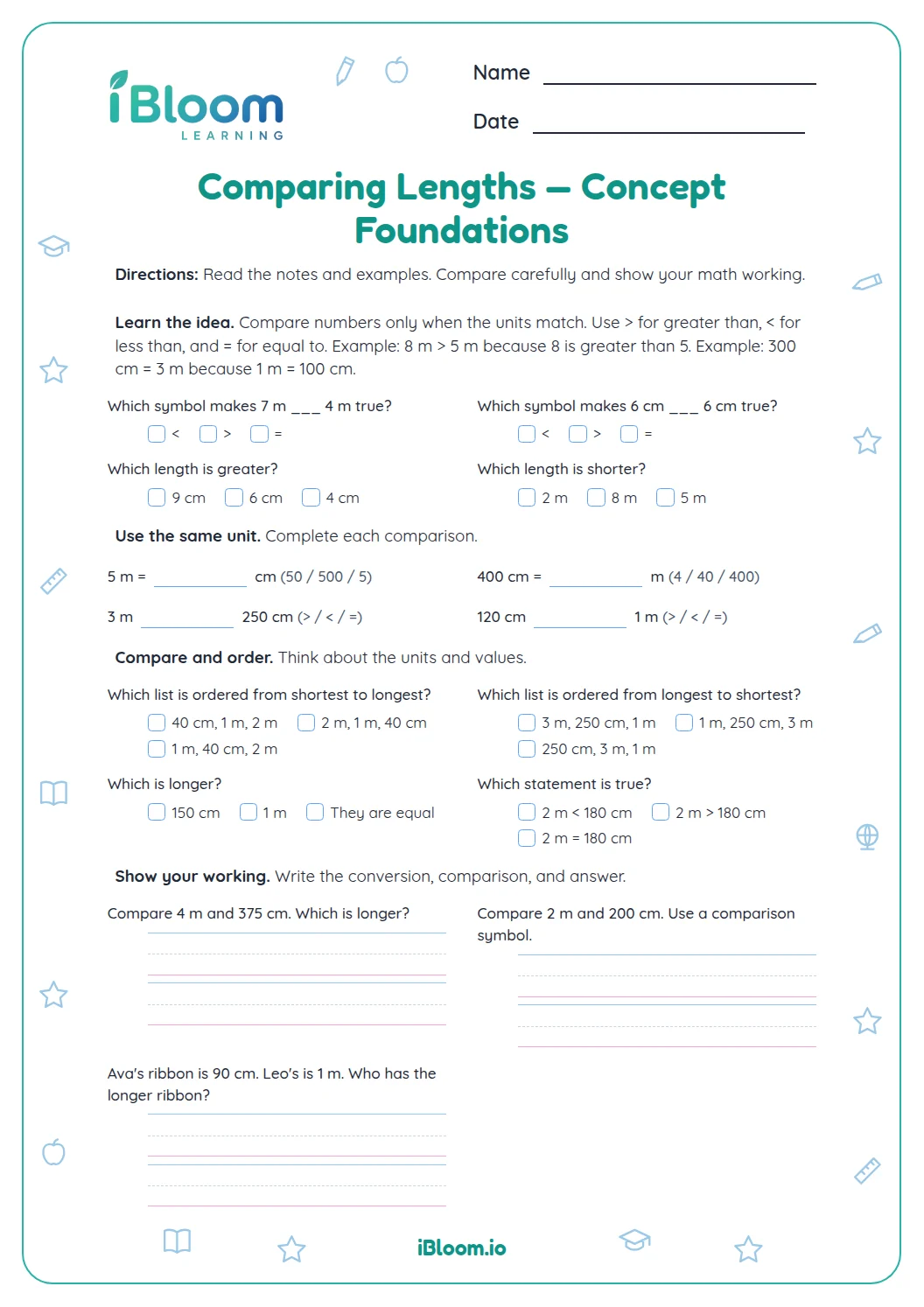
About this worksheet
This Grade 4 printable practices reading one-cup measures in fourths and solving kitchen situations with cup amounts. Students read graduated containers, add and subtract fractions of a cup, and solve recipe problems. A separate answer key gives concise results.
Aligned to 4.MD.A.2
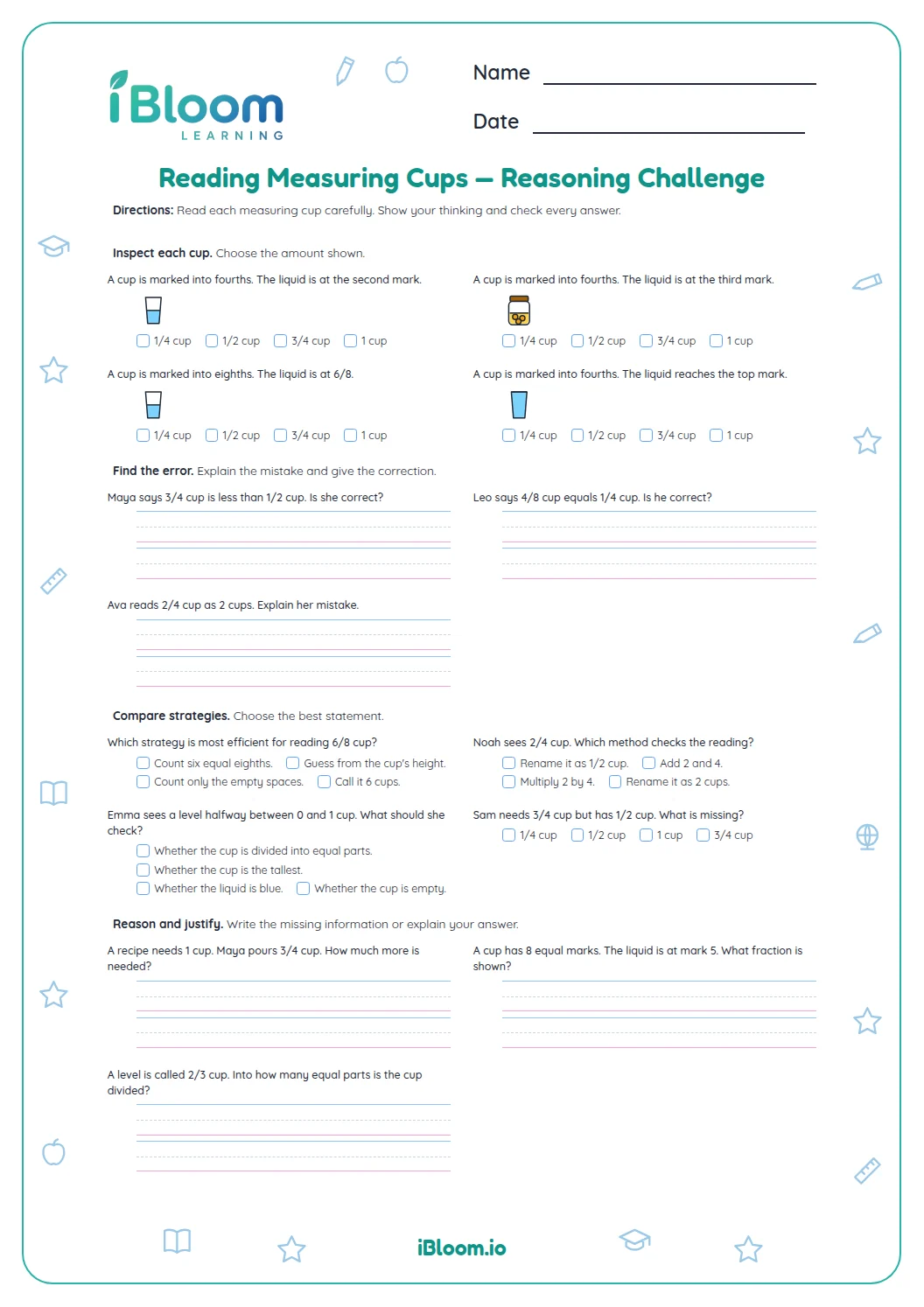
How do you read the one-cup measure?
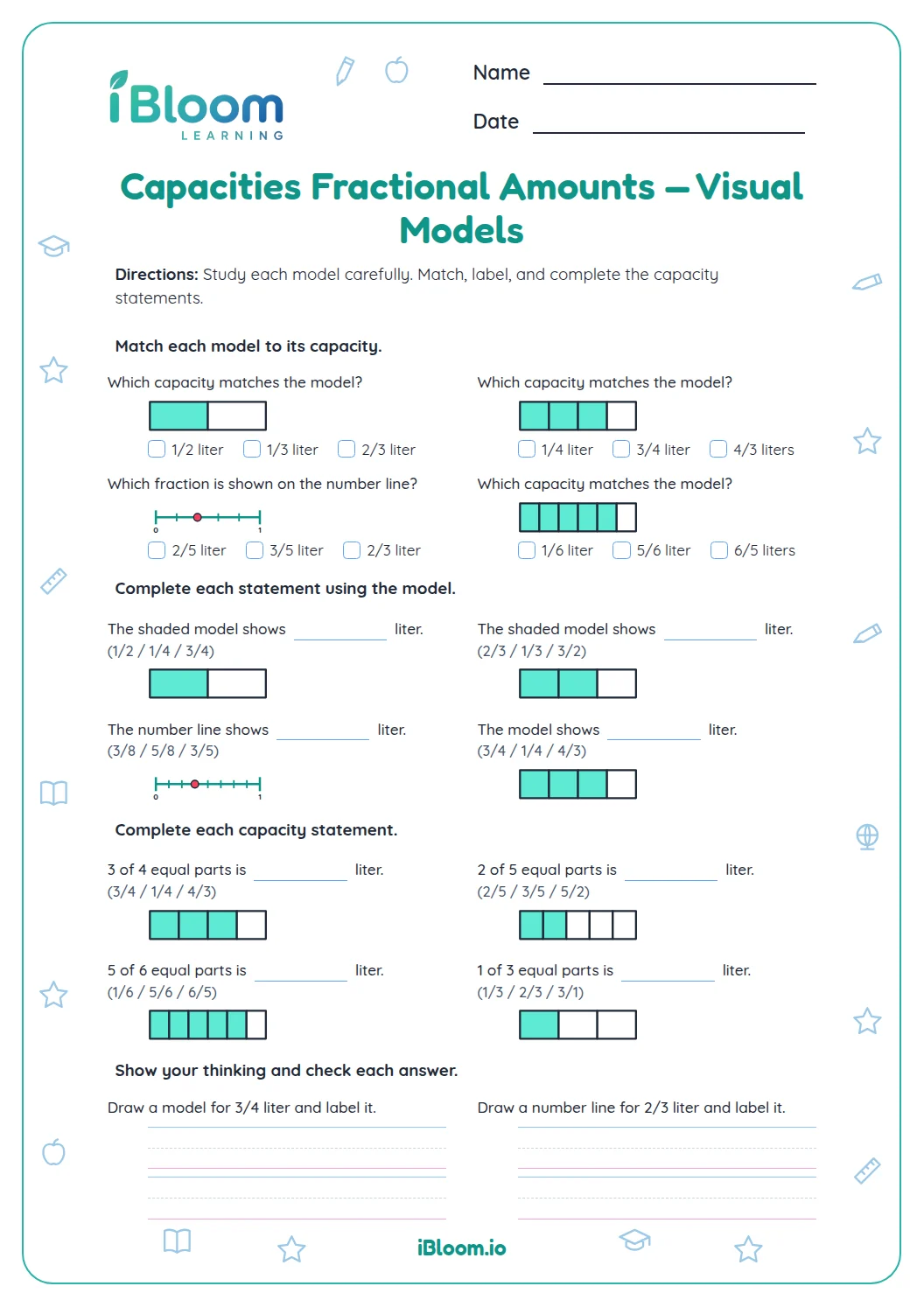
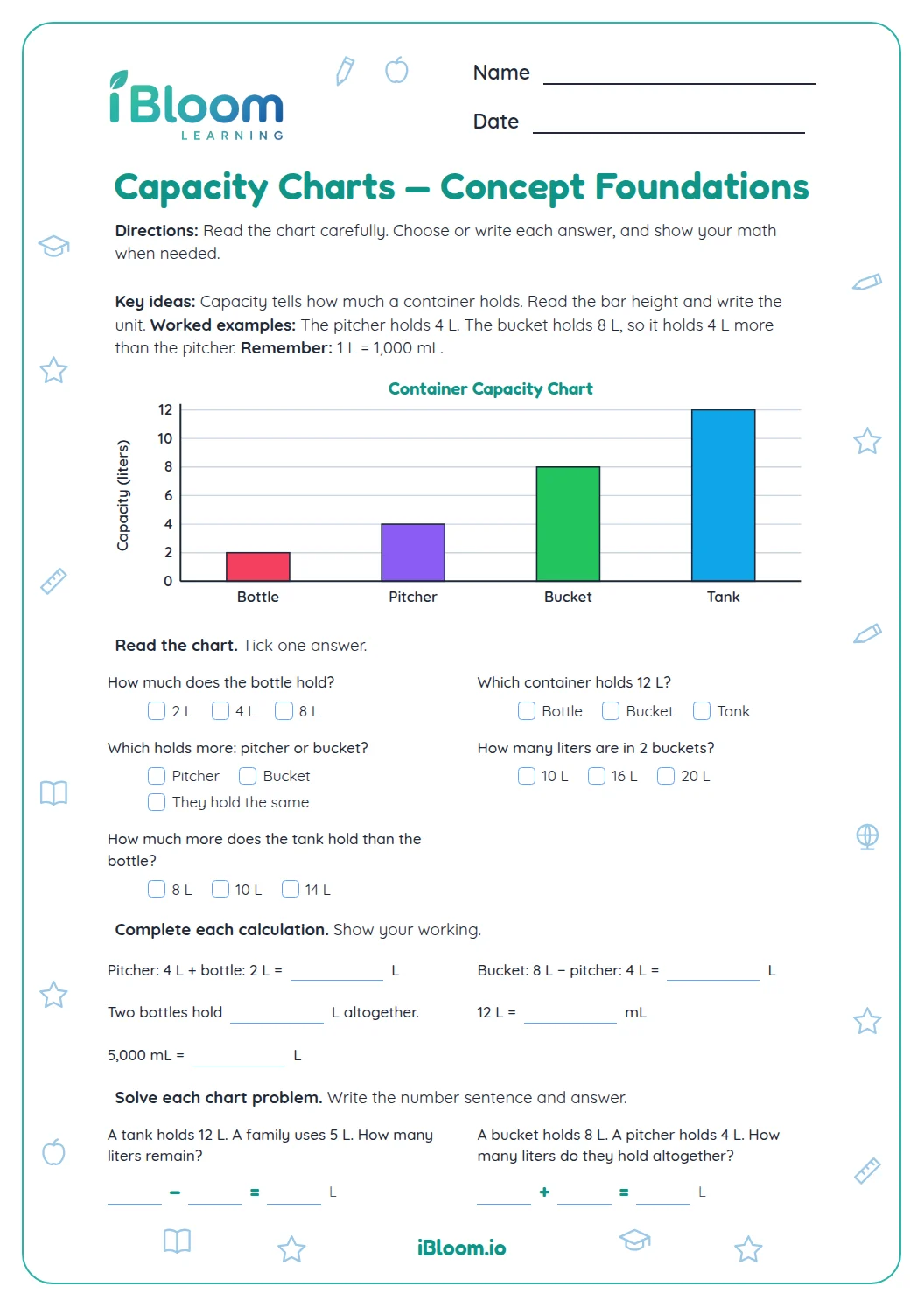
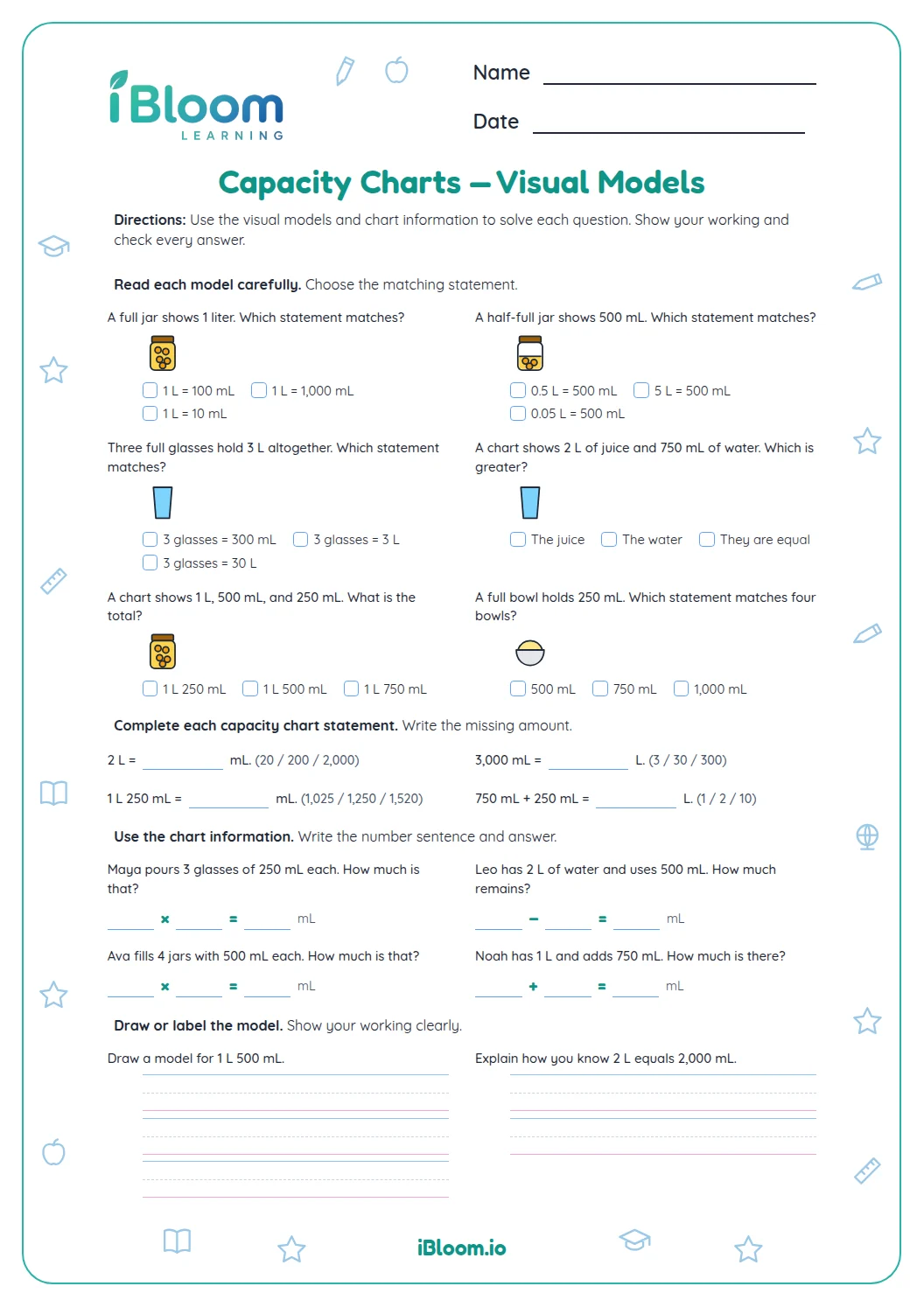
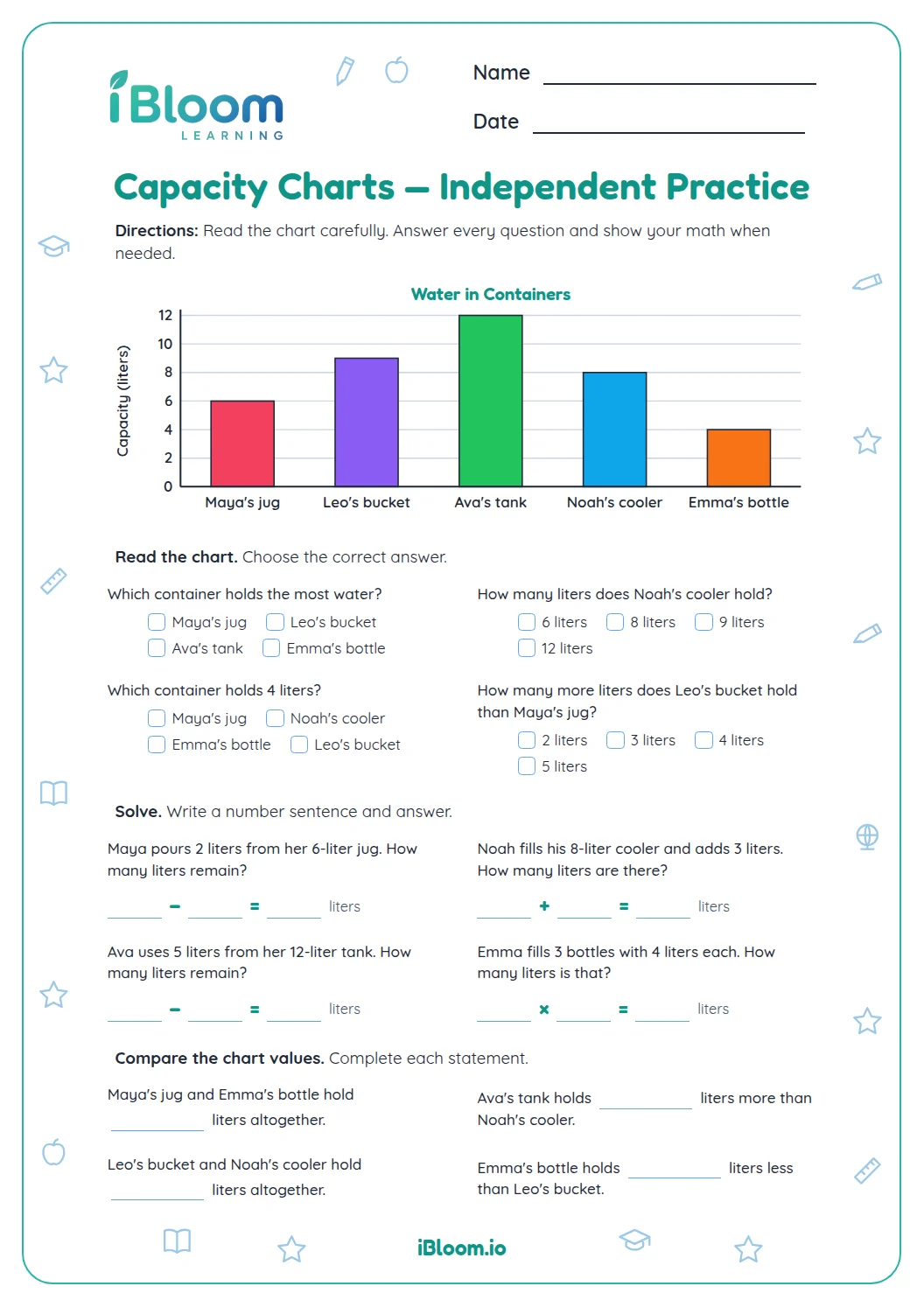
The container pictures use a one-cup measure as the whole. One quarter is one of four equal steps; two quarter steps make one half, and four make a full cup.
Question 2 is filled to halfway. Half of four quarter steps is two steps, so the amount is 1/2 cup.
- 1One cup has four equal quarters.
- 2Halfway is two of the four quarters.
- 3The measure holds 1/2 cup.
How do you combine amounts in a recipe?
Keep the unit in view and use equivalent fractions when needed. For question 5, 1/4 cup + 2/4 cup = 3/4 cup because the pieces are the same size. If denominators differ, rename one amount in equivalent quarters before adding.
What does the worksheet ask children to do?
The 16 questions move from picture reading to practical addition and subtraction, then finish with fraction checks. The scenarios use amounts that fit a one-cup measure or straightforward whole and fractional cups.
- Part A: read four graduated levels
- Part B: solve six recipe and pouring stories
- Part C: calculate, compare, and correct a fraction mistake
- Answer key: answers and brief explanations
How can we work through the cup stories?
- 1Point to the one-cup line and name it as one whole.
- 2For a level picture, count the quarter steps from the bottom.
- 3Circle the operation words in each kitchen story.
- 4Write the amounts with matching units before calculating.
- 5Use equivalent fourths to check sums involving halves.
- 6Compare the result with the amount in the story.
Common cup-measure mistakes
The mistake
Calling the halfway level 1/4 cup.
The fix
Count all four equal steps in the cup; halfway is two of four, or 1/2.
The mistake
Adding 1/2 + 1/4 as 2/6.
The fix
Rename 1/2 as 2/4, then add the numerators: 2/4 + 1/4 = 3/4.
The mistake
Dropping the unit from a story answer.
The fix
Write cups after the number so the result answers how much liquid.
Common Core alignment
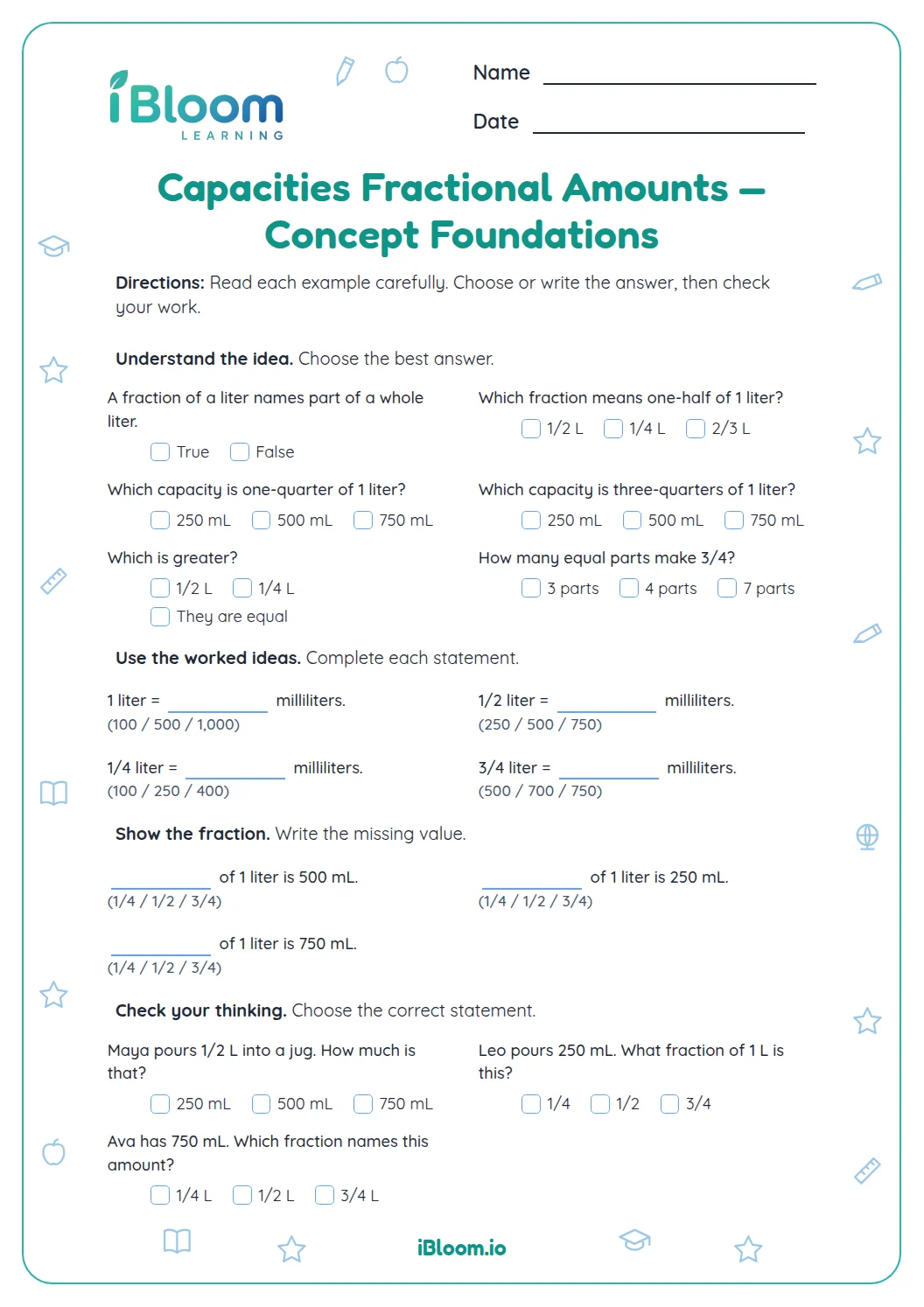
This sheet uses liquid-volume situations and fractional cup amounts.
Solve real-world problems with liquid volume and fractions of a unit.
On this sheet: Questions combine cup fractions and operations in liquid-volume situations.
Show the official wordingHide the official wording
Use the four operations to solve word problems involving distances, intervals of time, liquid volumes, masses of objects, and money, including problems involving simple fractions or decimals, and problems that require expressing measurements given in a larger unit in terms of a smaller unit. Represent measurement quantities using diagrams such as number line diagrams that feature a measurement scale.
What to practice next
Make more practice
Further reading
Questions parents and teachers ask
How many questions are on this worksheet?
There are 16 questions on the two activity pages. Four ask students to read a cup level, six use cup amounts in kitchen stories, and six ask for calculations or explanations. The answer key is separate, so an adult can check work after the student has tried each item.
What does halfway up a one-cup measure mean?
Halfway is 1/2 cup. The measure is divided into four equal quarter-cup steps, so two steps reach the halfway point. Question 2 asks students to identify this level; the later story problems use the same fourths to combine and compare amounts.
Can my child use this page without a measuring cup?
Yes. The first four questions show cup drawings filled to 1/4, 1/2, 3/4, and 1 cup. Students can read those models directly. If you have a measuring cup, filling it to the same marks can provide an additional hands-on check.
What is the answer to the pitcher problem?
The pitcher contains 3/4 cup: Mia pours in 1/4 cup and then 2/4 cup, so 1/4 + 2/4 = 3/4. Question 5 begins the story-problem section and asks students to show an equation with the amount. Keep the answer in cups.
How do you add a half cup and a quarter cup?
Rename 1/2 as 2/4, then add 2/4 + 1/4 = 3/4 cup. Question 14 also asks students to correct the mistaken sum 2/6. The key idea is to add equal-sized parts after rewriting fractions with a common denominator.