


About this worksheet
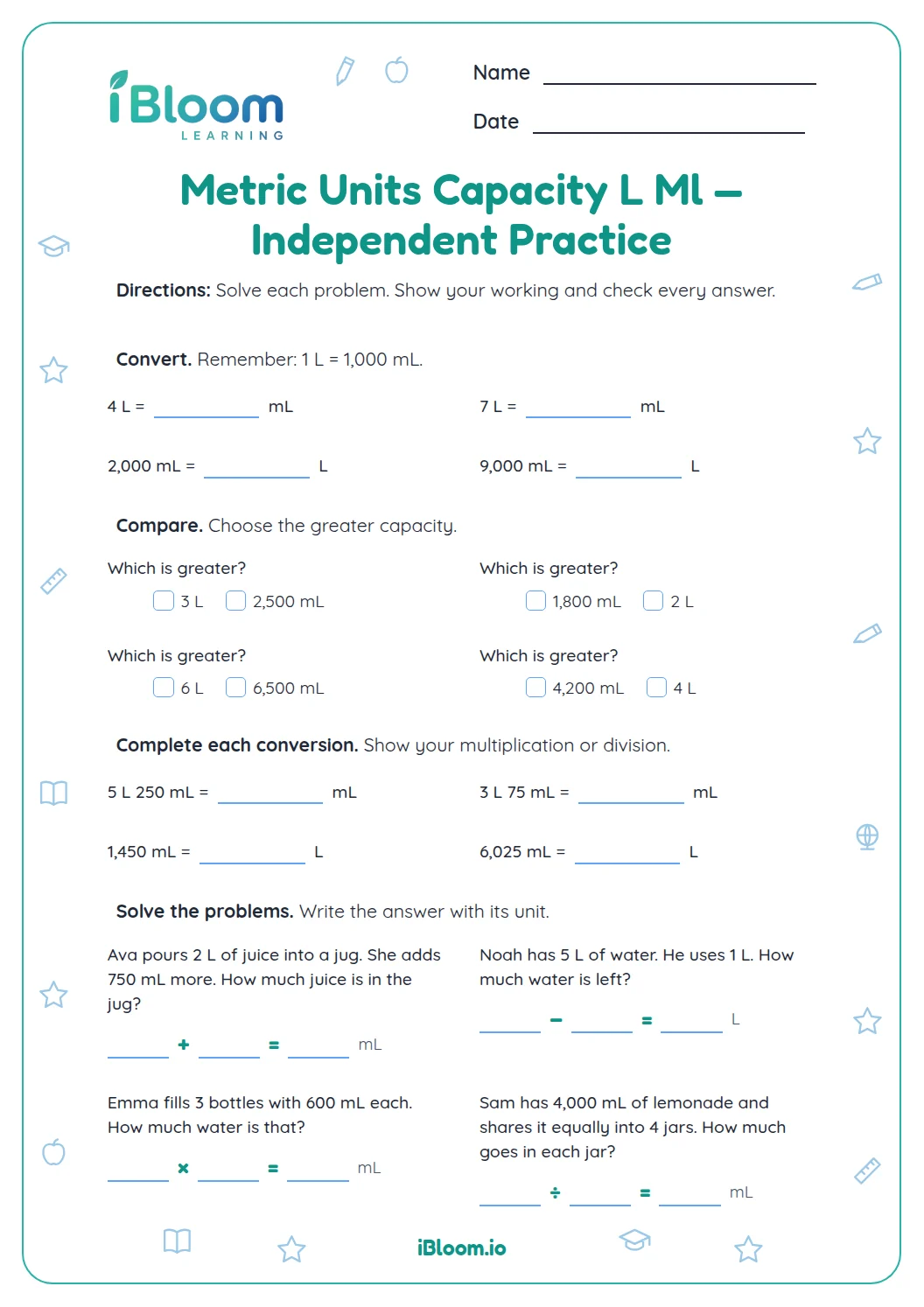
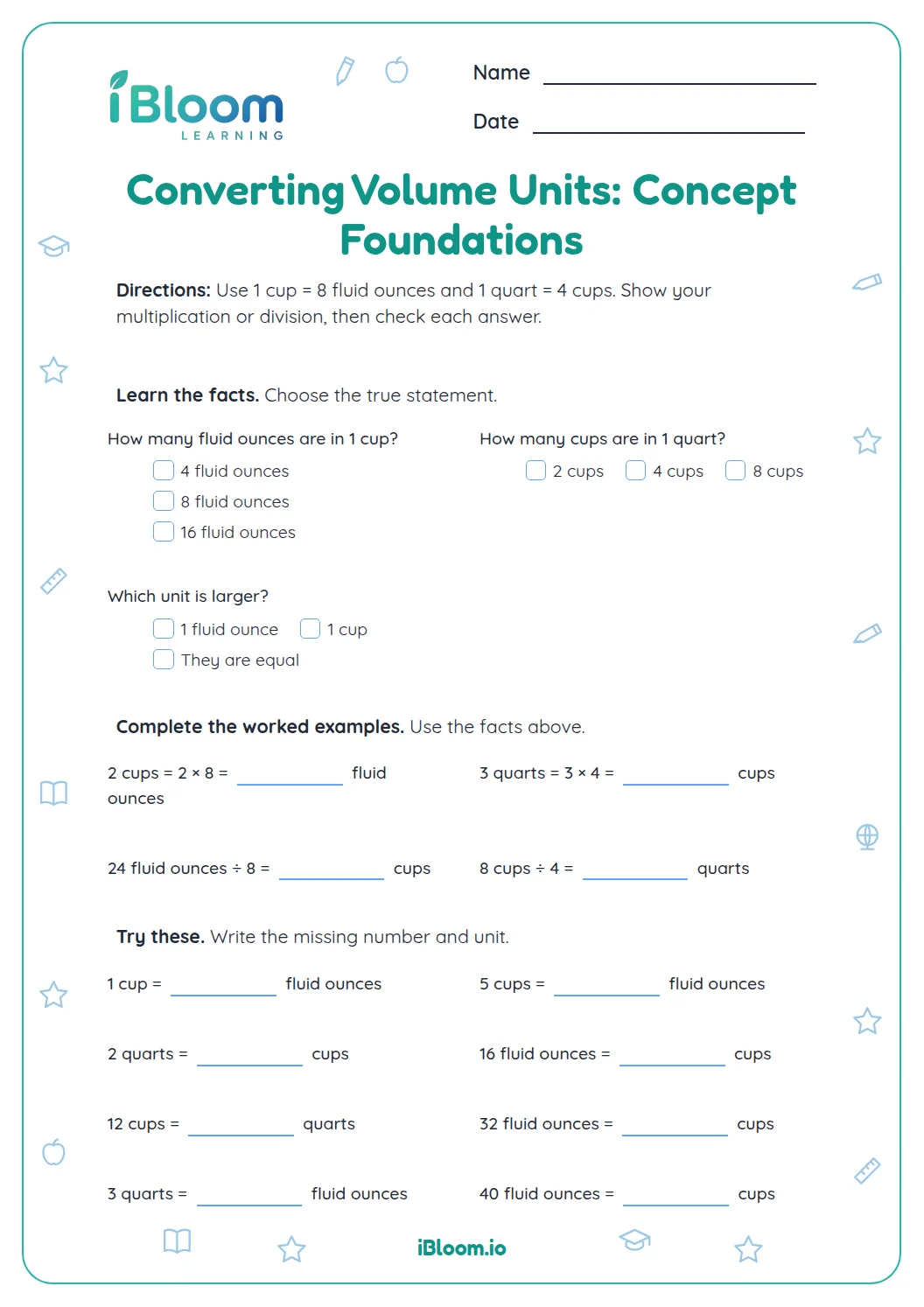
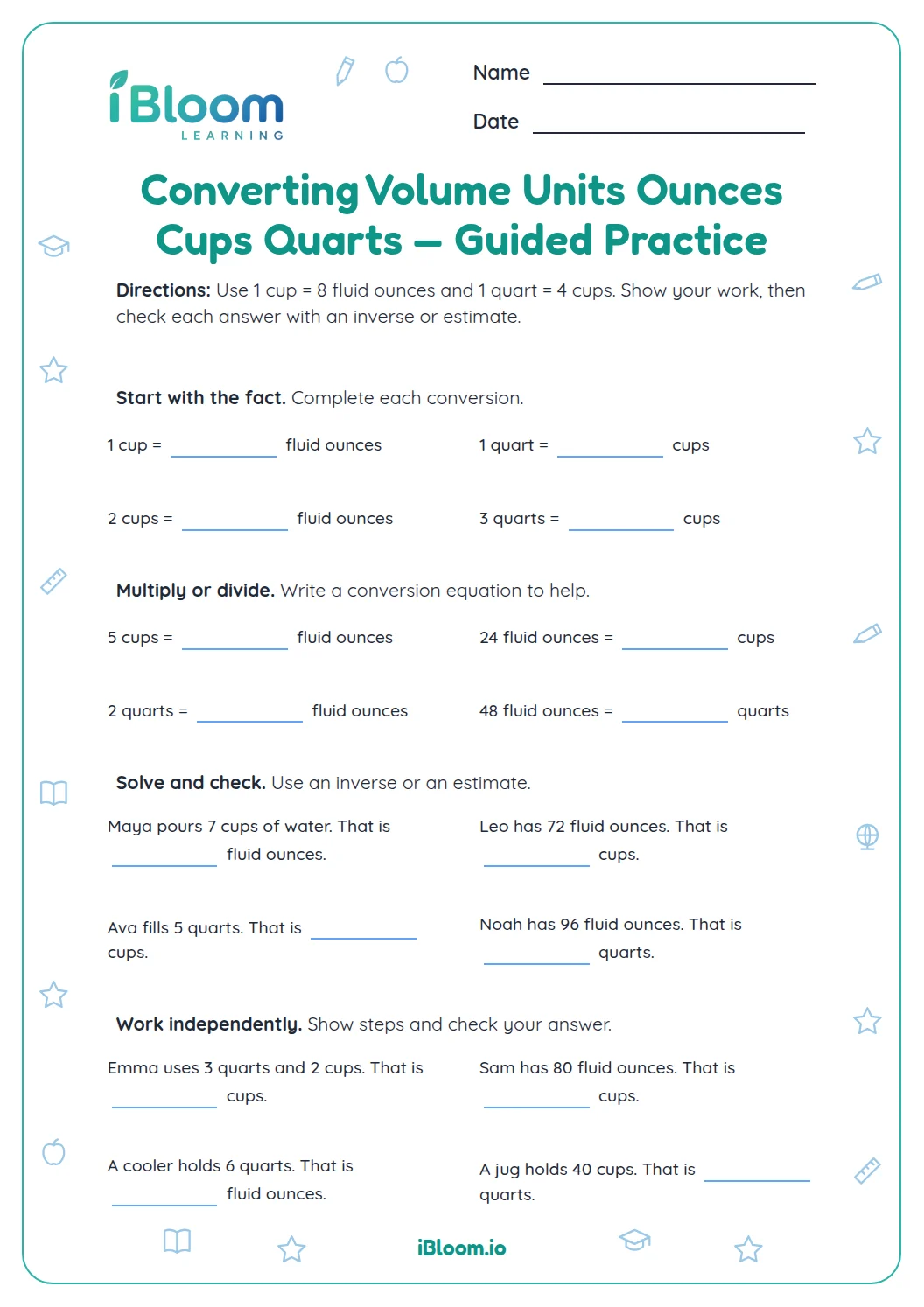
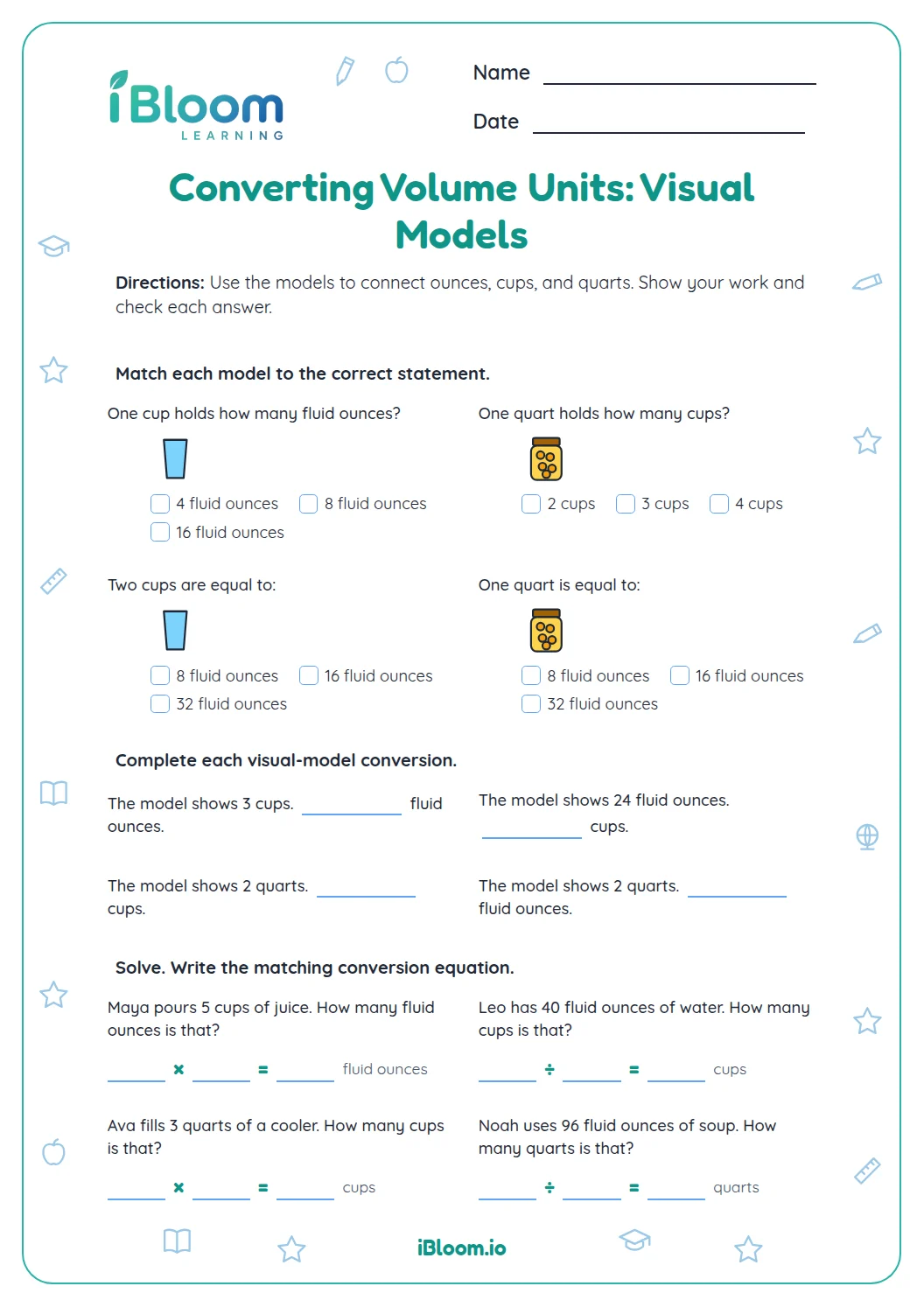
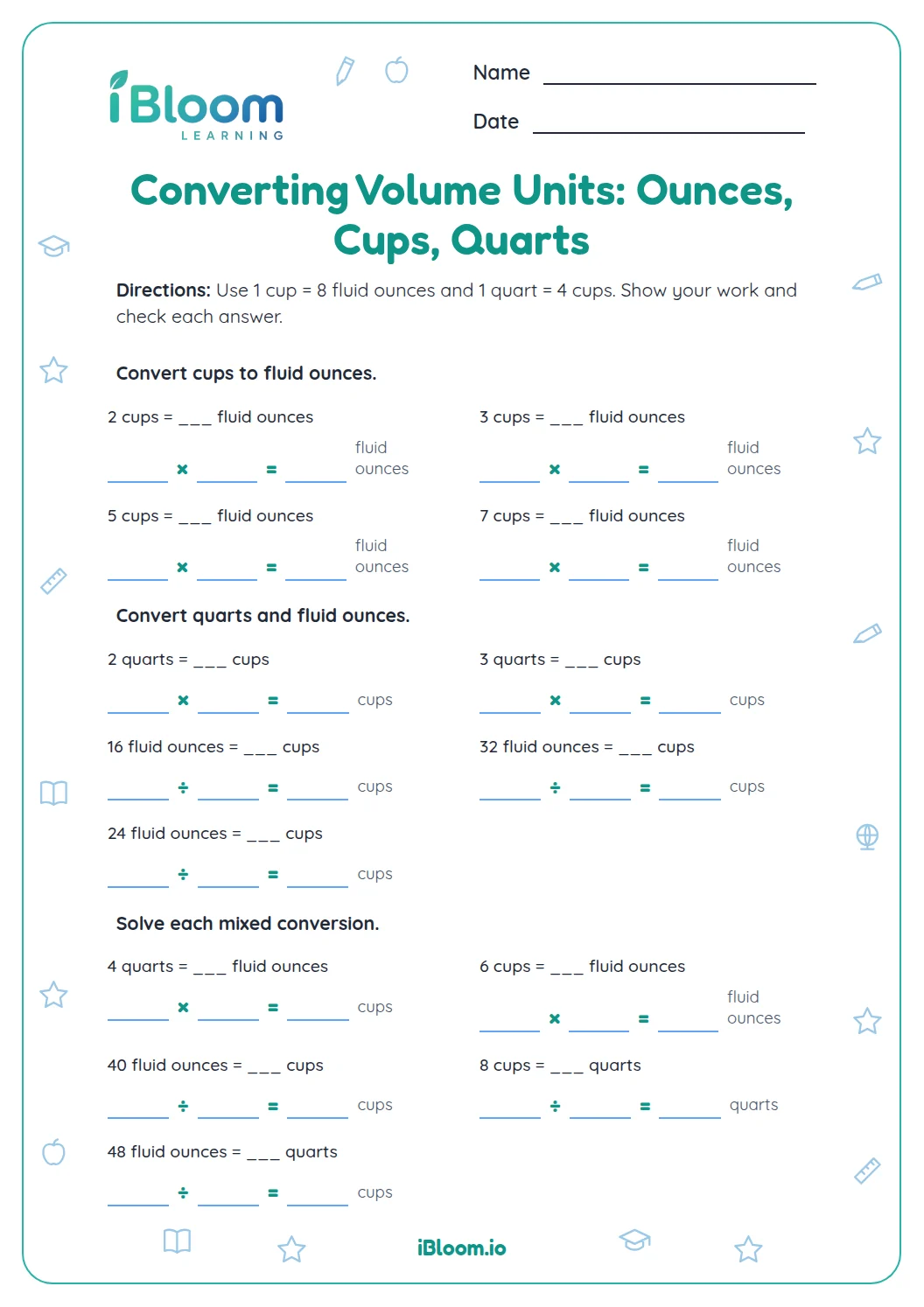
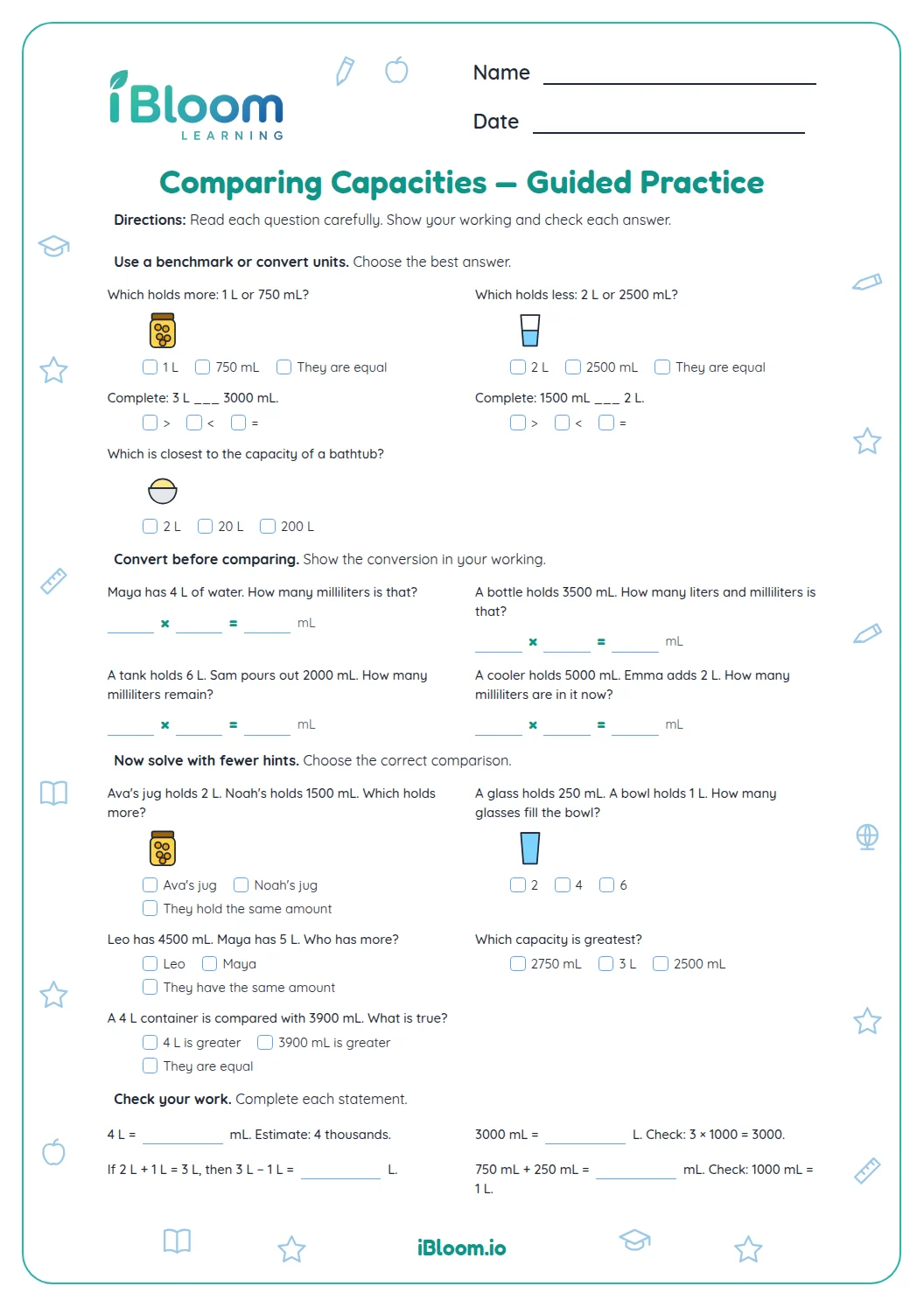
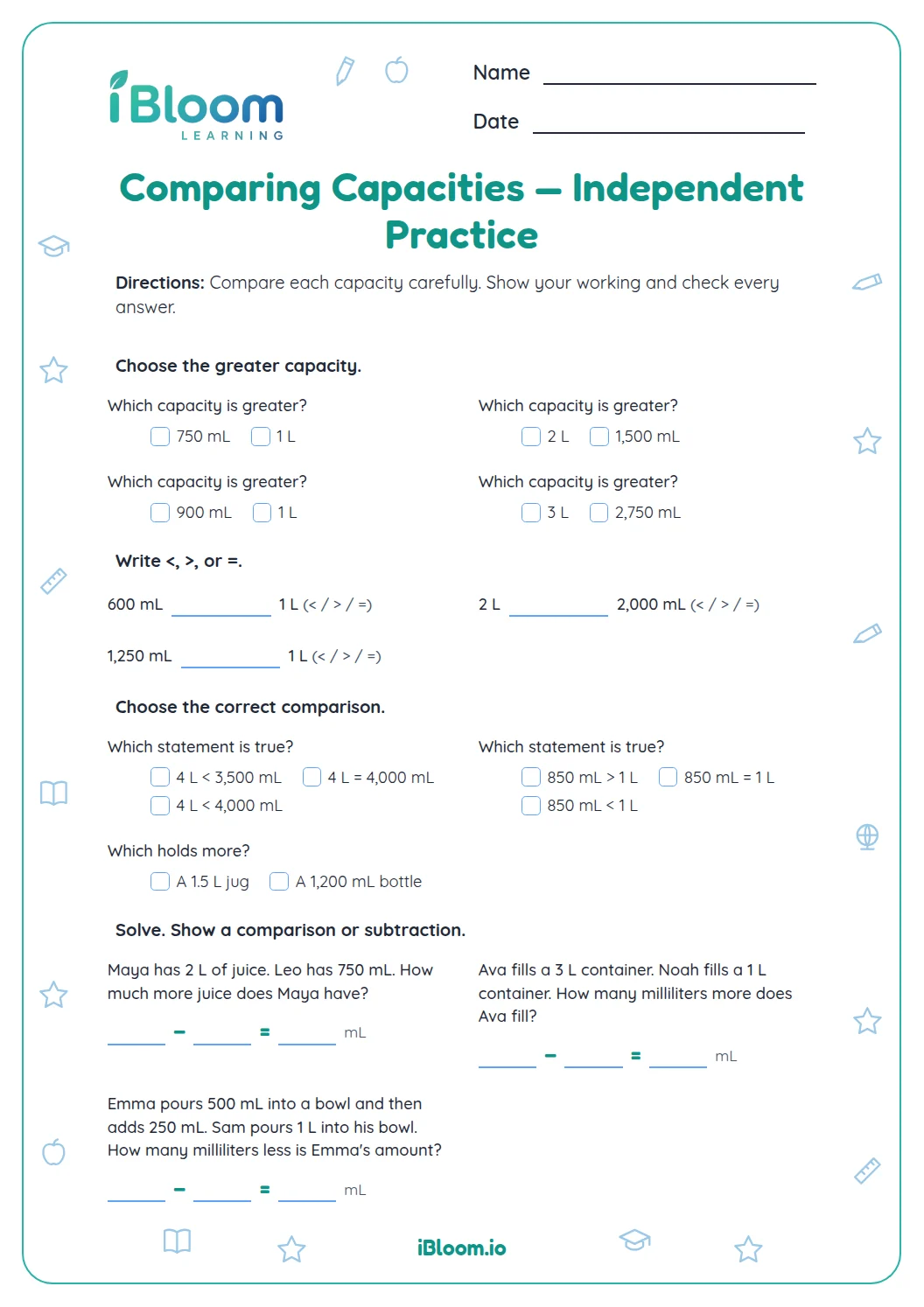
This free printable Grade 4 worksheet uses container models and conversion questions to build capacity fluency. Students relate liters to milliliters, read partial fills, and solve short liquid-volume problems. It practices Common Core 4.MD.A.1 and 4.MD.A.2, with equivalent measures and applied volume reasoning. A separate answer key is included.
Aligned to 4.MD.A.1 and 4.MD.A.2
How are liters and milliliters related?
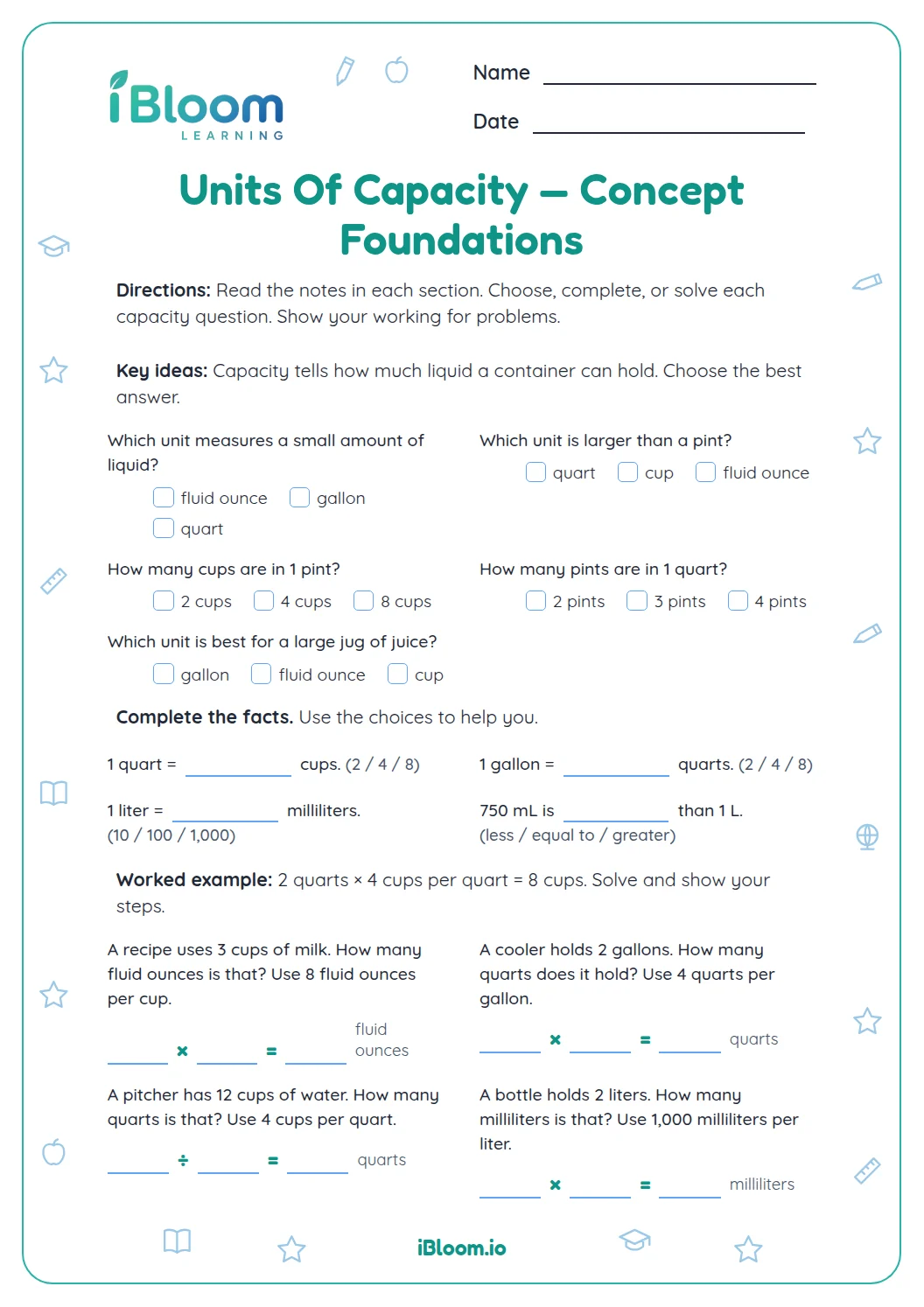
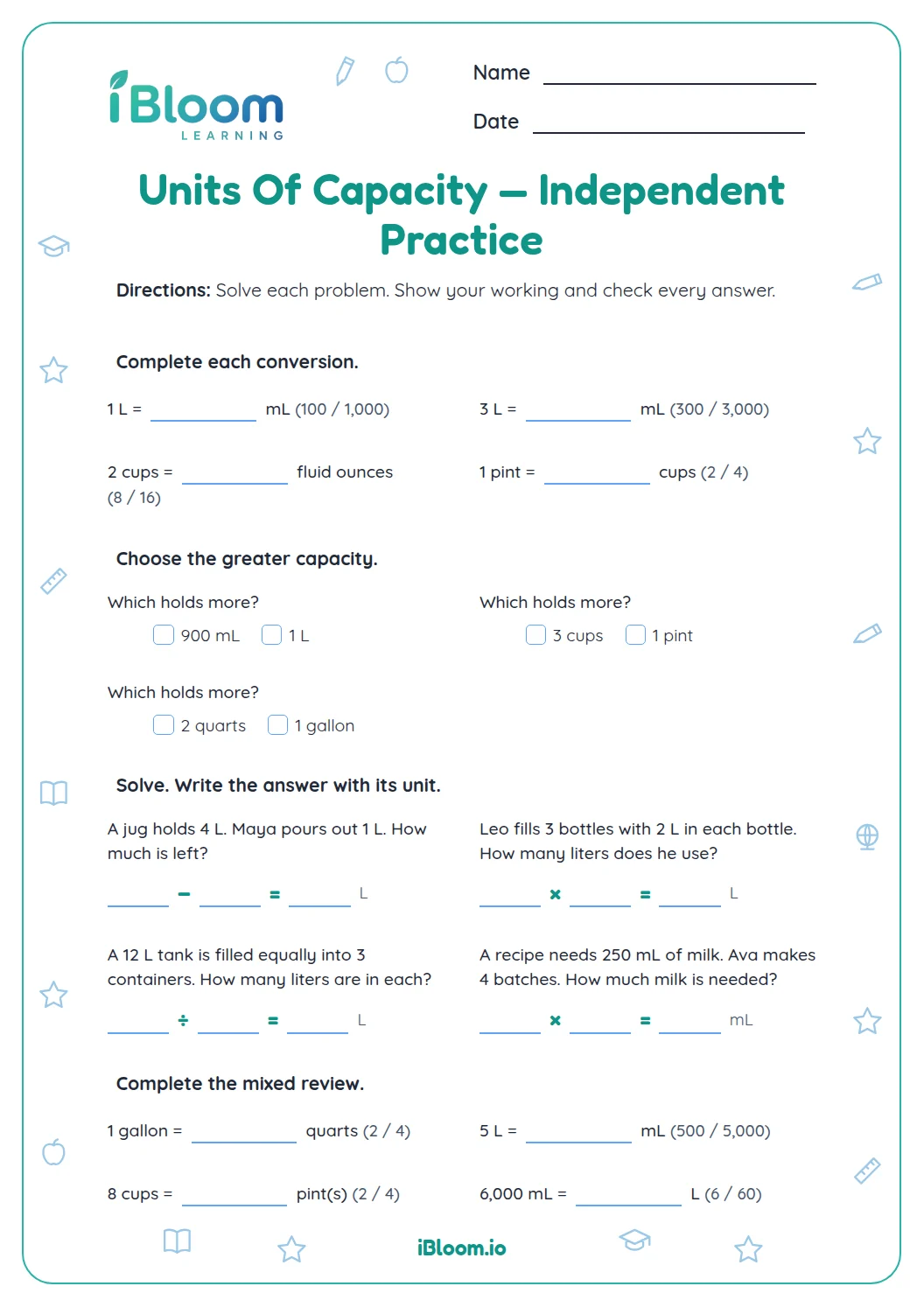
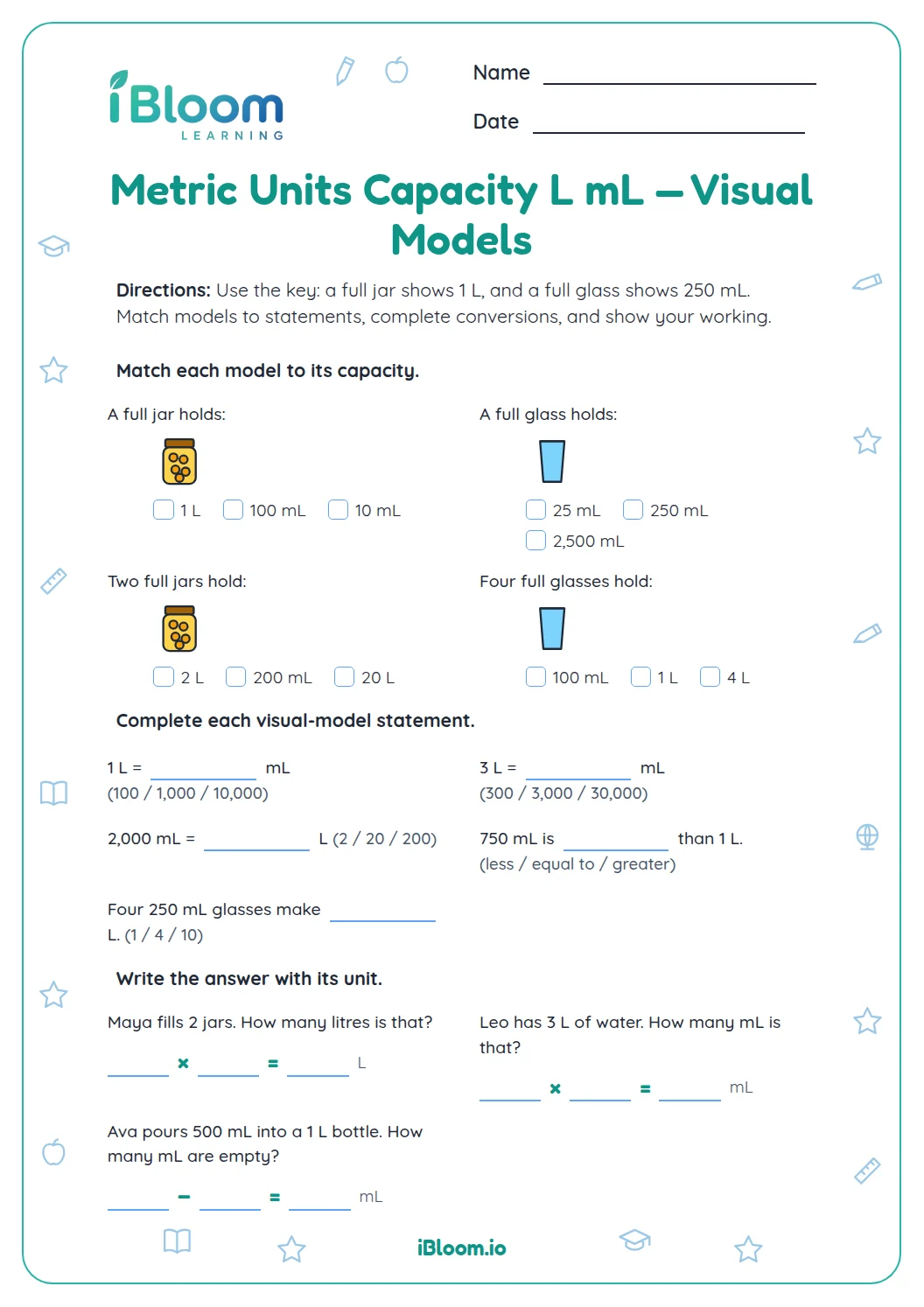
One liter equals 1,000 milliliters. To convert liters to milliliters, multiply by 1,000; to express milliliters as liters and milliliters, group each 1,000 mL as one liter and keep the remainder. The sheet uses these relationships in both numeric and container problems.
- 12 L 300 mL = ___ mL
- 22 L = 2,000 mL
- 32,000 + 300 = 2,300 mL
How do I find the amount in a partly filled container?
Find the fraction of the capacity that is filled. For a 2 L bottle that is half full, half of 2 L is 1 L, or 1,000 mL. Convert the answer to the unit the question requests.
How is the practice organized?
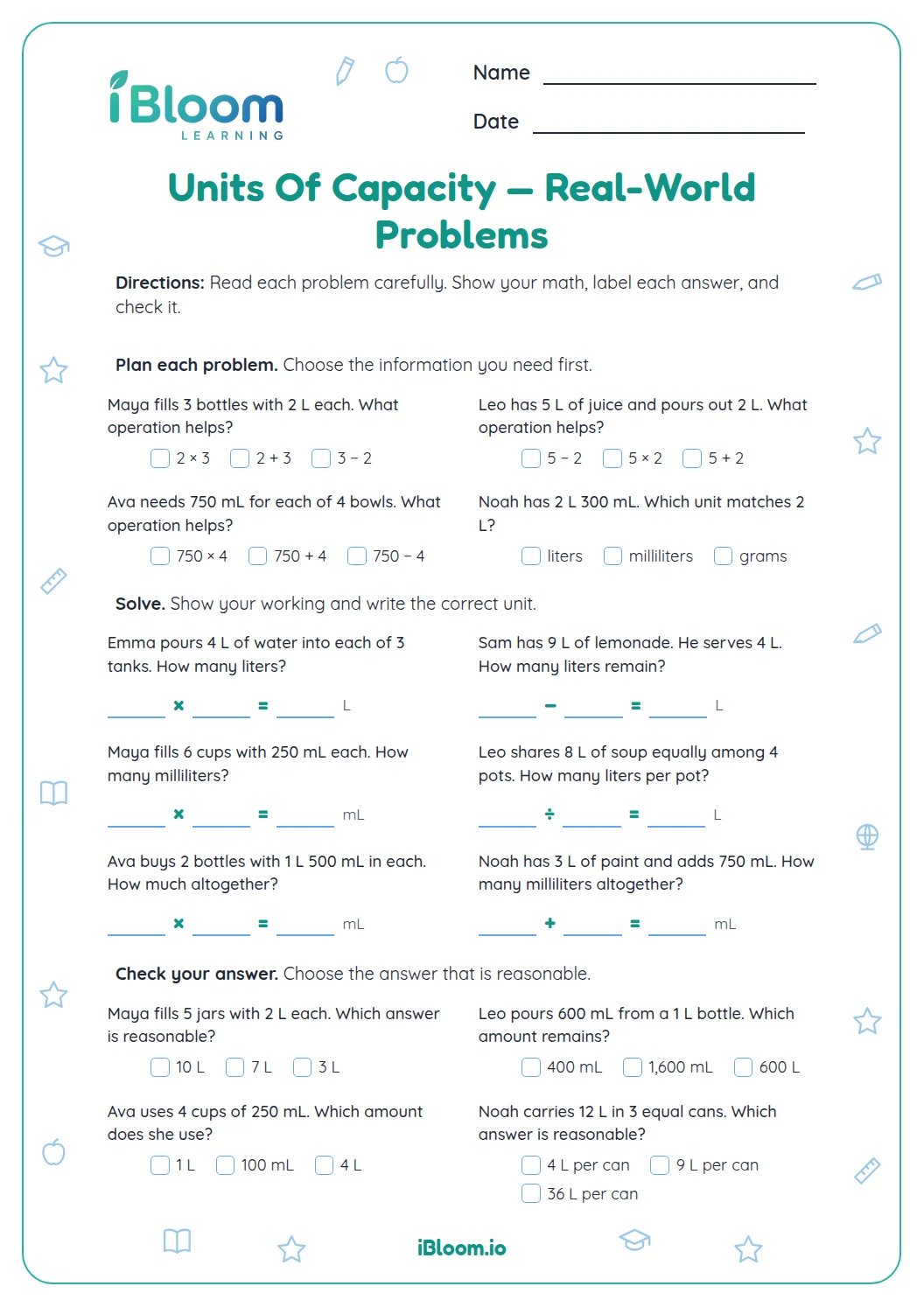
The questions move from basic liter-to-milliliter relationships to fill-level problems and short capacity situations. Answers sometimes ask for liters and sometimes milliliters, so check the unit printed after each blank.
How to use this worksheet
- 1Read the direction for the part before starting its first question.
- 2Look closely at each model and identify the quantities or features it represents.
- 3Work through one question at a time, showing a short calculation when it helps.
- 4For explanation questions, point to the detail or feature that supports the response.
- 5Use the separate key to check answers and revisit any missed reasoning.
Common mistakes and quick fixes
The mistake
Multiplying by 100 instead of 1,000 when changing liters to milliliters.
The fix
Use 1 L = 1,000 mL and check the size of the result.
The mistake
Writing 3,600 mL as 3 L 600 mL but losing the units.
The fix
Keep liters and milliliters in their named places.
The mistake
Finding a fraction of a container without using its full capacity.
The fix
Multiply the full capacity by the filled fraction before converting units.
Common Core alignment
This worksheet practices the Common Core skill named below through the printed questions and models.
Compare unit sizes and record equivalent measurements.
On this sheet: Children use a consistent volume unit to compare amounts and interpret equivalent measures.
Show the official wordingHide the official wording
Know relative sizes of measurement units within one system of units including km, m, cm; kg, g; lb, oz.; l, ml; hr, min, sec. Within a single system of measurement, express measurements in a larger unit in terms of a smaller unit. Record measurement equivalents in a two-column table. For example, know that 1 ft is 12 times as long as 1 in. Express the length of a 4 ft snake as 48 in. Generate a conversion table for feet and inches listing the number pairs (1, 12), (2, 24), (3, 36), …
Solve measurement problems involving liquid volume.
On this sheet: Students calculate and compare liquid volumes in practical situations.
Show the official wordingHide the official wording
Use the four operations to solve word problems involving distances, intervals of time, liquid volumes, masses of objects, and money, including problems involving simple fractions or decimals, and problems that require expressing measurements given in a larger unit in terms of a smaller unit. Represent measurement quantities using diagrams such as number line diagrams that feature a measurement scale.
What to practice next
Make more practice
Further reading
Questions parents and teachers ask
What skill does this units of capacity worksheet practice?
Students convert between liters and milliliters, find amounts in partly filled containers, and solve short capacity problems. The 14 items include both unit relationships and container models. A separate key lists each result, including the requested unit where it matters.
How should we use the visual models?
Each model table pairs a container capacity with its fill level. Find the stated fraction of the capacity, then convert the amount if the question asks for a different unit. For example, half of 2 L is 1 L, or 1,000 mL.
Is there an answer key?
Yes. A separate answer key is included with this printable worksheet. It lists the correct response for each selected-response and short-answer item, along with sample responses where a child may explain an idea in different words. Use it after the student has completed the page.
How many questions are on the grade 4 sheet?
The worksheet has 14 questions on two pages, followed by a two-page answer key. It combines liter-to-milliliter conversions, partly filled container calculations, and short volume problems. Allow about 20 minutes and include the unit requested in each answer.
What can I do when an answer is incorrect?
Return to the exact drawing or sentence for that item and ask the child to show how the answer follows from it. Have them check one step at a time, then solve a similar example orally. This keeps the correction tied to the skill instead of turning it into a guessing exercise.